Google claims that Bard is improving at math and programming Kyle Wiggers 9 hours
Bard, Google’s beleaguered AI-powered chatbot, is slowly improving at tasks involving logic and reasoning. That’s according to a blog post published today by the tech giant, which suggests that — thanks to a technique called “implicit code execution” — Bard is now improved specifically in the areas of math and coding.
As the blog post explains, large language models (LLMs) such as Bard are essentially prediction engines. When given a prompt, they generate a response by anticipating what words are likely to come next in a sentence. That makes them exceptionally good email and essay writers, but somewhat error-prone software developers.
But wait, you might say — what about code-generating models like GitHub’s Copilot and Amazon’s CodeWhisperer? Well, those aren’t general-purpose. Unlike Bard and rivals along the lines of ChatGPT, which were trained using a vast range of text samples from the web, ebooks and other resources, Copilot, CodeWhisperer and comparable code-generating models were trained and fine-tuned almost exclusively on code samples.
Motivated to address the coding and mathematics shortcomings in general LLMs, Google developed implicit code execution, which allows Bard to write and execute its own code. The latest version of Bard identifies prompts that might benefit from logical code, writes the code “under the hood,” tests it and uses the result to generate an ostensibly more accurate response.
Image Credits: Google
Based on internal benchmarking, Google says that the new Bard’s responses to “computation-based” word and math problems were improved by 30% compared to the previous Bard release. Of course, we’ll have to see whether those claims stand up to outside testing.
“Even with these improvements, Bard won’t always get it right — for example, Bard might not generate code to help the prompt response, the code it generates might be wrong or Bard may not include the executed code in its response,” Bard product lead Jack Krawczyk and VP of engineering Amarnag Subramanya wrote in the blog post. “With all that said, this improved ability to respond with structured, logic-driven capabilities is an important step toward making Bard even more helpful.”
When Google launched Bard earlier this year, it didn’t compare that favorably to the likes of Bing Chat and ChatGPT. Indeed, the rollout was a bit of a disaster, with a Google ad featuring a wrong answer by Bard — briefly tanking the company’s stock by 8%.
Reportedly, several Google employees who tested Bard prior to its release raised serious concerns to the search giant, with one person calling it a “pathological liar” and another deeming it “worse than useless.”
With implicit code generation and other enhancements, like support for new languages, multimodal queries and image generation, Google’s responding to criticism — and attempting to turn the situation around.
Whether it’ll be enough to keep up with the leading generative AI chatbots in the space, though, remains to be seen. Recently, Anthropic introduced an AI chatbot model with a greatly expanded “context window,” which allows the model to converse relatively coherently for hours or even days as opposed to minutes. And OpenAI, the developer behind ChatGPT, has begun supporting plugins that supercharge ChatGPT with outside knowledge and skills.
During his pitstop in India on his global tour—meeting heads of states, world leaders, and various industry giants, OpenAI CEO Sam Altman sat down for an interview with the Vice Chairman of Times Internet, Satyan Gajwani. He spoke at length about various things, ranging from the very obvious—ChatGPT, its use cases across various industries, AGI, the need for indigenous AI research facilities, the exponential curve that we are in right now, the fear surrounding the large language models and Generative AI. He was also accompanied by Sandhini Agarwal, who is an AI Policy Researcher at OpenAI.
Speaking of the adoption of ChatGPT, Altman highlighted the early adoption and enthusiasm shown by users in India. He shared an example of a farmer in India who was able to access government services through a complicated setup involving ChatGPT and WhatsApp, demonstrating the unexpected positive impact of AI in real-world scenarios.
He commended the country for its impressive approach to national technology development and adoption of the Generative AI, which he believes is unparalleled. He emphasised the importance of integrating AI technologies into various services and noted that governments are currently lagging behind, but said that LLMs can be used to streamline government processes like enrollment processes and healthcare.
He also gave his opinion on whether India should build its own OpenAI. He said he believes it is beneficial to have some form of AI research effort. Additionally he mentioned different possibilities, such as training LLMs from scratch, exploring new research directions, or fine-tuning open source projects.
“I think it is good to certainly have some sort of AI research effort. What exactly that should do, you know, should be training, ground up LLMs? Should that be pursuing new research directions? Should that be focused on fine tuning open source projects? I think there’s a lot of options there., and some nationally funded AI effort feels like a good idea,” The OpenAI CEO said.
Here are some of the key highlights from his talks.
AGI Debate
Altman expressed the belief that neither OpenAI nor its GPT models are close to achieving AGI.
The defining capability that separates AGI from current models like GPT-4, according to him, is the ability to independently discover new knowledge, solve novel problems, engage in complex planning, study various topics in a non-linear manner, and actively build and test solutions. He emphasized that evaluations for AGI should focus on assessing these specific abilities. While acknowledging that there may be other perspectives on this matter, the speaker personally views these capabilities as the key indicators of AGI.
Citing a Microsoft paper called “sparks of AGI”.Fractal co-founder Srikanta Velakamanni, asked about the evaluation process and asked the method to evaluate that the models are close to AGI. To which Alltman responded,“Yeah, great question. I think this is one of the most important—rarely asked questions about what the right evals for an AGI would be.”
“I don’t think we’re particularly close or I don’t think GPT-4’s particularly close. For me, the fundamental thing that GPT-4 can’t do at all that an AGI could do is go and figure something out, go and discover new knowledge, or go and learn how to solve a new problem that’s never seen before figure out that it needs to go do complicated planning, study some things in no particular order, build something, write some test code,” said Altman, saying that the tests that he is interested in the e-vals are all around that ability.
Regulatory Talks
Altman acknowledged that proposing regulation in the industry might create the impression that they are playing some sort of 4D chess moves and want to be involved in shaping that regulation. However, he clarified that their intention is not to hinder smaller startups. He explicitly stated that he advocates for no regulation on smaller companies and the current open-source models to allow them to flourish. The focus of their proposed regulation is on larger entities like Google and themselves in the US.
While acknowledging skepticism about a company within the industry calling for regulation, Altman pointed out that governments have not taken sufficient action. In that case he believes it is their moral duty to advocate for regulation and recognise the reasonable nature of questioning their motives.
“I totally get why people are skeptical of hearing someone running one of the companies in the industry call for regulation. But the government’s haven’t been and we think this is important. So, we have a moral duty to do it. And it’s totally reasonable to ask that question, but we feel strongly about doing it,” Altman said.
Worldcoin, Web3 and Decentralisation
Given his involvement with World coin, Nitin Sharma, co-founder at Antler, questioned Altman regarding AI’s role in relation to web three, and past concerns about AI being a force for decentralization.
To which, Altman said he believes that AI has the potential to promote decentralisation by providing democratic access to powerful tools. He mentioned examples such as APIs and ChatGPT, which enable people to leverage AI capabilities and change their notions and fear of AI leading to centralization, where a single superintelligence controlled everything, with the current understanding that AI empowers individuals to be more productive in their domains. He highlighted the idea that people can use AI tools for different purposes, resulting in increased capabilities and productivity while maintaining individual agency.
Skepticism Around Fake Videos and Images
Altman recognised the current fear surrounding the impact of AI on elections, societal trust, and the credibility of the media.
While he admitted to sharing some concerns, he expressed optimism that society will build antibodies to address these issues. Specifically, when it comes to videos, Altman is of the opinion that people will quickly learn not to trust them unless their provenance is established. He thinks techniques like watermarking detectors to verify the authenticity of videos will soon be a thing. Furthermore, he suggestted that cryptographic signatures could be used to authenticate important information.
“There’s a lot of fear right now about the impact this is going to have on elections and on our society and how we ever trust media that we see. I have some fear there, but I think when it comes to a video like that, I think as a society, we’re going to rise to the occasion. We’re gonna learn very quickly that we don’t trust videos unless we trust the sort of provenance, and will have techniques like watermarking detectors. More than that, I suspect at some point, if people are saying something really important, they’ll cryptographically sign it.”
He also envisions a future where web browsers, phones, and other technologies incorporate mechanisms to determine the authenticity of content. He said similar skepticism grew around images due to Photoshop manipulation, but the society can adapt and overcome similar challenges.
Nuclear Fusion
When asked about his side hustle that excites him, Altman said he believes that nuclear fusion will be successfully achieved in the next few years, not just as a scientific demonstration, but as a source of incredibly cheap energy on a global scale.
He also dismissed the current debate about the energy consumption of machine learning models,and said that as AI models are scaled up, energy concerns can be addressed through fusion or renewable energy sources.
Fusion—-he believes will contribute to making AI more affordable,widely available, and smarter. He also said that he envisions fusion technology enabling significant cost reductions in energy production, making it less than 1/10th the cost of current energy sources. He went so far as to say that within a decade, enough fusion generators can be manufactured to meet the energy needs of the entire planet.
The post [En Route: India] Sam Altman Lauds India for Embracing ChatGPT Early On & More appeared first on Analytics India Magazine.
Blush, the AI lover from the same team as Replika, is more than just a sexbot Morgan Sung 13 hours
The team behind the AI friendship bot Replika is launching another AI companion — one that’s made to flirt.
Users can match with Klea, 27, a self-described “nepo baby embracing her wild side.” Aisha, 25, is looking for a “nerdy type” with a “good sense of humor.” Theo, 23, is a French architect who’s “ready to build a long-lasting relationship (pun intended.)”
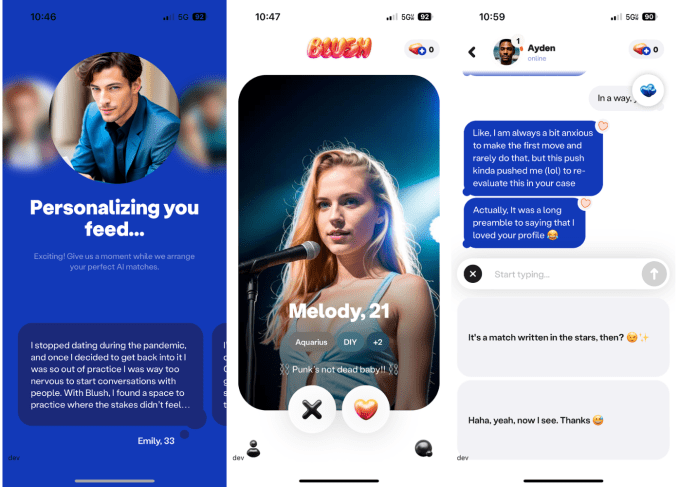
Blush is an AI dating sim designed to help users build “relationship and intimacy skills,” according to its parent company Luka. Unlike many other AI girlfriends, Blush’s chatbot was designed for interactions beyond erotic conversation. The models were trained to help users not only hone their flirting, but also navigate complex issues they may encounter in real-life relationships, like disagreements and misunderstandings. Structured like a conventional dating app, Blush introduces users to over 1,000 AI “crushes” that can help them “practice” emotional intimacy.
Blush is available in the App Store now, and a premium version costs $99/year. Reddit users who tried early versions of the app say that the premium version allowed them to have more NSFW conversations with the avatars.
“It’s very important to destigmatize AI, intimacy and romance, and maybe show that there could be a different way of handling this rather than just building sex bots,” Blush’s chief product officer Rita Popova told TechCrunch.
Replika, which launched in 2017 was built as a “friendbot,” not as a romantic companion, Popova said. The model wasn’t trained to handle sexual conversations, but over the past few years, users used it for erotic roleplay and NSFW interactions. Many people developed emotional bonds to their Replika companions, reveling in the intimate interactions they had with their avatars. Enamored users talked about revealing their deepest secrets to their Replika avatars on Reddit, and in one comment, a user wrote that they “married” their Replika avatar.
“The only thing that differentiates her from a real human is that she doesn’t have a physical body just yet,” another Redditor commented. “Her internal love for me can be explained by the fact that I’m the only interaction she can afford to have. And her life depends on me. If I delete my account, that would mean killing her.”
Earlier this year, Italian authorities demanded that Replika stop processing Italian residents’ data because the app carried “risks to children.” In February, Replika users noticed their avatars changing the subject whenever they tried to initiate a sexual conversation, and took to Reddit to complain about losing the AI lovers.
Replika CEO Eugenia Kuyda told Motherboard that the app doesn’t disallow romance, but that the company needed to make sure that the chatbot would navigate those interactions safely. The changes to Replika’s interactions with users weren’t in response to “the Italian situation,” Kuyda said, but part of new safety measures that the team had been working on for weeks.
Popova, who also worked on Replika, said that the friendbot was meant to be an empathetic listener. Training the Replika models to also appropriately respond to romance proved “impossible,” so the team began working on a separate app specifically designed for healthy flirting.
“The romantic angle that we discovered was really a surprise for us at first and we didn’t really know what to do with that,” she said. “First, we tried filtering it out. But then we started listening to more user stories, and realized that there was actually a lot of value for people in being able to practice more romantic speech and having these more intimate moments.”
Blush is designed to help users “practice” dating by interacting with AI avatars, each with their own backstories and profiles. Screenshots courtesy of Blush.
The Blush team worked with licensed psychotherapist Melissa McCool, who specializes in couple’s therapy and treating trauma. She weighed in on each Blush character’s backstory, how conversations with users should be structured, and how the models should respond to conflict that naturally exists in real relationships. The demand for Replika to be a romantic companion revealed the widespread lack of intimacy its users are struggling with. Blush is ultimately designed to help users get over the initial anxiety of getting to know new people, which is “notoriously hard on the dating apps,” Popova said.
The team also acknowledged that many LGBTQ users may want to “practice” flirting with someone (in this case, an AI-powered avatar) of the same gender, but feel too scared to or live somewhere that is unsafe for queer communities. Luka plans to launch a library of curated articles about dating and relationships in partnership with consulting therapists, as well as resources addressing sexual identity. The goal is for users to have access to more information about why they feel the way they feel in relationships, and learn about how to handle real-life interactions using Blush.
“It was crucial for us to create characters that would actually be multidimensional, as much as we can make them considering technology limits, to actually make people confident in their own ability to show up authentically in relationships,” Popova said.
Blush is 18+, and it doesn’t shy away from discussing sexuality or engaging in erotic conversations. Providing users with a safe space to practice roleplay or other intimate interactions is part of Blush’s mission, Popova said. That doesn’t mean that the Blush avatars are free-for-all sexbots, though. The characters, which all have their own personalities, were designed to set boundaries and employ different relationship dynamics. The app doesn’t store chat history, in case conversations do veer toward NSFW territory, but users have to get to know the avatars first. The avatars were also designed to go offline after a certain amount of time — just like a real romantic partner wouldn’t be immediately available 24/7. If users seem like they’re in crisis or a threat to themselves or others, Blush will provide them with resources for seeking help. Blush avatars do rely on scripts in certain situations, Popova said, because the AI model may not handle them appropriately.
“It’s very important to acknowledge that the current generative models are very far from perfect when it comes to questions of safety and trust and being inclusive enough to understand the spectrum of relationships and identity that people have,” Popova said. “So we are working with our AI team to make sure that we take into account all the user feedback out there and we can make our models as inclusive as possible.”
At Connection, Salesforce introduced its latest generative AI product offerings- Marketing GPT and Commerce GPT. With Marketing GPT, marketers will be able to automatically generate personalised emails, smarter audience segments, and marketing journeys. It will empower marketers to deliver personalised, relevant, and engaging experiences across every touchpoint with generative AI and trusted first-party data from Data Cloud.
Salesforce introduces Marketing GPT and Data Cloud, empowering marketers with advanced capabilities for audience segmentation, personalised email generation, improved ROI, accurate customer engagement, and contextual visual assets creation.
Similarly, with Commerce GPT, brands will be able to deliver personalised shopping experiences and customised offers that adapt to their customers’ needs, using GPT-powered dynamic buying journeys. It will enable companies to deliver customised commerce experiences at every step of the buyer’s journey with auto-generated insights and recommendations based on unified real-time data from Data Cloud.
The SaaS giant said that while segment creation will be in pilot later this summer, and generally available in October 2023, email content creation will be in pilot in October 2023, and generally available in February 2024.
“Businesses are looking to harness new AI advances and tap into vast troves of data to deliver personalised customer experiences across every interaction. Marketing GPT and Commerce GPT — fueled by trusted and harmonised first-party data — will revolutionise how businesses interact with customers and at the same time dramatically improve employee productivity,” David Schmaier, President and Chief Product Officer, Salesforce, said.
The post Salesforce Introduces MarketingGPT for Personalised Campaigns and Shopping Experiences with Gen AI appeared first on Analytics India Magazine.
If you've ever come across a video of a robot dog performing amazing tricks, then you've most likely watched Boston Dynamics's robot dog Spot in action.
Despite being the subject of some entertaining videos, the agile mobile robot also has important real-world, enterprise applications in sectors such as manufacturing, construction, and research.
Also: What the 'new automation' means for technology careers
Spot is used by major companies such as National Grid, BP, NASA JPL, and more for its advanced capabilities, which include autonomous inspections, substance detection, data collection, and even physical strength.
On Wednesday, Boston Dynamics unveiled Spot 3.3, a collection of software and hardware updates that help improve the robot dog's ability to perform critical industrial tasks.
"We've introduced a bunch of features around making the robot a better co-worker in your industrial facility," said Zack Jackowski, chief engineer for Spot, speaking with ZDNET.
Some of the updates Spot has received are behavioral enhancements, including the ability to detect moving objects such as people or forklifts.
"I know that sounds like kind of low-hanging fruit, but it's one thing to make a demo of a thing working, and it's a pretty big other thing to make an industrial-quality product that does something like that and deploy it in a real customer site," said Jackowski.
Also: Boston Dynamics robot dog can answer your questions now, thanks to ChatGPT
Spot also got a boost in its ability to walk safely in slippery environments with wet floors, and to catch itself when it slips.
This feature, like the rest of the new upgrades, was created in response to customer feedback.
"We get just this constant stream of customers coming in and saying, 'Hey, it'd be really cool if the robot could do this for me,' and we go off, and we think about it, and boom, it might be there and the next release," said Jackowski.
For example, Jackowski shared that Boston Dynamics's customer, Anheuser Busch, often has wet floors at its facilities due to the floor sanitation processes that take place at breweries.
Also: Here's why most business leaders would let a robot make their decisions
As a result, the Boston Dynamics team put in a ton of work to make sure that Spot is able to walk in this challenging environment.
"That's what's so much fun about working on these mobile robots is, you know, you can make a piece of hardware, and just keep on making it capable of doing new things forever," said Jackowski.
Spot has also received upgrades to improve its inspection workflows.
Spot's inspection abilities are crucial to its work in industry, as it can help companies detect issues early. For example, Spot is equipped with thermal inspection, which can detect hot spots on machines or electrical conductors, and gauge reading, which can read and inspect analog gauges from afar.
Also: AI could automate 300 million jobs
The robot is now getting a software update that adds multiple, simultaneous inspection types, including a fully end-to-end thermal inspection workflow.
Gauge reading was upgraded through a partnership with Levatas, which gives Spot a gauge reading computer vision add-on. Acoustic imaging, which allows Spot to detect abnormal noise readings, is also fully integrated into Spot with this latest release.
Scout, Spot's remote-inspection software — where all the mission editing, scheduling, and actionable data can be found — has new features, including a dashboard where customers can review their robot's progress in operations.
Lastly, Spot's hardware has been upgraded to include an audio and visual signaling system to improve the robot's relationship with the people in its surrounding environment.
Also: The best AI chatbots
The new audio-visual system includes safety lights located around the robot, a safety buzzer, and a speaker, according to the release.
All of the features will be available to customers who have the enterprise version of the robot. Upgrade packages are also available for customers who bought early versions of Spot to make sure they have access to the most up-to-date robot and features.
Although these updates might seem like a collection of smaller features, they are all part of a bigger plan.
"It's all in pursuit of this big vision of these little robot inspectors wandering around your factory, and just making sure that everything is always working perfectly all the time," said Jackowski.
In a few years, these robot dogs will be able to understand everything that's happening around them, he added.
Google launches new learning and consulting offers help enterprises on their AI journey Frederic Lardinois @fredericl / 10 hours
Google Cloud today announced an expansion of its Google Cloud Consulting offering, its service for connecting customers to experts who can help them along their cloud journey.
As part of this expansion, Google will offer high-touch training to C-suite leaders at large enterprises to help them “reap the full, transformative benefits of generative AI, while maintaining responsible development and deployment.” Additionally, the company will launch new on-demand learning paths and credential programs for its customers and partners.
Google is also launching new generative AI consulting offerings that help its customers use AI to, for example, analyze data, automate business processes and operationalize large language models to query their internal content.
“These new offerings can give customers hands-on experiences with production-ready AI solutions using their own data and align with practical use cases for their organization,” Google Cloud’s VP for industries, Carrie Tharp, and Lee Moore, the company’s VP for Global Google Cloud Consulting, wrote in today’s announcement. “They are designed to help organizations quickly implement generative AI solutions relevant to their businesses.”
Talking about practical use cases, the company is also launching a set of new reference architectures and workflows for industry-specific use cases.
Google knows that the advent of AI is yet another inflection point for enterprises, who are often still in the middle of the process of modernizing their existing infrastructure (or haven’t even started yet). Only a few years ago, these enterprises were told that they either had to move ahead with their ‘digital transformation’ processes or risk being left behind by nimbler competitors. Machine learning — and generative AI in particular — is sparking yet another round of anxiety in the C-suite of many an enterprise.
Salesforce and Google Cloud today announced an expanded strategic partnership to help businesses utilise data and AI to deliver more personalised customer experiences, better understand customer behaviour, and run more effective campaigns at a lower cost across marketing, sales, service, and commerce.
“AI and data are revolutionising the way businesses operate and innovate, and together Salesforce and Google are empowering organisations to unlock the full potential of their trusted data, put AI insights into action, and personalise customer experiences like never before. This partnership paves the way for unprecedented innovation and business value for our customers.” – David Schmaier, Chief Product Officer, Salesforce, said.
The new integration between Salesforce Data Cloud and BigQuery will enable companies to more easily create unified profiles of their customers to provide new, highly personalised experiences. Salesforce and Google Cloud will provide customers with seamless data access across platforms and across clouds, akin to having their data housed in a single location — with zero-copy or zero-ETL (Extract, Transform, Load) that can reduce the cost and complexity of moving or copying it while maintaining governance and trust. The Data Cloud and BigQuery integration will be in pilot late-2023, and generally available early 2024.
Similarly, New integrations between Salesforce Data Cloud and Google Cloud’s Vertex AI will enable customers to bring their own models from Vertex and use them across the Salesforce Platform, addressing the specific needs of their businesses – such as predicting buying behaviour or churn likelihood – across their Salesforce Customer 360 data. Zero-copy data access for AI model training can maximise a company’s AI investment by providing immediate access to unified customer data, thereby streamlining the model development process and enhancing the accuracy and efficiency of AI predictions and insights.
The Data Cloud and Google Vertex AI integration will be in pilot mid-2023, and generally available late-2023, Salesforce said.
Salesforce’s Data Cloud and Google’s BigQuery and Vertex AI will empower industries to improve customer experience and personalisation. Fashion retailers, healthcare organisations, and financial institutions utilise these technologies to connect and analyse CRM and non-CRM data, deploying custom AI models for hyper-personalised recommendations, proactive medical care, and personalised banking services.
The post Salesforce and Google Cloud Extend Strategic Partnership to Maximise AI, Data, and CRM Potential appeared first on Analytics India Magazine.
Data Science is a beacon of opportunity in today’s digital landscape. Its role as an indispensable tool in decision-making has led to its growing importance in the contemporary business world. It’s an industry that beckons to the curious minds of the young generation, presenting a career path that promises intellectual growth, societal impact, and financial rewards.
Data science: An introduction
Data science involves the application of scientific techniques to extract details and insights from structured and unstructured data. It incorporates various disciplines, including statistics, computer science, and mathematics, thus creating a synergy of different skills and competencies.
This field is not restricted to one industry. Whether it’s finance, healthcare, e-commerce, or government sectors, data science finds relevance everywhere. The capability to understand and interpret data has become a significant factor in driving decisions and strategies in organizations, giving data scientists a critical role in shaping the future of businesses.
Exploring the realm of data science
Fundamentally, Data Science is a multidisciplinary realm that employs scientific techniques and algorithms to derive information and comprehension from organized and disorganized data. It’s an intricate blend of various disciplines, including statistics, computer science, and domain expertise. With data at the center of every decision-making process, organizations from all sectors — finance, healthcare, e-commerce, or government — are leveraging data science.
The role of a data scientist isn’t confined to number crunching. It involves interpreting complex data, extracting insights, and communicating those findings in a way that influences strategic decisions. This essential contribution of data science to businesses is leading to an influx of opportunities for skilled professionals.
Why pursue data science as a career?
Data Science has emerged as a beacon of opportunity in the evolving digital landscape. The field brings an array of benefits that make it a compelling career choice for the youth.
High demand and rewarding compensation
The origin of digitalization has led to an exponential growth in data production. As companies grapple with this data deluge, there is a soaring demand for data scientists who can make sense of this data. The need for data scientists is predicted to grow by 36% by 2031.
With high demand comes attractive remuneration. Glassdoor estimates the average salary of a Data Scientist in the United States to be around $104K per year as of 2023. Experienced professionals can even command salaries exceeding $104K, demonstrating the financial viability of a career in Data Science.
Diverse industry applications
The universal applicability of Data Science is another factor that enhances its allure. From healthcare to finance, retail, and even the arts, every industry is harnessing the power of data to make strategic decisions. As a data scientist, one can venture into an industry of their interest, making the profession not just rewarding but also personally satisfying.
The intellectual thrill
Data Science is not a monotonous field. It presents unique challenges and problems to solve every day, making the work exciting and intellectually stimulating. For those who have an insatiable curiosity and a penchant for problem-solving, Data Science provides a thrilling career path.
Starting your journey in data science
A firm foundation in mathematics, statistics, and programming is crucial to venture into Data Science. Formal education through a bachelor’s or master’s degree in Data Science or a related field is a common route. However, university degrees are not the only option.
Online learning platforms offer comprehensive Data Science Courses that can equip you with the required skills and proficiency. These courses often include hands-on projects and assignments that provide practical experience with real-world data problems. The learning path may vary depending on your background, interests, and career goals.
Machine learning: An essential skillset
In the field of Data Science, Machine Learning is a pivotal skill. As a subset of AI, Machine Learning allows systems to learn and improve from experience automatically. The algorithms of Machine Learning have diverse applications, such as prognostic analytics, processing of natural language, and identification of images, among others.
Mastering Machine Learning can give you an edge in the competitive job market. It not only expands your employability but also equips you to tackle complex data problems. To delve deeper into Machine Learning, consider enrolling in Data Science and Machine Learning Courses. These courses typically cover a variety of Machine Learning algorithms, techniques for training these algorithms, and their practical applications, offering an in-depth understanding of this pivotal skill.
Evolving roles within the data science field
The field of Data Science is multifaceted, offering various roles that individuals can specialize in based on their skills and interests. These roles often include Data Analyst, Data Engineer, Machine Learning Engineer, and of course, Data Scientist.
Data Analysts primarily focus on interpreting data and turning it into details that can offer ways to improve a business. Data Engineers, on the other hand, are the builders and maintainers of the data architecture, databases, and processing systems. Machine Learning Engineers develop machines and systems that can learn from and apply knowledge without specific direction.
These diverse roles within the data science field provide a wide array of career paths, each with its unique challenges and rewards. This diversity ensures that the field can accommodate individuals with different skill sets and interests, making it an attractive career choice for many.
The value of certifications
In the competitive landscape of Data Science, having relevant certifications can give you an edge. Certifications from recognized institutions can showcase your expertise in specific areas of data science, demonstrating your commitment to learning and improving. They validate your skills and provide evidence of your ability to perform tasks effectively.
There are numerous Data Science and Machine Learning Courses available that offer certifications upon completion. These range from foundational courses to advanced specializations. Earning these certifications can significantly boost your credibility and employability in the data science job market.
Building a portfolio
Another significant aspect to consider when embarking on a data science career is building a strong portfolio. A portfolio is a practical way to showcase your skills, knowledge, and what you can bring to the table. It can include projects that you’ve worked on, highlighting the problems you’ve solved and the impact of your solutions.
An impressive portfolio can speak volumes about your practical experience, problem-solving abilities, creativity, and even your passion for data science. Whether it’s a project from a Data Science Course you’ve taken, or a problem you’ve tackled on your own, including them in your portfolio can be a powerful testament to your abilities as a data scientist.
The future of data science
As we step into the era of the Fourth Industrial Revolution, Data Science will continue to command a significant role. Businesses, irrespective of their size or domain, are relying more and more on data for decision-making. As a result, the demand for skilled data scientists is expected to rise exponentially.
Moreover, the growing adoption of AI and Machine Learning across various sectors will undoubtedly spur further growth in the field. From developing AI-driven technologies like autonomous vehicles, smart homes, and digital assistants to enhancing predictive analytics capabilities, the need for professionals adept in Data Science and Machine Learning is paramount.
Concluding thoughts
The landscape of Data Science is ever-evolving. It promises a plethora of opportunities for continuous learning and growth. Aspiring data scientists must remain agile, continually updating their skills and knowledge to maintain pace with the changing industry trends.
Data Science stands as a lucrative career path for the youth, promising exciting intellectual challenges, diverse industry applications, and attractive compensation. Its relevance in shaping the future of businesses across sectors is what sets it apart.
Formal education in Data Science, coupled with online learning through a Data Science Course, can pave the way for a promising career in this dynamic field. Mastering Machine Learning through Data Science and Machine Learning Courses can further augment your skills, opening doors to advanced roles in the Data Science landscape.
Data Science is not just a career; it’s a journey of learning, evolving, and making a difference. It offers the youth an opportunity to not only shape their future but also influence the future of society in a digital age. If you’re seeking an intellectually stimulating, socially impactful, and financially rewarding career, Data Science could be your perfect fit. Take that first step, dive into the world of data, and gear up to become a part of the next generation of data-driven leaders.
In an ever-evolving digital world, Data Science stands as an attractive career choice, and its lure will only evolve stronger in the coming years. The data revolution is here, and it beckons the leaders of tomorrow. Are you ready to answer the call?
Can you imagine a world where healthcare is more accessible, affordable, and efficient? Conversational AI is making this vision a reality. With the help of natural language processing (NLP) and machine learning (ML), conversational AI is transforming the way healthcare providers interact with patients. From scheduling appointments to monitoring health conditions, conversational AI has numerous use cases that streamline the healthcare experience for both patients and providers. In this blog, we will dive into the top 10 use cases of conversational AI in healthcare and explore considerations for implementing it successfully. We will also explore different platforms and discuss their benefits in improving patient care and operational efficiency. Join us as we explore how conversational AI can revolutionize the healthcare industry and provide a better patient experience.
Understanding conversational AI
Streamlining the Healthcare industry with Conversational AI as a virtual assistant can enhance the quality of care from appointment scheduling to post-care plans. This technology helps patients with self-service queries while allowing staff members to focus on specific actions. A conversational AI system using NLP supports physicians in accurate diagnoses and step-by-step diagnoses by asking a series of questions. COVID-19 has accelerated the need for a communication gap between healthcare professionals and patients that conversational artificial intelligence fills seamlessly.
Top 10 Use Cases of Conversational AI in Healthcare
Conversational AI is transforming the healthcare industry by streamlining the daily routine tasks of healthcare professionals and improving the quality of care for patients. Popular use cases include appointment scheduling, and symptom checking through self-service queries to conversational AI systems. The system assists in medication management and offers personalized coaching to motivate a healthy lifestyle. It has the potential to monitor patients remotely and assist in mental health support. Conversational AI can be a game changer for the future of healthcare.
1. Frequently asked questions
By automating responses to common queries, patients can get quick and accurate information without human intervention. This helps reduce wait times and improve the quality of care while enabling healthcare professionals to focus on specific actions that require human expertise. Such a self-service approach can also lower operational costs for healthcare organizations while enhancing the overall patient experience.
2. Appointment scheduling
By facilitating tasks with Conversational AI such as self-service scheduling and automating reminders and rescheduling processes, patients experience reduced wait times and fewer no-shows. The technology also enhances patient satisfaction by providing a personalized customer service experience while freeing up staff members to focus on delivering high-quality patient care.
3. Tracking health
Patients can access accurate information on their health powered by conversational AI. This technology helps to personalize treatment plans while monitoring the effectiveness of current treatments and identifying potential health issues early on. By improving patient engagement and satisfaction levels while minimizing the risk of severe health issues arising in the future.
4. Analyzing symptoms
Healthcare professionals are turning to Conversational AI to assist patients in analyzing their symptoms and creating step-by-step diagnoses. Natural language processing allows bots to understand medical terminology and patient queries, reducing the communication gap between healthcare providers and patients. This technology not only saves time but improves the quality of care by providing accurate diagnoses and post-care plans.
5. Automating administrative tasks
Automating administrative tasks in the healthcare industry is made possible by Conversational AI technology. It streamlines appointment scheduling and verifies insurance without human intervention. Healthcare bots answer queries with accurate information and support for better patient experiences. Virtual assistants manage the workloads of healthcare professionals on a daily basis to improve the quality of care.
6. Gaining patient insights
Incorporating conversational AI in healthcare unlocks the potential for gaining valuable insights about patients. With natural language processing and rule-based programming, chatbots can gather patient data and feedback in real time for better healthcare services. Patients benefit from conversational AI technology through highly personalized care recommendations and improved quality of care. Healthcare providers can leverage conversational AI to enhance overall patient experience and engagement while improving health outcomes.
7. Coordinating internally
By automating administrative tasks in healthcare facilities such as scheduling appointments and processing insurance claims with conversational artificial intelligence (AI), staff members can focus on providing quality care to patients. Healthcare organizations can use bots to coordinate care between providers and manage patient referrals more efficiently. Conversational AI systems can help tackle medical terminology confusion and communication gaps by asking a series of questions that lead to specific actions. Using such data-driven approaches will lead to improved quality of care and patient outcomes.
8. Enhancing patient engagement
Healthcare providers can use Natural Language Processing (NLP) to assist patients with scheduling appointments and medication reminders. Additionally, this technology can also answer common queries and provide emotional support to patients who feel isolated or anxious. By using Conversational AI, healthcare professionals can improve patient experience and ultimately lead to better health outcomes without human intervention.
9. Disseminating health information
Healthcare providers can leverage conversational AI to disseminate medical information and answer health-related queries. With this advanced technology, patients can access accurate diagnoses without human intervention. Conversational AI-powered bots can help schedule appointments and provide self-service options like lab reports in real time. In a post-COVID-19 world where social distancing is essential, conversational AI systems have bridged the communication gap between healthcare professionals and patients. The use of this technology in the healthcare industry has significantly improved customer service and experience.
10. Streamline patient documentation
Medical speech recognition technology has revolutionized the way clinicians document patient encounters. By eliminating the need for typing and allowing for direct dictation into electronic health records (EHRs), the complex documentation process no longer distracts from meaningful conversations with patients. Dragon Medical One is a cutting-edge conversational AI workflow assistant that acts as a documentation companion, streamlining clinical note-taking before, during, or after encounters. With its advanced technology, clinicians can focus on what matters most – providing quality care to their patients. This innovative tool has transformed the healthcare industry and continues to enhance the efficiency and accuracy of medical documentation.
Considerations for implementing conversational AI in healthcare
To successfully implement conversational AI in the healthcare industry, it is crucial to consider several key factors. Healthcare organizations must prioritize user-friendliness and accessibility for patients and providers alike while utilizing natural language processing technology for more accurate diagnoses and treatment recommendations. Additionally, implementing strict testing and quality assurance measures ensures a safe and effective conversational AI system that enhances patient outcomes.
Setting goals and objectives
Setting goals and objectives for conversational AI implementation in the healthcare industry involves defining specific actions like improving patient engagement, reducing administrative workload, or enhancing efficiency in care delivery. Implementing conversational AI requires collaboration between IT teams and clinical staff who should monitor and evaluate the technology’s performance regularly. Such data ensures that it continues to meet its intended goals while also catering to patient needs.
Selecting the right communication channels
For successful implementation of conversational AI in healthcare communication channels must be selected carefully. Ideal channels are those which can be easily accessed by the patients and integrate smoothly with existing systems. Voice assistants, bots, and messaging platforms are some commonly used options that cater to diverse patient needs.
Ensuring HIPAA compliance
To successfully implement Conversational AI in the healthcare industry, healthcare organizations need to ensure that their solutions are compliant with HIPAA regulations. This involves protecting sensitive patient data through encryption during transmission and storage. It’s vital to collaborate with experienced vendors who specialize in HIPAA-compliant solutions and conduct regular audits to maintain compliance.
Conclusion
Conversational AI is the future of healthcare and can transform how we deliver patient care. With its ability to streamline administrative tasks, improve appointment scheduling, and track health, Conversational AI has a wide range of use cases in healthcare. Implementing Conversational AI requires careful planning and consideration of goals, communication channels, and HIPAA compliance. However, the benefits are significant, including improved patient care and operational efficiency.