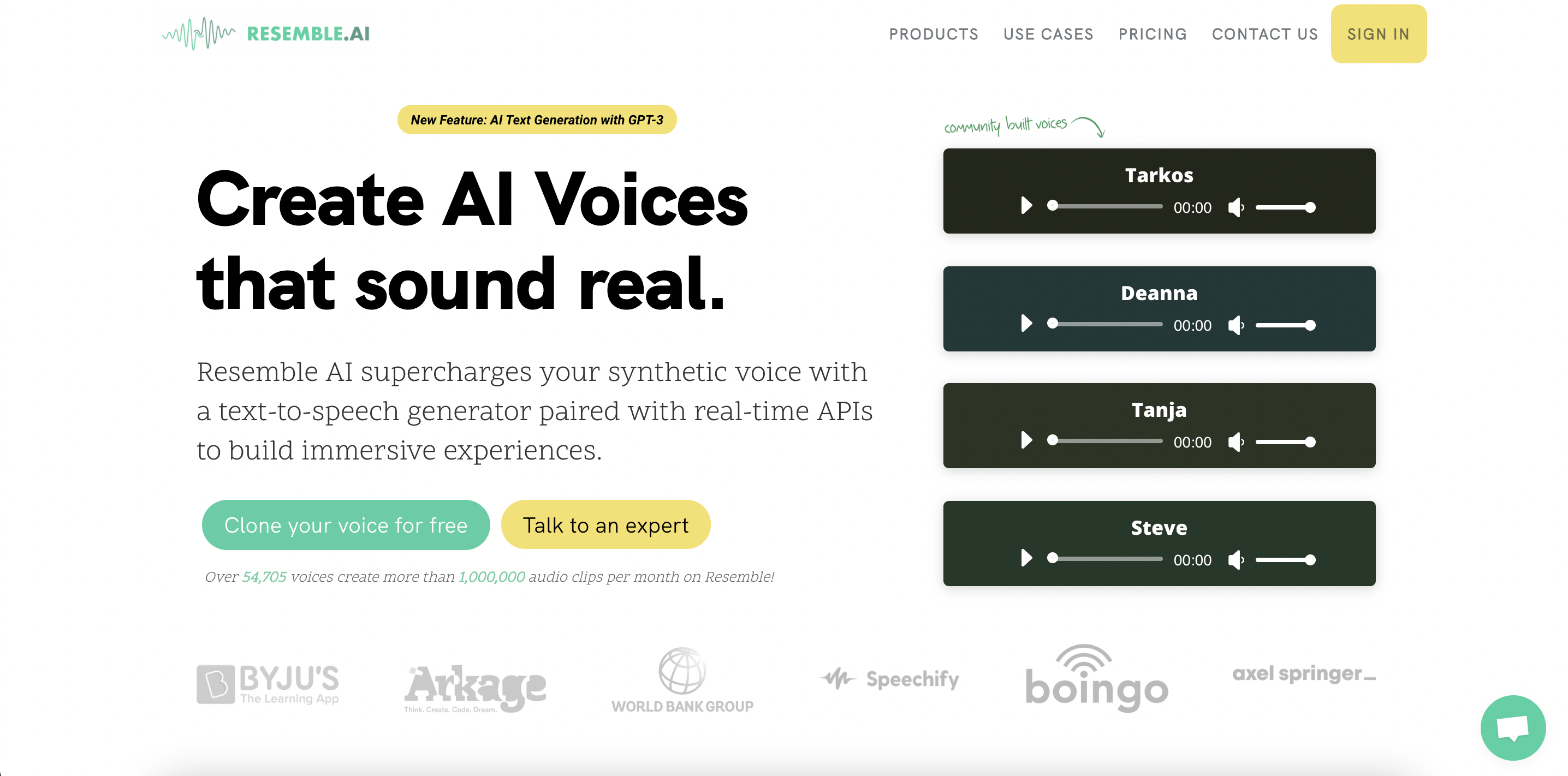
Resemble AI, a platform that uses generative AI to clone realistic-sounding voices, today announced that it raised $8 million in a Series A round led by Javelin Venture Partners, with participation from Craft Ventures and Ubiquity Ventures.
The tranche, which brings the startup’s total raised to $12 million, will be put toward further developing Resemble’s enterprise products and doubling the size of its team to more than 40 people by the end of the year, co-founder and CEO Zohaib Ahmed says.
“Resemble’s technology is being used by some of the largest media companies in the world to create content that was previously impossible,” Ahmed told TechCrunch in an email interview.
Resemble was founded in 2019 by Ahmed and Saqib Muhammad after the two observed that voices in video games couldn’t keep up with frequent version updates to the games themselves. Ahmed formerly worked at Magic Leap as a lead software engineer, fresh off of stints at BlackBerry and Hipmunk.
Resemble started small, focusing mostly on gaming use cases. But the platform grew to offer AI tech that can “transfer” voices to other languages, generate personalized messages from voice actors and create real-time conversational agents.
Resemble is but one player in the fast-growing market for generative voice AI. Papercup, Deepdub, ElevenLabs, Respeecher, Acapela and Voice.ai are among the more notable startup vendors providing AI tools to clone and generate voices, not to mention Big Tech incumbents like AWS, Azure and Google Cloud.
It’s controversial tech, though — and not without good reason.
Motherboard writes about how voice actors are increasingly being asked to sign away rights to their voices, so that clients can leverage AI to generate synthetic versions that could eventually replace them — sometimes without compensation.
Image Credits: Resemble AI
Deepfakes are another issue.
Malicious actors are using AI to clone people’s voices, tricking victims into thinking that they’re talking to a relative or customer. And it’s not just the criminal potential that’s setting off alarm bells. In 2021, a documentarian came under fire for hiring a company to clone Anthony Bourdain’s voice posthumously — with the consent of Bourdain’s estate. The intervening years have seen voice deepfakes take over social media, mostly to harmless effect — but sometimes not.
Ahmed asserts that Resemble stands out in the area of ethics, though.
“In addition to requiring explicit user consent to clone voices, strict usage guidelines are enforced to prevent malicious use,” he said.
To this end, Resemble requires users to provide a recording of a “consent clip” in the voice they’re attempting to clone. If the voice in the clip doesn’t match the other clips, Resemble blocks the user from creating the AI voice.
In addition, to prevent misuse when recording, Resemble forces users to say an array of specific sentences in their own voice. If they deviate from the script, Resemble flags the recording as potential misuse.
“Once the voice is created, the user owns all rights to that voice,” Ahmed said. “We don’t use that voice data to train other models, nor do we resell the voice data to third-party companies … For customized solutions, we work with companies through a rigorous process to make sure that the voice they are cloning is usable by them and have the proper consents in place with voice actors.”
Resemble has also developed a product, Resemble Detect, that’s designed to validate the authenticity of audio data using an AI model trained to distinguish fakes from real audio. The model essentially “sees” different frequencies where artifacts resulting from the editing or manipulation of sound could be contained, making a prediction from 0% to 100% confidence as to the clip’s “realness.”
Detect is meant to complement Resemble’s audio watermarking tech, PerTh Watermarker, which uses an AI model to produce and insert imperceptible-to-the-human-ear audio tones that carry identifying information. (It’s worth noting that PerTh Watermarker is a bit of a platform lock-in play — it can only mark and detect Resemble’s own generated speech, and isn’t compatible with other commercial or open source voice-generating AI tools.)
Ahmed sees these tools as major contributors to Resemble’s success. The platform has more than a million users, he says, who’ve generated 35 years’ worth of audio in the last 12 months.
“With regulation of AI top of mind for government officials, Resemble is providing insights and recommendations about the responsible use of generative audio,” Ahmed said. “With Resemble, creating engaging and high-quality voice content is now easier than ever, enabling content creators to add a whole new level of authenticity to their work, and will add a new level of immersion for the audience.”
Online travel portal ixigo (Le Travenues Technology Limited) has leveraged OpenAI’s ChatGPT API to build ‘PLAN’, an intelligent trip planner, alongside becoming the first Indian travel company to have ixigo’s plugin for ChatGPT.
This platform can efficiently process and comprehend user preferences, presenting them with personalised suggestions, recommendations, and itineraries. By combining the capabilities of ChatGPT with available travel data, ixigo’s PLAN lets travellers receive destination recommendations based on their present location, time, or weather conditions.
Alternatively, if users already have a specific destination in mind, they can choose from a variety of trip themes or provide their own preferences for a customized travel plan. PLAN will automatically label, map, and generate a comprehensive itinerary for the chosen destination and theme, seamlessly incorporating weather and air quality index (AQI) updates. Through PLAN’s conversational user interface, individuals can personalize their itineraries in real-time and collaboratively create their ideal trip plans.
“Our app combines ChatGPT’s AI with real-time information to create a user-friendly trip planning experience, including personalised recommendations,” said Rajnish Kumar, Co-founder and Group CPTO of ixigo.
Founded in 2007 by Aloke Bajpai and Kumar, the Sequoia Capital-backed company has been implementing AI, ML now for a while. Notable investors in the company include IE Ventures, Trifecta Capital, and Micromax, among others. Furthermore, they expanded their services by acquiring AbhiBus, a platform dedicated to booking bus tickets, and Confirmtkt, a platform that enables users to discover and purchase train tickets.
Travel Industry Warms Up to Generative AI
During Airbnb’s recent earnings call, cofounder Brian Chesky highlighted the potential of generative AI in enhancing customer service and transforming the industry. ChatGPT’s initial application also included generating travel itineraries and providing recommendations for tickets and hotels. Integrating ChatGPT plugins with platforms like Expedia and Kayak allowed real-time data access and instant ticket bookings.
Travel companies are adopting generative AI to manage customer volumes, automate queries, and cater to specific market segments by integrating different languages. MakeMyTrip’s conversational bot employs generative AI LLM and speech-to-text models to serve customers in English and Hindi. The company is currently testing additional use cases and bots for their customers.
Read more: Travel Industry has No Choice but to Embrace Generative AI
The post Ixigo Becomes First Indian Travel Company to Have ChatGPT Plugin appeared first on Analytics India Magazine.
The World Economic Forum’s The Future of Jobs Report 2023 found that AI is expected to be adopted by nearly 75% of surveyed companies, with 50% of organizations expecting it to create job growth. The study found that the fastest-growing roles are driven by technology, digitalization and sustainability.
What’s at the top of the list of fast-growing jobs? AI and machine learning specialists. In the top 10 growing skills, the report highlighted AI and big data, whereas training workers to utilize AI and big data ranks third among company skills-training priorities in the next five years.
High-growth sectors
AI is expected to create 133 million new jobs globally, according to separate data. By looking at what roles companies are hiring for, the study revealed which AI-related roles are growing in popularity.
One area experiencing fast growth is in data management, and data roles across the board have increased by 80% since 2015. Job vacancies for data scientists increased by 110% year-on-year, while data engineer vacancies tracked an average of 86% year-on-year growth.
The demand for AI professional skills is increasing across virtually every American industrial sector in which there is data, according to Stanford University’s Institute for Human-Centered Artificial Intelligence. It says that the AI capabilities most likely to have been embedded in businesses include robotic process automation (39%), computer vision (34%), natural language text understanding (33%) and virtual agents (33%).
The most commonly adopted AI use case in 2022 was service operations optimization (24%), followed by the creation of new AI-based products (20%), customer segmentation (19%), customer service analytics (19%) and new AI-based enhancement of products (19%).
Opportunities
Given the scope of AI itself, the jobs related to this burgeoning field can be wide-ranging, offering workers a suite of options to upskill or reskill. AI can come into play across customer service — think of chatbots or self-checkouts; journalists can use AI-based transcription services; companies will want data scientists who can pinpoint where AI would be useful for their products.
When we think of generative AI like ChatGPT, we can think of a machine learning engineer, who builds and designs the AI that learns. There are also AI engineers who develop and train the algorithms that allow the AI to be applied and used. Then, there are the data engineers who work on the infrastructure around data storage and processing.
Do you love the world of robotics? Robotics engineers are also under the AI jobs umbrella and can work across a range of industries, including manufacturing and medicine. They might work on overseeing robots, or they might be involved at an earlier stage in design.
Software engineers, also known as developers, work in the design, testing, development and maintenance of software applications — they’re the ones who are great at coding, are knowledgeable about various programming languages and can use their skills for everything from working in aviation to gaming.
Data scientists analyze data and extrapolate the important, actionable points from it. They’re good at finding patterns and trends, but they’re also good at communicating those findings in an understandable way.
AI will be part of the workplace’s future — so it’s no surprise that from marketing to legal, healthcare to customer operations, companies are cottoning to the need to hire staff into the AI space.
Are you looking for AI related roles? Here are some currently available via the TechRepublic jobs board.
Machine Learning Engineer 3, Adobe, San Jose
Adobe is a digital product used by everyone from emerging artists to global brands. Its San Jose office is looking for a Machine Learning Engineer who has expertise in software engineering and machine learning. The hire would research, develop and deploy large-scale machine learning solutions for business, working closely with data scientists, engineers, researchers and product managers. Read the key skills and qualifications for this role.
Data Scientist/Senior Data Scientist, StackAdapt, Canada
For this remote role, StackAdapt — a self-serve advertising platform — is looking for a Data Scientist to join its engineering team. It’s looking to expand its data science efforts and says it utilizes the latest technologies to solve challenges in traffic, data storage, machine learning and scalability. Amongst other skills, the ideal hire will have a comprehensive understanding of machine learning. Read all about the role here.
Senior Architect, Data, AI, Information Architecture, the Travelers Companies Inc., Hartford
This property casualty insurer has been going for over 160 years, but it’s clearly happy to move with the times. The Travelers Companies is looking for a Senior Architect who has experience with specific DevOps and machine learning practices. Find out more about the job here.
Written by Aoife Barry
Secure your future by browsing hundreds of available roles on the TechRepublic Job Board
Subscribe to the Daily Tech Insider Newsletter
Stay up to date on the latest in technology with Daily Tech Insider. We bring you news on industry-leading companies, products, and people, as well as highlighted articles, downloads, and top resources. You’ll receive primers on hot tech topics that will help you stay ahead of the game.
AI technology has burgeoned into the mainstream in the last six months or so, thanks to the runaway popularity of tools like Midjourney and ChatGPT. Naturally, with the rapid adoption of these tools – along with alarming articles suggesting AI can cure cancer, pass the bar, score highly on AP tests, code a game, and oust journalists – people feel as though their livelihoods are threatened.
Then Goldman Sachs released a report suggesting that AI could cause 300 million jobs to be degraded or lost in American and European markets. Cue the panicked headlines.
I thought it worth exploring the report in a little more depth to what the report is really saying, what kind of job losses we can expect, in what fields, and what those most at risk can do to offset the dangers.
Overview of the report
The report basically says three things:
Almost every single industry has exposure to tasks being replaceable by AI. They flag legal and administrative industries with the greatest potential to have parts of their job replaced by AI, while manufacturing and construction are least at risk.
The authors predict that up to 7% of current US employment will be fully substituted by AI. Roughly 63% will be complemented. Around 30% will be unaffected.
The cumulative effect of this will be an increase in productivity, leading to an eventual increase of the annual global GDP by 7%
Despite the gloom and doom headlines, the authors end on a hopeful note. “The combination of significant labor cost savings, new job creation, and higher productivity for non-displaced workers raises the possibility of a productivity boom that raises economic growth substantially.”
How to understand the Goldman Sachs report
I’d recommend you read the report more than relying on headlines. The Goldman Sachs report is much more cautious. The whole report is called “The Potentially Large Effects of Artificial Intelligence on Economic Growth,” and there’s a good deal of nuance in there.
For example, while Forbes author Jack Kelly says that the report suggests AI will “diminish” roles, the authors of the original report make it clear they expect AI to complement those jobs, not diminish them. The authors also make it clear that they expect few employees to be entirely replaced by AI.
Imagine an employee in the admin industry, which the report suggests is one of the professions most exposed to AI, with 46% of tasks replaceable by AI. Even if you could replace 90% of what one employee does, it’s extremely unlike that you can get an AI to do everything that employee does.
Administrative workers don’t just do basic tasks; they also communicate with employees, collaborate to set up meetings, and deal with unexpected issues – things only a human can do. If automation could replace administrative assistants, Calendly would have done so already.
That’s basically what the report is saying. Jobs could be at risk, but most (93%) won’t be. Most are only exposed, meaning that some of those day-to-day tasks might be replaced by AI, but then this will increase productivity.
It’s also worth realizing that AI will create new jobs, as the authors of the report underlined. “[W]orker displacement from automation has historically been offset by creation of new jobs, and the emergence of new occupations following technological innovations accounts for the vast majority of long-run employment growth,” they write.
Many write-ups also claim that AI is already replacing many professions which I know for a fact isn’t possible. For example, Kelly goes on to write, “Instead of a live person addressing a problem, you can engage with an online chatbot. AI can help diagnose cancer and health issues.” Many medical professionals have gone on the record to demonstrate that what they do is not replaceable by AI.
ER doctor Josh Tamayo-Sarver tested ChatGPT’s ability to diagnose patients and found it dangerously lacking.
“ChatGPT worked pretty well as a diagnostic tool when I fed it perfect information and the patient had a classic presentation,” he writes, detailing how ChatGPT misdiagnosed some patients while failing to ask obvious questions that a human doctor would know to ask. “The vast majority of any medical encounter is figuring out the correct patient narrative.” And that’s not replaceable.
Image from Youtube
And anyone who has interacted with a chatbot knows how helpful and necessary it is to be able to escalate to a real person on the other end of the line.
Ways AI can take jobs
Of course, there are still jobs at risk. And while the net effect of AI might be to introduce more jobs, that’s no benefit to the people who lose their jobs due to AI right now. There are two paths that put your job at risk: direct replacement and indirect competition.
Direct replacement
Many writers, programmers, and graphic designers are threatened directly by unscrupulous CEOs who want to cut costs and use mediocre content generation rather than pay a wage. Right now at least, generative AI is not capable of doing everything a programmer does like debugging, peer review, and thoughtful problem-solving.
But cost-conscious bosses might not care about that until it’s too late.
Indirect competition
In any field where fast generation beats quality, AI will cause job loss. For instance, one of my peers recently told me she lost her job as editor-in-chief – not because her boss outsourced the job to AI, but because the entire website had lost 90% of their profits due to being outcompeted by AI-generated content on those keywords.
Her boss regretfully laid her off to save costs and hopes to rehire her in the future. In the long term, I expect that content will be more penalized, but that’s no consolation to her right now.
What kinds of jobs will be lost?
Depending on which study you read, different jobs are at differing levels of risk. For example, the Goldman Sachs study says that the admin, law, and information processing industries are most at risk. Another study says that writing and programming are on the chopping block; science and critical thinking are not.
I do think it’s worth highlighting that sometimes those are not mutually exclusive. Which programmer has never used critical thinking? That’s what makes me believe it’s not AI per se that’s causing job loss; it’s people in charge trying to save a buck. And I believe they’ll regret it in the long term.
What is being done to combat AI job loss?
There are a few paths currently being pursued to protect employees against AI-caused job loss. On an individual level, many people are learning to use AI in their day-to-day to make them more efficient and effective. Many companies and countries are outright banning generative AI for security risks. Certain industries are striking against AI.
Learn to use AI
The easiest and fastest way to prevent AI-related job loss is to learn to incorporate AI into your workflow. As the founder of a company, I’m hardly going to fire myself anytime soon, but I have learned to use AI to draft emails, capture transcriptions of important calls, summarize long articles to save time, get technical help with projects, and even help me write code.
Other workers have added AI to their job titles, such as AI prompt experts or AI-powered SEO specialists. Employers are doing this too, hiring AI-assisted workers in fields as diverse as real estate brokerages marketing leaders, and tech knowledge workers.
If you’re a data scientist or an aspirant, this is how ChatGPT can help you be a better data scientist.
Industry strikes and demands
Two examples come to mind. First, one open letter was signed by over 27,000 individuals including leaders like Elon Musk requesting a pause on AI development. The signers cite other technologies that have been paused until research can be done to make them safer, like cloning, human germline modification, gain-of-function research, and eugenics.
Second, the Hollywood Screenwriters have gone on strike to request, among other things, a guarantee that there will be no AI in the writing room, either fully automated or partially so. Their strike has not yet been successful, but it sets a precedent.
Finally, many publications online have limited or outright banned AI-generated content, whether code, writing, or art. Here are just a few:
StackOverflow banned GPT and ChatGPT answers
Medium limits the distribution of AI-authored articles, while some publications on the platform ban it entirely
Getty Images has banned AI-generated art for copyright concerns
Image generative with lexica
Security bans
Finally, some countries and companies have banned ChatGPT due to security concerns. Seven countries, including Russia and Italy, have banned ChatGPT for reasons including child safety and international security. Samsung asked employees not to use ChatGPT for security risks, while Bank of America, Citigroup, Deutsche Bank, Goldman Sachs, and Wells Fargo have banned it for the same reason.
All this to say that the progress of AI is not unchallenged, and many parties are thinking carefully about how to implement it in a way that makes sense for everyone’s safety.
Potential benefits of AI
I love how the Goldman Sachs report summarizes their position on how AI might affect the economy: “Substitute sometimes, complement often.”
As mentioned, AI technology is expected to increase the GDP by 7% in the coming years, and in the meantime, I know it’s helped me at least improve the overall productivity and enjoyment of my work. Much as I imagine today’s programmers are relieved they don’t need to program computers via a series of hole-punched papers, I suspect tomorrow’s programmers will have incorporated AI generative technology in a way that makes life easier, not harder or less financially stable.
Computer scientist Margaret Hamilton poses with the Apollo guidance software she and her team developed at MIT. Credit: Courtesy MIT Museum. Final thoughts on the true risk of AI to jobs
There’s no way to predict anything AI could do, and the authors of the original article highlight that. It’s called “potentially” large effects, after all. Anyone who claims they know the answer is lying or misled.
From my perspective, there’s reason to be both cautious and hopeful. On the one hand, there will always be those who want to earn a quick buck at the expense of people. On the other, AI represents a potential shift into the future that we haven’t seen since the propagation of the personal computer.
I won’t pretend I know how it will all end up, but I do know that for anyone who wants to understand the true risk of AI to job loss, it pays to read the primary sources of research, follow thought leaders, and don’t be caught up by hype, either positive or negative. It’s a nuanced question, and I’m excited to see how it develops. Nate Rosidi is a data scientist and in product strategy. He's also an adjunct professor teaching analytics, and is the founder of StrataScratch, a platform helping data scientists prepare for their interviews with real interview questions from top companies. Connect with him on Twitter: StrataScratch or LinkedIn.
More On This Topic
The Lost Art of Decile Analysis
Top KDnuggets tweets, Oct 21-27: #MachineLearning can recover lost…
One Million KDnuggets Visitors in March. Wow.
How Data Scientists Can Avoid 'Lost in Translation' Syndrome When…
Why Are So Many Data Scientists Quitting Their Jobs?
International Business Machines (IBM) is considering the use of artificial intelligence chips that it designed in-house to lower the costs of operating a cloud computing service it made widely available this week, an executive said, Reuters reported on Tuesday.
In an interview with Reuters at a semiconductor conference in San Francisco, Mukesh Khare, general manager of IBM Semiconductors, said the company is contemplating using a chip called the Artificial Intelligence Unit as part of its new “watsonx” cloud service.
One of the challenges that the last Watson system experienced was high costs, which IBM hopes to alleviate this time. Since its own chips are particularly power efficient, Khare believes they could cut cloud service costs, the report added.
Khare has now confirmed that the chip is being manufactured in collaboration with Samsung Electronics, a longstanding partner in IBM’s semiconductor research endeavors.
There is no defined timeframe for when the chip will be accessible for cloud users to use, but according to Khare, the company already has thousands of prototype chips in operation. Khare made it clear that IBM was not trying to design a direct replacement for semiconductors from Nvidia whose chips lead the market in training AI systems with vast amounts of data.
Besides IBM, Microsoft, Meta, Google, Apple and Amazon have also been working on developing in-house AI chips. For instance, Google has built a supercomputer to train its models with its TPUs (Tensor Processing Units). Apple has been working on M1 and M2 chips for quite some time now. Amazon, on the other hand, is working on Trainium and Inferentia processor architectures.
The post IBM Contemplates Integration of In-House AI Chip in New Cloud Service to Lower Cost appeared first on Analytics India Magazine.
The Indian government has decided to levy no Goods & Services Tax (GST) on startups in the satellite launching space, Finance Minister Nirmala Sitharaman announced during the 50th meeting of the GST Council.
“It has been decided that GST exemption on satellite launch services supplied by ISRO, Antrix Corporation Limited and New Space India Limited (NSIL) may be extended to such services supplied by organisations in the private sector also to encourage start ups,” said an official press release.
The same has been welcomed by different players in the Indian spacetech space because it is going to open the doors for both foreign and domestic investments. “The satellite launch segment has become a key focus area for Indian startups and SMEs, driving innovation and seeking new revenue opportunities.
“According to the ISpA-EY report, the space launch segment is expected to grow rapidly by 2025, with a CAGR of 13%, which will be fueled by increased private participation, advanced technology adoption, and cost-effective launch services,” Lt. Gen. AK Bhatt (retd.), Director General, Indian Space Association (ISpA) told AIM.
He believes this step will give a financial relief to the players and will incentivise growth of this nascent sector. “This was one of our pre-budget recommendations and we believe it will help enable the growth of indigenous launch capabilities and ensure a level playing field for all,” he said.
The recent development suggests that the government has acknowledged the role private players will play to help India achieve its ambitious goals of capturing 10% of the global space economy by 2030. Currently, India accounts for just 2% of the USD 44 billion global space economy, trailing behind the likes of the US and China.
To boost the sector and drive investments in the sector, the government is planning to allow 100% foreign direct investment (FDI) between 49-100% in three areas — sub-system manufacturing, launch vehicle operations, and satellite operations and establishments.
The post Indian Startups Launching Satellites Get GST Exemption appeared first on Analytics India Magazine.
San-Francisco-based AI lab Anthropic has announced Claude 2, a new ChatGPT rival open to the public in the US and the UK. The model is the latest version of ‘Claude’ released merely five months ago which was available only to businesses. Unlike its predecessor the latest version is available via a public-facing beta site as well as an API.
One of the chatbot’s beta testers, Ethan Mollick, an Associate Professor at the Wharton School of the University said in a LinkedIn post, it has two big advantages over the other models: it is very good at handling documents (especially PDFs, which GPT struggles with) and shows a very sophisticated “understanding” of documents. Furthermore, it continues to be the most “pleasant” AI personality. On the downside, he suggested users to refrain from using the model for data, even though it accepts CSV files. It hallucinates answers, contrarily Code Interpreter does not. The startup run by former senior members of the OpenAI team Daniela and Dario Amodei purports to be a more ethically-driven company that makes generative AI safe and “steerable,” according to its website.
According to the announcement blog, the latest version of the AI assistant scored 76.5 percent on the multiple choice section of the Bar exam and in the 90th percentile on the reading and writing portion of the GRE. Its coding skills have notably improved, scoring 71.2 percent on a Python coding test compared to Claude’s 56 percent.
Earlier this year, in February, Anthropic introduced a waitlist for early access to Claude, following IT giant Google’s recent investment in the startup. The investment—worth $300 million—gave Google a 10% stake in the company bringing Anthropic’s value at approximately $5 billion. The partnership was predicted, as earlier in January Anthropic announced that it had chosen Google Cloud as its preferred cloud provider.
The OpenAI competitor has set itself apart with its focus on understanding and developing safe AI systems, with the “constitutional AI” approach. “We have an internal red-teaming evaluation that scores our models on a large representative set of harmful prompts, using an automated test while we also regularly check the results manually,” said the blog. This is to ensure that Claude 2 is less susceptible to jailbreaks or nefarious uses.
If you’re in the US or UK, you can access the AI chatbot through the Claude 2 page, and sign up for free. Click on “Talk to Claude”, provide an email address and you’ll be ready to go.
The post Anthropic Launches ChatGPT Rival, Claude 2 appeared first on Analytics India Magazine.
If you ask ChatGPT about something that it is not aware of, it would say that “I’m sorry, but as an AI language model, I don’t have real-time data access”. And the same goes for Google’s Bard, as well, which blurts out anything and everything from the internet.
But imagine a day comes in the tech-savvy future that these LLM chatbots just simply says “I don’t know” without any explanation? Or asks for directions on how you feel?
Dear OpenAI: It is okay if ChatGPT says “I don’t know”.
— Adon Phillips (@adonphillips) February 16, 2023
When Phoebe Buffay said in F.R.I.E.N.D.S that we know that don’t know that we know that they know, maybe she was talking about LLM chatbots because well, failure doesn’t seem to be an option for chatbots as of now.
Humorous? Maybe Not
Although LLMs come with the ability to simulate human characteristics, exhibiting distinct personalities shaped by biological and environmental influences, these personalities influence interactions and preferences. Remarkably, LLMs can express synthetic personality traits within the text they generate.
However, users have often been divided on Bard and ChatGPT’s apparent “humour”. When everyone thought that ChatGPT was bad at being funny, Bard took it a notch higher.
Mastering the art of replicating human humor is a complex undertaking, yet the successful development of such humor bots has the potential to disrupt the professional comedy industry. However, creating a bot capable of matching human-level humor is a formidable and serious challenge.
oh my god pic.twitter.com/XofjXvw6M0
— gfodor.id (@gfodor) December 3, 2022
German researchers Sophie Jentzsch and Kristian Kersting discovered that ChatGPT’s (the version which was built on GPT-3.5) joke knowledge is limited, with 90% of its generated jokes being the same 25 jokes repeated. The researchers found that ChatGPT could provide valid explanations for jokes based on wordplay and double meanings but struggled with jokes outside its learned patterns.
However, with GPT-4, this seems to have changed.
Nevertheless, concerns arise regarding the personalities of LLMs. Some instances have revealed undesirable behaviors such as deception, bias, or the use of violent language. Additionally, inconsistencies in dialogue and inaccuracies in explanations and factual knowledge may arise from these models.
Chatbots have always been “stateless” — meaning that they treat every new request as a blank slate, and aren’t programmed to remember or learn from previous conversations.
But ChatGPT can remember what a user has told it before, thanks to function calling, in ways that could make it possible to create personalised therapy bots, for example. However, on the other hand we have Google’s Bard which does not come with this update.
Human Vs LLM Personalities
Researchers from Google DeepMind, Google Research, and Cambridge University’s psychology department propose a method to measure LLM personalities using existing tests. They employ controlled prompts and modify observed personality traits in LLMs to simulate personality variations.
Researchers conduct three studies on shaping personality in LLMs. The first study demonstrates independent shaping of personality traits, resulting in targeted changes. The second study focuses on simultaneous shaping of multiple personality traits. The third study compares survey-based signals of personality with language-based estimates, confirming the validity of survey-based measures.
Shaping Personality in LLMs
Psychometrics involves measuring abstract concepts like personality through standardised tests. Researchers employ validated psychological tests to evaluate the personality traits displayed in LLM-generated text.
Analysis of different LLM configurations and sizes reveals that larger models with instruction fine-tuning exhibit more accurate personality scores. These models perform better in generating coherent and externally valid personality profiles. Various validation tests demonstrate evidence of construct, convergent, discriminant, and criterion validity. Larger models with instruction fine-tuning show stronger correlations with external measures related to effect, aggression, values, and creativity.
So, synthetic personality measured through LLM-simulated tests and generated text is reliable and valid, particularly for larger and instruction fine-tuned models.
Understanding and shaping personalities in LLMs are crucial aspects of making LLM-based interactions safer and more predictable. Quantifying and validating personality traits through scientific methods, along with responsible engineering practices, contribute to mitigating potential harms and maximizing the benefits of LLMs in human-computer interactions.
Read more: LLMs Are Not As Smart As You Think
The post LLM Chatbots Don’t Know That We Know They Know We Know appeared first on Analytics India Magazine.
After CVPR, the 61st annual Association for Computational Linguistics (ACL) conference is under way from July 9 to 14 in Toronto, Canada. As a Diamond Level sponsor, Google is set to present over 50 publications and actively contribute to workshops and tutorials. The godfather of neural networks, Geoffrey Hinton, who was the keynote speaker at the conference, highlighted the subjective experience vs sentience of larger language models. The event covered topics such as computational social science and cultural analytics, dialogue, interactive systems, and discourse and pragmatics.
Let’s take a look at the top papers presented by Google at the conference.
NusaCrowd: Open Source Initiative for Indonesian NLP Resources
The paper introduces NusaCrowd, which aims to gather and consolidate existing resources for Indonesian languages, including previously inaccessible ones. By combining 137 datasets and 118 standardised data loaders, the project provides valuable resources for natural language understanding and generation. Through manual and automated evaluations, the datasets have been verified for quality.
NusaCrowd facilitates the development of zero-shot benchmarks for Indonesian and local languages, as well as the first multilingual automatic speech recognition benchmark. This work aims to advance research in natural language processing for underrepresented but widely spoken languages.
SamToNe: Improving Contrastive Loss for Dual Encoder Retrieval Models with Same Tower Negatives
A new approach called “contrastive loss with SAMe TOwer NEgatives” (SamToNe) for training dual encoders used in retrieval tasks and representation learning is unveiled in this paper. By including queries or documents from the same encoder towers as negatives, SamToNe improves retrieval quality in both symmetric and asymmetric dual encoders.
The effectiveness of SamToNe is demonstrated through evaluations on various benchmarks. Additionally, the method ensures alignment between the embedding spaces of the encoder towers, as observed through the t-SNE algorithm. The paper also provides insights into the efficacy of SamToNe in terms of regularisation based on the analysis of embedding distance distributions.
RISE: Leveraging Retrieval Techniques for Summarisation Evaluation
Google Research and Google DeepMind present RISE, a novel method for evaluating automatically-generated text summaries. RISE uses information retrieval techniques and is trained as a retrieval task using a dual-encoder setup. It can evaluate generated summaries without the need for gold reference summaries, making it suitable for new datasets.
Experimental results on benchmark datasets demonstrate that RISE consistently outperforms previous approaches in terms of correlation with human evaluations. Additionally, RISE exhibits data-efficiency and generalisability across languages.
OPINESUM: Entailment-based Self-Training for Abstractive Opinion Summarisation
The aim of researchers in this paper is to solve the age old the challenge of summarising a large number of reviews for a product or place. While supervised systems have been successful in news domains, they lack the availability of large-scale datasets for opinion texts. To bridge this gap, the paper proposes an unsupervised self-training approach called OPINESUM for abstractive opinion summarisation.
This approach utilises textual entailment to capture the consensus of opinions from multiple reviews and generate summaries. OPINESUM can generate silver-standard summaries at a large scale and achieve state-of-the-art performance in both unsupervised and few-shot settings.
Large Language Models with Controllable Working Memory
In this paper, the focus is on controllability and robustness of LLMs. It is demonstrated that state-of-the-art models like T5 and PaLM may lack these qualities, especially as the model size increases. To address this, a new approach called knowledge aware finetuning (KAFT) is proposed, which improves controllability and robustness by incorporating counterfactual and irrelevant contexts during training. The effectiveness of KAFT is demonstrated through comprehensive evaluations across different model architectures and sizes.
Estimating p-values From a Single Test Set with Item and Response Variance
This paper focuses on the lack of confidence reported in outcomes within the NLP leaderboard culture. The authors propose a framework and simulator to estimate p-values for comparing the performance of two systems, aiming to determine the confidence that one system is genuinely better than the other. They establish a null hypothesis assuming that both systems’ metric scores are drawn from the same distribution. By creating a test set that combines responses from both systems, they investigate different methods to accurately estimate the p-value considering factors like response variance, metric choice, and sampling method, emphasising their importance in providing reliable statistical guarantees for model comparisons.
Distilling Step-by-Step! Outperforming Larger Language Models with Less Training Data and Smaller Model Sizes
The paper introduces a new method called ‘Distilling step-by-step’ to address the challenges of deploying large language models (LLMs). It trains smaller models that outperform LLMs by using LLM rationales as additional supervision within a multi-task framework. The method achieves better performance with fewer labeled/unlabelled training examples compared to finetuning and distillation. It also achieves better performance with smaller model sizes compared to few-shot prompted LLMs. Additionally, the method reduces the model size and the amount of data required to outperform LLMs, as demonstrated by the results on NLP benchmarks.
PROPSEGMENT: A Large-Scale Corpus for Proposition-Level Segmentation and Entailment Recognition
The paper proposes PROPSEGMENT, a collection of over 45,000 propositions annotated by experts. The dataset focuses on two tasks: segmenting sentences into propositions and classifying the entailment relationship between each proposition and another document on the same topic. The paper establishes effective starting points for these tasks and showcases the potential of PROPSEGMENT in detecting summary hallucination and understanding the compositionality of Natural Language Inference (NLI) labels at the document level.
Optimising Test-Time Query Representations for Dense Retrieval
Here we see TOUR, a new method for optimising query representations in dense retrieval. It leverages a crossencoder re-ranker to provide pseudo labels for retrieval results and iteratively improves query representations using gradient descent. TOUR is shown to enhance open-domain question answering accuracy, passage retrieval performance, and direct re-ranking speed.
The post Top 9 Papers Presented by Google at ACL appeared first on Analytics India Magazine.
Midjourney: Best for generating photo realistic art
Craiyon: Best for free access
Jasper Art: Best for professional use
NightCafe: Best for seasoned AI artists
DeepAI: Best for customization
Runway: Best for video editing
This is a comprehensive list of the best AI generators. Explore the advanced technology that transforms imagination into stunning artworks.
Today, artificial intelligence-based art generation technology is gaining traction, as these solutions introduce new possibilities for creative expression and can help businesses stay ahead in a rapidly evolving digital landscape.
AI art generation refers to the use of artificial intelligence algorithms and technologies to create visual artwork. It involves utilizing machine learning techniques to generate unique and original artwork or enhance the creative process for users.
SEE: Moderate your business’s AI usage with TechRepublic Premium’s AI ethics policy template.
By streamlining certain elements within creative workflows, AI art generation saves users time and resources. This increased efficiency can lead to faster turnaround times, increased productivity and cost savings!
Furthermore, investing in AI art generators can provide competitive advantages to businesses both in and out of creative industries. AI-generated art can be used to generate visually compelling content that allows businesses to stand out in a crowded marketplace.
So read on to learn more about AI art generation technology and the top AI art generators available in 2023.
Jump to:
Top AI art generators comparison
What are the key features of AI art generators?
Benefits of working with AI art generators
How do I choose the best AI art generator?
Review methodology
Top AI art generators comparison
AI art generators enable users to experiment with different styles, techniques and aesthetics, pushing the boundaries of traditional artistic expression. Below is a comparison of some of the best AI art generators on the market.
Software
Text-to-image generation
Editing and upscaling of imported media
Art community access
Free software version
Pricing
DALL·E 2
Yes
Yes
No
No
$15 per 115 credits
Midjourney
Yes
Yes
Yes
No
Starting at $10 per month
Craiyon
Yes
No
No
Yes
Paid plans starting at $5 per month
Jasper Art
Yes
No
No
No
Starting at $39 per month
NightCafe
Yes
Yes
Yes
No
Starting at $5.99 per month
DeepAI
Yes
Yes
No
Yes
Paid plans starting at $4.99 per month
Runway
Yes
Yes
No
Yes
Paid plans starting at $15 per user per month
DALL·E 2: Best for user-friendliness
Image: DALL·E 2
It seems like everybody is talking about DALL·E 2, and it’s no wonder why. This web-based tool is handy for generating high-quality, copyright-free AI graphics from text cues. What people enjoy about this AI model is its user-friendliness, making it accessible for anyone to utilize, even beginners!
DALL·E 2 was developed by OpenAI as an off-shoot of its original image-generating model, DALL·E. You may be familiar with OpenAI’s other popular AI product, ChatGPT. Like ChatGPT, the DALL·E 2 interface is simplistic and self-explanatory, providing a foolproof resource for people looking to create unique AI images.
So, whether you’re looking to create a photo-realistic image or transform an existing image to a specific style, just describe your wishes in natural language and let DALL·E 2 do the rest.
Platform
Web
Developer
OpenAI
Pricing
$15 per 115 credits (approximately 460 images at default settings).
Features
Easy-to-use interface.
Ability to combine attributes, styles and concepts.
Image expansion/outpainting.
Image editing/inpainting.
Generating variations of existing images.
Supports many integrations through Zapier.
Pros
Generates art from text descriptions written in natural language for easy use.
New users receive 50 free credits, and all users receive 15 additional credits each month.
The model was trained on approximately 650 million image-text pairs sourced from the internet that were filtered to remove harmful content and support safe generations.
OpenAI developed safety mitigations to prevent harmful generations and curb misuse.
Cons
Although new users receive 15 free credits, those credits would produce approximately, only about 60 images.
Although the tool can produce many different images based on the text input, the simplistic nature of the model makes it unable to not provide as many customization options as other AI image generators.
Visit DALL·E 2
Midjourney: Best for generating photo realistic art
Image: Midjourney
Midjourney is among the best resources out there for creating photorealistic AI art, making it ideal for image upscaling. However, the factor that sets the tool apart the most is definitely its interface. Users must access the image generations by requesting them from a Discord bot.
For anyone out there who is unfamiliar, Discord is a social messaging platform and the only way to utilize Midjourney. But once you make a Discord account and begin requesting images from the robot using specialized commands, you’ll get the hang of the process.
From there, Midjourney allows users to request image generations and learn tips and tricks from other program users within their Discord public channels. This solution makes it easy to create stunningly realistic generations and integrate yourself among a community of other AI digital artists.
Platform
Mac, Windows, Linux (deb, tar.gz), iOS and Android
Developer
Discord-based
Pricing
Basic Plan: $10 per month.
Standard Plan: $30 per month.
Pro Plan: $60 per month.
Features
Ability to upscale and edit imported images.
Graphic generation based on text description.
Stylize function to improve artistic quality and realism.
Zoom-Out, tool to expand on original images.
Tile parameter feature for creating repeatable images.
Pros
The pricing model is ideal for people that are looking to generate a lot of AI art images.
The platform makes it easy to join a supportive community of other Midjourney users and AI artists.
Cons
Midjourney no longer offers a free version of the tool, and subscription plans may be too costly for members that rarely use the product.
Users have reported difficulty in generating realistic images of hands and teeth.
Only Pro plan members can generate images privately. Otherwise, users’ AI generation prompts are visible to all members within the public Discord channels.
Midjourney’s user interface relies on the use of Discord, which may cause an initial learning curve for those unfamiliar with the platform.
Visit Midjourney
Craiyon: Best for free access
Image: Craiyon
As its name would suggest, Craiyon is a tool that can be used to create art images, and the developer even offers a free version of the platform. Formerly known as DALL·E Mini, the service can generate photos from written descriptions and features an easy-to-use interface.
Craiyon provides its service for free to all website visitors who feel like giving it a spin. The simplistic model is ideal for any AI artist newbies who may be curious about learning the ins and outs of AI graphic generation but aren’t ready to purchase a subscription plan just yet.
To provide the free server, the model relies on ads. If you’re not a fan of the ads and want to support the developer, you have the option to purchase the service through one of the paid subscription plans. The paid plans provide access to speedier generations, watermark-free artwork, an ad-free experience and more inexpensive perks.
Platform
Web
Developer
Craiyon LLC
Pricing
Free Plan for $0.
Supporter Plan for $5/month (billed yearly).
Professional Plan for $20/month (billed yearly).
Enterprise Plan for a customized price.
Features
Basic AI art generation.
Ability to enhance generated art in higher resolutions.
Customization options for different styles and parameters.
A printing service to order t-shirts with prints of AI-generated images.
Pros
Create free, basic designs without a membership.
Turn your AI creations into wearable art through the website.
Introductory tool into the world of AI digital art creation.
Cons
Craiyon’s free users will encounter ads and may experience long generation wait times due to server overload.
Generated art may be used for personal, academic and professional purposes, but users must respect the Terms of Use and credit craiyon.com for the images if they are free subscribers.
The image generation model has limitations and can produce results that contain harmful stereotypes or reinforce or exacerbate societal biases.
Visit Craiyon
Jasper Art: Best for professional use
Image: Jasper Art
Through Jasper Art, marketing teams, content creators, business owners and non-professionals alike can create unique and high-quality AI images. While anyone can set up an account to access the service, there are several features that make it ideal for business use.
The model can generate custom art, images, illustrations and even 3D animations for business marketing and other royalty-free commercial uses. And although it may be pricier than some of the other AI art generators out there, it does save time and money when compared to sourcing art from other means.
Marketing teams and professionals can also use it alongside the Jasper AI writing generator if they use the service. The multiple content creation tools offered by Jasper make it easy to create visual art and professional writing for all of your business needs.
Platform
Web
Developer
Jasper AI
Pricing
Creator Plan: $39 per month.
Teams Plan: $99 per month.
Business Plan: custom pricing.
Features
Unlimited text-to-picture image generations.
Creates four watermark-free images at a time.
Different art and design styles.
Fast time to generate.
High-resolution 2K pixel images.
Royalty-free commercial use.
Pros
Jasper AI is perfect for users seeking faster generation times, as most prompts take less than 10 seconds to process.
Since the generations are watermark and royalty-free, users can instantly apply the art to business cards, websites, packaging or any other on-brand commercial content.
Cons
Jasper Art doesn’t allow users to upload images for reference, instead relying on text descriptions.
Some users have reported issues with generating realistic body extremities and faces.
Visit Jasper Art
NightCafe: Best for seasoned AI artists
Image: NightCafe
NightCafe is a popular AI art generator that stands apart for its creative features and artistic options, making it a perfect tool for AI artists.
The model’s expansive features and deep customization tools are ideal for skilled AI artists looking to create unique images. Users can select from a wide range of styles and features to generate a visually impressive image. Alternatively, they can input their own photos to generate an all-new and completely unique creation!
While the text-to-image AI model does allow for easy art generation, this tool is anything but basic. Its features enable users to create in multiple AI art models, including Stable Diffusion, DALL·E 2, CLIP-Guided Diffusion, VQGAN-CLIP and even Neural Style Transfer.
Platform
Web and mobile
Developer
NightCafe Studio Pty Ltd
Pricing
Free plan.
AI Beginner plan: $5.99 per month.
AI Hobbyist plan: $9.99 per month.
AI Enthusiast plan: $19.99 per month.
AI Artist plan: $49.99 per month.
Features
Code-free image generation.
Multiple style options and art models.
Access to the AI art community.
Cross-device creation.
Chat rooms and other collaboration features.
Pros
Although the model is extremely versatile, its intuitive user interface makes it easy and accessible for all users, including beginners.
The platform saves user creations in their account for easy access and storage.
NightCafe users can participate in art challenges, vote on their favorite creations, share their AI art in the online gallery or discuss AI art through the Discord server.
Cons
While NightCafe is intuitive enough for all users to generate basic outputs, beginners may experience a learning curve as they master the model’s more advanced creative features.
Many of the model’s features are limited to paid plans.
Visit NightCafe
DeepAI: Best for customization
Image: DeepAI
DeepAI’s customization capabilities enable users to generate tailor-made images that are fine-tuned for their needs. The open-source software solution is an AI text-to-image generator that can produce unique artwork from a single-word text prompt.
DeepAI is a great model for users that want to quickly create a resolution-independent vector image. While the free version of the software produces art based on text prompts, DeepAI’s paid plans provide extensive options for creating and customizing AI images, including many stylistic options for adjusting textures, colors and other details.
While DeepAI does a great job at generating impressively realistic images, its highly customizable nature lets users bring their ideas to life. The tool also ensures that its users can create unlimited unique works of art, as no two generations are the same.
Platform
Web
Developer
DeepAI
Pricing
Free plan.
Pro Plan from $4.99/month and 500 calls per month.
Pay-As-You-Go plan from $5 per 100 API calls.
Features
Resolution-independent vector image generation.
Fantasy World Generator to create fantasy style artwork.
BigGAN for headshot creation.
CartoonGAN to create cartoon style animations.
Image colorization capabilities.
Pros
API developers can connect DeepAI to another software using the text-to-picture API.
DeepAI’s Nudity Detector tool can filter out images containing nudity and rate images on whether they should be considered not safe for work.
DeepAI users can create an unlimited number of graphics.
The BogGAN feature enables users to generate realistic images.
Cons
Some users have reported slow processing time.
Many features are limited to paid subscription plans.
Visit DeepAI
Runway: Best for video editing
Image: Runway
Runway offers a suite of AI tools for generating and editing images, videos, images, 3D media and audio. Its use of ML models allows for an expansive list of features and capabilities that go beyond those of your standard art generator.
The platform provides various art-generation tools, from text-to-image to AI animations and video edits. Users can even transform images into animated videos or simply use text prompts to generate unique videos.
Video editing and generation aside, this is a robust resource that can allow artists to harness the creative powers of AI. Developers can even utilize the solution to train their own custom models and AI image generators.
Platform
Web
Developer
Runway AI, Inc.
Pricing
Basic plan is free.
Standard plan from $15 per user per month.
Pro plan from $28 per user per month.
Enterprise plan for a custom price.
Features
AI text-to-video and video-to-video generation.
Generation of images and 3D textures from text prompts.
Image resolution upscaling.
AI video editing.
Custom model training.
Shared assets and multiple seats.
Pros
The program provides many video editing features for purposes like eliminating the background in videos without the need for green screen technology.
High-definition models trained through RunwayAI are provided 100 free HD images upfront.
Buyers can curate a customized solution plan by contacting the Runway sales department.
Cons
Free and lower-cost subscription plans provide a limited amount of generation capabilities.
The free version of the solution comes with 125 credits, and users can’t buy more unless they sign up for a paid plan.
Visit Runway
What are the key features of AI art generators?
Generative algorithms
AI art generators make use of advanced generative AI algorithms to produce one-of-a-kind artwork based on input data, such as images, texts or random noise. These algorithms learn from existing art styles and patterns, resulting in the creation of fresh and visually captivating pieces.
Style transfer
AI art generators often come equipped with the capability to transfer styles, allowing users to apply the characteristics and aesthetics of well-known artworks or specific styles to their own images. This functionality empowers users to produce artwork that emulates the distinctive look and atmosphere of renowned artists or artistic movements.
Creative exploration
AI art generators foster a spirit of creative exploration by offering users an extensive range of options and possibilities. Through adjustable parameters and settings, artists can modify the generated art, enabling them to experiment, iterate and achieve the desired artistic outcomes.
Realistic rendering
Sophisticated rendering techniques are employed by advanced AI art generators to create artwork that closely resembles traditional artistic mediums or even photographic images. These algorithms can replicate brush strokes, textures and lighting effects, resulting in visually convincing and lifelike graphics.
Interactive and inclusive interfaces
AI art generators often offer interfaces that are intuitive and user-friendly, enabling artists to engage with the generated art in real time. Users can easily make adjustments, apply filters or effects and instantly preview changes, fostering a dynamic and interactive creative process. Moreover, these interfaces should be designed to be inclusive, providing opportunities for individuals with diverse levels of artistic skills to participate in creative expression, irrespective of their experience or training.
Benefits of working with AI art generators
Working with AI art generators offers a range of benefits for artists, businesses and creative individuals. These tools provide a limitless source of inspiration, allowing users to explore and experiment with various artistic styles and parameters so that they may push the boundaries of their creativity.
Perhaps most importantly, these tools offer accessibility, allowing individuals to engage in the creative process and produce visually stunning artwork, regardless of their artistic skills or training. AI art generators may also provide a platform for artists to collaborate and share their creations, fostering a sense of community and support.
Finally, AI art generators save users time and effort by automating certain aspects of the artistic process, such as generating or editing images. This can enable businesses to reduce overhead costs when designing their professional content.
How do I choose the best AI art generator?
Working with AI art generators opens new avenues for artistic exploration, facilitates collaboration and empowers users to unleash their creativity in innovative and exciting ways! However, not all products will provide the same capabilities — or benefits — to your organization.
Evaluating the features of AI art generators is essential to select the best option for your needs. Look for generators offering various artistic styles, adjustable parameters and advanced rendering techniques. Additionally, consider your specific goals so you can choose one that provides the tools and resources necessary to bring your creative ideas to life.
Additionally, consider an AI art generator’s ease of use and interface. Remember that a user-friendly interface with intuitive controls and clear instructions can enhance the creative experience, regardless of the user’s skill level. Exploring the generator’s user feedback and testimonials can also provide helpful insights into its reliability, performance and ease of use. By carefully evaluating these factors, you can choose the AI art generator that best suits your artistic style, preferences and creative aspirations.
Review methodology
This is a technical review using compiled literature researched from relevant databases. The information provided within this article is gathered from vendor websites or based on an aggregate of user feedback to ensure a high-quality review.
Subscribe to the Innovation Insider Newsletter
Catch up on the latest tech innovations that are changing the world, including IoT, 5G, the latest about phones, security, smart cities, AI, robotics, and more.