Combat-happy Meta CEO Aims for Responsible and Safe AI with New Llama 2 Model July 18, 2023 by Agam Shah
Meta CEO Mark Zuckerberg wants to punch Elon Musk in the face but is also looking to beat down AI rivals with his company's latest large-language model.
The Llama 2 model, which was announced by Meta on Tuesday, joins a rash of open-source software AI available for users to download.
The model is available for free, and the model weights and tokenizers are available for download. But users need to fill out a download request as Meta wants to keep this AI model away from the hands of evildoers.
EnterpriseAI made a download request, but Meta first evaluates the request. We received a download link within two hours of filling out the forms. But once Meta approves the request, it can be downloaded via Github or HuggingFace.
The Llama 2 model is like ChatGPT – it was trained on available information on the Internet and can answer questions. Llama 2 is exclusively a chatbot, and once compiled, provides a prompt in which users can ask questions and compile stories.
(AVIcon/Shutterstock)
But Meta, which is the king of offering chat interfaces through its Facebook, WhatsApp, and newly developed Threads application, isn't offering a direct interface for users to try Llama 2 out.
"We're not offering Llama in a chat interface. Researchers or organizations would have to build their own interface on top of the model," a Meta spokesperson told EnterpriseAI.
Meta may have refused to offer a chat interface for Llama 2 as it may not want to deal with the backlash of hallucinating and biased chatbots presented by OpenAI and Microsoft, which had to put safety mechanisms in place. Meta has a history of political backlash for its controversial role in trying to sway public dialog.
Meta’s goal was to produce a transformer model that was safe at the outset. Custom implementations of Llama 2 on PCs will not be censored by Meta. Users can report problematic output of Llama 2 to Meta via the company’s website.
Users can also use Llama 2 via cloud services like Amazon Web Services and Microsoft. On Amazon, it is available via SageMaker JumpStart, which is widely used by Fortune 500 companies to test and develop AI models.
Meta claims the new transformer model is smarter than its predecessor, Llama 1, as it can reason better and provide more relevant answers. Llama 2 was trained on 40% more data than Llama 1, which reduces the instances of hallucinating or incorrect answers.
"We have taken measures to increase the safety of these models, using safety-specific data annotation and tuning, as well as conducting red-teaming and employing iterative evaluations," Meta researchers said in a paper outlining Llama 2.
(Ole.CNX/Shutterstock)
It took six months to train Llama 2, which included the pre-training and inputs based on human feedback. The training surprisingly relied heavily on supervised training at various levels of finetuning, which is a thumbs down on unsupervised training techniques, which was used to train GPT-4.
"The tuned versions use supervised fine-tuning and reinforcement learning with human feedback to align to human preferences for helpfulness and safety," Meta researchers wrote in the paper.
The model training also included techniques reminiscent of decision tree steps, in which less important data is rejected as part of the finetuning process.
The model comes with parameters ranging from 7 billion to 70 billion parameters. Meta claimed Llama 2 had better reasoning capabilities than open-source AI transformer models including Falcon and MosaicML's MPT with a comparable number of parameters.
But Llama 2 is not necessarily better than closed-source AI transformer models like GPT-4.
"They also appear to be on par with some of the closed-source models, at least on the human evaluations we performed," the researchers wrote in the paper.
The model was trained at Meta’s Research Super Cluster on Nvidia A100 GPUs with 80GB of memory. The training was completed in 3.3 million GPU hours.
In the digital world we live in, having a website is a cornerstone of any type of branding for both personal and business purposes. However, site development typically requires at least some basic knowledge of HTML, CMS, JavaScript, or other coding languages.
To make matters easier, Wix is streamlining the website-building process using AI.
Also:How to use ChatGPT to write code
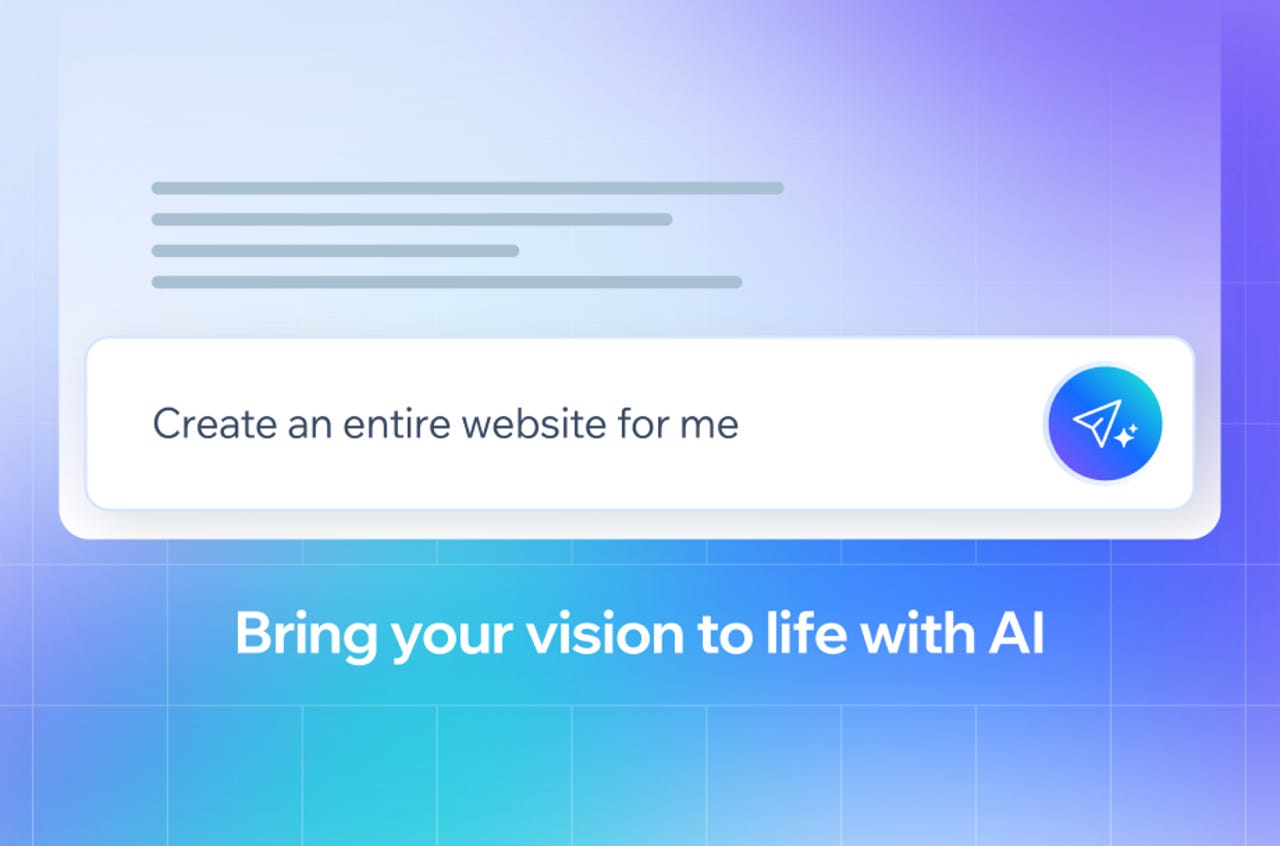
On Tuesday, Wix announced its AI Site Generator, which harnesses ChatGPT as well as Wix's proprietary AI models to design a unique website catered to your specific needs from just a prompt.
The AI Site Generator will be integrated with Wix's business applications, including Stores, Bookings, Restaurants, and more to make sure those important business solutions remain present in the generated website.
As a result, the final AI-generated product will be a complete site with images, text, and business solutions, making it different from an ordinary template where you have to input the aspects yourself.
Also: AI and advanced applications are straining current technology infrastructures
If you want to make a change to the generated website, you can just prompt the tool to make it for you instead of having to do it yourself.
The launch date for this tool was not disclosed but was said to be "coming soon."
If you'd like to start using AI for your website building needs, Wix has a suite of AI tools available for use already, including an AI Text Creator, AI Image Creator, AI Domain Creator, Auto Background Removal, and more.
Microsoft launches vector search in preview, voice cloning in general availability Kyle Wiggers 12 hours
At its annual Inspire conference, Microsoft announced a number of new AI features headed to Azure, perhaps the most notable of which is Vector Search. Available in preview through Azure Cognitive search, Vector Search uses machine learning to capture the meaning and context of unstructured data, including images and text, to make search faster.
Vectorization, an increasingly popular technique in search, involves converting words or images into vectors, or series of numbers, that encode their meaning — allowing them to be processed mathematically. Vectors enable machines to structure and make sense of data, enabling them to understand, for example, that words close together in “vector space” — like “king” and “queen” — are related and quickly surface them from a database of millions of words.
Companies like Qdrant and SeMI Technologies use vector search to power their database services, as do tech giants like Amazon and Google.
Microsoft’s flavor of vector search offers “pure” vector search, hybrid retrieval and “sophisticated” reranking. The company notes that it can be used in apps and services to generate personalized responses in natural language, deliver product recommendations and identify data patterns.
“Vector search is integrated with Azure AI, allowing customers to build search-enabled, chat-based apps, convert images into vector representations using Azure AI Vision [and] retrieve relevant information from large data sets to help automate processes and workflows,” the company writes in a blog post. “The integration of Vector search seamlessly extends to other capabilities of Azure Cognitive Search, including faceted navigation, filters and more.”
Elsewhere across Azure, Microsoft is launching what it’s calling the Document Generative AI solution, which integrates Microsoft’s existing AI-powered document processing services, including Azure Form Recognizer, with the Azure OpenAI Service. (Recall that the Azure OpenAI Service is Microsoft’s fully managed, enterprise-focused offering designed to give businesses access to AI tech from OpenAI — with whom Microsoft has a close commercial partnership — with added controls and governance features.)
The Document Generative AI solution — leveraging OpenAI’s latest AI language models — ingests files for tasks like report summarization, value extraction, knowledge mining and generating new types of documents. It essentially lets a company build an app like OpenAI’s ChatGPT that can read documents and use those documents as the basis for its responses.
For example, using the Document Generative AI, a customer could upload invoices, bills and contracts to allow employees to ask questions about service guarantees and specific line items. The Document Generative AI solution answers questions in text as well as images and tables, providing citations with a link to the source content.
Microsoft explains:
“[Using the Document Generative AI solution, you can] interact with documents using natural language and generate new content from your existing documents, including blog posts, newsletters, summaries and captions … Whether you require intelligent document chat capabilities, writing assistance, query support, comprehensive search functionality or even document translation, Document Generative AI can handle complex and diverse document tasks through models from OpenAI.”
In a related announcement, Microsoft revealed that OpenAI’s Whisper model, an automatic speech recognition model, will soon come to the Azure OpenAI Service as well as Microsoft’s family of AI speech services. Enterprise customers will be able to use Whisper to transcribe and translate audio content as well as produce batch transcriptions “at scale,” Microsoft says.
Rounding out the AI unveilings at Inspire, Microsoft announced the public preview of Real-time Diarization, an AI-driven speech service that can identify which of several people are speaking in real time. The company also announced the wider availability of Custom Neural Voice, which taps AI to closely reproduce an actor’s voice or create an original synthetic voice.
Previously, Custom Neural Voice was in more limited access. Customers still have to apply and be approved by Microsoft in order to use it.
Lest folks be concerned about the deepfakes potential, Microsoft says that Custom Neural Voice includes controls to help prevent misuse of the service. When a customer submits a recording, the voice actor — if one is being used — has to make a statement acknowledging that they understand the tech and are aware the customer is having a voice made. The recording is then compared via speaker verification to make sure the voices match before the customer can begin creating a voice.
Microsoft also contractually requires customers to get consent from voice talent, and customers have to agree to a code of conduct before they can begin using Custom Neural Voice. In addition, Microsoft offers watermarking and detection tools aimed at making it easier to identify if a given audio clip was created with Custom Neural Voice.
Those controls, assuming they work as advertised, won’t necessarily solve the licensing and consent controversies around voice cloning tech. But Microsoft’s evidently decided that it isn’t its battle to fight.
The Hitachi survey finds data storage needs may double in two years. Where will all that data go? There's the cloud, right?
If you're looking at moving your team or organization to artificial intelligence in a big way, you may need to examine and prepare to make investments in the infrastructure underneath — data capacity, processing capacity, tooling, and related resources.
While the world gets enmeshed in debates over the efficiency and risks of artificial intelligence, the matter of supporting infrastructure doesn't get enough attention. It appears many current systems may not be ready to handle AI workloads.
Also:Is AI the 'biggest bubble of all time'? Stability AI CEO thinks so
A majority of executives in a recent survey, 76%, feel their current infrastructures "will be unable to scale to meet upcoming demands" — aka, AI and associated analytic workloads. In addition, the survey of 1,288 executives, released by Hitachi Vantara, also finds 60% report they are simply "overwhelmed" by the amount of data they manage. By 2025, the report's authors predict, large organizations will be storing more than 65 petabytes of data. (It wasn't that long ago that a terabyte was a huge load.)
The Hitachi data mirrors findings out of the AI Infrastructure Institute (AIII), which found that only 26% of teams were "very satisfied" with their current AI/ML infrastructure. The big tech companies, of course, have the huge budgets, staffs, and capacity to make AI happen. Teams within these companies "built their own AI/ML infrastructure from scratch because there was nothing on the market to support their efforts," the AIII report authors state.
Also: The best AI chatbots: ChatGPT and other noteworthy alternatives
They add that lately, "we have seen a rapid proliferation of new tools and platforms that allow enterprises and small to medium businesses to benefit from the intelligence revolution. However, building the right AI/ML infrastructure that fits specific company needs is still a significant challenge."
Take simple raw storage capacity for example. The Hitachi survey finds data storage needs may double in two years. Where will all that data go? There's the cloud, right? Hold that thought, the survey's authors caution. Cloud is part of the solution, "but not a silver bullet," they point out. About 27% of data center workloads will be in public clouds by 2025, and another 21% co-located. About half of data center workloads, 49%, will remain within company walls — either in more traditional on-premises systems or in private clouds.
To complicate things a little more, IT executives estimate that they don't have control over half of the data flowing through their enterprises. This is "dark data" that's collected and stored, but is never used — and may represent almost half of all data.
Also: Meet the post-AI developer: More creative, more business-focused
It's not just data capacity that needs shoring up — tools are important. "The growth of any AI/ML team is a journey, and at each stage you need different tools," the AIII report observes. "At any early stage, with only a few top-notch data scientists, your tooling needs are much simpler. But as your team grows, you need newer and better tools to deal with that growth. Traditional enterprise IT considerations, like role-based access control and security, suddenly become important, as does ongoing monitoring and maintenance."
Additional needs that are arising with the rapid growth of AI are feature stores, as well as visibility in data versioning and lineage. "Some discover data versioning and lineage too late, after regulation or a public mistake highlights the need for it.," the AIII authors state. "As teams grow and compete for in-house resource scheduling across GPUs, it becomes essential. At each stage, new must-have tools rise to the surface rapidly."
The big-tech companies "built their own tools from scratch because there was nothing on the market to support their needs, but that approach is largely out of reach for other enterprises that don't have an army of developers," the AIII authors state. "It's also unsustainable, as technical debt and maintenance of those tools quickly becomes a nightmare, even as commercial tools start to bypass internally built systems with their capabilities."
Also: Ahead of AI, this other technology wave is sweeping in fast
The AIII analysts "expect more and more tech companies to replace parts of their home-rolled stack with commercial or open-source alternatives in the next five years. We expect that most enterprises in the early majority stage will not craft their own tools and instead focus on writing smaller tools that close the gap between modular pieces of the stack."
It's time for a quick "lightning round" roundup of Microsoft's AI and partnership announcements we haven't covered in more in-depth articles.
Also:The best AI chatbots
Hang onto your hats, because we'll be moving fast and covering a lot of ground.
1. Microsoft 365 Copilot pricing
We have some good news and some bad news for those interested in Microsoft 365 Copilot. Microsoft 365 Copilot is an AI Large Language Model (LLM) tool that can help you write, summarize, and create from within the Microsoft Office applications. Think of it as something of an embedded ChatGPT with smarts about each individual Office app.
The good news is that Microsoft 365 Copilot now has a price. It's $30 per month, per user, for Microsoft 365 E3, E5, Business Standard, and Business Premium customers when generally available.
The bad news? First, a general availability date has not been announced. And second, consumer users (for example, those of us who have Microsoft 365 Family) are not expected to be offered Copilot capabilities any time soon.
2. Sales-related AI capabilities
Sales-related activities and AI are a match made in heaven. If you think about it, sales activities often require managing a very substantial set of situations, all a bit different. Sales agents turn over relatively quickly in their jobs, so they're often less experienced than their jobs demand and customers require. Plus, more and more customers expect nearly instant responses to customer and tech support queries. AI can help with all of this.
Also:Generative AI can save marketing pros 5 hours per week, according to research
To this end, Microsoft has a slew of announcements for Inspire 2023 related to sales automation. Dynamics 365 Customer Insights will provide AI-enhanced data analysis and prediction for customer interaction data. This is also offered in a subscription program to help with customer journey orchestration. Microsoft Sales Copilot provides a range of productivity and support tools for CRM users. The company's new AIM program provides AI-guided support for moving customers from on-premises to cloud-based applications.
Finally, chatbots with Copilot will help sales organizations to field AI-driven chatbots with all the capabilities of services like ChatGPT, but tailored specifically for customer service, containing the unique product and service knowledge customers will need.
3. Improve business operations with AI capabilities
A business is really a giant machine. Everything a business does can be identified as a process. And if it can be identified as a process, a series of steps, it can be optimized. Process automation and process mining are used to understand business operations, maximize process insights, and reduce the complexity of processes. This way, organizations can find and eliminate bottlenecks, reduce costs, and increase overall productivity.
Microsoft's tool for doing this is called Power Automate Process Mining. It's meant to provide analysis and insights into business processes for continuous improvement. The big announcement at Inspire 2023 is general availability for Power Automate Process Mining, which will be in roughly two weeks, on August 1.
Also:This is how generative AI can change the gig economy for the better
AI features include tools that generate process insights to optimize existing processes, improve efficiency, and provide automation suggestions.
The company is also offering "Out-of-Box" templates to help get started faster, deep AI integration with the process automation and analysis tasks, and an ongoing process improvement environment so process analysis is not a once-only initiative but can be built into the overall DNA of all company processes. Finally, Microsoft announced a slew of license options.
Two useful resources are trial plans so you can check out the tool, and a getting started guide.
4. Upgrade to Azure migration support program
Proving that not even AI can save us from changing product names, Microsoft has renamed their Azure Migration and Modernization Program (AMMP) to Azure Migrate and Modernize… because they can.
The shorter-named program (which still doesn't really roll off the tongue) offers an expanded set of features, including assessments and deeper partner incentives, as well as support for additional workloads like high-performance computing (HPC), Oracle, Linux, SAP, and mainframe migrations.
Also:Microsoft, TikTok give generative AI a sort of memory
At Inspire 2023, Microsoft announced the company's intention to make a "substantial investment to increase the scale and availability" of Azure Migrate and Modernize.
5. $100M investment into partner innovation support
Today at Inspire 2023, Microsoft announced a "dedicated, incremental $100M investment" in the area of analytics and AI. The program's goal is to help partners Incorporate AI solutions into applications, generate insights from analytics, and built custom cloud-native applications with AI capabilities, like custom AI copilot solutions using customer or vendor-provided data.
The Redmond giant plans to offer guided assistance as partners "explore and design capabilities for unique business workloads," as part of migration, modernization, and new solution offerings.
6. New Microsoft AI Cloud Partner Program
Designed to leverage Microsoft AI and Microsoft Cloud initiatives with its partners, the new AI Cloud Partner Program announced at Inspire 2023 is designed to help partners build AI-based applications, modernize existing applications with new AI goodness, and help companies move services to the cloud at a faster pace.
Because every large tech company now seems to need its own metaverse, Microsoft announced that its industrial metaverse will be available to the Microsoft AI Cloud Partner Program in early 2024.
Also:Generative AI is coming for your job. Here are 4 reasons to get excited
Note that if you're an existing Microsoft partner, you will either be moved into the new AI Cloud Partner Program immediately, or very shortly. You do not need to take any action to be brought into the program and all your existing benefits and designations will be maintained.
7. New Solutions Partner designations
The new AI Cloud Partner Program also provides certain partners with a special AI designation, which they can use in their marketing efforts to bring awareness to the fact that they have a certain level of expertise in offering AI-level services.
Microsoft also announced a variety of other new designations that signify other proven skills and specializations, including a training service designation, an ISV (independent software vendor) designation, and a support services designation.
8. General availability of the ISV Success program
Last year, Microsoft announced that it was getting ready to spin up its ISV Success program. This program is designed to take promising early-stage independent software vendors and help them build "well-architected" applications, publish on the Microsoft Marketplace, and grow sales. It includes as a key benefit thousands of dollars in access to Microsoft and Azure services.
Also:5 ways to explore the use of generative AI at work
Today, Microsoft announced general availability of the ISV Success program. If you think your small coding operation has the right stuff, you can apply.
9. Marketplace vendors can work together more easily
Last month, Microsoft announced multiparty private offers in the Microsoft marketplace. When announced, the program was in private preview. Today, at Inspire 2023, Microsoft is announcing that the multiparty private offers feature is generally available.
So what are multiparty private offers? Essentially, it's a way for Microsoft partners to work together and bid on deals together, using Microsoft's commercial marketplace tools. There are a few nuances to this capability partners need to be aware of. First, the actual billing entity (the partner making the sale) must have a US tax profile. Marketplace partners using this feature may also indicate an intent to transact, which allows partners to come together prior to the sale in preparation for bidding and other customer interactions.
Fundamentally, if you're looking at big deals where a bunch of different vendors need to come together to make bids and provide services, and you want to do it under the commercial marketplace auspices, you can now do so.
10. Showing how it's done with Epic Systems
To show how its AI and partner initiatives can work together in practical solutions, Microsoft is showcasing its relationship with healthcare provider Epic Systems. Epic makes software for doctors and hospitals.
Epic has incorporated Microsoft's AI in two key ways. First, they've added it to their patient information software, making it easier for doctors to find patient information, update patient reports, and answer patient-related messages.
Epic has also incorporated Nuance DAX Express, a voice transcription tool from the vendor best known for Dragon Naturally Speaking. According to Nuance, this new tool is, "a workflow-integrated, fully automated clinical documentation application that is the first to combine proven conversational and ambient AI with OpenAI's newest and most capable model, GPT-4."
Also:What is GPT-4? Here's everything you need to know
This tool can automatically record what doctors and patients say during visits, reducing the overall recording workload that most health providers find tedious and time-consuming. Any reduction in paperwork overhead allows more time for clinicians to spend with patients and provide care.
Epic has integrated both of these capabilities in its new offerings, which are being showcased at Inspire 2023.
More from Inspire 2023
We hope you've enjoyed this lightning round of offering spotlights from Inspire. Stay tuned to ZDNET for the latest up-to-the-minute coverage of Inspire 2023, including even more coverage of the Redmond-based company's announcements, especially in the white- hot area of AI-based solutions.
You can follow my day-to-day project updates on social media. Be sure to subscribe to my weekly update newsletter on Substack, and follow me on Twitter at @DavidGewirtz, on Facebook at Facebook.com/DavidGewirtz, on Instagram at Instagram.com/DavidGewirtz, and on YouTube at YouTube.com/DavidGewirtzTV.
Microsoft announced a slew of new capabilities at its Inspire 2023 conference today. Among them are three new AI capabilities that merit deeper exploration.
These capabilities follow a substantial number of Azure-based AI releases this year from the Redmond-based corporation.
Also:The best AI chatbots
John Montgomery, Microsoft corporate vice president of AI Platform told ZDNET, "Increasingly, companies are looking for tools to customize their AI builds and fit their organization's needs and budget. Our goal is to make it easy for any organization to innovate with AI for things like building chatbots using organizational data and transforming search and document intelligence to get valuable insights and make better business decisions."
Let's dive in.
Azure AI Vector Search preview
As we've come to know the capabilities of large language models (LLM) like ChatGPT, one of the most amazing (and controversial) features is their ability to find and describe data in response to a query or a prompt. Performing analysis of enormous datasets requires very powerful search capabilities.
Most folks are familiar with the traditional keyword search, where a word or phrase is used as a lookup key for resulting data. But AI engineers have been working with a different kind of search, called vector search.
Also:7 advanced ChatGPT prompt-writing tips you need to know
Vector search not only looks at text, but it can also search media types like images, video, and audio. This chart gives a quick overview of how keyword search differs from vector search:
Feature
Vector Search
Keyword Search
Method
Numerical representations of data, search based on similarity
Text string word matches
Data Types
Text, image, audio, video
Text
Search Results
Compares vector representation of query and content
Compares query string to content
Semantic Understanding
Can capture the "meaning" of content, providing a level of context-based understanding
Matches based on string, so a search on "chair" means roughly the same thing to the engine whether searching for a desk chair or committee chair.
Flexibility
Can use both pre-trained and custom models, depending on project requirements.
Relies on word/phrase matches, which may not be as flexible.
Rather than using keywords, vector search creates a numerical representation of the data (called vector embeddings).
Vector search is part of Azure's Cognitive Search offering, which has a number of search mechanisms. Search applications can call on a hybrid set of these search options to perform large data searches, providing a deep bench of search capabilities.
Today, at Microsoft's Inspire 2023, Microsoft announced that vector search is now in public preview and developers can start incorporating this capability into their projects.
Azure Al Document Intelligence preview
AI chatbots like ChatGPT do provide considerable productivity benefits. But they rapidly run into walls once there's any attempt to use them in the corporate environment.
Also:ChatGPT productivity hacks: Five ways to use chatbots to make your life easier
While LLMs offer tremendous knowledge analysis (and a little bit of randomly generated hallucinatory filler), they lack the ability to process corporate information.
This lack of capability is driven by three key factors:
Data in public LLMs (ChatGPT in particular) have temporal bounds. In other words, ChatGPT doesn't know about anything after 2021.
Public LLMs definitely don't know about your corporate information, whether it's the contents of user manuals and repair manuals, or financial and strategy planning documents.
It's fortunate that there's no way to insert deep corporate information into a public LLM's dataset, because you definitely don't want all that proprietary information out there in public.
But there's enormous potential in combining the capabilities of generative AI chatbots with deep corporate data and documents. Imagine interacting with your proprietary user manuals, or being able to ask questions based on meeting notes going back years. The discovery potential, as well as the cross-departmental knowledge integration potential, is enormous.
That's where Document Generative AI, which is a collaboration between Azure AI Document Intelligence (formerly Azure Form Recognizer) and Azure OpenAI Service, comes in. This capability, also just announced at Inspire 2023, provides support for multiple document types, OCR (with AI-driven error correction), and information extraction.
On top of all that is all the security that Microsoft and Azure bring to all their cloud-based offerings, so you can upload your proprietary data and be assured that it will remain locked down and under your control.
Also:Generative AI is coming for your job. Here are 4 reasons to be excited
Beyond that, the real key to the Azure-based solution is scalability. Individual documents can be small all the way up to huge, and the library of documents can be enterprise-scale as well. Microsoft today announced that you can try out the service via this GitHub repo.
Whisper Model preview
The third main AI Azure AI announcement that caught our attention is the service's new Whisper Model, which handles audio transcription at enterprise scale. This, too, is a collaboration with OpenAI, providing the OpenAI services on top of Azure.
Whisper Model has the ability to understand 57 languages. It supports what Microsoft calls "enhanced readability," which essentially means the AI can understand what's being said in context and can create transcriptions with more colloquial wording, as appropriate.
Also:ChatGPT vs Bing Chat vs Google Bard: Which is the best AI chatbot?
A big feature here is scalability. Whisper Mode on Azure can scale to transcribe hundreds or even thousands of documents. It can, for example, transcribe thousands of customer service conversations, and index them using some of the tools we've discussed previously.
This also relates to the customization and Azure integration aspects of the service. As we've seen, Azure AI has a wide range of offerings and the new Whisper Model integrates into those offerings, allowing users to build out very customized applications.
It should be mentioned that IBM offers Watson speech-to-text, Google has an AI-driven speech-to-text solution, as does Amazon. Most offer similar capabilities to Whisper Mode in Azure.
The real differentiating factor with the Azure/OpenAI offering is how tightly it integrates into other Azure solutions and includes Azure security capabilities, making it a very natural component to add along with other aspects of custom applications.
Also:How does ChatPT actually work?
Whisper Model was announced at Inspire 2023. Once it is available in preview, users will be able to apply for access to the Azure OpenAI Service, which will then open the door for Whisper testing.
More AI from Inspire 2023
Microsoft's Montgomery said, "From our supercomputing infrastructure and trusted cloud capabilities to cutting-edge AI models and robust responsible AI tooling, we're focused on continuing to make Azure the best place for training, deploying and scaling AI models — both frontier and open."
In this article, we spotlighted three AI technologies announced at Inspire 2023. Microsoft clearly has put a lot of time and investment in providing AI tools for its Azure clients. Keep reading ZDNET for our ongoing coverage of Inspire 2023, as well as other AI initiatives Microsoft is announcing.
You can follow my day-to-day project updates on social media. Be sure to subscribe to my weekly update newsletter on Substack, and follow me on Twitter at @DavidGewirtz, on Facebook at Facebook.com/DavidGewirtz, on Instagram at Instagram.com/DavidGewirtz, and on YouTube at YouTube.com/DavidGewirtzTV.
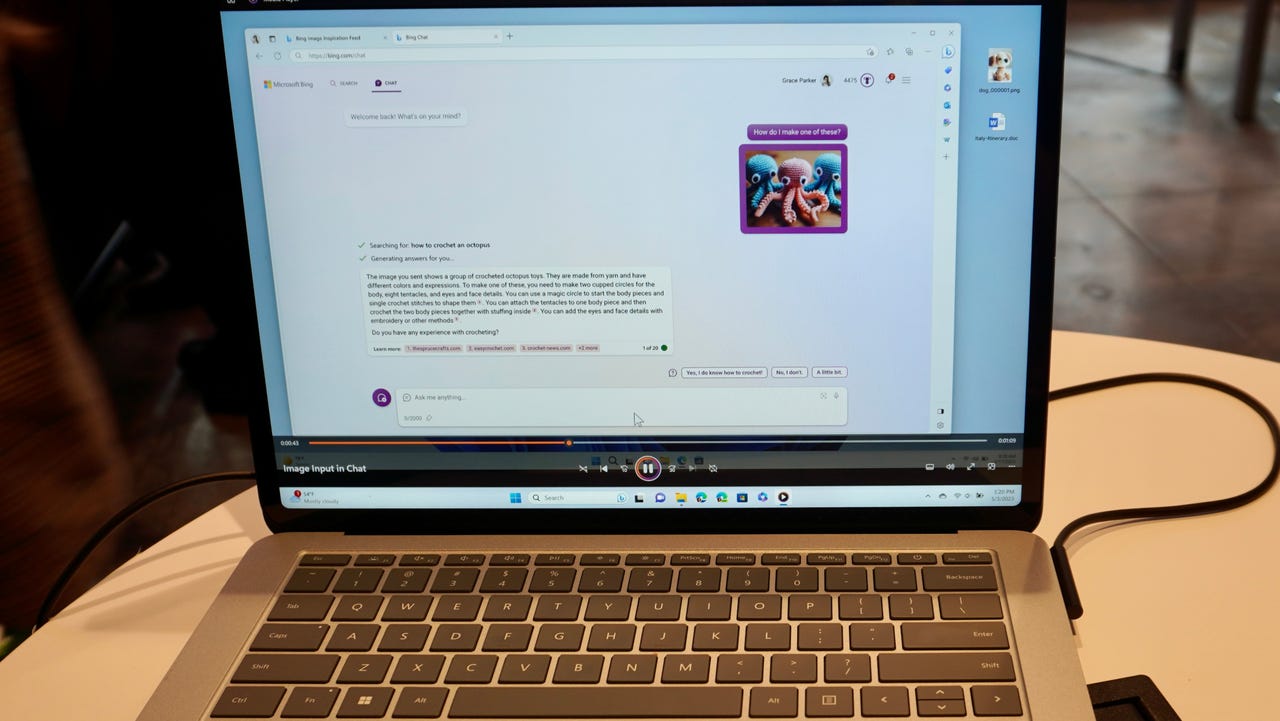
Microsoft's take on AI chatbots, Bing Chat, offers the best chatbot features including internet connectivity, GPT-4, source links and more. Now the technology is moving from a consumer platform to an enterprise one, too.
On Tuesday, Microsoft unveiled Bing Chat Enterprise, an AI-powered chat that is secure and suited for the workplace.
Also: Real-time deepfake detection: How Intel Labs uses AI to fight misinformation
There is no doubt that implementing AI in your workflow can improve your productivity as you could get assistance with idea generation, writing, coding, research, and more. Plus, studies continue to show that workers want to use AI in their careers.
However, security concerns are a major obstacle, as generative AI tools use user-inputted data to further train their models, making the privacy of the data you enter questionable.
Microsoft says that Bing Chat Enterprise provides the assistance the chatbot is known for without compromising business security by providing commercial data protection.
"With Bing Chat Enterprise, user and business data are protected and will not leak outside the organization. What goes in — and comes out — remains protected," according to the press release.
Also: This is how generative AI will change the gig economy for the better
Microsoft also reassures users that the chat data is not saved, no one can view their data, and most importantly the data is not used to train the AI model.
Starting today, Bing Chat Enterprise is rolling out in preview at no additional cost if you have a Microsoft 365 E3, E5, Business Standard, and Business Premium account. However, in the future, it will have a $5 per user fee.
Using your work account, you can access Bing Chat Enterprise anywhere Bing Chat is supported including its site and the Microsoft Edge sidebar.
Meta launches an AI research community, but devotes few resources to it Kyle Wiggers 7 hours
Angling to stay relevant in the exploding AI field, Meta is launching a new organization, the Open Innovation AI Research Community, to foster what it describes as “transparency, innovation and collaboration” among AI researchers.
Initially, the focus of the group will be the privacy, safety and security of large language models such as OpenAI’s ChatGPT; giving input into the refinement of AI models; and setting an agenda for future research. Meta says that it expects its own researchers to participate in the organization, but that the Open Innovation AI Research Community will always be “member-led,” with Meta’s AI R&D group, Meta AI, serving as a “facilitator.”
“The group will become a community of practice championing large open-source foundation models where partners can collaborate and engage with each other, share learnings and raise questions on how to build responsible and safe foundation models,” Meta writes in a blog post. “They’ll also accelerate training of the next generation of researchers.”
Meta intends to sponsor a series of workshops focused on “critical open research questions” and “developing guidelines for responsible open source model development and release.” But details beyond that remain vague. Meta says the Open Innovation AI Research Community might eventually have a website, social channels for collaborating and research submissions to academic conferences, but it doesn’t commit to any of this.
Members of the Open Innovation AI Research Community are presumably on the hook for funding their work. Meta didn’t indicate that it’ll set aside capital or compute for the group’s efforts — in fairness, probably to avoid the perception of undue influence. But that’s a tough sell factoring in the steep expenses associated with AI research.
Frankly, the Open Innovation AI Research Community comes across as performative from a company who’s repeatedly flirted with controversy where AI’s concerned.
Late last year, Meta was forced to pull an AI demo after it wrote racist and inaccurate scientific literature. Reports have characterized Meta’s AI ethics team as largely toothless and the anti-AI-bias tools it’s released as “completely insufficient.” Meanwhile, academics have accused Meta of exacerbating socioeconomic inequalities in its ad-serving algorithms and of showing a bias against Black users in its automated moderation systems.
Will the Open Innovation AI Research Community change all this? It seems unlikely. Meta’s encouraging “professors at accredited universities” with “relevant experience with AI” to participate, but this writer wonders why they would, given the wellspring of open machine learning research communities unaffiliated with any Big Tech company.
Perhaps I’ll be proven wrong. Perhaps Meta’s Open Innovation AI Research Community will indeed deliver on its promise, creating “a set of positive dynamics to foster more robust and representative models.” But I question the sincerity and level of devotion, here, on the part of Meta — particularly considering how few resources have been devoted to the effort from the outset.
The deadline to apply for the Open Innovation AI Research Community is September 10. Meta says that it welcomes applicants from “diverse research disciplines” and “technical capabilities to pursue research,” and that more than one participant from the same university may apply.
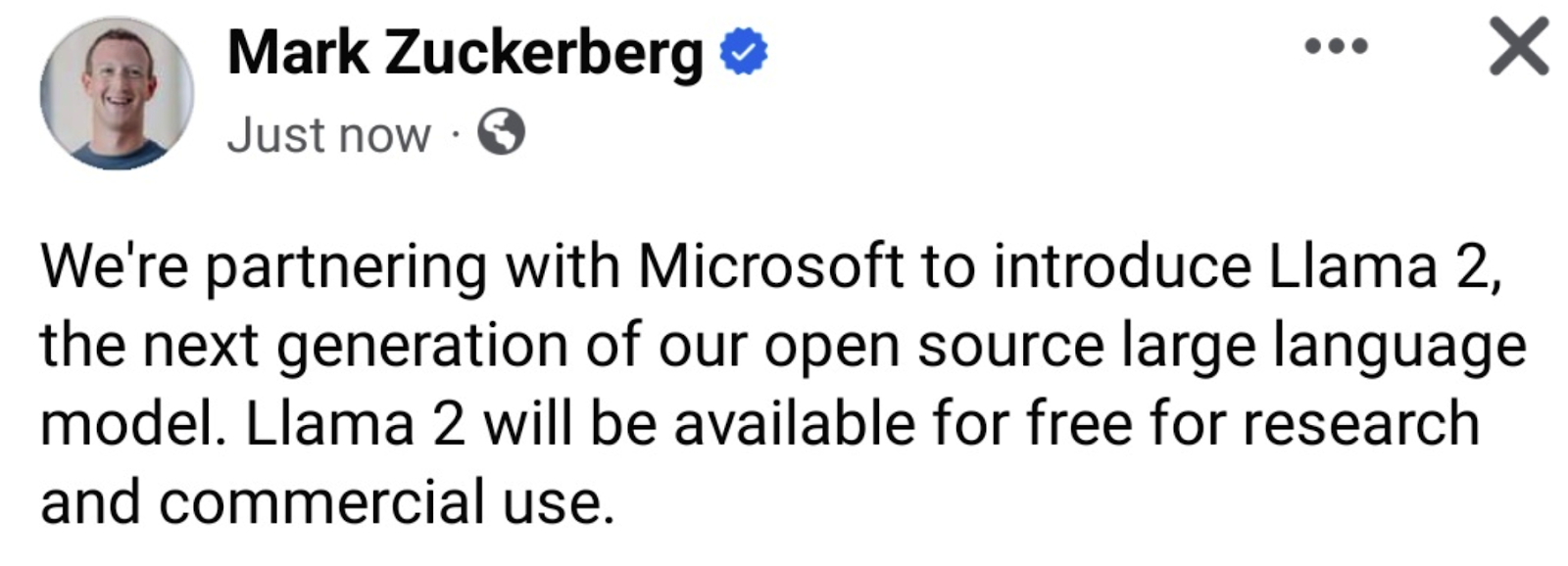
In a groundbreaking announcement today at Microsoft Inspire, Meta and Microsoft announced the release of Llama 2, the cutting-edge iteration of their renowned open source LLM, LLaMa.
The release is now made available as an open-source platform for research as well as commercial use.
Click here to check out the model on Hugging Face.
Building upon the success of the original LLaMA release earlier this year, which was hailed by the open source community, Llama 2 introduces a host of enhancements, bolstering its performance and safety measures. This also includes a fine-tuned model called Llama 2-chat, built for optimised dialogue use cases.
The model will also be available on Microsoft Azure AI model catalog and also accessible to developers on Windows platforms such as Subsystem for Linux (WSL), Windows terminal, Microsoft Visual Studio and VS Code.
This is huge: Llama-v2 is open source, with a license that authorizes commercial use! This is going to change the landscape of the LLM market. Llama-v2 is available on Microsoft Azure and will be available on AWS, Hugging Face and other providers Pretrained and fine-tuned…
— Yann LeCun (@ylecun) July 18, 2023
The highlight of this release is the introduction of the 7B, 13B, and 70B pre-trained and fine-tuned parameter models. Representing a substantial leap forward from its predecessor, Llama 2 incorporates a staggering 40% increase in pre-trained data, harnesses larger context data for training, and leverages GQA (Generalised Question-Answering) to achieve superior inference capabilities for the larger model.
Along with Microsoft, Meta also partnered with Amazon, HuggingFace, NVIDIA, Qualcomm, IBM, Zoom, Dropbox as well as a number of academic leaders from around the world to release the model highlighting the importance of open source software.
The paper highlights how the model is trained on publicly available data sources. Interestingly, the company also highlights that this does not include data from Meta’s products or services. “We made an effort to remove data from certain sites known to contain a high volume of personal information about private individuals,” said the researchers.
Read: The Biggest Winner from Threads: LLaMA
The fine-tuned Llama 2-Chat models have undergone meticulous optimisation for dialogue purposes. Employing a combination of supervised fine-tuning and multiple RLHF (Reinforcement Learning from Human Feedback) methods, including rejection sampling and PPO (Proximal Policy Optimization), the Llama 2 models have been enriched with over 1 million annotation points. This approach ensures enhanced interactions and responses in dialogues, setting new benchmarks in the field.
LLaMA2 Live Demo: pic.twitter.com/tJEuASN5ZB
— Marco Mascorro (@Mascobot) July 18, 2023
With rigorous evaluation against human and academic benchmarks across both closed and open alternatives, the Llama 2 model demonstrates an unparalleled level of competitiveness. Researchers and developers can now harness its formidable capabilities for a wide array of applications and projects, revolutionising the future of language processing and understanding.
Meta’s release of Llama 2 marks a significant step towards advancing the boundaries of AI research and its accessibility to the wider community. By making Llama 2 open source and available for commercial use, Meta fosters collaboration, inspiring further innovation, and opening the doors to new possibilities in the realm of generative AI.
The post Meta Partners with Microsoft to Release Llama-2 appeared first on Analytics India Magazine.
Within a week of collaborating with Associated Press (AP), one of the biggest news agency in the US, OpenAI is now out with their biggest partnership with any media organisation. Announcing over a $5 million partnership with American Journalism Project (AJP) , and another $5 million through API credits for its grantee organisations, a total of over $10 million will be invested by Sam Altman-led OpenAI. The partnership is said to explore ways to develop AI to support local news and in the process OpenAI will indirectly tie up with 41 news agencies that AJP supports.
Following the line of collaborating with not-for-profit news agency AP, OpenAI’s collaboration with non-profit media continues. Associated Journalism project is a venture philanthropy that invests in developing nonprofit newsrooms and through the OpenAI partnership, the organisation is looking at ways to enhance local newsrooms with AI technologies. AJP will use the funding to build an AI studio for training their portfolio organisations and leverage AI tools at their discretion.
Capturing Local Media Market
Following the ‘big fish in a small pond’ philosophy, OpenAI is slowly building a grasp over media through the smaller players. By collaborating with AJP, it has indirectly partnered with 41 non profit news establishments in the US. Foregoing major news outlets for the time being, OpenAI is growing their data pool through the local market. By gaining access to local news across the country, the company is building a strong foothold in relevancy.
Through AP collaboration, where OpenAI will gain access to news and information dating back to 1985 to current news, through AJP, the reach is to refine the news information through local players.
Why the Media Obsession?
In an earlier interview, when asked a hypothetical question, of what Altman will do if he had to run a large news media in a country like India, he said that he has heard from journalists and reporters that his product has helped them execute their boring parts of their job better allowing them to spend time on reporting and thinking of ideas. Therefore, he would encourage everyone to use it.
As a prelude to what is happening now, OpenAI is in fact pushing for product adoption across media outlets. But, what is OpenAI gaining from it? In the process, the company is not only addressing the gap of providing real-time data, but also evading future legal troubles.
The partnership comes at a time when the regulatory authorities are introspecting OpenAI’s actions. In spite of being a crusader of AI safety at senate hearings and formulating plans for democratising AI, OpenAI has not been able to evade the regulatory bodies. The FTC (federal trade commission) recently opened an expansive investigation into OpenAI’s activities over risks of leaking personal data. OpenAI was sent a document detailing concerns over the company’s products including information of third-parties using its API.
OpenAI’s partnership with news agencies also safeguards training content. With publishers and microblogging platforms such as Twitter, Reddit and Stack Overflow restricting content from being scraped, training of AI models will become increasingly difficult considering how people are filling websites with AI-generated junk. By collaborating with news agencies, OpenAI will have unhindered access to historical as well as real-time data that can be freely used for training their future models.
By partnering with news companies, OpenAI is setting a safe path for third party accountability. Associated Press and American Journalism Project, might just be the beginning of media control.
The post After AP News, OpenAI Craves for More News Agencies for Real-Time Data & Avoid Legal Tussle appeared first on Analytics India Magazine.