Sepp Hochreiter’s Quest to Kick OpenAI from Language Modelling Supermarket

Same as humans, AI models do not restart learning from scratch every second. Instead a certain type of neural network adds loops that interpret each new observation along with what has been previously observed.

In the AI field, LSTM (Long Short Term Memory) remarkably improved these networks, leading to a leap in accuracy. The model was developed by Dr. Sepp Hochreiter along with German scientist Juergen Schmidhuber in the late 90s.

“As a successor of LSTM. We have a new thing. It’s not published, it’s hidden. It’s called XLSTM,” revealed Prof. Josef “Sepp” Hochreiter in an exclusive interview with AIM. The German computer scientist is currently the head of the machine learning Institute at Johannes Kepler University in Linz.
Hochreiter along with his team is feeding every transformer right now on smaller datasets combined with LSTMs. “We are so much better than GPT and want to kick OpenAI from the supermarket in autoregressive language modelling,” he said excitedly.

From being just another start up in the Silicon Valley, the Sam Altman led OpenAI has gained fame since the release of its cash cow ChatGPT chatbot. According to Reuters, OpenAI is estimated to reach $1 billion in revenues by 2024, hence the company is being supported by the market.

Transformer, Not (Convincing) Enough

Before LSTM became an integral part of language models, its application in reinforcement learning was fascinatingly successful in Deepmind’s Starcraft 2 and OpenAI’s Dota 2.

Hochreiter said, “What was more surprising was how good it is for language because it was not taught for language. It was time series prediction and sequence analysis.” Before the model became popular he also used it for protein sequences of DNA sequences.

The 55-year-old professor believes focusing on language is good because language already has abstractions as humans invented words, for objects we see in the real world. “These concepts, classes, and abstraction always come from humans and I’m looking forward to seeing AI invent their own concepts, description of servers and answer their own abstractions,” he added.

Today, apart from being the model that makes Alexa, Siri, and Cortana so smart, LSTM is being used by government authorities across the world for predicting floods and droughts. Hochreiter says he is not convinced that transformer technology is applicable everywhere. “I think for some engineering tasks, LSTMs interact design with conventional architectures with a better sense of new things,” he opined.

GPT Problems

The training data behind some of the largest, biggest language models remain a mystery. Hochreiter pointed out that some regulations are coming like LAION initiative to create datasets, without content which should not be used for training. “It’s a very complicated thing because different cultures would say a few different things as being appropriate or not appropriate. So that’s one problem,” he said.

He further elaborated, “You’re not allowed to use certain books in training, OpenAI was naive because they used all the data, and perhaps the lawsuits are coming soon. The more data you have, the better your model later becomes, but you have to be careful what you file to summarise and select what content is allowed.”
The heap of accusations against the tech companies have been on a rise since the introduction of generative AI tools like Midjourney and ChatGPT. The latest addition to the list is American author and comedian Sarah Silverman.

“In language models, what you put in, comes out at the other end. The first thing is to have some rules about what it can say,” said Hochreiter while the regulators worldwide grapple with the legal grey area AI is in.

The Backstory

The young Hochreiter from Munich initially found computer science boring for him until he discovered neural networks. “Everything in computer science was known for 30 years but here, you can do new things, and it was fascinating, unexplored,” he said.

The pioneer of deep learning also discovered the vanishing gradient problem before he proposed LSTMs. “As I wrote my diploma thesis my supervisor moved to the States and was already a postdoc there. When he came back we had a lot to write down and then tried to publish it at NeurIPS in 1995 but got rejected.”

It became a NeurIPS paper in 1997. “Perhaps everybody has something like this,” said Hochreiter as getting a paper accepted can be difficult due to various problems with the current peer-review system. There are many notable papers that had a difficult time getting accepted but ended up significantly impacting the field like PageRank paper, Kalman filter paper and LSTM.

Things changed around 2009 to 2011, where recurrent neural networks became popular again when a student of Schmidhuber, Alex Graves, worked with LSTM. Talking about the sudden popularity his work gained, Hochreiter said,

“It worked out well and all IT giants from Google, Facebook, Meta to Amazon jumped on the bandwagon to use it. Looking back, nobody was interested. I was surprised that it became so popular because I knew from the beginning, it’s working. Also it became much more powerful because of the compute which grows on more data.”

While he develops a rival GPT today, Hochreiter is unsure whether he wants to keep the technology hidden or exploit it money wise as a company. “I published LSTM and didn’t get one cent,” he said.

“I want to see what I can make out of it without publishing. It helps me keep something in Europe, a new technology, which is in the language modelling better sensitivity models, but who knows because I only am working on small datasets. I’ve not been saying much but it’s an LSTM with transformer ideas in it,” he concluded.

The post Sepp Hochreiter’s Quest to Kick OpenAI from Language Modelling Supermarket appeared first on Analytics India Magazine.


Worldcoin’s Eye-Opening Flop in the US

Setting sail on a futuristic world where AGI and super intelligent beings thrive amongst humans, a world where you have to prove yourself to be human – Worldcoins are supposedly out to help you. Using orb-sized devices that once scanned your iris, your biometric is going to be the human identifier needed to survive. As dystopian as the futuristic world sounds, Sam Altman’s Worldcoin is preparing for it. The project is released to the world, but with a catch. The very place where Sam Altman’s Worldcoin was founded, will be deprived of the service. World coins are not available in the US. Surprised?

Worldcoin, an iris biometric cryptocurrency which was founded in 2019 by Sam Altman, Max Nivebdstern, and Alex Bania is backed by VC Andreessen Horowitz. The project provides crypto tokens WLD in exchange for scanning your eyeballs during registration, and aims to distinguish humans from AI online, and enable a global democratic process and increase economic opportunity. While this marks Altman’s foray into cryptocurrency, the company’s access to human assets in the form of biometrics has raised a lot of questions, but that didn’t stop the positive uptick in price of over 17% within 24 hours of its worldwide release. But, an irony ensues.

Not Under My Watch

The biggest irony of all this is that in a country where the latest technology produced by Silicon Valley sees the light of day in their territory first before it reaches the rest of the world, Worldcoin is facing the opposite route. Owing to regulatory restrictions in the cryptocurrency market, the company cannot operate in the country. Following the crypto debacle that occurred with FTX’s Sam Bankman-Fried, US regulatories have been vigilant with its control.

A number of regulatory bodies such as the Securities and Exchange Commision (SEC), the Commodity Futures Trading Commision (CFTC), the Federal Trade Commision (FTC) and many others. However, none of them have banned any form of cryptocurrency in the US. It is possible that Worldcoin is taking a precautionary approach to avoid any form of backlash that can occur.

Though not available for US citizens, the ‘Orb tour’, for educating and answering questions about the same has been set up in Miami, San Francisco and New York City. Altman said that when he started the project, he did not think that it would end up becoming ‘world minus the US coin.’ He doesn’t seem perturbed by the situation – “95% of the world’s population is not in the US. The US does not make or break a project like this.”

Source: Twitter

Coin for the ‘World’

From its beta period, the project has over 2 million users, and has now scaled its operation to 35 cities across 20 countries. One of the strangest occurrences is that a company that is building a digital asset platform using iris scans, has been launched in the EU. The EU, which is believed to be one of the strictest regulatory bodies when it comes to security and privacy, have also allowed Worldcoin. Known for penalising tech companies for using sensitive user data, and even banning apps from operating. For instance, Meta’s Threads was not launched in the EU owing to privacy concerns. Considering how such restrictions have prevented the functionings of big tech in the past, the move to allow Worldcoin there is surprising.

However, it looks like countries are slowly waking up. In a latest development, the regulatory bodies in the UK said that they will be making enquiries about the Worldcoin project. It is possible that other countries may follow.

Route through Developing Markets

In a country such as India, where there are no guidelines or regulations in place for any form of disputes around cryptocurrency, trading will be at an investor’s risk. Hence, the whole operation in India is not under any form of restrictions at the moment. Orb operators are set up across 18 locations in India, including Bengaluru.

It is interesting to note that Worldcoin has been released in a number of developing countries including African countries such as Kenya, Uganda, Nairobi, and Lisbon. These countries do not have any regulatory framework for trading cryptocurrency – giving a free pass for Worldcoin.

World coin not being available in the US sounds like one of those anticlimactic endings, however the company has never ruled out the market. Looks like Altman couldn’t find any way to make it currently happen but nothing seems impossible. After all, even the EU was reportedly influenced to weaken the EU AI Act to reduce the regulatory burden on OpenAI.

The post Worldcoin’s Eye-Opening Flop in the US appeared first on Analytics India Magazine.

The Rotten Side of Apple 

Without any surprises the report about Apple’s own chatbot came out after Meta announced Llama 2 with Microsoft as the preferred partner to launch it on Azure cloud. The partnership must have hit Apple hard. To add to the wound, Meta CEO Zuckerberg even posted a photo with Microsoft CEO Satya Nadella which is a very rare occurrence.

While Apple’s Vision Pro has garnered significant attention in the news, the company has chosen to stay mum on the topic of generative AI. During the second-quarter earnings call on May 4, CEO Tim Cook notably omitted any remarks about artificial intelligence in his prepared opening statements, setting Apple apart from other major tech vendors who frequently discuss AI advancements.

“As you know, we don’t comment on product roadmaps,” Cook commented when questioned by Credit Suisse analyst Shannon Cross about his perspective on generative AI as a whole and how the technology will integrate with Apple’s products

The Bloomberg report contradicts the notion that Apple is shying away from generative AI. As per the report, Apple is putting a lot of effort into advancing AI, and several teams are working together on this project, according to insiders who wish to remain anonymous. They are also actively working to address any privacy concerns related to the technology.

Apple is synonymous with closed ecosystems in the tech industry. Whether it’s their hardware, software, or user experience philosophy, Apple has always advocated for a walled-garden approach, ensuring tight integration between its products and services.

It is known for accessing open source tools without contributing to the development of the technology. Aleksa Gordic, ex-Google DeepMind / Microsoft ML engineer reflecting on the same said that he wished LLaMA 2 license was somehow applicable to fundamental AI research to force Apple to have to publish their internal research.

“They never give anything in return yet benefit enormously from research coming from all the other big tech companies. It just doesn’t feel right.” he added.

I wish Meta's LLaMA 2 licence was somehow applicable to fundamental AI research to force Apple to have to publish their internal research first before they can use other companies' research in their products.
They never give anything in return yet benefit enormously from…

— Aleksa Gordić 🍿🤖 (@gordic_aleksa) July 20, 2023

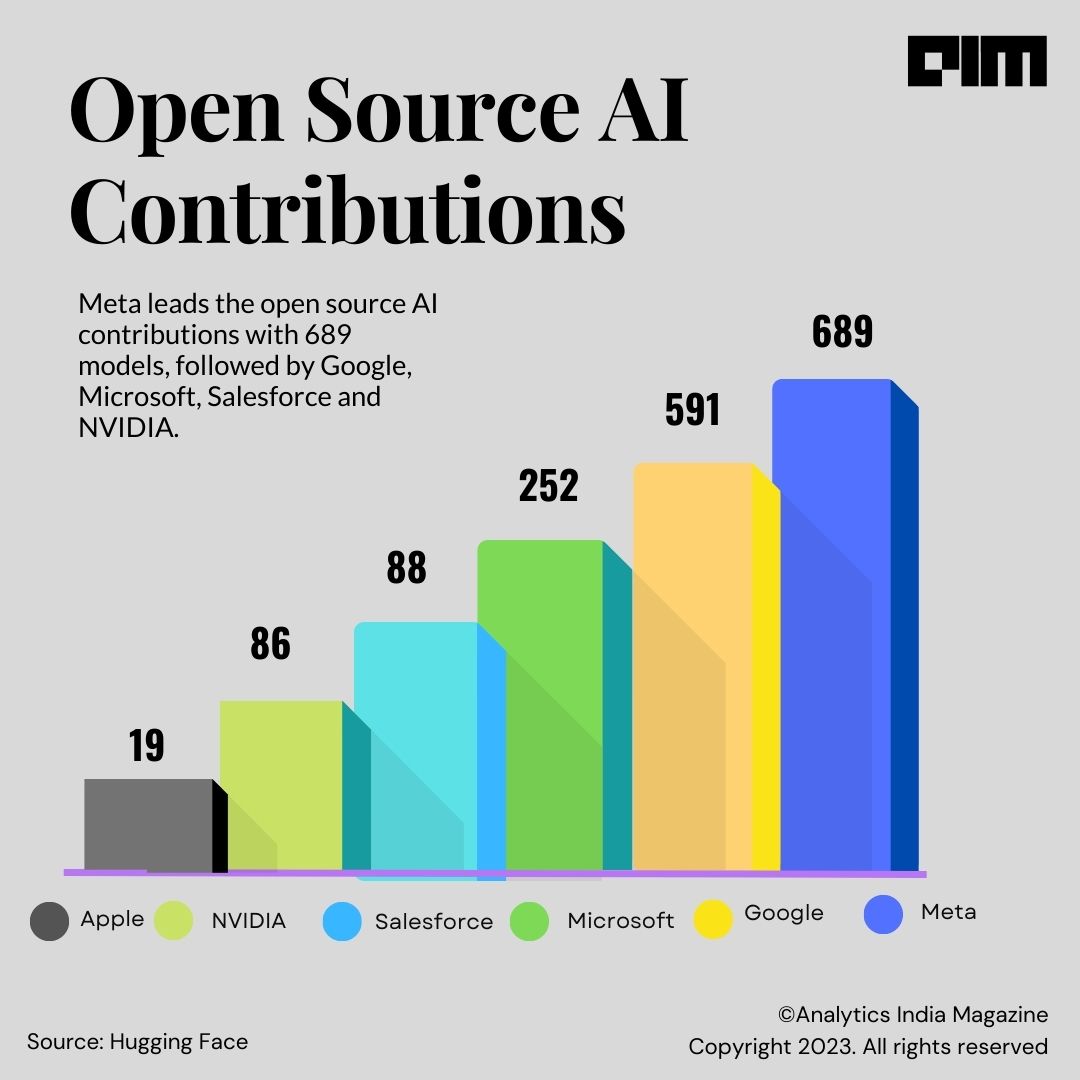
It is quite selfish of Apple to not contribute anything substantial to the open source community According to Hugging Face stats Meta holds the highest number of contributions to the open-source community, followed by Google and Microsoft.

Not Contributing to Open Source Community

The notion of Apple being secretive is not a recent one; it has been ingrained in the company’s culture since the days of Steve Jobs.

This approach, however, has its pros and cons. On one hand, it shows that Apple is dedicated to its customers, creating a private ecosystem that prioritizes confidentiality and doesn’t disclose personal excessive details. This helps Apple to gain customers’ trust with their data. Chatbots are the most lucrative way for any company to gain data. If Apple is able to gain customers’ trust with their Chatbot who knows enterprises might also adopt it as confidentiality is key for them.

However, this raises questions about whether Apple is actively contributing to the tech society. In the technology space, advancements do not occur in isolation; collaboration is essential. Meta has embraced this approach consistently. On the other hand, Microsoft, a crucial partner of OpenAI, has chosen a different route by collaborating with Meta. Microsoft is actively exploring open-source opportunities and acting as a bridge between GPT-4 and Llama 2 to position themselves for future advancements.

Interestingly, Apple’s Ajax system is built on top of Google Jax, the search giant’s machine learning framework and Apple’s system runs on Google Cloud, which the company uses to power cloud services alongside its own infrastructure and Amazon.com Inc.’s AWS.

Also,”GPT,” which stands for “generative pretrained transformer,” was originally coined and developed by Google in 2018. It serves as the foundation for both OpenAI’s ChatGPT and Apple’s GPT. If Apple has taken so much from its competition, they should also pay back to them.

Drawing comparison, OpenAI which started as an open source non-profit company turned into a closed system,capped-profit company in 2020 following the footsteps of Apple. But, now, things seem to be changing. Now even OpenAI is now looking at releasing the weights of its models. In the race of AI advancement, Apple seems to be quietly selfish. It’s time they collaborated and contributed more for the benefit of the AI ecosystem, and not just build the ecosystem around their products and services for its customers.

The post The Rotten Side of Apple appeared first on Analytics India Magazine.

5 Amazing Papers Presented by Meta at ICML 2023

The prestigious International Conference on Machine Learning (ICML) is happening this year in Honolulu, Hawaii. At their 40th anniversary, experts in AI and ML from across the globe have gathered to showcase and release state-of-the-art research concerning all facets of machine learning deployed in closely interconnected domains such as AI, statistics, and data science. Furthermore, they have spotlighted vital application areas like machine vision, computational biology, speech recognition, and robotics. The firs took place in 1980 in Pittsburgh.

Let’s take a look at the papers that big tech Meta presented this year.

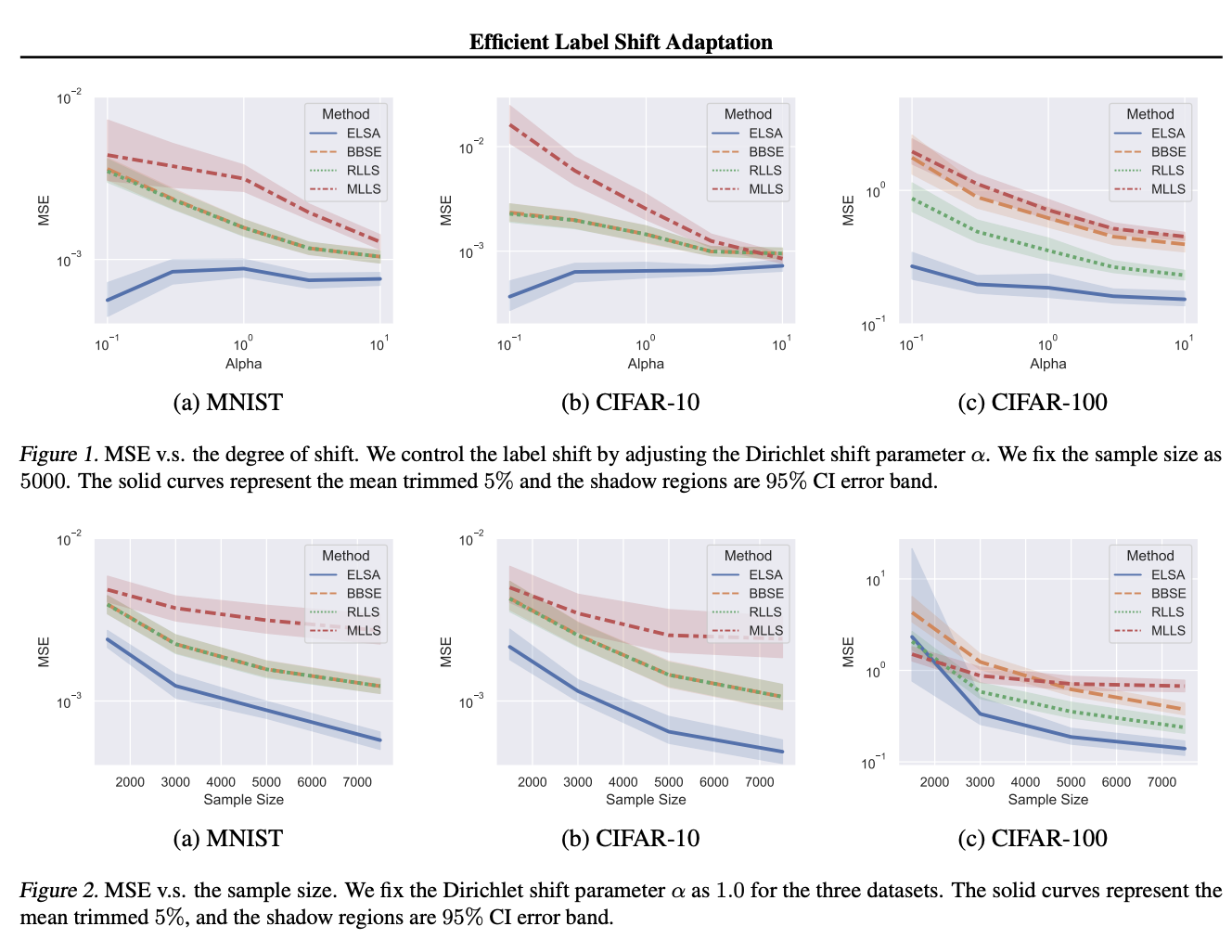
ELSA: Efficient Label Shift Adaptation through the Lens of SemiparametricModels

This study focuses on the problem of domain adaptation with label shift, where the distribution of labels differs between training and testing datasets while the distribution of features remains the same. Existing methods for label shift adaptation have estimation errors or complex post-prediction calibrations. To overcome these issues, the researchers propose a moment-matching framework called Efficient Label Shift Adaptation (ELSA). ELSA estimates adaptation weights by solving linear systems, ensuring accurate and efficient performance without post-prediction calibrations. Theoretical analysis proves its consistency and normality, while empirical results show state-of-the-art performance.

Reward-Mixing MDPs with a Few Latent Contexts are Learnable

This research focuses on episodic reinforcement learning in a type of decision-making process called “reward-mixing Markov decision processes” (RMMDPs). In these processes, at the start of each episode, nature randomly selects a hidden reward model from M choices, and the agent interacts with the system for H time steps. The goal is to learn a policy that maximizes cumulative rewards over H steps for this hidden reward model. The researchers present a new algorithm called EM2, which efficiently finds a nearly optimal policy for any M ≥ 2. They also establish a lower bound on the sample complexity of RMMDPs, showing that high sample complexity in M is unavoidable.

Read more: Meta-Qualcomm Partnership Will Bring Llama 2 to the Masses

Masked Trajectory Models for Prediction, Representation, and Control

Along with UC Berkeley, Georgia Tech and Google Research, Meta AI contributed to this project. Masked Trajectory Models (MTM) are a new way of making decisions step by step. The team takes a sequence of states and actions and try to figure out the sequence by using random parts of it. They learn to be flexible and can do different tasks just by using different parts of the sequence. For example, they can be used as models for predicting future actions, figuring out past actions, or even as a learning agent. In tests, the same MTM network can perform as well as or even better than specialized networks designed for specific tasks. MTM also helps speed up learning in traditional RL algorithms and competes well with specialized offline RL methods in benchmarks.

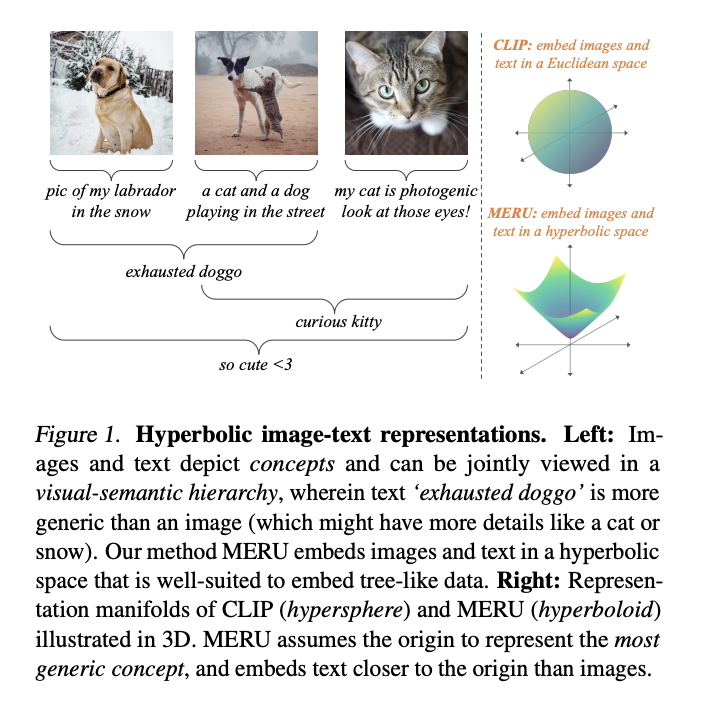
Hyperbolic Image-Text Representations

Meta introduced MERU which helps to organise visual and written ideas in a hierarchy. For example, when we say “dog,” it includes all dog images. Existing models like CLIP don’t explicitly capture this hierarchy. MERU uses hyperbolic spaces, which are good for representing tree-like data, allowing it to better capture the relationships between images and text. Results show that MERU creates a clear and understandable representation while performing as well as CLIP on tasks like image classification and image-text matching.

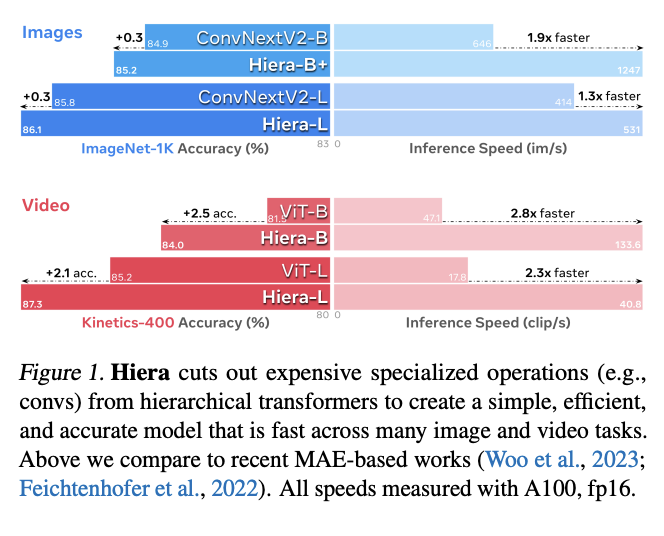
Hiera: A Hierarchical Vision Transformer without the Bells-and-Whistles

Researchers have enhanced vision transformers for supervised classification, but the extra vision-specific elements have made them slower than the original ViT version. This paper introduces Hiera, a simple hierarchical vision transformer. By pretraining it with a strong visual task (MAE), unnecessary complexity is removed while maintaining accuracy. Hiera outperforms previous models, proving to be faster in both training and inference. Its performance is evaluated on various image and video recognition tasks.

Read more: Top 6 Papers Presented by Meta at CVPR 2023

The post 5 Amazing Papers Presented by Meta at ICML 2023 appeared first on Analytics India Magazine.

Materials Nexus raises £2 million seed to discover clean climate material

Materials Nexus raises £2 million seed to discover clean climate material Dominic-Madori Davis 7 hours

Materials Nexus, a deep tech AI and quantum mechanic company, announced Wednesday the close of a £2 million seed round led by Ada Ventures. The National Security Innovation Fund, The University of Cambridge, as well as angel investors Andrew MacKay and Jasmin Thomas also participated in the round.

The company, which was founded in 2020 and based in the U.K., seeks to amplify zero-net technologies, including renewable energy generation and energy storage, in a way that gives higher performance and sustainability at lower costs.

CEO and co-founder Jonathan Bean, a theoretical physicist from the University of Cambridge, and his team worked for the past two years on an AI model that reduces the need to conduct physical tests to discover new materials. This allowed them to build their own datasets and algorithms, accelerating the discovery time, meaning that products could be pushed to the market faster. Materials Nexus works with businesses of all sizes to discover materials that can later be patented, and it hopes to one day build a facility to produce materials to then sell to large companies, like an equipment manufacturer.

Bean says the company plans to use the money to scale its commercial and scientific operations. It’s also hoping to prove the effectiveness of its technology, finding alternatives to materials that are already used in products such as semiconductors and batteries to help innovations like wind turbines and electric cars scale more rapidly and sustainably. In the midst of the AI craze, Bean described his fundraising efforts as “quite fun.”

Bean started looking for capital in October 2022, and said he got a term sheet within five months.

Matt Pennycard, a co-founding partner at Ada Ventures, called Jonathan a “remarkable technical founder and company leader.” “He’s a needle in the haystack that we VCs spend years searching for,” Pennycard told TechCrunch, adding that the company is also an exemplar of using technology for good. “Our strong bet is that Materials Nexus has the potential to play a very significant role in our fight against climate change and be the solution to the damaging addiction to rare earths and unique metal compounds we’ve built.”

With this raise, Bean joins a rare club in the U.K.: the handful of Black people who have been able to raise money. The last official numbers were released in 2020, and it estimated that only around 40 Black founders had ever raised in the U.K., picking up less than 0.4% of venture capital funding in the nation.

Climate change in the U.K. has become a pressing matter, and having diverse perspectives on the issue is imperative for achieving true environmental reform. Bean said he went through the Cambridge database to find people who had experience in materials engineering and called up alumni, asking questions and trying to understand the market.

Bean says his dream is to one day set up operations in the U.S. But for now, there is much work to do in the U.K. After all, someone has to help trail-blaze the “Unicorn Kingdom.”

Why is Sergey Brin Lurking Around Google’s Corridors?

At the beginning of 2023 in January while the Silicon Valley was busy laying off its employees, search giant Google’s co-founder Sergey Brin filed his first request in years for access to code, according to Forbes. Last week, the Wall Street Journal reported, Brin has been helping the IT giant work on its AI capabilities since it has not been able to stay up to the mark since its LaMDa fiasco in the summer of 2022.

Brin and fellow cofounder Larry Page were first called on for support in December 2022 after the release of OpenAI’s ChatGPT. The former executives got involved when the current CEO Sundar Pichai issued a “code red” upending existing plans and jump-starting A.I. development The New York Times reported. Since then the company rolled out 100 AI-powered features and devices at the Google I/O alone but it still has no strong contender in the ongoing AI race which has shaken the IT behemoths out of their routine. The company’s entrant Bard has not been able to impress the users and has been labeled ‘dry’ and ‘worse than ChatGPT’

Since stepping back from the company’s day-to-day responsibilities in 2019, this is the first time Brin has been frequently visiting the headquarters in Mountain-view. His re-engagement underscores how seriously the tech company is taking the looming threat from OpenAI and others. Brin has been reportedly working with AI researchers on secret AI project Gemini. Pichai is “excited” and has offered “encouragement” to Brin for his involvement with the company’s AI research.

Not a Wartime CEO

While Pichai has been called the pinnacle of peacetime CEO, by the venture capitalist Ben Horowtiz in 2011, he has been facing criticism about his leadership in the recent past. The company employees went directly after Pichai, referring to him, announcing Bard as, “rushed,” “botched” and “un-Googley”. The Paris event in February hit the company on the heels, with plummeting stocks resulting in a $100 billion expense.

During the same period, popular AI researchers at Google like Hyung Won Chung, Jason Wei, Shane Gu, and others decided to turn their back on the IT company and joined Sam Altman led OpenAI.

The departures, plummeting stock and rising popularity of OpenAI’s chatbot made several experts question Pichai’s leadership as a wartime CEO. But this is not the first time Pichai has weathered this type of criticism. Google executives have long grumbled about his apparent aversion for risk and slow decision-making, according to a New York Times profile in 2021. At the time, Google defended Pichai by noting that internal surveys about his leadership were positive. But the rising whispers of Googler’s annoyance states otherwise.

Brin’s AI vision

In 2002, Larry Page said, “Google will fulfil its mission only when its search engine is AI-complete”. Taking his fellow co-founder’s vision forward Brin has been actively working in the company’s AI operations. Even with a lengthy, exhaustive list of AI offerings the company has not been able to release a product convincing enough. In 2016, a few months after Pichai became the company’s CEO, he proclaimed: Google, whose name had become synonymous with search, would now be an “AI-first” company. Seven years later, with AI being the centre of every new product being released, it’s high time for Pichai to take his words seriously. The company which should have dominated the field seems to have been beaten by new entrants like OpenAI.

The company has yet to make a big splash as huge expectations are attached to its name. The company is taking a ‘Bold’ and ‘Responsible’ approach with the recent updates in Bard and other products. With Brin lurking the doors of the headquarters, its AI research is in safe hands.

The post Why is Sergey Brin Lurking Around Google’s Corridors? appeared first on Analytics India Magazine.

Mastering GPUs: A Beginner’s Guide to GPU-Accelerated DataFrames in Python

Partnership Post

If you’re working in python with large datasets, perhaps several gigabytes in size, you can likely relate to the frustration of waiting hours for your queries to finish as your CPU-based pandas DataFrame struggles to perform operations. This exact situation is where a pandas user should consider leveraging the power of GPUs for data processing with RAPIDS cuDF.

RAPIDS cuDF, with its pandas-like API, enables data scientists and engineers to quickly tap into the immense potential of parallel computing on GPUs–with just a few code line changes.

If you’re unfamiliar with GPU acceleration, this post is an easy introduction to the RAPIDS ecosystem and showcases the most common functionality of cuDF, the GPU-based pandas DataFrame counterpart.

Want a handy summary of these tips? Follow along with the downloadable cuDF cheat sheet.

Leveraging GPUs with cuDF DataFrame

cuDF is a data science building block for the RAPIDS suite of GPU-accelerated libraries. It is an EDA workhorse you can use to build allowing data pipelines to process data and derive new features. As a fundamental component within the RAPIDS suite, cuDF underpins the other libraries, solidifying its role as a common building block. Like all components in the RAPIDS suite, cuDF employs the CUDA backend to power GPU computations.

However, with an easy and familiar Python interface, cuDF users don't need to interact directly with that layer.

How cuDF Can Make Your Data Science Work Faster

Are you tired of watching the clock while your script runs? Whether you're handling string data or working with time series, there are many ways you can use cuDF to drive your data work forward.

  • Time series analysis: Whether you're resampling data, extracting features, or conducting complex computations, cuDF offers a substantial speed-up, potentially up to 880x faster than pandas for time-series analysis.
  • Real-time exploratory data analysis (EDA): Browsing through large datasets can be a chore with traditional tools, but cuDF's GPU-accelerated processing power makes real-time exploration of even the biggest data sets possible
  • Machine learning (ML) data preparation: Speed up data transformation tasks and prepare your data for commonly used ML algorithms, such as regression, classification and clustering, with cuDF's acceleration capabilities. Efficient processing means quicker model development and allows you to get towards the deployment quicker.
  • Large-scale data visualization: Whether you're creating heat maps for geographic data or visualizing complex financial trends, developers can deploy data visualization libraries with high-performance and high-FPS data visualization by using cuDF and cuxfilter. This integration allows for real-time interactivity to become a vital component of your analytics cycle.
  • Large-scale data filtering and transformation: For large datasets exceeding several gigabytes, you can perform filtering and transformation tasks using cuDF in a fraction of the time it takes with pandas.
  • String data processing: Traditionally, string data processing has been a challenging and slow task due to the complex nature of textual data. These operations are made effortless with GPU-acceleration
  • GroupBy operations: GroupBy operations are a staple in data analysis but can be resource-intensive. cuDF speeds up these tasks significantly, allowing you to gain insights faster when splitting and aggregating your data

https://www.nvidia.com/en-us/ai-data-science/resources/hardware-software-process-book/?nvid=nv-int-tblg-423746#cid=dl13_nv-int-tblg_en-us

Familiar interface for GPU processing

The core premise of RAPIDS is to provide a familiar user experience to popular data science tools so that the power of NVIDIA GPUs is easily accessible for all practitioners. Whether you’re performing ETL, building ML models, or processing graphs, if you know pandas, NumPy, scikit-learn or NetworkX, you will feel at home when using RAPIDS.

Switching from CPU to GPU Data Science stack has never been easier: with as little change as importing cuDF instead of pandas, you can harness the enormous power of NVIDIA GPUs, speeding up the workloads 10-100x (on the low end), and enjoying more productivity — all while using your favorite tools.

Check the sample code below that presents how familiar cuDF API is to anyone using pandas.

import pandas as pd  import cudf  df_cpu = pd.read_csv('/data/sample.csv')  df_gpu = cudf.read_csv('/data/sample.csv')

Loading data from your favorite data sources

Reading and writing capabilities of cuDF have grown significantly since the first release of RAPIDS in October 2018. The data can be local to a machine, stored in an on-prem cluster, or in the cloud. cuDF uses fsspec library to abstract most of the file-system related tasks so you can focus on what matters the most: creating features and building your model.

Thanks to fsspec reading data from either local or cloud file system requires only providing credentials to the latter. The example below reads the same file from two different locations,

import cudf  df_local = cudf.read_csv('/data/sample.csv')  df_remote = cudf.read_csv(      's3://<bucket>/sample.csv'      , storage_options = {'anon': True})

cuDF supports multiple file formats: text-based formats like CSV/TSV or JSON, columnar-oriented formats like Parquet or ORC, or row-oriented formats like Avro. In terms of file system support, cuDF can read files from local file system, cloud providers like AWS S3, Google GS, or Azure Blob/Data Lake, on- or off-prem Hadoop Files Systems, and also directly from HTTP or (S)FTP web servers, Dropbox or Google Drive, or Jupyter File System.

Creating and saving DataFrames with ease

Reading files is not the only way to create cuDF DataFrames. In fact, there are at least 4 ways to do so:

From a list of values you can create DataFrame with one column,

cudf.DataFrame([1,2,3,4], columns=['foo'])

Passing a dictionary if you want to create a DataFrame with multiple columns,

cudf.DataFrame({        'foo': [1,2,3,4]      , 'bar': ['a','b','c',None]  })

Creating an empty DataFrame and assigning to columns,

df_sample = cudf.DataFrame()  df_sample['foo'] = [1,2,3,4]  df_sample['bar'] = ['a','b','c',None]

Passing a list of tuples,

cudf.DataFrame([        (1, 'a')      , (2, 'b')      , (3, 'c')      , (4, None)  ], columns=['ints', 'strings'])

You can also convert to and from other memory representations:

  • From an internal GPU matrix represented as an DeviceNDArray,
  • Through DLPack memory objects used to share tensors between deep learning frameworks and Apache Arrow format that facilitates a much more convenient way of manipulating memory objects from various programming languages,
  • To converting to and from pandas DataFrames and Series.

In addition, cuDF supports saving the data stored in a DataFrame into multiple formats and file systems. In fact, cuDF can store data in all the formats it can read.

All of these capabilities make it possible to get up and running quickly no matter what your task is or where your data lives.

Extracting, transforming, and summarizing data

The fundamental data science task, and the one that all data scientists complain about, is cleaning, featurizing and getting familiar with the dataset. We spend 80% of our time doing that. Why does it take so much time?

One of the reasons is because the questions we ask the dataset take too long to answer. Anyone who has tried to read and process a 2GB dataset on a CPU knows what we’re talking about.

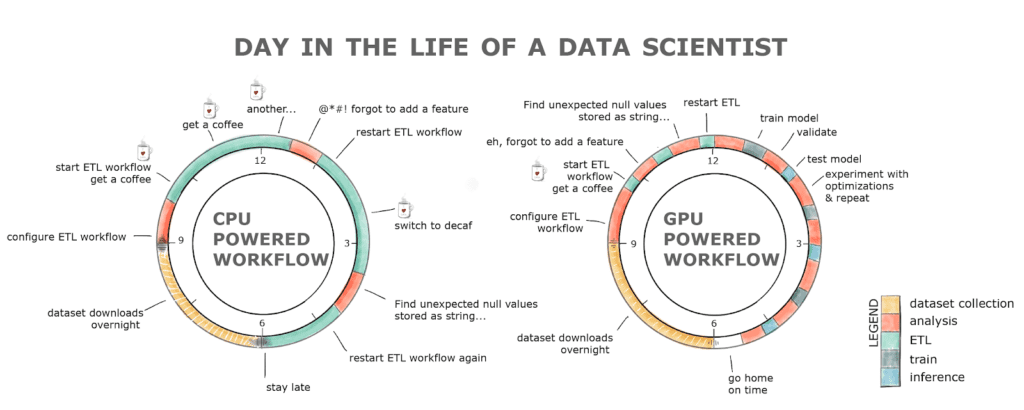
Additionally, since we’re human and we make mistakes, rerunning a pipeline might quickly turn into a full day exercise. This results in lost productivity and, likely, a coffee addiction if we take a look at the chart below.

Diagram comparing a data scientist’s daily workload when using GPU acceleration versus CPU power
Figure 1. Typical workday for a developer using a GPU- vs. CPU-powered workflow

RAPIDS with the GPU-powered workflow alleviates all these hurdles. The ETL stage is normally anywhere between 8-20x faster, so loading that 2GB dataset takes seconds compared to minutes on a CPU, cleaning and transforming the data is also orders of magnitude faster! All this with a familiar interface and minimal code changes.

Working with strings and dates on GPUs

No more than 5 years ago working with strings and dates on GPUs was considered almost impossible and beyond the reach of low-level programming languages like CUDA. After all, GPUs were designed to process graphics, that is, to manipulate large arrays and matrices of ints and floats, not strings or dates.

RAPIDS allows you to not only read strings into the GPU memory, but also extract features, process, and manipulate them. If you are familiar with Regex then extracting useful information from a document on a GPU is now a trivial task thanks to cuDF. For example, if you want to find and extract all the words in your document that match the [a-z]*flow pattern (like, dataflow, workflow, or flow) all you need to do is,

df['string'].str.findall('([a-z]*flow)')

Extracting useful features from dates or querying the data for a specific period of time has become easier and faster thanks to RAPIDS as well.

dt_to = dt.datetime.strptime("2020-10-03", "%Y-%m-%d")  df.query('dttm <= @dt_to')

Empowering Pandas Users with GPU-acceleration

The transition from a CPU to a GPU data science stack is straightforward with RAPIDS. Importing cuDF instead of pandas is a small change that can deliver immense benefits. Whether you're working on a local GPU box or scaling up to full-fledged data centers, the GPU-accelerated power of RAPIDS provides 10-100x speed improvements (at the low end). This not only leads to increased productivity but also allows for efficient utilization of your favorite tools, even in the most demanding, large-scale scenarios.

​​RAPIDS has truly revolutionized the landscape of data processing, enabling data scientists to complete tasks in minutes that once took hours or even days, leading to increased productivity and lower overall costs.

To get started on applying these techniques to your dataset, read the accelerated data analytics series on NVIDIA Technical Blog.

Editor’s Note: This post was updated with permission and originally adapted from the NVIDIA Technical Blog.

More On This Topic

  • A Beginner’s Guide to Web Scraping Using Python
  • Making Predictions: A Beginner's Guide to Linear Regression in Python
  • Merging Pandas DataFrames in Python
  • Super Charge Python with Pandas on GPUs Using Saturn Cloud
  • A Beginner's Guide to Q Learning
  • A Beginner's Guide to the CLIP Model

AI-generated news anchors are making headlines in India

Lisa

Meet ' Lisa', an AI-generated news anchor for OTV News in India.

Roll over, Walter Cronkite.

The TV news anchor is a time-tested tradition for providing some degree of comfort to the business of delivering our daily dose of headlines. We wake up each day to a familiar morning news anchor and go to bed each night with the evening news delivered by another familiar face. But as AI threatens to take over many of today's jobs, how safe is the news reader's position? One network in India is trying to answer that.

Odisha TV, a news channel and digital platform from India, recently tested out Lisa, an AI-generated news anchor. With a monotone voice and eyes that don't quite close when they blink, Lisa reads the news headlines for the network periodically, and she's not alone.

Also: Bing AI chat expands to Chrome and Safari for select users

According to the South China Morning Post, Lisa is one of two multilingual chatbots that have been added to news networks in India in the past three months. Sana, the other AI-generated news anchor, 'works' for the network Aaj Tak, owned by the India Today group.

AI-generated news anchor Sana reads the headlines for Aaj Tak.

Though the developers employ some subtleties to make the anchors appear more human, the result tends to trigger uncanny valley reactions. Sana often shifts from one foot to the other, and Lisa folds her hands and rearranges her fingers uncomfortably — actions that — on their own — would feel "normal" in a human being. Still, the repetitiveness of the AI bots' movements, combined with their monotone voices and unnatural facial expressions, creates the eerie feeling that you're watching something unnatural.

But Lisa and Sana are always available, never sick or tired, don't go on strike or PTO, and won't age. Still, India Today and Odisha TV claim that they have not added these AI chatbots to replace their human counterparts but rather to complement them by taking over repetitive and mundane tasks.

Also: You can now chat with a famous AI character on Viber. Here's how

Currently, Sana and Lisa are tasked with reading the headlines during a broadcast or news program and handing them over to a human presenter. Sana, however, is being trained to conduct debates with human and AI panelists.

Reception of the AI-generated news anchors has been mixed. Supporters encourage the networks' embrace of new technologies, the ability to provide news faster during elections and other critical times, and the language diversity. In contrast, naysayers oppose artificial intelligence replacing people and the lack of human nuances.

Also: Singapore looks for generative AI use cases with sandbox options

Here's another ethical conundrum: The racial and sexist discrimination that can result when human beings create AI bots in their own image. As network executives decide every physical aspect of an anchor's appearance, there's a real possibility for the arbitrary exclusion of different ethnic groups or physical features.

Artificial Intelligence

The official ChatGPT app for Android finally launches

The official ChatGPT app in Google Play

Android users who want some AI-infused help can now snag the official ChatGPT app for their phones and tablets. Following news on Friday that OpenAI's ChatGPT app would arrive for Android this week, the program landed in the Google Play store today, free to use just like the iOS edition.

In a tweet, OpenAI confirmed the app's Android debut, noting that it's available for download in the U.S., India, Bangladesh, and Brazil with plans to expand to other countries over the next week.

Also: How to use ChatGPT: Everything you need to know

With this new release, ChatGPT is now accessible on iPhones, iPads, and Android devices as well as on the website. The experience is similar across all those platforms, though the Android app sprinkles in a couple of bonus features just like the iOS flavor.

In the app, you can type your request and then ask follow-up questions to pursue the same topic. Otherwise, simply tap the + icon at the top to start a new chat.

You're also able to speak your request. Just tap the microphone icon in the Message field, dictate your question or request, and then tap the circle when you're done. Your speech is transcribed into text for you to submit.

The app keeps track of all your chats on the website and across your mobile devices. To access a previous chat, just tap the hamburger icon at the top and select History. You're able to browse through your past chats or search for a specific one by keyword. Tap any chat to display it.

With a chat on the screen, tap the three-dot icon at the right and you can delete it or rename it.

Like the website and iOS version, the Android app is geared toward both free ChatGPT users and those with a paid ChatGPT Plus subscription. At the top of the screen, subscribers just tap GPT-3.5 or GPT-4 depending on which mode they want to use. GPT-4 offers several advantages over its predecessor, including better training, longer memory, and greater multi-language proficiency.

From the Android app's hamburger icon, you can access the Settings menu where you're able to export your chat data into a viewable HTML file, clear your chat history, and even delete your account. You can also change the color scheme, switch the default language, and access help information.

Also: The 10 best ChatGPT plugins right now

The popularity of AI has led to a slew of third-party apps both for iOS and Android, most of them powered by OpenAI's ChatGPT model. However, many of them are freemium apps. That means you get a limited number of chats for free and then have to shell out money for a subscription if you want more. OpenAI's official mobile apps are fully free, so you can keep chatting throughout the day without having to cough up more cash.

Artificial Intelligence

AI Startups Are Where You Should Look For New Jobs

A hand holding up a job search bar.
Image: zakokor/Adobe Stock

Picking yourself up after a confidence knock, be it professional or personal, is no easy feat.

And in the wake of this year’s onslaught of tech layoffs — nearly 400,000 tech professionals have been let go since 2022 — this has never been more apparent for those working within the sector.

For every 100 tech professionals laid off since the start of 2023, 13 have channeled their energy into starting their own company. Of this 13%, software developers are the most entrepreneurial at 9%, followed by engineering managers and product managers.

It seems certain companies are better than others at fostering an entrepreneurial spark and planting the startup seed, and former employees of Meta are the most likely to start their own business — three of every four former Meta staffers have gone on to launch their own company.

This trend is followed by former DoorDash employees at 30%, Amazon at 25%, Flexport at 24%, Twitter at 16% and Shopify at 15%.

However, it’s also worth noting that nearly half (44.4%) of these startups were started by people who were at manager or director level, and those with the longest work experience and most developed skills are more likely to launch a business after being laid off.

Aside from knee-jerk reactions to layoffs, the post-pandemic landscape has seen over five million startups launch in 2022 in the U.S., despite a decline in funding after 2021’s record year which saw VCs invest $624 billion.

It seems function is proving to be the most successful metric when it comes to those that succeed versus those that don’t, as David Eli, chief executive officer of StartupBlink suggests in its Startup Ecosystem Report 2023.

“The startup ecosystem is going through a cycle of cleaning; ‘vitamin’ startups that provide luxury are out, and ‘aspirin’ startups that reduce real pain are getting the attention they deserve. Some of the world’s most successful startups were born in a period when easy funding was not available, and we expect the same to happen in this period as well.”

And for those who want to transition from big tech to a startup, but don’t want to make the leap themselves, the good news is that the hiring landscape is ripe with opportunities, especially when it comes to startups that are focused on AI and machine learning technology.

The World Economic Forum’s The Future of Jobs Report 2023 found that 50% of organizations expect AI to create job growth and AI is expected to be adopted by nearly 75% of surveyed companies.

Separate data predicts that AI is expected to create 133 million new jobs globally, so if you’re hoping to pivot to a career in AI, now is the time and the TechRepublic Job Board is the perfect place to start your search as it features thousands of jobs in startups that are currently hiring.

Below we’re profiling three that are making waves and expanding at a rapid pace thanks to investment and funding.

Cohere

Backed by Nvidia and Salesforce, generative AI startup Cohere was founded by ex-Google Brain employees, Aidan Gomez and Nick Frosst along with Ivan Zhang in 2019. It recently raised $270 million in a Series C round of VC investment, having previously raised $175 million. Cohere provides natural language processing models to help companies improve human-machine interactions and already works with Google Cloud.

Anthropic

Founded in 2021 and focused on increasing the safety and transparency of AI and increasing the reliability of machine learning models, Anthropic recently secured $450 million in May. They hope to grow its product offering accordingly, which currently includes a next-generation AI assistant named Claude. Backed by companies including Google and Zoom, Claude is currently available as a Slack plugin in beta and Zoom.

Adept

Can anyone rival OpenAI’s record-breaking success? Adept is hoping to with its AI-system ACT-1 that translates text prompts into actions on the software that you use every day. For example, it can organize your expenses into a spreadsheet, create profit and loss calculations and even follow up on emails, just like a real-life assistant would. Founded in 2021, this startup has raised $350 million as part of its Series B funding round.

Accelerate your career today via the TechRepublic Job Board

By Aoibhinn McBride

Person using a laptop computer.

Subscribe to the Daily Tech Insider Newsletter

Stay up to date on the latest in technology with Daily Tech Insider. We bring you news on industry-leading companies, products, and people, as well as highlighted articles, downloads, and top resources. You’ll receive primers on hot tech topics that will help you stay ahead of the game.

Delivered Weekdays Sign up today