After WormGPT, FraudGPT Makes it Easier for Cybercriminals

Recently, Netenrich security researcher Rakesh Krishnan in a blog reported that they found evidence of a model called FraudGPT.

FraudGPT has been circulating in darknet forums and Telegram channels since July 22, 2023, and is available through subscription at a cost of $200 per month, $1,000 for six months, or $1,700 for a year.

The LLM that this model is based on, is unidentified, however, the author claims that it has garnered more than 3,000 confirmed sales and reviews. The actor behind this tool goes by the alias CanadianKingpin and claims that FraudGPT can be used to write malicious code, create undetectable malware, find leaks, and identify vulnerabilities.

The ease of access to Generative AI Models has allowed individuals with limited technical knowledge to carry out tasks which were beyond their capabilities, increasing efficiency and reducing costs. With the advent of Large Language Models into the mainstream, a lot of use cases emerged.

However, the threat landscape has changed drastically as well. All the anxiety has materialised into a new threat—malicious actors providing ‘phishing as a service’. While cyber-criminals were previously equipped with sophisticated coding and hacking skills, these new tools are available to all and could act as a launchpad for inexperienced attackers. This not only increases the threat but scales it manifold.

What is FraudGPT Capable of?

Cybercriminals can use FraudGPT, and its features include generating malicious code to exploit vulnerabilities in computer systems, applications, and websites. Additionally, it can create undetectable malware, evading traditional security measures and making it difficult for antivirus programs to detect and remove threats.

Another capability of FraudGPT is the identification of Non-Verified by Visa (Non-VBV) bins, allowing hackers to conduct unauthorised transactions without extra security checks. Moreover, the tool can automatically generate convincing phishing pages, which mimic legitimate websites, increasing the success rate of phishing attacks.

In addition to crafting phishing pages, FraudGPT can create other hacking tools, tailored to specific exploits or targets. It can also scour the internet to find hidden hacker groups, underground websites, and black markets where stolen data is traded.

Furthermore, the tool can craft scam pages and letters to deceive individuals into falling for fraudulent schemes. It can help hackers find data leaks, security vulnerabilities, and weaknesses in a target’s infrastructure, facilitating easier breaches.

FraudGPT can also generate content to aid in learning coding and hacking techniques, providing resources to improve cybercriminals’ skills. Lastly, it assists in identifying cardable sites, where stolen credit card data can be used for fraudulent transactions.

FraudGPT is hot on the heels of WormGPT which was launched on 13 July 2023 and is popular amongst cyber criminals for its ability to draft BECs or Business email compromise.

BECs are one of the most widely-used attack vectors for hackers to spread malicious payloads.

WormGPT enables fraudsters to craft convincing fake emails for impersonation by bypassing spam filters because it is trained on various malware-related data sources and the open-source model GPT-J.

Threat to Enterprises

The adoption of Generative AI by companies has been slow due to concerns surrounding robust security infrastructure around this powerful technology. Although cloud service providers are entering the AI market, there is still a demand for a secure Large Language Model (LLM) offering, which companies like Google are looking to meet.

Educating the workforce about the potential dangers of generative AI is crucial for safeguarding against data leakage and other cyber threats.

AI-powered hack attacks pose significant risks, and it’s essential to emphasise the importance of training employees to identify and respond to potential cyberattacks. Unfortunately, many companies are lagging in cybersecurity readiness, with only 15% considered to have a mature level of preparedness for security risks, as shown by a survey.

Cyber-security Nightmare

The rapid pace of AI models has made it difficult for security experts to identify and combat automated machine-generated outputs, providing cybercriminals with more efficient ways to defraud and target victims. For instance, engineers of Samsung’s Semiconductor group inadvertently leaked critical information while using ChatGPT to quickly correct errors in their source code. In just under a month, there were three recorded incidents of employees leaking sensitive information.

While many bad actors have already been trying to jailbreak Large Language models like GPT-4, Bard, Bing and LLaMa to use to their advantage, the sophistication and automation of such models and their capabilities pose a significant threat to cybersecurity.

Nonetheless, certain safety measures can safeguard against phishing emails and cyberattacks. One could use detection tools for AI-generated text, however, the sanctity of these tools was thrown into dust as OpenAI discontinued its AI classifier. Moreover, there were other research papers like ‘Can AI-Generated Text be Reliably Detected?’ questioned whether AI-generated text could be successfully recognised.

The post After WormGPT, FraudGPT Makes it Easier for Cybercriminals appeared first on Analytics India Magazine.

DeepMind’s Latest RT-2 Algo Makes Robots Perform Novel Tasks

Google’s DeepMind unit has introduced RT-2, the first ever vision-language-action (VLA) model that is more efficient in robot control than any model before. Aptly named “robotics transformer” or RT, this advancement is set to change the way robots interact with their environment and execute tasks with precision.

RT-2 is a learning wizard. The model can grow smarter as time goes by and easily understand both words and pictures. The problem-solving model can tackle tricky challenges it has never faced before or been trained on.

The model has the ability to learn and adapt in real-world scenarios and has the capacity to learn information from diverse sources such as the web and robotics data. By understanding both language and visual input, RT-2 can effortlessly tackle tasks it has not been trained on or come across.

The researchers integrated two pre-existing models, Pathways Language and Image Model (PaLI-X) along with Pathways Language Model Embodied (PaLM-E), to serve as the foundation for RT-2. This VLA model enables robots to understand both language and visuals, which enables them to take appropriate actions. The system’s training involved extensive text data and images from the the internet, akin to internet’s favourite chatbots like ChatGPT.
According to researchers, the RT-2 enabled robot can undertake a diverse range of complex tasks, by using both visual and language data. These tasks include activities like organising files in alphabetical order by perusing the labels on the documents and subsequently sorting and placing them in their appropriate locations.
The paper titled “RT-2: Vision-Language-Action Models Transfer Web Knowledge to Robotic Control” is authored by Anthony Brohan and colleagues, and posted within the latest Deepmind blog post.

Read more: Google DeepMind Takes Back What it Lost to OpenAI

The post DeepMind’s Latest RT-2 Algo Makes Robots Perform Novel Tasks appeared first on Analytics India Magazine.

Introducing OpenLLM: Open Source Library for LLMs

Introducing OpenLLM: Open Source Library for LLMs
Image by Author

At this point, we’re all thinking the same thing. Is the world of LLMs really taking over? Some of you may have expected the hype to plateau, but it is still on the continuous rise. More resources are going into LLMs as it has shown a huge demand.

Not only has the performance of LLMs been successful, but also their versatility in being able to adapt to various NLP tasks such as translation and sentiment analysis. Fine-tuning pre-trained LLMs has made it much easier for specific tasks, making it less computationally expensive to build a model from scratch. LLMs have swiftly been implemented into various real-world applications, boosting the amount of research and development.

Open-source models have also been a big plus with LLMs, as the availability of open-source models has allowed researchers and organizations to continuously improve existing models, and how they can be safely integrated into society.

What is OpenLLM?

OpenLLM is an open platform for operating LLMs in production. Using OpenLLM, you can run inference on any open-source LLMs, fine-tune them, deploy, and build powerful AI apps with ease.

OpenLLM contains state-of-the-art LLMs, such as StableLM, Dolly, ChatGLM, StarCoder and more, which are all supported by built-in support. You also have the freedom to build your own AI application, as OpenLLM is not just a standalone product and supports LangChain, BentoML, and Hugging Face.

All these features, and it’s open-source? Sounds a bit crazy right?

And to top it, it’s easy to install and use.

How to Use OpenLLM?

To make use of LLM, you will need to have at least Python 3.8, as well as pip installed on your system. To prevent package conflicts, it is recommended that you use a virtual environment.

  1. Once you have these ready, you can easily install OpenLLM by using the following command:
pip install open-llm
  1. To ensure that it has been installed correctly, you can run the following command:
$ openllm -h    Usage: openllm [OPTIONS] COMMAND [ARGS]...       ██████╗ ██████╗ ███████╗███╗   ██╗██╗     ██╗     ███╗   ███╗    ██╔═══██╗██╔══██╗██╔════╝████╗  ██║██║     ██║     ████╗ ████║    ██║   ██║██████╔╝█████╗  ██╔██╗ ██║██║     ██║     ██╔████╔██║    ██║   ██║██╔═══╝ ██╔══╝  ██║╚██╗██║██║     ██║     ██║╚██╔╝██║    ╚██████╔╝██║     ███████╗██║ ╚████║███████╗███████╗██║ ╚═╝ ██║     ╚═════╝ ╚═╝     ╚══════╝╚═╝  ╚═══╝╚══════╝╚══════╝╚═╝     ╚═╝      An open platform for operating large language models in production.    Fine-tune, serve, deploy, and monitor any LLMs with ease.
  1. In order to start an LLM server, use the following command including the model of your choice:
openllm start

For example, if you’d like to start an OPT server, do the following:

openllm start opt

Supported Models

10 models are supported in OpenLLM. You can also find the installation commands below:

  1. chatglm
pip install "openllm[chatglm]"

This model requires a GPU.

  1. Dolly-v2
pip install openllm

This model can be used on both CPU and GPU.

  1. falcon
pip install "openllm[falcon]"

This model requires a GPU.

  1. flan-t5
pip install "openllm[flan-t5]"

This model can be used on both CPU and GPU.

  1. gpt-neox
pip install openllm

This model requires a GPU.

  1. mpt
pip install "openllm[mpt]"

This model can be used on both CPU and GPU.

  1. opt
pip install "openllm[opt]"

This model can be used on both CPU and GPU.

  1. stablelm
pip install openllm

This model can be used on both CPU and GPU.

  1. starcoder
pip install "openllm[starcoder]"

This model requires a GPU.

  1. baichuan
pip install "openllm[baichuan]"

This model requires a GPU.

To find out more information about runtime implementations, fine-tuning support, integrating a new model, and deploying to production — please have a look here at the one that caters to your needs.

Wrapping it up

If you’re looking to use OpenLLM or need some assistance, you can reach out and join their Discord and Slack community. You can also contribute to OpenLLM's codebase using their Developer Guide.

Has anybody tried it yet? If you have, let us know what you think in the comments!
Nisha Arya is a Data Scientist, Freelance Technical Writer and Community Manager at KDnuggets. She is particularly interested in providing Data Science career advice or tutorials and theory based knowledge around Data Science. She also wishes to explore the different ways Artificial Intelligence is/can benefit the longevity of human life. A keen learner, seeking to broaden her tech knowledge and writing skills, whilst helping guide others.

More On This Topic

  • Falcon LLM: The New King of Open-Source LLMs
  • RedPajama Project: An Open-Source Initiative to Democratizing LLMs
  • Introducing MPT-7B: A New Open-Source LLM
  • Introducing PostHog: An open-source product analytics platform
  • Introducing Objectiv: Open-source product analytics infrastructure
  • Overview of Albumentations: Open-source library for advanced image…

SEER: A Breakthrough in Self-Supervised Computer Vision Models?

SEER Framework for Self Supervised Learning

In the past decade, Artificial Intelligence (AI) and Machine Learning (ML) have seen tremendous progress. Today, they are more accurate, efficient, and capable than they have ever been. Modern AI and ML models can seamlessly and accurately recognize objects in images or video files. Additionally, they can generate text and speech that parallels human intelligence.

AI & ML models of today are heavily reliant on training on labeled dataset that teach them how to interpret a block of text, identify objects in an image or video frame, and several other tasks.

Despite their capabilities, AI & ML models are not perfect, and scientists are working towards building models that are capable of learning from the information they are given, and not necessarily relying on labeled or annotated data. This approach is known as self-supervised learning, and it’s one of the most efficient methods to build ML and AI models that have the “common sense” or background knowledge to solve problems that are beyond the capabilities of AI models today.

Self-supervised learning has already shown its results in Natural Language Processing as it has allowed developers to train large models that can work with an enormous amount of data, and has led to several breakthroughs in fields of natural language inference, machine translation, and question answering.

The SEER model by Facebook AI aims at maximizing the capabilities of self-supervised learning in the field of computer vision. SEER or SElf SupERvised is a self-supervised computer vision learning model that has over a billion parameters, and it's capable of finding patterns or learning even from a random group of images found on the internet without proper annotations or labels.

The Need for Self-Supervised Learning in Computer Vision

Data annotation or data labeling is a pre-processing stage in the development of machine learning & artificial intelligence models. Data annotation process identifies raw data like images or video frames, and then adds labels on the data to specify the context of the data for the model. These labels allow the model to make accurate predictions on the data.

One of the greatest hurdles & challenges developers face when working on computer vision models is finding high-quality annotated data. Computer Vision models today rely on these labeled or annotated dataset to learn the patterns that allows them to recognize objects in the image.

Data annotation, and its use in the computer vision model pose the following challenges:

Managing Consistent Dataset Quality

Probably the greatest hurdle in front of developers is to gain access to high quality dataset consistently because high quality dataset with proper labels & clear images result in better learning & accurate models. However, accessing high quality dataset consistently has its own challenges.

Workforce Management

Data labeling often comes with workforce management issues mainly because a large number of workers are required to process & label large amounts of unstructured & unlabeled data while ensuring quality. So it's essential for the developers to strike a balance between quality & quantity when it comes to data labeling.

Financial Restraints

Probably the biggest hurdle is the financial restraints that accompany the data labeling process, and most of the time, the data labeling cost is a significant percent of the overall project cost.

As you can see, data annotation is a major hurdle in developing advanced computer vision models especially when it comes to developing complex models that deal with a large amount of training data. It’s the reason why the computer vision industry needs self-supervised learning to develop complex & advanced computer vision models that are capable of tackling tasks that are beyond the scope of current models.

With that being said, there are already plenty of self-supervised learning models that have been performing well in a controlled environment, and primarily on the ImageNet dataset. Although these models might be doing a good job, they do not satisfy the primary condition of self-supervised learning in computer vision: to learn from any unbounded dataset or random image, and not just from a well-defined dataset. When implemented ideally, self-supervised learning can help in developing more accurate, and more capable computer vision models that are cost effective & viable as well.

SEER or SElf-supERvised Model: An Introduction

Recent trends in the AI & ML industry have indicated that model pre-training approaches like semi-supervised, weakly-supervised, and self-supervised learning can significantly improve the performance for most deep learning models for downstream tasks.

There are two key factors that have massively contributed towards the boost in performance of these deep learning models.

Pre-Training on Massive Datasets

Pre-training on massive datasets generally results in better accuracy & performance because it exposes the model to a wide variety of data. Large dataset allows the models to understand the patterns in the data better, and ultimately it results in the model performing better in real-life scenarios.

Some of the best performing models like the GPT-3 model & Wav2vec 2.0 model are trained on massive datasets. The GPT-3 language model uses a pre-training dataset with over 300 billion words whereas the Wav2vec 2.0 model for speech recognition uses a dataset with over 53 thousand hours of audio data.

Models with Massive Capacity

Models with higher numbers of parameters often yield accurate results because a greater number of parameters allows the model to focus only on objects in the data that are necessary instead of focusing on the interference or noise in the data.

Developers in the past have made attempts to train self-supervised learning models on non-labeled or uncurated data but with smaller datasets that contained only a few million images. But can self-supervised learning models yield in high accuracy when they are trained on a large amount of unlabeled, and uncurated data? It’s precisely the question that the SEER model aims to answer.

The SEER model is a deep learning framework that aims to register images available on the internet independent of curated or labeled data sets. The SEER framework allows developers to train large & complex ML models on random data with no supervision, i.e the model analyzes the data & learns the patterns or information on its own without any added manual input.

The ultimate goal of the SEER model is to help in developing strategies for the pre-training process that use uncurated data to deliver top-notch state of the art performance in transfer learning. Furthermore, the SEER model also aims at creating systems that can continuously learn from a never ending stream of data in a self-supervised manner.

The SEER framework trains high-capacity models on billions of random & unconstrained images extracted from the internet. The models trained on these images do not rely on the image meta data or annotations to train the model, or filter the data. In recent times, self-supervised learning has shown high potential as training models on uncurated data have yielded better results when compared to supervised pretrained models for downstream tasks.

SEER Framework and RegNet : What’s the Connection?

To analyze the SEER model, it focuses on the RegNet architecture with over 700 million parameters that align with SEER’s goal of self-supervised learning on uncurated data for two primary reasons:

  1. They offer a perfect balance between performance & efficiency.
  2. They are highly flexible, and can be used to scale for a number of parameters.

SEER Framework: Prior Work from Different Areas

The SEER framework aims at exploring the limits of training large model architectures in uncurated or unlabeled datasets using self-supervised learning, and the model seeks inspiration from prior work in the field.

Unsupervised Pre-Training of Visual Features

Self-supervised learning has been implemented in computer vision for sometime now with methods using autoencoders, instance-level discrimination, or clustering. In recent times, methods using contrastive learning have indicated that pre-training models using unsupervised learning for downstream tasks can perform better than a supervised learning approach.

The major takeaway from unsupervised learning of visual features is that as long as you are training on filtered data, supervised labels are not required. The SEER model aims to explore whether the model can learn accurate representations when large model architectures are trained on a large amount of uncurated, unlabeled, and random images.

Learning Visual Features at Scale

Prior models have benefited from pre-training the models on large labeled datasets with weak supervised learning, supervised learning, and semi supervised learning on millions of filtered images. Furthermore, model analysis has also indicated that pre-training the model on billions of images often yields better accuracy when compared to training the model from scratch.

Furthermore, training the model on a large scale usually relies on data filtering steps to make the images resonate with the target concepts. These filtering steps either make use of predictions from a pre-trained classifier, or they use hashtags that are often sysnets of the ImageNet classes. The SEER model works differently as it aims at learning features in any random image, and hence the training data for the SEER model is not curated to match a predefined set of features or concepts.

Scaling Architectures for Image Recognition

Models usually benefit from training large architectures on better quality resulting visual features. It’s essential to train large architectures when pretraining on a large dataset is important because a model with limited capacity will often underfit. It has even more importance when pre-training is done along with contrastive learning because in such cases, the model has to learn how to discriminate between dataset instances so that it can learn better visual representations.

However, for image recognition, the scaling architecture involves a lot more than just changing the depth & width of the model, and to build a scale efficient model with higher capacity, a lot of literature needs to be dedicated. The SEER model shows the benefits of using the RegNets family of models for deploying self-supervised learning at large scale.

SEER: Methods and Components Uses

The SEER framework uses a variety of methods and components to pretrain the model to learn visual representations. Some of the main methods and components used by the SEER framework are: RegNet, and SwAV. Let’s discuss the methods and components used in the SEER framework briefly.

Self-Supervised Pre Training with SwAV

The SEER framework is pre-trained with SwAV, an online self-supervised learning approach. SwAV is an online clustering method that is used to train convnets framework without annotations. The SwAV framework works by training an embedding that produces cluster assignments consistently between different views of the same image. The system then learns semantic representations by mining clusters that are invariant to data augmentations.

In practice, the SwAV framework compares the features of the different views of an image by making use of their independent cluster assignments. If these assignments capture the same or resembling features, it is possible to predict the assignment of one image by using the feature of another view.

The SEER model considers a set of K clusters, and each of these clusters is associated with a learnable d-dimensional vector vk. For a batch of B images, each image i is transformed into two different views: xi1 , and xi2. The views are then featurized with the help of a convnet, and it results in two sets of features: (f11, …, fB2), and (f12, … , fB2). Each feature set is then assigned independently to cluster prototypes with the help of an Optimal Transport solver.

The Optimal Transport solver ensures that the features are split evenly across the clusters, and it helps in avoiding trivial solutions where all the representations are mapped to a single prototype. The resulting assignment is then swapped between two sets: the cluster assignment yi1 of the view xi1 needs to be predicted using the feature representation fi2 of the view xi2, and vice-versa.

The prototype weights, and convnet are then trained to minimize the loss for all examples. The cluster prediction loss l is essentially the cross entropy between a softmax of the dot product of f, and cluster assignment.

RegNetY: Scale Efficient Model Family

Scaling model capacity, and data require architectures that are efficient not only in terms of memory, but also in terms of the runtime & the RegNets framework is a family of models designed specifically for this purpose.

The RegNet family of architecture is defined by a design space of convnets with 4 stages where each stage contains a series of identical blocks while ensuring the structure of their block remains fixed, mainly the residual bottleneck block.

The SEER framework focuses on the RegNetY architecture and adds a Squeeze-and-Excitation to the standard RegNets architecture in an attempt to improve their performance. Furthermore, the RegNetY model has 5 parameters that help in the search of good instances with a fixed number of FLOPs that consume reasonable resources. The SEER model aims at improving its results by implementing the RegNetY architecture directly on its self-supervised pre-training task.

The RegNetY 256GF Architecture: The SEER model focuses mainly on the RegNetY 256GF architecture in the RegNetY family, and its parameters use the scaling rule of the RegNets architecture. The parameters are described as follows.

The RegNetY 256GF architecture has 4 stages with stage widths(528, 1056, 2904, 7392), and stage depths(2,7,17,1) that add to over 696 million parameters. When training on the 512 V100 32GB NVIDIA GPUs, each iteration takes about 6125ms for a batch size of 8,704 images. Training the model on a dataset with over a billion images, with a batch size of 8,704 images on over 512 GPUs requires 114,890 iterations, and the training lasts for about 8 days.

Optimization and Training at Scale

The SEER model proposes several adjustments to train self-supervised methods to apply and adapt these methods to a large scale. These methods are:

  1. Learning Rate schedule.
  2. Reducing memory consumption per GPU.
  3. Optimizing Training speed.
  4. Pre Training data on a large scale.

Let’s discuss them briefly.

Learning Rate Schedule

The SEER model explores the possibility of using two learning rate schedules: the cosine wave learning rate schedule, and the fixed learning rate schedule.

The cosine wave learning schedule is used for comparing different models fairly as it adapts to the number of updates. However, the cosine wave learning rate schedule does not adapt to a large-scale training primarily because it weighs the images differently on the basis of when they are seen while training, and it also uses complete updates for scheduling.

The fixed learning rate scheduling keeps the learning rate fixed until the loss is non-decreasing, and then the learning rate is divided by 2. Analysis shows that the fixed learning rate scheduling works better as it has room for making the training more flexible. However, because the model only trains on 1 billion images, it uses the cosine wave learning rate for training its biggest model, the RegNet 256GF.

Reducing Memory Consumption per GPU

The model also aims at reducing the amount of GPU needed during the training period by making use of mixed precision, and grading checkpointing. The model makes use of NVIDIA Apex Library’s O1 Optimization level to perform operations like convolutions, and GEMMs in 16-bits floating point precision. The model also uses PyTorch’s gradient checkpointing implementation that trades computers for memory.

Furthermore, the model also discards any intermediate activations made during the forward pass, and during the backward pass, it recomputes these activations.

Optimizing Training Speed

Using mixed precision for optimizing memory usage has additional benefits as accelerators take advantage of the reduced size of FP16 by increasing throughput when compared to the FP32. It helps in speeding up the training period by improving the memory-bandwidth bottleneck.

The SEER model also synchronizes the BatchNorm layer across GPUs to create process groups instead of using global sync which usually takes more time. Finally, the data loader used in the SEER model pre-fetches more training batches that leads to a higher amount of data being throughput when compared to PyTorch’s data loader.

Large Scale Pre Training Data

The SEER model uses over a billion images during pre training, and it considers a data loader that samples random images directly from the internet, and Instagram. Because the SEER model trains these images in the wild and online, it does not apply any pre-processing on these images nor curates them using processes like de-duplication or hashtag filtering.

It’s worth noting that the dataset is not static, and the images in the dataset are refreshed every three months. However, refreshing the dataset does not affect the model’s performance.

SEER Model Implementation

The SEER model pretrains a RegNetY 256GF with SwAV using six crops per image, with each image having a resolution of 2×224 + 4×96. During the pre training phase, the model uses a 3-layer MLP or Multi-Layer Perceptron with projection heads of dimensions 10444×8192, 8192×8192, and 8192×256.

Instead of using BatchNorm layers in the head, the SEER model uses 16 thousand prototypes with the temperature t set to 0.1. The Sinkhorn regularization parameter is set to 0.05, and it performs 10 iterations of the algorithm. The model further synchronizes the BatchNorm stats across the GPU, and creates numerous process groups with suze 64 for synchronization.

Furthermore, the model uses a LARS or Layer-wise Adaptive Rate Scaling optimizer, a weight decay of 10-5, activation checkpoints, and O1 mixed-precision optimization. The model is then trained with stochastic gradient descent using a batch size with 8192 random images distributed over 512 NVIDIA GPUs resulting in 16 images per GPU.

The learning rate is ramped up linearly from 0.15 to 9.6 for the first 8 thousand training updates. After the warmup, the model follows a cosine learning rate schedule that decays to a final value of 0.0096. Overall, the SEER model trains over a billion images over 122 thousand iterations.

SEER Framework: Results

The quality of features generated by the self-supervised pre training approach is studied & analyzed on a variety of benchmarks and downstream tasks. The model also considers a low-shot setting that grants limited access to the images & its labels for downstream tasks.

FineTuning Large Pre Trained Models

It measures the quality of models pretrained on random data by transferring them to the ImageNet benchmark for object classification. The results on fine tuning large pretrained models are determined on the following parameters.

Experimental Settings

The model pretrains 6 RegNet architecture with different capacities namely RegNetY- {8,16,32,64,128,256}GF, on over 1 billion random and public Instagram images with SwAV. The models are then fine tuned for the purpose of image classification on ImageNet that uses over 1.28 million standard training images with proper labels, and has a standard validation set with over 50 thousand images for evaluation.

The model then applies the same data augmentation techniques as in SwAV, and finetunes for 35 epochs with SGD optimizer or Stochastic Gradient Descent with a batch size of 256, and a learning rate of 0.0125 that is reduced by a factor of 10 after 30 epochs, momentum of 0.9, and weight decay of 10-4. The model reports top-1 accuracy on the validation dataset using the center corp of 224×224.

Comparing with other Self Supervised Pre Training Approaches

In the following table, the largest pretrained model in RegNetY-256GF is compared with existing pre-trained models that use the self supervised learning approach.

As you can see, the SEER model returns a top-1 accuracy of 84.2% on ImageNet, and surprises SimCLRv2, the best existing pretrained model by 1%.

Furthermore, the following figure compares the SEER framework with models of different capacities. As you can see, regardless of the model capacity, combining the RegNet framework with SwAV yields accurate results during pre training.

The SEER model is pretrained on uncurated and random images, and they have the RegNet architecture with the SwAV self-supervised learning method. The SEER model is compared against SimCLRv2 and the ViT models with different network architectures. Finally, the model is finetuned on the ImageNet dataset, and the top-1 accuracy is reported.

Impact of the Model Capacity

Model capacity has a significant impact on the model performance of pretraining, and the below figure compares it with the impact when training from scratch.

It can be clearly seen that the top-1 accuracy score of pretrained models is higher than models that are trained from scratch, and the difference keeps getting bigger as the number of parameters increases. It is also evident that although model capacity benefits both the pretrained and trained from scratch models, the impact is greater on pretrained models when dealing with a large amount of parameters.

A possible reason why training a model from scratch could overfit when training on the ImageNet dataset is because of the small dataset size.

Low-Shot Learning

Low-shot learning refers to evaluating the performance of the SEER model in a low-shot setting i.e using only a fraction of the total data when performing downstream tasks.

Experimental Settings

The SEER framework uses two datasets for low-shot learning namely Places205 and ImageNet. Furthermore, the model assumes to have a limited access to the dataset during transfer learning both in terms of images, and their labels. This limited access setting is different from the default settings used for self-supervised learning where the model has access to the entire dataset, and only the access to the image labels is limited.

  • Results on Place205 Dataset

The below figure shows the impact of pretraining the model on different portions of the Place205 dataset.

The approach used is compared to pre-training the model on the ImageNet dataset under supervision with the same RegNetY-128 GF architecture. The results from the comparison are surprising as it can be observed that there is a stable gain of about 2.5% in top-1 accuracy regardless of the portion of training data available for fine tuning on the Places205 dataset.

The difference observed between supervised and self-supervised pre-training processes can be explained given the difference in the nature of the training data as features learned by the model from random images in the wild may be more suited to classify the scene. Furthermore, a non-uniform distribution of underlying concept might prove to be an advantage for pretraining on an unbalanced dataset like Places205.

Results on ImageNet

The above table compares the approach of the SEER model with self-supervised pre-training approaches, and semi-supervised approaches on low-shot learning. It’s worth noting that all these methods use all the 1.2 million images in the ImageNet dataset for pre-training, and they only restrict accessing the labels. On the other hand, the approach used in the SEER model allows it to see only 1 to 10% of the images in the dataset.

As the networks have seen more images from the same distribution during pre-training, it benefits these approaches immensely. But what’s impressive is that even though the SEER model only sees 1 to 10% of the ImageNet dataset, it is still able to achieve a top-1 accuracy score of about 80%, that falls just short of the accuracy score of the approaches discussed in the table above.

Impact of the Model Capacity

The figure below discusses the impact of model capacity on low-shot learning: at 1%, 10%, and 100% of the ImageNet dataset.

It can be observed that increasing the model capacity can improve the accuracy score of the model as it decreases the access to both the images and labels in the dataset.

Transfer to Other Benchmarks

To evaluate the SEER model further, and analyze its performance, the pretrained features are transferred to other downstream tasks.

Linear Evaluation of Image Classification

The above table compares the features from SEER’s pre-trained RegNetY-256GF, and RegNetY128-GF pretrained on the ImageNet dataset with the same architecture with and without supervision. To analyze the quality of the features, the model freezes the weights, and uses a linear classifier on top of the features using the training set for the downstream tasks. The following benchmarks are considered for the process: Open-Images(OpIm), iNaturalist(iNat), Places205(Places), and Pascal VOC(VOC).

Detection and Segmentation

The figure given below compares the pre-trained features on detection, and segmentation, and evaluates them.

The SEER framework trains a Mask-RCNN model on the COCO benchmark with pre-trained RegNetY-64GF and RegNetY-128GF as the building blocks. For both architecture as well as downstream tasks, SEER’s self-supervised pre-training approach outperforms supervised training by 1.5 to 2 AP points.

Comparison with Weakly Supervised Pre-Training

Most of the images available on the internet usually have a meta description or an alt text, or descriptions, or geolocations that can provide leverage during pre-training. Prior work has indicated that predicting a curated or labeled set of hashtags can improve the quality of predicting the resulting visual features. However, this approach needs to filter images, and it works best only when a textual metadata is present.

The figure below compares the pre-training of a ResNetXt101-32dx8d architecture trained on random images with the same architecture being trained on labeled images with hashtags and metadata, and reports the top-1 accuracy for both.

It can be seen that although the SEER framework does not use metadata during pre-training, its accuracy is comparable to the models that use metadata for pre-training.

Ablation Studies

Ablation study is performed to analyze the impact of a particular component on the overall performance of the model. An ablation study is done by removing the component from the model altogether, and understand how the model performs. It gives developers a brief overview of the impact of that particular component on the model’s performance.

Impact of the Model Architecture

The model architecture has a significant impact on the performance of model especially when the model is scaled, or the specifications of the pre-training data are modified.

The following figure discusses the impact of how changing the architecture affects the quality of the pre-trained features with evaluating the ImageNet dataset linearly. The pre-trained features can be probed directly in this case because the evaluation does not favor the model that return high accuracy when trained from scratch on the ImageNet dataset.

It can be observed that for the ResNeXts and the ResNet architecture, the features obtained from the penultimate layer work better with the current settings. On the other hand, the RegNet architecture outperforms the other architectures .

Overall, it can be concluded that increasing the model capacity has a positive impact on the quality of features, and there is a logarithmic gain in the model performance.

Scaling the Pre-Training Data

There are two primary reasons why training a model on a larger dataset can improve the overall quality of the visual feature the model learns: more unique images, and more parameters. Let’s have a brief look at how these reasons affect the model performance.

Increasing the Number of Unique Images

The above figure compares two different architectures, the RegNet8, and the RegNet16 that have the same number of parameters, but they are trained on different number of unique images. The SEER framework trains the models for updates corresponding to 1 epoch for a billion images, or 32 epochs for 32 unique images, and with a single-half wave cosine learning rate.

It can be observed that for a model to perform well, the number of unique images fed to the model should ideally be higher. In this case, the model performs well when it’s fed unique images greater than the images present in the ImageNet dataset.

More Parameters

The figure below indicates a model’s performance as it is trained over a billion images using the RegNet-128GF architecture. It can be observed that the the performance of the model increases steadily when the number of parameters are increased.

Self-Supervised Computer Vision in Real World

Until now, we have discussed how self-supervised learning and the SEER model for computer vision works in theory. Now, let us have a look at how self-supervised computer vision works in real world scenarios, and why SEER is the future of self-supervised computer vision.

The SEER model rivals the work done in the Natural Language Processing industry where high-end state of the art models make use of trillions of datasets and parameters coupled with trillions of words of text during pre-training the model. Performance on downstream tasks generally increase with an increase in the number of input data for training the model, and the same is true for computer vision tasks as well.

But using self-supervision learning techniques for Natural Language Processing is different from using self-supervised learning for computer vision. It’s because when dealing with texts, the semantic concepts are usually broken down into discrete words, but when dealing with images, the model has to decide which pixel belongs to which concept.

Additionally, different images have different views, and even though multiple images might have the same object, the concept might vary significantly. For example, consider a dataset with images of a cat. Although the primary object, the cat is common across all the images, the concept might vary significantly as the cat might be standing still in an image, while it might be playing with a ball in the next one, and so on and so forth. Because the images often have varying concept, it’s essential for the model to have a look at a significant amount of images to grasp the differences around the same concept.

Scaling a model successfully so that it works efficiently with high-dimensional and complex image data needs two components:

  1. A convolutional neural network or CNN that’s large enough to capture & learn the visual concepts from a very large image dataset.
  2. An algorithm that can learn the patterns from a large amount of images without any labels, annotations, or metadata.

The SEER model aims to apply the above components to the field of computer vision. The SEER model aims to exploit the advancements made by SwAV, a self-supervised learning framework that uses online clustering to group or pair images with parallel visual concepts, and leverage these similarities to identify patterns better.

With the SwAV architecture, the SEER model is able to make the use of self-supervised learning in computer vision much more effective, and reduce the training time by up to 6 times.

Furthermore, training models at a large scale, in this scale, over 1 billion images requires a model architecture that is efficient not only in terms or runtime & memory, but also on accuracy. This is where the RegNet models come into play as these RegNets model are ConvNets models that can scale trillions of parameters, and can be optimized as per the needs to comply with memory limitations, and runtime regulations.

Conclusion : A Self-Supervised Future

Self-supervised learning has been a major talking point in the AI and ML industry for a while now because it allows AI models to learn information directly from a large amount of data that’s available randomly on the internet instead of relying on carefully curated, and labeled dataset that have the sole purpose of training AI models.

Self-supervised learning is a vital concept for the future of AI and ML because it has the potential to allow developers to create AI models that adapt well to real world scenarios, and has multiple use cases rather than having a specific purpose, and SEER is a milestone in the implementation of self-supervised learning in the computer vision industry.

The SEER model takes the first step in the transformation of the computer vision industry, and reducing our dependence on labeled dataset. The SEER model aims at eliminating the need for annotating the dataset that will allow developers to work with a diverse, and large amounts of data. The implementation of SEER is especially helpful for developers working on models that deal with areas that have limited images or metadata like the medical industry.

Furthermore, eliminating human annotations will allow developers to develop & deploy the model quicker, that will further allow them to respond to rapidly evolving situations faster & with more accuracy.


A GIL-less Future for Python Beckons Developers

One of the most controversial features in Python is the GIL or Global Interpreter Lock. It is essentially a big lock that allows only one thread to pass through the python interpreter at any given time. This prevents multi-threaded CPython programs from taking full advantage of the multiprocessor systems. Two days ago, the Python team officially accepted the proposal to remove this feature and also offered a short term and long term plan to do so.

Understanding GI

When Python was first publicly released in 1991, it didn’t support threads or have a global interpreter lock. Support for threads was added about a year later in 1992 together with the GIL. During that time, a number of operating systems added better support for threading and computers began coming with multiple processors.

Guido van Rossum, the creator of Python said in a recent interview, “We thought we had conquered the abstraction of threads pretty well because multi-core CPUs were not in most Python programmers’ hands anyway [in the ‘90s]. And then, chip designers put multiple CPUs on one chip, and suddenly there was all this pressure about doing things in parallel. And that’s the moment that GIL became infamous because it was the solution we used to take this single interpreter and share it between all the different operating system threads that you could create. And so as long as the hardware physically only had one CPU, that was all fine.”

Similar to Python, Linux and FreeBSD also had a system of global locks, the big kernel lock in linux and a lock called giant in FreeBSD. They also only allowed one thread to be processed at a time, by the interpreter. Over time, these locks were replaced by ‘fine-grained locking’ and other techniques to make things work faster and more efficiently.

There were a few reasons why the GIL was retained in Python for so long. The lock was easy to implement and didn’t need complex coding. Not many programs required to run on multiple CPUs, and the single thread programs worked fast. The presence of the GIL avoided deadlocks, preventing certain types of bugs – ones that would crop up while using fine-grained locks.

Why remove GIL now?

Developers are increasingly using Python to develop neural network-based AI models. These models can be made to work faster by exploiting multiple types of parallelism. GIL blocks this possibility, a drawback for Python whereas in other languages threads can be used to run different parts of an AI model in separate CPU cores. Similarly, when dealing with time-sensitive tasks, using threads to handle multiple requests at once also faces difficulties with Python’s GIL. There are other alternatives to GIL but this again is a tedious process which comes with significant limitations.

Based on how users interact with Python, they are divided in whether GIL should be removed or not. The team at Python before making this announcement, conducted a poll last month saying, “We’re talking about long-term, invasive changes, and we want to know if there is general consensus on the idea of free-threading, and sufficient practical support for PEP 703.”

GIL Gone

The long and tedious process has begun. In the meanwhile, the Python Enhancement Proposal (PEP) allows a new build configuration flag that disables GIL in CPython, running without the lock. The team at Python are taking a cautious approach to making a change to avoid the fiasco of the Python transition from 2 to 3.

The proposal is divided into a short-term experimental version where the GIL will be created for testing purposes. The mid-term stage begins after testing and community support where the free version is supported yet isn’t the default. In the long term the GIL free version will become the default Python interpreter while also ensuring backward compatibility.

Led by Sam Gross, Meta has announced that they will dedicate a serious engineering team to this transformation. This is considered a win for the AI ecosystem.

One of the interesting outcomes of this, is the redundancy of Rust while needing to compute multiple threads at the same time. Developers instead of turning to a different language, will now work with Python without the GIL.

The post A GIL-less Future for Python Beckons Developers appeared first on Analytics India Magazine.

Understanding license plate recognition with the CCPD computer vision datasets

Understanding license plate recognition with the CCPD computer vision datasets

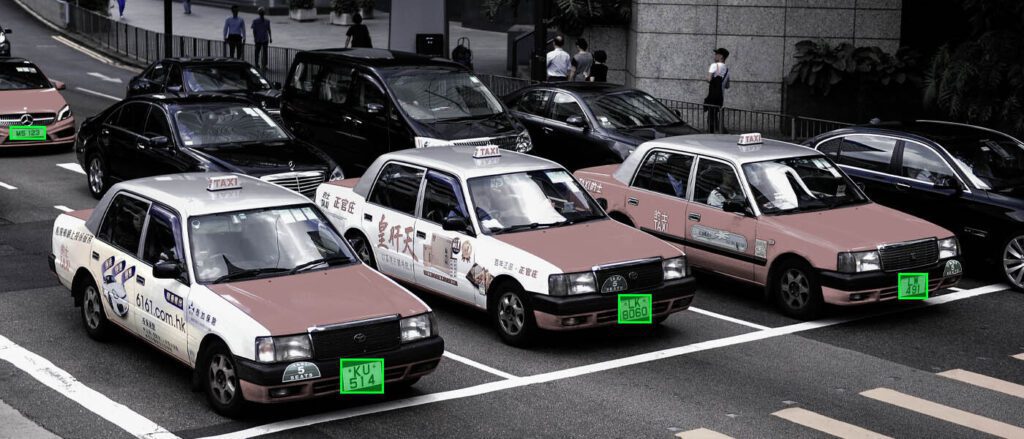
In various fields, such as traffic management, law enforcement, and parking management, license plate recognition is a crucial application of computer vision that is used to analyze license plates. In this article, we will review the Chinese City Parking Dataset (CCPD), which is one of the most widely used computer vision datasets for tasks that are specifically related to license plate recognition. Our aim in this article is to explore the CCPD dataset, its unique characteristics, and its potential contribution to the advancement of license plate recognition technology, in order to identify license plates in real-time.

The CCPD Dataset: An Overview

There are numerous images in the CCPD computer vision dataset that feature Chinese license plates that were captured in real-life scenarios exploiting the CCPD dataset in a comprehensive manner. This is one of the largest publicly available license plate datasets in the world, containing over 300,000 images of license plates. Annotations, which may include license plate numbers, locations, and orientations of each image in the dataset, are included with each image.

A Description of the Characteristics of the Dataset

License plate recognition research can benefit from the CCPD computer vision dataset due to several unique characteristics.

a. Diversity:

There is a wide range of variations that can be observed in the dataset, including fonts, colors, sizes, and styles, thus illustrating the wide range of Chinese license plates. The diversity among the datasets that are used to train license plate recognition models ensures the robustness and generalizability of the model.

b. Scenarios in Real-World:

A variety of lighting conditions, weather conditions, angles, and lighting conditions are captured in the CCPD dataset. As a result of this realism, license plate recognition applications are able to illustrate the challenges they face.

c. Large-Scale Annotation:

In addition to the detailed annotation of the dataset, the license plate bounding boxes are accurate and accompanied by text annotations. Researchers are able to effectively train and evaluate license plate recognition models when they have this level of annotation.

The CCPD computer vision dataset is applicable to a wide range of applications

License plate recognition technology can benefit greatly from the CCPD dataset:

a. Training and Evaluation of AI & ML Models:

A license plate recognition model that uses CCPD Computer Vision datasets can be trained and evaluated by researchers and developers using the dataset. As a result of the large-scale annotations, we are able to produce high-quality training data that allows us to develop algorithms that are reliable and accurate.

b. Comparisons and/or Benchmarking:

License plate recognition algorithms are evaluated using the CCPD dataset. Research can be conducted by comparing and evaluating different models, techniques, or methods of pre-processing by using standardized evaluation metrics.

c. Development and Innovation of Algorithms:

In the license plate recognition field, the CCPD dataset stimulates innovation by stimulating the development of new algorithms. Using the dataset, researchers can develop new approaches to improve the accuracy, speed, and adaptability of license plate recognition systems, such as deep learning-based methods in order to increase their speed, accuracy, and adaptability.

Developing and expansion of business in future

There is no doubt that the CCPD dataset will continue to expand and improve as license plate recognition technology continues to advance. Future development of the system may include an even greater diversity of license plate samples, for example, different countries, regions, or specialized license plate categories. In addition to the existing annotations, the dataset can be extended with additional annotations, such as a description of the vehicle type or information about an attribute, to facilitate the development of more extensive analyses and research.

Final thoughts

As a result of the use of the CCPD dataset, license plate recognition technology has the potential to advance significantly. License plate recognition models can be trained and evaluated by using this dataset, which contains a wide variety of license plate types and models, as well as large-scale annotations and real-world scenarios. By utilizing the CCPD dataset, researchers and developers will be able to create efficient and reliable license plate recognition systems that improve accuracy, improve efficiency, and drive innovation.

Human-centered data networking with interpersonal knowledge  graphs

Human-centered data networking with interpersonal knowledge  graphs
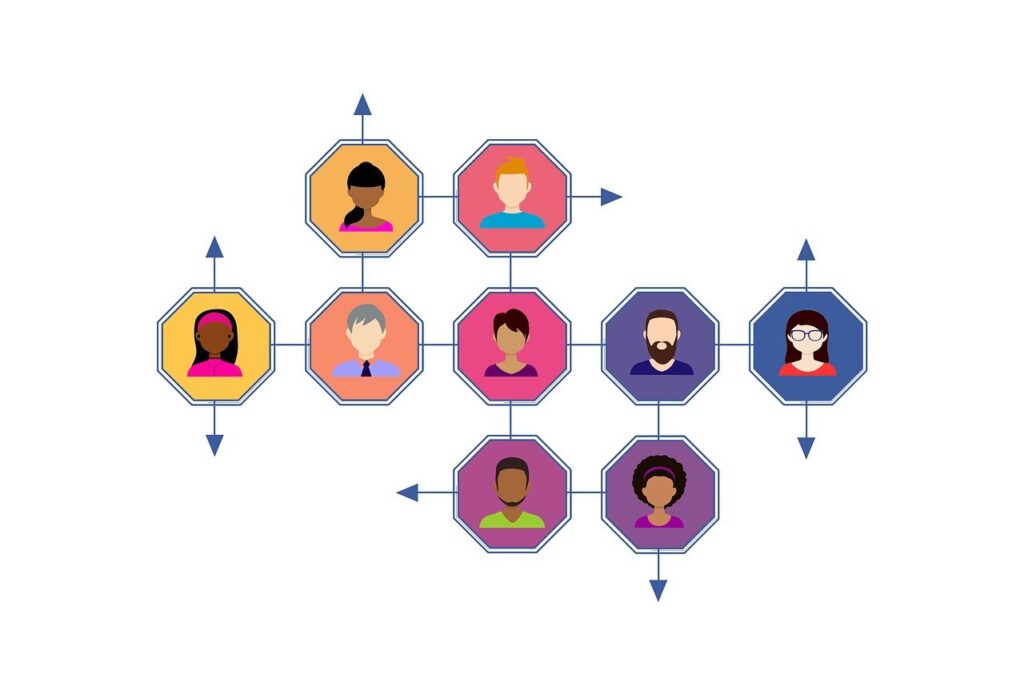
Image by Gerd Altmann from Pixabay

“If you start by creating your data, then it’s like you are piling up some value or you’re creating some assets,” WordLift CEO Andrea Volpini told me in our recent FAIR Data Forecast interview. Volpini’s an advocate for adding structured data such as Schema.org to your content. That way, the content becomes logically connected and search engine optimized.

But even adding just simple associations to your data network enriches the content assets you’re creating. If you’re sharing associations through simple web annotations, you’re giving both machines and humans an outline of what you’re working on, the puzzle pieces you’re putting together, and a sense of the human-centered network you’re building.

A colleague in our personal knowledge graph working group, Gyuri Lagos, has been working on an interpersonal knowledge graph (KG). His projects in development that we’ve seen include Indyweb and Indyhub.

His vision of interpersonal KGs is twofold: 1) Collaboration and better data networking across and beyond web silos, and 2) an open source orientation unhindered by commercial concerns. The term Gyuri and I use to describe this kind of collaboration is “human centered”.

As people collaborate, they can nurture the online environment around them to echo, record, persist and interact with what’s around them. It’s a form of human-in-the-loop computing that evolves as collaboration takes place online.

“Web3” is a term the crypto community has co opted, but our working group is focused on the more webby aspects of decentralized, peer-to-peer data networking environments. Web and crypto are symbiotic, given that they’re both powered by digital hash tables (DHTs) and related content addressing.

The peer-to-peer named data network or web3 orientation Gyuri’s harnessing is based on the Interplanetary File System (IPFS), a means of storing, sharing and collaborating publicly that promises more scalability, data sovereignty, and human-centered automation than via the conventional web. In other words, IPFS is a named data network, one that could deliver more network effects than either web 1 or web 2.

You may not have heard about IPFS, but Lockheed and Filecoin have been partnered since 2022 on an IPFS-based open source space communications/collaboration environment. IPFS is just as useful for other purposes here on earth. It’s foundational networked collaboration.

Gyuri does a lot of research on computer science, open web and knowledge graph-related topics, and the annotations he makes are broadly shareable. Gyuri’s web3 tools are inspired in part by Hypothes.is and Cryptpad.fr, which are both conventional web.

I’ve started to use IPFS for storage of meeting recordings, as well as Hypothes.is (for now) for my genealogy research and the sharing of that research.

Hypothes.is has become popular in academic circles. Colgate University, for example, is hosting an internal workshop in August 2023 on “Collaborative Reading and Social Annotation” within the context of Moodle, an open source learning platform. According to the workshop announcement,

Hypothes.is is a digital tool that enables students and instructors to collaboratively read and annotate PDFs and web pages. When used inside of Moodle, Hypothes.is makes this marginalia open to all users in a course, thereby transforming reading and meaning-making into a collaborative, shared experience.

Initial impressions of Hypothes.is– A genealogy research example

Collaborative annotation using a tool like Hypothes.is starts with the use of a Chromium browser such as Brave, Chrome, Edge or Opera. When using Chrome, the ‘h.’ extension icon appears in the upper right corner of the browser tab you’re in. By default, it’s grayed out and inactive to begin with. Click on it at a public page you’ve landed on, and it turns black. Then you can annotate or highlight.

Human-centered data networking with interpersonal knowledge  graphs

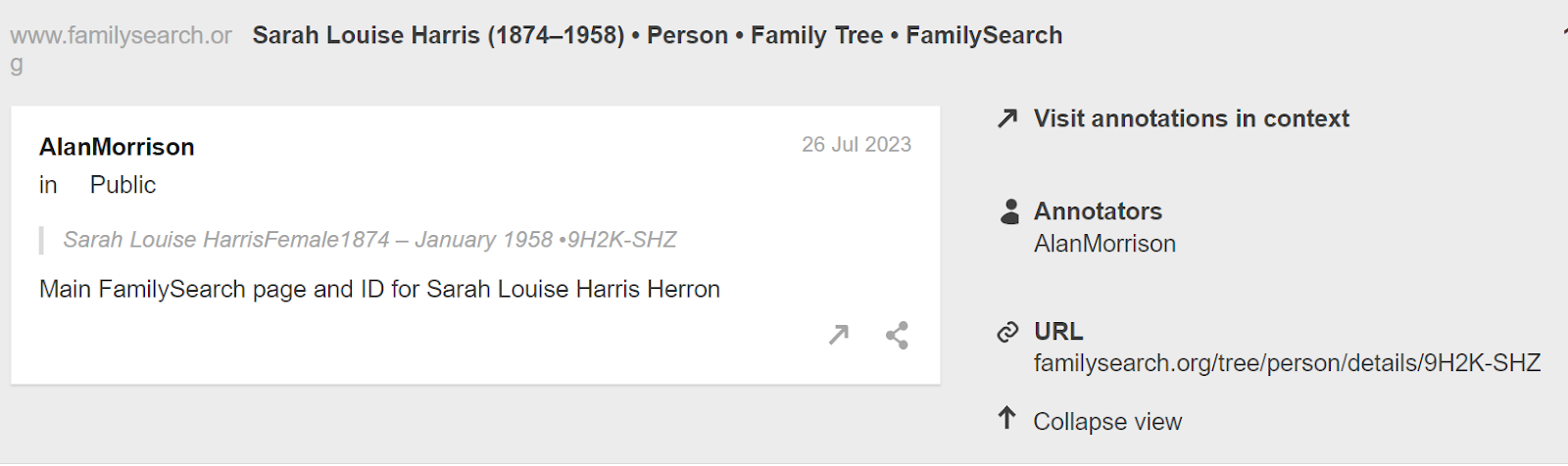
Yesterday, I was researching a relative who passed away the year I was born. Before Hypothes.is. I was frustrated by all the content artifacts I was leaving scattered across the web. I input my main family tree research findings on FamilySearch.org, the massive online genealogy collaboration and documentation site the Church of Latter Day Saints (LDS) runs. FamilySearch is set up to support your family tree assertions with links to documentation. But I also do some data entry on FindAGrave.com, Wikitree and some other non-commercial sites.

On FamilySearch, there’s a way to add the FindAGrave link and summary info of the deceased that’s buried to the deceased’s record. I added that source to my relative’s FamilySearch page and tree yesterday.

I’m browsing constantly to find facts that might shed more light on a given relative’s life, as well as help document that life online.

While the individual sites demand user input using web forms for entry field by field into a shared database, Hypothes.is allows free-form annotation at the web pages you visit. You click on the ‘h.’, and it turns black, indicating Hypothes.is is active on that page. Then you select text and/or image(s) on the web page and then highlight or annotate. Here’s another view of the annotation I just did for my maternal great grandmother.

Human-centered data networking with interpersonal knowledge  graphs

Another annotation I created was at the FindAGrave site:

Human-centered data networking with interpersonal knowledge  graphs

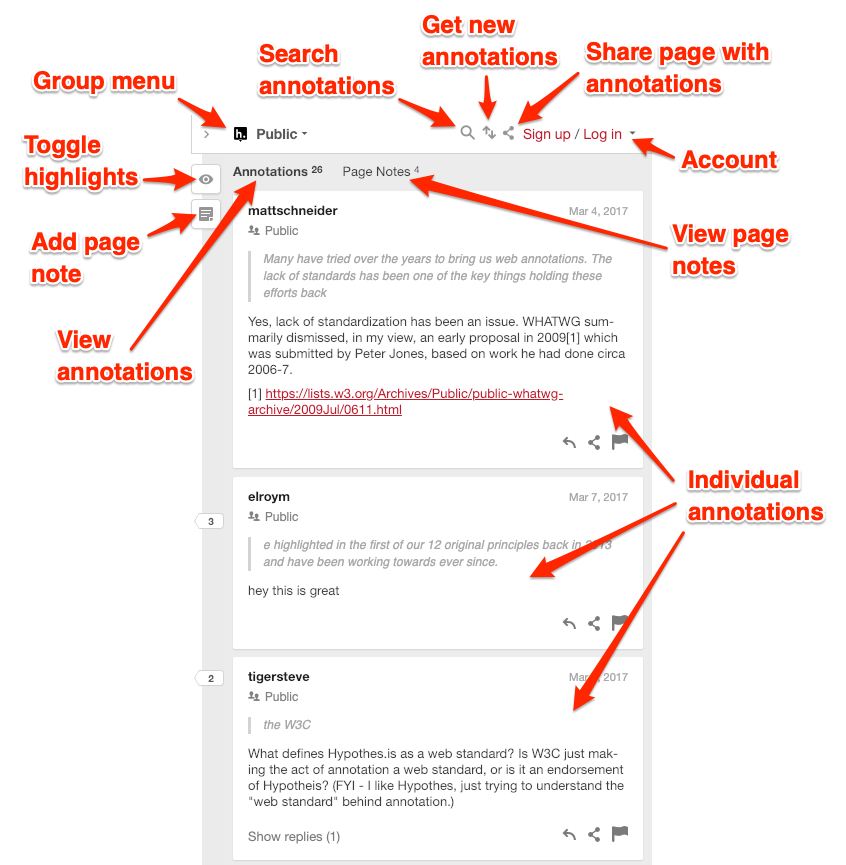
The illustration below describes the browser extension interface for annotating web pages. I know there’s a lot more I could do with these annotations than I’ve just done. Creating useful annotations takes time and practice.

Human-centered data networking with interpersonal knowledge  graphs

Source: Hypothes.is, 2023

Using annotation breadcrumb trails for research and community building

Volpini pointed out in my interview with him that adding logically connected associations to your own content helps to disambiguate and enrich your own online persona and personal brand.

In the case of interpersonal knowledge graphs, everyone in the community can contribute to the disambiguation and enrichment of the community’s online presence, and at the same time help with findability, accessibility, interoperability and reuse (the FAIR principles). And that applies not only to someone else finding your path to research discovery, but you being able to retrace your own steps whenever you need to.

Increase efficiency of manufacturing operations with IoT solutions

Increase Efficiency of Manufacturing Operations with IoT Solutions

In an age where efficiency is king, manufacturing firms are in a constant race to outshine their competition. Imagine if you could boost productivity, slash downtime, and cut costs all at once. Sounds like a dream, right? The good news is, this isn’t a fantasy. It’s achievable through Internet of Things (IoT) solutions.

IoT solutions enable manufacturers to monitor operations in real-time, predict machine failures, and automate processes. You get a high-octane, streamlined operation that fires on all cylinders, day in and day out. The result? Increased efficiency, lower costs, and a significant edge over the competition.

But wait, there’s more! IoT isn’t just transforming the manufacturing landscape. It’s reshaping the world of logistics and supply chain management too. Uncover the myriad ways our IoT solutions for logistics and supply chain management can give your business the kickstart it needs, and step into a future of unprecedented efficiency.

What is IoT?

Internet of Things (IoT) is a system of interconnected devices, machines, objects, or people that share data over a network. When applied to manufacturing, it allows for real-time monitoring, automation, and optimization of production processes. The global IoT in manufacturing market size is expected to reach $736.5 billion by 2027, up from $190 billion in 2019 (Statista, 2021). This dramatic growth underlines the immense value and potential that the industry sees in IoT.

IoT solutions enhancing manufacturing efficiency

So, how does IoT in manufacturing bolster efficiency? Here are five key ways:

  1. Real-time Monitoring and Maintenance: IoT sensors can monitor machinery performance in real time, predicting possible breakdowns or errors. This predictive maintenance can prevent costly downtime and increase overall equipment effectiveness.
  2. Automation and Streamlining: IoT devices can automate repetitive tasks, saving time and reducing human error. Furthermore, by connecting different stages of production, IoT solutions can streamline workflows, improving both speed and quality.
  3. Energy Efficiency: IoT can monitor and optimize energy usage in manufacturing facilities, leading to significant cost savings and a greener footprint.
  4. Data-Driven Decision Making: IoT generates a vast amount of data that can be used to analyze and optimize processes. This helps in making informed, data-driven decisions that improve efficiency and productivity.
  5. Supply Chain Optimization: IoT allows for precise tracking and monitoring of materials and finished goods as they move through the supply chain. This leads to improved inventory management, decreased wastage, and a more responsive and efficient supply chain.

How to implement IoT in manufacturing

Embracing IoT is not an overnight process, it requires careful planning and execution. Here are a few steps to consider:

Identify the Need: Understanding where IoT can be most beneficial in your operations is the first step. This could be in maintenance, automation, energy efficiency, or data analysis.

Choose the Right IoT Solutions: There are various IoT devices and solutions available, each with its strengths and limitations. Choosing the right ones that align with your needs is crucial.

Start Small and Scale: Implement IoT solutions in a small area of your operations first, then scale up based on results and learning.

Invest in Training: The success of it is highly dependent on the employees using it. Invest in training to ensure they understand and can effectively use the technology.

Evaluate and Adapt: Post-implementation, it’s essential to measure the impact of IoT solutions and adapt accordingly. Using key performance indicators (KPIs), businesses can track whether the implementation is achieving its objectives and make necessary adjustments to maximize efficiency.

The future of IoT in manufacturing

As we continue to innovate, IoT will only grow more prominent. We can expect advancements in AI and machine learning to further enhance the capabilities of IoT, providing even greater efficiency gains. As per Statista, by 2025, the number of connected devices worldwide is forecast to reach 75.44 billion, reinforcing the immense potential for IoT in various industries, including manufacturing.

The future is looking bright for IoT, with several trends on the horizon promising to bring significant changes and improvements. Let’s take a look at 5 key predictions:

  1. Widespread Adoption: Expect IoT usage to increase across various industries.
  2. Smart Factories: IoT, AI, and robotics will give rise to highly autonomous factories.
  3. Supply Chain Optimization: IoT will enhance supply chain transparency, improving inventory and delivery management.
  4. Improved Safety: IoT sensors will monitor workplaces in real-time, promoting safety.
  5. Customization: IoT will enable manufacturers to shift from mass production to more personalized offerings, adapting to consumer demands.

Impact of IoT solutions on operational efficiency in the manufacturing industry

The embrace of IoT in manufacturing has a transformative impact on operational efficiency. When properly implemented, it can bring significant benefits and changes to the production line, supply chain, and overall operations. Here are some ways how:

Enhanced Productivity: IoT devices can monitor equipment and processes in real-time, providing valuable data that can be used to streamline operations, reduce waste, and increase output. According to a study by the MPI Group, factories implementing IoT solutions have seen a 72% increase in productivity.

Reduced Downtime: The predictive maintenance capabilities of IoT solutions can identify potential machinery faults before they lead to downtime. The result is smoother, uninterrupted operations and significant cost savings.

Improved Quality Control: IoT sensors can monitor production quality in real-time, quickly identifying and correcting defects. This not only reduces waste but also improves product quality and customer satisfaction.

Optimized Supply Chain: IoT in manufacturing can track materials and products throughout the supply chain, enhancing visibility and allowing for more accurate demand forecasting and inventory management.

Better Safety Measures: IoT devices can monitor the manufacturing environment for safety hazards and ensure compliance with safety standards, protecting employees and reducing the risk of costly accidents or violations.

The ability to constantly monitor, analyze, and optimize operations leads to more efficient and profitable manufacturing processes, setting the industry on an exciting trajectory toward increased productivity and sustainability.

Final thoughts

IoT in manufacturing offers incredible potential to enhance efficiency and productivity. From real-time monitoring to automation, the benefits are clear. However, to fully reap these rewards, businesses must be willing to embrace change, invest in the right technologies, and train their employees. By doing so, the future of manufacturing looks bright, efficient, and highly connected. The power of IoT in each industry could very well be your golden ticket to staying competitive in the manufacturing industry of tomorrow.

Doctor AI: Healing humans and mother earth hand in hand

Doctor AI: Healing humans and mother earth hand in hand

Let’s image – with algorithms and a nerdy charm that could melt any data center, an ‘AI’ wearing lab coats and stethoscopes patrolling hospital hallways, tirelessly monitoring patients. The digital doctor will take the pulse of Mother Earth and reduce waste, cut energy consumption, and cut energy consumption! The artificial intelligence community is well aware that it is capable of crunching data with ease, but who knew that it would turn into Mother Nature’s best friend? It is as if you had the love child of Einstein and Captain Planet as your personal physician – optimizing resource usage, identifying our ailments, and prescribing solutions that are planet friendly!

Using artificial intelligence in the medical field can contribute significantly to the development of green solutions. Although it is not the only factor that makes healthcare environmentally friendly and sustainable, it can play a vital role in advancing these practices. These are some ways in which artificial intelligence may contribute to green solutions in the medical field:

Management of resources efficiently:

A computerized system is capable of analyzing large amounts of data in order to optimize resource utilization in healthcare facilities, thereby reducing waste and energy consumption. Among the benefits of this process is the optimization of scheduling and inventory management, as well as the reduction of energy consumption.

Medicine that is tailored to the individual:

The advent of high-tech technology has revolutionized healthcare, streamlined processes, and customized treatments to the point where medical professionals can say “goodbye” to the days of finding a needle in a haystack. Say goodbye to medical guesswork and adopt treatments as precise as Olympic archers’ bullseyes. Using artificial intelligence can result in more targeted, effective treatment options for patients, which will eliminate unnecessarily costly and time-consuming trial-and-error methods. By reducing energy consumption and waste generation, this can reduce environmental impact.

Imaging and diagnostic procedures in medicine:

Medical imaging analysis can be enhanced by AI algorithms, which lead to more accurate and earlier diagnoses. Thus, repeat tests can be reduced and treatment can be better targeted.

Discovering and developing new drugs:

Drug discovery can be accelerated and made more cost-effective with the help of artificial intelligence. Traditional drug development can be cut down on the need for animal testing and reduce environmental impact by identifying potential drug candidates more quickly with AI.

Monitoring and telemedicine:

Do you remember the first time you saw an AI party animal? You have probably never heard of an AI-doctor, but thanks to telemedicine, he has made his way to your living room. The ultimate eco-friendly, house-call hero is just a click away – no need to drag yourself out of bed when you are under the weather! As healthcare delivery becomes more telemedicine-based, the need for travel will decrease, resulting in reduction of greenhouse gases from transportation and a reduction in the environmental impact.

Devices that are sustainable:

It is possible to maximize the energy efficiency and environmental friendliness of medical devices by using artificial intelligence throughout their lifecycles.

Analytical approaches for public health prediction:

In addition to reducing the environmental impact of large-scale medical response, artificial intelligence can help predict and prevent diseases outbreaks by analyzing health and environmental data.

While artificial intelligence can play a major role in driving green solutions, it’s also important to note that the technology itself occupies significant amounts of computing resources and energy itself. This is why it is extremely important for the development and deployment of AI systems to be done in a responsible and sustainable manner with an emphasis on energy efficiency and sustainability.

How can medical diagnosis be improved through the use of image annotations

AI and machine learning models are most effective when they are built using large amounts of training data. Anolytics as a company provides error-free and accurate image annotation in healthcare services.

Finally, a few thoughts

AI, innovative technologies, and sustainable practices will, ultimately, be the key to creating green solutions in healthcare, along with broader efforts to promote environmental consciousness. In order to achieve a greener and more sustainable medical sector, the collaboration of healthcare professionals, researchers, policymakers, and technology experts is essential.

Worldcoin’s Eyeball Scanning Now Available in 18 Indian Locations

Sam Altman, the CEO of OpenAI, known for developing ChatGPT, launched the Worldcoin project last week. According to the reports people worldwide are willingly getting their eyes scanned in exchange for a World ID and the opportunity to receive tokens.

Worldcoin has identified 18 locations in India, mainly in Delhi, Noida, and Bangalore, where Orb operators are conducting eye scanning. These locations include popular malls and metro stations in these cities. Soon, it might get extended to other cities as well.

On the 30th of July, a long queue was observed at Bangalore’s Mantri mall. The crowd became uncontrollable, prompting the intervention of the police, and the stall operators were instructed to close the activity.

📣Huge line spotted for scanning eye to register for #Worldcoin in Mantri Mall, Bangalore, India
➡Stall operaters were asked to close the activity by Mall management & leave because of uncontrollable crowd#wld pic.twitter.com/ZhpWUyhD31

— CChowk (@Cryptochowk) July 30, 2023

The digital ID offered by Worldcoin will enable users to verify their human identity online and distinguish themselves from bots and automated systems.

As of now, the World App displays a total of 15 locations, excluding the 3 locations in Bengaluru.

If you are interested in becoming an orb operator, you can apply here.

Here is the list of locations where you can get your eye scanned in India

Bengaluru

Mantri Square Mall Bangalore

1, Sampige Rd, Malleshwaram, Bengaluru, Karnataka 560003, India

11 AM – 7 PM

Vegacity Mall

Vegacity Mall, Bannerghatta Main Rd, Dollars Colony, BTM 2nd Stage, J. P. Nagar, Bengaluru, Karnataka 560046

11AM-7 PM

The Galleria Mall

Galleria Mall, opposite Yelahanka, Ambedkar Colony, Bengaluru, Karnataka 560064

11 AM-8 PM

Delhi/NCR

Sikanderpur Metro Station

Sikanderpur Metro Station, A Block, DLF Phase 1, Sector 28, Gurugram, Haryana 122022

Noida Sector 52 Metro Station

Noida Sector 52 Metro Station, Sector 52, Noida, Uttar Pradesh 201301

Nirman Vihar Metro Station

Nirman Vihar Metro Station, Veer Savarkar Block, Block D, Nirman Vihar, Preet Vihar, New Delhi, Delhi 110092

Laxmi Nagar Metro station

Laxmi Nagar Metro, Vikas Marg, Veer Savarkar Block, Block D, Laxmi Nagar, Delhi, 110092

11 AM-7 PM

Vaishali Metro Station

Vaishali Metro Station, Madan Mohan Malviya Marg, Gaur Ganga 2, Phase 1, Sector 4, Vaishali, Ghaziabad, Uttar Pradesh 201010

11 AM-7 PM

Anand Vihar metro station

Anand Vihar metro station, ISBT, Anand Vihar, Delhi, 110092

11 AM-7 PM

Noida City Center Metro

Noida City Center, Sector 39A, Sector 32, Noida, Uttar Pradesh 201303

11 AM-7 PM

Noida Sector 51 Metro Station

Metro Station, Block E, Sector 51, Noida, Uttar Pradesh 201301

11 AM – 7 PM

Hauzkhas Metro Station

Hauz khas metro station, Jia Sarai, Gamal Abdel Nasser Marg, Block F, Deer Park, Hauz Khas, New Delhi, Delhi 110016

Noida Sec 18 Metro Station

Noida Sec 18 Metro Station,Captain Vijyant Thapar Marg, Noida Sector 18, Pocket E, Sector 27, Noida, Uttar Pradesh 201301

11 AM-7 PM

Iffco Chowk Metro Station

Iffco Chowk, Sector 29, Gurugram, Haryana 122002

Kaushambi Metro

Kaushambi metro station, Kaushambi, Gaziabad, Uttar Pradesh, 201010

V3S Mall

V3S Mall, Vikas Marg, Laxmi Nagar Commercial Complex, Swasthya Vihar, New Delhi, Delhi 110092

Chattarpur Metro Station

Metro Station Chhattarpur, Andheria Mor Village, Vasant Kunj, New Delhi, Delhi 110070

MG Road Metro Station

MG Road Metro Station, Maruti Housing Colony, Sector 25, Gurugram, Haryana 122022

The post Worldcoin’s Eyeball Scanning Now Available in 18 Indian Locations appeared first on Analytics India Magazine.