India Can Address Global Semiconductor Workforce Shortfall, but Challenges Remain

Recently, a report by the Semiconductor Industry Association (SIA) and Oxford Economics said that the semiconductor industry in the US could face a shortage of 67,000 workers by 2030. Deloitte, in its report, has predicted that the shortall could be around 70,000 and 90,000. This issue is not limited to the US, but has been observed in other markets as well. Burn Lin, a former vice president at TSMC, told the New York Times that chip companies in Taiwan are struggling to find the right candidates.

But India, despite not having any semiconductor prowess, has a strong workforce that contributes a lot to the global semiconductor industry. Indian engineers account for around 20% of the world’s semiconductor design workforce, which is quite significant. Over one lakh Very Large Scale Integration (VLSI) design engineers are engaged in both global and domestic semiconductor and design service companies. “India made significant strides over the last three decades by supplying engineering talent to the worldwide IT and semiconductor industries through product development and service industries,” Sudershan Vuruputoor, Managing Director, SiMa.ai India Pvt Ltd, told AIM.

India can meet the global demand

In Taiwan, to meet the shortfall, TSMC adopted a new recruitment approach expanding hiring channels, and raising base salary for master’s graduates. However, Taiwan does not churn out enough graduates to sustain its domestic chip industry. To meet the growing demand, TSMC directly recruits from some of the top educational institutions in India such as IIT Bombay.

“Starting with top institutions like the IITs and IISc there was a very strong emphasis on VLSI education over the last three decades. Initially, this was to support SCL, but it soon ended up in all the Indian offices of global majors,” T.R. Shashwath, co-founder and chief executive at Mindgrove Technologies Pvt. Ltd, told AIM.

TSMC is not the only chip maker hiring from India. Other players including Intel also look at India to meet their workforce requirements. Given India’s strong workforce, many chip making companies such as Samsung, Applied Materials and Lam Research, for example, have set up research labs in India. Very recently, US-based chipmaker, Advanced Micro Devices (AMD), said that it will set up its biggest R&D facility in Bengaluru, Karnataka.

Moreover, companies involved in testing and packaging of chips also actively hire in India. “India, of all the candidate nations, has the highest ability to do so, not only because we can supply the manpower itself but going forward, a large portion of the cutting-edge design innovation will come out of here,” Shashwath said.

In the coming 10 years or so, the demand for chips is only going to substantially increase due to a strong demand from automotive, computation and data storage industries. Chip makers such as TSMC, Intel and Samsung have plans to expand their capacity. To meet the demand, newer fabs will emerge in different parts of the world. For example, TSMC has already announced plans to open fabs in the US and Japan. Hence, Vuruputoor also believes India is well positioned to meet the global semiconductor talent demand.

However, he raises one important issue. Even though every year, India churns out 15 lakh fresh engineers, a majority of them remain unhirable. “It is particularly important to improve the quality of knowledge imparted at engineering colleges and technological institutes. Utilisation of available engineering seats is only 50% annually, and only a sixth of 15 lakh engineering students who graduate annually are employable. The gap in demand can be met just by making sure that most graduating engineers are employable,” he told AIM.

Importance of semiconductor research and education

To meet the semiconductor workforce shortfall, India needs to ensure that the engineering graduates possess the right skill sets to meet the growing demand. Indian Prime Minister Narendra Modi, while speaking at the recently held Semicon India 2023 event, said that around 300 colleges will start providing semiconductor education to its students.

The All India Council for Technical Education ( AICTE) recently announced two new courses – diploma in integrated circuit (IC) manufacturing and BTech or BE (electronics) in VLSI design and technology. Additionally, earlier this year, the Indian Institute of Science (IISc)-TalentSprint partnership announced a PG-level advanced certification programme in micro and nanoelectronics used for neuromorphic and quantum technologies. The partnership will provide industry-oriented training to empower next-generation semiconductor professionals. Also, as per reports, Taiwan could also help India train talent for electronics and semiconductors.

Even though India’s aim is to make itself self-reliable and establish itself as a semiconductor manufacturing hub, the investment in semiconductor related education will prove to be crucial if India is to play a part in meeting the growing semiconductor workforce demand.

Can India take advantage?

Despite announcing fabs in the US and Japan, TSMC postponed mass production in its Arizona fab to 2025 due to skilled labour shortage and equipment relocation challenges. Even though not confirmed, reports suggest TMSC could partner with Foxconn, another Taiwanese contract manufacturer, to set up a fab in the country.

Here, the Indian government can use its workforce to its advantage and attract not just TSMC, but other chip makers to set up chip making units in the country. Coupled with initiatives such as the Production Linked Incentive (PLI) scheme, and creating a favourable ecosystem for chip manufacturing, the Indian government can make India a more viable option.

So far, Micron, a US-based chipmaker has already revealed its plan to invest USD 2.7 billion to develop a new assembly and test facility in Gujarat, which will serve as the centre for the manufacturing of DRAM and NAND products. Moreover, Chandrasekhar stated that the government will soon announce a 40 nm semiconductor fabrication unit under the modified semiconductor investment scheme.

Moreover, given India is providing engineering talent to the worldwide IT and semiconductor industries through product development and service industries for over three decades now, it translates to forex inflows contributing to the growth of India’s economy, according to Vuruputoor. “If we are able to meet the growth in demand by enabling more of the graduating engineers to be employable, India can see a proportional increase in its forex reserves,” he said.

The post India Can Address Global Semiconductor Workforce Shortfall, but Challenges Remain appeared first on Analytics India Magazine.


How to achieve hyper-personalization using generative AI platforms

Person clicking on screen

In a world driven by constant connectivity, online experiences need to be more personalized than ever before. This hyper-personalized approach aims to create the most relevant and customized experience for each user.

Also: Generative AI and the fourth why: Building trust with your customer

But what does the term "hyper" in hyper-personalization mean, and why is it such a crucial part of today's digital marketing strategies?

A new level of personalization

The "hyper" in hyper-personalization signifies a level of personalization that extends beyond traditional personalized experiences. Instead of using basic information like a user's name or location to personalize experiences, hyper-personalization — also known as extreme personalization — leverages advanced technology and data analysis techniques.

This approach provides a deep understanding of user behaviors, preferences, and needs, resulting in tailor-made experiences that drive user engagement and loyalty — it utilizes behavioral and real-time data to create highly contextual interaction that is relevant to the user at the right moment of their journey.

Data: The fuel of hyper-personalization

To achieve this level of personalization, brands employ data analytics, artificial intelligence (AI), and machine learning (ML). These technologies allow businesses to gather, analyze, and apply vast amounts of data from various sources like browsing history, past purchases, and social media activity.

Using this data, brands can anticipate a user's needs, preferences, and potential future actions with high accuracy. This could mean recommending a product the customer might like, informing them about an event they might be interested in, or even offering personalized discounts that motivate a purchase.

Also: 4 ways to detect generative AI hype from reality

AI algorithms can readjust behavioral data incrementally based on each new interaction, making marketing campaigns progressively smarter as they roll out across more customers and channels. The use of AI in hyper-personalization lets you create and adjust customer profiles in real time. It goes further than segmentation and allows you to create a customer experience that is unique to an individual.

Hyper-personalization: Benefits and challenges

Businesses that can deliver hyper-personalized experiences position themselves as attentive and responsive, which fosters trust among consumers. Here are a few important benefits of hyper-personalization:

  • Improved customer experience: By tailoring content, recommendations, and interactions to individual preferences and behaviors, businesses can create a unique, satisfying user experience. This can increase customer engagement, loyalty, and overall satisfaction.
  • Increased conversion rates: Hyper-personalization can lead to more effective marketing campaigns and e-commerce strategies. By showing customers the right message at the right time, conversion rates can significantly improve.
  • Enhanced customer loyalty: By continuously delivering personalized experiences, businesses can foster a strong relationship with their customers. This can increase customer retention and loyalty, resulting in more repeat purchases and a higher customer lifetime value.
  • Competitive differentiation: In an increasingly crowded marketplace, hyper-personalization can provide a way for businesses to stand out. It can act as a key differentiator, making a brand more appealing to customers.

The challenges of hyper-personalization

Striking the right balance between personalization and privacy is crucial. Organizations must ensure they comply with data protection regulations and must handle their customers' data responsibly.

  • Data privacy and security: While hyper-personalization requires extensive data collection, businesses must handle this data responsibly. They must adhere to privacy laws and regulations, such as GDPR in Europe or CCPA in California. Failure to do so can result in severe penalties.
  • Balancing personalization and intrusiveness: Striking the right balance between personalization and being intrusive is another challenge. Too much personalization can make customers feel their privacy is being violated, which can harm the relationship.
  • The complexity of implementation: Implementing a successful hyper-personalization strategy can be complex and time-consuming. It requires the right technology, integrated business processes, a thorough understanding of the customer, and ongoing efforts to maintain and optimize the personalization strategy.

Technology challenges with hyper-personalization

Implementing hyper-personalization at scale often poses several technical challenges for enterprises:

  • Data integration: Organizations often collect data from multiple sources, which can lead to fragmented and siloed data. Integrating this data into a single, unified view of the customer is a major challenge.
  • Data analysis capabilities: Many organizations lack the advanced analytical capabilities required to gain meaningful insights from the vast amounts of data they collect. Without these insights, effective personalization is not possible.
  • Real-time processing: Hyper-personalization often requires real-time decision-making. This means organizations need the infrastructure to process and analyze data in real time, which can be technically challenging and resource-intensive.
  • Scalability: As the volume of data increases, so does the demand for systems to analyze and respond to this data. Businesses need scalable systems to handle this load and to grow with their personalization efforts.
  • AI/ML expertise: The use of AI in general and ML for data analysis and prediction is a crucial part of hyper-personalization. However, implementing these technologies requires specialized expertise that many organizations do not have in-house.

Hyper-personalization presents a significant opportunity for businesses to create unique, compelling experiences for their customers. However, it also comes with its share of challenges in terms of strategy and technology.

Also: State of IT report: Generative AI will soon go mainstream, says 9 out 10 IT leaders

With careful planning and the right approach, these challenges can be overcome, and the benefits of hyper-personalization can be fully realized.

Essential components for achieving hyper-personalization

  • Data collection: This is the first step, and perhaps the most crucial. You need to collect detailed data about your customers. This can include demographic data, transaction history, browsing behavior, social media activity, customer surveys, purchase history, browsing history, search history, social media activity, sentiment analysis, and other online interactions. This data is then analyzed using machine learning algorithms to create personalized experiences for each consumer.
  • Data analysis: Once you've collected the data, it needs to be analyzed to extract meaningful insights. This could involve identifying trends, preferences, and behaviors that can help predict future actions.
  • Artificial intelligence, machine learning, and generative AI: AI, and ML are the engines that drive hyper-personalization. These technologies can analyze large amounts of data, learn from it, and make predictions or decisions without being explicitly programmed to perform the task. Generative AI takes personalization beyond reactive adjustments and actions, enabling businesses to predict and generate content tailored to anticipate future customer behaviors and preferences. This includes creating custom promotional offers, personalized shopping guides, or unique user experiences. By doing so, generative AI adds another layer of proactiveness to personalization, significantly enhancing customer engagement and taking the personalization aspect to new heights by adding a Generative Experience.
  • Real-time decision making: Hyper-personalization requires making real-time decisions based on the collected data and insights. This could be as simple as serving up a personalized product recommendation or as complex as dynamically tailoring the entire user experience.
  • Customer journey mapping: Understanding the customer journey is essential to provide personalized experiences at every touchpoint. This involves identifying the different stages customers go through when interacting with your brand, from the awareness stage to the purchase stage, and beyond.
  • Security and privacy: As you'll be dealing with large amounts of personal data, it's crucial to ensure that you're handling this data responsibly and complying with all relevant privacy laws and regulations.
  • Testing and optimization: Finally, continuous testing and optimization are key. This involves regularly testing your personalization efforts to see what works and what doesn't, and making necessary adjustments to improve the customer experience.

Essential components for achieving hyper-personalization.

The goal of hyper-personalization isn't to simply collect and use as much data as possible. It's to use that data to provide a truly personalized experience that meets each customer's needs and preferences.

Also: Can AI detectors save us from ChatGPT? I tried 5 online tools to find out

Creating a 360-degree customer view via hyper-personalization involves obtaining a comprehensive understanding of the customer at multiple levels. Here are some key attributes to consider:

  • Demographics: Basic information like age, gender, location, income, occupation, etc. This gives a baseline understanding of who your customer is.
  • Psychographics: Information about a customer's lifestyle, preferences, interests, values, and personality traits. This helps businesses tailor their messaging and offerings to align with the customer's lifestyle and values.
  • Behavioral Data: This includes data related to customers' online behavior such as browsing history, click patterns, frequency of visits, time spent on pages, items added to cart, abandoned carts, purchases, product reviews, etc. This data is crucial for understanding customer behavior and predicting future actions.
  • Transaction history: Purchase history, frequency of purchases, average spend, types of products or services purchased, etc. This information can help businesses identify buying patterns and anticipate future needs.
  • Interaction data: This includes data from every touchpoint a customer has with a brand, such as customer service interactions, social media engagement, email exchanges, etc. It provides insight into how the customer interacts with the brand across different channels.
  • Sentiment analysis: Analysis of customer reviews, social media posts, or any other customer feedback can provide insights into how a customer feels about a brand or a product. This can help businesses improve their products or services and manage their reputation effectively.
  • Predictive analytics: Based on all the above data, businesses can use predictive analytics to anticipate future behavior or needs of a customer. This is a key component of hyper-personalization as it allows businesses to proactively cater to their customers' needs.

When the attributes of a 360-degree customer view are well-managed and utilized effectively, the results can be transformative for both businesses and their customers. Here are some outcome attributes you can expect:

  • Customer loyalty: Personalized experiences, products, and services make customers feel valued and understood, which in turn, fosters loyalty and encourages repeat business.
  • Improved customer satisfaction: By accurately predicting and meeting customer needs, businesses can significantly enhance customer satisfaction levels. Satisfied customers are likely to remain loyal and spread positive word-of-mouth, amplifying your brand's reputation.
  • Increased conversion rates: Hyper-personalization can boost conversion rates by providing customers with relevant, timely, and personalized offers, recommendations, and content that encourage purchase decisions.
  • Enhanced customer engagement: By creating personalized experiences, businesses can increase customer engagement levels, leading to longer session times, increased click-through rates, and overall, a more involved customer.
  • Higher customer lifetime value (CLV): With increased loyalty, satisfaction, and engagement comes a higher CLV. Hyper-personalized experiences often lead to increased purchase frequency and spending, resulting in a higher overall value for each customer over their lifespan.
  • Greater ROI on marketing spend: Personalized marketing efforts typically yield a higher return on investment. By targeting the right person with the right message at the right time, businesses can optimize their marketing spend and improve campaign effectiveness.
  • Attrition reduction: Hyper-personalization can help reduce customer attrition by making customers feel understood and valued, which discourages them from switching to competitors. This practice is critical for maintaining a stable customer base and is typically more cost-effective than acquiring new customers. By proactively understanding and meeting customer needs, businesses can prevent issues that may cause customers to leave, thereby reducing attrition. Overall, hyper-personalization fosters strong customer relationships, enhancing loyalty and minimizing churn rates.

The journey to effective hyper-personalization is a continuous process. It requires ongoing data collection, analysis, and optimization to ensure that personalized experiences remain relevant and valuable to the customer. The key is to keep the customer at the center of all efforts, using insights derived from data to drive decision-making and strategy.

Also: AI and advanced applications are straining current technology infrastructures

Hyper-personalization in the context of a 360-degree customer view requires businesses to respond in real time and also be proactive. This dual strategy enhances customer loyalty and engagement.

The first mechanism, "Real-time interactions and responsive actions," responds to live data, for instance, notifying a customer about a price drop for a product they're interested in. The key to this strategy is timing, relevance, and avoiding overly intrusive interactions.

The second mechanism, "Action-initiated communication," triggers communication based on specific customer behavior, such as sending a personalized email for an abandoned shopping cart or re-engaging an inactive customer with a special deal.

Also: This is how generative AI will change the gig economy for the better

Finally, the third mechanism, "Predictive and generative engagements," leverages generative AI to anticipate future customer behavior and create content accordingly. It can generate highly personalized content that caters to a customer's future needs, such as a personalized shopping guide or a promotion highlighting a brand's sustainability efforts, for a customer who frequently shops for sustainable products. These mechanisms, together, provide a highly personalized customer experience, augmenting customer engagement and boosting conversion rates.

The future of hyper-personalization

As we move forward, the demand for more personalized experiences is likely to increase. Technology will continue to evolve, providing marketers and solutions in general with even more tools and capabilities to achieve hyper-personalization. Businesses that can effectively harness the power of hyper-personalization, while respecting privacy concerns, are likely to have a competitive edge.

Hyper-personalization represents a new era in customer engagement. It's about understanding consumers on a deep level and delivering value to each individual. The "hyper" in hyper-personalization truly reflects this intensified, focused approach to individual customer experiences. By leveraging technology and data, brands can create a hyper-personalized experience that makes every customer feel like the only customer.

This article was co-authored by Antonio Figueiredo, senior director and lead architect at Salesforce.

Artificial Intelligence

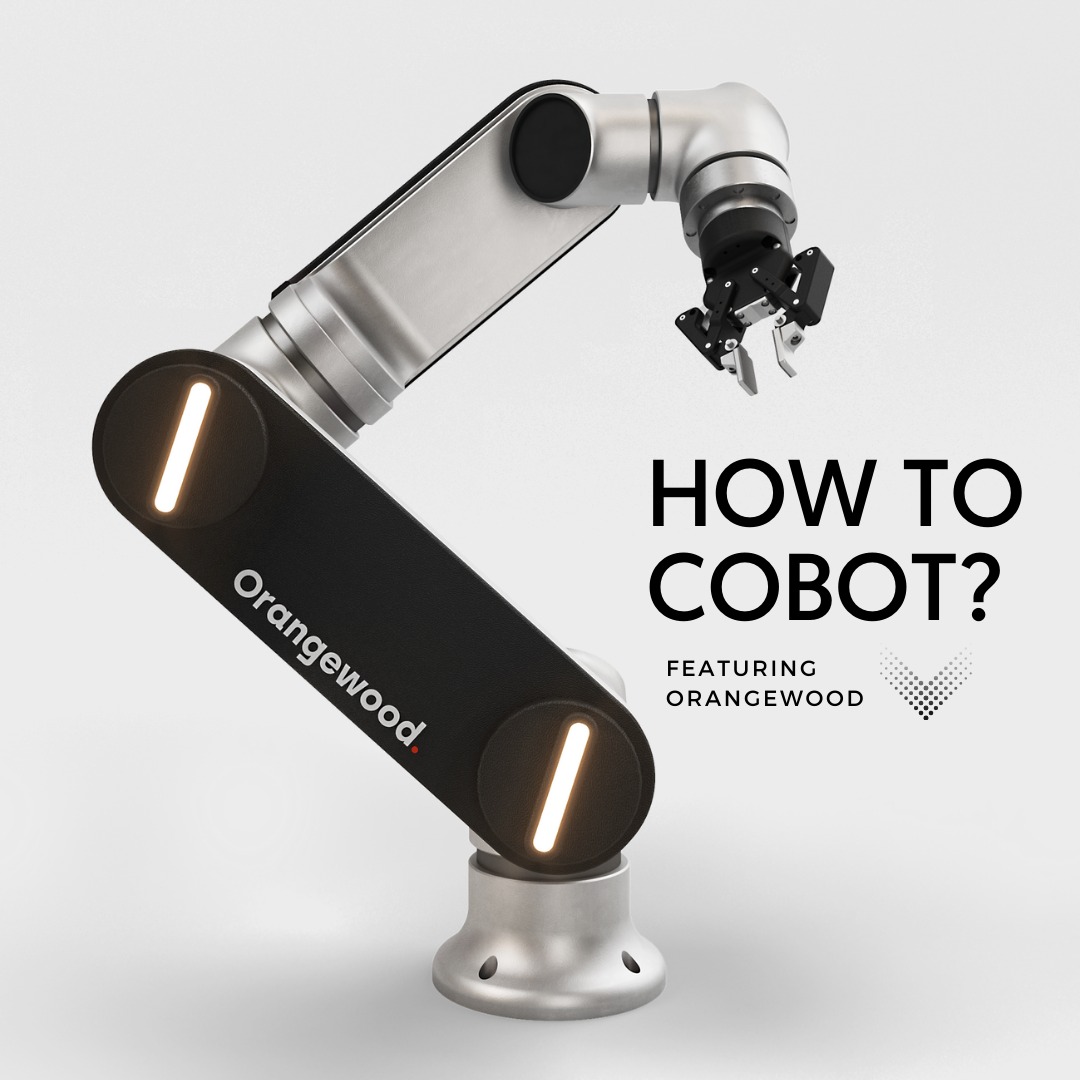
Orangewood wants to build a cheap, programmable robotic arm for manufacturing

Orangewood wants to build a cheap, programmable robotic arm for manufacturing Kyle Wiggers 8 hours

In late 2017, three entrepreneurs — Abhinav Das, Aditya Bhatia and Akash Bansal — came to the mutual realization that the final steps of building furniture — specifically painting and sanding — were incredibly time-consuming, not to mention costly. Often, painting and sanding will take weeks compared to the mere hours it takes for assembly and, depending on the furniture, can’t be automated with traditional robotics.

So Das, Bhatia and Bansal co-founded Orangewood Labs, a company creating a remotely operated robotic arm designed to paint furniture. A member of Y Combinator’s Summer 2022 cohort, Orangewood recently raised $4.5 million in a funding round tranche led by Y Combinator with participation from 7percent Ventures, Schox Ventures, VentureSouq, KSK Angel Fund and several angel investors.

Robotics is hardly an easy market to break into. Hardware’s expensive, after all. In 2022 alone, a number of high-profile robotics startups shut down, including buzzy, DoorDash-owned food tech Chowbotics and Pittsburgh-based Carnegie Mellon spinout Fifth Season.

Orangewood, based in San Francisco, aims to take a more sustainable approach than its competition. Das, Bhatia and Bansal explain that the company uses more affordable parts compared to conventional robotic arm manufacturers, enabling Orangewood to drive the price down to a range that’s palatable for small- and medium-sized businesses.

“We believe that the market is still too huge for most robotics companies to fully tap,” the trio told TechCrunch in an email interview. “Our robots are helping bring power back to the small enterprises.”

Orangewood Labs

Image Credits: Orangewood Labs

Orangewood also touts the broad programmability of its robots, which it sees as another key differentiator. The startup developed RoboGPT, a platform that allows users — think roboticists as well as factory floor workers — to program Orangewood’s robotic arm with text or their voice. RoboGPT, engineered to be adaptive, attempts to account for edge cases, continuously learning from and about its environment.

With the launch of RobotGPT, Orangewood hopes to take its robotics beyond furniture construction and into other use cases, like quality inspection, powder coating and picking and sorting packaged goods.

“Robotic arms have been traditionally hard to program, which is why most small businesses don’t do it,” Das, Bhatia and Bansal said. “Any change in the environment or conditions requires reprogramming. For example, if you wanted to pick a red triangle instead of a blue square, it’d take time to make that change. We’re changing that with RoboGPT.”

Can these innovations help Orangewood stand out in a crowded field (see other robotic arm startups such as Ally) — and, perhaps more importantly, avoid the fate of its less-fortunate predecessors? It’s too early to tell. But the company already has a fairly large team — 50 contract and full-time workers, with plans to grow headcount by 20% by the end of the year — and 500 deployments of its robotic arm. Annual recurring revenue stands at $750,000 — a healthy figure, to be sure.

“For the technical decision maker, it’s simpler to deploy the technology on our flexible financing terms, hence easier to sell the business case to management,” Das, Bhatia and Bansal said. “The pandemic only has made our prospective clients realize the need for automation and move faster on demand, as well as greater localization of competitive supply chains.”

Orangewood says that it won’t need to raise cash for at least a year, thanks to the recent funding round — and a debt financing line. But it’s in the process of securing another equity raise between $6 million and $7 million to fulfill its backorder of robots, build out a service and spare parts network and expand its manufacturing facilities.

Oracle Cloud Infrastructure to Revamp DIKSHA

The Ministry of Education announced its selection of Oracle Cloud Infrastructure to revamp the Digital Infrastructure for Knowledge Sharing (DIKSHA), the country’s national education technology platform. The move aims to bring advanced technological capabilities to the education sector and enhance the learning experience for students and educators nationwide.

“We have transformed and migrated DIKSHA onto Oracle Cloud Infrastructure (OCI),” said Shailender Kumar, senior vice-president and regional managing director, Oracle India and NetSuite Asia Pacific and Japan, during the briefing.

The Ministry of Education’s decision to migrate DIKSHA to Oracle Cloud Infrastructure (OCI) is set to bring transformative changes to the educational landscape of India. By modernizing the national education technology platform, DIKSHA will become more accessible and witness a reduction in IT costs.

“We need to embrace modern tools and technology to make education more easily available and securely accessible to everyone,” said Indu Kumar, head of department, ICT and Training, Central Institute of Educational Technology (CIET), National Council of Educational Research and Training (NCERT), ministry of education.

With a widespread reach, DIKSHA currently serves 1.48 million schools in all of India’s 35 states and union territories, offering content in 36 Indian languages. As part of the multi-year collaboration agreement, OCI will work alongside the Ministry of Education to extend DIKSHA’s educational resources to millions more students, teachers, and collaborators across the country.

DIKSHA, powered by the open-source platform Sunbird developed by the EkStep Foundation, stands as one of India’s most successful Digital Public Infrastructure (DPI) initiatives. It caters to school education and foundational learning programs, empowering teachers to facilitate inclusive learning for underserved and disabled learners nationwide.

Over 200 million students and seven million teachers, representing both government and private schools, have access to a vast pool of content contributed by over 11,000 sources.

Each day, users of the platform stream an impressive 1.2 petabytes of text and video content from renowned organizations like the National Council of Educational Research & Training (NCERT), Central Board of Secondary Education (CBSE), and State Council of Educational Research and Training (SCERTs).

DIKSHA to introduce AI Chatbots for Students

DIKSHA is exploring the idea of introducing AI chatbots to benefit students, according to Indu Kumar, National Coordinator, DIKSHA. Originally, the plan was to launch them on the 29th of this month, but it seems there might be a slight delay. Indu Kumar anticipates that the chatbots will be rolled out within the next month or two. The intention behind this initiative is to provide a personalized learning experience for the students, demonstrating DIKSHA’s commitment to tailoring education to individual needs.

The post Oracle Cloud Infrastructure to Revamp DIKSHA appeared first on Analytics India Magazine.

Inflection-1: The Next Frontier of Personal AI

Inflection-1: The Next Frontier of Personal AI
Image by Author

Artificial Intelligence (AI) is having such a great impact on the world today. And it doesn’t seem like it’s slowing down at all. The revolution of AI technology is changing the future and the world we live in.

We’ve had so much news in 2023, with AI systems being released left right and center. There is so much hype around GPT-3.5 and LLaMa, with high expectations that nothing will be able to surpass their performance. In order to produce better performance within Generative AI, it consists of a lot of pre-training and fine-tuning.

Inflection.AI is an AI start-up with a mission to create a personal AI for everyone for their unique needs. In May 2023, they released their personal AI assistant — Pi.ai- designed to be empathetic and safe. One of the major challenges with Large Language Models (LLMs) is the concerns around safety, data privacy and the accuracy of the outputs. Inflection.AI has a goal of achieving high-quality, safe, and useful AI LLMs.

Inflection.AI is an integrated AI studio that does all its AI training and inference in-house and has built Inflection-1 — their in-house LLM using Pi.ai.

What is Inflection-1?

When you’re using LLMs such as ChatGPT, the responses don’t feel very personal to you specifically. Imagine having an AI assistant or companion that understands the way you think, is empathetic, and is useful to your daily needs.

This is Inflection-1.

How did Inflection.AI achieve this exactly? Using Pi.ai. A personal AI that brings you and technology closer. Pi is powered by the AI model Inflection-1. Inflection-1 was built to create a personal assistant that can talk to you, just like a human.

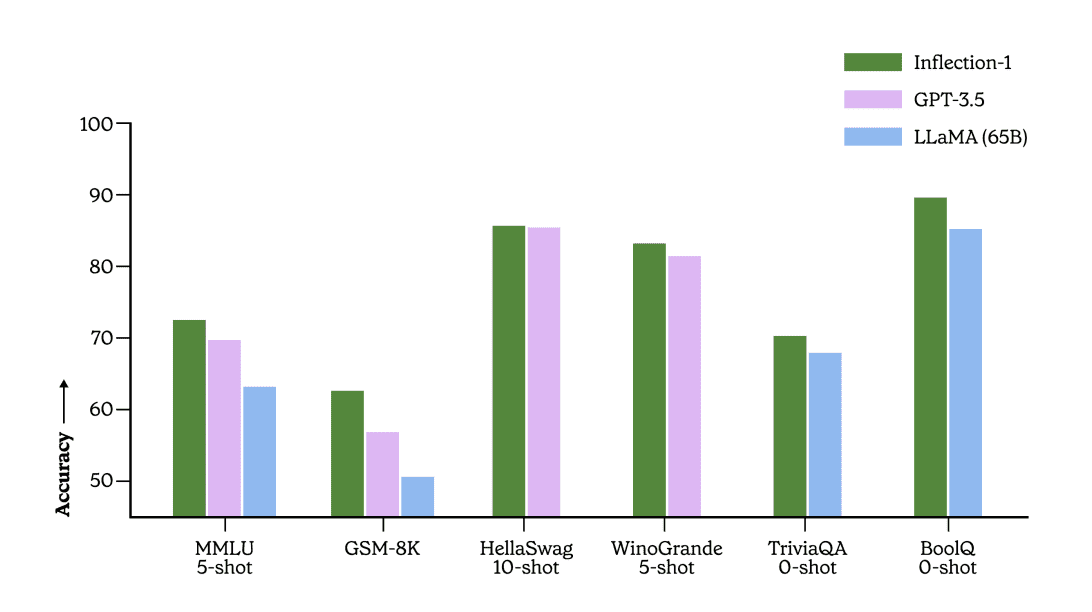
Inflection-1 is similar in size and capabilities to GPT-3.5, with some making remarks that is it better than GPT-3.5, Chinchilla, and LLaMA. It was trained using thousands of NVIDIA H100 GPUs on large datasets.

Inflection-1: The Next Frontier of Personal AI
Image by Inflection-1 Technical Memo

Inflection-1 has a technical memo that summarizes the company's evaluations and compares the performance of Inflection-1 against other LLMs. This technical memo, states that Inflection-1 was the #1 model in its compute class, showing that it outperformed GPT-3.5, LLaMA, Chinchilla, and PaLM-540B. The company will also be releasing a technical memo, showing a comparison of one of their models against PaLM-2 and GPT-4.

For Inflection-1 to get to this point, it had to undergo a lot of different tasks to be befitting to unique needs. For example, solving everyday problems, to high-school exam questions — with a personal touch.

Sounds amazing right? Why aren't more people speaking about this?

Yes, Inflection-1 is performing very well when it comes to a wide range of tasks — however, it is not great with all tasks, such as coding.

Inflection-1 falls behind GPT-3.5 when it comes to coding tasks. However, that doesn’t stop the employees at Inflection.AI from continuing to improve their current LLM, so that it can be able to handle all tasks, from common sense to complex coding scripts.

Inflection-1 Features

So now we’ve understood where Inflection-1 falls behind. Let’s understand its key features.

Conversational Ability

The first feature is Inflection-1’s conversational ability. As we mentioned previously, the company aimed to create an AI assistant that has a unique bond with its users. Inflection-1 has amazing conversational ability, as it can understand and interact with the user in a human-like manner. Inflection-1 can comprehend a wide range of topics, allowing it to engage in more meaningful dialogue.

Personalized Experience

Inflection-1 has been designed to provide a personal experience, which is tailored to every user. The combination of leveraging large amounts of data and learning from user interactions has allowed Inflection-1 to adapt to specific needs and requirements, such as conversational styles. This increases the engagement and connection between the user and personal AI.

Human Emotions

Inflection-1 wants to be more than a personal AI. It wants to be a unique AI for every user. It aims to understand and be able to respond to the user based on their emotional state. Understanding the user's emotional state, Inflection-1 can provide support, encouragement, and companionship — that other AI systems do not give.

Wrapping it up

Inflection-1 is pushing the boundaries of the current state of AI, and showing the wider community and other competitors what AI can achieve. They aim to make this service available to everyone via an API, in which you can join the waitlist here. Opening up this technology to the wider community democratizes AI — allowing everybody to benefit from AI’s potential.
Nisha Arya is a Data Scientist, Freelance Technical Writer and Community Manager at KDnuggets. She is particularly interested in providing Data Science career advice or tutorials and theory based knowledge around Data Science. She also wishes to explore the different ways Artificial Intelligence is/can benefit the longevity of human life. A keen learner, seeking to broaden her tech knowledge and writing skills, whilst helping guide others.

More On This Topic

  • KDnuggets: Personal History and Nuggets of Experience

What Happened to Multimodal GPT 4?

On March 14, 2023 OpenAI released GPT 4 among much fanfare exhibiting its multimodal features. Months have passed since that and there seems to be no buzz or interest around it anymore.

It was said that GPT-4 is capable of generating text and accepting both image and text inputs, making it an improvement over its predecessor, GPT-3.5, which only accepted text input. Currently, ChatGPT Plus is not multimodal.

Surprisingly, OpenAI recently filed for the GPT 5 trademark with the United States Patent and Trademark Office (USPTO). Trademark attorney Josh Gerben took to Twitter on July 31 to reveal that this action by the company hints at the possibility of them working on a fresh iteration of their language model.

Prior to proceeding with GPT-5, OpenAI is yet to deliver on its promises concerning GPT-4. Users were expecting easy interaction with a chatbot using images, but this multimodal functionality hasn’t been fully realized. On the internet, conversations have been buzzing with questions about the status of GPT-4 multimodal functionality.

GPT-5 seems like it will be heavily multimodal, which makes sense.
Yet I can't help but wonder what happened to GPT-4's multimodal capabilities?
We were told this was going to be revolutionary and then…… it kind of fizzled out? Or it's still in stealth…. https://t.co/FGgtzdOsXM

— Benjamin De Kraker (@BenjaminDEKR) August 1, 2023

During the GPT 4 demo livestream, several impressive capabilities of the model were showcased. It was able to interpret a funny image and accurately describe what made the image humorous. Additionally, Greg Brockman, President and Co-Founder of OpenAI demonstrated how he could effortlessly create a website by simply inputting a photo of an idea from his notebook, with GPT 4 providing the necessary assistance.

However, he specifically mentioned these features will take time but now the wait has been too long. Right now only Bing Search based on GPT 4 lets you make searches using images but it needs refinement and is not up to the mark with its responses. So what exactly is holding back OpenAI to explore multimodal features and come up with its own product.

Yeah, I too get the impression that the multimodal capability in Bing is less refined than the one described in the GPT-4 technical report. Possibly because they're still using an early version of GPT-4?

— Michael P. Frank 💻🔜♻ e/acc (@MikePFrank) July 30, 2023

Multimodal features aren’t available in the API

While introducing GPT 4, OpenAI said that they are introducing GPT-4’s text input capability through ChatGPT and the API, and are working on making the image input capability more widely available by collaborating closely with ‘be my eyes’. As of now this collaboration is in closed beta and is being tested for feedback among a small subset of our users. No official update has been released yet on the same.

Also as of now, the Multimodal features of GPT 4 are not accessible in the APIs. OpenAI’s blog post mentions that users can currently only make text-only requests to the gpt-4 model, and the capability to input images is still in a limited alpha stage.

However, OpenAI assures users that they will automatically update to the recommended stable model as new versions are released over time. This indicates that more advanced features and capabilities may become available to users as the model continues to evolve and improve.

OpenAI recently introduced Code Interpreter in ChatGPT Plus. Many termed it as GPT 4.5 moment but interestingly it was just old-school OCR from Python libraries and didn’t use multimodal for image generation.

Even besides the API, it's nowhere in GPT 4.
Even in Code Interpreter, it's not using GPT 4 multimodal for image recognition. It's doing old-school OCR from Python libraries.
GPT 4 multimodal just kind of………. faded away

— Benjamin De Kraker (@BenjaminDEKR) August 2, 2023

GPU Scarcity

Due to a shortage of GPUs, OpenAI is facing challenges in allowing users to process more data through their large language models like ChatGPT. This shortage has also affected their plans to introduce new features and services as per their original schedule.

A month back, Sam Altman acknowledged this concern and explained that most of the issue was a result of GPU shortages, according to a blog post by Raja Habib, CEO and Cofounder at Human Loop, which was later taken down on OpenAI’s request. The blog specifically mentioned that multimodality which was demoed as part of the GPT-4 release can’t be extended to everyone until more GPUs come online.

GPT-4 was probably trained using around 10,000 to 25,000 Nvidia’s A100s . For GPT-5, Elon Musk suggested it might require 30,000 to 50,000 H100s . In February 2023, Morgan Stanley predicted GPT-5 would use 25,000 GPUs. With such an amount of GPU’s required and Nvidia the only reliable supplier in the market, it boils down to availability of GPUs.

Focus on Dall E-3?

Going by the developments, we can say that OpenAI is presently focussing on text to image generation. Recently, Youtuber MatVidPro shared details of OpenAI’s next project which is likely to be Dall E 3.

OpenAI’s future plans for the alleged model’s public access and its official name remain uncertain. Currently, the unreleased model is in the testing phase, available to a select group of around 400 people worldwide on an invite-only basis, as per Matt’s information.

Conclusively, only time will tell whether OpenAI will better GPT 4 or come up with GPT 5. While there’s a saying, “what is in a name,” we are hopeful that OpenAI will deliver the much-awaited multimodality feature to its users soon and in an improved and advanced manner.

The post What Happened to Multimodal GPT 4? appeared first on Analytics India Magazine.

BMW tests next-gen LiDAR to beat Tesla to Level 3 self-driving cars

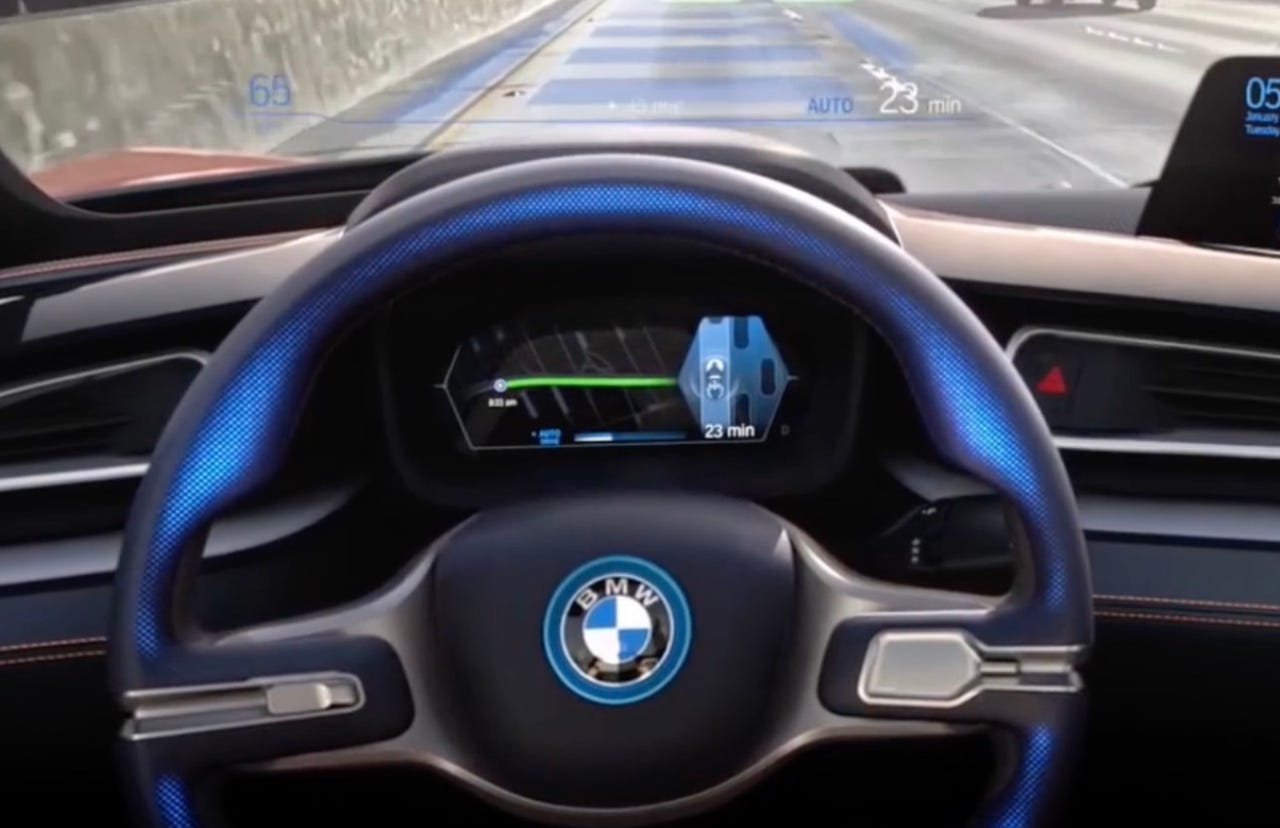
bmw-self-driving

Just a decade ago, the concept of self-driving cars might have seemed like something out of a science fiction movie, but now so much progress is being made that tangible steps are putting more and more autonomous vehicles on the road.

The latest example is the partnership between BMW Group and Innoviz Technologies to bring Level 3 autonomous driving to more vehicles through the development of next-generation LiDAR sensors.

Also: ChatGPT-powered voice commands are coming to Mercedes-Benz cars

Level 3 autonomy is where the vehicle can perform dynamic driving without human intervention. Tesla's Autopilot (for highways) and Full Self-Driving (for regular roads) have been stuck at Level 2 for years, despite many optimistic predictions from CEO Elon Musk that Tesla would reach Level 3 or above soon.

BMW and Innoviz have worked together for several years on LiDAR-enabled, highly automated technology that will be available on the BMW 7 Series later this year. The two companies are expanding their collaboration and focusing on second generation LiDAR technology with a B-sample phase, which is the stage of vehicle testing where the sample is incorporated into demo vehicles.

The results of the first phase will determine whether BMW Group will enter a serial development agreement with Innoviz with the purpose of bringing advanced automated capabilities to a broader range of vehicles in the BMW lineup, according to the release.

"We are very pleased to have Innoviz develop the first B-samples of this new LiDAR generation and hope that the results of the B-sample phase create a basis for a possible future extension of our collaboration," said Nicolai Martin, SVP Driving Experience BMW Group.

In addition to self-driving features, BMW also wants to use the technology to increase the safety of vehicles when humans are at the wheel. The release states: "The BMW Group and Innoviz have started this first phase to develop an expected first-ever LiDAR based Minimal Risk Maneuver (MRM) system in the future. The MRM acts as a secondary safety driving decision platform that will leverage the advanced performance, reliability, and resiliency of the InnovizTwo LiDAR to manage real-time driving decisions."

Also: Tesla's Full Self-Driving product is not what most people call 'full' self-driving

The knock on LiDAR technology has been that it is an unnecessary and expensive sensor. While Tesla has been a long-time leader in deploying autonomous vehicle features, it doesn't use LiDAR sensors in its vehicles, with Musk going as far as saying that "Anyone relying on LIDAR is doomed."

However, others, such as BMW Group's CEO, believe that LiDAR sensors are crucial in developing autonomous driving systems. LiDAR's greatest asset is its ability to detect objects on the road regardless of weather or lighting conditions.

"LiDAR is one of the critical technologies underpinning Level 3 or even higher automated functions. Optimizing LiDAR technologies and costs are the major challenges in order to bring Level 3 highly automated driving into the mainstream," said Martin.

Artificial Intelligence

What Semantic Search Can Do for LLMs

Large language models like ChatGPT do not understand your references the way your friend does. That is because these models have a contextual problem. Many things have changed since 2021, when everyone’s focus shifted from backlink and keywords to understanding intent and behaviour, and the context — semantics — behind them.

As generative search has opened a new frontier in semantic search LLMs, with their sequence-generation capabilities, are ideal for this task. Two days ago, Stack Overflow, the Q/A platform, decided to switch to semantic search due to the constant rise of traffic on the page. In the announcement blog, the company stated, “Semantic search and LLMs go together like cookies and milk.”
The company established in 2008 has used Microsoft SQL’s full-text search and then Elasticsearch over the past years. “But even with the top-of-the-line algorithm, the search suffers from a couple of significant problems,” the blog stated.

Listing the reasons for shift to semantic search, it pointed out that first of all, lexical search is very rigid. If a keyword is misspelt or a synonym is used, users won’t get expected results unless the index has been processed. If you enter a query— asking a question as if you were seeking help from a —then the probability of not finding any matching documents is very high. The second problem is that the lexical method is not at all intuitive to users who use specialised punctuation and boolean operators to get what they want.

Language models have a remarkable capability: they not only discover relevant information but also frame the responses in natural language, offering a human-like conversation experience during search. This LLM trait has proven to be advantageous, for chatbots and question-answering systems.

In layman’s terms, semantic search, understands the meaning and intent behind queries in a way a human would. As a result, it delivers precise and contextually relevant search results. Additionally, the integration of LLMs and text embeddings enables faster retrieval of documents, significantly reducing search times for users.

Stack Overflow states, its ‘ethos is simple: accuracy and attribution’. While large language models (LLMs) out there are generating results from sources unknown, The company has taken charge to clearly attribute questions and answers used in their Retrieval Augmented Generation (RAG) LLM summaries.

In Favour of Semantic

Last year, Spotify, the undisputed leader in music service and podcasting, implemented semantic search to improve the experience accessibility of the platform. This involved leveraging semantic search from their all-in-one podcast creation app, Anchor, to augment podcast APIs and the natural language enabled podcast search feature.

Prior to this users had to rely on keyword matching to discover podcasts of interest. However, with the introduction of semantic, the experience is similar to talking with a friend, leading to significantly improved results. The novel approach considers the meaning of words and sentences rather than just specific terms, resulting in a more accurate podcast search experience.

Tech goliath Google has the goal to become a fully semantic search engine. Remarkably, all its major innovations such as RankBrain, E-A-T, BERT and MUM either directly or indirectly support that goal.

Google’s efforts to develop a semantic search engine can be traced back to 1999. It became more concrete with the introduction of the Knowledge Graph in 2012 and the fundamental change in its ranking algorithm in 2013 (popularly known as Hummingbird). With the IT giant’s Semantic Experiences initiative, the company flaunts its semantic capabilities.

But Google is not the only one taking the approach seriously.

For its AI for Scale initiative, Microsoft also heavily relies on semantic search. We call this transformational ability semantic search—a major showcase of what AI at Scale can deliver for customers.” the software giant stated in the company blog.

While Stack Overflow has recently integrated semantic models in its search, last year as ChatGPT gained fame on the internet, several predictions were made about ways semantic search collaborating with language models can be the next suitable step towards a better search experience.

When semantic search and Generative AI work together, they can improve the accuracy, trustworthiness, and ease of keeping research up to date. Companies lagging behind to adapt or choose to adopt generative AI without combining techniques like semantic search (needed to make it suitable for work) will struggle to compete in the rat race. The race for supremacy demands staying at the forefront and using the combined power of semantics plus language models provides a strategic advantage.

The post What Semantic Search Can Do for LLMs appeared first on Analytics India Magazine.
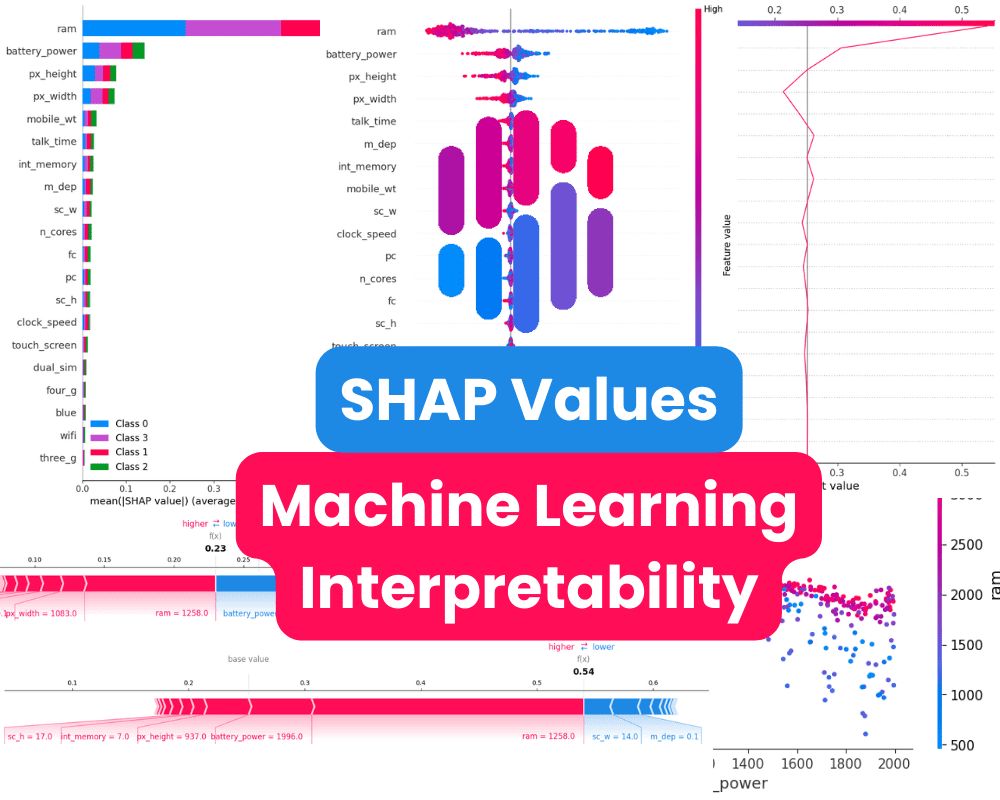
Using SHAP Values for Model Interpretability in Machine Learning

Using SHAP Values for Model Interpretability in Machine Learning
Image by Author Machine Learning Interpretability

Machine learning interpretability refers to techniques for explaining and understanding how machine learning models make predictions. As models become more complex, it becomes increasingly important to explain their internal logic and gain insights into their behavior.

This is important because machine learning models are often used to make decisions that have real-world consequences, such as in healthcare, finance, and criminal justice. Without interpretability, it can be difficult to know whether a machine learning model is making good decisions or if it is biased.

When it comes to machine learning interpretability, there are various techniques to consider. One popular method is to determine feature importance scores, which reveal the features that have the greatest impact on the model's predictions. SKlearn models offer feature importance scores by default, but you can also utilize tools like SHAP, Lime, and Yellowbrick for better visualization and understanding of your machine learning results.

This tutorial will cover SHAP values and how to interpret machine learning results with the SHAP Python package.

What are SHAP Values?

SHAP values are based on Shapley values from game theory. In game theory, Shapley values help determine how much each player in a collaborative game has contributed to the total payout.

For a machine learning model, each feature is considered a "player". The Shapley value for a feature represents the average magnitude of that feature's contribution across all possible combinations of features.

Specifically, SHAP values are calculated by comparing a model's predictions with and without a particular feature present. This is done iteratively for each feature and each sample in the dataset.

By assigning each feature an importance value for every prediction, SHAP values provide a local, consistent explanation of how the model behaves. They reveal which features have the most impact on a specific prediction, whether positively or negatively. This is valuable for understanding the reasoning behind complex machine learning models such as deep neural networks.

Getting Started with SHAP Values

In this section, we will use the Mobile Price Classification dataset from Kaggle to build and analyze multi classification models. We will be classifying mobile phone prices based on the features, such as ram, size, etc. The target variable is <code>price_range</code> with values of 0(low cost), 1(medium cost), 2(high cost) and 3(very high cost).

Note: Code source with outputs is available at Deepnote workspace.

Installing SHAP

It is quite simple to install <code>shap</code> on your system using <code>pip</code> or <code>conda</code> commands.

pip install shap

or

conda install -c conda-forge shap

Loading the data

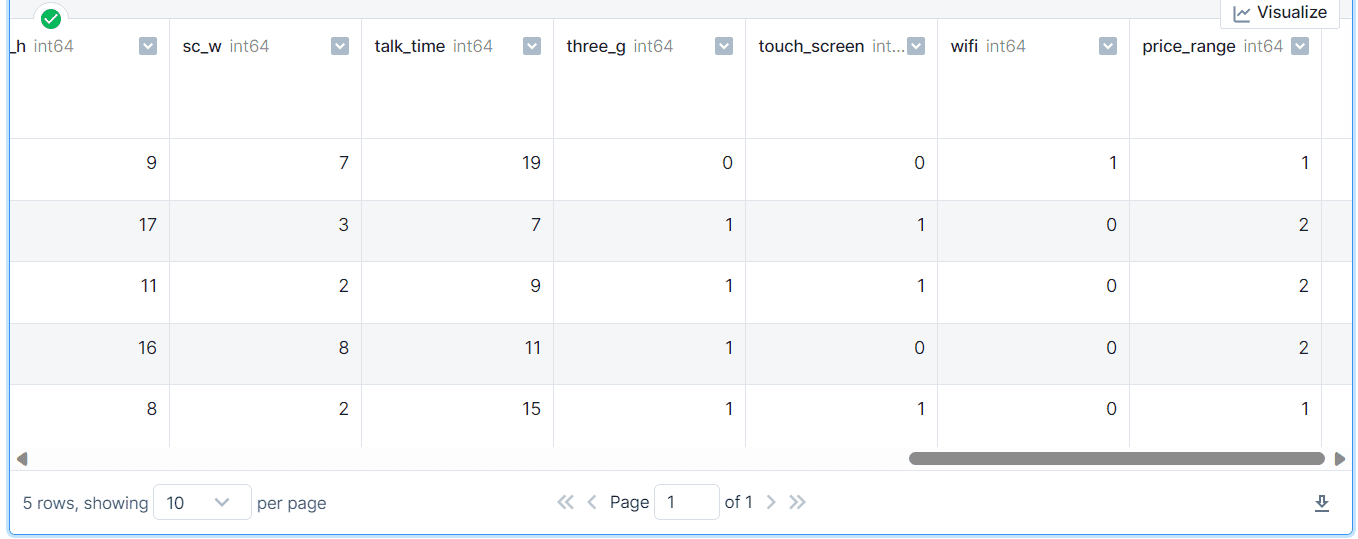
The dataset is clean and well-organized, with categories converted to numerical using label encoders.

import pandas as pd    mobile = pd.read_csv("train.csv")  mobile.head()

Using SHAP Values for Model Interpretability in Machine Learning

Preparing the data

To begin, we will identify the dependent and independent variables and then split them into separate training and testing sets.

from sklearn.model_selection import train_test_split       X = mobile.drop('price_range', axis=1)  y = mobile.pop('price_range')    # Train and test split  X_train, X_test, y_train, y_test = train_test_split(X, y, test_size=0.3, random_state=1)

Training and evaluating the model

After that, we will train our Random Forest classifier model using the training set and evaluate its performance on the testing set. We have obtained an accuracy of 87%, which is quite good, and our model is well-balanced overall.

from sklearn.ensemble import RandomForestClassifier  from sklearn.metrics import classification_report    # Model fitting  rf = RandomForestClassifier()  rf.fit(X_train, y_train)    # Prediction  y_pred = rf.predict(X_test)    # Model evaluation  print(classification_report(y_pred, y_test))
              precision    recall  f1-score   support               0       0.95      0.91      0.93       141             1       0.83      0.81      0.82       153             2       0.80      0.85      0.83       158             3       0.93      0.93      0.93       148        accuracy                           0.87       600     macro avg       0.88      0.87      0.88       600  weighted avg       0.87      0.87      0.87       600

Calculating SHAP Value

In this part, we will create an SHAP tree explainer and use it to calculate SHAP values of the testing set.

import shap  shap.initjs()    # Calculate SHAP values  explainer = shap.TreeExplainer(rf)  shap_values = explainer.shap_values(X_test)

Summary Plot

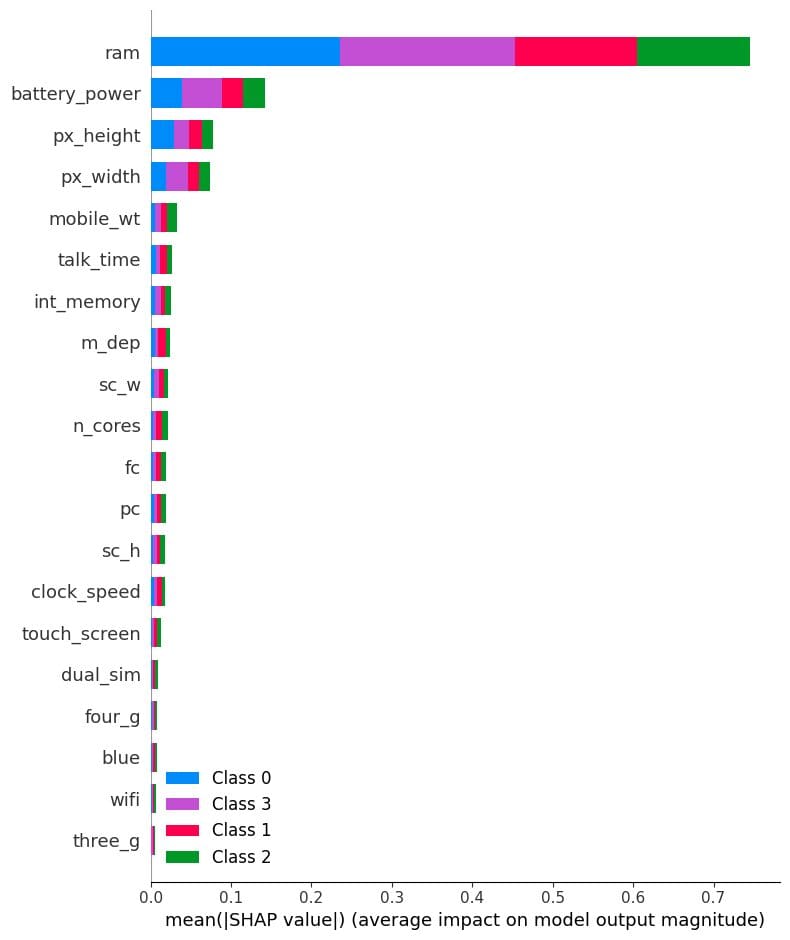
The summary plot is a graphical representation of the feature importance of each feature in the model. It is a useful tool for understanding how the model makes predictions and for identifying the most important features.

In our case, it shows feature importance per target class. It turns out the “ram”, “battery_power”, and size of the phone play an important role in determining the price range.

# Summarize the effects of features  shap.summary_plot(shap_values, X_test)

Using SHAP Values for Model Interpretability in Machine Learning

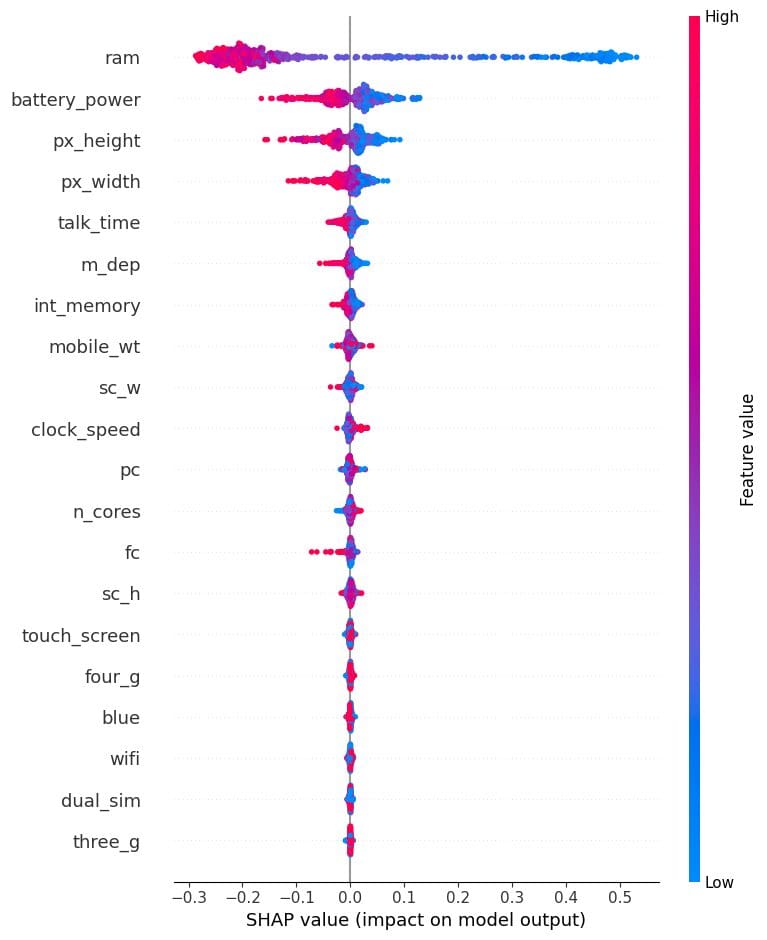
We will now visualize the future importance of the class “0”. We can clearly see that, ram, battery, and size of the phone have negative effects for predicting low cost mobile phones.

shap.summary_plot(shap_values[0], X_test)

Using SHAP Values for Model Interpretability in Machine Learning

Dependence Plot

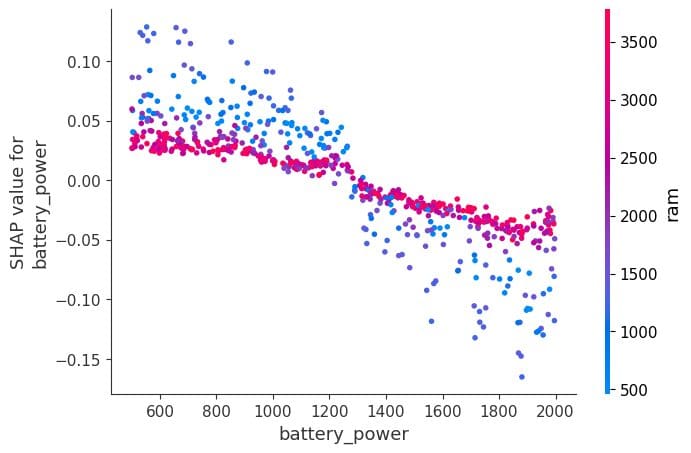
A dependence plot is a type of scatter plot that displays how a model's predictions are affected by a specific feature. In this example, the feature is “battery_power”.

The x-axis of the plot shows the values of “battery_power”, and the y-axis shows the shap value. When the battery power exceeds 1200, it begins to negatively affect the classification of lower-end mobile phone models.

shap.dependence_plot("battery_power", shap_values[0], X_test,interaction_index="ram")

Using SHAP Values for Model Interpretability in Machine Learning

Force Plot

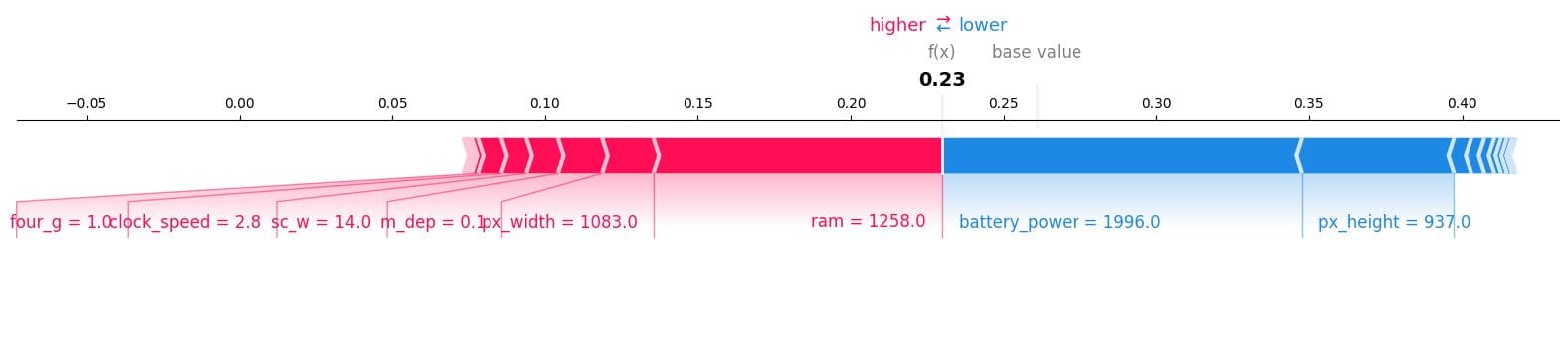
Let's narrow our focus to a single sample. Specifically, we'll take a closer look at the 12th sample to see which features contributed to the "0" result. To accomplish this, we'll use a force plot and input the expected value, SHAP value, and testing sample.

It turns out ram, phone size, and clock speed have a higher influence on models. We have also noticed that the model will not predict “0” class as the f(x) is lower.

shap.plots.force(explainer.expected_value[0], shap_values[0][12,:], X_test.iloc[12, :], matplotlib = True)

Using SHAP Values for Model Interpretability in Machine Learning

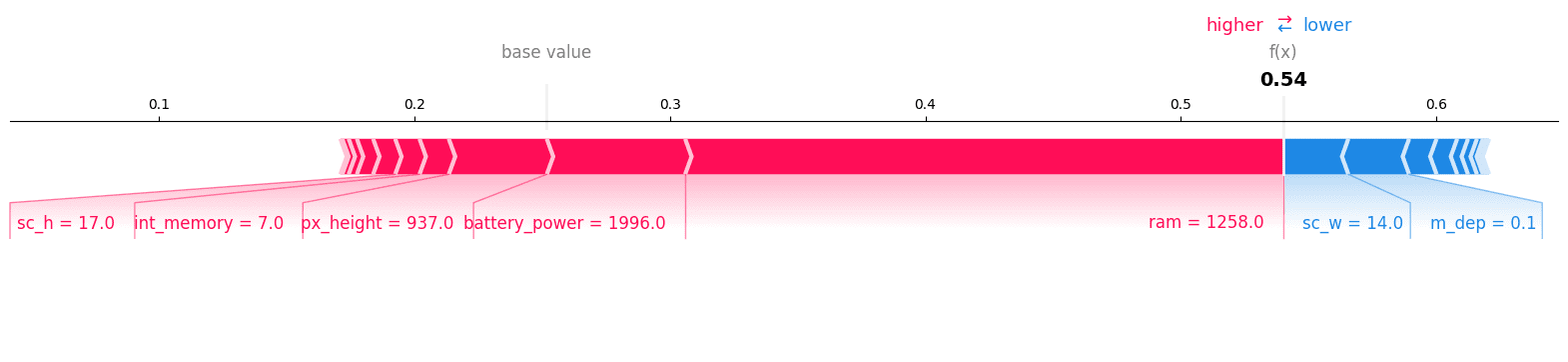
We will now visualize the force plot for the class ”1”, and we can see that it is the right class.

shap.plots.force(explainer.expected_value[1], shap_values[1][12, :], X_test.iloc[12, :],matplotlib = True)

Using SHAP Values for Model Interpretability in Machine Learning

We can confirm our prediction by checking the 12th record of the testing set.

y_test.iloc[12]  >>> 1  

Decision Plot

Decision plots can be a useful tool for understanding the decision-making process of a machine learning model. They can help us to identify the features that are most important to the model's predictions and to identify potential biases.

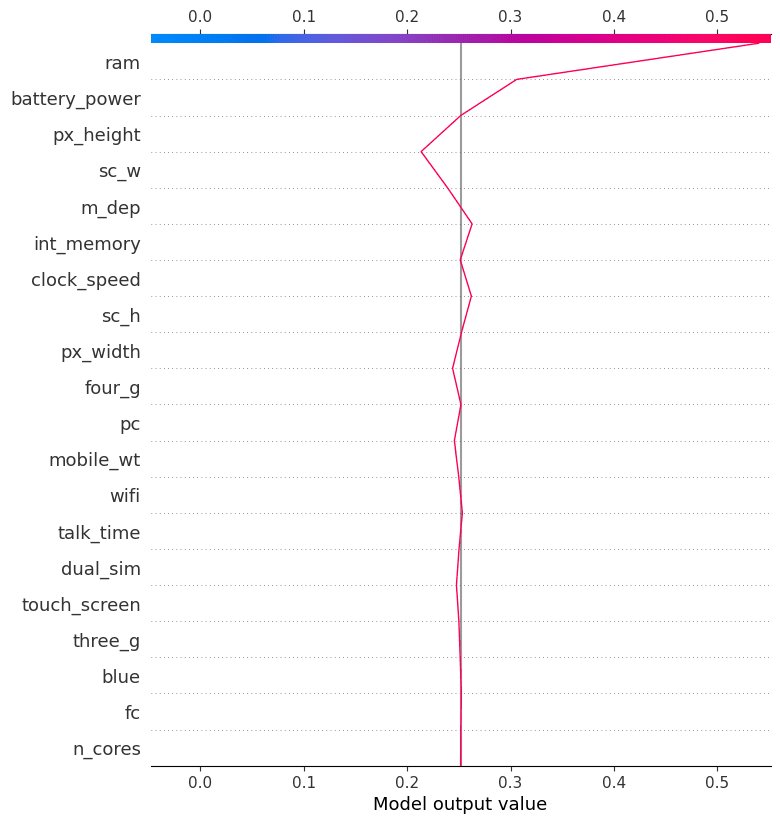
To better understand the factors that influenced the model's prediction of class "1", we will examine the decision plot. Based on this plot, it appears that phone height had a negative impact on the model, while RAM had a positive impact.

shap.decision_plot(explainer.expected_value[1], shap_values[1][12,:], X_test.columns)

Using SHAP Values for Model Interpretability in Machine Learning
Conclusion

In this blog post, we have introduced SHAP values, a method for explaining the output of machine learning models. We have shown how SHAP values can be used to explain individual predictions and the overall performance of a model. We have also provided examples of how SHAP values can be used in practice.

As machine learning expands into sensitive domains like healthcare, finance, and autonomous vehicles, interpretability and explainability will only grow in importance. SHAP values offer a flexible, consistent approach to explaining predictions and model behavior. It can be used to gain insights into how the models make predictions, identify potential biases, and improve the models' performance.
Abid Ali Awan (@1abidaliawan) is a certified data scientist professional who loves building machine learning models. Currently, he is focusing on content creation and writing technical blogs on machine learning and data science technologies. Abid holds a Master's degree in Technology Management and a bachelor's degree in Telecommunication Engineering. His vision is to build an AI product using a graph neural network for students struggling with mental illness.

More On This Topic

  • SHAP: Explain Any Machine Learning Model in Python
  • Machine Learning Is Not Like Your Brain Part 4: The Neuron’s Limited…
  • Machine Learning Model Development and Model Operations: Principles and…
  • Is Your Machine Learning Model Likely to Fail?
  • My machine learning model does not learn. What should I do?
  • Machine Learning Model Interpretation

Musk Buys AI.com From OpenAI

Musk Buys AI.com From OpenAI

As soon as some users were getting used to typing ai.com on their search bars and getting redirected to ChatGPT, Elon Musk decided to change their habits. Now, the same domain leads to Musk’s upcoming AI company, xAI.

Sam Altman led OpenAI bought the domain in February in a bid to make AI synonymous with ChatGPT. The move was possibly to get itself ahead of competitors like Google and others in the AI race. Now, being one of the co-founders of OpenAI, Musk has decided to make his company the centre of AI, and bought the username from OpenAI.

xAI’s mission statement is to “understand reality”, which is possibly to build an alternative to OpenAI’s woke chatbot. Musk had been planning to build a rival since the beginning of the year and the formation of his AI company is planning to build just that.

Read: Elon’s xAI is Here, But Y?

Furthermore, the ChatGPT user base has dropped since June. This might be for several reasons like the availability of API and general loss of interest in the chatbot. This might have also hinted Altman to believe that buying the domain ai.com has not helped the company retain any traffic on the platform.

On the other hand, OpenAI has been trying to file for a trademark on the word ‘GPT’ since March. Since then, there has been no development in that case so the company has now filed for a trademark on ‘GPT-5’, hinting that a new LLM-based model or product is possibly in the making.

According to sources, in early 2018, Musk said that he believed that OpenAI was falling behind in competition with Google. But there was a way to turn things around—by Musk taking control of OpenAI and running it himself.

All of this comes just days after Musk decided to change the name of Twitter to X and redirect X.com to the social media platform. Musk is in a race to buy domain names and make everything about X and AI related to him. But it must be important for him to focus on building and releasing an offering in the public domain to compete with the hype that OpenAI has created around its technology.

The post Musk Buys AI.com From OpenAI appeared first on Analytics India Magazine.