What Happened to Meta’s One Image to Bind it All?

Humans can conjure up the smells, sounds, and how the space would feel based on an image and the other way around. Given a picture of a beach you would know exactly how the waves would sound, the smell of salty air and the heat around you, or if you hear snoring, you can picture a person lying down in deep sleep. Meta AI’s ImageBind paper that was published in late May addresses the question – Can you bind many different and unrelated modalities together, like a human?

To ‘bind’ multiple modalities, beyond just text and images, the researchers of the paper kept images as the primary data and tested audio, heat map (a thermal camera), text, and IMU (inertial measurement which is in the family accelerometers, gyroscopes), and depth.

To link two unrelated modalities like depth and text, the researchers used contrastive learning. Keeping the image data as the primary requirement, the diagram below from the paper shows the solid bold lines representing the actual links to the image that are available in any given data.

Next, the researchers show how the emergent linking happens where now you can take a thermal and depth data points and get the right image. This capability didn’t exist before this step; it’s emergent. Using the pairs of aligned observations such as the sound of barking and the text ‘dog’, it gives the output correctly as an image of a dog. Another example given in the paper is the image of a stork and the sound of waves combines the modalities and shows images of a stork in water.

What the paper seems to be building up on is that you don’t actually need a data-pair with the image to link it together. For example, with just the depth or heat map information paired with a text (that has the actual link with the image) the user can create an image that binds all three. The paper calls this ‘emergent alignment’.

Why CLIP was the perfect choice

Meta’s Facebook has one of the largest datasets of paired images and texts. Curiously, instead of using their own dataset, the researchers used OpenAI’s CLIP where it should have made sense to use their own datasets collected over the last ten years to train this model. On the other hand, there is no sign of GPT-4 multimodal architecture.

Hugo Ponte, a robotics researcher, however explains in some detail why it was a genius move by Meta to use CLIP instead.

CLIP is a model that has created an embedding space shared for both images and language making it ridiculously powerful and useful. The addition of ImageBind on the CLIP dataset makes the model not only for text but pretty much all the other modalities mentioned as in the paper. If the user has audio, IMU, heat map, depth, and text data you can create an image that is closest to that data.

Ponte further breaks down the paper and the authors’ reason for selecting CLIP – “I see that it’s a genius move that they didn’t change the CLIP embedding space which now means that you can actually go back to every single paper that uses CLIP that people have released for the last three years, and you can just plug this (ImageBind)in instead.”

Using ImageBind, we can project anything into CLIP. “They extended CLIP, they didn’t replace it, but made it even better because CLIP works on contrastive learning as well where you need paired examples of the image and the text on what the image shows,” added Ponte.

Further the ImageBind authors have employed a Vision Transformer (ViT), a common architecture nowadays to create similar embeddings for related concepts across different modalities, like associating “dog” with an image of a dog.

What’s next for ImageBind

Meta released the code as open source but funnily enough it is not available for commercial purposes which limits the use cases so far. Yet, developers have built in a clever search engine demo using ImageBind. The search engine retrieves AI-generated images using text, audio or even visual inputs.

Yann LeCun, Meta AI chief, said that the model wasn’t released publicly probably for legal reasons, or it could be because it is just the initial paper with such a wide number of modalities. This has slowed down the adoption of the paper with only a few demos developed on it. The extensive modalities however look like it’s a step towards Yann Lecun approach to AGI. The model so far, can learn from different ‘senses’ to produce the right image mimicking how humans perceive the world.

The post What Happened to Meta’s One Image to Bind it All? appeared first on Analytics India Magazine.

PyTorch Tips to Boost Your Productivity

PyTorch Tips to Boost Your Productivity
Image by Author
Introduction

Have you ever spent hours debugging a machine learning model but can’t seem to find a reason the accuracy does not improve? Have you ever felt everything should work perfectly but for some mysterious reason you are not getting exemplary results?

Well no more. Exploring PyTorch as a beginner can be daunting. In this article, you explore tried and tested workflows that will surely improve your results and boost your model’s performance.

1. Overfit a Single Batch

Ever trained a model for hours on a large dataset just to find the loss isn’t decreasing and the accuracy just flattens? Well, do a sanity check first.

It can be time-consuming to train and evaluate on a large dataset, and it is easier to first debug models on a small subset of the data. Once we are sure the model is working, we can then easily scale training to the complete dataset.

Instead of training on the whole dataset, always train on a single batch for a sanity check.

batch = next(iter(train_dataloader)) # Get a single batch    # For all epochs, keep training on the single batch.  for epoch in range(num_epochs):      inputs, targets = batch          predictions = model.train(inputs)

Consider the above code snippet. Assume we already have a training data loader and a model. Instead of iterating over the complete dataset, we can easily fetch the first batch of the dataset. We can then train on the single batch to check if the model can learn the patterns and variance within this small portion of the data.

If the loss decreases to a very small value, we know the model can overfit this data and can be sure it is learning in a short time. We can then train this on the complete dataset by simply changing a single line as follows:

# For all epochs, iterate over all batches of data.  for epoch in range(num_epochs):      for batch in iter(dataloader):          inputs, targets = batch              predictions = model.train(inputs)

If the model can overfit a single batch, it should be able to learn the patterns in the complete dataset. This overfitting batch method enables easier debugging. If the model can not even overfit a single batch, we can be sure there is a problem with the model implementation and not the dataset.

2. Normalize and Shuffle Data

For datasets where the sequence of data is not important, it is helpful to shuffle the data. For example, for the image classification tasks, the model will fit the data better if it is fed images of different classes within a single batch. Passing data in the same sequence, we risk the model learning the patterns based on the sequence of data passed, instead of learning the intrinsic variance within the data. Therefore, it is better to pass shuffled data. For this, we can simply use the DataLoader object provided by PyTorch and set shuffle to True.

from torch.utils.data import DataLoader    dataset = # Loading Data  dataloder = DataLoader(dataset, shuffle=True)

Moreover, it is important to normalize data when using machine learning models. It is essential when there is a large variance in our data, and a particular parameter has higher values than all the other attributes in the dataset. This can cause one of the parameters to dominate all the others, resulting in lower accuracy. We want all input parameters to fall within the same range, and it is better to have 0 mean and 1.0 variance. For this, we have to transform our dataset. Knowing the mean and variance of the dataset, we can simply use the torchvision.transforms.Normalize function.

import torchvision.transforms as transforms    image_transforms = transforms.Compose([  	transforms.ToTensor(),  	# Normalize the values in our data  	transforms.Normalize(mean=(0.5,), std=(0.5))  ])

We can pass our per-channel mean and standard deviation in the transforms.Normalize function, and it will automatically convert the data having 0 mean and a standard deviation of 1.

3. Gradient Clipping

Exploding gradient is a known problem in RNNs and LSTMs. However, it is not only limited to these architectures. Any model with deep layers can suffer from exploding gradients. Backpropagation on high gradients can lead to divergence instead of a gradual decrease in loss.

Consider the below code snippet.

for epoch in range(num_epochs):  	for batch in iter(train_dataloader):      	inputs, targets = batch      	predictions = model(inputs)     	      	       	optimizer.zero_grad() # Remove all previous gradients      	loss = criterion(targets, predictions)      	loss.backward() # Computes Gradients for model weights     	       	# Clip the gradients of model weights to a specified max_norm value.      	torch.nn.utils.clip_grad_norm_(model.parameters(), max_norm=1)     	       	# Optimize the model weights AFTER CLIPPING      	optimizer.step()

To solve the exploding gradient problem, we use the gradient clipping technique that clips gradient values within a specified range. For example, if we use 1 as our clipping or norm value as above, all gradients will be clipped in the [-1, 1] range. If we have an exploding gradient value of 50, it will be clipped to 1. Thus, gradient clipping resolves the exploding gradient problem allowing a slow optimization of the model toward convergence.

4. Toggle Train / Eval Mode

This single line of code will surely increase your model’s test accuracy. Almost always, a deep learning model will use dropout and normalization layers. These are only required for stable training and ensuring the model does not either overfit or diverge because of variance in data. Layers such as BatchNorm and Dropout offer regularization for model parameters during training. However, once trained they are not required. Changing a model to evaluation mode disables layers only required for training and the complete model parameters are used for prediction.

For a better understanding, consider this code snippet.

for epoch in range(num_epochs):        	# Using training Mode when iterating over training dataset  	model.train()  	for batch in iter(train_dataloader):      	    # Training Code and Loss Optimization        	# Using Evaluation Mode when checking accuarcy on validation dataset  	model.eval()  	for batch in iter(val_dataloader):      	    # Only predictions and Loss Calculations. No backpropogation      	    # No Optimzer Step so we do can omit unrequired layers.

When evaluating, we do not need to make any optimization of model parameters. We do not compute any gradients during validation steps. For a better evaluation, we can then omit the Dropout and other normalization layers. For example, it will enable all model parameters instead of only a subset of weights like in the Dropout layer. This will substantially increase the model’s accuracy as you will be able to use the complete model.

5. Use Module and ModuleList

PyTorch model usually inherits from the torch.nn.Module base class. As per the documentation:

Submodules assigned in this way will be registered and will have their parameters converted too when you call to(), etc.

What the module base class allows is registering each layer within the model. We can then use model.to() and similar functions such as model.train() and model.eval() and they will be applied to each layer within the model. Failing to do so, will not change the device or training mode for each layer contained within the model. You will have to do it manually. The Module base class will automatically make the conversions for you once you use a function simply on the model object.

Moreover, some models contain similar sequential layers that can be easily initialized using a for loop and contained within a list. This simplifies the code. However, it causes the same problem as above, as the modules within a simple Python List are not registered automatically within the model. We should use a ModuleList for containing similar sequential layers within a model.

import torch  import torch.nn as nn      # Inherit from the Module Base Class  class Model(nn.Module):        def __init__(self, input_size, output_size):      	    # Initialize the Module Parent Class      	    super().__init__()        	     self.dense_layers = nn.ModuleList()        	    # Add 5 Linear Layers and contain them within a Modulelist      	    for i in range(5):          	    self.dense_layers.append(              	    nn.Linear(input_size, 512)          	    )        	    self.output_layer = nn.Linear(512, output_size)    	def forward(self, x):        	    # Simplifies Foward Propogation.       	    # Instead of repeating a single line for each layer, use a loop      	    for layer in range(len(self.dense_layers)):          	x = layer(x)        	    return self.output_layer(x)

The above code snippet shows the proper way of creating the model and sublayers with the model. Th use of Module and ModuleList helps avoid unexpected errors when training and evaluating the model.

Conclusion

The above mentioned methods are the best practices for the PyTorch machine learning framework. They are widely used and are recommended by the PyTorch documentation. Using such methods should be the primary way of a machine learning code flow, and will surely improve your results.
Muhammad Arham is a Deep Learning Engineer working in Computer Vision and Natural Language Processing. He has worked on the deployment and optimizations of several generative AI applications that reached the global top charts at Vyro.AI. He is interested in building and optimizing machine learning models for intelligent systems and believes in continual improvement.

More On This Topic

  • Top 6 Tools to Improve Your Productivity on Snowflake
  • Maximize Your Productivity as a Data Scientist by Organizing
  • 7 AI-Powered Tools to Enhance Productivity for Data Scientists
  • How to label time series efficiently – and boost your AI
  • 5 ChatGPT Features to Boost your Daily Work
  • Boost Your AI and ML Skills for Free at NVIDIA Conference

VMware Introduces Private AI Offerings to Drive Enterprise Adoption of GenAI

At VMware Explore 2023, VMware has introduced new Private AI offerings to drive enterprise adoption of generative AI and tap into the value of trusted data.

Private AI is an architectural approach that unlocks the business gains from AI with the practical privacy and compliance needs of an organisation.

VMware Private AI is bringing compute capacity and AI models to where enterprise data is created, processed, and consumed, whether that is in a public cloud, enterprise data centre, or at the edge.

With these new offerings, VMware is helping customers combine the flexibility and control required to power a new generation of AI-enabled applications that will help dramatically increase worker productivity, ignite transformation across major business functions, and drive economic impact.

To make Private AI a reality for enterprises and fuel a new wave of AI-enabled applications, VMware also announced VMware Private AI Foundation with NVIDIA, extending the companies’ strategic partnership to ready enterprises that run VMware’s cloud infrastructure for the next era of generative AI.

Additionally, VMware announced Private AI Reference Architecture for Open Source to help customers achieve their desired AI outcomes by supporting best-in-class open-source software (OSS) technologies today and in the future.

“The remarkable potential of generative AI cannot be unlocked unless enterprises are able to maintain the privacy of their data and minimize IP risk while training, customising, and serving their AI models. With VMware Private AI, we are empowering our customers to tap into their trusted data so they can build and run AI models quickly and more securely in their multi-cloud environment,” Raghu Raghuram, CEO, VMware said.

The post VMware Introduces Private AI Offerings to Drive Enterprise Adoption of GenAI appeared first on Analytics India Magazine.

Google DeepMind’s Unlikely Route of AI Stock Images

In an attempt to eliminate misleading representation of AI in ‘stock imagery and pop culture’, Google DeepMind released Visualising AI. By partnering with artists, various artworks depicting AI themes related to research, technologies, and real-world consequences, such as artificial general intelligence (AGI), robotics, neuroscience, sustainability, and generative AI have been created. The images are available on stock-free image sites Unsplash and Pexels. With this, Google DeepMind forays into imagery — a new route that the company is paving for itself.

Breaking Stereotypes

The portrayal of AI usually overlooks worldwide viewpoints, leading to an absence of diversity that can magnify societal inequalities — visualising AI looks to address this. With a preconceived notion of how AI is depicted through streams of code, blue brains or white robots with men in suits, the repository of new images will contain artist-envisioned images inspired by conversations with scientists, engineers, and ethicists from Google DeepMind.

All the art work — image and motion graphics — is available for anyone to download free of charge. Since its launch, Visualising AI has engaged with 13 artists and has created over 100 artworks which has gained over 100 million views and 800,000 downloads. These have been used by media outlets, research and civil society organisations.

The Image Ride

From robotics, protein folding, and maybe even AGI to this, Google DeepMind’s recent fascination with imagery is quite offbeat. However, Google has experimented with a number of image tools. Google’s text-to-image diffusion model Imagen, which is built on large transformer language models, was released in the beta mode. Google had also launched Muse, a text-to-image transformer model, and StyleDrop which allows the synthesis of images in a specific style using the Muse text-image model.

Looking at other image generation tools in the market, Google has not been able to have a hold over the market. Midjourney, Stable Diffusion, Dall-E 2, and now with Adobe, Canva and other players, the market is being crowded with consumers spoilt for choice. Furthermore, OpenAI is said to be working on their next image-generation tool which is said to be better than Midjourney.

While not being an image-generation tool, Visualising AI has entered the global stock images and video market, extending its influence in this domain. In 2022, the market size of worldwide stock images and videos was assessed at approx. $4.96 billion. By 2028, the market is expected to rise to $7.33 billion. The surge in digital media and heightened need for visual content across diverse industries has led to substantial market growth.

Way Through Partnerships

Recently, Google partnered with Adobe to bring Firefly and Express to Bard. The integration will allow users to generate Firefly images within Bard and these images can be further modified using Express. With Big Techs wanting to diversify into domains that are not their main stream of business, partnerships have been the recent go-to strategy. However, each of the partnerships usually has a larger implication for the company in question.

OpenAI has been actively partnering with a diverse range of companies, from media to product firms. Notably, they acquired Global Illumination, a product company which employs AI for crafting creative tools. OpenAI’s collaborations extend to news media such as Associated Press and American Journalistic Project too, aiming to gain a foothold in the media industry and enhance model training.

With Visualising AI, Google DeepMind partnering with artists to provide images on Pexels and Unsplash might just be the beginning. While currently it is offering images on AI and other technologies in the same space, it is possible that in the future Google DeepMind might venture into other image categories. Considering how other companies are vigorously pursuing image-generation tools, Google DeepMind might be slowly catching up.

The post Google DeepMind’s Unlikely Route of AI Stock Images appeared first on Analytics India Magazine.

Upwork Reveals Top 10 Generative AI-Related Skills and Hires in 2023

Working generative AI concept.
Image: Ewa/Adobe Stock

It is not hyperbole to say that generative AI is ubiquitous, so it comes as no surprise that companies are planning to hire more people as a result of the technology. Due to generative AI, 49% of hiring managers will hire more independent talent, while 49% will hire more full-time employees. These are all according to new research from Upwork in a survey of 1,400 U.S. business leaders.

AI was the fastest growing category on the work platform in the first half of 2023, with generative AI job posts up more than 1,000% in Q2 2023 compared to the end of last year. Related searches increased more than 1,500% in the same time period, the company said in a press release.

“This sentiment around hiring plus the surge of activity from companies served as strong early indications that businesses are paying significant attention to the opportunities generative AI can provide,” the Upwork release said.

Jump to:

  • Diverse use cases for generative AI
  • Top 10 generative AI-related searches by companies
  • Fastest-growing generative AI-related searches
  • Top 10 gen AI-related projects clients hired freelancers for
  • Generative AI-related skills on talent profiles
  • How to respond to the generative AI frenzy

Diverse use cases for generative AI

When it comes to generative AI, ChatGPT was the first tool that sparked public attention, according to Dr. Kelly Monahan, managing director of the Upwork Research Institute. Upwork’s platform data shows that many of the searches at the beginning of the year were from people coming and looking for freelancers with ChatGPT skills, but that is changing, Monahan told TechRepublic.

Now, as people have become more knowledgeable about the capabilities of generative AI, “they are beginning to develop a deeper understanding of the actual applicational uses of the technology,” she said. “This maturity cycle is reflected in the fastest-growing generative AI-related searches.”

SEE: Upwork Launches New Generative AI Tools and Services Hub (TechRepublic)

Instead of looking for just a single tool, like ChatGPT, Monahan added, “They are searching for the diverse use cases of generative AI technologies like AI content creation, services like Gradio (which is used for building machine learning web apps) and prompt engineering.”

Top 10 generative AI-related searches by companies

These are the top 10 generative AI-related searches by companies from Jan. 1 to June 30, 2023, on Upwork.

  1. ChatGPT.
  2. BERT.
  3. Stable Diffusion.
  4. TensorFlow.
  5. AI chatbot.
  6. Generative AI.
  7. Image processing.
  8. PyTorch.
  9. Natural language processing.
  10. Bard.

SEE: ChatGPT vs Google Bard (2023): An In-Depth Comparison (TechRepublic)

Fastest-growing generative AI-related searches

These are the fastest-growing generative AI-related searches on Upwork in the same timeframe (Q2 2023 vs. Q1 2023).

  1. AI content creation.
  2. Gradio.
  3. Azure OpenAI.
  4. Convolutional neural network.
  5. Large language models.
  6. Generative AI.
  7. AI chatbot.
  8. Midjourney.
  9. Prompt engineering.
  10. PyTorch.

SEE: Hiring kit: Prompt engineer (TechRepublic Premium)

Top 10 gen AI-related projects clients hired freelancers for

These are the top 10 generative AI-related projects clients hired freelancers for in the first half of 2023.

  1. ChatGPT.
  2. Natural language processing.
  3. TensorFlow.
  4. Image processing.
  5. PyTorch.
  6. AI content creation.
  7. Midjourney.
  8. AI chatbot.
  9. Model tuning.
  10. Stable Diffusion.

Among freelance professionals, Upwork said it has seen “a growing supply of independent talent with generative AI skills” on its platform in the first half of 2023. Independent professionals on Upwork have completed more than 20,000 projects involving AI work in the last year alone.

However, the company noted, it did not see interest in specific skills like prompt engineering — which is the practice of crafting prompts to elicit responses from the language model — until the second quarter of 2023.

Generative AI-related skills on talent profiles

These are the generative AI-related skills listed on Upwork talent profiles with the largest quarter-over-quarter growth (Q2 2023 vs. Q1 2023).

  1. Large language model.
  2. Generative AI.
  3. You Only Look Once.
  4. Object detection.
  5. Stable Diffusion.
  6. Prompt engineering.
  7. ChatGPT.
  8. Azure OpenAI.
  9. AI chatbot.
  10. AI text-to-speech.

As Upwork has seen in the past, independent talent continues to be on the cutting edge of emerging technologies, the company said. Freelancers are “quickly recognizing, learning and mastering” skills so they can provide businesses with the specialized knowledge and deep understanding of artificial intelligence principles, techniques, algorithms and methodologies required to maximize generative AI’s full potential.

SEE: Forrester’s Top 10 Emerging Technologies in 2023 and Beyond (TechRepublic)

How to respond to the generative AI frenzy

“Companies and professionals should adopt a generative AI plus mentality in their work,” Monahan said. “What I mean by this is that everyone, no matter their profession, should consider their work and how AI can be a part of that workflow.”

The process starts with having a basic fluency in the generative AI skills that impact their profession, she said.

For writers, Monahan suggested that they learn how to effectively use AI content creation tools; whereas, for creative professionals, it means understanding how to leverage tools such as Adobe’s Firefly for quick fixes or edits.

“Companies that want to encourage this should adopt a culture of learning around AI,” she added. “Whether that means providing training or access to generative AI tools or encouraging team members to take classes or certifications. Each company will figure out what works best for their own organization, but encouraging people to learn and understand generative AI is an important place to start.”

Subscribe to the Innovation Insider Newsletter

Catch up on the latest tech innovations that are changing the world, including IoT, 5G, the latest about phones, security, smart cities, AI, robotics, and more.

Delivered Tuesdays and Fridays Sign up today

Microsoft Might Soon Bring Generative AI to Paint

Microsoft Might Soon Bring AI Capabilities to Paint

Microsoft has embarked on a dynamic journey of integrating AI into its Windows 11 ecosystem. According to a report by Windows Central, the company is pushing to integrate Windows 11 applications, including Photos, Snipping Tool, and Paint with generative AI capabilities such as text-to-image.

Moreover, the image generator on Paint would use the same technology as Bing’s Image Creator, which is OpenAI’s DALL-E.

The illustration in the banner by Windows Central depicts a button labelled “Magic Paint,” accompanied by a sidebar which enables users to input an image description for the purpose of generating images. It appears that one can then transfer this resultant image onto their canvas for adjustments; however, the precise functionality is not yet definitively established.

Aside from the Paint application, Microsoft has intentions to integrate AI tools into other software such as Photos, the Camera app, and the Snipping Tool. In the context of Photos, this could encompass a novel feature facilitating the identification of individuals or objects within a photo, subsequently allowing for their extraction and insertion into other areas.

Regarding the Camera app, there’s a possibility that Microsoft will incorporate optical character recognition (OCR) technology into both applications. This advancement has the potential to empower each app to recognize text, individuals, and objects within photos or screenshots, thereby significantly simplifying the process of copying and pasting information from these sources.

Shifting focus to the Snipping Tool, insiders reveal Microsoft’s intent to incorporate OCR technology here as well. This strategic enhancement would enable Windows 11 to promptly recognise and replicate text from screenshots onto the clipboard, streamlining information utilisation.

The timeline for the rollout of these AI integrations remains ambiguous, as Microsoft is meticulously fine-tuning these concepts. An imminent event scheduled for September 21 is anticipated to unveil new Surface hardware while shedding further light on Microsoft’s AI roadmap for Windows.

Over the past year, the tech giant has consistently spotlighted AI functionalities across its product portfolio. Notably, the trend has transcended to its flagship operating system, Windows 11. Two prominent AI-driven features, Windows Studio Effects and the eagerly anticipated Windows Copilot, have already been announced, with the latter set to debut this fall.

The post Microsoft Might Soon Bring Generative AI to Paint appeared first on Analytics India Magazine.

Python in Excel Comes With a Twist

Python in Excel Comes With a Twist

Excel spreadsheets just got a major overhaul. Microsoft has announced a public preview of Python in Excel. Developers or data analysts now would not have to install any extra software to access the functionality, as Excel’s built-in connectors and Power Query will come bundled with Python integration. Microsoft has also added a PY function for Python data to be available within the grid on the spreadsheets.

In the blog, Stefan Kinnestrand from Microsoft explains that now users will be able to do advanced data analysis within the familiar Excel interface leveraging Python, which would be available on the Excel ribbon. “You can manipulate and explore data in Excel using Python plots and libraries, and then use Excel’s formulas, charts and PivotTables to further refine your insights,” he added.

This announcement comes in a partnership with Anaconda, a leading Python repository for enterprises which will include libraries such as pandas, statsmodels, seaborn, and Matplotlib. Microsoft went the cloud way here by using Anaconda Python distribution on Azure.

The features are rolling out in the Windows beta channel on Microsoft 365 Insiders and will only be available on the desktop version of Excel, and run on Microsoft Cloud.

Why the cloud way?

It is worth noting that developers and data analysts have mixed feelings about this release.

Integrating Python in Excel is something that developers have been trying to do for a long time by utilising pandas read_excel, OpenPyXL, PyXLL. But with this native integration by Microsoft, advanced spreadsheet users can integrate scripts in Python language and their Excel formulas in a single workbook without any additional software. This would also allow shareable experiences of a single notebook over the cloud.

The only downside that people have been concerned about is why it is wholly running on the cloud and not locally. Python can run perfectly well locally now and does not require a Microsoft Cloud connection to perform tasks. Though there are essential libraries being offered through Azure Cloud, since there is no option of running it locally, people are opting out of this change.

In a Reddit discussion, a user said, “Python is such a lightweight runtime anyway, why not just include it inside the software instead of requiring internet which is probably slower than running the code natively even on a low end laptop.” Moreover, some users argue that running on the internet has possibly made scripting on Google Docs a nightmare.

On the other hand, people say that though Python is lightweight, running libraries like Scipy and matplotlib requires heavy computation. To make up for this, Microsoft has integrated it within its cloud services, making it widely available. Or as someone pointed out, it is merely to earn some bucks on the cloud for Microsoft by getting more people to subscribe to their cloud services.

Well, whatever works for now

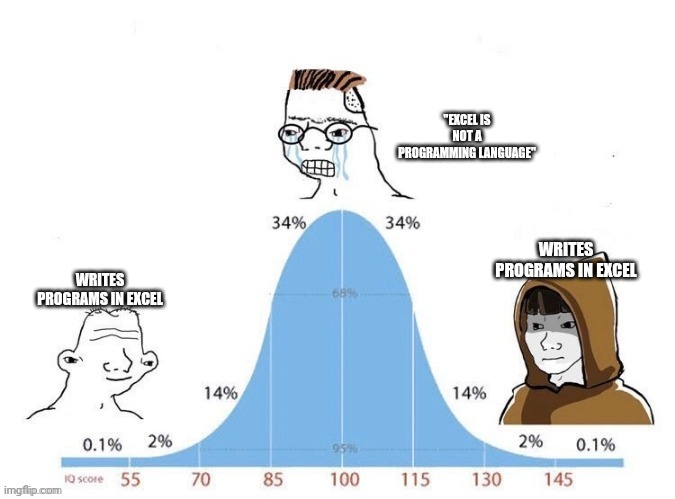
People have been arguing for a long time that Python has been eating up Excel’s market share for a long time, even calling it as dead. But people still find Excel most comfortable for data analysis. Undoubtedly, integrating Python in Excel marks as a huge step for people trying to leverage Python when working on Excel, and would single handedly modernise data analysis on the software. Looks like people saying Excel is not a programming language are going to return to it soon and people on Excel would start learning Python soon.

Even then, hosting it solely on the cloud brings up the point of security and data privacy, even after partnering with Anaconda for it. To address the privacy issue, Microsoft has said that they are providing “enterprise-level security”, which means that the code would be running on cloud isolated containers and would not have network access, which would arguably still be dicey for a lot of customers.

“The cloud part is going to be a huge deal breaker in so many industries. This will automatically be blocked by default at my work place for certain,” said a user on HackerNews.

Companies that allow the use of Excel and Python locally, and want to integrate both functionalities in one framework, would still not be happy by shipping their data and Python code on a server outside of theirs.

This marks as a significant step for the future where running coding generative AI applications on Excel would be a thing. In January, Microsoft had announced that they would be experimenting with GPT into their office applications.

Interestingly Microsoft has been following this path all this while – acquiring Github – acquiring OpenAI that helped them make Copilot for writing Python code – Code interpreter on ChatGPT – AI assistance on PowerBI – to now Python in Excel. What’s Next? Will it be AI writing Python on our excel sheets? Exciting times ahead!

The post Python in Excel Comes With a Twist appeared first on Analytics India Magazine.

Hugging Face Introduces IDEFICS, Open GPT-4 Styled MultiModal 

Hugging Face introduced IDEFICS (Image-aware Decoder Enhanced à la Flamingo with Interleaved Cross-attentionS), an open-access visual language model which accepts arbitrary sequences of images and texts and produces text.

IDEFICS, an 80 billion parameter multimodal model, is designed to process combinations of images and texts and generate coherent textual responses. Its capabilities include image-related inquiries, visual descriptions, and crafting narratives based on multiple images.

It is based on Flamingo, a state-of-the-art visual language model initially developed by DeepMind, which has not been released publicly.

IDEFICS underwent training using a blend of openly accessible datasets, including Wikipedia, Public Multimodal Dataset, and LAION. Additionally, we introduced a novel dataset named OBELICS, comprising 141 million interwoven image-text documents sourced from the internet, encompassing a vast collection of 353 million images.

IDEFICS serves as an open-access counterpart to Flamingo, showcasing performance on par with the proprietary model across diverse image-text comprehension assessments and comes in two variants—the base version and the instructed version. Each variant is available in the 9-billion and 80-billion parameter sizes.

Interestingly, OpenAI hasn’t been able to make ChatGPT multimodal yet. Also as of now, the multimodal features of GPT-4 are not accessible in the APIs. OpenAI’s blog post mentions that users can currently make text-only requests to the GPT-4 model, and the capability to input images is still in a limited alpha stage.

OpenAI introduced Code Interpreter in ChatGPT Plus. Many termed it as the GPT-4.5 moment but interestingly it was just old-school OCR from Python libraries and didn’t use multimodal for image generation.

Apart from IDEFICS, as of now Bard and Bing also accept images as input and creates text. You can try IDEFICS here.

The post Hugging Face Introduces IDEFICS, Open GPT-4 Styled MultiModal appeared first on Analytics India Magazine.

India Races Ahead in AI Skills Race, Ranks 4th Globally

Generative AI going mainstream has led people to tailor their resumes as well as LinkedIn profiles. The share of Indian members who have added AI skills to their LinkedIn profiles is 14x as compared to January 2016, highlighted in the latest report by the professional networking platform.

The Indian economy contributes to the landscape with a workforce of 47 lakh techies. But even the world’s most techie populous nation has started to run out of the demanding AI workforce. While 416,000 professionals are engaged in AI and data science in India, a Nasscom report exposed a gaping demand for 213,000 more professionals, predicted to worsen in the next couple of years. The World Economic Forum’s recent report adds that India’s job landscape will shift by 22% in the next five years, largely due to emerging AI roles.

Searches > Posting

While the Indian economy grapples with the talent crunch, companies are ready to pay AI experts enough to retire early.

Job postings for genAI roles surged by 50% from July 2022 to July 2023 on Indeed, a job-seeking platform, according to Insider. Searches for these positions skyrocketed by 12,300% during the same period, highlighting the growing interest. Bangalore, often called the Silicon Valley of India, offers the highest salaries for ML experts, as per upGrad. In contrast, Chennai’s average ML salaries are 5% lower than the national average.

Companies like HyperVerge, Razorthink, IQVIA, are paying a handful of lakhs for machine learning engineer posts. Data analysts with programming skills can get the highest salary of data scientists in India as per upGrad. Computer vision engineers are being paid up to INR 21 lakhs. Furthermore, an AI researcher’s salary in India ranges between INR 3.0 lakhs to 35.0 lakhs with an average of 9.0 lakhs. Other roles like deep learning engineer, AI product manager and AI consultants have also seen a demand surge in the job market.

On the global payscale, some of these jobs, such as an AI-focused product-manager role at Netflix paying $900,000 a year, come with compensation well into the six figures. Other companies like Amazon, Google, Goldman Sachs et al. are also willing to pay top dollar for AI/ML experts well-versed with frameworks and language models.

Huge pay for AI skills isn’t new. Back in the olden days of 2017, Tom Eck, then the CTO of industry platforms at IBM, made a statement that top-tier AI researchers “are getting paid the salaries of NFL quarterbacks, which tells you the demand and the perceived value.”

GenAI In-Demand

Overall the number of job listings referencing GPT or ChatGPT on LinkedIn has substantially grown 21-fold since ChatGPT’s debut in November 2022. Not only are job postings increasing, but more members on the platform globally are adding AI skills to their profiles than ever before. In June 2023, the number of AI-skilled members was 9x more than in 2016.

The report covered 25 countries and tracked 121 AI skills highlighting noteworthy trends. In 2022, among the swiftly growing AI-related skills added to user profiles, all top five skills were “hinting at the emergence of generative AI”. These included abilities like question-answering, which saw an impressive 332% increase, as well as classification and recommender systems.

Likewise, Microsoft’s 2023 Work Trend Index identified three essential skills by industry leaders: analytical judgment, flexibility, and emotional intelligence.

LinkedIn has also shown an increased emphasis on AI. Since April, posts about generative AI have risen by 25% monthly. Profiles mentioning specific genAI keywords, such as “GAI,” “ChatGPT,” “Prompt Engineering,” and “Prompt Crafting,” have surged by 75% per month since the start of the year. Owned by Microsoft, LinkedIn also introduced features in May enabling users to generate AI-based recruiter messages, job descriptions, and user profiles.

In theory, currently the estimation of AI job roles is proliferating the same as the rate adoption of the content creating technology. With the surge in demand, candidates need to upskill with the knowledge of the core programming languages, frameworks, and abstract concepts as the industry evolves.

The post India Races Ahead in AI Skills Race, Ranks 4th Globally appeared first on Analytics India Magazine.

Generative AI: Cybersecurity Weapon, But Not Without Adaptable, Creative (Human) Thinkers

Generative AI and cybersecurity concept.
Image: PB Studio Photo/Adobe Stock

Generative AI was — not surprisingly — the conversational coin of the realm at Black Hat 2023, with various panels and keynotes mulling the extent to which AI can replace or bolster humans in security operations.

Headshot picture of Kayne McGladrey.
Kayne McGladrey. Image: Hyperproof

Kayne McGladrey, IEEE Fellow and cybersecurity veteran with more than 25 years of experience, asserts that the human element — particularly people with diverse interests, backgrounds and talents — is irreplaceable in cybersecurity. Briefly an aspiring actor, McGladrey sees opportunities not just for techies but for creative people to fill some of the many vacant seats in security operations around the world.

Why? People from non-computer science backgrounds might see a completely different set of pictures in the cybersecurity clouds.

McGladrey, Field CISO for security and risk management firm Hyperproof and spokesperson for the IEEE Public Visibility initiative, spoke to TechRepublic at Black Hat about how cybersecurity should evolve with generative AI.

Jump to:

  • Are we still in the “ad hoc” stage?
  • Will AI support or supplant the entry-tier SOC analysts?
  • A boon for SOCs when the tar hits the fan
  • Looking outside the tech box for cybersecurity talent

Karl Greenberg: Jeff Moss (founder of Black Hat) and Maria Markstedter (Azeria Labs founder and chief executive officer) spoke during the keynote on the increasing demand for security researchers who know how to handle generative AI models. How do you think AI will affect cybersecurity job prospects, especially at tier 1 (entry level)?

Kayne McGladrey: For the past three or four or five years now, we’ve been talking about this, so it’s not a new problem. We’re still very much in that hype cycle around optimism of the potential of artificial intelligence.

Karl Greenberg: Including how it will replace entry-level security positions or a lot of those functions?

Kayne McGladrey: The companies that are looking at using AI to reduce the total number of employees they have doing cybersecurity? That’s unlikely. And the reason I say that does not have to do with faults in artificial intelligence, in individuals or faults in organizational design. It has to do with economics.

Ultimately, threat actors — whether nation-state sponsored, sanctioned or operated, or a criminal group — have an economic incentive to develop new and innovative ways to conduct cyberattacks to generate profit. That innovation cycle, along with diversity in their supply chain, is going to keep people in cybersecurity jobs, provided they’re willing to adapt quickly to new engagement.

Karl Greenberg: Because AI can’t keep pace with the constant change in tactics and technology?

Kayne McGladrey: Think about it this way: If you have a homeowner’s policy or a car policy or a fire policy, the actuaries of those (insurance) companies know how many different types of car crashes there are or how many different types of house fires there are. We’ve had this voluminous amount of human experience and data to show everything we can possibly do to cause a given outcome, but in cybersecurity, we don’t.

SEE: Used correctly, generative AI is a boon for cybersecurity (TechRepublic)

A lot of us may mistakenly believe that after 25 or 50 years of data we’ve got a good corpus, but we are at the tip of it, unfortunately, in terms of the ways a company can lose data or have it processed improperly or have it stolen or misused against them. I can’t help but think we’re still sort of at the ad hoc phase right now. We’re going to need to continuously adapt the tools that we have with the people we have in order to face the threats and risks that businesses and society continue to face.

Will AI support or supplant the entry-tier SOC analysts?

Karl Greenberg: Will tier-one security analyst jobs be supplanted by machines? To what extent will generative AI tools make it more difficult to gain experience if a machine is doing many of these tasks for them through a natural language interface?

Kayne McGladrey: Machines are key to formatting data correctly as much as anything. I don’t think we’ll get rid of the SOC (security operations center) tier 1 career track entirely, but I think that the expectation of what they do for a living is going to actually improve. Right now, the SOC analyst, day one, they’ve got a checklist – it’s very routine. They have to hunt down every false flag, every red flag, hoping to find that needle in a haystack. And it’s impossible. The ocean washes over their desk every day, and they drown every day. Nobody wants that.

Karl Greenberg: … all of the potential phishing emails, telemetry…

Kayne McGladrey: Exactly, and they have to investigate all of them manually. I think the promise of AI is to be able to categorize, to take telemetry from other signals, and to understand what might actually be worth looking at by a human.

Right now, the best strategy some threat actors can take is called tarpitting, where if you know you are going to be engaging adversarially with an organization, you will engage on multiple threat vectors concurrently. And so, if the company doesn’t have enough resources, they’ll think they’re dealing with a phishing attack, not that they’re dealing with a malware attack and actually someone’s exfiltrating data. Because it’s a tarpit, the attacker is sucking up all the resources and forcing the victim to overcommit to one incident rather than focusing on the real incident.

A boon for SOCs when the tar hits the fan

Karl Greenberg: You’re saying that this kind of attack is too big for a SOC team in terms of being able to understand it? Can generative AI tools in SOCs reduce the effectiveness of tarpitting?

Kayne McGladrey: From the blue team’s perspective, it’s the worst day ever because they’re dealing with all these potential incidents and they can’t see the larger narrative that’s happening. That’s a very effective adversarial strategy and, no, you can’t hire your way out of that unless you’re a government, and still you’re gonna have a hard time. That’s where we really do need to have that ability to get scale and efficiency through the application of artificial intelligence by looking at the training data (to potential threats) and give it to humans so they can run with it before committing resources inappropriately.

Looking outside the tech box for cybersecurity talent

Karl Greenberg: Shifting gears, I ask this because others have made this point: If you were hiring new talent for cybersecurity positions today, would you consider someone with, say, a liberal arts background vs. computer science?

Kayne McGladrey: Goodness, yes. At this point, I think that companies that aren’t looking outside of traditional job backgrounds — for either IT or cybersecurity — are doing themselves a disservice. Why do we get this perceived hiring gap of up to three million people? Because the bar is set too high at HR. One of my favorite threat analysts I’ve ever worked with over the years was a concert violinist. Totally different way of approaching malware cases.

Karl Greenberg: Are you saying that traditional computer science or tech-background candidates aren’t creative enough?

Kayne McGladrey: It’s that a lot of us have very similar life experiences. Consequently, with smart threat actors, the nation states who are doing this at scale effectively recognize that this socio-economic populace has these blind spots and will exploit them. Too many of us think almost the same way, which makes it very easy to get on with coworkers, but also makes it very easy as a threat actor to manipulate those defenders.

Disclaimer: Barracuda Networks paid for my airfare and accommodations for Black Hat 2023.

Subscribe to the Cybersecurity Insider Newsletter

Strengthen your organization's IT security defenses by keeping abreast of the latest cybersecurity news, solutions, and best practices.

Delivered Tuesdays and Thursdays Sign up today