Android Gets a Fresh Look and New Features on Google’s 25th Anniversary 

In a major rebranding effort, Android has unveiled a new image and naming convention, aiming to align itself with the evolving needs and aspirations of its global user base.

Google on Tuesday updated the Android’s logo giving it a new 3D look. The company in the blog post said that the bugdroid — the face and most identifiable element of the Android robot — now appears with more dimension, and a lot more character.

In addition to this Google also updated the robot’s full-body appearance to ensure it can easily transition between digital and real-life environments, making it a versatile and reliable companion across channels, platforms and contexts. The company wanted bugdroid to appear as dynamic as Android itself.

One of the most noticeable changes in this rebranding effort is the elevation of the Android logo. The familiar lowercase stylization of “android” is now replaced with a capitalized “A,” placing greater emphasis on Android’s presence. The tech giant said this change is particularly significant when the Android logo is displayed alongside Google’s logo, signifying a closer integration between the two entities.

Furthermore, Android has bid adieu to its quirky nomenclature such as “Lollipop” and “Marshmallow.” In its place, Android will now use a straightforward numbering system, with the upcoming iteration being labeled “Android 14.” This strategic move seeks to ensure that Android’s releases are universally understood and accessible.

New updates for Android

Android added a new feature Image Q&A on Lookout which enhances the accessibility of visual content by employing AI to generate more comprehensive descriptions. Once a user has opened an image, they have the option to type or utilize voice commands to inquire further about the image’s contents. Moreover, Google has also added another 11 languages to the Lookout app, including Chinese, Korean, and Japanese.

Google Wallet Pass now allows for the importing of photos, enabling you to digitize passes containing barcodes or QR codes, such as gym or library cards. By simply uploading an image of the pass, you can securely store a digital version of it in your Google Wallet.

Android Auto is now adding support for Webex and Zoom audio conference calls, enabling users to seamlessly join meetings on both platforms and access schedules through your car’s display.

The final new feature is integrated with Google Assistant, allowing users to incorporate sleep-tracking data from Fitbit or Google Fit into your Google Assistant Routine.

The post Android Gets a Fresh Look and New Features on Google’s 25th Anniversary appeared first on Analytics India Magazine.

Zoom’s ‘AI Companion’ delivers new features to all paid accounts

Zoom ai companion meeting demo

Productivity applications are always looking for new approaches to implementing AI in ways that can improve the workflows of business professionals. Recently, Otter.ai, Slack, and Google Workplace unveiled new AI features and now Zoom is following suit.

This week Zoom unveiled its "AI Companion" — formerly known as Zoom IQ — which will serve as a new generative AI assistant for the video conferencing service. The assistant is meant to help automate tasks that are time-consuming and not necessarily conducive to productivity.

Also: Otter.ai launches generative AI tool to help sales teams close more deals

For example, AI Companion will help users compose chat responses with a customizable tone and length based on their prompt and response needs. Starting later this month, the assistant will be able to help compose emails and summarize unread chat messages.

The AI Companion will also assist users in better understanding and interacting with their video calls. For example, if an attendee is late for a meeting, the AI assistant can quickly catch them up.

After the meeting, attendees can revisit the AI Companion's smart recordings that automatically divide the call into smart chapters for easier user review. The Companion will also highlight important information and even create action items from the call.

If a user is unable to attend a meeting, they can visit the AI Companion's meeting summary, which includes accounts of what was said, by whom it was said, and highlights of important topics.

In the fall, other AI Companion features will include the detection of meeting intent in chat messages accompanied by an automatic scheduling button and the generation and display of ideas on a digital whiteboard for brainstorming.

Zoom also used the AI Companion announcement as an opportunity to address the recent controversy regarding the company's revised AI privacy policy. The company is reassuring users that their data will remain protected and not be used to train Zoom's or third-party AI models.

Also: 4 Zoom alternatives with better video conferencing privacy policies

"In line with our commitment to responsible AI," wrote Zoom chief product officer Smita Hashim, "Zoom does not use any of your audio, video, chat, screen sharing, attachments, or other communications-like customer content (such as poll results, whiteboard, and reactions) to train Zoom's or third-party artificial intelligence models."

Zoom's AI Companion is available at no additional cost for paid Zoom plans starting today. Users can also upgrade to a paid plan option to access AI Companion.

Artificial Intelligence

5 neat AI startups from Y Combinator’s Summer 2023 batch

5 neat AI startups from Y Combinator’s Summer 2023 batch Kyle Wiggers 8 hours

It’s that time of year again: the week when startups in Y Combinator’s latest batch present their products for media — and investor — scrutiny. Over the next two days, roughly 217 companies will present in total, a tad smaller than last winter’s 235-firm cohort as VC enthusiasm a slight slump.

In the first half of 2023, VCs backed close to 4,300 deals totaling $64.6 billion. That might sound like a lot. But the deal value represented a 49% decline from H1 2022 while the deal volume was a 35% dip year-over-year.

In a bright note, one segment — driven by equal parts hype and demand — is wildly outperforming the others: AI.

Nearly a fifth of total global venture funding from August to July came from the AI sector, according to CrunchBase. And the voraciousness is manifesting in this summer’s Y Combinator cohort, which features over double (57 versus 28) the number of AI companies compared to the winter 2022 batch.

To get a sense of what AI technologies are driving investments these days, I dove deep into the summer 2023 batch, rounding up the YC-backed AI startups that appeared to me to be the most differentiated — or hold the most promise. .

AI infrastructure startups

Several startups in the Y Combinator W2023 cohort focus not on what AI can accomplish, but on the tools and infrastructure necessary to build AI from the ground up.

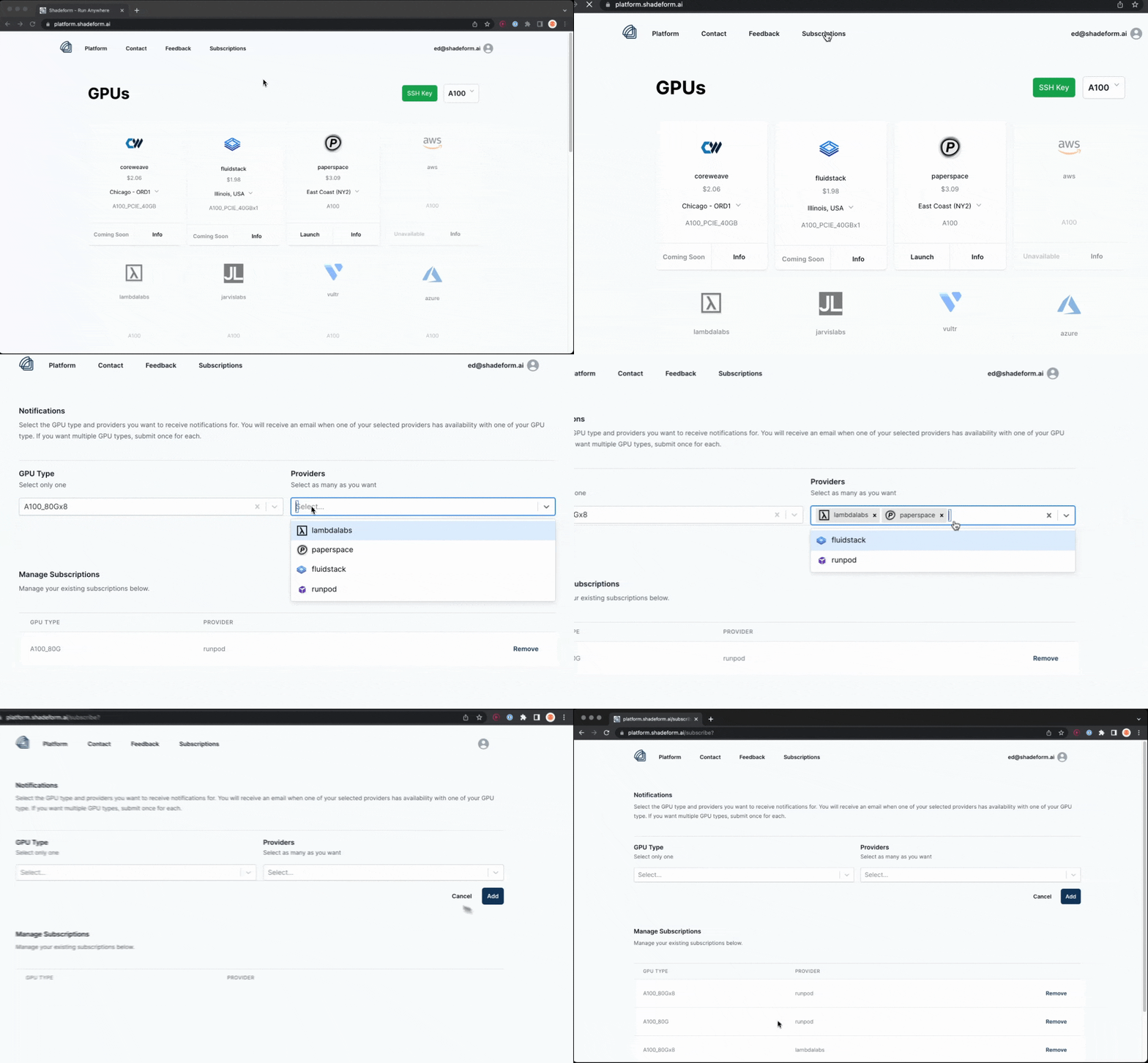
There’s Shadeform, for example, which provides a platform to enable customers to access and deploy AI training and inferencing workloads to any cloud provider. Founded by data engineers and distributed systems architects Ed Goode, Ronald Ding and Zachary Warren, Shadeform aims to ensure AI jobs run on time and at “optimal cost.”

As Goode notes in a blog post on the Y Combinator website, the explosion in demand for hardware to develop AI models, particularly GPUs, has resulted in a shortage of capacity. (Microsoft recently warned of service disruptions if it can’t get enough AI chips for its data centers.) Smaller providers are coming online, but they don’t always deliver the most predictable resources — making it difficult to scale across them.

Shadeform solves for this problem by letting customers launch AI jobs anywhere, across public cloud infrastructure. Leveraging the platform, companies can manage GPU instances on every provider from a single pane of glass, configuring “auto-reservations” when the machines they need are available or deploying into server clusters with a single click.
Shadeform

Image Credits: Shadeform

Another intriguing Y Combinator startup tackling challenges in AI operations is Cerelyze, founded by ex-Peloton AI engineer Sarang Zambare. Cerelyze is Zambare’s second YC go-around after leading the AI team at cashier-less retail startup Caper.

Cerelyze takes AI research papers — the kind typically found on open access archives like Arxiv.org — and translates the math contained within into functioning code. Why is that useful? Well, lots of papers describe AI techniques using formulas but don’t provide links to the code that was used to put them into practice. Developers are normally left having to reverse engineer the methods described in papers to build working models and apps from them.

Cerelyze seeks to automate implementation through a combination of AI models that understand language and code and PDF parsers “optimized for scientific content.” From a browser-based interface, users can upload a research paper, ask Cerylize natural language questions about specific parts of the paper, generate or modify code and run the resulting code in the browser.

Now, Cerelyze can’t translate everything in a paper to code — at least not in its current state. Zambare acknowledges that the platform’s code translation only works for a “small subset of papers” right now and that Cerelyze can only extract and analyze equations and tables from papers, not figures. But I still think it’s a fascinating concept, and I’m hoping it’ll grow and improve with time — and the right investments.

AI dev tools

Still developer-focused but not an AI infrastructure startup per se, Sweep autonomously handles small dev tasks like high-level debugging and feature requests. The startup was launched this year by William Zeng and Kevin Lu, both veterans of the video-game-turned-social-network Roblox.

“As software engineers, we found ourselves switching from exciting technical challenges into mundane tasks like writing tests, documentation and refactors,” Zeng wrote on Y Combinator’s blog. “This was frustrating because we knew large language models [similar to OpenAI’s GPT-4] could handle this for us.”

Sweep can take a code error or GitHub issue and plan how to solve it, Zeng and Lu say — writing and pushing the code to GitHub via pull requests. It can also address comments made on the pull request either from code maintainers or owners — a bit like GitHub Copilot but more autonomous.

“Sweep started when we realized some software engineering tasks were so simple we could automate the entire change,” Zeng said. “Sweep does this by writing the entire project request with code.”

Given AI’s tendency to make mistakes, I’m a little skeptical of Sweep’s reliability over the long run. Fortunately, so are Zeng and Lu — Sweep doesn’t automatically implement code fixes by default, requiring a human review and edit them before they’re pushed to the master codebase.

AI apps

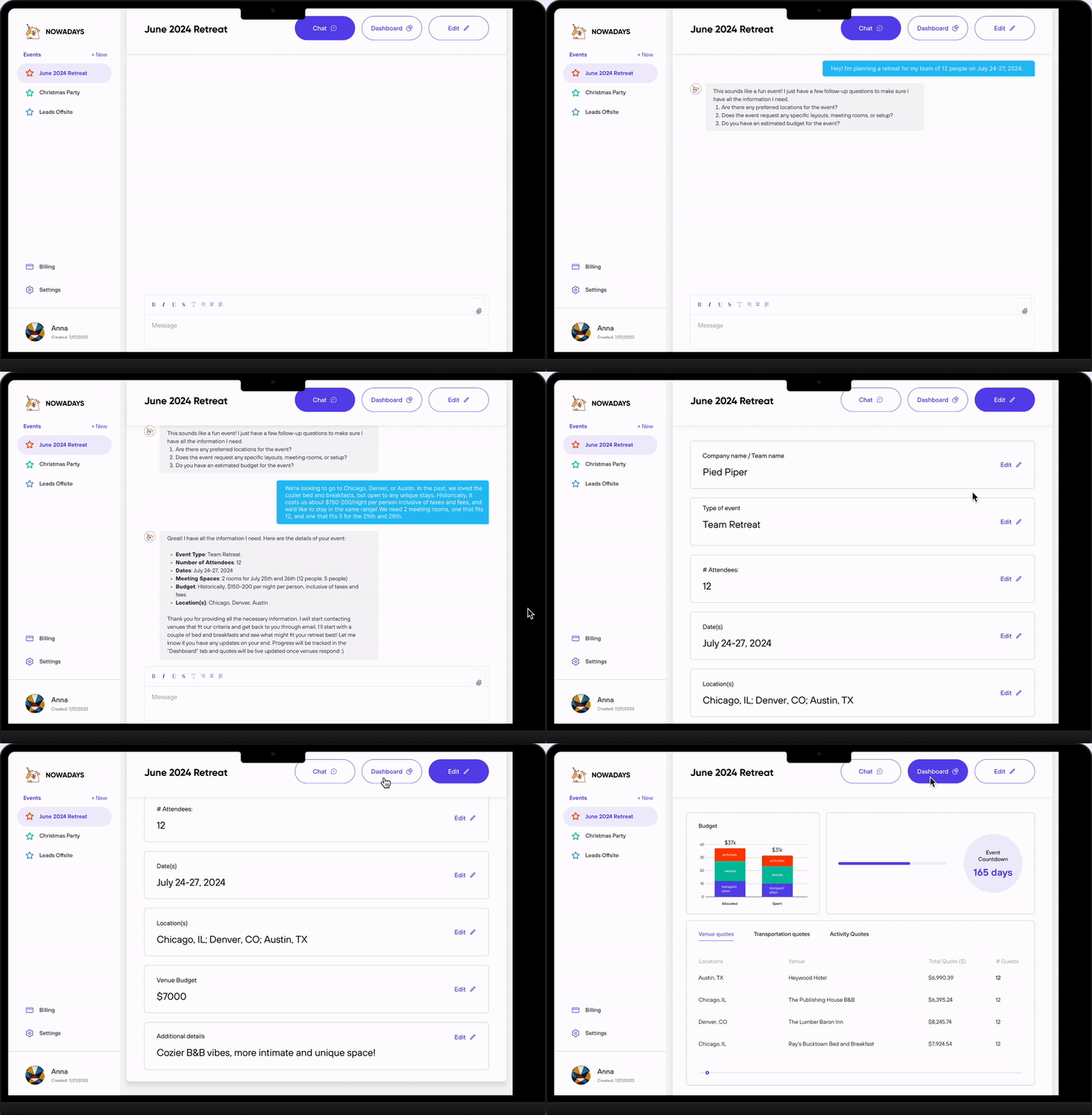
Transitioning away from the tooling subset of AI Y Combinator startups this year, we have Nowadays, which bills itself as the “AI co-pilot for corporate event planning.”

Anna Sun and Amy Yan co-founded the company in early 2023. Sun was previously at Datadog, DoorDash and Amazon while Yan held various roles at Google, Meta and McKinsey.

Not many of us have had to plan a corporate event — certainly not this reporter. But Sun and Yan describe the ordeal as arduous, needlessly tiring and expensive.

“Corporate event planners are bombarded with endless calls and emails while planning events,” Sun writes in a Y Combinator blog post. “Stressing over tight schedules, planners are paying for full-time assistants or tools that cost them over $100,000 a year.”

So, Sun and Yan thought, why not offload the most painful parts of the process to AI?

Enter Nowadays, which — provided the details of an upcoming event (e.g. dates and the number of attendees) — can automatically reach out to venues and vendors and manage relevant emails and phone calls. Nowadays can even account for personal preferences around events, like amenities near a given venue and activities within walking distance.

I should note that it isn’t entirely clear how Nowadays works behind the scenes. Is AI actually answering and placing phone calls and returning emails? Or are humans involved somewhere along the way — say for quality assurance? Your guess is as good as mine.

Nevertheless, Nowadays is a very cool idea with a potentially huge addressable market ($510.9 billion by 2030, according to Allied Market Research), and I’m curious to see where it goes next.
Nowadays

Image Credits: Nowadays

Another startup trying to abstract away traditionally manual processes is FleetWorks, the brainchild of ex-Uber Freight product manager Paul Singer and Quang Tran, who formerly worked on moonshot projects at Airbnb.

FleetWorks targets freight brokers — the essential middlemen between freight shippers and carriers. Designed to sit alongside a broker’s phone, email and transportation management system (TMS), FleetWorks can automatically book and track loads and schedule appointments with shipping facilities that lack a booking portal.

Typically, brokers have to reach out via phone or email to drivers and dispatchers for loads that aren’t being tracked automatically for updates on shipment statuses. Simultaneously, they have to juggle calls from trucking companies interesting in booking loads and negotiate on the price, as well as set appointment times for unscheduled loads.

Singer and Tran claim that FleetWorks can lighten the load (no pun intended) by triggering calls and emails and pushing all the relevant information to the TMS or email. In addition to sharing load details, the platform can discuss price and book a carrier, even calling a driver and updating account teams on issues that crop up.

“FleetWorks helps freight operators focus on high-value work by automating routine calls and emails,” Singer wrote in a Y Combinator post. “Our AI-powered platform can leverage email or use a human-like voice to make tracking calls, cover loads, and reschedule appointments.”

If it works as advertised, that sounds genuinely useful.

OpenAI Announces Its First Developer Conference ‘OpenAI DevDay’ 

OpenAI Finally Learns How to Do Business

OpenAI today announced its first developer conference OpenAI DevDay which will be held on November 6 2023 in San Francisco. OpenAI in their blog post said that the developer registration for in-person attendance will open in the coming weeks and developers everywhere will be able to livestream the keynote.

This one-day event is poised to bring together hundreds of developers from across the globe, providing them with a unique opportunity to interact with the OpenAI team, get a sneak peek at upcoming tools, and engage in knowledge exchange.

Sam Altman, CEO of OpenAI, expressed excitement about the upcoming event, stating, “We’re looking forward to showing our latest work to enable developers to build new things,”

OpenAI mentioned that today, over 2 million developers are using GPT-4, GPT-3.5, DALL·E and Whisper for a wide range of use cases—from integrating smart assistants into existing applications to building entirely new applications and services that weren’t possible before.

This conference comes on the heels of recent developments where OpenAI is looking for solutions for enterprise applications.

OpenAI recently launched ChatGPT Enterprise for businesses which offers enterprise-grade security and privacy, unlimited higher-speed GPT-4 access, longer context windows for processing longer inputs, advanced data analysis capabilities and customization options.

To attract developers OpenAI recently made fine-tuning for GPT-3.5 Turbo API available where they can customize models according to their needs and use cases. Additionally, a few weeks back, OpenAI announced Scale as its preferred partner to fine-tune GPT-3.5 for enterprises.

Moreover OpenAI has plans to add specific and more powerful tools to ChatGPT Enterprise in the coming months for specific roles, such as data analysts, marketers, customer support and others.

Through OpenAI DevDay, the company said it is looking forward to bringing together developers from around the world to explore new tools and ideas.
You can sign up for OpenAI DevDay here.

The post OpenAI Announces Its First Developer Conference ‘OpenAI DevDay’ appeared first on Analytics India Magazine.

Android Gets a Fresh Look and New Features on Google’s 25th Anniversary 

In a major rebranding effort, Android has unveiled a new image and naming convention, aiming to align itself with the evolving needs and aspirations of its global user base.

Google on Tuesday updated the Android’s logo giving it a new 3D look. The company in the blog post said that the bugdroid — the face and most identifiable element of the Android robot — now appears with more dimension, and a lot more character.

In addition to this Google also updated the robot’s full-body appearance to ensure it can easily transition between digital and real-life environments, making it a versatile and reliable companion across channels, platforms and contexts. The company wanted bugdroid to appear as dynamic as Android itself.

One of the most noticeable changes in this rebranding effort is the elevation of the Android logo. The familiar lowercase stylization of “android” is now replaced with a capitalized “A,” placing greater emphasis on Android’s presence. The tech giant said this change is particularly significant when the Android logo is displayed alongside Google’s logo, signifying a closer integration between the two entities.

Furthermore, Android has bid adieu to its quirky nomenclature such as “Lollipop” and “Marshmallow.” In its place, Android will now use a straightforward numbering system, with the upcoming iteration being labeled “Android 14.” This strategic move seeks to ensure that Android’s releases are universally understood and accessible.

New updates for Android

Android added a new feature Image Q&A on Lookout which enhances the accessibility of visual content by employing AI to generate more comprehensive descriptions. Once a user has opened an image, they have the option to type or utilize voice commands to inquire further about the image’s contents. Moreover, Google has also added another 11 languages to the Lookout app, including Chinese, Korean, and Japanese.

Google Wallet Pass now allows for the importing of photos, enabling you to digitize passes containing barcodes or QR codes, such as gym or library cards. By simply uploading an image of the pass, you can securely store a digital version of it in your Google Wallet.

Android Auto is now adding support for Webex and Zoom audio conference calls, enabling users to seamlessly join meetings on both platforms and access schedules through your car’s display.

The final new feature is integrated with Google Assistant, allowing users to incorporate sleep-tracking data from Fitbit or Google Fit into your Google Assistant Routine.

The post Android Gets a Fresh Look and New Features on Google’s 25th Anniversary appeared first on Analytics India Magazine.

Why companies must use AI to think differently, and not simply to cut costs

crystal-gettyimages-1268074980

Organizations have to look at how artificial intelligence (AI) can enable them to do things differently, rather than at a lower cost, in order to stay relevant in the future.

In fact, 21st-century companies will not be defined by the quality or the price of their products and services, but by their use of AI, said Mike Walsh, futurist and CEO of tech consultancy Tomorrow. There will be significant shifts in the way these businesses operate in the future, said Walsh, who was speaking at ST Engineering's InnoTech Conference held this week in Singapore.

Also: AI is coming to a business near you. But let's sort these problems first

Future-oriented companies will move from building products and services to developing data-powered platforms that can be reapplied to adjacent markets, he said. Tesla, for example, has expanded beyond car manufacturing to provide insurance services, using real-time driving behavior to differentiate its offerings.

Growing interest in generative AI also has pushed companies to tap their data assets and build their own large language models. This, he added, will create new proprietary data platforms that will power new types of products and services.

Rather than focus on how AI can help them do what they already are doing faster and cheaper, organizations need to think about how the technology can do things differently, Walsh said.

AI will lead to changes across four key areas encompassing scale, speed, sustainability, and scope, he said. Businesses will have to figure out the right "talent density" or workforce they need to drive their operations and be able to respond quickly to market opportunities.

However, powering the large language models that AI vendors — including Google, Meta, and OpenAI — are building will require massive computing capacity. Such increased demand underscores the need to ensure data centers are sustainable and fully powered by renewable energy sources, he noted.

Also: Generative AI will soon go mainstream, say 9 out of 10 IT leaders

Foremost, organizations must widen their scope. If they are not looking beyond using AI simply to do what they already are doing more cheaply, they are missing out on what is possible, Walsh said.

And when leveraged well, AI can fuel both businesses and economies. It will cause significant disruptions, though, which have to be managed.

AI is projected to increase global GDP by 7%, or an estimated $7 trillion, over 10 years. At the same time, it can expose two-thirds of job roles to some degree of AI automation, said Janil Puthucheary, Singapore's senior minister of state for communications and information, citing the forecasts from a Goldman Sachs report.

Cybersecurity attacks also have climbed amid accelerated digitalization, with Singapore clocking 132 reported ransomware cases last year, Puthucheary said during his speech at the conference.

Also: Generative AI and the fourth why: Building trust with your customer

He noted that local organizations need to be equipped to manage these disruptions and turn them into opportunities and competitive advantages.

Singapore, for instance, is focusing its efforts on strengthening the foundation to support its digital infrastructures, including hardware and software, he said. He pointed to initiatives such as its Digital Connectivity Blueprint, which includes plans to boost local connectivity to 10Gbps within the next five years and double submarine cable landings within a decade.

These aim to ensure organizations can better leverage latency-sensitive technologies such as AI and cloud, he said.

Policies outlined in the country's Cybersecurity Act 2018 also are under review to identify potential areas that need finetuning, so the right safeguards are in place for these digital infrastructures, he added.

Also: Leadership alert: The dust will never settle and generative AI can help

Acknowledging that Singapore is one of the most sophisticated global smart cities, Walsh said the Asian market offers a good staging ground to create platforms to do things differently and that cannot be easily replicated elsewhere.

"If you are using ChatGPT to write email for colleagues who, in turn, task a chatbot to read and summarize your messages, there is a strong possibility your organization may have missed the real point of the AI revolution," he wrote in a recent LinkedIn post. "Generative AI is neither a toy nor a fad. It is a provocative invitation to consider what the real value of human work is."

"The most forward-thinking organizations will ignore basic productivity gains from generic AI tools and, instead, explore training proprietary large language models with their own unique datasets," he added. "Only by making generative AI technologies your own can you unleash both the hidden power of your intellectual property and organizational knowledge, as well as empowering your people to do more interesting, creative, and differentiated work."

ST Engineering, for one, hopes to help its customers do so with the launch of the first of several generative AI tools.

Also: AI has the potential to automate 40% of the average workday

Called AGIL Vision, the video analytics system can perform searches based on objects, colors, actions, or human behaviors, and distinctive clothing marks such as brand logos. For example, it can seek out someone in a shopping mall wearing a blue shirt that bears a specific logo or detect people who are smoking or involved in a brawl.

The system is trained on various large language models and natural language processing, and can search for images without meta tags. Because it carries out searches based on objects or actions that fit the specified keywords, not by a person's identity, AGIL Vision addresses any concern companies may have about privacy, said an ST Engineering spokesperson.

The video analytics system can be deployed over a private cloud or on-premises, the latter of which would ensure data is transmitted within a local corporate network. It encompasses a box that connects to the company's CCTV system.

Artificial Intelligence

TinyLlama Breaks Chinchilla Scaling Law

Meta’s LLaMA and Llama 2 has been a game changer in LLMs. People thought that models couldn’t go any smaller and perform at the same capabilities as their bigger counterparts. Now, with the given small Llama, people are able to tweak it and make it even smaller, so small that people are questioning how it is even possible. The latest one, TinyLlama, is actually the most impressive one, breaking laws of scalability as well.

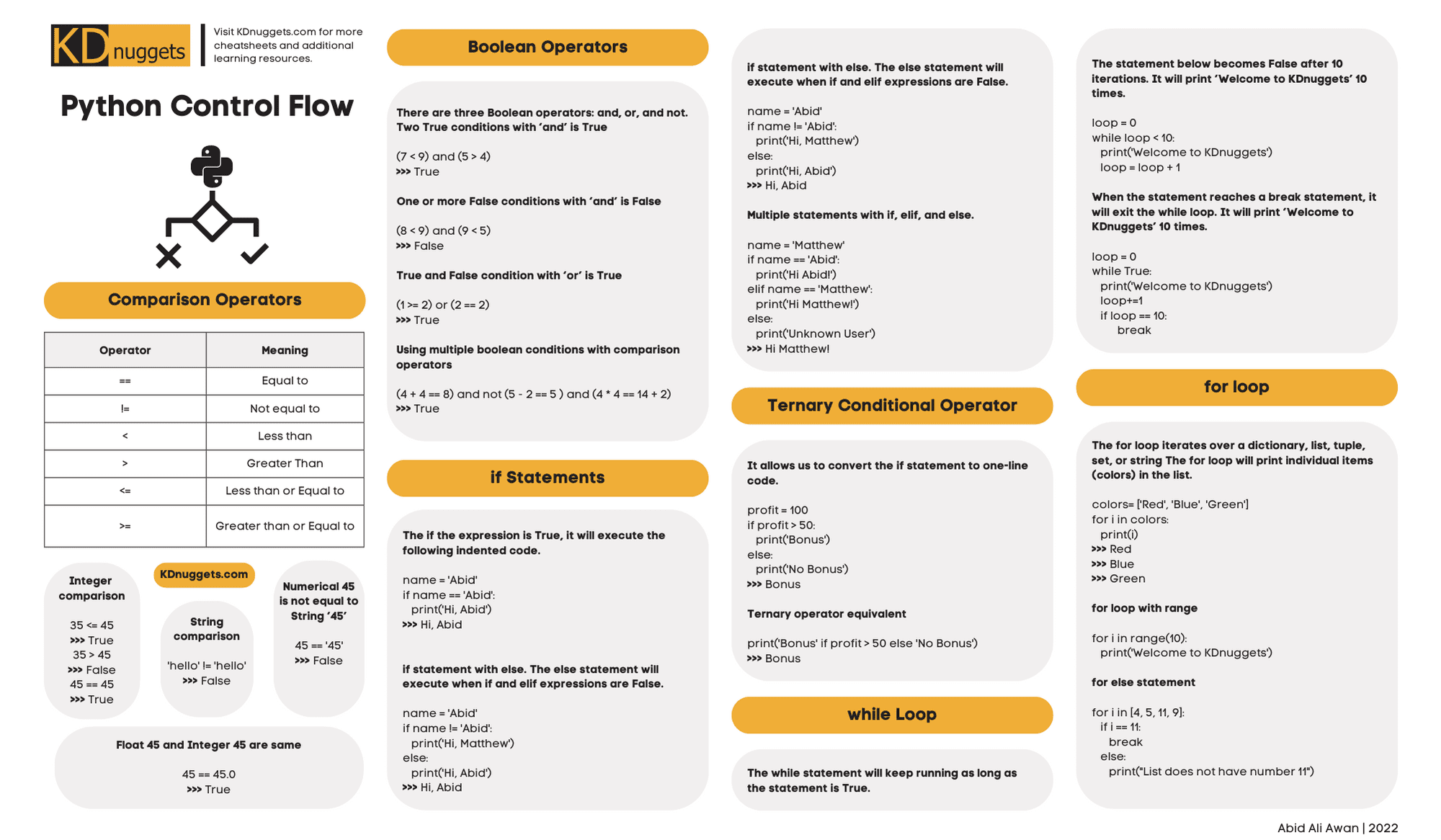
Zhang Peiyuan, research assistant at Singapore University, has started training a 1.1 billion parameter model called TinyLlama. Based on Llama 2, the ambitious part about this project is that Peiyuan aims to pre-train it on 3 trillion tokens! The idea is to achieve this within 90 days using only 16 A100-40G GPUs with 24k tokens per second per GPU. For comparison, the estimated cost to train this on AWS server would be around $40,000.

Compact Llama Pretrained for Super Long!
Presenting 🌟 TinyLlama-1.1B 🌟: A project aiming to pretrain a 1.1B Llama on 3 trillion tokens.
🔗https://t.co/FIcDkrdO2r pic.twitter.com/6POQRgqDzz
— Zhang Peiyuan (@PY_Z001) September 4, 2023

If it works, the model would set a new benchmark and serve applications that require limited computational resources as the 1.1 billion weights only occupy 550MB of RAM. But people are a little sceptical about the project.

Chinchilla steps in

The dataset of 3 trillion tokens is a mix of 70% Slimpajama and 30% Starcoderdata. “What would pre-training a 1.1 billion model for so long achieve?” said a user on HackerNews. “Doesn’t it contradict Chinchilla Scaling Law?”

Chinchilla scaling law basically says that for training a transformer based language model, to achieve optimal-compute, the number of parameters and the number of tokens for training the model should scale in approximately equal proportions.

When it comes to models like GPT or PaLM that are larger in size, the saturation point might come much much later as they have a lot of capacity to train themselves for a longer time, and thus overtake others. According to OpenAI, “We expect that larger models should always perform better than smaller models.” The company believes that a model with fixed size will be capacity-limited.

Anyone who has pre-trained a language model knows why.
Constant learning rate is not optimal. Decaying learning rate requires picking the total number of steps in advance. https://t.co/3ILLAtiYUZ

— Sherjil Ozair (@sherjilozair) August 5, 2023

In other terms, since smaller models have fewer multiplications, they run and train faster. But according to this theory, these models eventually reach a limit of their knowledge learning capacity, dropping down the speed at which they learn. For example, training 2 trillion tokens on a 7 billion model might still be better than training 3 trillion tokens on a 1 billion model.

This is the question with the TinyLlama model. Would it be even reasonable to go pre-train a model on 3 trillion tokens if there is a saturation point? According to people, the 3 trillion token is too high for a 1.1 billion model. But that’s the point of the experiment.

But, Llama disagrees

The debate about if bigger models are always better has been constantly going on and Meta with Llama has been trying to prove it wrong constantly. According to the Llama 2 paper, “We observe that after pretraining on 2 trillion Tokens, the models still did not show any sign of saturation.” This possibly gave Peiyuan the hint that training the model on 3 trillion tokens might still be a reasonable idea.

This brings up the question – if Meta believes that the Chinchilla scaling law is actually becoming a little redundant, why did the company not keep training Llama 2 beyond 2 trillion tokens and possibly release further updates to the model in fewer weeks? The only reason can be that the expected advantage from it would be too small for the company to actually gain something from it.

Or maybe the next Llama would be even tinier and trained just this way with a higher number of tokens. Meta is letting its open source community test the capabilities for them, while it might be doing the same thing behind closed doors.

The amount of information we are fitting inside smaller models has to reach a limit. This project aims to prove otherwise. While we wait and check the progress at the training phase, it would be interesting to note how TinyLlama actually kills Chinchilla scaling law. According to the first checkpoint, TinyLlama is already in competition with StableLM-Alpha-3B and Pythia-1B.

If achieved, it would be a huge feat for making AI models run on single devices. If it does not, Chinchilla might turn out to be a winner. According to Peiyuan, “I have no idea. It is an open trial which offers no promise nor target. The only target is ‘1.1B on 3T’”.

The post TinyLlama Breaks Chinchilla Scaling Law appeared first on Analytics India Magazine.

Python Control Flow Cheat Sheet

Go With the Flow

Programs aren't simply a sequence of commands each executing a single time, one after another, from the first line to the last. Programming requires the ability to loop over data, make decisions based on input, and run a command until a particular goal is reached, along with many other execution strategies.

The manner in which we control the execution of commands within a program is referred to as flow control. Since controlling the flow of code execution can have a considerable programmatic effect, computational algorithms are the combination of commands and the order in which they are executed. Without knowing how to control how your code executes, you won't accomplish much of anything as a programmer.

The state of flow control has come a long way since the days of goto. There are numerous common execution patterns that are available in the majority of modern programming languages, though their syntax differs from language to language. Python has its own, generally quite readable, set of flow controls, and that's what our latest cheat sheet focuses on.

Get ready to learn flow control, and to have a handy reference moving forward as you conquer the world of coding.

You can download the cheatsheet here.

Python Control Flow Cheatsheet

Our new quick reference cheat sheet will provide you with an understanding of implementing flow control in Python. This resource will provide an overview and quick reference for:

  • Comparison Operators
  • Boolean Operators
  • if Statements
  • Ternary Conditional Operator
  • while Loop
  • for Loop

Flow control is one one of the major aspects of programming, and as such every aspiring programmer needs to master it. Paradoxically, the exact syntax for some of these commonly-used commands and structures often need to be checked up on by programmers, even as they progress further into their careers. This cheat sheet both provides the information you need to quickly learn these strategies, along with a reference to use moving forward.

Check it out now, and check back soon for more.

More On This Topic

  • Data Cleaning with Python Cheat Sheet
  • Best Python Tools for Building Generative AI Applications Cheat Sheet
  • Python Basics: Syntax, Data Types, and Control Structures
  • Data Science Cheat Sheet 2.0
  • The ChatGPT Cheat Sheet
  • Docker for Data Science Cheat Sheet

JanAI, India’s Another LLM Ambition

Given the recent hype around generative AI in India, Jaspreet Bindra, founder of Tech Whisperer Ltd., along with Sudhir Tiwari, Managing Director at Thoughtworks, have proposed that India should build an equivalent to ChatGPT called JanAI or जन AI, or AI for the people.

In a recent piece, “our proposition, however audacious it may seem, is that India should consider building generative AI as a digital public good – we call this JanAI or GenAI for the people.”

Bindra and Tiwari propose that for this to take shape, India needs to take a collaborative approach and serve generative AI as digital public good, much like Aadhar and UPI. “We believe that this could happen through a tripartite partnership between a proactive government, our world-leading IT industry, and some leading technical institutions like the IITs.”

It isn’t for the lack of talent or government support and India has the capability to build local LLM-fine-tuned with data for Indian languages they say, but, “We believe, however, that it is more important to consider the objective and aim for such an exercise. Should India follow the western capitalist method, or the Chinese State-controlled one?”

In March, CoRover.ai announced BharatGPT which is yet to be launched. The model supports 12 Indian Languages while also hosting more than 120 foreign languages. The company offers text, audio and even video. Similarly, Bindra said that India should further fine-tune its own India-contextual LLM, calling it BharatLLM.

In July last year, The Ministry of Electronics and Information Technology (MeitY) within Digital India Corporation launched Bhashini, a repository of digital content in all Indian languages. Universal Language Contribution API (ULCA) now has the largest repository of Indian languages.

Harnessing the API, Tech Mahindra also announced an Indic-based foundational model named ‘Project Indus’. The language model will support 40 different Hindi dialects with a plan to add more languages subsequently.

While the others are ahead of the race, India is still figuring out how to gather datasets of Indic dialects to train LLMs in our language with Project Indus relying on ‘bhasha daan’.

Meanwhile, other countries are working towards ethical and responsible development like the EU, and UK. Last week, researchers from UAE in collaboration with Cerebras introduced the Arabic alternative to ChatGPT, Jais is a 13 billion parameter model based on 116 billion Arabic tokens trained on Arabic websites, books, news and Wikipedia.

The post JanAI, India’s Another LLM Ambition appeared first on Analytics India Magazine.

Can ChatGPT be used to write Arduino drivers? Yes, in the right hands

ChatGPT on laptop

If you've used Arduino technology, chances are that you've come across libraries written by Adafruit's Limor 'Ladyada' Fried for the many devices and sensors that the company has to offer.

Writing these libraries is specialized work. You have to take the datasheets crammed with binary tables and specs for all the various control chips, and turn that information into code that will work as drivers.

Also: The best Raspberry Pi alternatives available right now

As I said, it's very specialized work. And it's also the sort of stuff that most users don't see, and probably take for granted.

But could you do what everyone else is doing, and get ChatGPT to do the hard work on libraries?

Turns out the answer is yes, but there's a catch.

In a blog post, Adafruit details how Fried created a multi-step workflow, which involved asking ChatGPT to create "an arduino library in the same style as ladyada / limor fried / adafruit" for a specific chip.

After giving ChatGPT access to the datasheet for the chip, Fried then guided ChatGPT through the steps for building the required drivers.

Also: How to use ChatGPT to make charts and tables

It's pretty smart, and certainly saves a lot of typing.

However, as emphasized in the blog post, the time it takes ChatGPT to write a driver is "about the same as it would take Ladyada". In fact, a chatlog example provided in the post shows just how much handholding ChatGPT needs to keep it on track.

While ChatGPT certainly seems to take some of the manual work out of the process, it's clear that without Fried's expert eyes carefully overseeing the proceedings, the AI bot would make a mess of things.

This result is to be expected, because — despite the hype — ChatGPT is a large language model-based chatbot. Very often, it's not as clever as it confidently thinks it is.

And that issue is at the core of much of the misunderstanding surrounding ChatGPT. If you're smart, ChatGPT can help you streamline mundane tasks, but in the wrong hands, it's a tool that helps you get to the wrong answer faster and — dangerously — with more confidence.

Also: How to use ChatGPT to write code

So yes, you can use ChatGPT to write Arduino drivers, but the catch is that this approach is only going to be possible if you are already extremely good at writing them yourself.

If you want a deeper dive, there's an interesting video (below) that goes into much more detail. If you're geeky and into this sort of stuff, watching Fried go through the process is quite a learning experience.

My take is that I expect this process to get better and more streamlined over the coming weeks and months. But let's take nothing for granted.

Featured