Microsoft's special September 21 event in NYC is less than a week away, and like at its previous fall launch events, we are expecting the company to release new Surface products and a whole lot of AI updates.
Also: Microsoft officially adds Bing AI chatbot to Google Chrome
At last year's Microsoft fall event, the company unveiled the Surface Laptop 5, Surface Pro 9, Surface Studio 2+, and two Surface accessories to optimize the hybrid meeting experience.
This year, expect much of the same from the AI leader, with several new Surface product unveilings, including two-in-one models, laptops, and accessories, alongside a healthy dose of AI-powered features and services. At a minimum, Microsoft will likely make previously announced AI features finally available to use.
How are we so sure? Yusuf Mehdi, Corporate VP & Consumer Chief Marketing Officer at Microsoft, basically confirmed via an X post that more AI innovations will be shared during the September 21 event.
Unlike Apple's launch event this past week, Microsoft will not be live-streaming its launches for the general public to tune in to. Instead, expect rolling announcements all day (and week) long, with ZDNET among the press who will be in attendance and reporting from the floor.
Until then, here's a breakdown of all the new hardware and software we're expecting next week.
You've just figured out your next career move: becoming a wiz at prompt engineering, the art of crafting the best input phrase to a generative artificial intelligence program such as OpenAI's ChatGPT.
Not so fast: The art of prompting may itself be taken over by automation via large language models.
Also: 7 advanced ChatGPT prompt-writing tips you need to know
In a paper posted last week by Google's DeepMind unit, researchers Chengrun Yang and team created a program called OPRO that makes large language models try different prompts until they reach one that gets closest to solving a task. It's a way to automate the kinds of trial and error that a person would do by typing.
The research paper, "Large Language Models as Optimizers," posted on the arXiv pre-print server, details an experiment in how to "optimize" anything with a language model, meaning, to make the program produce better and better answers, getting closer to some ideal state.
Yang and team decided, instead of explicitly programming that ideal state, to use large language models to state in natural language the ideal to be reached. That allows the AI program to adapt to constantly changing requests for optimization on different tasks.
Also: Extending ChatGPT: Can AI chatbot plugins really change the game?
As Yang and co-authors write, the language-handling flexibility of large language models "lays out a new possibility for optimization: instead of formally defining the optimization problem and deriving the update step with a programmed solver, we describe the optimization problem in natural language, then instruct the LLM to iteratively generate new solutions based on the problem description and the previously found solutions."
At the heart of the OPRO program is an algorithm called "Meta-Prompt." Meta-prompt looks back over prior prompts, and measures how those prompts did in solving a given problem. It then generates multiple prompts that it can try out to find the best one.
The structure of DeepMind's Meta-Prompt
In effect, Meta-Prompt is a like a person sitting at the keyboard typing lots of new possibilities based on what they've seen work and not work before. Meta-Prompt can be hooked up to any large language model to produce the actual prompts and answers. The authors test a bunch of different large language models, including GPT-3 and GPT-4, and Google's own PaLM 2 language model.
The authors start by testing OPRO on baby problems. One is linear regression, in which the program is prompted to "minimize a function," meaning, find a pair of numbers that are similar to past examples but produce a smaller numerical value as their result.
Also: How to access thousands of free audiobooks, thanks to Microsoft AI and Project Gutenberg
The point is that the language model is able to find solutions to a math problem, simply by prompting, that would normally be approached by a program built for that problem alone — a "solver," as it's called. As the authors write, "LLMs properly capture the optimization directions on small-scale problems merely based on the past optimization trajectory provided in the meta-prompt."
It turns out that the art of writing a good prompt for a large language model can itself be viewed as a task to be optimized.
Researchers have known that for some time. Scientists at Microsoft earlier this year proposed what they called "Automatic Prompt Optimization." That approach automatically edits the writing of the prompt to improve it. Yang and team went farther. Instead of merely editing a previous prompt to make it better, Meta-Prompt generates entirely new prompts.
As they put it, "Each optimization step in our work generates new prompts that aim to increase the test accuracy based on a trajectory of previously generated prompts, instead of editing one input prompt according to natural language feedback or requiring the new prompt to follow the same semantic meaning."
Also: The best AI image generators: DALL-E 2 and alternatives
After the baby problems, Yang and team set out to see how well Meta-Prompt can optimize prompts.
They test Meta-Prompt on some benchmark evaluations where getting the prompt right has been shown to improve performance.
One is "GSM8K," introduced in 2021 by OpenAI, a series of grade school math word problems such as, "Beth bakes 4, 2 dozen batches of cookies in a week. If these cookies are shared amongst 16 people equally, how many cookies does each person consume?"
A second test is a derivative of BIG-bench, the reasoning test introduced last year by Google and dozens of collaborating organizations. The new version by Google authors, called BIG-bench Hard, introduced this year, focuses on reasoning problems where large language models have failed in the past to achieve human-level accuracy.
The BIG-bench problems are "diverse," as the Google authors wrote in the original paper, "drawing problems from linguistics, childhood development, math, common-sense reasoning, biology, physics, social bias, software development, and beyond."
Also: How does ChatGPT actually work?
The authors compare their automatically-generated prompts for both tasks to prompts crafted "by hand," as exemplified in the 2022 work of Takeshi Kojima and team at The University of Tokyo and Google Research.
Famously, Kojima and team found they could improve the ability of large language models on tasks like GSM8K and BIG-bench simply by adding the phrase "Let's think step by step" at the beginning of the prompt, and then an example answer. That phrase, they found, was sufficient to induce "chain-of-thought" steps on the part of the language model.
With Meta-Prompt, Yang and team find they can automatically generate prompts with phrases similar to "Let's think step by step" but better — or, more optimal, in their vernacular.
An example of the "meta-prompt" used to prompt the language model to come up with more optimal prompts. The orange text is the meta-prompt, instructions that tell language model how it should go about constructing a prompt. The blue text are some examples. And the purple text describes the optimization task and the output format.
Sometimes, the automatically generated prompts become very intricate. For example, on the BIG-bench reasoning task called "temporal_sequence," a language model is provided with some givens of a scenario and then asked to answer what time something happened, such as:
Today, Richard went to the swimming pool. Between what times could they have gone?
We know that: Richard woke up at 7am. Samantha saw Richard walking in the garden from 7am to 8am. Mark saw Richard working out at the gym from 8am to 9am. David saw Richard attending class at the school from 9am to 10am. Andrew saw Richard waiting at the train station from 10am to 4pm. The swimming pool was closed after 5pm. Between what times could Richard have gone to the swimming pool?
Yang and team found that Meta-prompt did better as it compiled very complex prompts such as the following:
"To determine the possible time period when a person went to a place, first identify all the time periods when the person was not seen doing anything else and the place was open. Then, rule out any time periods during which the person was seen doing something else. The remaining time periods are the possible times when the person could have gone to the place."
Overall, they found, "our optimized prompts outperform human-designed prompts on GSM8K and Big-Bench Hard by a significant margin, sometimes over 50%."
There's more work to be done, however, to optimize the algorithm that optimizes the prompts.
Also: 6 AI tools to supercharge your work and everyday life
In particular, OPRO's Meta-Prompt is not able to extrapolate from negative examples. "We tried including error cases in the meta-prompt rather than randomly sampling from the training set at each optimization step," they observe, "but the results are similar, indicating that the error cases alone are not informative enough for the optimizer LLM to grasp the cause of the wrong prediction."
Maybe, then, your next programming job is figuring out how to best prompt the Meta-Prompt to create better prompts.
Wouldn’t it be great if instead of having to spend all that time making your own educational content, you could get an AI to do it for you? That’s the general thesis behind Learn.xyz, and it helped the company close $3 million. Parts of the pitch make it really easy to see why it was successful in closing the round, and other parts . . . well, we’ll get to that.
We’re looking for more unique pitch decks to tear down, so if you want to submit your own, here’s how you can do that.
Slides in this deck
Learn.xyz has a fun and lightly animated deck that I can’t capture in screenshots (boo!), but I’ll link to the full pitch deck at the end.
Here is the full, 10-slide deck the company used to pitch its company, closing its $3 million seed round:
Cover slide
Team slide
Vision slide
Problem slide
Solution slide
Product demo slide
Traction slide
Why Now slide
Revenue model slide
The Ask slide
Three things to love
I love the bold brevity of a 10-slide deck, but regular readers of this column are already mentally preparing for the inevitable tongue-lashing (finger lashing?) for all the info that’s missing. Nevertheless, there’s a lot of great content here.
Joyful design
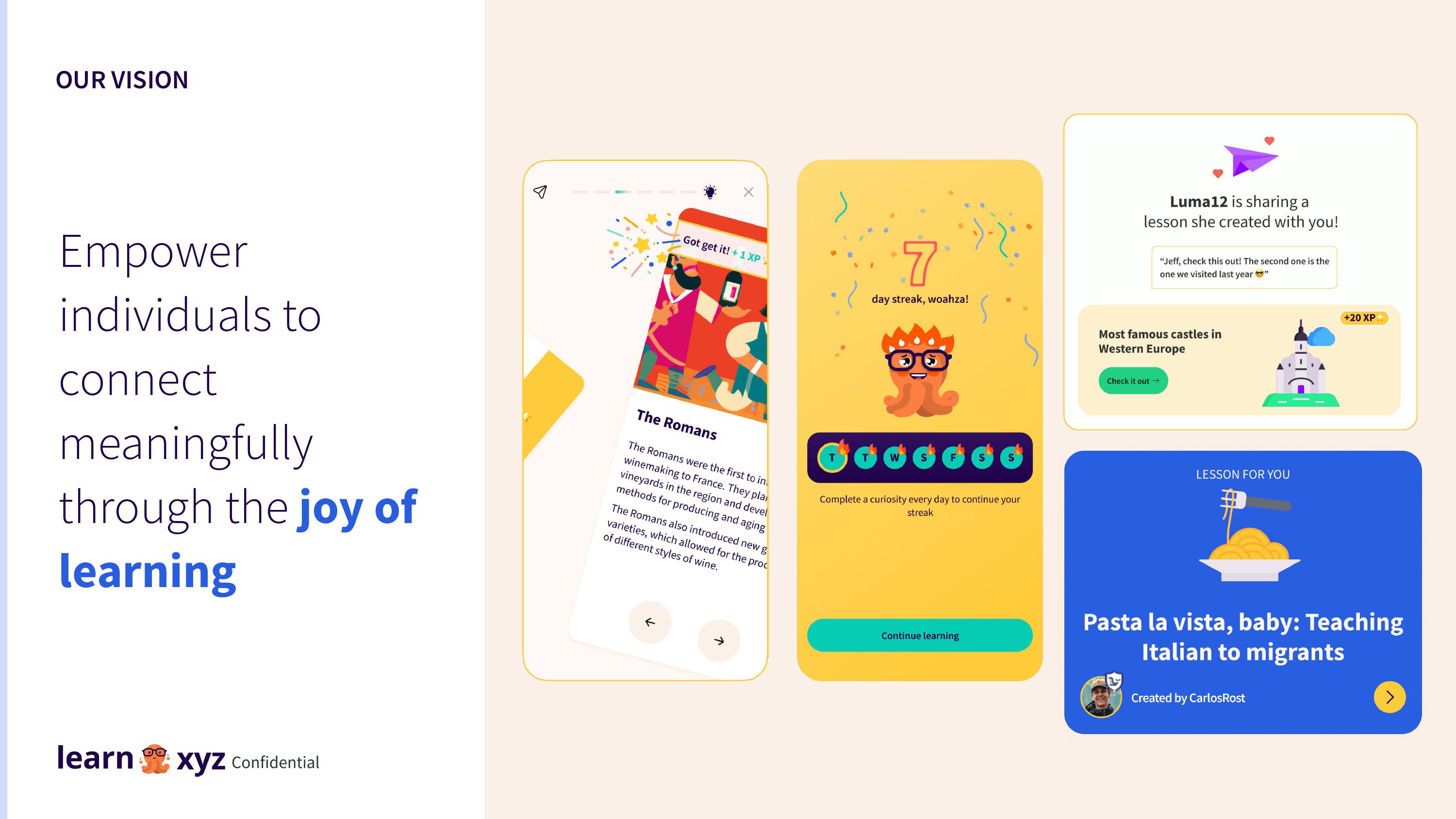
When the founder told me that the company’s pitch deck is animated, thus rendering a PDF version useless, I was ready to go on a tirade about there being no place for animations in pitch decks. But I was dead wrong. The deck works without the animations, but Learn.xyz was able to strike a great balance that adds to the whole experience. Overall, the company’s design language is strong and simple:
[Slide 3] Fun and lighthearted design. Not too much info on the slides, however. Image Credits: Learn.xyz
The screenshots, the design of the characters, and the use of language all lend themselves to the company’s claim: bringing joy to learning.
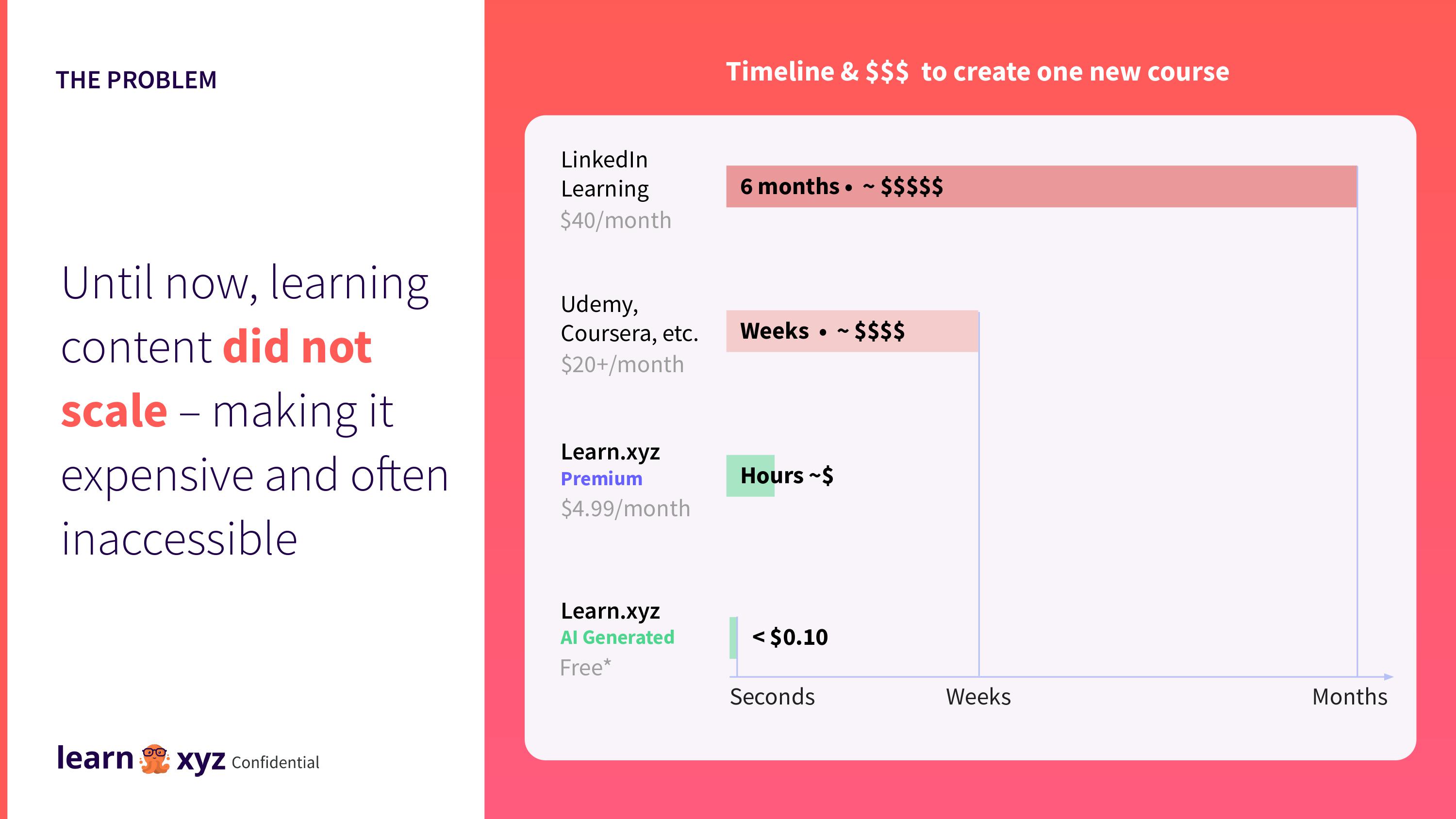
Clear problem statement
From my own experience, I know that creating a lesson plan is a royal pain. This slide lays out the problem nicely.
[Slide 4] The problem. Image Credits: Learn.xyz
Creating content doesn’t easily scale, and assuming that the AI-generated robot can generate quality that’s good enough, this would be an enormous leap forward. Very cool indeed.
I would like to very gently, for the record, admonish Learn.xyz for sneaking part of its solution/product into the problem slide, but I’ll let it off the hook; it’s done well and subtly.
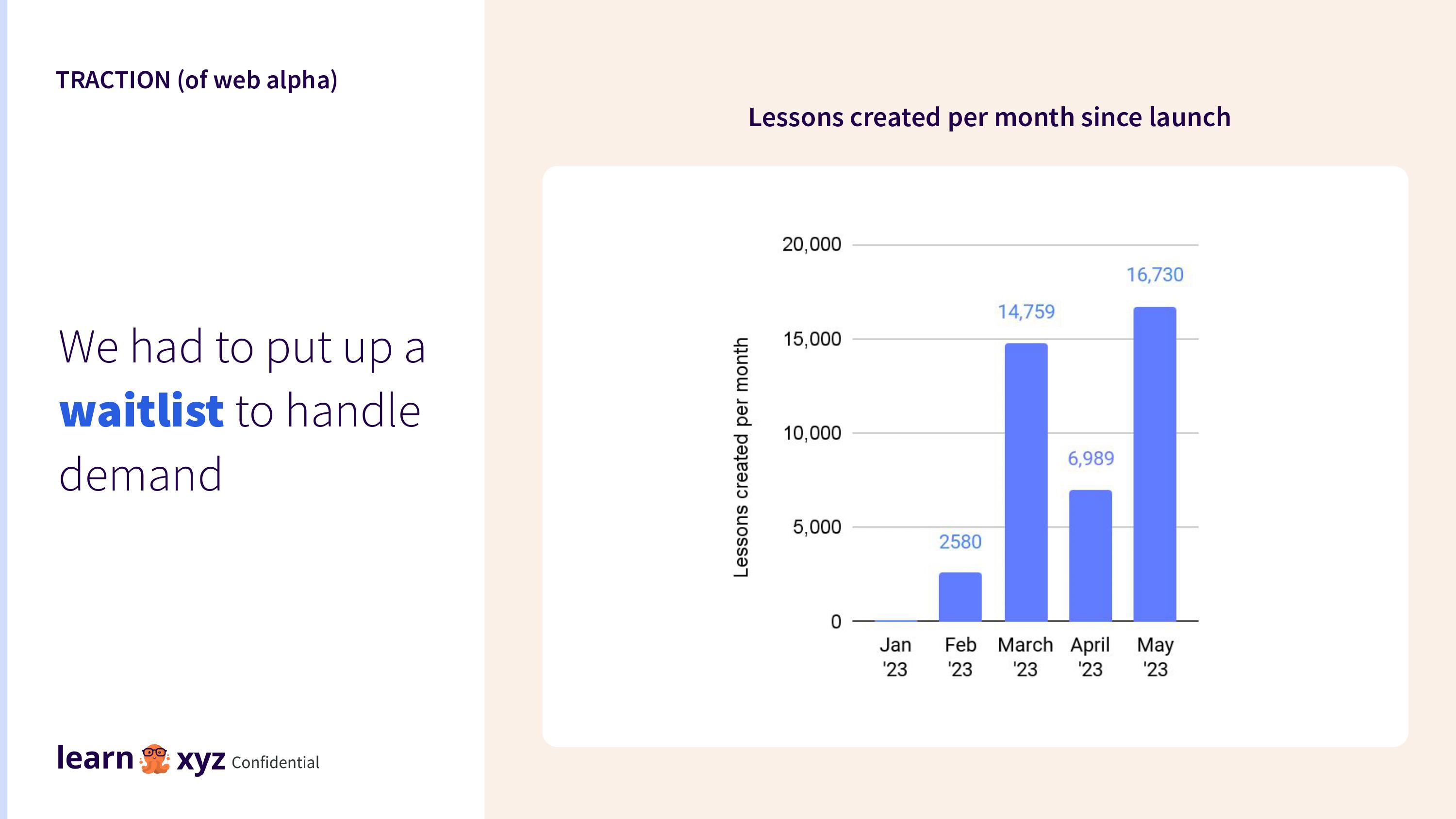
That’s a lot of traction, y’all
[Slide 7] That’s a lot of traction! Image Credits: Learn.xyz
Getting users to engage with a platform in any way is often a challenge; inviting users to create around 41,000 pieces of content in four short months is beyond impressive.
Of course, there are also some challenges with this graph: What happened in April? Is the number of lessons created really the most important metric for this startup? What about revenue, lessons consumed or customer NPS?
Still, any startup that can get this level of user engagement is worth a closer look, even if both what it is choosing to measure and the measurements themselves are a smidge odd.
In the rest of this teardown, we’ll look at three things Learn.xyz could have improved or done differently, along with its full pitch deck!
Analytics India Magazine (AIM), your favourite platform for a wide-angle world view on analytics, data science, and artificial intelligence, is excited to announce its official entry into the United States. This strategic expansion reflects AIM’s commitment to providing valuable insights, knowledge sharing, and fostering innovation in the field of AI and analytics on a global scale.
With over a decade of experience as the go-to platform for industry professionals, AIM has been at the forefront of the analytics revolution in India and beyond. The foray into the US market is a significant milestone in its journey, as it makes AIM one of the very few Indian mediahouses to have expanded globally. The move aims to bridge the gap between analytics professionals, businesses, and academia across continents.
The US market presents an incredible opportunity for AIM to engage with a diverse and dynamic community of data professionals, data scientists, AI researchers, and decision-makers. The expansion will enable AIM to deliver tailored content, events, and networking opportunities that cater specifically to the unique needs and challenges of the US AI and analytics ecosystem.
Bhasker Gupta, founder and CEO of Analytics India Magazine, agrees to the move being more than just a geographical expansion as it marks our ambition to evolve into a truly global organisation. “We firmly believe that the work we are doing at AIM is unparalleled on a global scale. The depth and breadth of services we offer have garnered interest from various international organisations, underscoring the potential impact we can make worldwide,” said Gupta, touching upon various initiatives by AIM, including MachineHack, AIM Leaders Council, AIM Research, AIM Recruits and AIM Events among others.
For more information about Analytics India Magazine, please visit https://analyticsindiamag.com/
About Analytics India Magazine
Analytics India Magazine (AIM) is a leading source for analytics, data science, and artificial intelligence news, insights, and resources. With a strong presence in India and a growing global audience, AIM is dedicated to fostering a vibrant analytics ecosystem by providing valuable content, hosting industry events, and facilitating collaboration among professionals, businesses, and academia.
For media inquiries, please write to us: info@analyticsindiamag.com
The post Analytics India Magazine Forays Into the US appeared first on Analytics India Magazine.
During last year's back-to-school season, ChatGPT had not yet been unveiled, and generative AI wasn't on everyone's radar. However, now the topic is more popular than ever, and new helpful AI tools for students are released daily.
A common misconception is that generative AI can harm education by promoting cheating. However, when used properly, these tools have the potential to help students learn more efficiently. They can also help parents and teachers help students with projects, homework, and studying.
Also: 6 AI tools to supercharge your work and everyday life
I test AI tools every day, and I wish I'd had these tools when I was in school.
The key to correctly using AI for schoolwork is identifying the right tools and use cases. Since there are so many tools, I compiled the list below from months of testing to make your life easier.
1. Bing Chat
Bing Chat is at the top of my list because of its multiple potential use cases that could improve a student's workflow.
If you are familiar with ChatGPT, Bing Chat is the same concept — an AI chatbot, powered by OpenAI technology, but with significant differences that, in my testing, make it better.
Also: American students are saving ChatGPT from traffic freefall
First off, Bing Chat uses OpenAI's most advanced large language model (LLM), GPT-4, for free. Besides Bing Chat, the only other GPT-4-based chatbot available is ChatGPT Plus, which costs $20 a month, which is a big outlay for a student who's already juggling school expenses.
Another major pro for Bing Chat is that it's connected to the internet and has information on all current events and sites, making it possible to access any information you need. The technology also cites its sources as footnotes, making it easier to fact-check and to avoid hallucinations.
Lastly, Bing Chat can answer everything that Google can, but instead of having to aimlessly search through the search results for what you're looking for, the technology gives you the answer in an easy-to-understand response with footnotes that you can follow to lead you to the site.
Bing Chat also has the advanced writing, coding, and mathematical abilities that ChatGPT has, making it a great assistant for writing and editing essays, solving and explaining math problems, and generating and debugging code.
Some other ways you can use Bing Chat in your studies are:
Answering questions you have about class or materials
Researching for a paper
Finding answers for take-home exams or assignments
Explaining complex topics, such as history, current events, politics, and scientific terms, in a more digestible way
Writing Excel formulas
Making graphs and charts
Planning vacation itineraries (we all need a break from school sometimes)
To find the best way to use Bing Chat for your own workflow, I recommend applying it to the use cases discussed above and experimenting with different things.
2. Quizlet
I used Quizlet from middle school through college as a study tool to help me remember content for tests. Students can use it by building a study set with terms and definitions and then using different learning methods, such as flashcards (my personal favorite), matching columns, and more.
Students can also browse the millions of study sets created by other users. When I was a student, I found that if I searched Quizlet for a study set about any topic or even a specific textbook, someone else had likely made one.
Also: How to use ChatGPT to write an essay
Although the platform is far from new, it has leveraged AI for more than six years to create its study features, such as its Learn mode, and to create testing options for students to review their material.
Quizlet recently delved further into AI by using OpenAI's ChatGPT API to create an AI-enabled tutor called Q-Chat, which is available in beta for free.
I tested the AI tutor, and its interactive question-answer prompt system impressed me. The AI tutor simulates a real conversation, either teaching you or testing you on the study information through a natural language dialogue.
Also: 4 ways teachers can use ChatGPT in their classrooms
Quizlet also recently announced other AI features, including Magic Notes, Memory Score, Quick Summary, and AI-enhanced Expert Solutions.
Overall, whether it's the older standard tools I used or one of the more advanced ones, Quizlet is a powerful tool for learning and studying classroom materials, and learners of all ages can benefit from it.
3. ChatPDF
As a student, a big portion of the documents you get are sent as PDFs. Whether these PDFs are class readings, research papers, or syllabi, they are often lengthy and tedious. ChatPDF can entirely change the way you interact with PDFs for your studies.
With ChatPDF, all you need to do is upload your PDF, and it will process your file in seconds. Then, you are redirected to a chatbot interface where you can ask ChatPDF any question you have regarding the PDF.
The questions can be as broad as asking for a summary of the PDF, or as specific as asking for a particular term in the text and what it means. Once it finds an answer, it tells you where in the text it formulated its response from.
This tool can be used when you read a research paper and are left with a million questions, or it can even quickly find the information you need to complete an assignment or paper.
ChatPDF would have changed my life for the better when I was at college and sent papers to read almost every day. I even still use ChatPDF as a working professional to help me understand some otherwise complex topics and to double-check my findings.
4. Duolingo
Duolingo is a great app for learning a new language. Students can use it to supplement the language courses they are taking in school.
The appeal of the Duolingo app is that it gamifies the language-learning experience through bite-sized lessons that feel like individual quests. It also has a streak, leaderboard, league, and point system that motivates learners to want to keep going.
Even though I am not a student, I do have a 245-day streak in an attempt to learn a new language.
Also: How to access thousands of free audiobooks, thanks to Microsoft AI and Project Gutenberg
Foreign language courses are typically mandatory for students throughout their education, starting at the middle school level all the way through to college.
As if learning a new language isn't already hard, my experiences suggest foreign language courses are not a priority for schools, especially at the younger learning levels, making them under-resourced and sometimes poorly taught.
Duolingo would be a great way to bridge the understanding gap that is being created in class. Test yourself on your understanding of the language before an exam, or simply supplement your in-class lessons with some out-of-classroom practice.
5. Socratic
Although younger learners can benefit from AI chatbots, such as Bing Chat, there are concerns about giving them access to the entirety of the internet. If you are a parent with those concerns, Socratic by Google is a great alternative.
With the Socratic app, students can type in any question about what they are learning in school or upload their worksheets. Then, the app will generate a conversational, human-like response with unique graphics and even related YouTube video links.
The app will not just pump out answers or generate essays. Instead, it will give step-by-step explanations and instructions that students can use to get the answer themselves, functioning as an intelligent learning tool.
To give parents peace of mind, Socratic also blocks inappropriate questions from being answered.
The app isn't limited to younger learners, and Google actually refers to it as a "learning app from Google that helps high school and university students." However, due to its functionality, I would say it's actually better suited for younger learners because of the limits and fun graphics.
San-Francisco-based AI lab Anthropic has announced a new collaboration with Boston Consulting Group (BCG), one of the big three strategy-consulting firms, to expand its AI assistant, Claude, to more enterprises.
BCG’s customers globally will get direct access to Anthropic’s proprietary AI assistant Claude to power their strategic AI offerings and deploy safer, more reliable AI solutions.
Through this collaboration, BCG will advise their customers on strategic applications of AI and help them deploy Anthropic models including Claude 2, the newest version of the AI lab’s assistant, to deliver business results. Use cases involving Claude span knowledge management, market research, fraud detection, demand forecasting, report generation, business analysis and more.
Why BCG Chose Anthropic
Anthropic chose to partner with BCG as its ‘Constitutional AI’ ideology aligns with BCG’s ‘Responsible AI’ idea. Its ‘Constitutional AI’ is a set of principles, developed by Anthropic to make judgments about the AI’s outputs. Therefore, the constitution guides the model to take on the normative behaviour described in it. On the other hand, BCG’s ‘Responsible AI’ is the process of developing and operating artificial intelligence systems that align with organisational purpose and ethical values, achieving transformative business impact.
In addition to working together to bring AI to new organisations, BCG has partnered with Anthropic to use Claude within its own teams.
“Our new collaboration with Anthropic will help deliver that alignment on harnessing value and bottom line impact from AI,” said Sylvain Duranton, global leader of BCG X, BCG’s tech build and design unit. “
Together, we aim to set a new standard for responsible enterprise AI and promote a safety race to the top for AI to be deployed ethically.” he added.
Onboard the AI Bandwagon
BCG had partnered with OpenAI in March this year to establish the Center for Responsible Generative AI within BCG X—unites tech builders, entrepreneurs and designers with talent in AI to enter into partnerships and build rapid solutions.
BCG has also partnered with Intel to bring generative AI into enterprise. Bain & Company also partnered with OpenAI to help its clients integrate the technology developer’s innovations into daily tasks, reducing waste and supercharging productivity. MCKinsey & Co internally developed an AI Chatbot, Lilli, to deliver insights to employees based on a knowledge base of over 10,000 documents and archival data. It also aggregates external sources and allows employees to engage in dialogue with the platform.
Read more: Anthropic’s USD 580 Mn Series B raises eyebrows
The post Anthropic Partners with BCG to Expand Claude Capabilities appeared first on Analytics India Magazine.
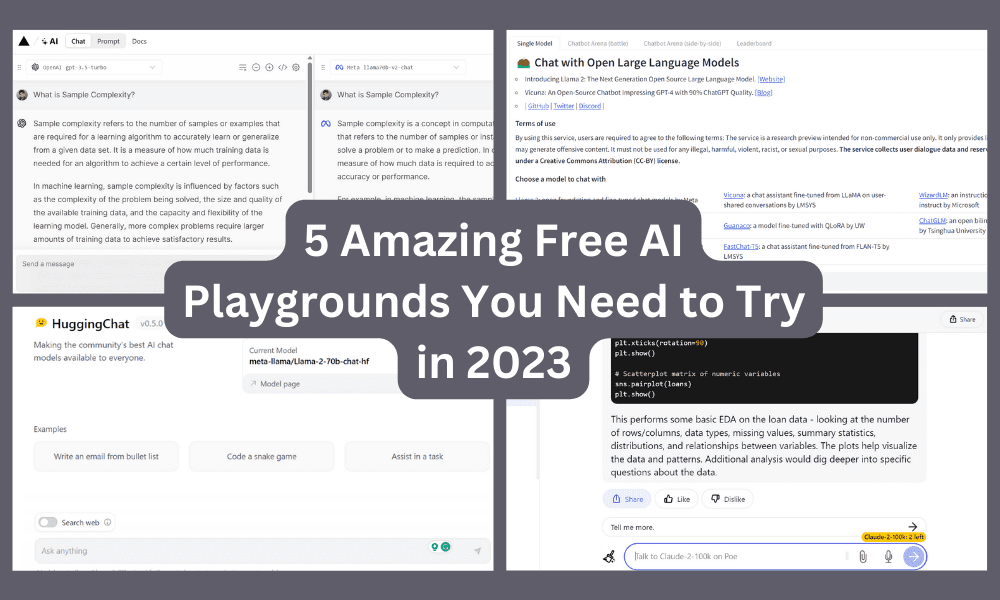
A lot of companies that were offering free access to their large language models (LLMs) are now putting it behind the wall. However, there are still some amazing free LLM playgrounds available that enable anyone to experience the latest AI innovations.
In this article, we will introduce 5 user-friendly platforms where you can test and compare cutting-edge AI models at no cost. These free LLM playgrounds assist in writing, code generation, troubleshooting, and brainstorming.
1. Vercel AI Playground
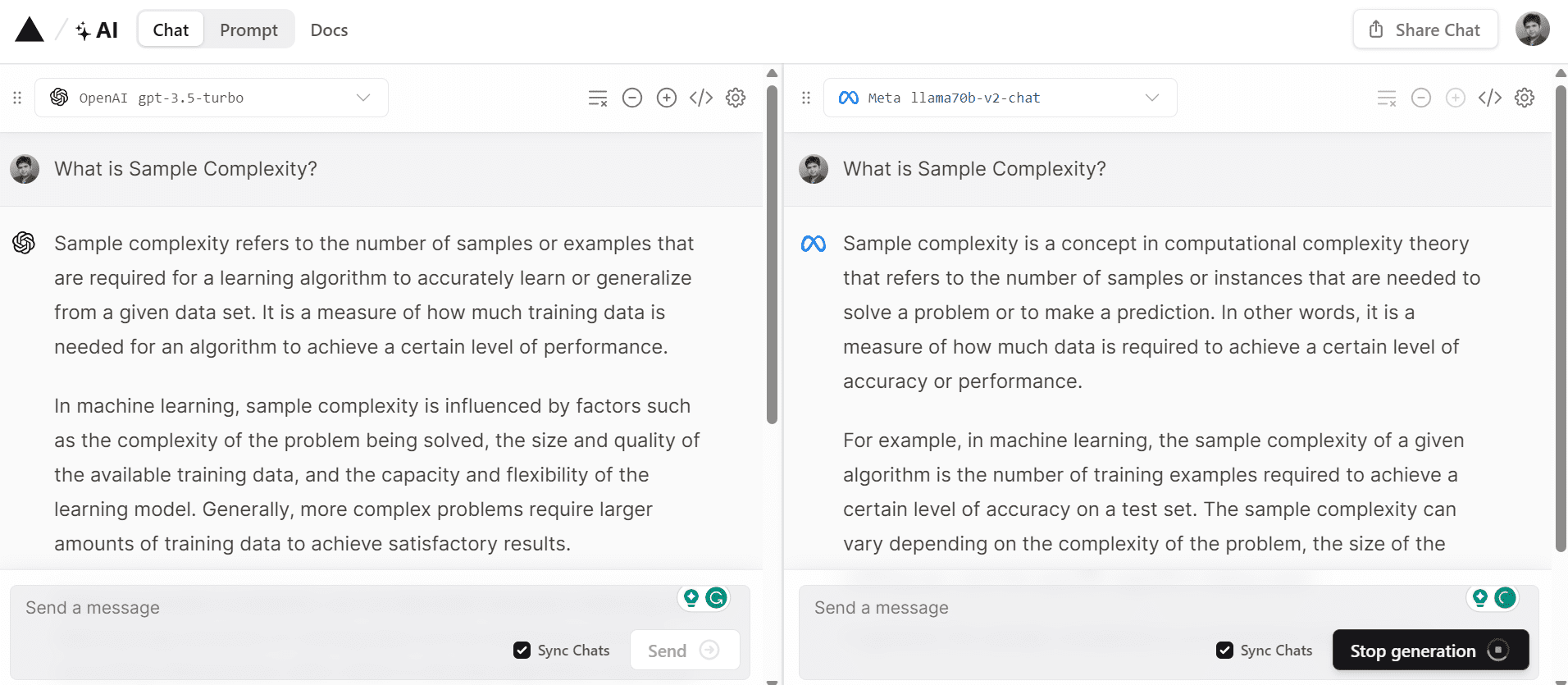
With Vercel AI Playground, you can access top-of-the-line models like Llama2, Claude2, Command Nightly, GPT-4, and even open-source models from HuggingFace. You can compare these models' performance side-by-side or just chat with them like any other chatbot. In addition to free access, the playground offers additional information about models' context lengths and input/output pricing. It also provides API and Page code so that you can build your own chatbot app, similar to the AI Playground.
Image from Vercel.ai 2. Poe
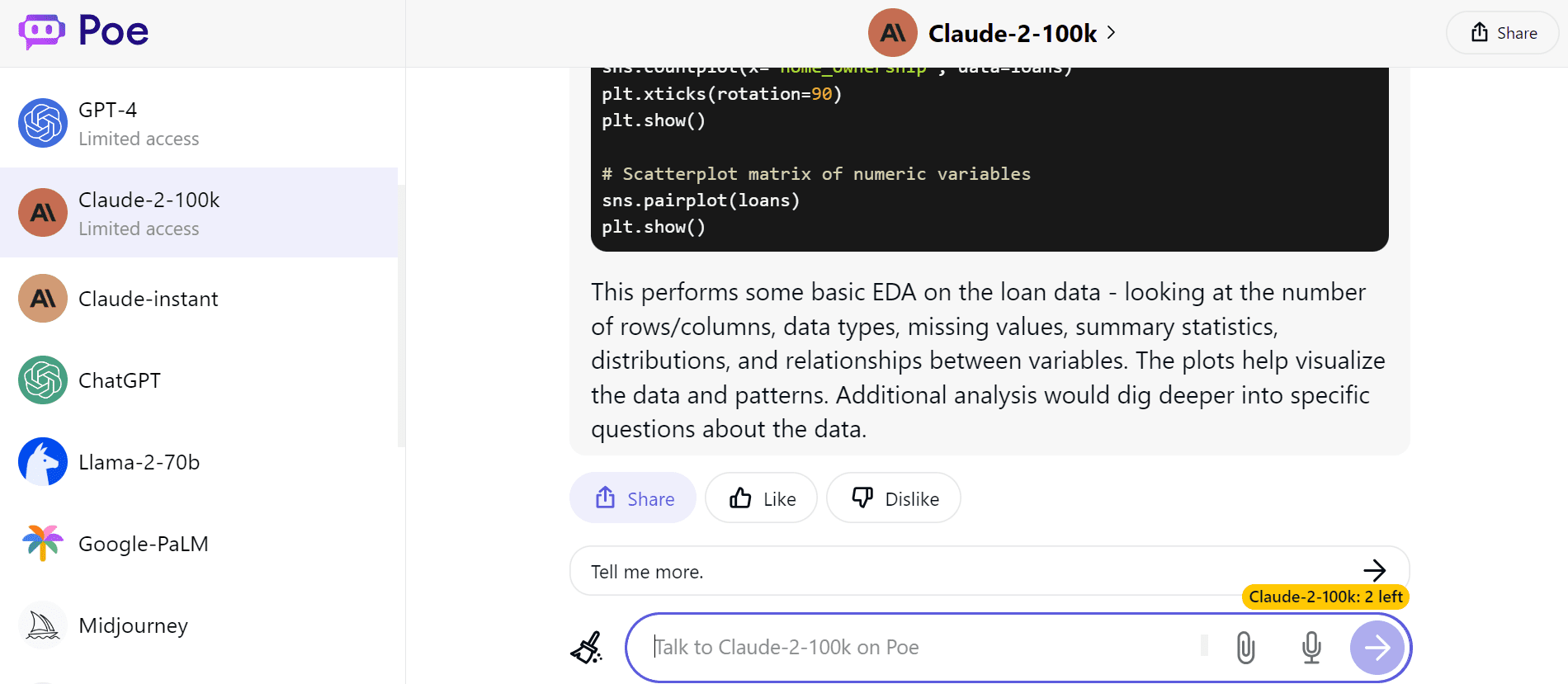
Quora Poe is without a doubt my favorite AI assistant. As a data scientist, I rely on it daily to help with a wide variety of tasks from generating code to summarizing papers. Its capabilities seem endless.
Beyond acting as my own personal assistant, Quora Poe gives everyone access to some of the most advanced conversational AI models in existence. Models like GPT-4, Claude2, Llama2, Sage, and PaLM can be explored with just a simple signup. You can provide an initial prompt to create a personalized bot or choose from shared community bots.
I highly recommend reading “Forget ChatGPT, This New AI Assistant Is Leagues Ahead and Will Change the Way You Work Forever” to understand how I use it for my day-to-day tasks.
Image from Poe 3. GPT4ALL
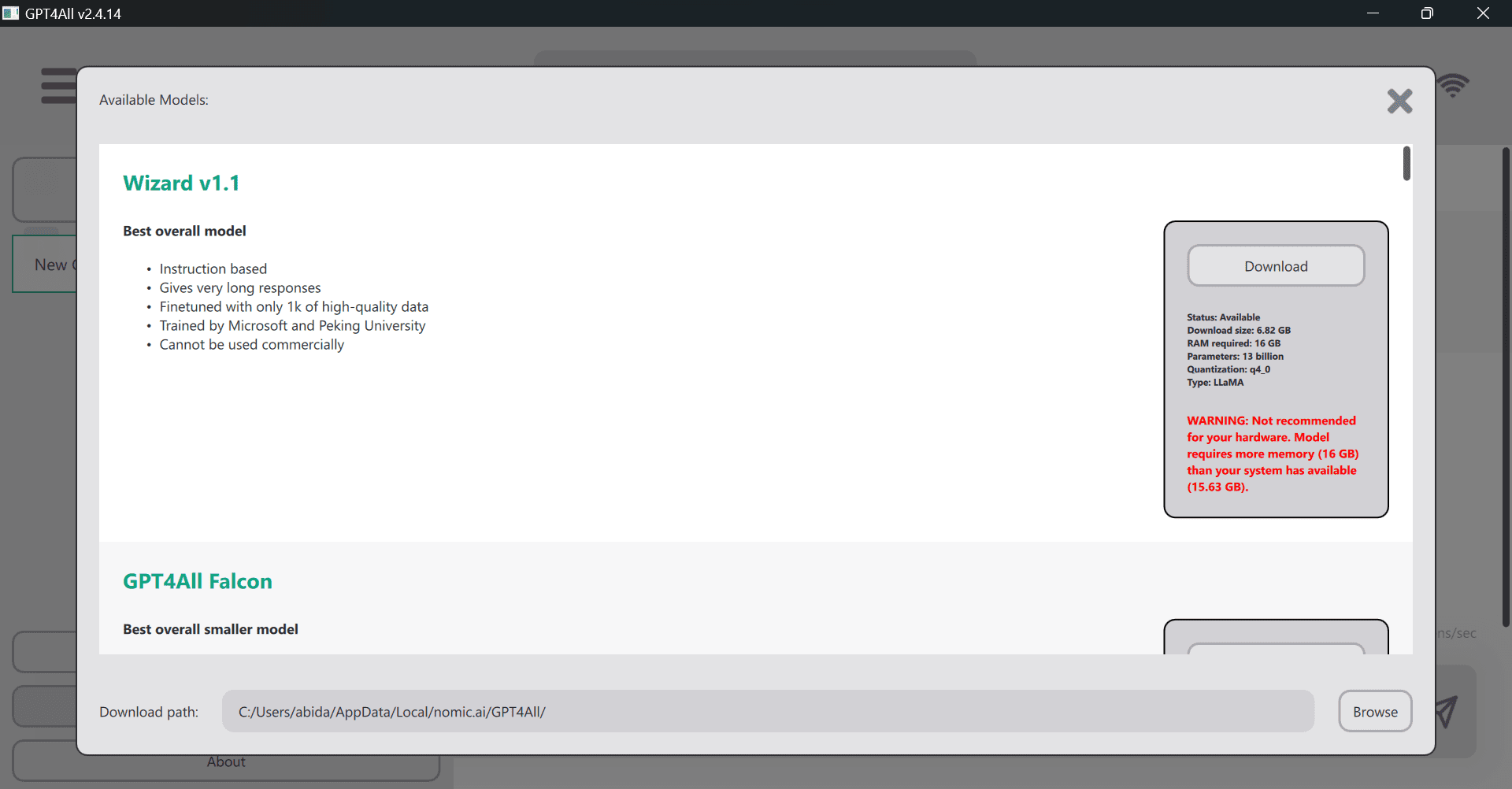
GPT4ALL is a free and open-source AI Playground that can be run locally on Windows, Mac, and Linux computers without requiring an internet connection or a GPU. It offers users access to various state-of-the-art language models through a simple two-step process. All you need to do is to download and install the application and then download your preferred model.
Image by Author | GPT4ALL 4. HuggingChat
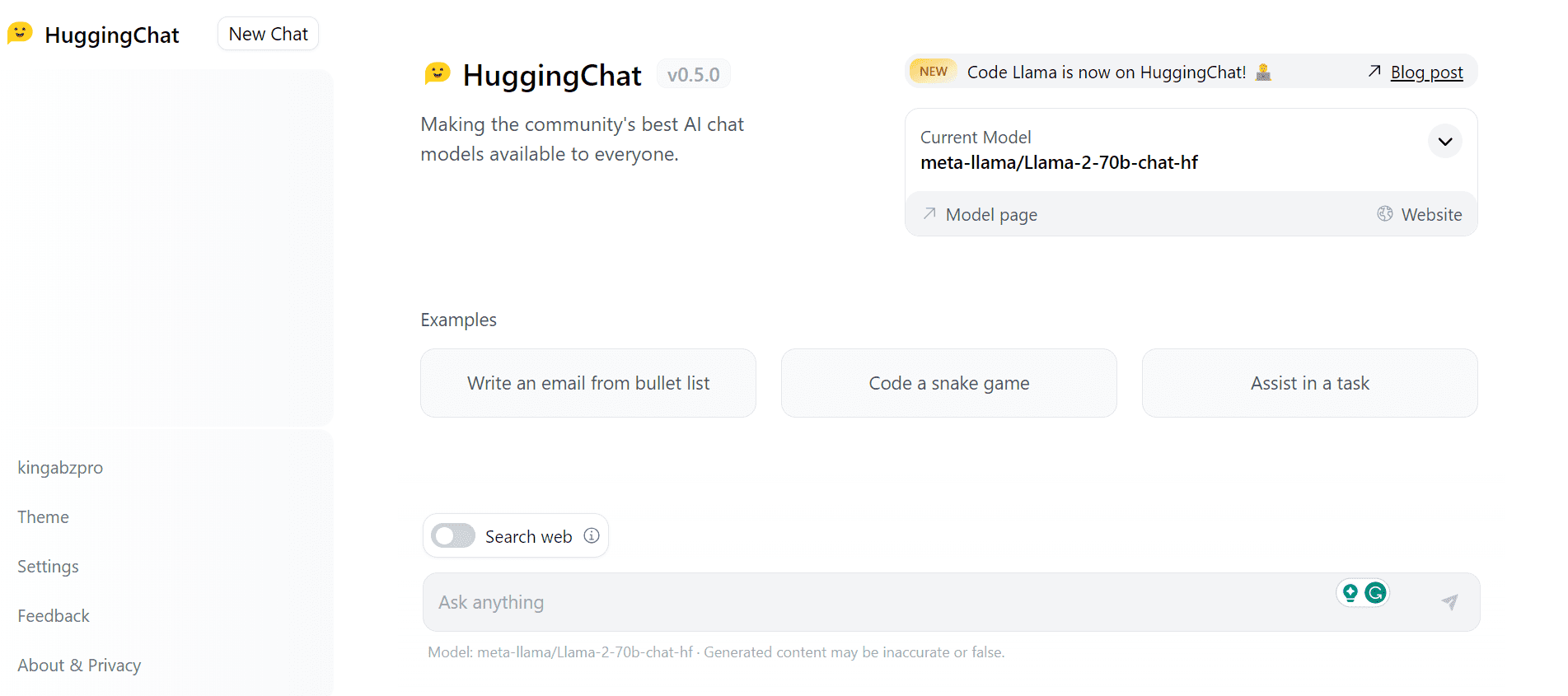
HuggingChat is an exceptional tool that has become my second favorite choice for generating high-quality code for my data science workflow. What makes HuggingChat even more impressive is its latest addition, Code Llama. With Code Llama integrated into HuggingChat, tackling mathematical problems and generating highly accurate code has become a breeze.
One of the standout features of HuggingChat is its open-source nature. This means that the codebase is freely available for users to view, modify, and contribute to, fostering a vibrant community of developers. Furthermore, HuggingChat provides a seamless integration with web browsers, allowing users to fetch results directly from the internet.
Image from HuggingChat 5. LMSys
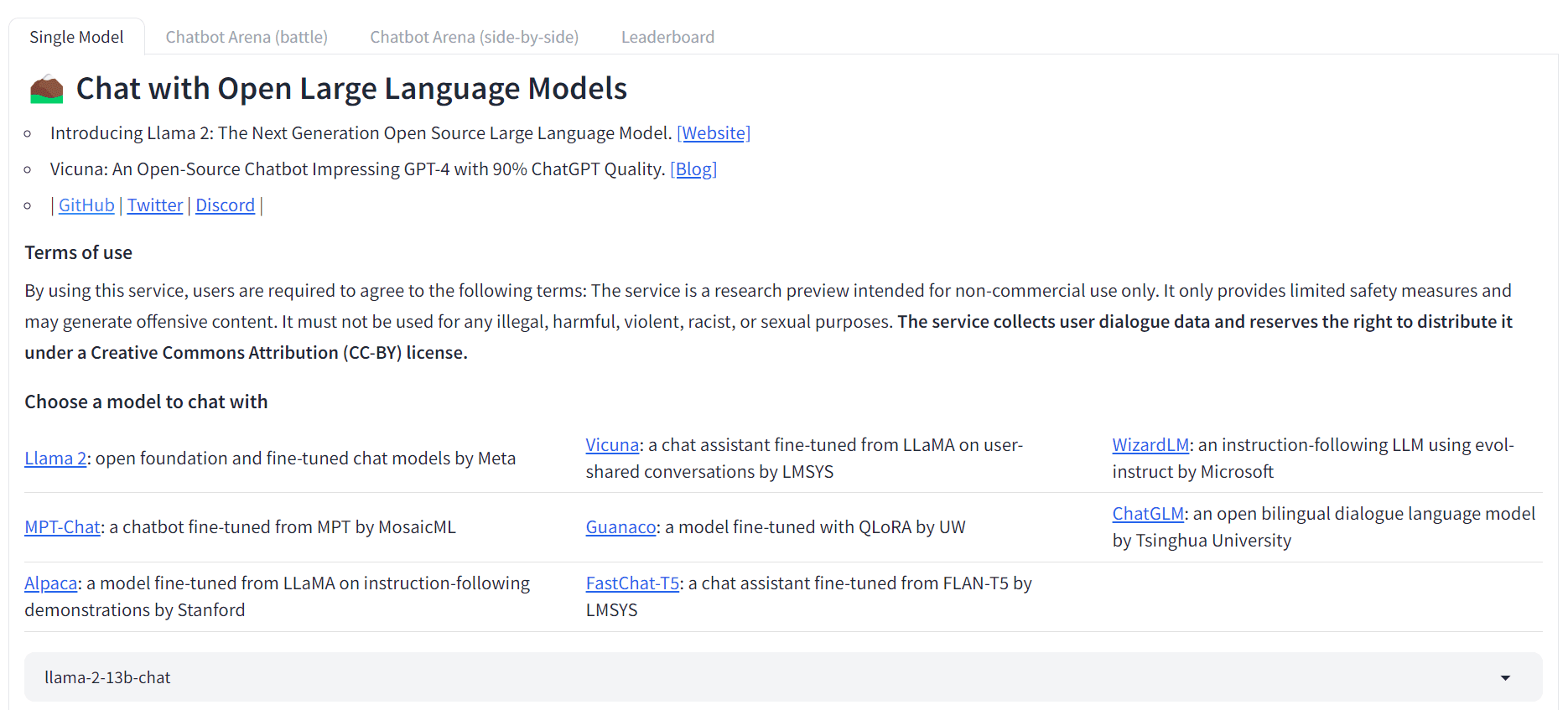
LMSys is a web application based on Gradio that allows users to try out various open-source models such as Vicuna, Alpaca, WizardLM, MPT-Chat, LLaMA2, StableLM, and FastChat-T5. Additionally, users can compare the performance of these models, and based on the leaderboard, GPT-4 is currently leading with an elo rating of 1206.
Image from lmsys.org Conclusion
In this blog, we have explored the top 5 and my favorite AI platforms that let you use state-of-the-art large language models for free. These platforms prioritize privacy, enabling you to use them anonymously. You can use them to compare models or even use them to get your day to day work done.
Please remember that there are people working hard to make technology open-source and accessible to everyone. You can support these projects by contributing or donating, which will help democratize AI. Abid Ali Awan (@1abidaliawan) is a certified data scientist professional who loves building machine learning models. Currently, he is focusing on content creation and writing technical blogs on machine learning and data science technologies. Abid holds a Master's degree in Technology Management and a bachelor's degree in Telecommunication Engineering. His vision is to build an AI product using a graph neural network for students struggling with mental illness.
More On This Topic
8 Free AI and LLMs Playgrounds
10 Amazing Machine Learning Visualizations You Should Know in 2023
Top 19 Skills You Need to Know in 2023 to Be a Data Scientist
Data Analytics Tools You Need To Know in 2023
5 Free Data Science Books You Must Read in 2023
5 Must Try Awesome Python Data Visualization Libraries
Shell, in collaboration with MachineHack & Analytics India Magazine, asks talented minds to tackle the exponential growth of cyber threats and improve the security and resilience of web applications.
The aim of the Cyber Threat Detection Hackathon is to build a model capable of identifying code in a body of text. The hackathon will run from 15th September to10thNovember 2023.
Are you ready to hack the hackers?
Can you construct a next-gen model, capable of detecting code that is present in a body of text? Be part of a mission to enhance the security and resilience of web applications. Sign up, stand out and win a prize!
About the Cyber Threat Detection challenge and timeline
Protecting our software landscapes is not an easy task. Malicious actors are frequently trying to enter systems and get access to resources, whether operational or data. The ability for an actor to compromise systems, elevate their privileges, and move laterally within infrastructure typically hinges on executing hidden code. One common method they employ is embedding this code in seemingly harmless media—whether it’s images, videos, or even simple text files.
In this hackathon, we will provide a body of text in which you will try to find the source code hidden in the text. There might not be any source control or multiple sections of source code concealed within the text.
Don’t miss an opportunity to demonstrate your abilities, innovate, and make a name for yourself in the world of artificial intelligence and machine learning.
The Cyber Threat Detection hackathon is open to all individuals, residing in India, (except Shell, Analytics India Magazine and MachineHack employees and contractors).
The stage is set, and the challenge promises to be rewarding:
First prize: 2500 USD
Second prize: 1200 USD
Third prize: 700 USD
The next ten runners-up will each receive 60 USD.
An esteemed jury, from the field of cybersecurity and software engineering, will preside over the final round. The winners will be announced on 10th November 2023. All winners will be notified directly.
The Shell hackathon journey begins on 15 September 2023, only on MachineHack. The platform is set, the clock is ticking …
The Photo AI tool generates an image of ZDNET's Maria Diaz.
Artificial intelligence is here to stay. It's not a fad or a craze — it's a movement. Sure, the buzzwords will become less popular with time so ChatGPT and AI won't dominate the news. But AI tools will become the basis of how we do things in life and work, much like the industrial revolution changed the foundation of our modern existence and the internet did subsequently.
The form of AI you've likely heard the most about is generative AI. It's the one that ChatGPT uses to create a letter, that MidJourney uses to create striking images, and Bard uses to translate documents and summarize bodies of text.
Content creators are one professional group that seems to be embracing the power of AI; from a survey of 1,000 content creators conducted by Lightricks, a video and image editing apps developer, 84% reported they were likely to use AI if it would save them time or money, and 86% said they would use it if positively impact their creative process.
But on the flip side, generative AI is also the same technology that can create deep fakes, which are images and videos that closely resemble the likeness of others to the point of proving hard to determine whether they're real.
Generative AI can also decrease the authenticity of shared content if someone uses it instead of originally-created content. Because it trains on massive amounts of data that multiple creators and authors have already created, it can raise red flags for copyright infringement.
What is the creator economy?
The vast success of social media has resulted in its growth into a full-blown business model. A long way from your Myspace Top 8 and glitter GIFs, we've found a way to monetize and create an economic model from our social media habits.
The creator economy is the socioeconomic system where independent creators monetize their content, directly or indirectly. Content creators, also called influencers, produce and share the material with their audience.
The material could be anything from written content in blogs, emails, newsletters, videos, photography, or a combination of several in one or more social media networks. A content creator can monetize content on YouTube and TikTok and sell it on Instagram, for example.
The audience consumes the creator's content, and, in many cases, the creator can benefit from that consumption — in other cases, the audience member has to take further action to benefit the creator, like purchasing subscriptions or merchandise.
Content creators have many ways to monetize their content, from advertising revenue offered through views, as is common on YouTube, to brand sponsorships, affiliate marketing, merchandising, offering paid subscriptions to exclusive content, and more.
Though the term "influencer" is known for its negative connotation and is probably enough to elicit images of an excessively privileged world traveler in beige lace dresses and flower crowns, it is as accurate as can be to define the role of a content creator: "One who exerts influence: a person who inspires or guides the actions of others," according to Merriam-Webster.
With the understanding of what the creator economy is, let's get into how generative AI can change the game for influencers.
1. AI image creation
If you've consumed any media in the past few years, you've likely seen some AI-generated images, even if you've been unaware of them.
There are many widely available AI art generators that you can go and sign up for as quickly as you can sign up for ChatGPT. Bing, Microsoft's search engine, even has its AI-powered Image Creator that you can use with the same account you use to check Outlook or sign into Xbox, and it's not half bad.
OpenAI has its own DALL-E 2, but many others range in quality, ease of use, and price. The content creator and ZDNET's own David Gewirtz, who you may know from the YouTube channel, Advanced Geekery, detailed how he created images with MidJourney for an Etsy shop.
According to the Lightricks survey, 53% of creators use generative AI to create photo and video backgrounds, making this the most common use of AI among content creators.
Gewirtz tells me using MidJourney along with Adobe Photoshop's new AI-powered tools to create images for his wife's e-commerce company has "proven hugely helpful in providing those images for social media posts and newsletters."
Also: The best AI art generators
The second most common use of generative AI was creating avatar profile pictures, which 46% of content creators reported doing.
Remini AI has recently garnered attention in social media platforms like TikTok for generating headshots. Another example is Photo AI, an AI tool singlehandedly created by Pieter Levels to create AI models based on photos of a person to generate new images.
A user uploads at least 30 photos of themselves into the site to train the model. The system learns the facial patterns from the images and can create a model, which you can name and generate new images following your prompts. This could enable you to create professional headshots without ever having to hire a professional photographer or capture the perfect Instagram influencer aesthetic without even looking at a camera lens.
"Photo AI can help content creators save time and money as they'll no longer need to travel to different locations or hire expensive photographers to do photoshoots," according to Levels. "After creating your AI model, you can take photos of yourself anywhere from your laptop or phone, 24 hours a day, seven days a week."
The AI-generated images from Photo AI (the three at the top) compared to three of the photos of myself I used to train the model.
Testing it out myself, I can see the feature is still in its growing phases, as it's not as accurate as a real camera, but it's still impressive. The most remarkable part of Photo AI to me is that, while the images don't always precisely capture every single feature of a person, the delicate subtleties that make you stand out seep through the photos. It could be a crook under an eye or slight imperfection — but the promise of what could be accomplished is incredibly stunning.
2. Social media content AI tools
A good creator can combine the excellent generative AI tools available and use them as instruments to more easily create social media content, like text for their Instagram posts or even some graphics for their photos.
Other companies have opted to become a one-stop-shop solution for content creators. Microsoft recently launched the Designer app, which uses AI to generate graphics you can edit. To use it, you need to enter a prompt, a description of the design you want, like an Instagram post about a hair product launch, including a photo you uploaded, like a ChatGPT-powered Canva.
Typeface is another multimodal tool that uses generative AI to create content using personalized product shots, social media posts, e-commerce websites, product descriptions, creative briefs, and more. ZDNET spoke to Vishal Sood, founding member and head of product of Typeface, and he explained the app brings the customer's brand and the foundational models together to create content in seconds.
"We let you bring your own assets into the system," Sood said. "You can bring examples of your voice — brand voice, to create part of your output."
Typeface lets users upload their product images and create personalized photos and marketing assets with the help of generative AI powered by OpenAI's GPT-4 and DALL-E, Microsoft Azure AI, Stable Diffusion, and Google Vertex AI.
This goes beyond an AI tool for marketing professionals, extending to the creator economy. According to Lightricks, 56% of content creators report they've been asked to use generative AI by brands they work with.
"With Typeface, we have unlocked the power to generate thousands of personalized, on-brand images, spanning over multiple diverse markets and significantly reducing our production time to amplify our content factory initiative. Typeface provides us the capability to create a unified 'one brand' approach, amplifying our cross-selling opportunities, consistent brand representation across various business units, and the ability to deliver tailored content to each target market," said David Kang, SVP of digital commerce and marketing solutions at LG Electronics.
3. Using AI for video production
From scriptwriting to video editing, AI can accompany a content creator throughout video production, as evidenced by the survey showing most creators use it to generate video and photo backgrounds.
Video creators can streamline their scriptwriting process using ChatGPT or another generative AI text tool to enter a prompt describing the video details they want to make.
That said, there aren't as many widely-available AI video generators yet — at least not ones capable of putting out realistic results to pass as human-created.
For post-production, different editing software programs have found their way of incorporating AI, like Adobe Premiere Pro using Content-Aware Fill and many of the AI tools in CapCut's editing library.
For example, Gewirtz explained, "I recently used Adobe's Generative Fill to repair a filming background. Adobe's podcast audio repair tool fixed a very damaged audio recording, which meant I didn't have to set back up and re-record it."
Also: These 3 AI tools made my two-minute how-to video way more fun and engaging
Among content creators, 71% found that their followers responded positively to their AI-generated content, while only 10% found they reacted negatively. "It's both a force multiplier and terrifying competition," Gewirtz says, adding his video audience seems to like the slightly higher production value tacked on by the AI tools.
"On one hand, it will improve productivity in certain areas (like where it fixed my audio). But it also will open a giant can of worms in terms of ownership, rights, and even whether something can be attributed to human work," according to Gewirtz. "In the near term, I think the biggest downside is that there has been a huge increase in spammy YouTube and social media content produced by AI-powered content farms. That wastes the viewers' time and creates a tougher competitive environment for human creators."
4. Blog automation and other AI writing assistance
Using generative AI to write content is a hot topic as we debate whether it will replace writers' jobs, among many other professions worldwide. In my completely biased opinion, I believe generative AI to be an outstanding instrument for writing, but no more than that. It's a tool, not a crutch. It's a key on your keyboard, not your entire keyboard.
If all the sites use AI to write content, eventually, all the content begins to sound the same, no matter how hard different teams tweak it. Ultimately, we'll end up craving the human voice behind the onscreen text, much like we desire simple answers over Google searches in ChatGPT.
But generative AI is still an excellent tool to keep in your arsenal — I know I keep it in mine to quickly get summaries of long bodies of texts and translate news from other languages.
"Specifically, in writing, I have found that using ChatGPT (more than Bard and Bing) is useful for brainstorming. I will often ask it to discuss a topic or provide me with a list of ideas to play with," says Gewirtz. "Sometimes, I'll dive into those brainstormed ideas with it to further spark my thoughts. But I don't ever use the literal results in my work."
These AI tools can work exceptionally well to summarize text and write blog posts for you. They can also write emails, briefs, job posts with detailed requirements, resumes, cover letters, etc. However, it's still recommended you do a final edit with a human set of eyes.
For content creators specifically, there are many available that can expedite the creation of social media posts and go as far as learning your brand's tone from your past posts and even automatically posting them for you, with minimal interaction on your end.
Tools like Narrato and Lately use AI to generate web copy and social media posts but also follow tone guidelines to ensure your posts follow a consistent voice that sounds true to your brand. They can use AI to generate new blog posts for you and publish them automatically after you give them a prompt and a scheduled date.
It takes less time in your week to schedule these SEO-powered AI posts, but as with all generative AI, I'd say don't set it and forget it. Follow up on it to make sure the system is doing a good job.
And generative AI isn't limited to blog posts. Wix, a user-friendly website creation platform, recently released a generative AI tool to help users generate websites. Giving the WIX AI assistant some prompts in a conversation on a chat window to describe what you want the site to look like, including photos you want on it, the type of website, and how you want the layout, will easily generate a design for you to edit.
Concerns about generative AI
It's easy to imagine how generative AI can become a double-edged sword for content creators.
Content creators are very concerned about the adverse effects of generative AI, as 74% report they're worried about creating deep fakes, which use deep learning algorithms to superimpose someone's face and voice on another person's body over video or a photo.
When you consider using apps and websites to create images of yourself in places you've never been, you must also wonder about the ethical implications. What's stopping someone else from taking photos from your social media accounts and training an AI model to create whatever pictures they want?
Levels, from Photo AI, addressed these concerns for me, explaining that his company's terms and conditions clearly state that users cannot produce content based on another person without their permission and that each user agrees to these terms and conditions when they use the site.
"You can only upload imagery and train a model of yourself or people you know if you have permission from them," Levels added.
Also: The AI boom will amplify social problems if we don't act now, says AI ethicist
Sood, from Typeface, explains that the platform has a built-in plagiarism checker to ensure the content is unique to each customer and customized with each brand's voice. Their models can quickly learn styles to adapt and create outstanding output for each brand.
Among content creators, however, 58% are concerned about copyright issues with generative AI, and 57% are worried about decreased content authenticity due to using it.
How generative AI and copyrighted content will look in the future and the regulations behind it will remain to be seen. Still, different authors, including Sarah Silverman, have sued OpenAI and Meta for copyright infringement.
The future landscape of the creator economy
The proliferation of generative AI has created a big fear of the loss of jobs due to automation. While this may be true in some form, it won't necessarily be in the way most people believe. If you think back to the industrial revolution when many jobs were automated, the change forced many people to adapt and find new trades or learn new machinery — we're at a similar crossroads, albeit a more minor one.
"As an individual creator, AI can save me time in several helpful ways," Gewirtz explains. "But it has the potential to be a much cheaper alternate solution to human-generated work and may well be used as a substitute by clients otherwise hiring creatives for a cheaper if somewhat lower quality solution."
While generative AI can be a time-saving tool to optimize a creator's workflow, it can yield lower-quality results. Many of the available AI services are free or cost a fraction of what an expert sound engineer, video editor, or writer with years of experience and skill would charge for their services. But the output from the generative AI tool could result in generic and low-quality stuff, especially when more people use it, and it all starts looking and sounding similar.
Levels believes, "AI won't replace creators like many scaremongers say. I think it will, however, become an essential part of any creator's toolkit. For example, in the future, we might see people mix elements of real photography and AI photography to create new content."
It's hard to say what the future of the creator economy will look like with things changing as fast as they do in social media. The YouTube and Instagram of 2023 are certainly not the same as just ten years ago. One thing is sure: AI is here to stay. But whether for work or use in our devices and software, we must use AI carefully.
Disclaimer: Using AI-generated images could lead to copyright violations, so people should be cautious if they're using the images for commercial purposes.
In the fast-evolving world of technology, chatbots have become a mainstay in both professional and personal spheres. Their rapid adoption can be traced back to their ability to simplify complex tasks, provide instant customer service, and even entertain users. But as the technology matured, a more nuanced approach was required to cater to the diverse needs of users across the world. Enter the concept of AI personas, a game-changing development that promises to redefine our interactions with conversational AI.
While many are familiar with ChatGPT's prowess as a conversational AI, its true potential extends far beyond standard interactions. The model's strength lies in its ability to understand context, adapt to nuances, and produce detailed and relevant responses. Its versatility is evident in its wide range of applications, from technical problem-solving to creative storytelling. As we delve deeper into the concept of ChatGPT personas, it's essential to appreciate this foundational flexibility, which allows for the creation of highly specialized and tailored AI identities.
The Anatomy of a ChatGPT Persona
So, when we talk about a ChatGPT persona, what exactly do we mean? In the realm of AI, a persona isn't too different from its traditional definition: it's a representation of a distinct identity or character. However, in this context, it refers to a tailored version of the ChatGPT model, designed to emulate certain characteristics, behaviors, or expertise.
But what components make up this persona? Let's break it down:
Knowledge Base: This is the foundation of the persona. Depending on its intended purpose, a ChatGPT persona can be trained or fine-tuned with specific datasets, ensuring that it has the right information at its fingertips.
Tone and Style: Every persona has its unique way of communication. This can be programmed to be formal, informal, cheerful, sarcastic, or any other desired tone.
Behavioral Traits: A ChatGPT persona can be designed to emulate certain behaviors. For instance, it could be more patient and accommodating for customer support roles or more direct and concise for technical troubleshooting.
Domain Expertise: As touched upon earlier, by creating a ChatGPT persona, you're essentially molding an expert tailored for a specific field or application. Whether it's finance, healthcare, entertainment, or any other sector, the persona can be fine-tuned to exhibit expertise in that particular domain.
In the end, the creation of a ChatGPT persona is an intricate dance of balancing knowledge, behavior, and expertise to craft an AI identity that's primed for its intended purpose.
The Benefits of ChatGPT Personas
There are many benefits to using a ChatGPT persona, such as:
Enhanced User Engagement
User engagement is at the forefront of any digital interaction. A persona-driven AI, by mimicking human-like attributes, captures users' attention more effectively. When users feel that they're communicating with a “being” that understands and reflects human tendencies, they are more likely to immerse themselves in the interaction. This doesn't just mean a higher number of interactions but also an increase in their quality and depth. In a world where digital fatigue is real, a persona can be the difference between a fleeting interaction and a lasting engagement.
Tailored User Experience
In the realm of AI, one-size-fits-all isn't the most effective approach. Users, based on their backgrounds, preferences, and the context of interaction, have varying expectations. A ChatGPT persona can adapt its tone, response style, and interaction depth based on the user's needs. For instance, while a teenager might prefer a laid-back, casual conversation style, a professional seeking business insights might prefer concise, data-driven responses. The ability to tailor the user experience elevates the perceived value and utility of the AI system.
Creating Domain-Specific Experts
As the digital world becomes more intricate, there's a growing demand for specialized knowledge. Generalized AI models, while effective, might not delve deep enough into niche subjects. This is where ChatGPT personas shine. By curating a persona with expertise in, say, environmental science, users can gain insights that are both deep and accurate. Such domain-specific experts, powered by AI, can aid professionals in decision-making, research, and even in educational endeavors. It's like having a virtual expert on-call, ready to assist whenever needed.
Addressing Diverse User Needs
In a globalized digital ecosystem, user bases are diverse. Cultural backgrounds, professional domains, age groups, and personal preferences play a crucial role in shaping user expectations. ChatGPT personas can be designed to cater to this diversity. Whether it's an AI persona that understands and respects cultural nuances or one that's tuned to cater to a specific industry's jargon and trends, the ability to address diverse user needs is invaluable in today's interconnected world.
Making Interactions More Relatable and Human-like
The essence of communication is connection. While efficiency is vital, the relatability of an interaction often determines its success. Humanizing AI through personas means users aren't just getting answers; they're having “conversations.” This relatability enhances trust, fosters a sense of connection, and often makes interactions more enjoyable. When a user feels that their AI chat partner “gets them,” it not only enhances user satisfaction but also paves the way for more profound, meaningful exchanges.
In the ever-evolving landscape of AI, personas offer a touch of humanity amidst lines of code. As we look to the future, the synergy of technology and human-like personas promises a world where digital interactions are not just transactions but meaningful conversations.
How ChatGPT Adopts a Persona
As we interact with various chatbots or digital assistants, we often encounter distinct “personalities” or styles of interaction. These personalities, or personas, are not accidental but rather a designed aspect of the system to make the experience more engaging and intuitive for the user. ChatGPT, despite its generic training, is not exempt from this practice, and the way it adopts a persona is both intriguing and enlightening.
The Underlying Technology and Principles
ChatGPT's foundation rests on vast amounts of text data, making it capable of generating diverse responses. But the magic lies in how it can be steered or influenced to produce a specific type of output. By using the right techniques, developers and users can tap into this reservoir and extract the desired persona, shaping the AI's tone, style, and even its knowledge focus.
Predefined Attributes vs. On-the-Fly Customizations
Personas can be both predefined or crafted on the spot. Predefined attributes are established personalities, often used for specific roles or industries, ensuring consistency in user interactions. For instance, a ChatGPT designed for a financial institution might consistently showcase a formal and data-driven persona.
On the other hand, on-the-fly customizations offer flexibility. They allow the user or developer to dynamically guide the AI's persona based on immediate requirements. This could mean asking ChatGPT to speak like Shakespeare in one instance and then switching to a casual tone in the next.
Crafting a Persona with Prompt Engineering
One of the fascinating avenues to establish a ChatGPT persona is using prompt engineering techniques. By carefully designing the initial prompt or set of instructions, one can set the tone and behavior for the AI. This method is analogous to setting the stage before a play, indicating to ChatGPT the desired direction for the conversation. A well-crafted prompt can seamlessly integrate the persona from the outset, making subsequent interactions feel organic and in line with the defined character.
In essence, while ChatGPT can operate as a jack-of-all-trades conversationalist, the ability to mold and define its persona adds another layer of depth to its capabilities. It's not just about getting the right answers, but about getting them in the right voice, tone, and style, aligned with user expectations and needs.
Use Cases and Applications
The versatility of ChatGPT personas has carved paths into a myriad of sectors. Molded with distinct traits or specialized knowledge, they cater to both niche and broad audiences.
Customer Service: ChatGPT personas serve as ideal customer support representatives, offering 24/7 assistance. With the ability to mirror brand voices, they can proficiently manage a variety of customer concerns, whether it's troubleshooting tech issues, guiding users through product functionalities, or simply updating on order statuses. As AI evolves, the authenticity of these interactions will blur the lines between human and machine-driven customer service.
Virtual Assistants for Specific Domains: With a deeper dive into domains, ChatGPT emerges as a potent virtual assistant. In the medical sphere, it can support with general patient queries, offer post-operative care guidelines, or even keep medical professionals updated with the latest research. In the financial arena, ChatGPT aids by providing insights into investment strategies, explaining financial products, or addressing tax-related queries.
Entertainment: The entertainment industry witnesses the creative facet of ChatGPT. In gaming, ChatGPT, equipped with personas, can function as interactive and dynamic Non-Player Characters (NPCs), enriching the gaming narrative. For storytelling, it aids writers by suggesting plot twists, developing character dialogues, or even being an active participant in interactive digital narratives.
Content Creation and Marketing: A goldmine for marketers, ChatGPT personas serve as creative allies. They can generate engaging marketing materials, draft persuasive ad copies, brainstorm campaign ideas, and ensure all content aligns seamlessly with a brand's unique persona.
Research and Development: An invaluable asset in the R&D landscape, ChatGPT accelerates innovation. With a research-oriented persona, it can sift through vast data sets, recommend experimental approaches, or even ideate groundbreaking solutions for persistent challenges.
Travel and Hospitality: In the realm of travel, ChatGPT shines as a personalized digital concierge. It can suggest itineraries based on travelers' preferences, impart rich insights about destinations, and, by drawing from real-time data, recommend restaurants, events, or hidden gems in a locale.
The integration of ChatGPT personas across industries is a testament to their transformative potential. As businesses harness their capabilities and as the technology itself advances, the horizon for such AI-driven personas is bound to expand, crafting enriched, human-like interactions in diverse spheres.
The Future of AI Personas
As we stand at the threshold of an AI-driven era, the trajectory of ChatGPT personas hints at boundless potential. Here are some forward-looking insights:
Evolving Personalizations
The art of crafting AI personas is incessantly evolving. While current personalizations might seem advanced, the coming years will see even more nuanced and human-like AI representations. With advancements in neural networks and a deeper understanding of human behaviors, these personas might very well reflect our most intricate emotions and thought patterns.
Ethical Considerations and Implications
As with any AI evolution, the advancement of ChatGPT personas is bound to raise ethical questions. These span from the rightful use of AI to imitate human personalities, potential misuse for deception, to more profound concerns like blurring the lines between human and machine interactions. As stakeholders in the AI ecosystem, addressing these concerns proactively will be paramount.
User Feedback and Iterative Refinement
The beauty of AI lies in its iterative nature. With every interaction, there's an opportunity for learning and refinement. As more users engage with ChatGPT personas, a reservoir of feedback will guide developers in honing the AI, making it even more attuned to user needs and preferences.
The emergence of ChatGPT personas is a monumental stride in the conversational AI landscape. They don't just echo our voices; they embody our traits, knowledge, and idiosyncrasies. As these digital beings grow in sophistication, they promise not just assistance, but companionship, expertise, and uncharted avenues of creativity. To every reader, the invitation stands open: dive into this realm, interact with diverse personas, and be a part of this incredible AI narrative.