Use Case Language Models: Taming the LLM Beast – Part 1

Slide1-3

“Sometimes, you don’t know where you’re going until you get there.” – Schmarzo-ism?

Yes, writing this blog turned into a journey. I started in one direction, but after several twists and turns, I ended up with this concept – that use case-centric language models can be combined into entity-centric language models that can support multiple use cases at minimal marginal costs, significantly impacting the economics of AI development.

“I love it when a plan comes together.” – Hannibal Smith, The A-Team

A language model is a probabilistic model of a natural language that can generate probabilities of a series of words based on text corpora in one or multiple languages it was trained on

The enthusiasm and intrigue surrounding Large Language Models (LLMs) have exploded (think Oppenheimer-level explosion). In the past nine months, the emergence of cutting-edge Generative AI (GenAI) tools, such as OpenAI’s ChatGPT, Google Bard, and Microsoft Bing, has sparked a surge of enthusiasm and CEO-level interest in LLMs.

LLMs are robust AI systems trained on massive collections of textual data, enabling LLMs to uncover relationships between subject areas in those massive data sets. The Generative AI’s human-like responses to complex LLM interactions have led to much consternation among industry and government leaders regarding the general dangers of GenAI and general AI.
Slide2-4

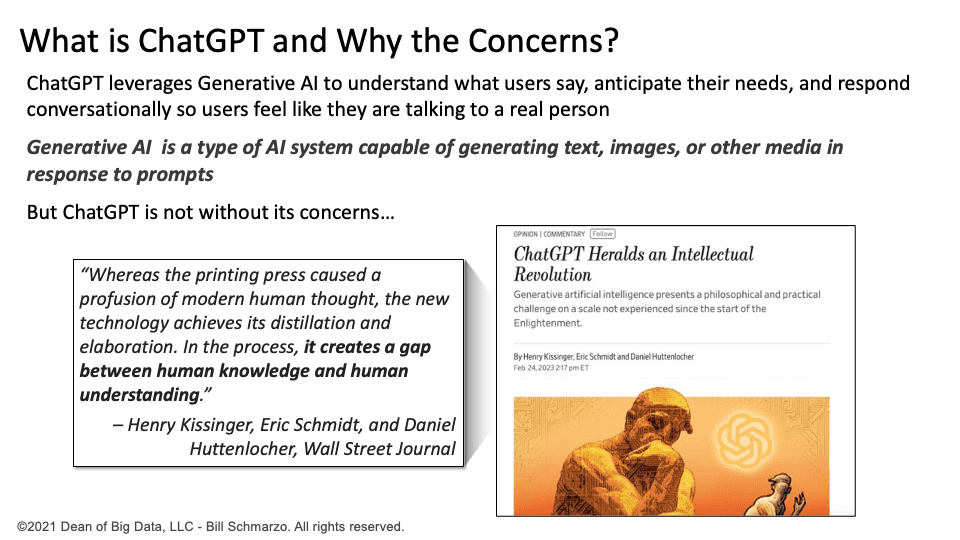
“Whereas the printing press caused a profusion of modern human thought, the new technology achieves its distillation and elaboration. In the process, it creates a gap between human knowledge and human understanding.”

– Henry Kissinger, Eric Schmidt, and Daniel Huttenlocher, Wall Street Journal

As companies strive to develop and profit from Large Language Models (LLMs), they are encountering challenges associated with the intricate and costly construction and ongoing maintenance of these LLMs. Consequently, companies are exploring Small Language Models (SLMs), which are more focused and contextually specific, and therefore, they are less costly to build, less complex to manage, and provide a clear ROI.

In his blog “Bringing AI to Your Data: The Power of Domain-specific Language Models,” my friend Navin Mukraj discussed the potential of domain-specific small language models:

Domain-specific LLMs are meticulously crafted to cater to sectors like healthcare or finance. These models tap into the goldmine of industry-specific data, presenting insights and solutions that are finely attuned to address the intricacies of niche challenges.

Examples of domain language models include:

  • A travel advice language model that can answer questions and provide recommendations for travelers based on their preferences and needs.
  • A medical diagnosis language model that can analyze symptoms and medical records and suggest possible diagnoses and treatments.
  • A code generation language model that can generate code snippets or programs based on natural language descriptions or specifications.
  • A legal advice language model that can analyze contracts and extract the key terms, clauses, and obligations for the parties involved.
  • An educational support language model that can generate questions based on a given text or topic and grade the answers provided by the students
  • A financial advice language model could help with budgeting, investing, saving, etc. It could use data sources such as income, expenses, assets, liabilities, goals, etc. It could generate outputs such as financial plans, recommendations, reports, etc.
  • A diet advice language model could help with nutrition, fitness, weight loss, etc. It could use data sources such as calories, macronutrients, food preferences, allergies, etc. It could generate outputs such as meal plans, recipes, tips, etc.

Domain language models are a more cost-effective option for companies seeking to exploit the language model explosion. However, I believe organizations can take one more step towards leveraging and swiftly capitalizing on the language model trend – use case-specific small language models (use case language models).

Use Case Language Models

Use case language models are trained or adapted to excel in solving specific, cross-domain problems by integrating and analyzing pertinent data from various data sources to deliver comprehensive and actionable responses, such as improving customer retention, increasing sales revenue, or optimizing inventory management.

Use case language models have several advantages over LLMs and domain-centric small language models, including:

  • Accuracy: provide more accurate and relevant answers for specific problems or goals across multiple domains. They can integrate and analyze data from multiple data sources that are relevant and informative for that problem or goal.
  • Efficiency: process natural language inputs and outputs faster and more efficiently, as they require less computation and memory resources. They can also run on devices with limited resources (smartphones, IoT devices) without compromising performance or functionality.
  • Interpretability: explain their natural language outputs and provide evidence or justification for their decisions or actions. They can also allow users to understand their internal logic and reasoning, which are more transparent and understandable.
  • Controllability: allows users to adjust their natural language outputs and modify their behavior according to their preferences. They can also better adhere to ethical and social norms, such as privacy, fairness, safety, etc., as they are more accountable and responsible.

Examples of use case language models include:

  • A customer retention language model to retain customers and reduce churn. It would integrate and analyze data from customer feedback, sales records, market trends, etc., and generate personalized offers, recommendations, and customer incentives. For example, a customer retention language model could help a subscription-based service identify customers at risk of canceling their subscriptions and send them personalized messages or emails highlighting the benefits of staying with the service based on their usage patterns or offering discounts or free trials.
  • An inventory optimization language model to optimize inventory levels and reduce costs. It would integrate and analyze demand forecasts, supply chain information, product specifications, etc., and generate optimal business inventory plans, orders, and allocations. For example, an inventory optimization language model could determine how much inventory to order for each product category and location based on historical sales data, seasonal trends, customer preferences, etc.
  • A marketing campaign effectiveness language model to improve the effectiveness of marketing campaigns. It would integrate and analyze campaign performance metrics, customer behavior data, market research data, etc., and generate actionable insights and recommendations for the business. For example, a marketing campaign effectiveness language model could evaluate marketing campaigns’ return on investment (ROI) across different channels and platforms, such as email, social media, web, etc.

How can we ensure the relevant use of use case language models? We can embed them as a component of a larger solution that addresses a specific business or operational challenge that spans multiple domains. We can embed them into our AI-powered Apps.

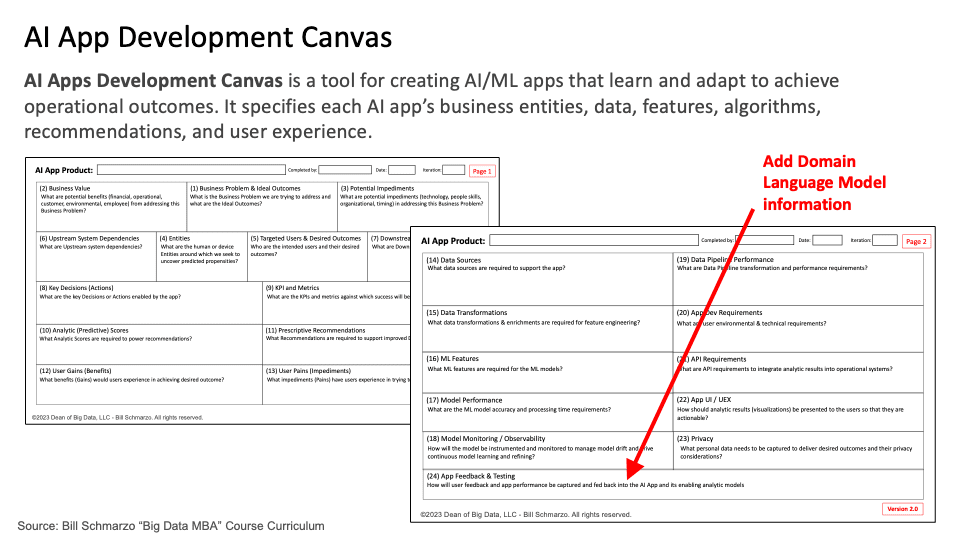
Integrating Use Case Language Models into AI App Development Canvas

AI Apps are domain-infused, AI/ML-powered applications that continuously learn and adapt with minimal human intervention in helping non-technical users manage data and analytics-intensive operations to deliver well-defined operational outcomes.

By integrating the Use Case small language model into our AI Apps, we enable our stakeholders to utilize the language model’s data analytics capabilities for improved decision-making or problem-solving. The Use Case language model further enhances the capabilities of our AI app by enabling stakeholders to explore and analyze data more efficiently.
Slide3-2

Figure 1: Updated AI App Development Canvas

Let’s say that we want to build a “Customer Retention” AI App for marketing, sales, and customer service to identify, segment, and target customers at risk of leaving or with high growth potential and create personalized offers to deliver the following results:

  • Improved customer retention rate by predicting and preventing customer churn with timely and effective interventions.
  • Increased customer loyalty rate by rewarding and recognizing loyal customers with incentives and referrals.
  • Enhanced customer growth rate by upselling and cross-selling relevant products and services to high-potential customers.
  • Reduced operational costs by automating and optimizing customer retention and growth campaigns.

We could integrate a “Customer Retention” (use case) language model into our Customer Retention AI App that would support the business stakeholder’s engagement and interrogation of the Customer Retention AI app. That Customer Retention language model would be built from the following data sources: Sales transactions, Customer support, Customer demographics, Product returns, Payments, and Social Media.

Use Case Language Models Summary

Use case language models are more focused, more cost-effective, and can provide a more immediate ROI than LLMs. They become a key enabler in creating AI-powered apps that can drive more meaningful, relevant, responsible, and ethical outcomes.

However, I can enhance the economics of language models by transforming Use Case language models into Business Entity language models. Let me explain in Part 2…

How Moveworks is Revamping Conversational AI with LLMs

Across enterprises of all sizes, not every challenge can be tackled internally. This is where technology service providers step in to efficiently address critical issues such as IT support, ticketing, HR policies, finances and more. With the advent of generative AI, these solutions have reached unparalleled levels of excellence. One standout player in this space is the “enterprise copilot” platform Moveworks.

“We noticed that IT support for enterprises hadn’t seen much innovation for years. Employees faced delays and inefficiencies in getting IT issues resolved. This led us to develop a conversational AI service that could understand natural language and help employees troubleshoot IT problems seamlessly,” said Vaibhav Nivargi, Co-founder and CTO of California-based Moveworks.AI which aims to boost employee productivity by taking care of IT support, finance, facilities, HR and more, in an exclusive interaction with AIM.

Founded in 2016 by Bhavin Shah, CEO, Vaibhav Nivargi, Varun Singh, VP of Product and Jiang Chen, CTO (AI) with the vision to strengthen individuals’ efficiency.

Over the years, their vision has expanded beyond IT support as similar issues exist in HR, finance, facilities, and various other domains. Additionally, they introduced a developer platform called Creator Studio designed to empower customers and partners to enhance the platform’s capabilities.

And now, with the emergence of generative AI models like ChatGPT, it is a cherry on the cake. These models showcased the boundless possibilities of generative AI, effortlessly generating images, videos, and more. There was an ongoing debate surrounding whether these models were evolving towards sentience or simply reaching the next level of predictive prowess. Nevertheless, they remained undeniably fascinating.

“We have a diverse range of customers including LinkedIn, Coca-Cola, Palo Alto, DocuSign, Salesforce, HCL, Wipro, Slack, Nutanix and others and we use various models based on specific use cases. This significantly reduces the time it takes to resolve issues and tickets for employees,” said Nivargi.

Employees often don’t even realise they’re interacting with a Moveworks bot, as it becomes integrated into the company’s identity. For example, Palo Alto’s chatbot is called Sheldon while Slack’s is AskBot and Pinterest’s is known as K9. All of these AI chatbots are actually the Moveworks bot. It also enables targeted messages using the bots, which can be particularly useful for important announcements within the organization.

“Additionally, we’ve added data analytics to our offerings, allowing CIOs, finance teams, and others to gain insights from natural language data. This data-driven approach helps us continuously improve our models and provide better support to our customers,” commented the Standford alumni.

Implementation of Generative AI

Much before generative AI came into existence, Moveworks began its tryst with it, starting with Google’s language model BERT in 2019.

The tech team, headed by both Nivargi and Chen, employs a combination of LLMs to provide precise conversational support. They have also forged partnerships with tech giants like Microsoft Azure and OpenAI to leverage generative AI capabilities. These models are particularly useful for generating synthetic data when a client has limited data, allowing users to specify the data’s characteristics to generate more data that matches their requirements.

“Depending on the problem, we fine-tune the larger models to suit the customers’ needs,” he added. Choosing the right model depends on various factors such as modality, accuracy, and pricing.

For example, OpenAI’s GPT-4 offers broad language understanding and generation capabilities, enabling nuanced responses to employee queries. Task-specific discriminative models enhance precision for specific support functions, ensuring accurate responses to common service needs. Moveworks has even developed its custom LLM, MoveLM, fine-tuned on enterprise data to handle industry-specific vocabulary and workflows.

“Moreover, there are other models employed for communication, which are trained using specific data sets to teach the model how to communicate effectively. These intermediate models are often used in single and zero-shot settings,” he added.

The implementation of LLMs at Moveworks involves chaining the outputs of different models to deliver a cohesive conversational experience. This approach balances the versatility of foundation models with the precision of task-specific models, ensuring the accurate automation of various enterprise tasks.

Solving Customer Problems, One at a Time

When addressing customer pain points, it is a common notion that AI may replace human tasks; however, Nirvagi and his team observed that AI augments human capabilities rather than replacing them. In essence, their technology improves employees’ functions, making the corporate environment more efficient.

“We integrate with a multitude of systems, including IT, HR, knowledge, identity, and space management systems. Whether you need to book a conference room or solve an IT issue, Moveworks is there to assist,” he added.

Companies typically maintain internal support teams to manage these issues, which can be costly. But that is what Moveworks aims to do, at a lower cost.

“We address pain points that may seem infrequent on an individual basis but collectively add up to significant productivity challenges,” he said.

Back home, the company houses a variety of Indian IT clients like Infosys, TCS, Wipro, and HCL Tech. However, the problems are the same everywhere, regardless of their demographics, size, or industry. Whether it’s an MNC brand like Databricks or a smaller company, the ticketing problem is consistent.

Nirvagi commented, “While each company may have some unique aspects, the core issue is widespread. The company’s ability to integrate with various ticketing systems allows them to gather valuable feedback and continuously improve their service.” To grow even bigger and stronger, Moveworks is hiring across various verticals. Considering the tech talent India has to offer, Moveworks is in an expansion mode in the country, with their second headquarters based in Bengaluru.

Read more: Behind Indian IT’s Mixed Emotions for LGBTQ+

The post How Moveworks is Revamping Conversational AI with LLMs appeared first on Analytics India Magazine.

6 White Papers To Develop AI Ethically

Today, AI is lauded more than ever before. While the use cases of these products and services are sought after the spotlight on ethical concerns as well has never shone brighter.

The diverse spectrum of individuals, ranging from corporate leaders, and frontline workers to government officials, are embracing AI with increasing speed trying to figure out the best ways to ensure AI does not cause unintended harm. While the AI models today are revolutionary they continue to grapple with ethical concerns like lack of inclusivity, opaqueness and their nature of making up information.

White papers and reports play a critical role in creating a fairer, more robust and transparent AI system. Here are 6 white papers that can assist everyone from the big tech to researchers in developing AI ethically.

A pro-innovation approach to AI regulation

The UK government is aiming for a balanced approach to AI regulation and innovation through the ‘light touch’ framework proposed in the latest white paper. Their goal is to create a flexible set of rules based on principles, making the UK a global AI hub. The authorities plan to adapt existing laws and regulations to keep up with AI developments.

The recent consultation on this framework ended in June 2023, and we can expect a detailed government response and potential guidance on how to put these principles into action by December.

State of AI Ethics Report 2022

The 6th volume of the Montreal AI Ethics Institute’s report has a Spanish text contribution in the report to produce multilingual content for the community. The team also added a new chapter on Trends that highlights subtle and not-so-subtle changes taking place in the AI ethics landscape. The 2022 version must be read to bring AI ethics meaningfully into organisations, or personal research.

The team also covered AI regulations that are in development around the world, including EU, US, NATO, UK, and UNESCO.

Advancing racial literacy in tech report

In a paper authored by Data & Society Fellows Jessie Daniels, Mutale Nkonde, and Darakhshan Mir, a call is made to technology companies to practice racial literacy. This call to action underscores the need to break away from existing paradigms.

The report highlights a fundamental truth: tech products emerging from Silicon Valley and reaching global audiences are not racially neutral. Instead, they carry with them the assumptions and values of the dominant culture. This exportation of cultural ideals highlights the importance of adopting racial literacy as a foundational element within strategies, rather than treating it as a mere reactive customer service approach.

Advancing AI ethics beyond compliance: From principles to practice

The 2019 paper by IBM talks majorly about the disparity in views of business leaders and consumers and how CEOs view ethical issues as less important than either their C-level team or board members do.

The report authored by Brian Goehring, Francesca Rossi, and Dave Zaharchuk further advises acting collaboratively to deal with the complex and novel issues which cannot be dealt with as an individual organisation.

Responsible Use of Technology

Building on this paper by the World Economic Forum, the Responsible Development, Deployment and Use of Technology project seeks to produce a framework and suite of implementation tools for organisations to use to advance responsible technology practices.

These tools will implement our desire for a smart and deliberate combination of both ethics‑based and human‑rights‑based approaches. With a multi-stakeholder steering committee now in place, the project is focused on pursuing global stakeholder input and participation.

Bridging AI’s trust gaps: Aligning policymakers and companies

A global survey conducted jointly by The Future Society and EYQ (Ernst & Young’s global think tank), uncovered significant disparities in alignment between private sector entities and policymakers. These disparities, outlined in this white paper, can lead to new legal challenges for the stakeholders.

The paper’s primary objective is to address questions regarding the alignment between policymakers and corporations. It delves into their current state of alignment, sheds light on their priority areas concerning AI applications, and evaluates the extent of corporate awareness regarding emerging issues in this domain.

The post 6 White Papers To Develop AI Ethically appeared first on Analytics India Magazine.

Cisco to Acquire Splunk for $28 Billion, Accelerating AI-Enabled Security and Observability

pic-9.jpg
Image: iStockphoto/jejim

Cisco announced yesterday its intention to acquire Splunk, a renowned name in data observability and security, in a deal valued at approximately $28 billion. Cisco intends to pay $157 in cash for each share of Splunk.

This acquisition, which is Cisco’s biggest deal ever, is aimed at furthering the company’s move to develop the next generation of AI-enabled security and observability solutions that aren’t capable of only threat detection and response but also threat prediction and prevention.

Also, Splunk’s technology helps businesses monitor and analyze their systems for cybersecurity risks and other threats. Cisco has focused mainly on manufacturing computer networking equipment, which is a line of business that has recently come under an increasing rate of supply chain attacks. With this acquisition, Cisco hopes to cut down its decades-long reliance on networking equipment manufacturing and solidify its cybersecurity and AI commitments to meet client demand and fuel growth.

Jump to:

  • When will the Cisco/Splunk deal close?
  • Why this acquisition is a good business move for Cisco and Splunk
  • Industry experts’ reactions to the Cisco/Splunk news
  • What this means for the future of SIEM and SOC teams

When will the Cisco/Splunk deal close?

This deal is set to close by the end of the third quarter of 2024. Although a unanimous agreement has been reached by the boards of directors at both Cisco and Splunk, the deal is still subject to regulatory approval and the consent of Splunk shareholders. Assuming the deal is finalized, Splunk CEO and President Gary Steele will join Cisco’s executive leadership.

Cisco initially expressed interest in acquiring Splunk last year, as reported in February 2022 by The Wall Street Journal. This caused Splunk’s stock price to increase.

Why this acquisition is a good move for Cisco and Splunk

New revenue streams and security innovations

Cisco asserts that the merger will accelerate its revenue growth without impacting its previously announced share buyback program or dividend program. In addition, this acquisition is fueled by the changing landscape in which Cisco operates.

The rising influence of the public cloud has significantly impacted Cisco’s traditional legacy technologies, necessitating the exploration of new and substantial revenue streams. In response, Cisco has identified cybersecurity as a key area for growth and investment as it seeks to adapt and thrive amidst evolving industry dynamics. This is also good for Splunk, as the company has struggled in recent years with cloud innovations for its security information and event management platform.

Prior to this Splunk news, Cisco’s largest deal was the $7 billion purchase of Scientific-Atlanta, a leading provider of cable set-top boxes, end-to-end video distribution networks and video systems integration back in 2006, which only accounted for a 7% of Cisco’s market cap at the time.

What the CEOs are saying

“We’re excited to bring Cisco and Splunk together. Our combined capabilities will drive the next generation of AI-enabled security and observability. From threat detection and response to threat prediction and prevention, we will help make organizations of all sizes more secure and resilient,” said Chuck Robbins, chair and chief executive officer of Cisco, in the company’s press release about the deal.

Splunk’s Steele is quoted in the press release as stating that the decision was necessary to bring about another phase of growth in the company’s journey. “Uniting with Cisco represents the next phase of Splunk’s growth journey, accelerating our mission to help organizations worldwide become more resilient while delivering immediate and compelling value to our shareholders. Together, we will form a global security and observability leader that harnesses the power of data and AI to deliver excellent customer outcomes and transform the industry.”

SEE: Checklist: Network and systems security (TechRepublic Premium)

Industry experts’ reactions to the Cisco/Splunk news

Some industry experts have expressed concerns about how technologies from each firm will fuse into the other, especially in the areas of AI and SIEM cloud adoption. Neither Cisco nor Splunk are considered key players in the AI space, and Splunk hasn’t perfected SIEM cloud automation.

In a statement made available to TechRepublic, Adam Geller, chief executive officer of cloud-native SIEM platform Exabeam, reacted by stating, “We believe this is a good outcome for Splunk. They’ve struggled to get to cloud-native and their innovation velocity has slowed. This acquisition might be the best exit for them. Today’s cybersecurity customer demands innovation in cloud-native solutions, particularly in this AI-driven era where over 90% of today’s enterprises are using the cloud over on-premises solutions.”

Reacting to the news in a LinkedIn post, Rob Strechay, lead enterprise tech analyst at SiliconANGLE Media’s theCUBE, argued that while the deal offers to bring SIEM and extended detection and response together for a more comprehensive platform, it still faces a challenge in AI integrations and advancements. “Splunk and Cisco are behind on their use of AI, and the current architectures of the products do not lend themselves to immediate competitive advantage, in particular with some of the independent and hyperscale security competitors,” Strechay wrote.

What this means for the future of SIEM and SOC teams

The global SIEM market is projected to reach $5.5 billion by 2025, according to MarketsandMarkets. While there is a potential that Cisco and Splunk have complementary capabilities that span the security analytics spectrum, there are challenges that may stand in their way.

A recent survey of more than 230 security professionals by Gurucul at the 2023 RSA Conference shows that SIEM users still face many challenges, thus affecting SIEM adoption.

More than 42% of the respondents struggle with adding new data to SIEM tools, and that this process sometimes takes days, weeks or even months. This indicates that SIEM providers are still struggling to efficiently implement a reliable automated data ingestion feature in their SIEM solutions. Nearly 23.6% of survey respondents revealed they use third-party automated data source mapping tools to ingest data into their SIEM solutions. Also, about 17% responded aren’t confident that SIEM solutions can help them detect unknown threats.

These survey results reveal the SIEM market still has a long way to go. So, regardless of who acquires whom, the SIEM market is very much open to the vendor(s) capable of addressing most or some of these challenges.

Subscribe to the Cybersecurity Insider Newsletter

Strengthen your organization's IT security defenses by keeping abreast of the latest cybersecurity news, solutions, and best practices.

Delivered Tuesdays and Thursdays Sign up today

Why I’m signing up for Alexa’s Emergency Assist, and what Steel Magnolias has to do with it

Echo Show 8

Alexa Emergency Assist will be supported on every Echo device, from the oldest Echo speaker to the newest Echo Show 8 (pictured).

Do you know what happens if you tell Alexa "I'm scared" several times in a row? The virtual assistant will respond empathetically and tell you to call 911 in an emergency. But what if you or someone else at home needs help and you're not close to a phone? What about people who don't have a phone or kids who are too young to know your address?

A newly announced feature coming to Alexa named Emergency Assist can help. This feature works similarly to Alexa Guard, but it's not meant to replace it. It's a 24/7 emergency response service that works for anyone with an Echo device at home, and it's compatible with all Echo speakers and Echo Shows. Saying "Alexa, call for help" will prompt the voice assistant to start a call with an agent who is capable of dispatching first responders to the caller's home.

Also: Everything Amazon just announced: Alexa updates, new Echo Show, Fire tablets, and more

As a mom who's currently teaching young kids what to do in an emergency, after having to call 911 twice within six months due to medical issues, this feature immediately had my attention. The potential benefit of having a system that can call first responders and direct them to your home — and even tell them what room the emergency might be in, if your device is named after its location in the home — is immeasurable for us.

It could also be a game-changer for older people living alone who fall or otherwise have a medical event when their phone is out of reach.

Right now, when you ask Alexa to call for help without the Emergency Assist program, the virtual assistant notifies your emergency contact that you might need help. With Emergency Assist, Alexa will start a call to an agent from the device, and will alert up to 25 predetermined emergency contacts that you've reached out to the Urgent Response team, and then again when you're done.

The emergency response team will see any identifiable information you've entered into the Alexa app for these purposes, including your address and any applicable gate codes necessary to access your home. The emergency response team will then relay that information to first responders. Users can also enter any allergies to food or medication in the Alexa app, current medical concerns and diagnoses, and medication currently being taken.

Also: Amazon says new Eero Max 7 Wi-Fi device will let you download a 4K movie in seconds

Alexa Emergency Assist will work as a subscription separate from Alexa Guard, Prime, and other subscriptions. It starts out on a limited-time offer of $5.99 a month or $59 a year when it becomes available in the coming months. After the limited-time offer ends, the price will increase — although Amazon hasn't stated by how much.

I think it's common for parents to avoid thinking of worst-case scenarios — it's why we put off making a will and other end-of-life decisions when our children are young. But it's also important to consider what would happen to your kids if the only parent in the home at any given time collapsed.

Also: The best tablets for kids, according to parents

This is one of those parenting fears instilled in me (thanks, Steel Magnolias), and the reason I am teaching my kids to call 911. But putting in place a system like Alexa Emergency Assist could literally be a life-saving decision.

Amazon

What is Microsoft Copilot? Here’s everything you need to know

Microsoft Copilot

Artificial Intelligence

  • AI is a lot like streaming. The add-ons add up fast
  • How to use ChatGPT to do research for papers, presentations, studies, and more
  • Uh oh, now AI is better than you at prompt engineering
  • What is generative AI and why is it so popular? Here's everything you need to know

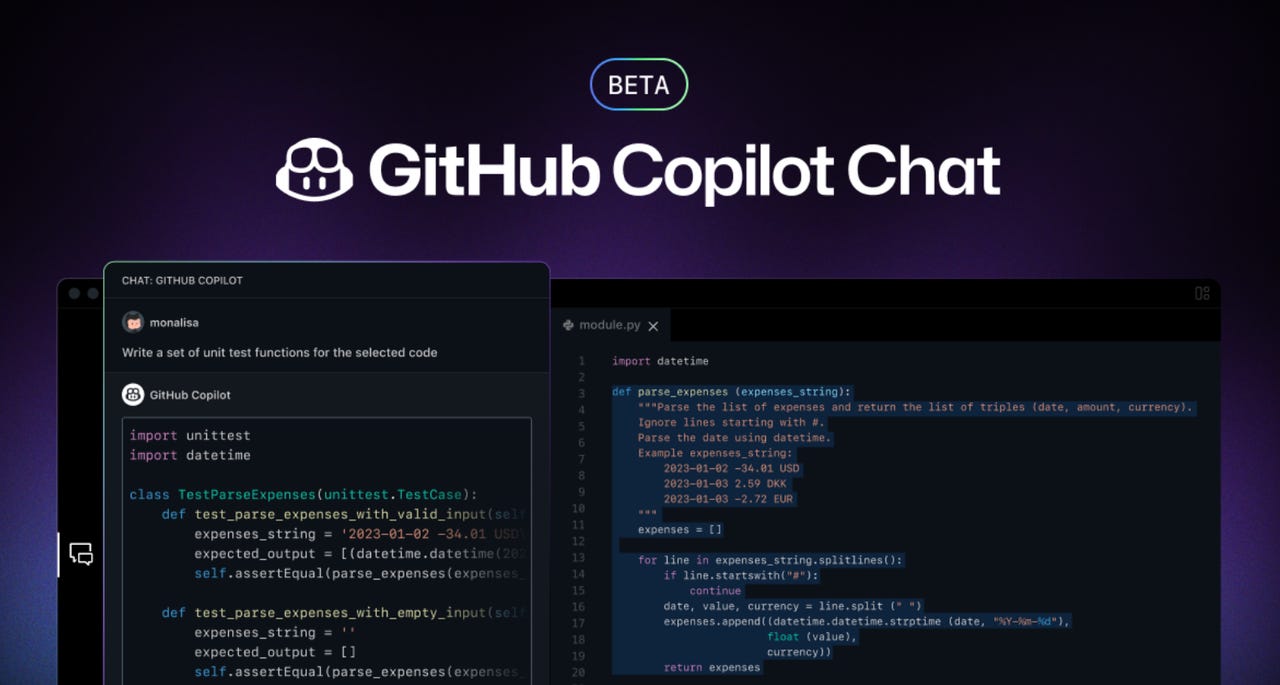
GitHub’s AI-powered coding assistant moves to public beta. How to access it

GitHub Copilot Chat

Although generative AI tools can perform many tasks well, there has been a significant interest in their coding abilities since they can perform tasks that take people years to learn within seconds. Github is harnessing those capabilities on its own platform with GitHub Copilot Chat.

In July, Github first introduced its GitHub Copilot, an assistant that can help answer coding questions, troubleshoot bugs, and learn new languages. However, access to the tool was limited to GitHub Copilot for Business users.

Also: I went hands-on with Microsoft's new AI features, and these 5 are the most useful

This week, GitHub announced that it is expanding its public beta to all GitHub Copilot individual users for free.

With this expansion, all individual users working on projects in both GitHub's Visual Studio and Visual Studio Code can access the assistant without having to leave the integrated development environment (IDE).

"By reducing the need for context switching, it streamlines the development process, which helps developers maintain their focus and momentum," says GitHub.

Some other tasks that GitHub Copilot Chat can assist with are fixing security issues, code analysis, simple troubleshooting, and real-time guidance that suggests best practices and tips in real-time, according to the release.

Also: How to use ChatGPT to write code

To access the feature, a user needs to have an active GitHub Copilot subscription and, if using Visual Studio Code, have the latest version of it installed. The user must also be signed in with the same GitHub ID that has access to GitHub Copilot.

Then, users have to install the Visual Studio Code extension or Visual Studio Code to access the actual GitHub Copilot Chat. For full instructions, interested users can visit GitHub's instructions.

Artificial Intelligence

Microsoft 365 Copilot Release Date Set for November

Microsoft Copilot badge in 3D.
Image: AdriaVidal/Adobe Stock

Microsoft 365 Copilot will be available for business and enterprise users globally on November 1, Microsoft announced yesterday. The AI assistant can draw information from across Bing, Edge, Microsoft 365 and Windows and interpret text, images and video. Interestingly, Microsoft 365 Copilot will include a tutorial called Copilot Lab, which is a prompt-building and sharing application.

Copilot will technically first roll out in Windows on Sept. 26 as Microsoft Copilot with the next Windows 11 update. The November 1 general availability will be separately branded as Microsoft 365 Copilot.

Microsoft 365 Copilot will cost $30 per user per month for enterprise accounts, the tech giant revealed during a presentation on Sept. 21.

Jump to:

  • Microsoft 365 Copilot unifies the generative AI assistant across applications
  • Copilot Lab teaches the basics of prompt engineering

Microsoft 365 Copilot unifies the generative AI assistant across applications

Microsoft 365 Copilot comes packaged with Microsoft 365 Chat, Microsoft announced on Sept. 21. Microsoft 365 Chat enables the AI to trawl across a wide range of work documents — emails, meeting notes and Teams chats — to draw connections and integrate data from multiple sources. Microsoft 365 Copilot touches all of the 365 applications: Word, Excel, PowerPoint, Outlook and Teams.

“Microsoft’s announcement of the unified Copilot experience lays the groundwork for the cohesive, consistent experiences promised by generative AI,” said Forrester Senior Analyst Rowan Curran in an email to TechRepublic. “Generative AI is only as powerful as the data and systems it connects. By linking the Copilot experience across all its different products, Microsoft is beginning to enable this.”

Microsoft Copilot can compose emails and text messages and create, edit and interpret images or video. Colette Stallbaumer, general manager of Microsoft 365, demonstrated using Microsoft 365 Copilot and a plugin to match her travel plans with the travel plans of other people from her company that had been shared internally.

Microsoft Copilot runs on OpenAI’s DALL-E 3 model. Its primary competition is Google’s Duet AI.

SEE: 6 free alternatives to Microsoft Word in 2023 (TechRepublic)

Copilot Lab teaches the basics of prompt engineering

Many employees still need help understanding generative AI, said Curran. Microsoft addresses this need with Copilot Lab, which offers a library of suggested prompts, quick tips for writing more specific prompts for better results and a built-in feature for sharing prompts with coworkers.

SEE: Hiring kit: Prompt engineer (TechRepublic Premium)

Microsoft says Copilot Lab is a way to “build new work habits for a new AI-powered era of productivity,” according to the company’s press release. Copilot is an interesting acknowledgement that not everyone knows how to use generative AI or has ideas for what they could use it for.

“People are incredibly enthusiastic about using generative AI, but most people need help understanding its limits, risks, guardrails and customizations to help them leverage the technology’s maximum impact in their work and personal lives,” Curran said.

Subscribe to the Microsoft Weekly Newsletter

Be your company's Microsoft insider by reading these Windows and Office tips, tricks, and cheat sheets.

Delivered Mondays and Wednesdays Sign up today

5 new creator tools YouTube just unveiled, including an AI video generator

YouTube Dream Screen

Many social media platforms like TikTok are taking precautions to limit the proliferation of AI-generated content. YouTube, however, is facilitating the creation of AI content on its platform by adding a new generative AI feature.

On Thursday, YouTube unveiled five new creator tools, including "Dream Screen," a feature that allows users to add AI-generated images or videos as a background for YouTube Shorts.

Also: I went hands-on with Microsoft's new AI features, and these 5 are the most useful

The demo of the experimental feature shows that users will be able to type in a prompt of what video or image they'd like to use as the background within the short-creating UI.

In the example, a user types, "Panda drinking coffee," and as seen by the photo at the top of the article, the platform generates several videos depicting that scene. The user would then be able to overlay a video on the scene.

YouTube also incorporated AI to help creators better understand what content to make with a new "AI insights" feature, which will give creators video idea suggestions based on what their audience is already watching.

Similarly, Assistive Search in Creator Music will leverage AI to help creators find the perfect soundtrack to add to their videos, reducing the time spent aimlessly scrolling through music options.

Also: Why open source is the cradle of artificial intelligence

AI will also help creators reach larger audiences with an automatic dubbing tool, which will allow viewers to toggle between the original language or the AI-generated dubs in their native language.

Lastly, YouTube unveiled a new editing app called YouTube Create to enable creators to easily edit YouTube content from their phones. The demo shows a UI similar to TikTok with text, stickers, sound, captions, and voiceover options.

Artificial Intelligence

Oracle Introduces Integrated Vector Database for Generative AI

Oracle Introduces Integrated Vector Database for Generative AI September 22, 2023 by Ali Azhar

(JLStock/Shutterstock)

Vector databases have been all the buzz in the world of Generative AI. Oracle, a giant in the software and cloud computer industry, announced this week its plans to add AI vectors to Oracle Database 23c. The new set of features is called AI Vector Search. It will include vector indexes, vector data types, and vector search SQL operators.

Oracle 23c provides developers access to innovative Oracle Database features to help simplify the development of applications. These capabilities are set to be further enhanced with the introduction of these AI Vector Search. It will help boost developer productivity by allowing them to store and retrieve semantic content, including a variety of data types, such as images, documents, and other unstructured data.

The introduction of an integrated vector database for generative AI will support Retrieval Augmented Generation (RAG), which has emerged as a leading generative AI technique. RAG uses a combination of large language models (LLM) and business data to generate natural language responses. A key benefit of RAG is that it provides high accuracy and avoids exposing private or confidential data such as its LLM training data.

According to Juan Loazia, executive vice president, Mission-Critical Database Technologies Oracle, adding AI vector search to Oracle Database will enable customers to get all the benefits of AI without sacrificing data integrity, performance, or security. Using Oracle AI Vector Search does not require machine learning expertise, making it suitable for administrators and developers of all technical levels.

Juan Loaiza also said “ Searches on a combination of business and semantic data are easier, faster, and more precise if both types of data are managed by a single database. By adding AI Vector Search to the Oracle Database, we enable customers to quickly and easily get the benefits of artificial intelligence without sacrificing security, data integrity, or performance. Using Oracle AI Vector search does not require machine learning expertise. All database users, including developers and administrators, can learn to use it in less than 30 minutes.”

(Jonathan Weiss/Shutterstock)

Oracle Database tools such as SL Developer and APEX will be enhanced by generative AI tools to enable developers to use natural language to generate SQL queries and applications without needing to code. In addition, developers will be able to generate complete applications combining AI Vector Search with Oracle’s existing low-code APEX development framework.

Oracle APEX (Oracle Application Express) allows developers to accelerate the process of using AI for rapid application development. It is fully integrated with Oracle Database and with the introduction of Vector AI search, the capabilities of Oracle APEX will be further enhanced.

According to Holger Mueller, vice president and principal analyst, Constellation Research, vector search is primarily an Online Transaction Processing (OLTP) feature and it needs reliability, performance, and scalability. He added that vendors like Oracle who have a proven track record of delivering mission-critical OLTP are well positioned to become leaders in this market.

He further added that Oracle’s innate ability to deliver enterprise-class performance is a key capability for the new Vector Search feature. This will help further build the confidence and trust of CxOs for Oracle Database. Oracle has not announced the availability or pricing details for the new feature.

Related Items

Microsoft and Oracle Expand Partnership to Deliver Oracle Database Services on OCI in Microsoft Azure

The Boundless Business Possibilities of Generative AI

Oracle Adds AI Capabilities to Oracle Analytics Cloud

Related