While artificial intelligence (AI) is seen as the ultimate productivity tool for software development, the impact of AI development tools on teams is still in its infancy.
These are takeaways from a recent report on DevOps trends, which is published by Google Cloud's DevOps Research and Assessment (DORA) team, and based on data from 36,000 technology professionals worldwide.
Also: Implementing AI into software engineering? Here's everything you need to know
It's common for experts to suggest these days that AI will deliver significant boosts to software development and deployment productivity, along with developer job satisfaction.
"So far our survey evidence doesn't support this," the report's authors, Derek DeBellis and Nathen Harvey, both with Google, state.
Also: Is AI in software engineering reaching an 'Oppenheimer moment'?
"Our evidence suggests that AI slightly improves individual well-being measures — such as burnout and job satisfaction — but has a neutral or perhaps negative effect on group-level outcomes such as team performance and software delivery performance."
These flat findings are likely due to the fact that we're still at the early stages of AI adoption, they surmise: "There is a lot of enthusiasm about the potential of AI development tools, as demonstrated by the majority of people incorporating at least some AI into the tasks we asked about. But we anticipate that it will take some time for AI-powered tools to come into widespread and coordinated use in the industry."
Also: Six skills you need to become an AI prompt engineer
Despite the limited impact of AI so far, the survey does identify the factors that are moving development shops forward. In their research, DeBellis and Harvey isolated a segment of "elite" professionals who are on top of their game. These professionals only require lead times of one day to make changes in applications, versus a week to a month at low-preforming shops. They can deploy software multiple times a day. They also report change-failure rates for buggy software of 5% or less. By contrast, those in low-preforming software shops have rates exceeding 60%.
While AI may help IT professionals in the future, there are best practices that the elite group is pursuing that are making a difference today. The co-authors identify those practices:
Build with users in mind: The Google research shows "that a user-centric approach to building applications and services is one of the strongest predictors of overall organizational performance. Teams that focus on the user have 40% higher organizational performance than teams that don't."
Establish a healthy culture: "Teams with generative cultures, composed of people who felt included and like they belonged on their team, have 30% higher organizational performance than organizations without a generative culture."
Strive for high-quality documentation: "High-quality documentation amplifies the impact that DevOps technical capabilities — for example, continuous integration and trunk-based development — have on organizational performance. Overall, high-quality documentation leads to 25% higher team performance relative to low-quality documentation."
Distribute work fairly: "We find that respondents who take on more repetitive work are more likely to experience higher levels of burnout, and women and members of underrepresented groups are more likely to take on more repetitive work. Women or those who self-reported their gender do 40% more repetitive work than men."
Leverage cloud flexibility: "Using a public cloud, for example, leads to a 22% increase in infrastructure flexibility relative to not using the cloud. This flexibility, in turn, leads to teams with 30% higher organizational performance than those with inflexible infrastructures."
Contrary to widespread and deeply ingrained impressions, software developers do not work in isolation. Instead, they work in teams, and strive to focus on their business. The survey helps shed light on what's important for top-performing developers — and AI is still more of a shiny object than a differentiator.
The influence of AI in healthcare is wide-ranging, with noteworthy contributions including better patient care, progress in research, cost reduction, and improved accessibility to healthcare services. Ashutosh Khare Centre Leader (India) & Head – Analytics at Cigna, during the ongoing Cypher2023 event, the biggest AI conference in India, delved into the different use cases where generative AI can prove to be transformative in the overall healthcare sector.
Cigna Group is headquartered in Bloomfield, Connecticut, USA. It was formed in 1982 with the merger of ILA Corporation and Connecticut General Corporation. Even though it is present in 30 different countries and serves 200 million customers worldwide. Khare said its major source of revenue is the US market. In India, Cigna has a Global Capacity Centre (GCC) in Bengaluru and is planning to hire around 1000 people in the next two years.
Healthcare chatbots
“We manage a multitude of contracts, particularly within the realm of healthcare, including millions of agreements with various vendors, agencies, pharmacies, and clinical companies across the United States. Presently, we are in the stages of developing a chatbot system that will comprehensively handle these documents,” Khare said.
This chatbot will also be integrated into an IVR (Interactive Voice Response) system, enabling it to respond to inquiries effectively and efficiently. Moreover, Cigna is working on implementing a medical chatbot that streamlines insurance-related queries. Instead of patients sifting through documentation and manual processes to determine their insurance eligibility, this chatbot swiftly analyzes patient data, insurance details, and medical history. It provides quick, accurate answers about eligibility for specific medical treatments or interventions.
Disease Diagnosis
One of the areas where healthcare companies are heavily investing is disease diagnosis. For instance, Cigna is actively working on developing AI algorithms capable of diagnosing diseases from a variety of medical imaging data. This technology can identify patterns indicative of various diseases, such as skin diseases from images of images.
Drug Discovery
Generative AI is also a game-changer in drug discovery. It aids pharmaceutical companies in identifying new drug molecules, offering potential solutions for various ailments. The AI algorithms analyze a vast array of data sources, such as medical records, wearable device data, and genetic information, providing more accurate risk assessments.
“GPT-4 and Bard are two of the most widely used Large Language Models (LLM) right now. We use a fine-tuned version of Bard which is called BioBard and is used specifically for clinical research,” Khare said.
Managing Healthcare Costs
Cost management is a challenge in the healthcare industry. Khare said generative AI assists in optimising medical coding and billing practices, ensuring accurate submission of insurance claims, thereby reducing claim denials and payment delays.
It also aids in managing healthcare costs by reducing unnecessary medical tests and optimising provider contracts.
Ethical concerns
As AI becomes increasingly prevalent in healthcare, ethical considerations are paramount. Transparency, privacy, and data security are crucial. The decision-making process of healthcare AI should be transparent and explainable. Patients should have control over their health data and be informed about how it will be used.
Cigna, like other healthcare companies, understands the significance of maintaining a human touch in healthcare. AI should complement human expertise, not replace it. The goal is to bring about equity and accessibility in healthcare while ensuring ethical practices and accountability throughout the process.
Although there are numerous use cases in consideration, Khare mentions that for the current year, they have chosen six specific use cases to focus on. They plan to expand this to 15 for the following year.
“If we are able to implement two -three generative use cases in six months, then that’s good progress,” Khare said.
The post Cypher2023: Demystifying the Transformation in the Health Insurance and Healthcare Sector Through AI appeared first on Analytics India Magazine.
The second day of Cypher 2023, India’s largest AI fiesta began with Genpact’s Chief Strategy Officer Katie Stein telling a room packed with a thousand listeners, “I would argue that generative AI is our moment of fire, our moment to change and transform how businesses run and to change society.” The almost decade-old employee of Genpact, an IT leader further suggested organisations who have recently started integrating AI to move ahead responsibility and inclusively.
Beyond discussing the technical advancements, day two of Cypher 2023 also featured a captivating panel discussion titled ‘The Fusion of Art and AI: Navigating the Impact of Artificial Intelligence in the Creative Industry’ The discussion delved into algorithm-driven creativity and the indispensable human touch.
The panel further went down the rabbit hole of different facets of the field including, but not limited to ethics of AI in art. With a particular emphasis on the ethical dimensions of AI in art, “Pollock” marked a shift in the ongoing dialogue around the intersection of art and AI.
The panel comprised artists who had transitioned from traditional to AI-based artistic endeavours, offering unique insights into this evolving landscape. Notably, Cypher’s art gallery, known as ‘Pollock,’ proudly exhibited a collection of AI-generated artwork. Four renowned artists, namely Vimal Chandran, Tapan Aslot, Sneha Chakraborty, and Gokul Pillai provided a comprehensive perspective on this phenomenon, sharing their experiences and viewpoints from both an industrial and artistic standpoint.
Radha Krishna Kavuluru, a Scientist at the prestigious Indian Space Research Organization (ISRO), took the stage to impart valuable insights into the world of Earth Observation (EO) datasets. This session shed light on the immense potential of ISRO’s EO datasets and their various applications in the industry.
The audience gained a deep understanding of how these datasets can provide insights into Earth’s dynamic processes, making them must have tools for organisations across several industries. Kavuluru’s presentation showed the practical importance and real-world impact of EO data, making it a must-attend session for those interested in harnessing the power of space technology for Earth monitoring and analysis.
Even Dr Himagiri Gedela, Head of Projects at Hindustan Aeronautics Limited (HAL), presented a thought-provoking session on the strategic application of Industry 4.0 technologies in the aircraft production industry.
The day’s open mic session featured a group of accomplished women from the industry, who shared their visions of an ideal AI assistant. Amidst the jest, these insightful women raised thought-provoking points addressing the gender disparity that plagues the tech industry and the unique challenges faced at different career levels.
Besides these sessions, this year’s Cypher was headlined by Bengaluru’s folk-rock band Swarathma. It was no ordinary performance; the band used advanced visual tools as well as this year’s favourite AI tool, ChatGPT to add magic to their music—justly encapsulating the spirit of Cypher 2023.
In addition to these enlightening sessions, this year’s Cypher was graced by Bengaluru’s folk-rock sensation, Swarathma. Their performance was no ordinary spectacle, as the band used advanced visual tools and the favoured AI tool of the year, ChatGPT, infusing art with tech—capturing the very essence of Cypher 2023.
These are but a glimpse of the second day of India’s prominent AI conference. As the second day drew to a close, marked by both insight and entertainment, anticipation is rife for what the third day of Cypher holds. The last day of Cypher 2023 is lined up with hands-on workshops, and keynote sessions and in terms of entertainment, we have comedians Ravi Gupta and Cyrus Broacha joining up for the day.
The post Cypher 2023: Key Highlights (Day 2) appeared first on Analytics India Magazine.
Since the release of ChatGPT almost a year ago, generative AI has been on the rise, with companies consistently developing or adopting AI models every day. A new report by Gartner shows that the growth will only keep trending upward in the years ahead.
The research firm predicts that 80% of enterprises will have used generative AI APIs (application programming interfaces) or models, or developed their own by 2026.
That means that in only three years, the number of businesses that adopt or create generative AI models will have grown sixteenfold since, according to Gartner data, less than 5% of enterprises have done so in 2023.
"Generative AI has become a top priority for the C-suite and has sparked tremendous innovation in new tools beyond foundation models," said Arun Chandrasekaran, distinguished VP analyst at Gartner.
The research firm delineated some of the innovations that are projected to have massive impacts on organizations over the next ten years, including generative AI-enabled applications, foundation models, and AI, trust, risk, and security management (AI TRiSM).
Generative AI-enabled applications simply refer to applications that leverage generative AI to complete a specific task. ChatGPT would be an example of generative AI-enabled applications, as it uses AI to synthesize your text prompts and output a response.
Organizations can adopt these applications to facilitate the work internally for workers or to offer experiences for customers that improve their services and the customer's experience.
"The most common pattern for GenAI-embedded capabilities today is text-to-X, which democratizes access for workers, to what used to be specialized tasks, via prompt engineering using natural language," said Chandrasekaran in the report.
A prime example is the growing number of consulting firms that are either adopting or developing their own AI models to make it easier for clients to find the resources they need from the firm's vast databases.
A challenge with these applications is that they are prone to hallucinations and inaccurate responses that make their reliability questionable.
Foundation models refer to the machine learning models that underly generative AI applications, for example, what GPT is to ChatGPT.
These foundation models are trained on large amounts of data and are used to power different applications that can complete a wide variety of tasks.
Gartner placed foundation models at the Peak of Inflated Expectations on the Hype Cycle, predicting that by 2027, they will underpin 60% of natural language processing (NLP) use cases.
"Technology leaders should start with models with high accuracy in performance leaderboards, ones that have superior ecosystem support and have adequate enterprise guardrails around security and privacy," said Chandrasekaran.
Lastly, AI TRiSM refers to the set of solutions that can address the issues that surround generative AI models and ensure their successful deployment.
Some risks that plague generative AI models are reliability, misinformation, bias, privacy, and fairness.
If left unaddressed properly, these issues can be particularly hurtful for organizations since they risk the leaking of sensitive data and the spread of misinformation throughout an organization.
"Organizations that do not consistently manage AI risks are exponentially inclined to experience adverse outcomes, such as project failures and breaches," said Chandrasekaran.
AI TRiSM is therefore crucial for organizations to minimize those risks and protect the members of their organization.
Our lives are busy. When we have limited time available to keep our homes clean and tidy, it isn't long until the clutter builds up and a molehill has turned into a mountain.
This is where modern home appliances shine. Intelligent thermostats can automatically manage our energy consumption and heating requirements; smart lighting can be scheduled, and when it comes to cleaning, robot vacuums can take some of the daily workload off your plate.
Also: The best October Prime Day deals still available
Robot vacuums aren't the holy grail of domestic tasks, of course, but if you purchase the right model, you won't need to worry about keeping your floors swept and mopped. You can schedule them to perform these jobs for you — or to spot clean as and when you need — freeing up a little more time for you to spend how you like. And while Amazon's Prime Big Deal Days sale is over, you can still find several discounts on top-rated robot vacuums and mops.
Below are the best robot vacuum deals still available after October Prime Day.
Best October Prime Day robot vacuum deals still available
Here are the best deals still available on ZDNET experts' favorite robot vacuums.
iRobot Roomba s9+ self-emptying robot vacuum: $688 (Save $312 on ZDNET's pick for best robot vacuum for pet hair)
iRobot Roomba Combo j7: $799 (Save $300 on ZDNET's pick for best 2-in-1 iRobot vacuum mop)
Roborock Q5+ robot vacuum with self-empty dock: $400 (Save $300 on ZDNET's pick for best budget Roborock)
Roborock S8 robot vacuum and mop cleaner: $600 (Save $150 on ZDNET's pick for best Roborock with object detection)
iRobot Roomba i4 EVO robot vacuum: $200 (Save $200 on ZDNET's pick for best budget iRobot vacuum)
October Prime Day robot vacuum and mop combo deals still available
MAMNV robot vacuum and mop combo: $170 (Save $320)
ONSON 2-in-1 robot vacuum and mop combo with Wi-Fi: $109 (Save $511 at Walmart)
ONSON blue robot vacuum and mop combo: $103 (Save $217 at Walmart)
Software developers thrive on certainty. If you feed a program a set of inputs, you'll always get the same outputs. For most of software's history, software was built entirely on deterministic logic. What goes in determines what goes out.
We even have a term for that: top-down programming. All algorithms follow a path, with branching that's also based on expected logic. When we debug code, we run down that same path over and over again, finding where behavior deviates from expectation, and wrangling it back on track.
Certainty and deterministic logic work for a lot of software. But the real world doesn't work that way. By contrast, AI is probabilistic. Answers are never exact. Instead, AI uses models to predict behavior, and then generates that behavior.
Perhaps the best way to describe this is how traditional software is updated vs. AI. Traditional software gets updates and patches. AI learns, evolving on its own, understanding and assimilating user feedback without manual intervention. This makes traditional software more precise, but AI more flexible.
By implementing AI into software engineering, we get the best of both worlds: software that is both precise and flexible. This article will explore that merger, and what it means for developers and engineers, as well as the users of their creations.
You can follow my day-to-day project updates on social media. Be sure to subscribe to my weekly update newsletter on Substack, and follow me on Twitter at @DavidGewirtz, on Facebook at Facebook.com/DavidGewirtz, on Instagram at Instagram.com/DavidGewirtz, and on YouTube at YouTube.com/DavidGewirtzTV.
Most organizations still are choosing to pay up in a ransomware attack, with more than half forking out more than $100,000 to regain access to their systems and data. They also are trying to keep up with the potential for generative artificial intelligence (AI) to pave new ways for adversaries to launch attacks.
A high 96% of respondents in a Splunk study had encountered a ransomware attack, of which just over half (52%) described the impact on their business systems and operations as significant.
Also: Ransomware has now become a problem for everyone, and not just tech
Furthermore, 83% admitted to paying the ransom, according to the 2023 CISO Report, which conducted quantitative surveys with 350 chief security officers and leaders in 10 markets, including Australia, Germany, India, Japan, and Singapore. The study also included qualitative research based on hour-long phone interviews with 20 cybersecurity leaders in Canada, the US, and the UK.
Among those that paid the ransom, 53% forked out more than $100,000, including 9% who said their organization dished out at least $1 million. Some 18% paid the ransom directly to the hackers, while 37% did so via cyber insurance and 28% went through a third party.
To build up their cyber resilience and visibility, the respondents indicated the need for cross-function collaboration. Some 92% noted a significant or moderate increase in cybersecurity collaboration between their security, IT, and engineering teams. These links also were brought closer through initiatives such as digital transformation, cloud-native software development, and a greater focus on risk management.
Another 77% described their collaboration with the IT and development teams on incident root cause analysis and resolution as "good" while 42% noted there was room for improvement.
Among the top security concerns, 40% pointed to social engineering, while 37% were worried about threats related to operational technology (OT) and Internet of Things (IoT), and 33% were concerned about ransomware attacks.
Also: ChatGPT and the new AI are wreaking havoc on cybersecurity in exciting and frightening ways
Some 70% also believe generative AI provides threat actors more opportunities to launch attacks, with 36% anticipating that AI will power faster and more efficient attacks. Another 36% said the technology could be used for voice and image impersonations for social engineering, while 31% said it could further expand the attack surface of their supply chain.
However, 35% were themselves experimenting with the technology to beef up their cyber defenses in malware analysis and workflow automation. For instance, 26% were tapping AI to analyze data sources in order to determine which sources should be optimized or removed, while 23% use generative AI to create detection rules.
Most CISOs, at 93%, had extensively or moderately adopted integrated automation into their processes.
Furthermore, 86% believe generative AI would plug skills gaps and shortages in the security team, taking over labor-intensive and time-consuming functions, and freeing up security staff to work on more strategic tasks.
Also: The best VPN services, tested and reviewed
These employees also would need upskilling, as 46% of respondents revealed plans for their security teams to be updated on effective prompt engineering. Another 39% pointed to efforts to train employees to better understand threats that might surface due to generative AI.
The CISOs, however, expressed concern about a flux of tools, with 88% pointing to a need to cut down on the number of security analysis and operations tools with other applications, such as threat intelligence, SOAR (security orchestration, automation, and response), and SIEM (security information and event management).
🚀 Elevate Your Machine Learning Game! Join Uplimit's Full-Stack Machine Learning with Metaflow Course.
Unlock the power of Metaflow to bridge the gap between data science and production ML workflows. 🛠️ Ideal for enhancing your ML and data pipeline skills.
📊 Master business-critical ML models and data pipelines with Metaflow, the industry-standard tool. 🧠 Explore applications like generative AI and LLM use cases.
If you’re jumping into the tech industry or have been in it for a while, you would have heard of Kaggle. It is a data science competition platform which is aimed at data scientists and machine learning enthusiasts.
The online platform aims to guide users in their professional careers to reach their goals in their data science or machine learning journey with the powerful tools and resources it provides.
As people are trying to improve and progress in their careers, you will see a lot of people flock to online courses, competitions, and more. Kaggle is an amazing platform for people to test themselves, throw themselves in the deep end and come face to face with the reality of their skillset.
Many people have built projects on the Kaggle platform, having access to a variety of datasets, with great resources such as free access to NVIDIA K80 GPUs in kernels. The question we are going to pose today is ‘Are Kaggle Competitions Useful for Real-World Problems?’.
A question was raised on Quora: should I invest my time participating in Kaggle or working on interesting side projects? Which will be more beneficial for my career?
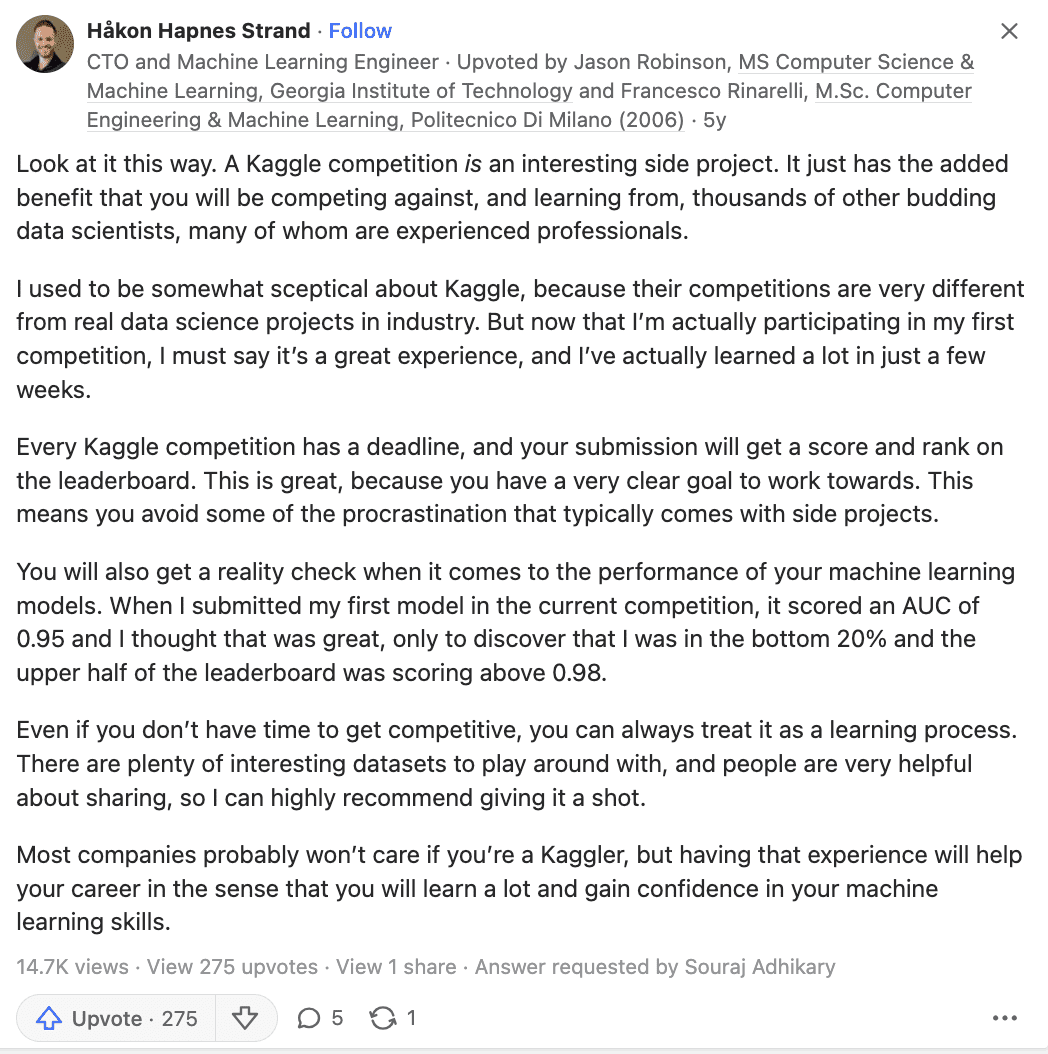
With a variety of responses, but as you can see in the image screenshot below explains the answer to your question.
Let’s get into whether Kaggle competitions are useful for real-world problems. Kaggle vs. Real-World
So we have spoken about how Kaggle competitions help your learning journey and how aspects of it reflect what happens in the real world. But is it useful for real-world problems? The overall answer is no. Let me explain why in different aspects.
Identifying the Problem
As a data scientist or machine learning engineer, your first task is to identify the problem or understand the current business problem that needs to be solved. For example, you may need to distinguish if the type of problem is supervised or unsupervised, decide which model you will use, etc.
This is one of the most important decisions you are going to make. If you don’t have an overall understanding of the organization, it will make your life harder as you cannot identify the root problem.
Real-world: Identify the problem or understand the current business problem that needs to be solved
Kaggle: You are provided with a detailed description of the problem and what you are evaluating.
Data Preparation
With Kaggle competitions, the host of the contest provides you with prepared datasets along with a detailed description of the problem at hand. This saves data scientists a lot of time going out to collect, clean and structure data — which happens in the real world.
Some believe that Kaggle spoon-fed new data scientists and machine learning engineers with provided data, allowing them to get straight to work. Data preparation is an important phase in the data science lifecycle, and Kaggle has shown to do it all for users.
In the real world, your company may or may not provide you with data. If they have not, you will have to collect it yourself, ensure it aligns with the problem at hand, and clean and structure it. You are also freely allowed to look for additional relevant data, whereas on Kaggle you are restricted to using outside data.
Real-world: Data collection and preparation help you to work around your identified problem.
Kaggle: Provides you with prepared data that is aligned with a detailed description of the problem at hand.
Feature Engineering
Once you have got your data and it’s all shiny clean, your next step as a data scientist is to go in and become a feature engineer. Feature engineering is rooted in your problem at hand, what you are trying to solve and how you are going to solve it.
With this, you will have a better understanding of how much time you will spend on feature engineering, and if other elements of the data science lifecycle are more important.
However, in Kaggle competitions, feature engineering plays a big role in where you end up on the leaderboard. Yes, feature engineering is part of the data science lifecycle, but real-world data science projects focus more on the factor that drives your model, rather than small incremental gains.
Real-world: The level of feature engineering is dependent on the problem at hand and where your focus is.
Kaggle: The level of feature engineering is used as an incentive to get higher up on the leaderboard.
Modelling
Choosing the correct model is based on a lot of factors, such as the explainability of the model, the data you are using, the performance of the model, and bringing the model to production. These are all in line with your problem at hand, as it is down to you to determine which one fits your business's needs.
Whereas on Kaggle, users are more concerned about which model performs the best and processes the data they are working with. The factors that are taken into consideration when choosing their model are far less realistic than what is dealt with in the real world.
Real-world: Choosing the correct model based on a variety of factors that are linked to your business’s problem at hand.
Kaggle: Choosing the correct model based on performance as you are taking part in a competition.
Validation
Validation is an aspect that both Kaggle and the real world show resemblance. Validating the performance of your model is an important aspect as it allows you to explore where you can make changes to improve your model and shows you if your model has value in the real world.
Kaggle competitions show you how building a robust model is of use in the real world.
Model into Production
In the real world, the majority of models you are building are aimed to move into production. This is because there is a purpose behind your model, you were trying to solve a real-world problem. Your model will one way or another find its way to be integrated into the business process to help in future decision making.
On the other hand, when you're taking part in a Kaggle competition, your #1 concern is where you ranked on the leaderboard and not how your model will be implemented and used in the future.
Real-world: Every model you build has a purpose and you want to move it into production to solve your business’s problem at hand.
Kaggle: The overall aim of building your model was to see where you ranked on the leaderboard and what you can do better next time in comparison to your competitors.
Learning Curve
Kaggle teaches you a lot. Through Kaggle competitions and working on different tasks and datasets, you can learn a lot. Personally, I don’t believe there is any harm in learning more and coming across challenges. You just learn how to overcome these challenges by reflecting on your weaknesses and how to turn them into strengths.
Would you rather be in the position of knowing more before you land your dream job, or not knowing? The answer is pretty simple and it depends on what you want out of your career.
Kaggle competitions show you the performance of your model which is good for your learning journey. As stated in the screenshot above, you could assume that the performance of your model is really good, only to realize that it wasn’t as good as others in the same competition.
With that being said, Kaggle competitions push you during your learning journey, allowing you to compete with people from all over the world and up-skill as an individual.
Deadlines
In the real world, when you are working on projects you are given deadlines. Deadlines help you keep on top of your tasks which are in line with the organization's business plan. Every deadline is the start of a new project.
Kaggle competitions have deadlines which reflect what your day-to-day tasks could typically look like. This is a great way to understand how your time is used as well as overcoming procrastination.
Wrapping it up
Based on the points we went over, the usefulness of Kaggle competitions is purely down to individuals. Yes, every aspect of a Kaggle competition may not mirror what happens in the real world, but many of us can say that about some of the things we learned at school.
Is that enough to say it is not useful for real-world problems?
Kaggle competitions provide you with a lot of learning experience and allow you to explore skills you may have never targeted before. There is a lot of experience that can come out of Kaggle competitions which can be used in your career later on.
Nisha Arya is a Data Scientist and Freelance Technical Writer. She is particularly interested in providing Data Science career advice or tutorials and theory based knowledge around Data Science. She also wishes to explore the different ways Artificial Intelligence is/can benefit the longevity of human life. A keen learner, seeking to broaden her tech knowledge and writing skills, whilst helping guide others.
More On This Topic
Using Data Science to Predict and Prevent Real World Problems
How to solve machine learning problems in the real world
Data Science Projects That Can Help You Solve Real World Problems
5 Practical Data Science Projects That Will Help You Solve Real Business…
Learn Machine Learning 4X Faster by Participating in Competitions
The Range of NLP Applications in the Real World: A Different Solution To…
If you think ChatGPT and the other generative AI tools are transformative to communication and understanding, wait until you see what happens when generative AI joins forces with marketing and sales teams.
We're looking at an enormous increase in the ability of businesses to meet the unique needs of individual customers, as well as an enormous increase in the capability for businesses to target those customers with psychological and demographic precision. The application of AI to marketing and sales gives a whole new meaning to the phrase "buyer beware."
Rather than general-purpose AI tools that can respond to text prompts or generate images on demand, we're starting to see more special-purpose tools that use the same large language model (LLM) approach we've been exploring in ChatGPT.
We'll explore what Adobe's doing with generative AI-driven marketing — and it's big.
Customer experience management and the buyer's brain
Adobe is best known for its portfolio of tools for creative professionals. Product names like Adobe Photoshop, Premiere Pro, and Acrobat are familiar to nearly everyone. But Adobe is also a market leader in another business that might not be as familiar to everyone: customer experience management.
Customer experience (or CX) is one of the biggest buzzwords in the world of marketing-speak. But just because it's one of those phrases only an AI could love doesn't make it any less important. In fact, managing customer experience is critical to any business that wants to succeed in today's marketplace.
Also:How to use Photoshop's Generative Fill AI tool to easily transform your boring photos
Put simply, "customer experience" is how your customers perceive their interactions with your company. "Perceive" is the key word. The better the perception of a customer experience, the more your company and brand create favorable associations in your customer's psyche. The worse the perception of that experience, the more negative those associations, and the less willing those customers will be to engage with your company again.
When customers interact with your company, a lot goes on inside their heads. They start to build a map of your brand's benefit to their lives. This mapping isn't just taking place as they buy your stuff. There's a pre-engagement psychological game going on as well: how much value they anticipate they'll derive from your offerings. There's experienced benefit, which is how much actual value or utility a customer gets. And then there's the big one: retrospective benefit, which is the customer's overall memory — positive or negative — of the experience.
Also: Adobe Generative Expand adds to Photoshop's AI arsenal
Companies that maximize the perceived pre-benefit bring in more fresh opportunities. Companies that maximize the actual value benefit reduce support costs and create potential repeat customers. And companies that maximize the post-game engagement create champions, generate word of mouth, and turn customers into fans and enthusiasts.
That end-to-end experience — pre, purchase, and post — constitutes the customer experience. And, all of that brings us back to Adobe's set of announcements.
Tapping the collective zeitgeist with the customer data platform
So, how do brands turn customers into fans and enthusiasts in a predictable, repeatable, goal-directed manner? With data. Gobs and gobs and gobs of data. Petabytes of data.
"In an unpredictable economic climate, where consumers now re-evaluate the products and services they buy each day, a brand's key growth driver is the ability to show people you accurately understand their current needs," says Anjul Bhambhri, senior vice president of Adobe Experience Cloud platform engineering.
Think about all the potential touchpoints with customers. There are social media in all its forms, from Twitter and Pinterest to Facebook pages, groups, and everyone's main feed. There's email and chat, phone support, offline in-store visits, and offline event interactions. Then there are mixed online/offline interactions, such as those that occur at trade shows. And there's every action on your website or in your app, every purchase, and every viewing of an ad, influencer video, or piece of editorial that mentions your offerings.
Also: The AI-powered Adobe Express is now generally available
All of the information from those touchpoints can and should be captured. The role of a customer data platform is to capture and then manage the flow of all the data, so it's not siloed. That's a very, very big job.
Also: These 3 AI tools made my two-minute how-to video way more fun and engaging
If there's a surge in returns in the spring from products built in a cold factory during winter months, you need to be able to notice that behavior and make the intuitive leap to understanding what's wrong, and then fixing the problem. If a much-anticipated movie sequel is about to be released, perhaps you'll want to stock up certain stores with goods that reflect the movie's style or notify customers that your analytics show you are fans of the movie's genre.
This brings us to Adobe's Real-Time Customer Data Platform (Real-Time CDP), which Adobe reports now delivers over 600 billion predictive insights annually based on real-time customer profiles.
Also: Adobe Firefly, now out of beta, boasts fix for DALL-E's drawbacks
Adobe focuses on three generative AI capabilities in its Real-Time CDP:
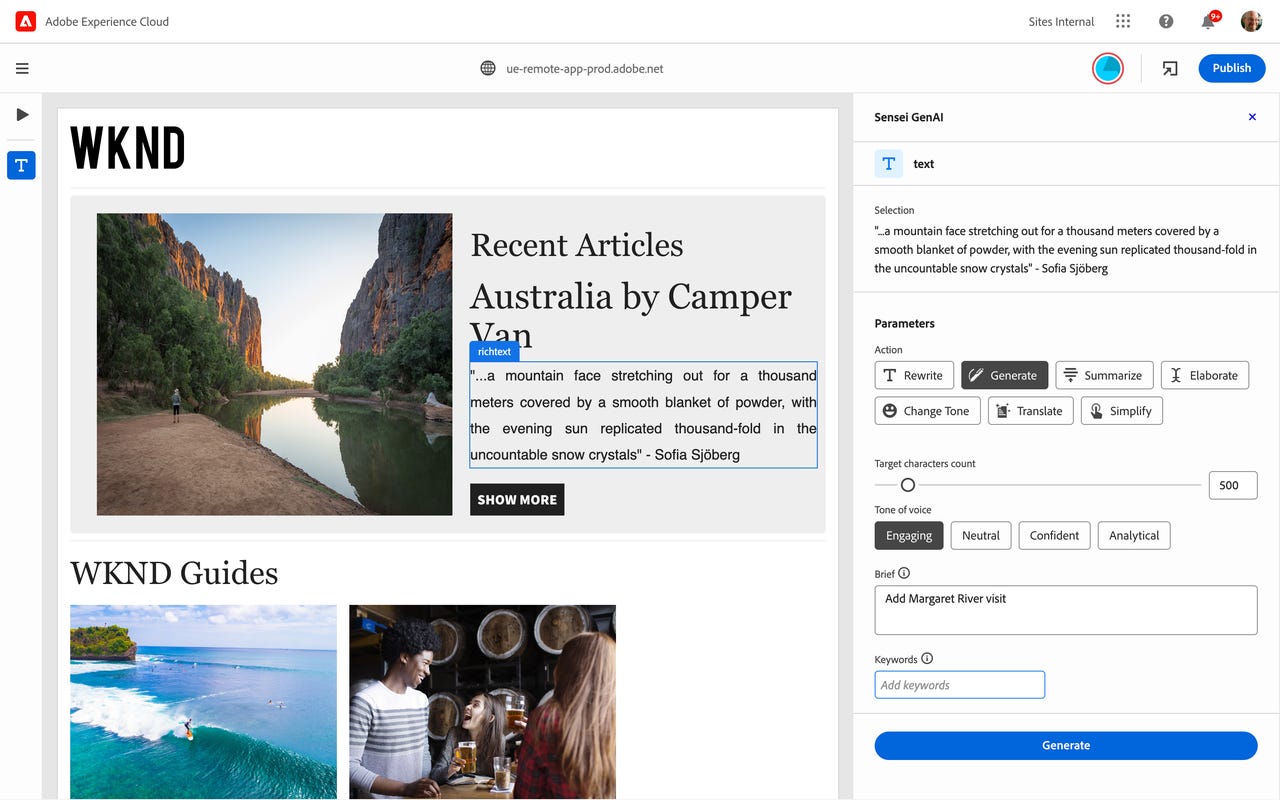
Rich segmentation: Adobe is using its new Adobe Sensei Generative AI Services capability to identify and define precision audience segments, allowing for personalized campaigns to be delivered at scale.
Adobe Journey Optimizer: This games out customer experiences in real time, providing insights as they happen and providing "next-best offers and touch points for customers." If you and your friend didn't see the same offer from the same company at the same time, this may be why.
Generative Playbooks: Customer journey guides have been around since product managers discovered they could get free coffee in the office. But what Adobe is offering is dynamically created customer journeys, the capability to identify new use cases from raw data, and the ability to simulate customer behavior — all with the AI quality we've been seeing from GPT-style LLMs. If you want to identify new opportunities and identify new markets, this tool will get you a far way along.
"Adobe Experience Cloud applications, from Adobe Real-Time CDP to Adobe Journey Optimizer and Customer Journey Analytics, work together to help brands drive the next phase of their digital transformation, which will be anchored in wide-scale personalization," says Adobe's Bhambhri.
Adobe is also pushing its game forward in healthcare, financial services, B2B, and retail. It has initiatives in these four areas:
Managing consumer data responsibly: Adobe's Real-Time CDP prioritizes privacy and offers new Privacy & Security Shield and Healthcare Shield products for regulated industries and healthcare brands.
Enhancing B2B account-based marketing: Think of this initiative as the customer journey, but on a company-to-company and team level.
Leveraging e-commerce for richer personalization: Adobe's Real-Time CDP and Commerce integrations enhance e-commerce for brands by analyzing online behavior, targeting content, and personalizing offers.
Prospecting, enriching, and activating with partners: Adobe improves Real-Time CDP with partner enrichments, Amazon Ads, TikTok, and LiveRamp integrations to solve cookieless prospecting challenges for brands.
This collection of initiatives is how the customer experience and the customer data come together. Customer interactions generate more data. Real-time analytics changes the customer experience dynamically. Wash. Rinse. Repeat.
Adobe's image and text generative AI services
Adobe is banging the AI drum really, really hard. At the core of its approach are its Sensei GenAI Services. Given the current sensitive climate to cultural appropriation, it's not entirely clear that "sensei" was Adobe's best choice for branding its AI engine, but the capabilities available on offer seem impressive.
Also: AI is a lot like streaming. The add-ons add up fast
One such tool is Firefly, trained on Adobe Stock images, along with public domain and copyright-free images. The product, much like DALL-E 2 and Midjourney, can generate custom images. Interestingly, the company specifically says those images will be "safe for commercial use." As with other generative tools — and the very capable Adobe Express — Firefly is designed to make it easier for marketers to create content without regard to artistic skill level.
On the text side of the generative AI equation (have you noticed the new "GenAI" buzzword?), Adobe's introducing four new services based on LLMs, including:
Marketing copy generation: A tool for creating message variations, modifying tone of voice, and incorporating keywords in the copy generated. As a guy who's spent a large part of his life getting paid to write marketing copy, I'm not exactly sure what I think about this tool. It could help remove the drudgery, or it could reduce billings.
Conversational experiences: This service is a super-charged version of the chatbots used to power customer support widgets during off-hours. Given my tech support experiences with ChatGPT, this service could well reduce customer frustration and benefit the overall customer experience.
Caption generation: This service is an enhancement to the company's analytics offering (Customer Journey Analytics). The analytics tools help uncover opportunities or identify roadblocks. Where this tool comes into play is that it gives those opportunities and roadblocks relevant names to help marketers and managers visualize the overall impact of the data.
"Adobe has a long history of unlocking Al as a co-pilot for marketers, and we have a vision for generative Al that covers the full lifecycle of customer experience management, with the enterprise-grade security and data governance that our customers expect," said Amit Ahuja, senior vice president, Digital Experience Business, Adobe. "Business growth is driven by customer experiences, and generative Al is a transformative, foundational technology that will impact every aspect of how brands connect with their customers."
So, there you go — Adobe's got a lot going on in its customer experience and AI offerings. What do you think? Will these initiatives improve actual customer experiences? Will they help your business manage growth and opportunities? Let us know in the comments below.
You can follow my day-to-day project updates on social media. Be sure to follow me on Twitter at @DavidGewirtz, on Facebook at Facebook.com/DavidGewirtz, on Instagram at Instagram.com/DavidGewirtz, and on YouTube at YouTube.com/DavidGewirtzTV.