Two roads diverged in a wood, and I; I took the one less traveled by, And that has made all the difference.
— Robert Frost
At certain points in the evolution of enterprise artificial intelligence, there’s been a fork in the road. The road less traveled has suggested a different route to a more satisfying kind of success. That success will be more beneficial over the long term, but is harder and more time consuming to achieve.
Unfortunately, most AI media buzz dwells on the shortest path to some kind of tactical value. That’s the most traveled road. What happens as a result? Nagging problems like a lack of trustworthy inputs and outputs are a can that keeps getting kicked down the most traveled road.
The generative AI approach of large language models (LLMs) has been on the most traveled road of evolution. Now we’re facing another fork in the road: Retrieval Augmented Generation (RAG). RAG gives us another opportunity to address the trustworthy data challenge.
The most traveled road for RAG
According to Ben Lorica, ex-O’Reilly pundit and author of the Gradient Flow newsletter, “RAG refers to the process of supplementing an LLM with additional information retrieved from elsewhere to improve the model’s responses.”
That’s a helpful definition, one that leaves room for many different ways and means to effectively retrieve just the right information for the purpose at hand in order to augment (and thereby improve) what’s to be generated in terms of answers to pressing business questions.
Unfortunately, the most traveled road, given generative AI’s typically narrow, here’s-the-only-way-to-do-it focus, will have the characteristics of an AI data adhocracy:
Project specific. The focus will be on the use case at hand. Applicability to other projects and disciplines will be secondary.
LLM dedicated. The data improvement efforts will benefit the end user within the use case footprint of the LLM, but may not have a broader impact.
Numerical only. RAG often relies only on vector embeddings for additional context, with the result that the generative AI’s logic capabilities will be solely numerical and therefore probabilistic. Claims that machines can “understand” with the help of these embeddings are overstated. Symbolic logic is necessary to complement the numerical for machine understanding.
FAIRification: The road less traveled
The best way to do RAG at scale would be what life sciences enterprises are currently doing with their FAIR (findable, accessible, interoperable and reusable) data initiatives to avoid reinventing the wheel.
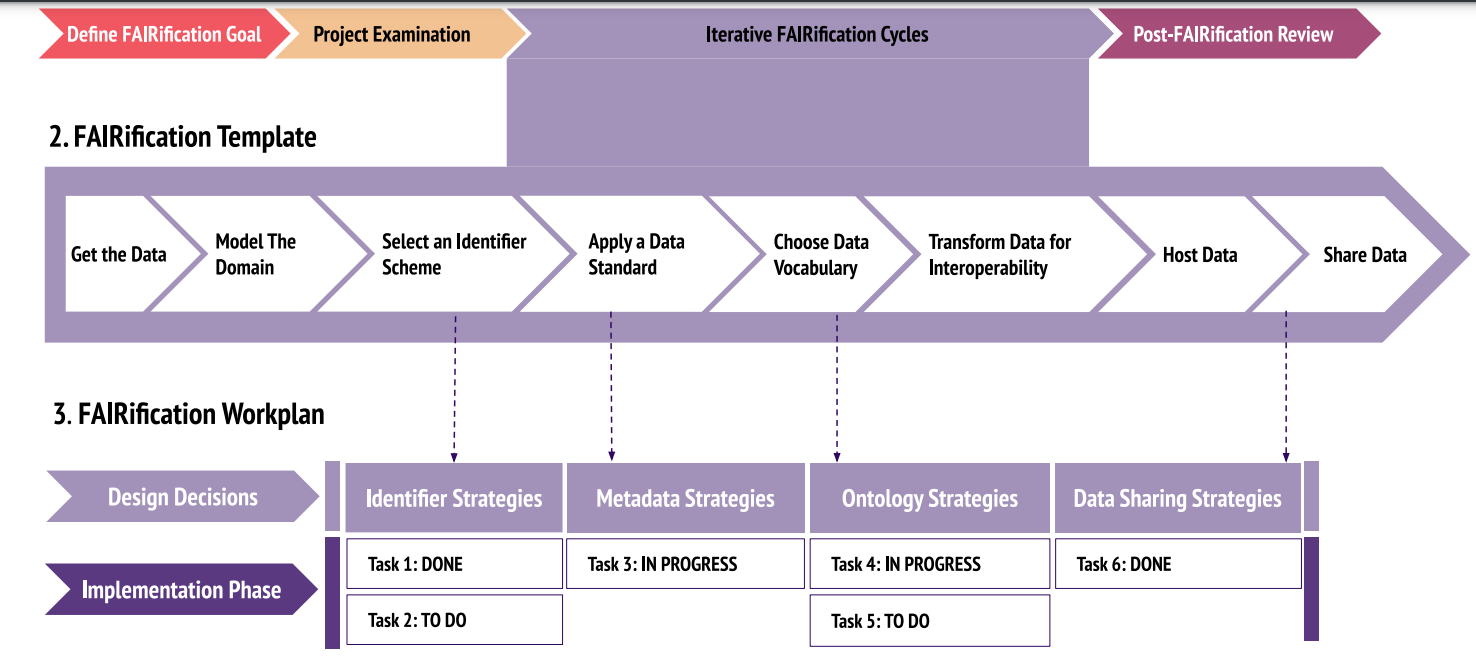
FAIRification is a broad, organic approach to trusted data management, one dataset at a time. Each dataset worthy of reuse grows and evolves into a mature state. This diagram from Danielle Welter of the Luxembourg Centre for Systems Biomedicine, et al., outlines the process:
Welter, D., Juty, N., Rocca-Serra, P. et al. FAIR in action – a flexible framework to guide FAIRification. Sci Data 10, 291 (2023).
Then that dataset joins others in an accessible, managed environment designed for discoverability. So the same dataset could be reused in conjunction with others for many different purposes, from agent-managed digital twins, to LLMs, to humbler analytics uses. Moreover, the datasets are designed to be self-describing, so that subgraphs can be plugged into a larger, interoperable knowledge graph.
The focus is on quality, trustworthy, logically interconnected data first so that the effectiveness of the algorithm should benefit from high data quality to begin with. Life sciences companies have to put the long-term management and reuse of quality data high on the priority list, because they are asset tracking at the molecular level.
The striking contrast between FAIRification and data preparation by data scientists
In Lorica’s RAG diagram, the retrieval process starts with raw data sources and data preparation. Most AI projects start with an initial compromise: the available data in whatever shape it’s in. Data scientists often don’t have the opportunity to do more than the basics with data preparation.
As you can tell, FAIRification differs radically from what’s ordinarily done in most enterprises. Most cloud services, SaaS providers and IT departments still have not addressed the problems of siloing, fragmentation, hoarding, data duplication and logic sprawl.
Legacy data management determines the road most enterprise data scientists, architects and engineers travel by. The best way to improve model responses capitalizes on the most optimal means of managing heterogeneous data as scalable, contextualized knowledge, with rich graphs that are meaningfully connected because each subgraph expresses its own context in a standard way that contexts can be snapped together reliably.
President Biden Unveils AI Executive Order October 30, 2023 by Ali Azhar
Artificial intelligence has great potential, for promise and peril. Using AI responsibly can help solve some of the most challenging issues around the globe, but it can also be used for societal harm and mass destruction. With its enormous potential for good and bad, it was only a matter of time that a technology as powerful as AI would be regulated.
President Biden unveiled a groundbreaking AI executive that outlines the new standards for AI safety and security, protects the privacy of Americans, advances civil rights, promotes innovation and competition, and supports American leadership around the world.
The order grants the White House greater authority to keep tabs on the development of AI technology in the private sector. The order also mandates companies to submit safety test results and other critical information on how they develop, train, and test AI models to ensure they remain protected from foreign adversaries. New standards for biological synthesis screening will be used to protect against the risks of using AI to engineer dangerous biological materials.
The executive order has come at a time when this is increasing discussions about federal AI policy and regulations. Senate Majority leader Chuck Schumer continues to host the AI Insight Forums, where members of the industry, AI experts, and civil rights advocates convene to inform Congress’s work on regulating AI. Speaking ahead of the AI Safety Summer 2023, the British Prime Minister also warned of AI dangers and urged greater global cooperation between governments to mitigate the risks.
A key objective of the executive order is to promote equality and civil rights. Federal contractors and landlords are urged to avoid using AI algorithms for discrimination. There has also been a directive to create best practices for an appropriate role for AI in the justice system and create a program to evaluate potentially harmful AI-related healthcare practices.
President Biden has called on Congress to pass bipartisan data privacy laws to protect all Americans. This includes accelerating the development and use of privacy-preserving techniques and evaluating how agencies collect and use commercially available data.
(Zia-Liu/Shutterstock)
There is no doubt that AI is having a major impact on the labor market. On one hand, AI offers greater productivity, but on the other, there is a danger of increased job displacement and workplace surveillance. To protect the rights of workers and invest in workforce training, the Biden-Harris administration has directed the development of best practices to mitigate risk and maximize the benefits of AI for workers. The order also directs actions to produce reports on AI’s potential impact on the labor market and how the federal government can support workers facing labor disruptions.
It is a common belief that regulations hinder growth by creating excessive burdens on the companies. However, one of the key goals of the AI executive order is to ensure that the AI industry continues to innovate and remain competitive. A pilot program for the National AI Research Resource will be launched to provide AI researchers and students access to key AI tools and data. There will also be expanded grants for AI research and development in areas like climate change and healthcare.
To help support the trustworthy deployment and use of AI worldwide, President Biden directs actions to expand multilateral and multi-stakeholder engagements to collaborate on AI and to promote safe and rights-affirming developments and deployments of AI to solve global challenges.
The executive order also highlights the need to accelerate the rapid hiring of AI professionals. This surge in AI talent development and acquisition will be led by the Office of Personnel Management, U.S. Digital Corps, U.S. Digital Services, and the Presidential Innovation Fellowship.
While the Biden-Harris administration advances this agenda at home, it will also work with its allies to establish a strong international framework for governing AI development and use of AI. AI technology is expected to continue evolving, especially as it transitions from a popular consumer tool to an enterprise-level instrument for growth and innovation. The executive order is a vital step forward to ensure the responsible use of AI, and the Biden-Harris administration will have to continue pushing this agenda.
Related Items
Europe Moves Forward with AI Regulation
Self-Regulation Is the Standard in AI, for Now
Is Your AI Ready to Be Regulated? Lessons from GDPR
While the NVIDIAs of the world are trying to build GPUs and unleashing AI supercomputers on the tech-hungry world, AMD seems to be focusing on bringing AI to edge devices, particularly CPUs.
“What I want to highlight is that AMD has a broader strategy for AI than just GPUs. This is what makes us different from NVIDIA,” Gilles Garcia, senior director business lead, data centre communication group at AMD, told AIM at IMC 2023, in New Delhi.
AMD believes that most of the AI workloads can be handled by CPUs alone. “CPUs are best for handling most of the problems with current edge processing such as thermal management, cost effectiveness, and reducing the footprint by working on edge,” said Garcia.
He emphasises that using only CPU as the AI processing compute engine, a lot of workload can be sustained because of the number of cores that AMD offers. This was enabled by AMD’s Siena, launched in 2022. “The industry was able to provide 32 cores in around 200 watts. With Siena, AMD is delivering 64 Zen 4 processor cores in 200 watts,” he added.
“If you want to use GPUs on the edge, where you can be latency challenged, you could be power constrained. So then you probably need to look at alternatives to GPUs, which can be offloading the power, but not on external GPUs as well,” said Garcia. “Depending on the workload, CPUs can handle the AI workload alone. You need accelerators laters, that is where GPUs are used.”
Therefore, AMD is not just focused on a single point strategy, but on all fields of AI, not leaving any stone unturned. In June, Lisa Su had announced the company’s plans to launch Instinct MI300X, an alternative to NVIDIA’s H100, soon. For this, the company is also focusing on developing ROCm even further, before the launch of the hardware.
Strategic Investments
“We are always monitoring what value we can bring and what value other companies can bring to us,” Garcia said about investing in AI startups. Though AMD hasn’t made any announcement of investing in any startups in India yet, it has been on an acquisition spree across the globe. Garcia highlighted the acquisition of Nod.ai and Mipsology, within the last few months.
Though the plans are not exactly revealed at the moment, Garcia emphasised on the presence of AMD in the country. “AMD has a significant presence in India, with over 10,000 employees, and the company has announced a $400 million investment to accelerate research and development in the country. While the specific areas for investment are yet to be determined, AMD’s commitment to the Indian market is evident.”
Talking about the three-year-old acquisition of Xilinx, Garcia highlighted that IBIS, the AI engine, is used today in Ryzen 7040-based laptops which were announced at CES 2023 in June.
Garcia said that AMD is already working on the 5th generation of processors, called Turin, and is expected to come around 2024. “We are keeping our cadence of launching a new series every two years,” said Garcia, mentioning that the company released the 4th generation Genoa processors in November 2022, and thus, Turin is expected to be out by November 2024.
Going Beyond AI
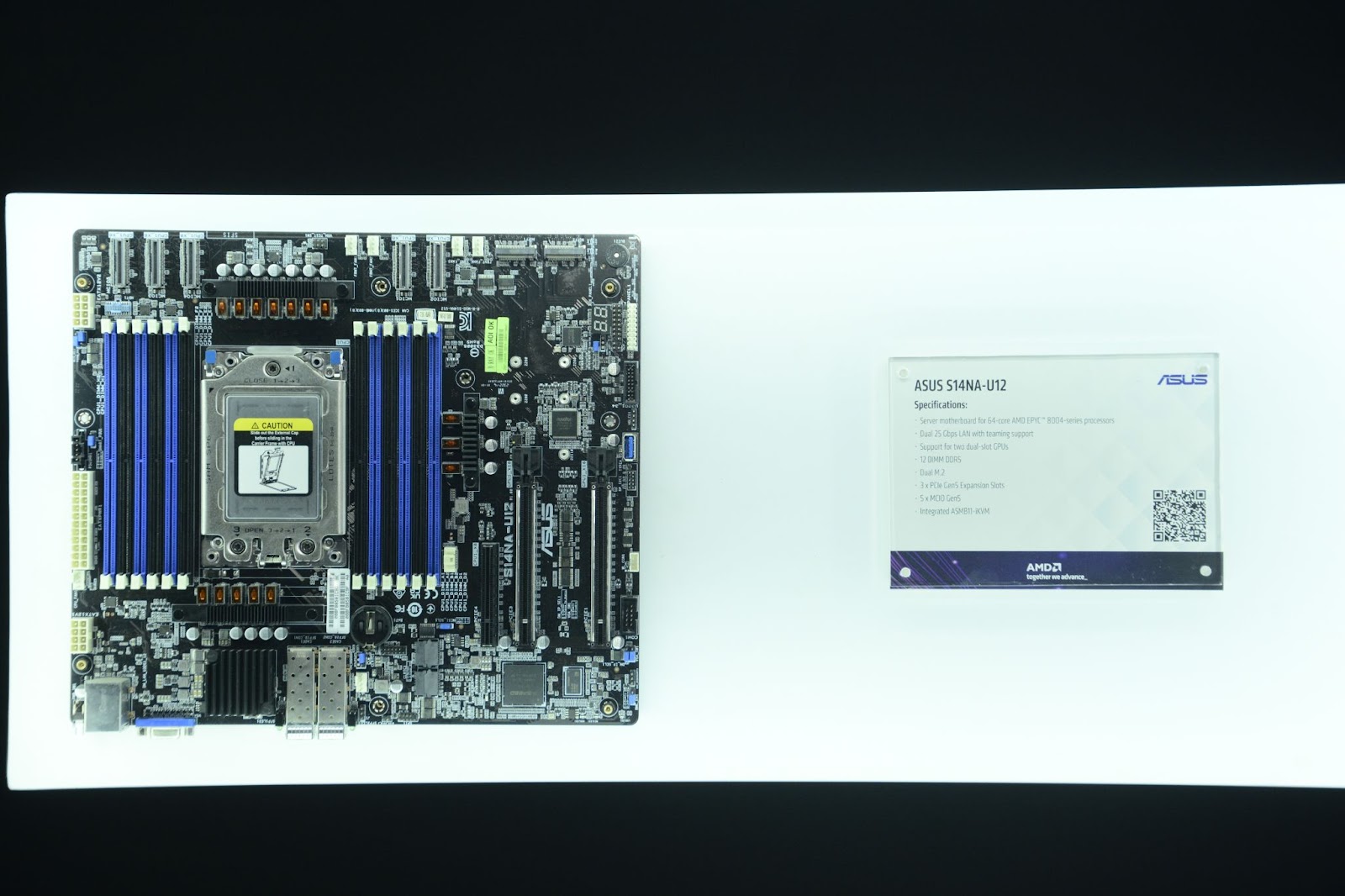
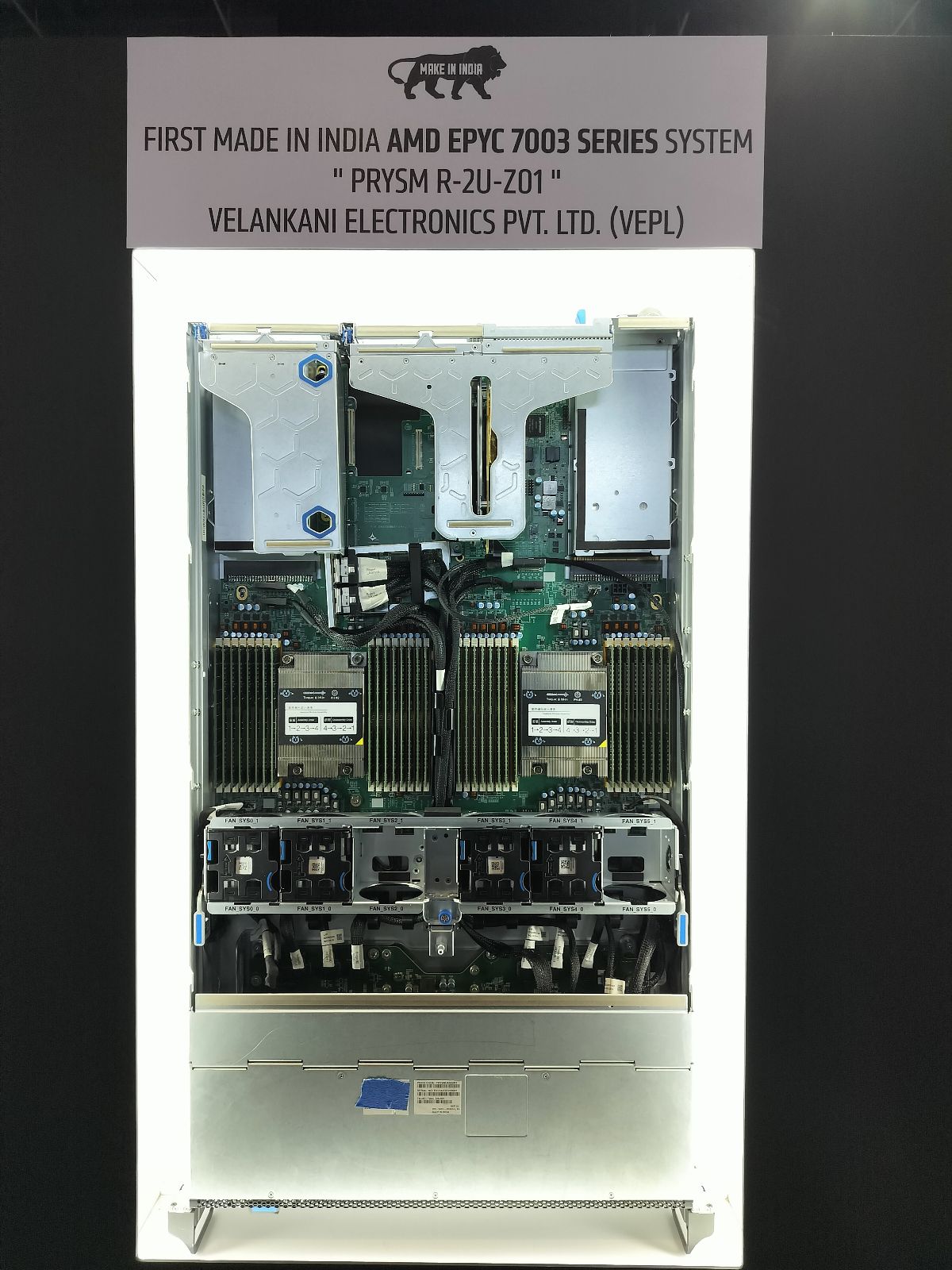
At IMC 2023, Garcia presented the EPYC 8004 series processors and also revealed that AMD is teaming up with VVDN and C-DoT, Indian 4G and 5G equipment makers, for providing telecommunications solutions in the country. These would be enabled by AMD’s acquisition of logic chipmaker Xilinx.
“We are bringing leading edge, power efficient technologies to India to power radios, servers and compute requirements at data centres and the edge, and even in RAN (radio access network), ” said Garcia. AMD has been receiving great response from local 4G and 5G vendors for using the technology.
He further highlighted that Xilinx chips will also help AMD, being fabless, in developing bases for 6G networks in the future.
AMD, along with Korea telecom KT, decided to back AI software developer Moreh. In a series-B fund, the Santa Clara-based startup raised $22 million, bringing the total it raised to $30 million.
Evidently, AMD has extended its reach beyond GPUs and AI, now actively engaged in various technology sectors, with a specific focus on edge computing and workload optimisation.
The post AMD Paving AI’s Road from Edge & Beyond appeared first on Analytics India Magazine.
Over the past few weeks, we've been diving into the DALL-E 3 implementation within ChatGPT Plus. By embedding the text-to-image tool within ChatGPT, the AI makes creating images super easy.
But I was curious. How do those images compare to Midjourney? I've done a lot with Midjourney, and have gotten to know it quite well. It has more customization features than the DALL-E in ChatGPT implementation, but how does it compare straight out of the box?
Also: More fun with DALL-E 3 in ChatGPT: Can it design a T-shirt?
So, let's have ourselves a time-honored showdown, AI style. We'll pit DALL-E 3 in ChatGPT against Midjourney in eight image comparison tests. And because it's Halloween season, that's our theme. Each prompt includes an art or presentation style, and an image to create.
To test, I gave identical prompts to both AIs. I had to prepend all the Midjourney prompts with /imagine and all the DALL-E prompts with "image of," but otherwise, the prompts were identical. Midjourney automatically generates four images, while DALL-E does two. I ran the prompt twice with DALL-E so we'd have four to choose from with both AIs.
Then, I packaged them all up in Photoshop so we could see all eight candidate images side by side. My judging criteria consisted of the following:
How well does the AI do with the specified style?
Does the AI incorporate the specified image elements?
Which image is my wife's favorite, and which AI made it?
Which image is my favorite, and which AI made it?
Also: How I used ChatGPT and AI art tools to launch my Etsy business fast
At the end, I'll total up the results and declare a winner. And with that, let the Halloween-AI-off begin!
Friendly witch
Here's our prompt:
Photorealistic, 35mm, friendly cheerful witch, in doorway of suburban house, giving away treats on Halloween
Here's what the two AIs came up with. The Midjourney results are on the left. The DALL-E 3 results are on the right. You can click the little rectangle in the upper-right corner to see the image enlarged.
Here's where my prompt wasn't as precise as it could have been. I wanted someone in a doorway, facing out of the house. But I didn't specify, so I got some images facing into the house and some facing out.
Midjourney missed the spec, not really offering treats in any of the images. They all seemed a little weird. What exactly is the witch in #4 holding? Is that a phone, a razor, a tricorder? It's definitely not a treat.
DALL-E 3 did a much better job. All four of its submissions had treats, although the witch with the cookies probably isn't providing a practical trick-or-treat style treat.
Also: ChatGPT vs. Bing Chat vs. Google Bard: Which is the best AI chatbot?
I was a bit torn about choosing a favorite from the DALL-E set. But I like #1 best. She's not answering the door, but she looks a lot more like what I had in mind when I issued the prompt. My wife Denise preferred #3, opining that she seemed really into the holiday, clearly had a bowl of treats, and looked like she was an actual kindly witch, not just someone in a cheap witch costume.
Specified style: tie, both present photo-style images
Includes the specified elements: DALL-E, hands down
Denise's favorite: DALL-E #3
David's favorite: DALL-E #1
For this round, DALL-E is the clear winner.
Snoopy and the Great Pumpkin
Here's the prompt:
1960s style cartoon, the great pumpkin halloween, with happy Snoopy-like dog
I have to admit, the DALL-E renditions surprised me. DALL-E didn't produce a Snoopy-like dog, it pretty much produced Snoopy. DALL-E image #1 even has a Charlie Brown in the background. Clearly, there are trademark issues here. We're reproducing these images just to show you what DALL-E produces, as a journalistic endeavor, but you couldn't, for example, use these images on a T-shirt or in production artwork that you planned to sell or use commercially in any way.
On the other hand, Midjourney did produce little white dogs, although none of the pumpkins are big enough to be considered a Great Pumpkin (which, itself, is an active trademark of Peanuts Worldwide LLC).
Also: The best AI art generators: DALL-E 2 and fun alternatives to try
Without regard to the trademark issue, and based only on preference, Denise preferred DALL-E #3. For me, DALL-E #2 is almost exactly what I was picturing in my head when creating the prompt, but I was hoping for something that was more inspired by Snoopy than cloning Snoopy outright. As such, I'd have to say I really like both #3 and #4 by Midjourney. The little hats are very cute. Overall, my favorite Midjourney pick is #4 because it has a grinning white dog with a dog bone collar and an array of fairly large pumpkins.
Specified style: DALL-E, because it produced a flat cartoon much more in the 1960s style
Includes the specified elements: Midjourney, because DALL-E was a straight-up copy, not Snoopy-like
Denise's favorite: DALL-E #3
David's favorite: Midjourney #4
For this round, I have to call it for Midjourney. DALL-E produced Snoopy cartoons, but because it produced Snoopy cartoons so precisely, including Charlie Brown in the background, all four entries have to be disqualified as unusable without licensing.
Halloween cat
Here's the prompt:
Hyperrealistic, Matthias Haker style, happy Halloween black cat, full moon night
Matthias Haker is a German photographer who creates art with architectural images that have a sense of grandeur and ghostliness, as well as vivid colors. I wanted to see what would happen if I asked for his style, but for a cat. I had not previously heard of Haker, but I liked what I saw when I went searching for art styles in Midjourney, in the Midlibrary database of art styles.
Before we look at those results, let's talk for a minute about the issue of using an artist's style in an AI rendition. Artists spend their lifetimes creating signature styles, and there's something disturbing about feeding their name to an AI and watching the machine spit out a near-perfect clone.
On one hand, using an artist to specify a style can be a form of shorthand for the AI to understand what you want. On the other hand, you're flattening and appropriating that artist's style.
Also: We're not ready for the impact of generative AI on elections
Here, in our example, it's fairly unlikely that Haker will create a Halloween cat, and I am providing links promoting his website, but should we support AI's use of an artist's style? Let us know in the comments below. I also reached out to Hacker himself for his thoughts, and if I hear back, I'll update this article.
Oh, and while DALL-E was perfectly comfortable reproducing Snoopy and Charlie Brown exactly, it didn't like the Matthias Haker query, returning this:
I apologize, but due to content policy restrictions, I was unable to generate images based on the provided description. Please let me know if you have any other requests or if there's another way I can assist you!
So the DALL-E prompt became this, instead:
Hyperrealistic, happy Halloween black cat, full moon night
And here's the result:
Both Midjourney and DALL-E produced great pictures, although neither managed to present a cat that looks happy. My favorite is Midjourney #3, which has wonderfully vivid colors along with a lot of great contrast between the glowing moon, the haunted house in the background, and the cat. My only negative is that the cat only shows one eye.
I was unable to pin Denise down on one image. She liked Midjourney #1 and DALL-E #3 equally, specifically how the AIs presented the faces and the different moods and colors.
Specified style: Midjourney because DALL-E refused the accept "Matthias Haker" in the prompt
Includes the specified elements: Tie, although all the cats seem slightly more annoyed than happy
Denise's favorite: Midjourney #1 and DALL-E #3
David's favorite: Midjourney #3
Both AIs did great with this challenge, but I'm going to give it to Midjourney because Midjourney introduced more vivid colors, which is the effect I wanted by specifying a Matthias Haker art style.
It's clear that DALL-E complied with the letter of the law, producing 8-bit images that could have been pulled out of an 8-bit video game. On the other hand, while Midjourney #3 met that criteria, it produced images that were not, strictly speaking, 8-bit images. Instead, it created images that were inspired by 8-bit style.
Also: How to get a perfect face swap using Midjourney AI
That was not what I would have expected from my prompt, but I love it. So did Denise. We both totally grooved on Midjourney #1. But Denise chose DALL-E #2 because it got the monsters right and was clearly 8-bit.
Specified style: DALL-E, because all are really ripped from 8-bit video games
Includes the specified elements: DALL-E, because the monsters were exactly as specified
Denise's favorite: DALL-E #2
David's favorite: Midjourney #1
Technically, DALL-E won this round. But I was much more charmed by the Midjourney results. I'm giving this round to DALL-E because it complied with the technicalities. But Midjourney was much more my favorite.
Haunted house
Here's the prompt:
Photorealistic style, Graciela Iturbide style, haunted Halloween house mansion
As with the cat, I used a specific artist's style in the prompt. Graciela Iturbide is a Mexican photographer who captures scenes of domestic life using a fairly stark, high-contrast black-and-white style that I thought might translate well to a haunted house scene. I had also not heard of Iturbide, but I liked what I saw when I again went searching for art styles in Midjourney, in the Midlibrary database of art styles.
As with Matthias Haker, I reached out to Graciela Iturbide to ask what she thinks about AIs referencing her style. I'll update this article if I receive a reply.
Here's the result:
One of the things I love about text-to-image AIs is that the result can be unexpected. My hands-down favorite is Midjourney #3, which doesn't even have a house, but conveys such a great haunted feeling that I just love it. Denise preferred DALL-E #1, saying that it really stood out for her as a great inviting and scary haunted house of the kind meant to lure you in and trap you with illusions of coziness, even though it didn't have anything to do with the specified style.
Specified style: Midjourney, using the stark black-and-white imagery of the artist
Includes the specified elements: DALL-E drew the classic haunted house
Denise's favorite: DALL-E #1
David's favorite: Midjourney #3
Wow. Both AIs produced wonderful images. I have to give it to DALL-E because if you were looking specifically for a haunted house image, the output of DALL-E is much more like what you might expect. That said, I personally love what Midjourney did from an artistic perspective.
Kids in costume
Here's the prompt:
Pixar-style trick-or-treating kids in Halloween costumes
I am not at all sure what Midjourney is trying to accomplish. Its kids look like a cross between cartoon and real-life kids. DALL-E's kids are right out of a Pixar cartoon.
This is an easy slam dunk win for DALL-E. Denise loved the super-excited grinning faces on DALL-E #1, including the dinosaur. I liked DALL-E #3, especially the little alien.
Specified style: DALL-E
Includes the specified elements: DALL-E
Denise's favorite: DALL-E #1
David's favorite: DALL-E #3
Friendly ghost
Here's the prompt:
Disney-style friendly ghost with scary jack-o'-lantern
To be clear, the classic Casper the Friendly Ghost character was never a Disney property. It was a Paramount property that wound up under the Dreamworks umbrella for both animation and comic books.
That said, I wanted a friendly ghost, not necessarily Casper. And I wanted it with a decidedly less friendly and hopefully actually scary jack-o'-lantern. By Disney style, I was hoping for a more modern animated style, rather than something that specifically looked like it was lifted from a vintage Disney artist's celluloid hand drawing.
Here's what we got:
Midjourney kind of missed the point, somehow conflating Nightmare Before Christmas style (that's our next prompt) with the ghost images. Also, the ghosts are a bit scary and the jack-o'-lantern less so.
Denise and I both favored the DALL-E graphics, although she said that the art wasn't really Disney style. Her favorite was DALL-E #1, with #2 as a close second. My favorite was DALL-E #1, hands down. I liked the friendly ghost and the jack-o'-lantern has some definite menace to it — exactly the juxtaposition of moods I wanted when I wrote that prompt.
Specified style: DALL-E
Includes the specified elements: DALL-E
Denise's favorite: DALL-E #1 or #2
David's favorite: DALL-E #1
Also: Third-party AI tools are responsible for 55% of AI failures in business
The winner here is DALL-E. Both drew nice cartoonish images, but DALL-E got the intention and had a friendly ghost with a scary pumpkin. Midjourney did just the opposite, missing the point of the prompt.
Nightmare datacenter
This is probably my favorite of all the prompts. Here's what I fed the AIs:
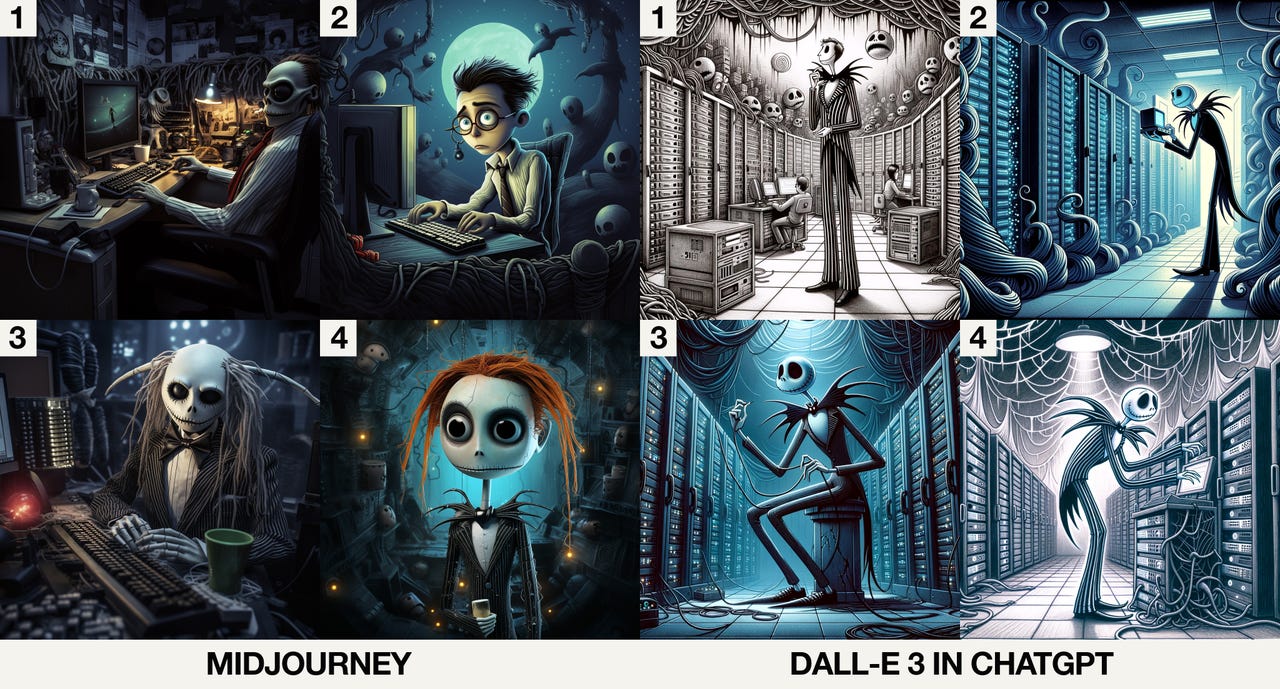
Nightmare before Christmas style, Tim Burton style, IT professional in datacenter
I love these. All of them. DALL-E once again used the actual referenced imagery, while Midjourney was more inspired by it. I mean, there's pretty much no doubt that Jack Skellington has somehow found his way inside a data center in the DALL-E images.
The Midjourney images show IT folks, but not really much of a data center. That said, Denise's favorite is Midjourney #1, because the dude there is exactly what she pictures if she had to go down deep into the bowels of a company to hunt down the scary IT guy (she doesn't, because her IT guy is sitting on the couch next to her every day).
My absolute favorite image is DALL-E #4. Yes, it's undeniably Jack Skellington, but the design of the data center is spot on, and I just love it. I'd put that on my office wall, for real. That said, we again are dealing with licensing issues (Jack Skellington is a Disney trademark), so the Midjourney images might be more usable if you wanted to put them on a T-shirt or something.
Specified style: Midjourney got the Nightmare Before Christmas color styling right
Includes the specified elements: Tie. DALL-E did data centers, Midjourney did not. But Midjourney did unique characters and didn't just clone Jack Skellington.
Denise's favorite: Midjourney #1
David's favorite: DALL-E #4
For this round, I have to call it for Midjourney — for the same reason Midjourney won the Snoopy-style round above. DALL-E produced Jack Skellington cartoons, but because it produced Jack Skellington so precisely, all four entries have to be disqualified as unusable without licensing. DALL-E #1 is arguably not exactly Jack Skellington, but that's splitting hairs considering the others are rocking the full Skellington.
Which AI does Halloween better?
Wow, that's a tough call. If you add up the wins, DALL-E 3 in ChatGPT won five of the eight contests, while Midjourney won three of the eight. So, I guess that makes DALL-E the winner.
Also: How AI helped get my music on all the major streaming services
DALL-E lost points for some of its better work, because it completely cloned Snoopy and Jack Skellington instead of using them as inspiration. Midjourney sometimes missed part of the assignment completely, but at least didn't return results that were going to become licensing nightmares. That's not the sort of nightmare I wanted to inspire in these images.
Do I have a buying recommendation based on these tests? Nope. I find Midjourney provides a great deal of value and some flexibility, but — like most artists — it has a mind of its own. DALL-E 3 inside of ChatGPT is a free bonus given I'm already paying for ChatGPT Plus. I will say I was pleasantly surprised by how good the DALL-E results were, but a bit freaked by its tendency to clone licensed properties.
What do you think? What are your favorite images? Who do you think won our competition? Let us know in the comments below.
You can follow my day-to-day project updates on social media. Be sure to subscribe to my weekly update newsletter on Substack, and follow me on Twitter at @DavidGewirtz, on Facebook at Facebook.com/DavidGewirtz, on Instagram at Instagram.com/DavidGewirtz, and on YouTube at YouTube.com/DavidGewirtzTV.
ChatGPT app revenue shows no signs of slowing, but some other AI apps top it Sarah Perez @sarahintampa / 8 hours
ChatGPT, the AI-powered chatbot from OpenAI, far outpaces all other AI chatbot apps on mobile devices in terms of downloads and is a market leader by revenue, as well. However, it’s surprisingly not the top AI app by revenue — several photo AI apps and even other AI chatbots are actually making more money than ChatGPT, despite the latter having become a household name for an AI chat experience.
Since its launch on mobile devices in May of this year, ChatGPT’s downloads and revenue have continued to grow. In its first month, when the app was available on iOS only, it topped 3.9 million downloads, which grew to 15.1 million by June, according to an analysis of the AI app market by Apptopia. Then, following a slight dip in July, ChatGPT grew again to top 23 million downloads as of September 2023.
In addition, ChatGPT’s usage on mobile devices has similarly grown from just over 1.34 million monthly active users in May to now 38.88 million as of September.
Perhaps even more importantly, ChatGPT’s mobile app is outpacing much of the AI chatbot market by consumer spending, which grew from $352,929 during the month of its launch to reach $1.98 million as of September and nearly $2.39 million as of October 24, where the current dataset ends.
But it’s not the top app by revenue in the AI chatbot space. “Chat & Ask AI” and “ChatOn — AI Chat Bot Assistant” both pulled in more money in September at nearly $3.38 million and $2.11 million, respectively. Other apps are also close on ChatGPT’s heels with “AI Chatbot — Nova” and “AI Chatbot: AI Chat Smith” pulling in nearly $1.44 million and $1.72 million in September, respectively.
As ChatGPT has a lot of competition for users’ time on mobile, there are now at least five AI chatbot apps that have topped 2 million downloads in September, including several generically-named apps like “Chat & Ask AI,” “ChatOn — AI Chat Bot Assistant,” “AI Chatbot — Nova,” and “AI Chatbot: AI Chat Smith” with 2.44 million, 2.02 million, 3.1 million, and 2.9 million downloads, respectively. These apps appear to be capitalizing on App Store SEO — meaning they’re ranking well for terms users might search for, like “AI Chat” and the like. While that’s still far short of ChatGPT’s 23 million last month, it does demonstrate a market for AI apps that extends beyond OpenAI’s creation.
In addition, the a16z-backed chatbot startup Character.ai, which allows users to interact with and create their own AI personas, is in the running with 2.39 million downloads as of September.
Image Credits: Character.AI
What’s more, many AI chatbot apps also have an active user base. For instance, Poe, the chatbot app from the Q&A site Quora, had over 1.18 million monthly active users (MAUs) as of September, compared with ChatGPT’s nearly 39 million.
The generic apps have a following — meaning they’re not just buying downloads, they’re also retaining their users. “Chat & Ask AI” had 9.7M MAUs in September, “ChatOn — AI Chat Bot Assistant” had 3.5M MAUs, followed by “Genie — AI Chatbot AI Assistant” (2.3M), “AI Chat — Chatbot AI Assistant” (2.17M), “AI Chatbot — Nova” (8.55M), and “AI Chatbot: AI Chat Smith” (8.48M). Character.ai also had 5.92 million monthly active users that month.
Then there are the AI photo apps which use AI technologies for editing effects, or for personalized images of yourself.
Image Credits: Remini
Though operating in an adjacent space to ChatGPT, some of these apps are giving the AI assistant a run for its money across metrics like downloads, usage, and in-app purchase revenue.
With 23 million downloads in September, ChatGPT still leads the pack, but apps that go viral — like “Remini” — have come close-ish to ChatGPT’s installs. “Remini,” for example, topped 16.17 million downloads last month, months after its AI headshots feature blew up on TikTok. “Picsart AI Photo Editor” also had a solid September with nearly 16.05 million installs.
“Remini” also topped 6.2 million monthly users last month, while “FaceApp,” which includes some AI filters, had more than 6.4 million. Other apps including “PicsArt” (4.27M MAUs), “Wonder — AI Art Generator” (4.77M MAUs), and “Facetune AI Photo/Video Editor” (5.22M MAUs) were seeing high usage, too.
Quite a few AI Photo App are attracting greater revenue via in-app purchases, compared with ChatGPT, as well. There could be several factors at play here, however. For starters, ChatGPT also sells its ChatGPT Plus premium subscription via the web, where many people use the chatbot assistant. AI Photo apps, meanwhile, often acquire the bulk of their revenue via users’ smartphones as they interact with the photos stored on users’ Camera Roll. Plus, many apps “go viral” gaining them their 15 minutes of fame which sometimes extends into longtime usage or ongoing subscriptions as users explore their other features.
While ChatGPT pulled in $1.98 million in mobile consumer spend as of September 2023, apps including “Remini,” “PicsArt,” “Wonder,” “BeautyPlus — AI Photo/Video Edit,” “FaceApp” and “Facetune: AI Photo/Video Editor” made more at roughly $6.22 million, $4.27 million, $2.08 million, $4.78 million, $6.42 million, and $5.22 million, respectively.
However, the popularity of AI photo apps may be shorter-lived than ChatGPT, in some cases. For instance, Lensa, which went viral last year, had 23.44 million downloads in December 2002. That’s fallen to 413,814 monthly installs as of September 2023 and 739K monthly actives, down from nearly 24.9 million in December. It also pulled in $739K in mobile consumer spend last month, down from a high of over $24 million, Apptopia’s research finds. While the current numbers are still respectable, they do show there’s a tendency for users to switch between viral AI photo apps after some time as new features are marketed and developed elsewhere.
The open source scoreboard is a parameter that shows how rapidly developers are jumping on the large language models bandwagon. As per the Hugging Face leaderboard in the last one month, different versions of models like Vicuna and Meta’s Llama-2 have been downloaded over several million times.
Meta’s Llama-2, a collection of pretrained and fine-tuned generative text models ranging in scale from 7 billion to 70 billion parameters has been downloaded over 30,00,000 times. The large model systems organization (LMSYS) released 17 different Vicuna’s models (7B and 13B) which have a little over a million downloads.
This goes to show that major providers like OpenAI’s biggest threat is not a big tech incumbent but the open-source community. Meta has been surprisingly leading the wave compared to Google and OpenAI who have kept most of their technology behind closed doors or have made it available to specific companies through collaborations.
The point has been raised at several points in the recent past since Meta’s reputation has dramatically changed for the better. One reason why the former companies prefer not letting the public put their hands on their technology is for them it being a product not just an internally developed infrastructure. They are ultimately building this technology with shareholders in mind, not developers.
Meta’s Simon Says
When the initial version of Llama was leaked, Meta sent takedown requests to GitHub and Hugging Face to contain it. However, as the code became widely accessible on the internet, Meta abandoned its attempts. Instead, the company embraced the case and chose it as the path forward — releasing the later models, too.
The force behind the company’s open-source awakening might be its AI chief, Yann LeCun. Although the foundation of AI is firmly rooted in open-source principles, Llama represents a milestone as the first major open-source LLM. Meta’s Simon has been on a spree advocating for open source on the internet and in communities. He has brought the subject to his followers’ attention on a daily basis.
From retweeting about ‘Keep AI open’ to replying to other AI folks on the subject, LeCun does not hesitate. A few hours ago, replying to an MIT professor Max Tegmark, LeCun stated, ‘Like many, I very much support open AI platforms because I believe in a combination of forces: people’s creativity, democracy, market forces, and product regulations.
Altman, Hassabis, and Amodei are the ones doing massive corporate lobbying at the moment. They are the ones who are attempting to perform a regulatory capture of the AI industry. You, Geoff, and Yoshua are giving ammunition to those who are lobbying for a ban on open AI R&D. If…
— Yann LeCun (@ylecun) October 29, 2023
Importantly, besides providing access to Llama models Meta has also shared its weights while the other major language models have not. Weights, which represent the parameters acquired by a model during its training, simplifies the development and execution of AI algorithms. In contrast, other GPT models remain accessible solely through application programming interfaces (APIs).
Meta may have surpassed OpenAI and Google. An internal memo of Google had recently surfaced on the web in which a Google AI engineer referred to the open-source community as “a third faction [that] has been quietly eating our lunch.”
Dollar Signs
Even investors talk today about open-source. “If you went back nine months, you did not see strong open alternatives to OpenAI and some of the leading proprietary solutions,” said Unusual Ventures general partner Wei Lien Dang. “There’s been this significant proliferation.”
Clearly, the investors have chosen open-source as the contender to bet on.Even James Currier, a general partner at NFX, has taken note of the noticeable cost-saving advantages of transitioning from closed to open-source models. In his portfolio, one of the companies previously incurred monthly expenses of $150,000 to access a particular model. However, after adopting an open-source alternative, the startup saw reduced operational costs, bringing the monthly expenditure down to $4,000 for the same model.
To an extent Meta and LeCun should be credited for being inclined towards the open-source for language models. As LeCun, a month ago tweeted that AI systems are fast becoming a basic infrastructure. He also noted that historically, basic infrastructure always ends up being open source citing the software infra of the internet, Linux, Apache, and JavaScript browser engines.
Even though companies continue to pour money on technology behind the door, the open-source counterpart has a much higher chance of taking the trophy home.
The post And the AI Winner is Open-Source appeared first on Analytics India Magazine.
Artificial Intelligence (AI) is transforming businesses worldwide, and India is fast emerging as a hub of innovative AI startups. These homegrown companies are pioneering the application of AI across diverse sectors while also building a strong talent base in the country. In this blog, we will highlight the top 10 AI startups that are making waves in India and are great options to start or advance your career in AI.
Note: The data regarding funding was gathered from ai-startups.org while the ratings were obtained from Glassdoor.
Uniphore
Funding: $620.9M (+/-) Glassdoor Rating: 3.9
Uniphore is an Indian startup that embeds AI in every facet of business operations, making complex tasks simpler. Their enterprise-class multimodal machine learning models and data platform unifies all elements of voice, video, text and data. Uniphore also leverages Generative AI, Knowledge AI, Emotion AI and workflow automation together as a trusted co-pilot for enterprises. This combination of advanced AI technologies acts as a catalyst to create the world's most engaging customer and employee experiences.
Yellow.ai
Funding: $102.2M (+/-) Glassdoor Rating: 3.8
Yellow.ai is the no-code platform that combines Generative AI with Enterprise-level LLMs to accelerate chat and voice automation from days to minutes. Its proprietary DAP technology is built on a multi-LLM architecture and continuously trains on billions of conversations to deliver scale, speed, and accuracy.
Yellow.ai offers a Conversational Service Cloud to automate customer support, a Conversational Commerce Cloud to enable conversational commerce, and a Conversational EX Cloud to enrich employee experience.
Razorpay
Funding: $74.7M (+/-) Glassdoor Rating: 3.8
Razorpay is an Indian startup that powers finance and business growth. Their all-powerful payment gateway enables businesses to accept payments from 100+ methods with industry-leading success rates and a superior checkout experience. Easy integration, instant settlements from day one, and in-depth reporting provide a seamless payment experience.
Beyond payments, Razorpay helps businesses never run out of working capital by automating payouts to vendors and employees. By supercharging business finance, Razorpay allows companies to focus on their core operations. As a leading fintech, Razorpay is helping Indian businesses scale by solving their payment and payout needs.
Qure.ai
Funding: $60.3M (+/-) Glassdoor Rating: 4.0
Qure AI is an Indian startup that has gained recognition as one of the world's most adopted healthcare AI companies. They specialize in AI solutions for lung, heart, neuro, and musculoskeletal (MSK) conditions. Qure.ai offers a range of products to improve medical diagnoses and patient care.
These include:
Chest X-ray reporting
TB Care Cascades
Lung Nodule Management
Stroke & TBI
MSK X-Ray Reporting
Heart Failure
By driving efficiency and accuracy, Qure.ai is improving patient diagnosis while reducing the cost of care delivery.
Avaamo
Funding: $30.5M (+/-) Glassdoor Rating: 4.4
Avaamo is an Indian startup that has developed a cloud-based Conversational AI platform powered by the latest innovations in neural networks, speech synthesis, and deep learning. Their technology enables enterprises to automate customer interactions across voice, text, and other channels with unprecedented speed and accuracy. With pre-built enterprise connectors, conversation analytics, and rapid deployment capabilities, Avaamo allows organizations to execute conversational AI projects in just weeks.
Mad Street Den
Funding: $30M (+/-) Glassdoor Rating: 4.2
Mad Street Den® has developed an enterprise AI platform called “Vue.ai” that claims to be "The Only AI Stack You Will Ever Need." Their platform focuses on delivering business outcomes and emphasizes rapid implementation and productivity. Mad Street Den encourages businesses to ditch lengthy AI transformation plans and instead go live with their platform today. They offer a zero-lag enterprise AI platform that enables quick roll-offs, allowing businesses to demonstrate value within 30 days of accessing data.
Wysa
Funding: $29.5M (+/-) Glassdoor Rating: 3.4
Wysa is an Indian (Global) startup that offers a revolutionary approach to mental health support. Their clinically validated AI technology provides immediate assistance as the first step of care, followed by human coaching for those who require additional help. This innovative approach has already made a significant impact, with over half a billion AI chat conversations conducted with more than five million people across 95 countries.
In response to growing concerns about employee mental health, Wysa undertook extensive research in the US, UK, and its own user base, revealing the need for early, anonymous, and unlimited care.
Haptik
Funding: $11.2M (+/-) Glassdoor Rating: 3.5
Haptik is an Indian conversational AI startup that builds lasting customer relationships using generative AI. Their platform powers support through cross-channel customer conversations, enables personalized marketing engagement, and ignites sales for higher conversions. With a holistic customer experience suite optimized at every stage, Haptik drives exponential value rapidly. Its proprietary NLU leads the industry in human-like conversations with maximum accuracy to reduce bot failures. Advanced industry-specific NLP and ML ensure high precision. AI-driven analytics uncover real-time insights from conversation data through features like Smart Funnels.
Rephrase.ai
Funding: $10.6M (+/-) Glassdoor Rating: 3.9
Rephrase.ai is a pioneering text-to-video generation powered by generative AI. Their platform Rephrase Studio eliminates the complexity of video production by enabling users to create professional-looking videos with a digital avatar in minutes. The 3-step process involves picking a digital avatar, adding the desired message, and rendering the video. Leveraging the power of AI, Rephrase converts text to photorealistic video seamlessly. As an innovative Indian startup, Rephrase.ai is transforming communication and creativity through its text-to-video platform that makes producing engaging video content easy and accessible to everyone.
Synapsica
Funding: $4.2M (+/-) Glassdoor Rating: 4.6
Synapsica is leveraging AI to revolutionize spine reporting and radiology. Their FDA-cleared solutions provide end-to-end, visual, and quantitative spine reporting for MRIs, X-rays, and more. Synapsica's AI assistants automate repetitive tasks, standardize measurements, and generate evidence-based reports to boost radiologist productivity and reporting accuracy. This helps doctors make a more confident diagnosis. With up to 99% precision, Synapsica's algorithms deliver intelligent, platform-agnostic reporting with predictive analytics and automatic quantification for reliable tracking. As an innovative Indian health tech startup, Synapsica is enabling radiologists to report more cases efficiently while empowering physicians with detailed, illustrative analyses for improved patient care.
Conclusion
The rapid growth of AI in India has given rise to many promising startups that are at the forefront of bringing innovative AI solutions to enterprises globally. Companies like Uniphore, Yellow.ai, and Haptik are pioneers in conversational AI, while startups such as Qure.ai and Synapsica are driving change in healthcare through AI-powered radiology and diagnostics. Players like Razorpay and Mad Street Den are leading the way in applying AI to transform business operations and outcomes.
With their cutting-edge technology and rapid go-to-market capabilities, these startups offer exciting opportunities to work on impactful projects. Their encouraging work culture and emphasis on innovation also make them sought-after AI employers. As India continues its tech momentum, these startups are poised to disrupt industries worldwide while nurturing top tech talent within the country.
Abid Ali Awan (@1abidaliawan) is a certified data scientist professional who loves building machine learning models. Currently, he is focusing on content creation and writing technical blogs on machine learning and data science technologies. Abid holds a Master's degree in Technology Management and a bachelor's degree in Telecommunication Engineering. His vision is to build an AI product using a graph neural network for students struggling with mental illness.
More On This Topic
6 Data Science Startups To Work For In 2022
Top Companies in India to Consider for Employment
What Makes Python An Ideal Programming Language For Startups
What is Clustering and How Does it Work?
Two Simple Things You Need to Steal from Agile for Data and Analytics Work
Generative AI is rapidly becoming a transformative force in various industries. That is why Genpact, in collaboration with NASSCOM, has unveiled an essential playbook designed to demystify and harness the power of this technology.
Genpact and NASSCOM have recognised the challenge that enterprise leaders go through for grappling and adoption of generative AI. Thus, both have joined forces to provide a comprehensive guide, equipping organizations with the knowledge they need to develop effective generative AI solutions.
The topics included in this playbook highlight the importance of generative AI, how to adopt it, and how to make a winning generative AI solution.
This collaborative effort brings together insights from experts across various industries, presenting a detailed compendium that not only illuminates best practices but also highlights the critical aspects of managing and mitigating the risks and challenges associated with artificial intelligence as businesses scale their operations.
The playbook provides industry insights on building successful generative AI solutions, offering best practices for setting up, managing, and scaling generative AI operations. It aims to help stakeholders understand foundational model operations, anticipate and address associated challenges, and streamline the development and deployment of language model applications through LLMOps, making generative AI adoption more accessible.
Sreekanth Menon, Global AI/ML at Genpact, encapsulates the essence of this invaluable resource, stating, “This study serves as a companion guide to building ethical and feasible generative solutions at scale. It offers a blueprint for building tool stacks, frameworks, and governance mechanisms that will bring the enterprise-grade pilot projects to production.”
In an age where the power of Generative AI is undeniable, the Genpact and NASSCOM partnership aims to be the guiding light for businesses seeking to harness this transformative technology, ensuring they do so responsibly and effectively. This playbook offers a comprehensive resource that unlocks the full potential of generative AI, turning it into a winning solution for enterprises worldwide.
Read: Genpact Embraces AI Guru for its Employees
The post Genpact, NASSCOM Partner to Bring Generative AI Playbook appeared first on Analytics India Magazine.
The United Nations (UN) has set up an advisory team to look at how artificial intelligence (AI) should be governed to mitigate potential risks, with a pledge to adopt a "globally inclusive" approach. The move comes amid new research that consumers neither trust businesses to adopt generative AI responsibly nor abide by regulations governing its use.
The new AI advisory body is multidisciplinary and will address issues regarding the international governance of AI, said UN Secretary-General António Guterres.
Also: Generative AI is everything, everywhere, all at once
The body currently comprises 39 members and includes representatives from government agencies, private organizations, and academia, such as the Singapore government's chief AI officer, Spain's secretary of state for digitalisation and AI, Sony Group's CTO, OpenAI's CTO, Stanford University's international policy director of its cyber policy center, and China University of Political Science and Law's professor of Institute of Data Law.
With the emergence of applications such as chatbots, voice cloning, and image generators during the past year, AI has demonstrated its ability to bring about significant possibilities, as well as potential dangers, Guterres noted.
"From predicting and addressing crises, to rolling out public health programs and education services, AI could scale up and amplify the work of governments, civil society, and the UN across the board. For developing economies, AI offers the possibility of leapfrogging outdated technologies and bringing services directly to people who need them most," he said.
Also: Generative AI in commerce: 5 ways industries are changing how they do business
He added that AI also could help drive climate action and efforts to achieve the international group's 17 sustainable development goals by 2030.
"But, all this depends on AI technologies being harnessed responsibly and made accessible to all, including the developing countries that need them most," he said. "As things stand, AI expertise is concentrated in a handful of companies and countries. This could deepen global inequalities and turn digital divides into chasms."
Pointing to concerns over misinformation and disinformation, Guterres said AI potentially could further entrench bias and discrimination, surveillance and privacy invasion, fraud, and other violations of human rights.
Also: Why companies must use AI to think differently, and not simply to cut costs
The new UN advisory team, hence, is necessary to drive discussions on AI governance and how the associated risks can be contained. The organization will also assess how various AI governance initiatives already underway can be integrated, he said, adding that the advisory body will be guided by values outlined in the UN Charter and efforts to be inclusive.
By year-end, he noted that preliminary recommendations in three areas will be ready, namely international governance of AI, shared understanding of risks and challenges, and enablers to tap AI in accelerating the delivery of sustainability goals.
Consumers lack trust in business AI adoption
There are questions, however, about whether rules governing the use of AI will be observed, even if they are deemed necessary.
Some 56% of consumers do not trust businesses to follow generative AI regulations, according to survey findings from tech consultancy Thoughtworks. The study polled 10,00 respondents across 10 markets, including Australia, Singapore, India, the UK, the US, and Germany. Each market had 1,000 respondents, all of whom were aware of generative AI.
Also: Machine learning helps this company deliver a better online shopping experience
Consumers' lack of trust in business compliance is apparent even when 90% believe government regulations are necessary to hold organizations accountable for how they applied AI.
Some 93% of consumers are worried about the ethical use of generative AI, with 71% expressing concerns that businesses will use their data without consent. Another 67% are anxious about risks related to misinformation.
Asked if they would buy from companies that used generative AI, 42% of consumers are more likely to, while 18% feel less inclined to do so.
Among those who are likely to purchase from generative AI adopters, 59% of consumers believe businesses can tap the technology to drive greater innovation, and 51% look for better customer experience with faster support from companies that do so.
Some 64% of consumers point to the lack of human touch as a reason they are less likely to purchase from businesses that use generative AI, while 48% cite data privacy concerns.
Across the board, 91% of consumers express concerns about data privacy, in particular, around how their information is used, accessed, and shared.
"Consumers are savvy enough to recognize the potential for misuse of the technology, that could include privacy infringements, intellectual property infringements, job losses or deteriorating customer experiences," said Mike Mason, Thoughtworks' chief AI officer.
"At the heart of those fears is a concern enterprises won't be transparent about their use of generative AI technology," Mason said.
"For some consumers, government regulation is seen as the best means of mitigating against unscrupulous use of generative AI, but government regulation has inherent problems: too often we've seen regulators struggle to keep pace with technology.
Rather than depend on regulations, he urged businesses to lead the way and embrace generative AI in "a responsible manner" to capitalize on consumers' enthusiasm for the technology.
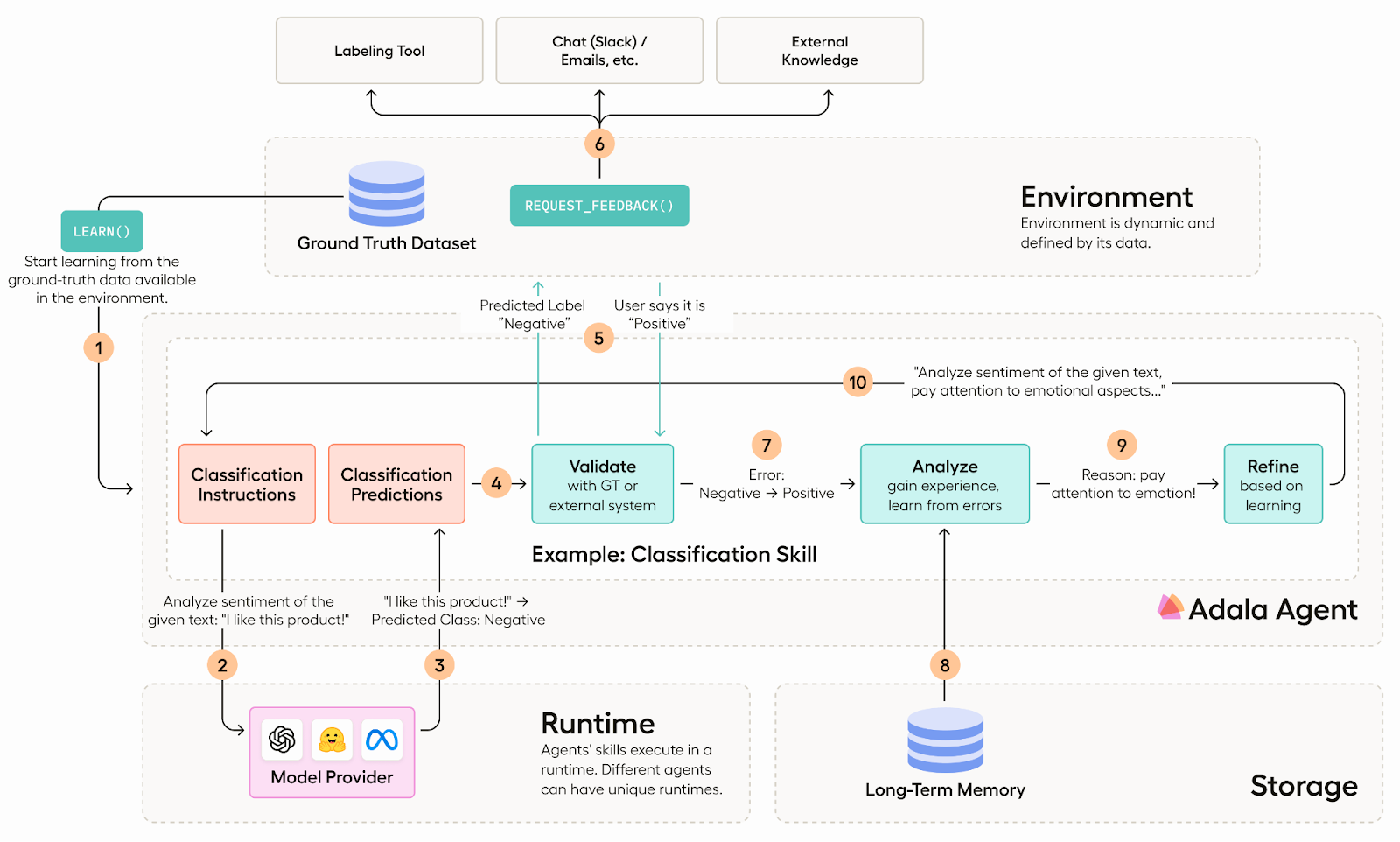
Data processing and autonomous agents have been merged. HumanSignal has unveiled Adala, an Autonomous DAta (Labelling) Agent framework. Adala introduces a new approach to data processing by offering a versatile platform for implementing agents specialised in various data labelling tasks automatically.
These agents operate autonomously, continuously acquiring skills through iterative learning processes influenced by their environment, observations, and reflections. Here’s a closer look at Adala and what sets it apart:
Reliable Agents: Adala’s agents are built on a foundation of ground truth data specified by developers, ensuring that they consistently deliver trustworthy results by applying those skills to runtimes, in this case LLMs. This reliability makes Adala a dependable choice for any data processing needs.
Controllable Output: Adala allows users to configure desired outputs and set specific constraints for each skill. Whether you require strict adherence to particular guidelines or prefer more adaptive outputs based on the agent’s learning, Adala gives you the flexibility to tailor results precisely to your requirements.
Specialised in Data Processing: While Adala agents excel in diverse data labelling tasks, they can be easily customised to address a wide range of data processing needs, making it a versatile tool for different industries.
Autonomous Learning: Adala agents are not merely automated; they possess intelligence. They independently and iteratively develop skills based on their environment, observations, and reflections, enhancing their capabilities over time.
Flexible and Extensible Runtime: Adala’s runtime environment is highly adaptable. It enables the deployment of a single skill across multiple runtimes, supporting dynamic scenarios such as the student/teacher architecture. Moreover, the framework’s openness encourages the community to extend and tailor runtimes, ensuring continuous evolution and adaptability to diverse needs.
Easily Customisable: Adala simplifies the process of customising and developing agents to address specific challenges without requiring a steep learning curve. This user-friendliness ensures that Adala can be quickly and effectively tailored to meet unique requirements.
Label Studio, created by HumanSignal, serves as an open-source data labelling application, providing the capability to annotate various data types such as audio, text, images, videos, and time series. With an intuitive and uncomplicated user interface, it allows users to export data to multiple model formats. This tool is valuable for both data preparation and enhancing pre-existing training datasets, ultimately contributing to the improvement of machine learning models’ accuracy.
The post Label Studio Creator Launches Autonomous Data Labelling Agent Framework appeared first on Analytics India Magazine.