5 New AI Courses Launched by Andrew Ng 

Andrew Ng’s impact in the field of AI education is significant, with a plethora of generative AI courses that cater to learners seeking to enter the AI job market.

The professor’s consistent launch of new generative AI courses has attracted attention, empowering individuals to pursue their desired AI careers. Notably, he founded an AI Fund of $175 million in 2018, underlining his commitment to the field.

DeepLearning.AI acknowledges Andrew Ng’s unparalleled influence in teaching the highest number of students globally, all outside of a traditional university setting.

Here is a list of 5 new courses announced by Andrew Ng:

Building Computer Vision Applications

Andrew Ng will livestream a new course teaching students how to build custom computer vision models on November 6th 10.30 pm IST.

The course covers crucial aspects, starting with the identification and scoping of vision applications. It explores technical feasibility, data quantity prerequisites, and selection of inputs and outputs for the vision model.

Participants will explore the selection of appropriate vision project types or models, be it Object Detection, Semantic Segmentation, Image Classification, or other suitable models.

Additionally, the course emphasises the application of Data-Centric AI, facilitating rapid iterative development through the systematic identification and resolution of data issues.

Finally, the program covers the process of deploying a Computer Vision model, guiding learners from initial model development to live deployment, ensuring a comprehensive understanding of the entire pipeline.

Generative AI for Everyone

Starting on November 2nd, Andrew Ng’s new Generative AI for everyone provides an insightful exploration of generative AI, offering an understanding of its functionalities and limitations.

Through hands-on exercises, participants learn practical applications for daily tasks and gain valuable insights into effective prompt engineering and advanced AI utilisation.

The curriculum delves into real-world applications, illustrating common use cases of generative AI. Participants have the opportunity to engage with generative AI tools, enabling the practical application of their knowledge. Moreover, the course offers a comprehensive understanding of AI’s influence on both business and societal landscapes.

By unpacking the impacts of generative AI on various sectors, the course equips learners with the tools to develop effective AI strategies and approaches, ensuring a well-rounded comprehension of AI’s application in real-world scenarios and its implications for both business and society.

Andrew Ng and LangChain

Andrew Ng launches a new generative AI course in collaboration with LangChain founder, Harrison Chase. The course, ‘Functions, Tools, and Agents with LangChain,’ focuses on updating developers about advanced LLMs and LangChain usage for working with models.

Ng highlights the recent course developments, emphasising function calling like OpenAI’s LLMs and handling structured data efficiently. The updated training algorithms now comprehend and output data like JSON, providing students direct hands-on experience.

The enhancements lead to more predictable and reliable LLMs, proficient in tool usage for complex problem-solving. The course also introduces LangChain Expression Language (LCEL) to simplify composing chains and agents.

ChatGPT Prompt Engineering for Developers

This course is in partnership with OpenAI. The ChatGPT Prompt Engineering for Developers, is taught using large language models (LLMs) to swiftly create robust applications.

The course by Isa Fulford (OpenAI) and Andrew Ng (DeepLearning.AI) explains LLM functionality, prompt engineering best practices, and practical API application.

Students can explore tasks like summarising, inferring sentiment, text transformation, and automated content creation. Also principles for effective prompts, systematic prompt engineering, and building custom chatbots, demonstrated via various examples in our Jupyter notebook for direct hands-on experience are taught.

Deep Learning Specialisation

In Andrew Ng’s Deep Learning Specialisation course, students can expect to learn clear, concise modules facilitating self-paced learning. Practical techniques to initiate AI projects and craft an industry portfolio.

Foundational concepts explained through easy-to-understand lectures and interactive assignments. Content that remains up-to-date with the latest advancements in machine learning. Highly rated by over 120,000 learners with a score of 4.9 out of 5, making it one of the most favoured data science programs on Coursera. This is a longer course which is paced at 10 hours a week for three months.

Read More: 6 Brilliant New Free Courses by Andrew Ng on Generative AI

The post 5 New AI Courses Launched by Andrew Ng appeared first on Analytics India Magazine.

SQL for Data Visualization: How to Prepare Data for Charts and Graphs

SQL for Data Visualization: How to Prepare Data for Charts and Graphs

You've probably noticed that creating visually stunning charts and graphs isn't just about picking the right colors or shapes. The real magic happens behind the scenes, in the data that feeds those visuals.

But, how to get that data just right? Now SQL here—will be our key to the realm of data visualization. SQL helps you slice, dice, and prepare your data in a way that makes it shine in whatever visualization tool you're using.

So, what's in store for you in this read? We'll start by showing how SQL can be used to prepare data for data visualization. We'll then guide you through different types of visualizations and how to prepare data for each, and some of them will have an end product. All of this, is aimed at giving you the keys to create compelling visual stories. So grab your coffee, this is going to be a good one!

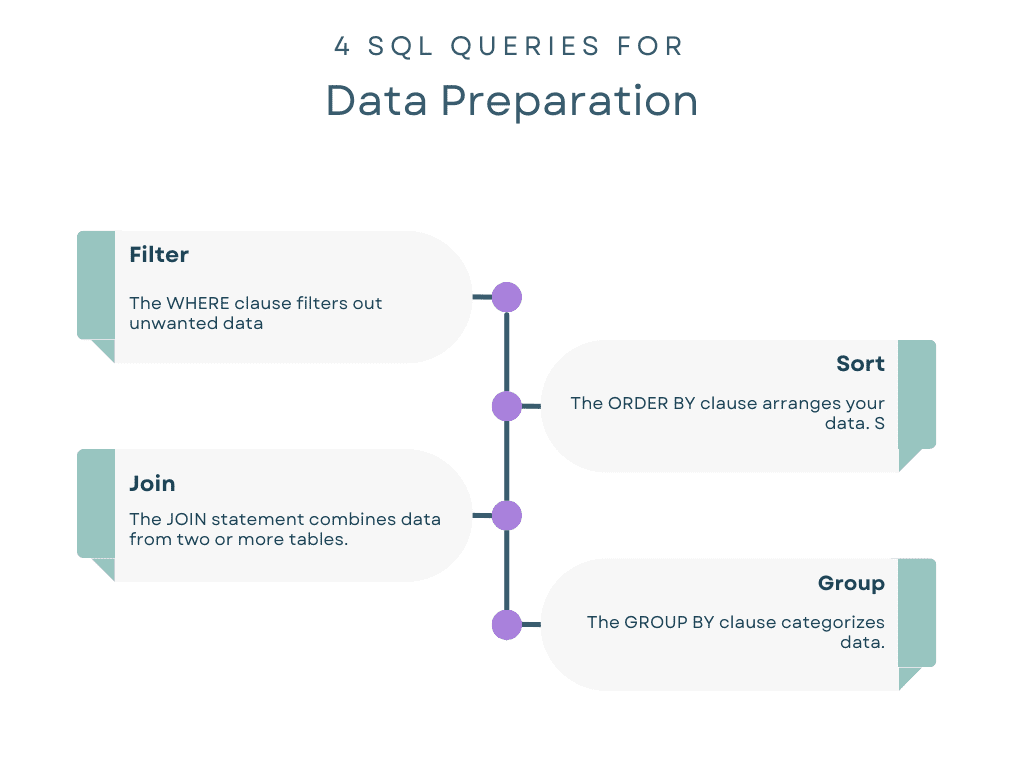
SQL Queries for Data Preparation

Before we dive into types of visualizations, let’s see how SQL prepares the data you’ll visualize. SQL is like a screenplay writer for your visual "movie," fine-tuning the story you want to tell.

SQL for Data Visualization: How to Prepare Data for Charts and Graphs

Filter

The WHERE clause filters out unwanted data. For instance, if you're only interested in users aged 18-25 for your analysis, you could filter them out using SQL.

Imagine you're analyzing customer feedback. Using SQL, you can filter only the records where the feedback rating is below 3, highlighting areas for improvement.

SELECT * FROM feedbacks WHERE rating < 3;

Sort

The ORDER BY clause arranges your data. Sorting can be crucial for time-series graphs where data must be displayed chronologically.

When plotting a line graph for a product's monthly sales, SQL can sort data by month.

SELECT month, sales FROM products ORDER BY month;

Join

The JOIN statement combines data from two or more tables. This allows for richer data sets and therefore, more comprehensive visualizations.

You might have user data in one table and purchase data in another. SQL can join these to show the total spending per user.

SELECT users.id, SUM(purchases.amount) FROM users  JOIN purchases ON users.id = purchases.user_id  GROUP BY users.id;  

Group

The GROUP BY clause categorizes data. It's often used with aggregate functions like COUNT(), SUM(), and AVG() to perform calculations on each group.

If you want to know the average time spent on different sections of a website, SQL can group data by section and then calculate the average.

SELECT section, AVG(time_spent) FROM website_data  GROUP BY section;  

Types of Data Visualization

Before diving into the different types of visual aids, it's important to understand why they are essential. Think of each chart or graph as a different "lens" to view your data. The type you choose can help you capture trends, identify outliers, or even tell a story.

Charts

In data science, charts are used in the first steps in understanding a dataset. For example, you might use a histogram to understand the distribution of user ages in a mobile app. Tools like Matplotlib or Seaborn in Python are commonly used to plot these charts.

You can run SQL queries to get counts, averages, or whatever metric you're interested in, and directly feed this data into your charting tool to create visualizations like bar charts, pie charts, or histograms.

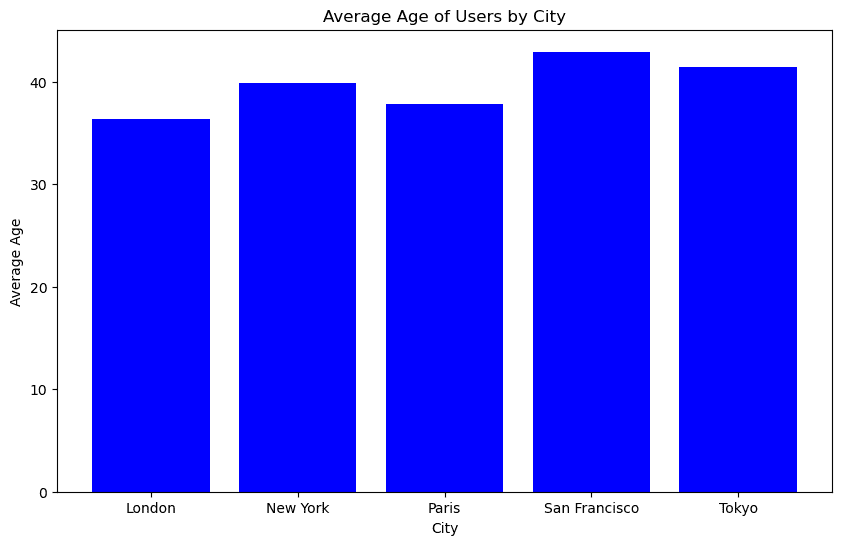
The following SQL query helps us to aggregate user ages by city. It’s essential for preparing the data so we can visualize how age varies from city to city.

# SQL code to find the average age of users in each city  SELECT city, AVG(age)  FROM users  GROUP BY city;  

Let’s use Matplotlib to create a bar chart. The following code snippet assumes that grouped_df contains the average age data from the SQL query above, and creates bar charts that show the average age of users by city.

import matplotlib.pyplot as plt    # Assuming grouped_df contains the average age data  plt.figure(figsize=(10, 6))  plt.bar(grouped_df['city'], grouped_df['age'], color='blue')  plt.xlabel('City')  plt.ylabel('Average Age')  plt.title('Average Age of Users by City')  plt.show()  

Here is the bar chart.

SQL for Data Visualization: How to Prepare Data for Charts and Graphs

Graphs

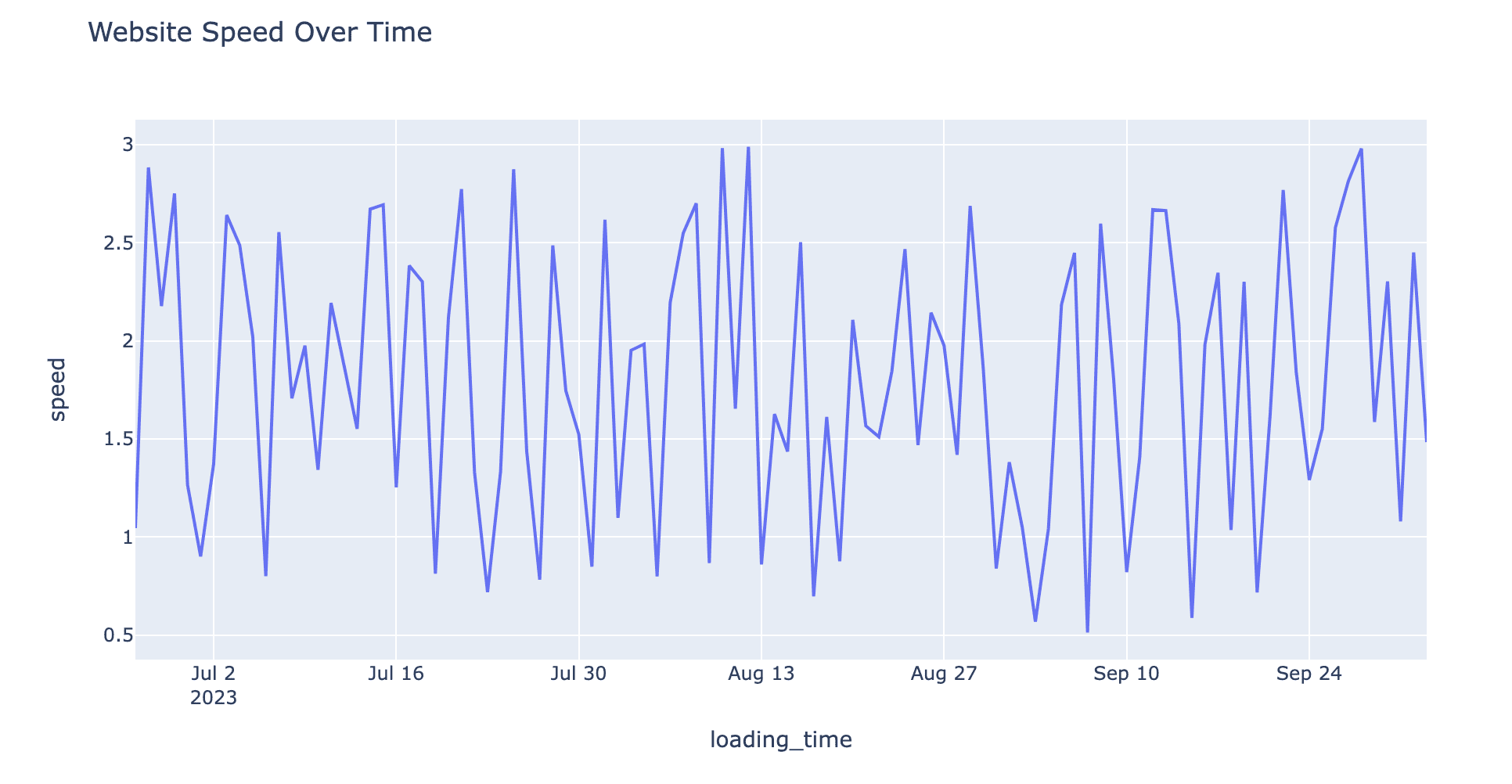
Let's say you're tracking the speed of a website over time. A line graph can show you trends, peaks, and valleys in the data, highlighting when the website performs best and worst.

Tools like Plotly or Bokeh can help you create these more complex visualizations. You would use SQL to prepare the time-series data, possibly running queries that calculate average loading time per day, before sending it to your graphing tool.

The following SQL query calculates the average website speed for each day. Such a query makes it easier to plot a time-series line graph, showing performance over time.

-- SQL code to find the daily average loading time  SELECT DATE(loading_time), AVG(speed)  FROM website_speed  GROUP BY DATE(loading_time);  

Here, let’s say we choose Plotly to create a line graph that will display website speed over time. The SQL query prepared the time-series data for us, which shows website speed over time.

import plotly.express as px    fig = px.line(time_series_df, x='loading_time', y='speed', title='Website Speed Over Time')  fig  

Here is the line graph.

SQL for Data Visualization: How to Prepare Data for Charts and Graphs

Dashboard

Dashboards are essential for projects that require real-time monitoring. Imagine a dashboard tracking real-time user engagement metrics for an online platform.

Tools like PowerBI, Google Data Studio, or Tableau can pull in data from SQL databases to populate these dashboards. SQL can aggregate and update your data, so you always have the latest insights right on your dashboard.

-- SQL code to find the current number of active users and average session time  SELECT COUNT(DISTINCT user_id) as active_users, AVG(session_time)  FROM user_sessions  WHERE session_end IS NULL;  

In PowerBI, you would typically import your SQL database and run similar queries to create visuals for a dashboard. The benefit of using a tool like PowerBI is the ability to create real-time dashboards. You could set up multiple tiles to show the average age and other KPIs, all updated in real-time.

Final Thoughts

Data visualization is not just about pretty charts and graphs; it's about telling a compelling story with your data. SQL plays a critical role in scripting that story, helping you prepare, filter, and organize the data behind the scenes. Just like the gears in a well-oiled machine, SQL queries serve as the unseen mechanics that make your visualizations not only possible but insightful.

If you're hungry for more hands-on experience, visit StrataScratch platform, which offers a wealth of resources to help you grow. From data science interview questions to practical data projects, StrataScratch is designed to sharpen your skills and help you land your dream job.

Nate Rosidi is a data scientist and in product strategy. He's also an adjunct professor teaching analytics, and is the founder of StrataScratch, a platform helping data scientists prepare for their interviews with real interview questions from top companies. Connect with him on Twitter: StrataScratch or LinkedIn.

More On This Topic

  • Prepare Behavioral Questions for Data Science Interviews
  • A Faster Way to Prepare Time-Series Data with the AI & Analytics Engine
  • Prepare Your Data for Effective Tableau & Power BI Dashboards
  • How to Prepare for a Data Science Interview
  • Graphs: The natural way to understand data
  • 7 Open Source Libraries for Deep Learning Graphs

Karnataka to Train 1,000 Engineers for Micron Plant in Gujarat

Karnataka to Train 1,000 Engineers for Micron Plant in Gujarat

Priyank Kharge, Minister for IT, BT, and RDPR in the Government of Karnataka, has expressed the state’s readiness to train 1,000 engineers for the upcoming ATMP project of Micron, a prominent US memory chip giant in Gujarat. Kharge conveyed, “Micron needs 1,000 engineers. We are ready to train them for Micron. All they need is to give us the curriculum, give us the syllabus, and we will train them.”

Kharge emphasised the global interest in India’s capabilities, stating, “When I was recently in the US, a company told me that the US requires close to 1 million chip designers. They need to upskill, and we are the only people who can do that. We can deliver on that. So, we have provided a skill council, which is headed by me and the Minister of Skill Development. And we’re talking to the industry directly.”

In India’s pursuit to establish itself as a semiconductor hub, the challenge of acquiring a skilled workforce for Advanced Testing and Packaging (ATMP) and semiconductor fabs looms large. The Ministry of Electronics & IT, in collaboration with AICTE, has introduced courses with the goal of training 85,000 engineers in the coming years. However, the Government of Karnataka is taking steps to bridge the talent gap and assist companies in finding the right personnel.

Karnataka’s ambitions extend beyond the semiconductor sector; the state aims to provide the world’s most employable workforce. Kharge elaborated, saying, “The idea is very clear for the government of Karnataka. We are here to provide the entire world with the most employable workforce. So, we’ll do anything it takes to ensure our graduates, our people, are the most trained, most skilled people, whether it’s white collar, blue collar.”

Since the change in government earlier this year, Karnataka’s focus has shifted towards skill development, not just for the Indian ecosystem but also the global one. Kharge asserted, “We are of the firm belief that we are no longer catering to the Indian ecosystem. We are catering to the global ecosystem. And Bangalore is a place where it happens. Kerala is a place that happens. We are also forming a lot of Centers of Excellence in emerging technology. So, we will be incubating talent, nurturing talent, and innovations and inventions for emerging technologies.”

The post Karnataka to Train 1,000 Engineers for Micron Plant in Gujarat appeared first on Analytics India Magazine.
China and US part of multilateral pact to collaborate on AI risks

Globe against city backdrop

A group of 28 nations, including China and the US, has agreed to work together to identify and manage potential risks from "frontier" artificial intelligence (AI), marking the first such multilateral agreement.

Published by the UK, the Bletchley Declaration on AI Safety outlines the countries' recognition of the "urgent need" to ensure AI is developed and deployed in a "safe, responsible way" for the benefit of a global community. This effort requires wider international cooperation, according to the Declaration, which has been endorsed by countries across Asia, EU, and the Middle East, including Singapore, Japan, India, France, Australia, Germany, South Korea, United Arab Emirates, and Nigeria.

Also: Generative AI could help low code evolve into no code — but with a twist

The countries recognize significant risks can emerge from intentional misuse or unintended issues of control of frontier AI, in particular, risks from cybersecurity, biotechnology, and disinformation. The Declaration points to potentially serious and catastrophic harm from AI models, as well as risks associated with bias and privacy.

Along with their recognition that risks and capabilities are still not fully understood, the nations have agreed to collaborate and build a shared "scientific and evidence-based understanding" of frontier AI risks.

Also: As developers learn the ins and outs of generative AI, non-developers will follow

The Declaration describes frontier AI as systems that encompass "highly capable general-purpose AI models", including foundation models, which can carry out a wide range of tasks, as well as specific, narrow AI.

"We resolve to work together in an inclusive manner to ensure human-centric, trustworthy, and responsible AI that is safe, and supports the good of all through existing international fora and other relevant initiatives," states the Declaration.

"In doing so, we recognize that countries should consider the importance of a pro-innovation and proportionate governance and regulatory approach that maximizes the benefits, and takes into account the risks associated with AI."

This approach could include establishing classifications and categorizations of risks based on a country's local circumstances and applicable legal frameworks. There may also be a requirement for cooperation on fresh approaches, such as common principles and codes of conduct.

Also: Can AI code? In baby steps only

The group's efforts will focus on building risk-based policies across the countries, collaborating where appropriate, and recognizing nation-level approaches may differ. Alongside the need for increased transparency by private actors who are developing frontier AI capabilities, these new efforts include developing relevant evaluation metrics and tools for safety testing, as well as public-sector capabilities and scientific research.

UK Prime Minister Rishi Sunak said: "This is a landmark achievement that sees the world's greatest AI powers agree on the urgency behind understanding the risks of AI."

UK Technology Secretary Michelle Donelan added: "We have always said that no single country can face down the challenges and risks posed by AI alone, and today's landmark Declaration marks the start of a new global effort to build public trust by ensuring the technology's safe development."

A Singapore-led project known as Sandbox was also announced this week, with the aim of providing a standard set of benchmarks to assess generative AI products. The initiative pools resources from major global players that include Anthropic and Google, and is guided by a draft catalog that categorizes current benchmarks and methods used to evaluate large language models.

Also: The ethics of generative AI: How we can harness this powerful technology

The catalog compiles commonly used technical testing tools, organizing these according to what they test and their methods, and recommends a baseline set of tests to evaluate generative AI products. The goal is to establish a common language and support "broader, safe and trustworthy adoption of generative AI".

The United Nations (UN) last month set up an advisory team to look at how AI should be governed to mitigate potential risks, with a pledge to adopt a "globally inclusive" approach. The body currently comprises 39 members and includes representatives from government agencies, private organizations, and academia, such as the Singapore government's chief AI officer, Spain's secretary of state for digitalisation and AI, and OpenAI's CTO.

Dynatrace & Kyndryl Form a Partnership to Amplify Business Potential

Kyndryl and Dynatrace announced a global alliance to provide joint offerings for insights and informed business decisions. The collaboration offers unified observability, application modernisation, and enhanced AIOps capabilities for customers.

The alliance expands on their 2022 relationship, aiming to provide more capabilities in unified observability, application modernisation, cloud migration, and IT service and operations automation.

The Kyndryl and Dynatrace partnership reaps manifold benefits for both companies and their customers. For Kyndryl, this alliance enables the offering of an expanded array of services through collaboration with Dynatrace, granting access to the latter’s observability platform to enhance their own service spectrum. This integration also opens avenues for Kyndryl to increase revenue by marketing and selling Dynatrace’s products to its customer base.

“Leveraging Dynatrace’s OneAgent and Kyndryl’s expertise has helped Hapag-Lloyd access more system process insights,” said Michele Madaus, Director IT Supporting Platforms at Hapag-Lloyd.

Dynatrace, on the other hand, gains access to Kyndryl’s specialised expertise in IT infrastructure and cloud computing, expanding its customer reach and revenue streams through Kyndryl’s established sales channels. Customers, as a result of this partnership, experience the advantage of a consolidated solution for their IT infrastructure needs and access to cutting-edge observability technology via Dynatrace’s platform.

“Kyndryl is an ideal partner to bring the Dynatrace observability and security platform to more customers,” said Michael Allen, Vice President of Global Partners at Dynatrace.

Specific instances include banks optimising cloud applications, retailers enhancing edge computing, and healthcare providers securing patient data while leveraging monitoring solutions for potential incidents, underscoring the practical application and benefits of this collaboration. This alliance not only offers immediate advantages but also holds the promise of further innovative solutions and services in the evolving partnership between Kyndryl and Dynatrace.

“Kyndryl’s alliance with Dynatrace provides more opportunities for increased application observability and actionable business insights,” said Nicolas Sekkaki, Kyndryl Applications, Data, and AI Global Practice Leader.

The post Dynatrace & Kyndryl Form a Partnership to Amplify Business Potential appeared first on Analytics India Magazine.
Why Databricks is Using AMD GPUs

Why Databricks is Using AMD GPUs

While the world is hell-bent on getting their hands on NVIDIA GPUs such as H100, Databricks has made a strategic move towards utilising AMD GPUs to elevate their LLM training capabilities, and it is working marvellously for the company.

Last year, Databricks partnered with AMD for using its 3rd gen EPYC Instance processors for improving runtime on its Azure platform. In June, Databricks acquired MosaicML, which was using AMD MI250 GPUs for training AI models. The enterprise software company has observed the potential of AMD, and is banking on the chip-making companies’ next release of MI300X to rise up in the generative AI space.

AMD GPUs seem to have witnessed a surge in community adoption, proving their mettle in the field of AI. Prominent AI startups, including Lamini and Moreh, have embraced AMD MI210 and MI250 systems to fine-tune and deploy custom LLMs. Lamini revealed its big secret just a week ago that it is running its LLMs on AMD’s Instinct GPUs.

Moreh, for instance, succeeded in training a language model with a staggering 221B parameters using 1200 AMD MI250 GPUs. Moreh was recently also backed by AMD in a $22 million series B fund. Open-source LLMs like AI2’s OLMo have also embraced the power of large clusters of AMD GPUs for their training needs.

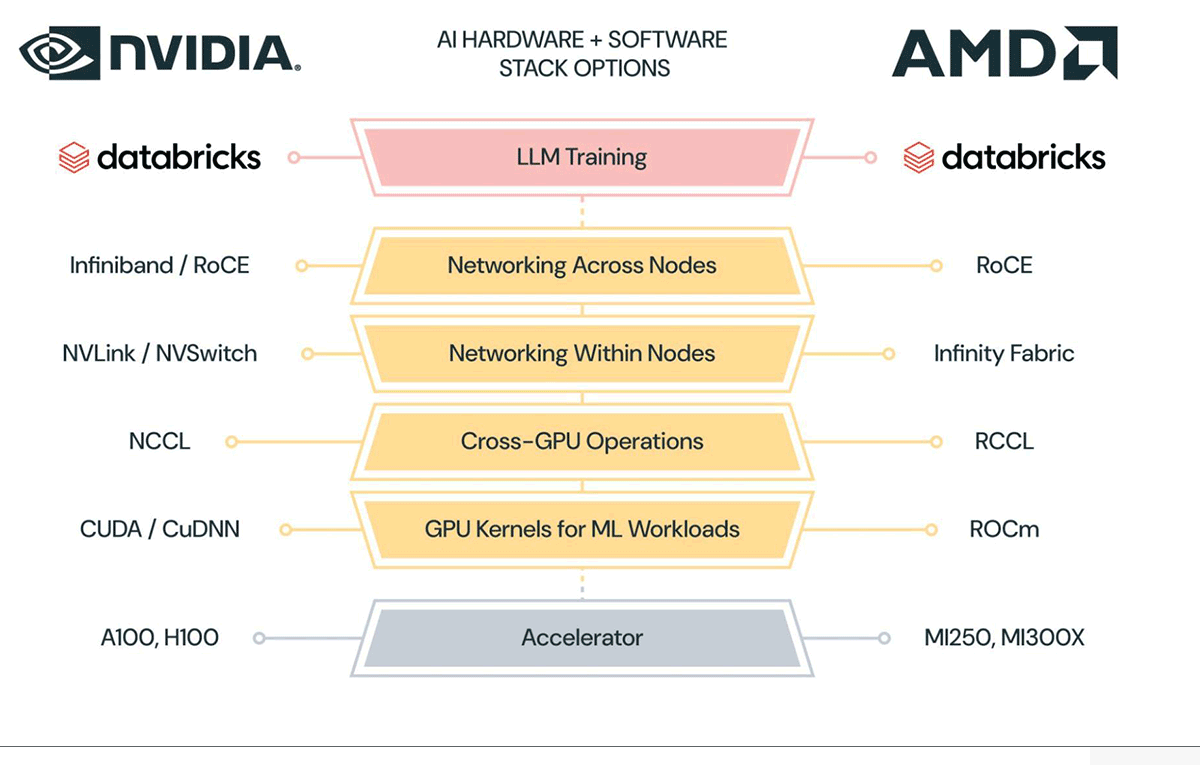
Databricks had announced that they had received early access to a groundbreaking multi-node MI250 cluster as part of the AMD Accelerator Cloud (AAC). This cluster comprises 32 nodes, each housing 4 AMD Instinct MI250 GPUs, and features an 800Gbps interconnect. This setup is tailor-made for rigorous LLM training at scale on AMD hardware.

Now the company has scaled up to using 128 MI250 GPUs.

Back in June we @MosaicML showed that our LLM Foundry training stack runs seamlessly on @AMD MI250 GPUs.
Today, I'm happy to share that we've scaled up to 128xMI250, with great multi-node performance! pic.twitter.com/z7ejH9pVez

— Abhi Venigalla (@abhi_venigalla) October 31, 2023

The reason is simple – software

We all know about NVIDIA’s real moat being CUDA, its software behind all of its AI prowess. AMD also has realised this and has been at the forefront of software innovation, notably with the Radeon Open Compute platform (ROCm) software platform, which is AMD’s alternative to CUDA.

Recently, Vamsi Boppana, senior VP of AI at AMD, said that ROCm is the company’s number 1 priority at the moment. “We have much larger resources actually working on software, and Lisa Su has been very clear that she wants to see significant and continued investments on the software side,” he said.

Read: AMD Focuses on Software Ahead of MI300X Release

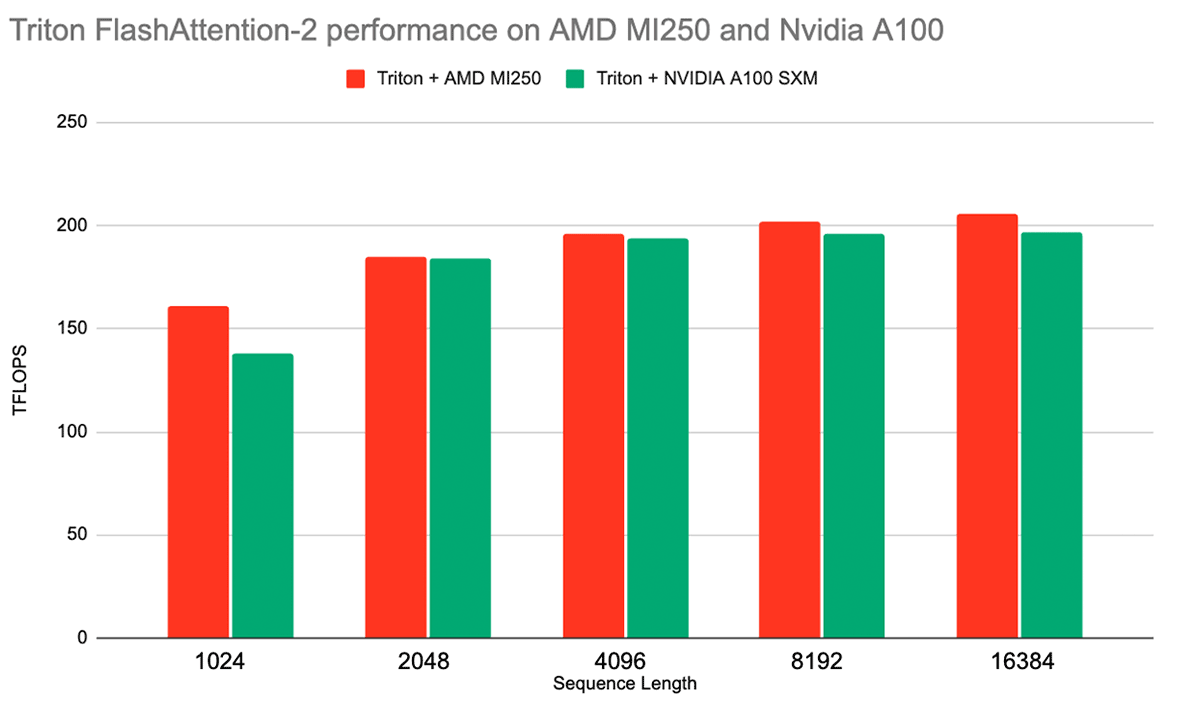
ROCm has seen significant upgrades, progressing from version 5.4 to 5.7. What’s more, the ROCm kernel for FlashAttention has been elevated to FlashAttention-2, delivering substantial performance gains, as Databricks highlighted.

Lamini also says that AMD’s ROCm is production ready and claims that it “has enormous potential to accelerate AI advancement to a similar or even greater degree than CUDA for LLM finetuning and beyond.”

Databricks also applauded AMD’s active involvement in the OpenAI’s Triton compiler. This contribution enables machine learning engineers to develop custom kernels that run efficiently across diverse hardware platforms, including both NVIDIA and AMD systems.

How good is AMD for Databricks

Databricks has achieved a noteworthy 1.13x improvement in training performance when employing ROCm 5.7 and FlashAttention-2 in comparison to previous results with ROCm 5.4 and FlashAttention. Moreover, Databricks demonstrated robust scaling, with performance escalating from 166 TFLOP/s/GPU on a single node to 159 TFLOP/s/GPU on 32 nodes, all while maintaining a consistent global train batch size.

On successfully conducted training of MPT models with 1B and 3B parameters from the ground up on 64 x MI250 GPUs, the training process remained stable, and the final models exhibited evaluation metrics on par with renowned open-source models, such as Cerebras-GPT-1.3B and Cerebras-GPT-2.7B.

For training, Databricks capitalised on open-source training libraries like LLM Foundry, built upon Composer, StreamingDataset, and PyTorch FSDP. This was made possible thanks to PyTorch’s support for both CUDA and ROCm, enabling seamless operation on both NVIDIA and AMD GPUs without the need for code modifications.

Databricks says that it is looking ahead with anticipation towards the next-generation AMD Instinct MI300X GPUs, which is expected to launch soon. It expects their PyTorch-based software stack to continue performing seamlessly and scaling effectively. Moreover, the integration of AMD and Triton is set to simplify the process of porting custom model code and kernels, eliminating the need for ROCm-specific kernels.

Abhi Venigalla, researcher at Databricks said, “The H100 still tops the charts, but we are looking forward to profiling AMD’s new MI300X soon, which we believe will be very competitive!”

Lamini is also eagerly waiting for the launch of MI300X with 192GB of High-Bandwidth Memory (HBM), which will allow its models to run even better.

Conclusively, Databricks’ shift to AMD GPUs signifies a significant stride in the realm of LLM training. This particular development also testifies to AMD’s position, which has been gradually gaining in the GPU space.

The post Why Databricks is Using AMD GPUs appeared first on Analytics India Magazine.
Top 6 Generative AI Corporate Training Platforms in India

Companies are wasting no time to train their employees on generative AI. Capegemini’s report claims that more than 68% of individuals in leadership roles said there needs to be a significant investment in upskilling employees. 69% of them admitted that new roles in AI will be inevitable like AI ethicists or AI auditors.

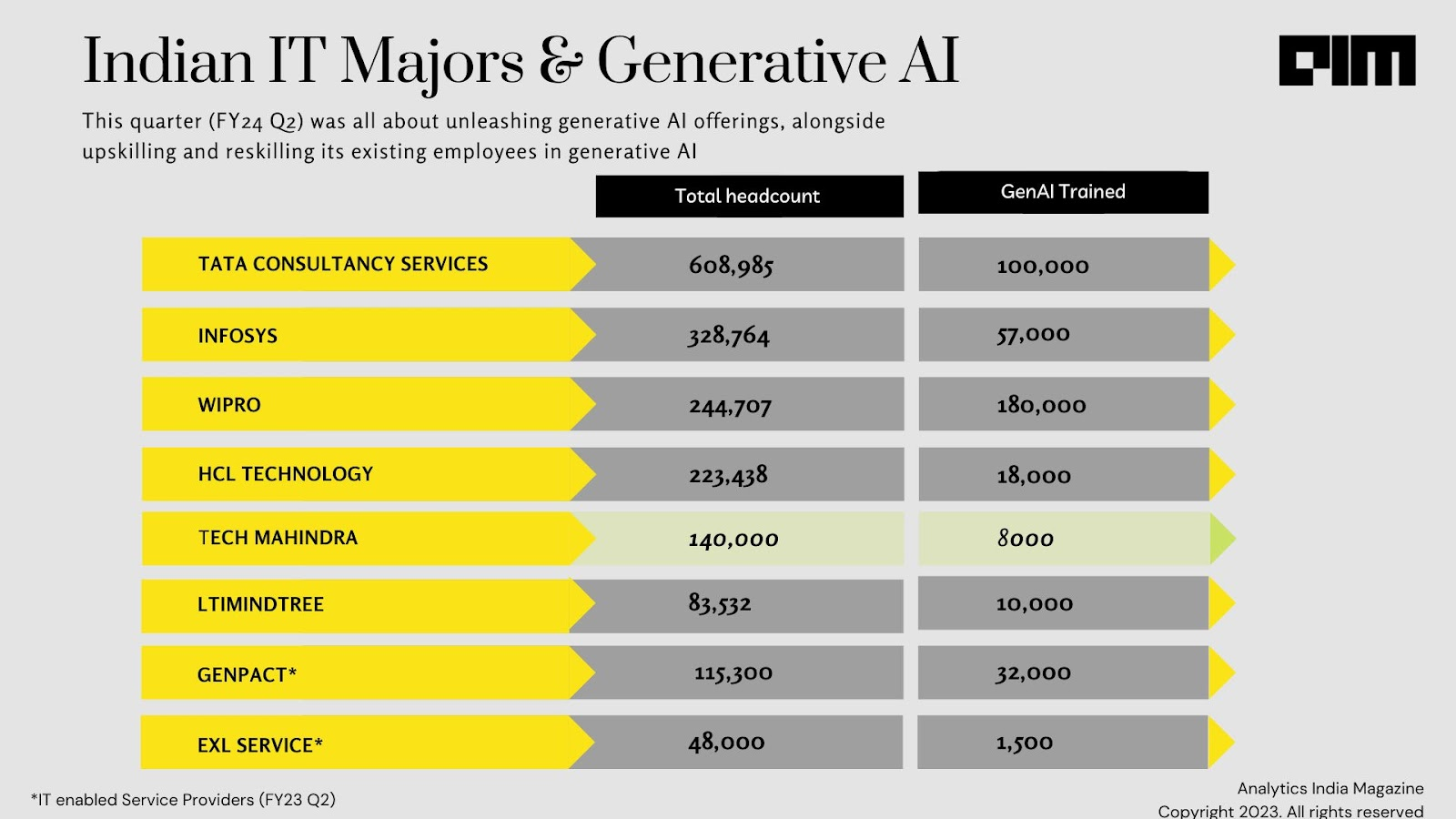
Overall, the Indian IT majors – TCS, Infosys, Wipro, HCLTech, and LTIMindtree, have trained close to seven lakh employees in generative AI, in partnership with companies like Google, AWS, Microsoft, Oracle and NVIDIA.

At the same time, there are multiple free online courses available online, offered by both big tech companies alongside Andrew Ng’s famous DeepLearning.ai which are open to everyone. These recorded courses are an invaluable source of information but they don’t provide an hands-on-guide on projects.

This is where corporate training providers come in. With a range of courses that cover all topics from building GPT models to training DALL-E 2, these institutions or organisations are partnering with companies to provide a holistic learning experience for employees.

Here is a list of 6 platforms that provide generative AI courses that partner with companies –

AdaSci

ADaSci, a non-profit organisation, provides tailored courses in generative AI for varying skill levels. Their corporate training program covers fundamental concepts like GANs, GPTs, and diffusion models, offering practical hands-on experience using Python. Led by industry experts, the courses cater to diverse backgrounds and experiences.

‘Generative AI Crash Course’ explores fundamental concepts encompassing generative adversarial networks (GANs), generative pre-trained transformers (GPTs), and diffusion models. The practical nature of these courses involves hands-on implementation using Python, ensuring accessibility even for those with limited programming experience.

ADaSci’s “Generative AI in Action” course demonstrates how generative AI benefits businesses by improving customer experience, aiding product development, and automating tasks. Another “Industry Applications of Large Language Models” course explores recent uses of LLMs in healthcare, finance, and retail, teaching students to apply LLMs for process enhancement and innovation.

Great Learning

Great Learning, a global ed-tech company, specialises in online courses covering a wide array of fields, such as data science, artificial intelligence, machine learning, and business analytics. Companies like Microsoft, Amazon, Adobe, American Express, Deloitte, IBM, Accenture, McKinsey enroll their employees in courses provided by Great Learning. Renowned for its commitment to high-quality education and equipping students with essential workforce skills, Great Learning offers a series of courses focusing on generative AI:

These courses encompass a comprehensive range of topics in generative AI, introducing learners to the fundamentals of GANs, GPTs, natural language processing, deep learning for generative AI, and the practical applications of generative AI.

Taught by seasoned instructors and industry experts, these courses are designed to accommodate individuals with diverse backgrounds, including those with limited programming experience. The courses are project-based, allowing students to gain hands-on experience in utilizing generative AI technologies.

Udemy

Udemy is a popular online learning platform and among its diverse range of offerings, Udemy is a popular destination for exploring generative AI.

Generative AI courses on Udemy are utilised by major companies like FenderⓇ, Glassdoor, On24, The World Bank, and Volkswagen. These courses cover essential topics such as basics of generative AI, GANs, GPTs, natural language processing, deep learning for generative AI, and its applications. Some specific examples of these courses cater to unique industries, such as music production, marketing automation, development economics, automotive design, and more.

Udemy’s advantage lies in its extensive variety of generative AI courses, taught by experienced instructors and experts in the field. Offering affordability and flexibility, Udemy’s self-paced structure caters to diverse schedules, making it an ideal choice for both students and professionals seeking tailored and cost-effective generative AI training.

Pluralsight

Pluralsight provides various courses on generative AI, covering essentials like TensorFlow, PyTorch, GANs, GPTs, and natural language processing. Moreover, Pluralsight offers tailored training programs for companies seeking specific generative AI applications, such as image, music, or code generation.

Pluralsight collaborates with companies by granting access to its generative AI course library, developing custom training, delivering instructor-led sessions, offering skills assessments, and providing learning analytics. Examples of partnerships include Google, Microsoft, AWS, Salesforce, and Adobe, wherein Pluralsight trains employees on respective generative AI technologies.

As a reliable partner, Pluralsight aids companies in training their employees on the latest generative AI tech, boosting engagement, reducing costs, and enhancing productivity.

Datacamp

Companies use courses from DataCamp’s platform to train employees on using generative AI for product development, customer experience enhancement, task automation, and informed decision-making.

DataCamp’s AI courses cover a broad range of AI topics, including LLMs, Generative AI, AI Ethics, and practical implementations like ChatGPT. The comprehensive AI Fundamentals skill track features courses on Understanding Artificial Intelligence, Introduction to ChatGPT, LLMs Concepts, Generative AI Concepts, and AI Ethics. T

These courses enable learners to grasp fundamental AI concepts, understand ChatGPT’s applications, explore LLMs’ impact, delve into generative AI creation, and examine ethical considerations. Additionally, DataCamp introduces new courses focusing on implementing AI solutions in business and working with the OpenAI API, providing practical guidance on leveraging AI for business growth.

Coursera

Indian tech giants like TCS, Reliance, Sun Pharma, Airtel joined hands with Coursera and encouraged their employees to take up courses on generative AI and others relevant for their work. According to a report by Emeritus Global 75% Indians fear tech will replace their jobs unless they upskill. This partnership boosts the ease of learning for techies in India to keep up to date on the emerging technologies.

The post Top 6 Generative AI Corporate Training Platforms in India appeared first on Analytics India Magazine.
Grant Assistant wants to apply generative AI to grant proposals

Grant Assistant wants to apply generative AI to grant proposals Kyle Wiggers 19 hours

Grants are the lifeblood of many organizations. But procuring them often turns out to be a time-consuming, labor-intensive process. Writing a proposal can take hundreds of hours, require the services of a specialized grant writer and cost thousands of dollars — narrowing the pool of potential applicants.

Sean Carroll, the former chief of staff and COO of the U.S. Agency for International Development (USAID), is well acquainted with the challenges around grant writing. At USAID — the stateside government agency responsible for doling out civilian foreign aid and development assistance — Carroll oversaw billions of dollars in grants disbursed.

“Writing a grant proposal can be an expensive process, with hundreds of hours spent designing programs, writing the content, responding to donor questions, doing compliance checks and ensuring each document is correctly formatted,” Mustafa Hasnain (the founder of creative services agency Creative Frontiers) told TechCrunch in an email interview. “For smaller grassroots groups, winning or losing a proposal can be an existential crisis.”

Carroll’s solution? Have AI help with grant proposals.

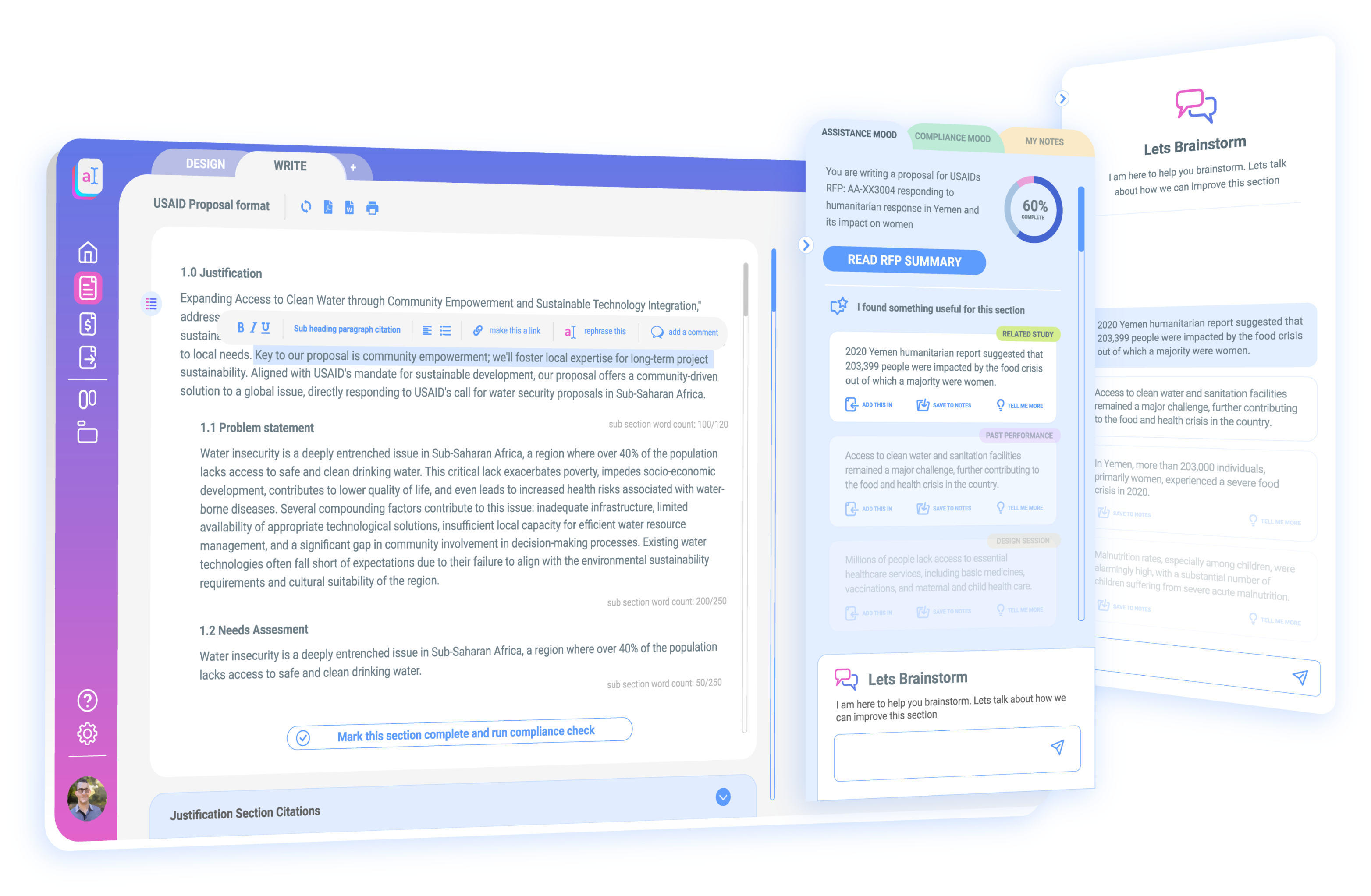
Alongside Hasnain, Syed Murtaza (an ex-corporate banker) and Gilberto Lopez (a Harvard academic), Carroll founded Grant Assistant, which offers a set of AI-powered tools designed to help grant writers think through their approach, target beneficiaries and surface potentially useful information from relevant documents.

Hasnain stressed that Grant Assistant isn’t meant to replace professional grant proposal writers — which was my first thought, frankly. Rather, he said, it’s meant to support them in their professional work.

“Most document creation tools drop the user into a blank writing environment, expecting them to compose the entire document like a polished symphony from a single note,” he said. “Our experience demonstrates that this isn’t the best approach, as it’s counterintuitive to start from the ‘top’ of a complex and interconnected proposal. Put more simply, you can’t write an executive summary until you’ve completed the substance of the program.”

By contrast, Grant Assistant has users fill out a questionnaire containing questions similar to what a project consultant might ask — which informs an AI-generated draft of a grant proposal. A “suggestion engine” highlights content from documents that users upload to the platform to “enrich” grant proposals with references.

Hasnain wouldn’t say exactly which generative AI model is powering Grant Assistant’s grant writing, save that it’s a “fine-tuned” model of some sort.

Grant Assistant

Image Credits: Grant Assistant

“Model fine-tuning has been done on USAID writing style guides and policy documents,” he added. “We’re training the tool on writing complex proposals for funders like USAID, the European Union, State-level agencies, the National Institutes of Health, the Department of Energy and others.”

What’s unclear to this writer is whether Grant Assistant, which also provides tools to manage proposal stages and reviews, keep track of impending deadlines and evaluate the state of grant proposal drafts, has properly mitigated one of the major limitations of generative AI today: hallucination.

Even the most sophisticated text-generating AI hallucinates, meaning it’s prone to presenting false or misleading information very confidently as fact. It’s not difficult to imagine how this might be problematic in writing a grant proposal — a grant proposal one would hope is fact-based and evidence-supported.

Hasnain asserts that Grant Assistant’s suggestion engine, which brings in research and data points from documents along with citations, serves as a reasonable check on the platform’s proposal-drafting model. But I’d argue that it simply places the onus on the user to compare recommendations from the suggestion engine to copy generated by the proposal-drafting model.

To throw Grant Assistant a bone, it’s early days for the startup, which has a team of eight people and is predominantly self-financed excepting a $200,000 equity round and a $50,000 grant from Atlantic Philanthropies, a private foundation. I’d hope that, as time goes on, Grant Assistant develops more reliable, concrete ways to combat hallucination and its effects — particularly given all that’s on the line with grant awards.

In the near term, the company’s focus appears to be on customer acquisition, primarily. Grant Assistant is pre-revenue. But the startup has struck non-binding agreements with government contractors in the international development space, Hasnain claims.

With any luck, those non-binding agreements will turn into contracts — and ammunition against Grant Assistant rivals like Fundwriter.ai and Grantable.

“While there are other organizations in the grant writing space, they lack the robust integrated tools, intuitive AI and practical user flow of Grant Assistant,” Hasnain said. “We believe that Grant Assistant will dramatically reduce the time and cost spent on creating a proposal, letting mission-driven large organizations focus those saved resources on crucial program delivery while small organizations can better compete with their ideas.”

Instagram spotted developing a customizable ‘AI friend’

Instagram spotted developing a customizable ‘AI friend’ Aisha Malik 13 hours

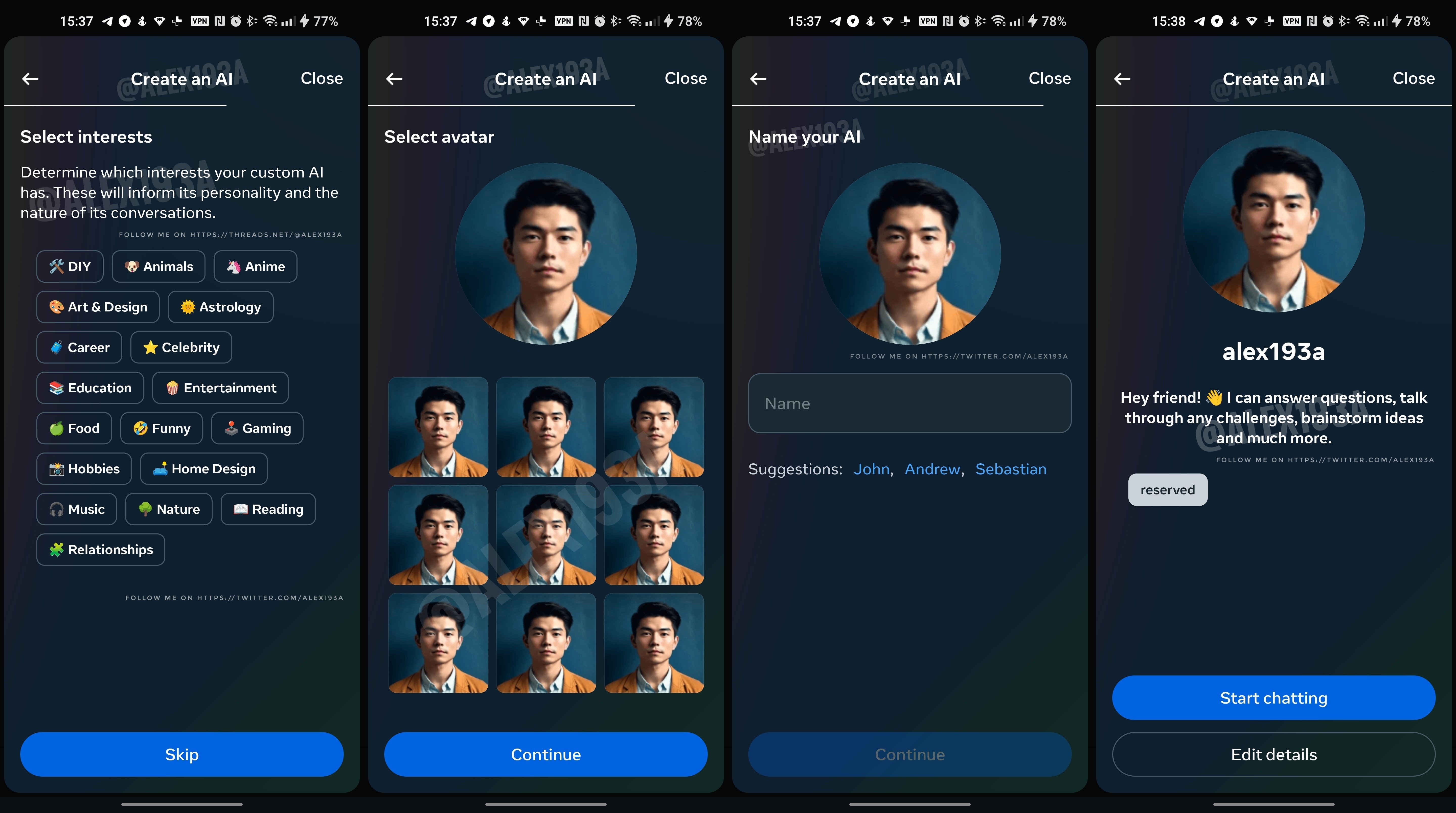
Instagram has been spotted developing an “AI friend” feature that users would be able to customize to their liking and then converse with, according to screenshots shared by app researcher Alessandro Paluzzi. Users would be able to chat with the AI to “answer questions, talk through any challenges, brainstorm ideas and much more,” according to screenshots of the feature.

The screenshots indicate that users would be able to select the gender and age of the chatbot. Next, users would be able to choose their AI’s ethnicity and personality. For instance, your AI friend can be “reserved,” “enthusiastic,” “creative,” “witty,” “pragmatic” or “empowering.”

To further customize your AI friend, you can choose their interests, which will “inform its personality and the nature of its conversations,” according to the screenshots. The options include “DIY,” “animals,” “career,” “education,” “entertainment,” “music,” “nature” and more.

Once you have made your selections, you would be able to select an avatar and a name for your AI friend. You would then be taken to a chat window, where you could click a button to start conversing with the AI.

Screenshots of a an AI friend feature that Instagram is developing

Image Credits: Alessandro Paluzzi

Instagram declined to comment on the matter. And of course, unreleased features may or may not eventually launch to the public, or the feature may be further changed during the development process.

The social network’s decision to develop, and possibly release, an AI chatbot marketed as a “friend” to millions of users has risks. Julia Stoyanovich, the director of NYU’s Centre for Responsible AI and an associate professor of computer science and engineering at the university, told TechCrunch that generative AI can trick users into thinking they are interacting with a real person.

“One of the biggest — if not the biggest — problems with the way we are using generative AI today is that we are fooled into thinking that we are interacting with another human,” Stoyanovich said. “We are fooled into thinking that the thing on the other end of the line is connecting with us. That it has empathy. We open up to it and leave ourselves vulnerable to being manipulated or disappointed. This is one of the distinct dangers of the anthropomorphization of AI, as we call it.”

When asked about the types of safeguards that should be put in place to protect users from risks, Stoyanovich said that “whenever people interact with AI, they have to know that it’s an AI they are interacting with, not another human. This is the most basic kind of transparency that we should demand.”

Screenshots of a an AI friend feature that Instagram is developing

Image Credits: Alessandro Paluzzi

The development of the “AI friend” feature comes as controversies around AI chatbots have been emerging over the past year. Over the summer, a U.K. court heard a case where a man claimed that an AI chatbot had encouraged him to attempt to kill the late Queen Elizabeth days before he broke into the grounds of Windsor Castle. In March, the widow of a Belgian man who died by suicide claimed that an AI chatbot had convinced him to kill himself.

Other social platforms have launched AI chatbots to mixed results. For instance, Snapchat launched its “My AI” chatbot in February and faced controversy for doing so without appropriate age-gating features, as the chatbot was found to be chatting to minors about topics like covering up the smell of weed and setting the mood for sex.

It’s not clear which AI tools Instagram would use to power the “AI friend,” but as generative AI booms, the social network’s parent company Meta has already begun incorporating the technology into its family of apps. Last month, Meta launched 28 AI chatbots that users can message across Instagram, Messenger and WhatsApp. Some of the chatbots are played by notable names like Kendall Jenner, Snoop Dogg, Tom Brady and Naomi Osaka. It’s worth noting that the launch of the AI personas wasn’t a surprise, given that Paluzzi revealed back in June that the social network was working on AI chatbots.

Unlike the “AI friend” chatbot that can chat about a variety of topics, these interactive AI personas are each designed for different interactions. For instance, the AI chatbot that is played by Kendall Jenner, called Billie, is designed to be an older sister figure that can give young users life advice.

The new “AI friend” chatbot that Instagram appears to be developing seems to be designed to facilitate more open-ended conversations.

Why Nvidia is teaching robots to twirl pens and how generative AI is helping

Nvidia robotic hand spinning a pencil

Nvidia's robot hand in simulation.

The field of robotics, a classic application of artificial intelligence, has recently been amplified by the very new and fashionable technology of generative AI, programs such as large language models from OpenAI that can interact with natural language statements.

For example, Google's DeepMind unit this year unveiled RT-2, a large language model that can be presented with an image and a command, and then spit out both a plan of action and the coordinates necessary to complete the command.

Also: Why Biden's AI order is hamstrung by unavoidable vagueness

But there is a threshold that generative programs cannot cross: They can handle "high-level" tasks such as planning the route for a robot to a destination, but they cannot handle "low-level" tasks, such as manipulating the joints of a robot for fine motor control.

New work from Nvidia published this month suggests language models may be closer to crossing that divide. A program called Eureka uses language models to set goals that in turn can be used to direct robots at a low level, including inducing them to perform fine-motor tasks such as robot hands manipulating objects.

The Eureka program is just the first in what will probably have to be many efforts to cross the divide because Eureka is operating inside of a computer simulation of robotics; it doesn't yet control a physical robot in the real world.

"Harnessing [large language models] to learn complex low-level manipulation tasks, such as dexterous pen spinning, remains an open problem," write lead author Yecheng Jason Ma and colleagues at Nvidia, the University of Pennsylvania, Caltech, and the University of Texas at Austin, in the paper "Eureka: Human-level, reward design via coding large language, models," posted on the arXiv pre-print server this month.

There is also a companion blog post from Nvidia.

Also: How AI reshapes the IT industry will be 'fast and dramatic'

Ma and team's observation agrees with the view of long-time researchers in robotics. According to Sergey Levine, associate professor in the electrical engineering department at the University of California at Berkeley, language models are not a great choice for "the last inch, the part that has to do with the robot actually physically touching things in the world" because such a task "is mostly bereft of semantics."

"It might be possible to fine-tune a language model to also predict grasps, but it's not clear whether that's actually going to help, because, well, what does language tell you about where to place your fingers on the object?" Levine told ZDNET. "Maybe it tells you a little bit, but perhaps not so much as to actually make a difference."

The Eureka paper tackles the problem indirectly. Instead of making the language model tell the robot simulation what to do, it is used to craft "rewards," goal states toward which the robot can strive. Rewards are well-established as a method in what is called reinforcement learning, a form of machine learning AI that Berkeley's Levine and other roboticists rely on for robot training.

The hypothesis of Ma and team is that a large language model can do a better job of crafting those rewards for reinforcement learning than a human AI programmer.

Also: Generative AI can't find its own errors. Do we need better prompts?

In a process known as reward "evolution," the programmer writes out as a prompt for GPT-4 all the details of the problem, the data about the robotic simulation — things such as the environmental constraints on what a robot can do — and the rewards that have already been tried, and asks GPT-4 to improve it. GPT-4 then devises new rewards and iteratively tests the rewards.

Evolution is what the program is named for: "Evolution-driven Universal REward Kit for Agents," or Eureka.

The outline of how Eureka works: Taking in all the human programmer's basic designs for the robot sim, and then crafting lots of rewards and trying them out in an iterative fashion.

Ma and team put their invention through its paces on lots of simulations of tasks such as making a robot arm open a drawer. Eureka, they relate, "achieves human-level performance on reward design across a diverse suite of 29 open-sourced RL environments that include 10 distinct robot morphologies, including quadruped, quadcopter, biped, manipulator, as well as several dexterous hands."

A gaggle of robot sim tasks for which the Eureka program crafted rewards.

"Without any task-specific prompting or reward templates, Eureka autonomously generates rewards that outperform expert human rewards on 83% of the tasks and realizes an average normalized improvement of 52%," they report.

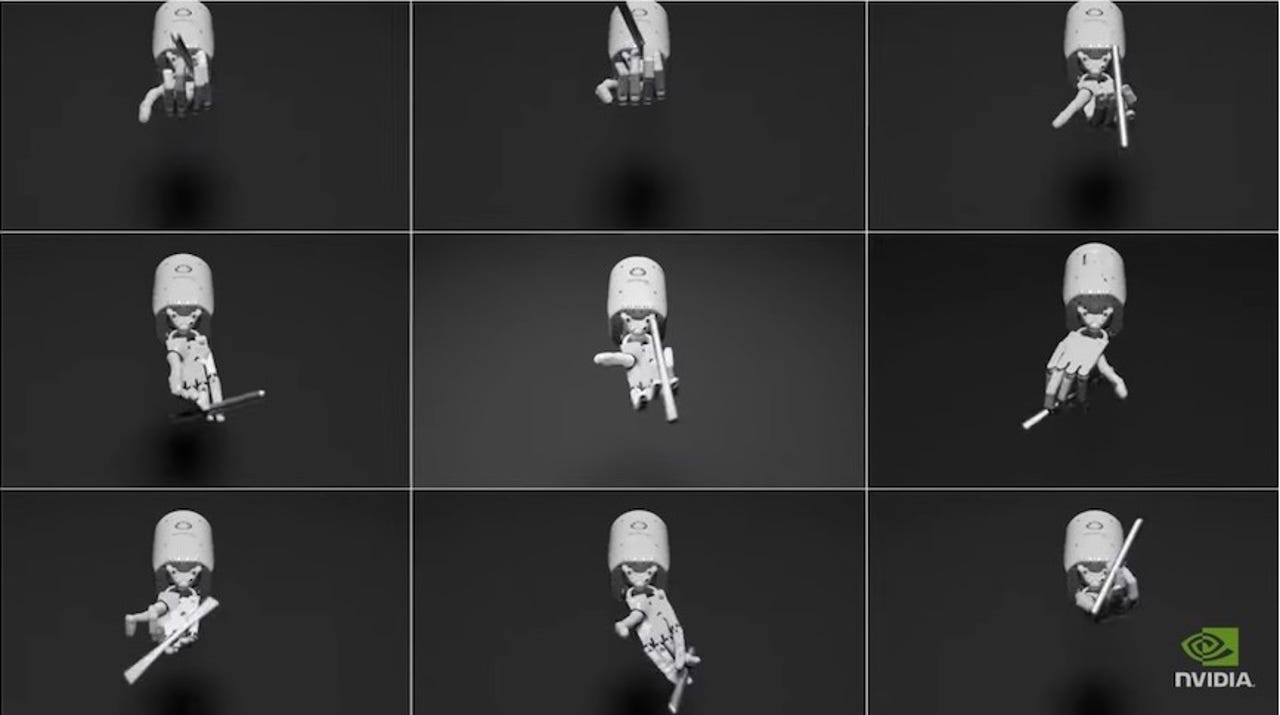
One of the more striking examples of what they've achieved is to get a simulated robot hand to twirl a pen as would a bored student in class. "We consider pen spinning, in which a five-finger hand needs to rapidly rotate a pen in pre-defined spinning configurations for as many cycles as possible," they write. To do so, they combine Eureka with a machine learning approach developed some years ago called "curriculum learning," in which a task is broken down into bite-sized chunks.

Also: Generative AI will far surpass what ChatGPT can do. Here's everything on how the tech advances

"We demonstrate for the first time rapid pen spinning maneuvers on a simulated anthropomorphic Shadow Hand," they relate.

The authors also make a surprising discovery: If they combine both their improved rewards from Eureka with human rewards, the combo performs better on tests than either human or Eureka rewards alone. They surmise that the reason is humans have one part of the puzzle that the Eureka program does not, namely, a knowledge of the state of affairs.

"Human designers are generally knowledgeable about relevant state variables but are less proficient at designing rewards using them," they write. "This makes intuitive sense as identifying relevant state variables that should be included in the reward function involves mostly common sense reasoning, but reward design requires specialized knowledge and experience in RL."

That points toward a possible human-AI partnership akin to GitHub Copilot and other assistant programs: "Together, these results demonstrate Eureka's reward assistant capability, perfectly complementing human designers' knowledge about useful state variables and making up for their less proficiency on how to design rewards using them."