Nvidia’s H200 GPU is a Milestone in AI Technology

In a significant leap forward for artificial intelligence and computing, Nvidia has unveiled the H200 GPU, marking a new era in the field of generative AI. This cutting-edge graphics processing unit emerges as an upgrade to its predecessor, the H100, which notably played a pivotal role in training OpenAI's advanced large language model, GPT-4. The introduction of the H200 GPU is not just a technological advancement; it's a catalyst in the booming AI industry, addressing the soaring demands of big companies, startups, and government agencies alike.

The H200's debut comes at a time when the world is witnessing unprecedented growth in AI capabilities, stretching the boundaries of what machines can learn and accomplish. With its enhanced features and capabilities, the H200 stands as a testament to Nvidia's commitment to pushing the frontiers of AI technology. Its impact extends beyond the realms of machine learning and AI, poised to redefine the landscape of computational power and efficiency in a rapidly evolving digital world.

As we delve deeper into the specifics of the H200, its technical prowess, and the implications for the AI sector and broader tech community, it's clear that Nvidia is not just responding to the current demands but also shaping the future of AI development.

Image: Nvidia

The Evolution of Nvidia's GPUs

The journey from Nvidia's H100 to the newly announced H200 GPU encapsulates a narrative of relentless innovation and technological advancement. The H100, a robust and powerful GPU in its own right, has been instrumental in some of the most significant AI breakthroughs in recent times, including the training of OpenAI's GPT-4, a large language model known for its sophisticated capabilities. This chip, estimated to cost between $25,000 and $40,000, has been at the heart of AI development across various sectors, powering the creation of models that require thousands of GPUs working in tandem during the training process.

However, the leap to the H200 signifies a substantial upgrade in terms of power, efficiency, and capabilities. The H200 isn't just an incremental improvement; it's a transformative shift that amplifies the potential of AI models. One of the standout enhancements in the H200 is its 141GB of next-generation “HBM3” memory, designed to significantly boost the chip's performance in “inference” tasks. Inference, the phase where a trained model generates text, images, or predictions, is crucial for the practical application of AI, and the H200's advancements directly cater to this need.

The importance of such a development cannot be understated. As AI models become increasingly complex and data-intensive, the demand for more powerful and efficient GPUs has skyrocketed. The H200, with its enhanced memory and capability to generate output nearly twice as fast as the H100, as demonstrated in tests using Meta's Llama 2 LLM, represents a critical step in meeting these escalating demands.

Moreover, the H200's arrival has been met with immense anticipation and excitement, not just within the tech and AI communities but also in the broader market.

Image: Nvidia

Financial Impact and Market Reception

The launch of Nvidia's H200 GPU has had a significant impact on the company's financial standing and market perception. This new development has supercharged Nvidia's stock, reflecting a surge of more than 230% in 2023. Such a robust performance is indicative of the market's confidence in Nvidia's AI technology and its potential. The company's fiscal projections for its third quarter, anticipating around $16 billion in revenue—a staggering 170% increase from the previous year—underscore the financial implications of their advancements in AI GPUs.

This financial upswing is a direct consequence of the heightened interest and demand in the AI sector, especially for powerful GPUs capable of handling advanced AI tasks. The H100's price range already placed it as a high-value asset in the AI market. The H200, with its enhanced capabilities, is set to further this trend, appealing to a wide range of customers from big tech companies to government agencies, all seeking to leverage the power of AI.

Moreover, the introduction of the H200 GPU brings Nvidia into a competitive stance with other industry players, most notably AMD with its MI300X GPU. The competition is not just about raw power or memory capacity but also encompasses aspects like energy efficiency, cost-effectiveness, and adaptability to various AI tasks. Nvidia's H200, with its upgraded features and compatibility with previous models, positions the company strongly in this competitive landscape.

This market enthusiasm for Nvidia's AI GPUs isn't just a short-term reaction; it's a reflection of a broader trend in the tech industry towards AI and machine learning. As companies and governments increasingly invest in AI technology, the demand for powerful, efficient GPUs like the H200 is expected to grow, making Nvidia's position in the market even more pivotal.
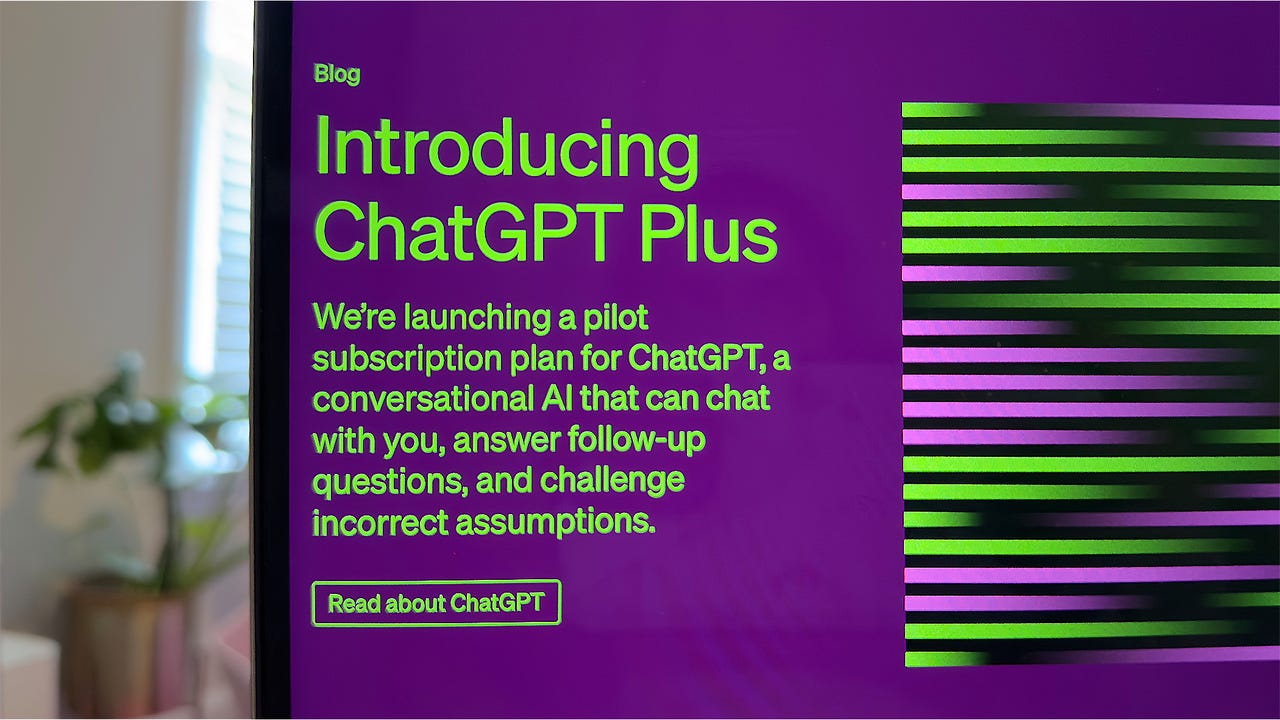
ChatGPT got its biggest update yet, including a new look

ChatGPT Plus

ChatGPT has remained largely unchanged since its launch almost a year ago — until now. Following OpenAI's DevDay, the company's first developers conference last week, ChatGPT got its biggest update. Along with the ability for ChatGPT Plus subscribers to create their own GPT chatbots, the ChatGPT Plus interface has a new look and features.

For ChatGPT Plus subscribers, the changes are pretty major. OpenAI finally combined most of the extra GPT-4 features into its most powerful model instead of making users select each one from a dropdown list.

Also: I spent a weekend with Amazon's free AI courses, and highly recommend you do too

Now, each time Plus subscribers select GPT-4, they'll have access to Advanced Data Analysis, DALL-E 3's image generation, and access to the internet, all combined with GPT-4's capabilities.

Before this update, Plus users had to select the GPT-4 model and then choose one of the features available to use it — each feature had to be used exclusively.

The GPT-4 model now has all capabilities built into one.

For example, if users selected Browse with Bing, they'd ask GPT-4 questions, and the AI chatbot would respond with answers sourced from an internet search. But these users wouldn't have been able to ask it to create an AI-generated image with DALL-E 3 unless they switched to this feature beforehand.

Also: Why Microsoft temporarily blocked ChatGPT from employees on Thursday

Using plugins is still separate from GPT-4's abilities, as plugins are varied and can conflict with GPT-4's newly built-in capabilities.

As for access to the Turbo version of GPT-4, OpenAI has yet to release the improved models for general use. GPT-4 Turbo will give ChatGPT knowledge of world events up to April 2023 and a 128k context window, making it capable of processing over 300 pages of text in a single prompt.

Also: OpenAI CEO sees uphill struggle to GPT-5, potential for new kind of consumer hardware

"GPT-4 Turbo is available for all paying developers to try by passing gpt-4-1106-preview in the API and we plan to release the stable production-ready model in the coming weeks," according to a product announcement from OpenAI.

ChatGPT Plus is a subscription that costs $20 per month and comes with the model's extra capabilities, like web browsing, DALL-E 3, Advanced Data Analysis, plugins, access to new features, and access even during high traffic times.

Artificial Intelligence

These are technology leaders’ biggest worries about using AI at work

AI brain concept

Generative AI may be an impressive productivity tool, but IT and business users alike need to beware that it is also complicating work-lives and business processes as well. That's the warning from the authors of a new IEEE study, which cautions that "using AI isn't as easy as it seems."

The findings of the survey, conducted among 350 global technology executives leaders in September, assert that while just about every company wants to harness AI's potential, there's a need for education and organizational preparation along the way.

Also: I spent a weekend with Amazon's free AI courses, and highly recommend you do too

Despite any obstacles, there is a massive movement to AI. Seventy percent indicated they had introduced or were planning to introduce tools that used natural language processing in the coming year, up from 67% in the previous year's survey. Top use cases for AI in the coming year include real-time cybersecurity, increasing supply chain efficiency, aiding and accelerating software development, automating customer service, and speeding up screening of job applicants.

Still, moving to AI will not happen overnight. "Integrating AI into existing work isn't as straightforward as flipping a switch," the study's authors point out. Think back to many previous so-called easy-to-implement technologies — from cloud computing to IoT devices — that have "often been met with mixed success." If anything, digital transformation initiatives "have astoundingly high failure rates, meaning they didn't meet expectations, exceeded costs, blew through deadlines or in some cases were abandoned."

This is a potential not-so-glamorous future for AI as well — if anything, "introducing advanced technology like AI may be more difficult," the researchers suggest.

Close to six in ten executives, 59%, feared becoming too dependent on AI for important decisions and processes, citing "overreliance on AI and potential inaccuracies" as a top concern of AI use in their organizations.

Also: AI and automation: Business leaders adopt small-scale solutions for greater impact

The next leading concern, cited by 50%, is difficulties in sharing knowledge and training employees. Executives said they are worried about their companies' ability to tap the "institutional knowledge of current professionals to train newcomers."
Close to half, 47%, said that difficulty integrating AI into existing workflows is one of their top concerns when it comes to using generative AI over the coming year.

The quality of training data is another issue that is arising as AI use accelerates, the IEEE report authors state. "AI systems need to be trained using data. But data sets are frequently made by people who can be biased or inaccurate. As a result, AI systems can perpetuate biases." Verifying training data is difficult "because the provenance is not available and volume of the training data is enormous," according to Paul Nikolich, IEEE life fellow.

Also: Here's how to create your own custom chatbots using ChatGPT

Generative AI is still relatively new, with few people with appropriate expertise. Executives were asked to list the top skills they sought in candidates for AI-related roles. A variety of technical skills comprised the list, but various soft skills also ranked high.

"Prompt engineering, creative thinking and the ability to verify AI's deliverables — these three skills are what you need to generate meaningful outcomes with the aid of generative AI," said Yu Yuan, senior member of IEEE, quoted in the report.
Ironically, more AI is needed to build AI. "One of the biggest bottlenecks in technology is the availability of human resources for coding," according to Carmelo José Albanez Bastos Filho, an IEEE senior member. "In many cases, there is intellectual work with high added value, but many of the software development activities are relatively simple and should be automated soon."

Artificial Intelligence

Getting Started with Claude 2 API

Getting Started with Claude 2 API
Image by Author What is Claude 2?

Anthropic's conversational AI assistant, Claude 2, is the latest version that comes with significant improvements in performance, response length, and availability compared to its previous iteration. The latest version of the model can be accessed through our API and a new public beta website at claude.ai.

Claude 2 is known for being easy to chat with, clearly explaining its reasoning, avoiding harmful outputs, and having a robust memory. It has enhanced reasoning capabilities.

Claude 2 showed a significant improvement in the multiple-choice section of the Bar exam, scoring 76.5% compared to Claude 1.3's 73.0%. Moreover, Claude 2 outperforms over 90% of human test takers in reading and writing sections of the GRE. In coding evaluations such as HumanEval, Claude 2 achieved 71.2% accuracy, which is a considerable increase from 56.0% in the past.

The Claude 2 API is being offered to our thousands of business customers at the same price as Claude 1.3. You can easily use it through web API, as well as Python and Typescript clients. This tutorial will guide you through the setup and usage of the Claude 2 Python API, and help you learn about the various functionalities it offers.

Setting Up

Before we jump into accessing the API, we need to first apply for API Early Access. You will fill out the form and wait for confirmation. Make sure you are using your business email address. I was using @kdnuggets.com.

After receiving the confirmation email, you will be provided with access to the console. From there, you can generate API keys by going to Account Settings.

Install the Anthropic Python client using PiP. Make sure you are using the latest Python version.

pip install anthropic

Setup the anthropic client using the API key.

client = anthropic.Anthropic(api_key=os.environ["API_KEY"])

Instead of providing the API key for creating the client object, you can set ANTHROPIC_API_KEY environment variable and provide it the key.

Accessing Claude 2

Here is the basic sync version of generating responses using the prompt.

  1. Import all necessary modules.
  2. Initial the client using API key.
  3. To generate a response you have to provide a model name, max tokes, and prompt.
  4. Your prompt usually has HUMAN_PROMPT ('nnHuman:') and AI_PROMPT ('nnAssistant:').
  5. Print the response.
from anthropic import Anthropic, HUMAN_PROMPT, AI_PROMPT  import os      anthropic = Anthropic(      api_key= os.environ["ANTHROPIC_API_KEY"],  )    completion = anthropic.completions.create(      model="claude-2",      max_tokens_to_sample=300,      prompt=f"{HUMAN_PROMPT} How do I find soul mate?{AI_PROMPT}",  )  print(completion.completion)

Output:

As we can see, we got quite good results. I think it is even better than GPT-4.

Here are some tips for finding your soulmate:    - Focus on becoming your best self. Pursue your passions and interests, grow as a person, and work on developing yourself into someone you admire. When you are living your best life, you will attract the right person for you.    - Put yourself out there and meet new people. Expand your social circles by trying new activities, joining clubs, volunteering, or using dating apps. The more people you meet, the more likely you are to encounter someone special.........

You can also call Claude 2 API using asynchronous requests.

Synchronous APIs execute requests sequentially, blocking until a response is received before invoking the next call, while asynchronous APIs allow multiple concurrent requests without blocking, handling responses as they complete through callbacks, promises or events; this provides asynchronous APIs greater efficiency and scalability.

  1. Import AsyncAnthropic instead of Anthropic
  2. Define a function with async syntax.
  3. Use await with each API call
from anthropic import AsyncAnthropic    anthropic = AsyncAnthropic()      async def main():      completion = await anthropic.completions.create(          model="claude-2",          max_tokens_to_sample=300,          prompt=f"{HUMAN_PROMPT} What percentage of nitrogen is present in the air?{AI_PROMPT}",      )      print(completion.completion)      await main()

Output:

We got accurate results.

About 78% of the air is nitrogen. Specifically:  - Nitrogen makes up approximately 78.09% of the air by volume.  - Oxygen makes up approximately 20.95% of air.   - The remaining 0.96% is made up of other gases like argon, carbon dioxide, neon, helium, and hydrogen.

Note: If you are using the async function in Jupyter Notebook, use await main(). Otherwise, use asyncio.run(main()).

Claude 2 Streaming

Streaming has become increasingly popular for large language models. Instead of waiting for the complete response, you can start processing the output as soon as it becomes available. This approach helps reduce the perceived latency by returning the output of the Language Model token by token, as opposed to all at once.

You just have to set a new argument stream to True in completion function. Caude 2 uses Server Side Events (SSE) to support the response streaming.

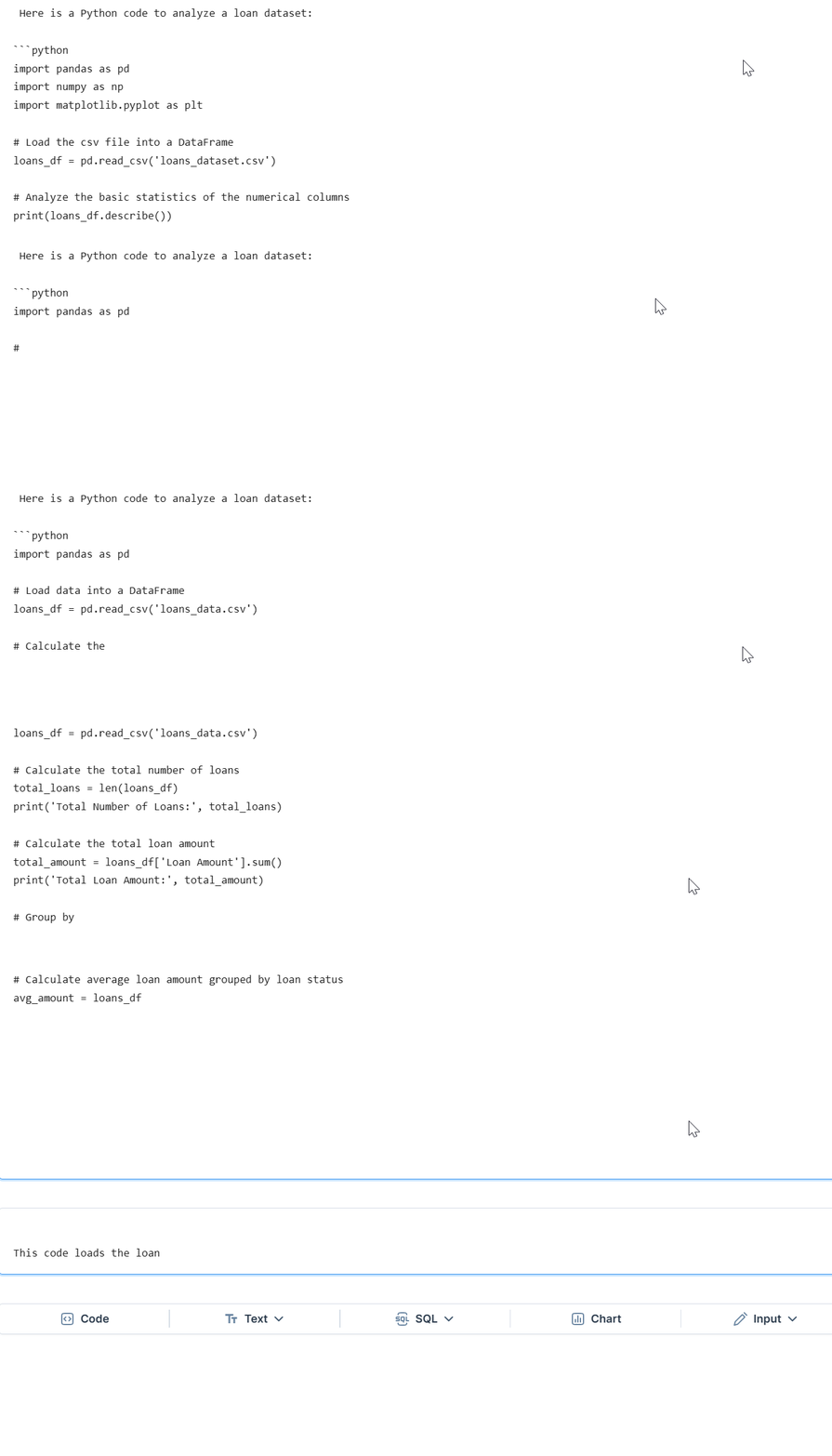
stream = anthropic.completions.create(      prompt=f"{HUMAN_PROMPT} Could you please write a Python code to analyze a loan dataset?{AI_PROMPT}",      max_tokens_to_sample=300,      model="claude-2",      stream=True,  )  for completion in stream:      print(completion.completion, end="", flush=True)

Output:

Getting Started with Claude 2 API Billing

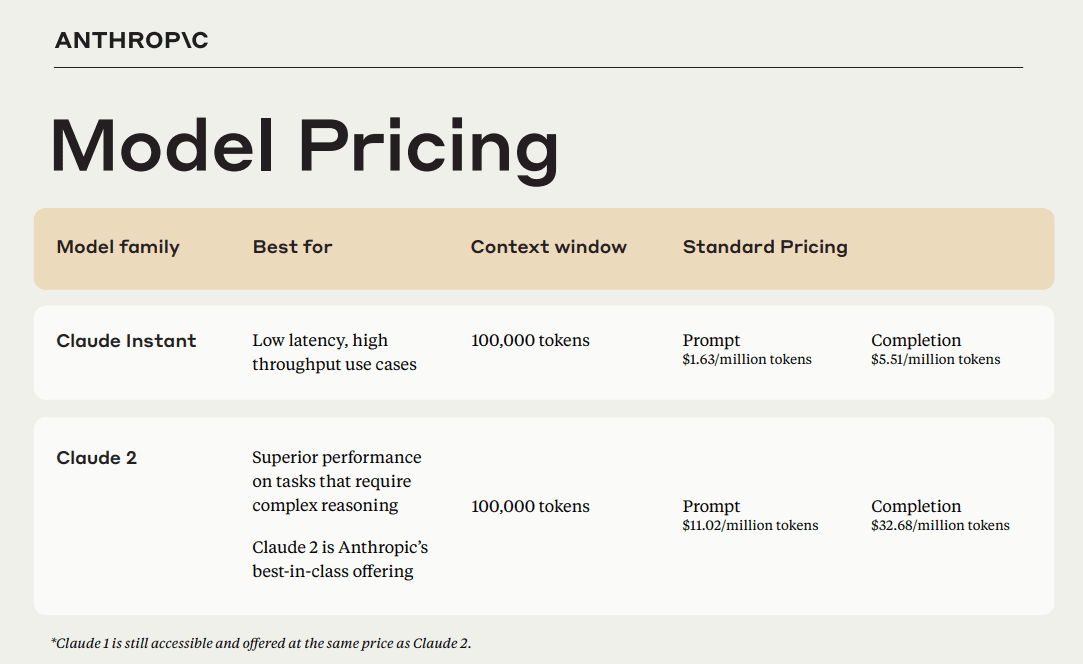
Billing is the most important aspect of integrating the API in your application. It will help you plan for the budget and charge your clients. Aloof the LLMs APIs are charged based on token. You can check the below table to understand the pricing structure.

Getting Started with Claude 2 API
Image from Anthropic

An easy way to count the number of tokens is by providing a prompt or response to the count_tokens function.

client = Anthropic()  client.count_tokens('What percentage of nitrogen is present in the air?')
10

Other Functions

Apart from basic response generation, you can use the API to fully integrate into your application.

  • Using types: The requests and responses use TypedDicts and Pydantic models respectively for type checking and autocomplete.
  • Handling errors: Errors raised include APIConnectionError for connection issues and APIStatusError for HTTP errors.
  • Default Headers: anthropic-version header is automatically added. This can be customized.
  • Logging: Logging can be enabled by setting the ANTHROPIC_LOG environment variable.
  • Configuring the HTTP client: The HTTPx client can be customized for proxies, transports etc.
  • Managing HTTP resources: The client can be manually closed or used in a context manager.
  • Versioning: Follows Semantic Versioning conventions but some backwards-incompatible changes may be released as minor versions.

Conclusion

The Anthropic Python API provides easy access to Claude 2 state-of-the-art conversational AI model, enabling developers to integrate Claude's advanced natural language capabilities into their applications. The API offers synchronous and asynchronous calls, streaming, billing based on token usage, and other features to fully leverage Claude 2's improvements over previous versions.

The Claude 2 is my favorite so far, and I think building applications using the Anthropic API will help you build a product that outshines others.

Let me know if you would like to read a more advanced tutorial. Perhaps I can create an application using Anthropic API.

Abid Ali Awan (@1abidaliawan) is a certified data scientist professional who loves building machine learning models. Currently, he is focusing on content creation and writing technical blogs on machine learning and data science technologies. Abid holds a Master's degree in Technology Management and a bachelor's degree in Telecommunication Engineering. His vision is to build an AI product using a graph neural network for students struggling with mental illness.

More On This Topic

  • Meet Gorilla: UC Berkeley and Microsoft’s API-Augmented LLM…
  • ChatGPT Dethroned: How Claude Became the New AI Leader
  • Top 10 Tools for Detecting ChatGPT, GPT-4, Bard, and Claude
  • 3 Ways to Access Claude AI for Free
  • HuggingChat Python API: Your No-Cost Alternative
  • OpenAI’s Whisper API for Transcription and Translation

AI and automation: Business leaders adopt small-scale solutions for greater impact

Person touching abstract AI data

Business leaders recognize automation is changing the way companies operate. The hope is that automation — whether it's in the form of robots, machine learning, or artificial intelligence (AI) — will make us all more productive in the not-so-distant future.

However, getting to the point where automation enhances our working life is far from straightforward. Despite the cacophonous hype associated with AI during the past year, experts suggest emerging technologies must be explored in a careful and considerate manner.

Also: Generative AI and machine learning are engineering the future in these 9 disciplines

That's certainly the approach being taken by Sasha Jory, CIO at insurer Hastings Direct. While her team is investigating "all sorts of different things" in automation, she says they've already learned a valuable lesson from their explorations.

"One of the things we've found with automation is that if a process is broken and doesn't work today, then automating that process just makes the mess go faster," she says.

Avoiding that nightmare scenario means taking a tactical approach to automation. "We choose carefully where we think that we can make a difference," says Jory. "A lot of our automation is about removing manual processes, bringing in streamlining, creating opportunities through robotics to do processes, and teaching the technology to do things that previously a human being would have done."

Also: Generative AI is everything, everywhere, all at once

Rather than a big-bang approach that relies on a huge investment in enterprise-wide services, such as robotic process automation (RPA), Jory and her team search for small-scale opportunities.

That's a big shift from a few years ago when the IT industry was abuzz with the potential of RPA, which uses software robots or AI agents to perform repetitive tasks that might once have been pursued by humans.

Adobe CIO Cynthia Stoddard, for example, described in an interview for ZDNET in 2021 how her organization embraced RPA.

The technology giant has worked with UiPath to create a Centre of Excellence for RPA, which manages the building, tooling, and implementation of the automation platform across Adobe, as well as the automation of business processes.

Stoddard says the successful use of RPA in finance helped sponsor the wider adoption of the technology across the business, producing big boosts in productivity.

Also: As developers learn the ins and outs of generative AI, non-developers will follow

However, not every business is able to spend a large amount of money and effort building an enterprise-wide approach to automation — and that's a sentiment that resonates with Jory at Hastings.

"We're not pursuing big, large-scale process automation, because that is time-consuming and can often be very difficult," she says. "Our approach is all about picking small things where we can make a difference."

Evidence suggests Jory might not be the only digital leader who's looking at small-scale ways to automate processes.

While Gartner says spending on RPA software reached $2.8 billion in 2022, up from $2.3 billion in 2021, annual growth in the RPA market has slowed during the past few years from 62% in 2019 to 22% in 2022.

Also: What technology analysts are saying about the future of generative AI

Nash Squared's recently released Digital Leadership Report also shows growth in RPA is making slow progress; the proportion of CIOs who say their organizations have large-scale RPA implementations has crept up from 10% to 12% this year.

A few years ago, RPA might have been the only way to take advantage of automation in a strategic manner. Now, other technologies are available, recognizes Bev White, CEO at Nash Squared, and using those small-scale solutions might be more appropriate than a big-bang approach.

"RPA can be really a fantastic game-changer in certain industries for wholescale processing of massive piles of data that needs dealing with," she says. "At the same time, I don't think it's for everyone. RPA is one of those things that came out with great aplomb. It's got its fans; it's delivered some fantastic returns on investment. But it's now one of many things CIOs can consider — and it's not always the right thing. There are other ways of embracing automation that could be more productive."

Also: How trusted generative AI can improve the connected customer experience

In short, if you're a digital or a business leader with a limited budget, you don't always have to invest in a large-scale RPA project, White told ZDNET — especially now that other tools, including robotics, generative AI, and machine learning, are available.

"Well, that's the point," she says. "And dipping a toe into AI isn't as expensive. You can run three or four small projects to test out different elements and still have a decent amount of change left in your pocket."

That's certainly the case at Hastings, where Jory gives an example of how the company uses automation in its IT processes to ensure everything runs smoothly with as little human intervention as possible.

"If a messaging queue got stuck in the past, then somebody would go in and remove a message and push the queue forward," she says. "Now, we've got technology that will go in and identify the queue is stuck, and the message that is holding it back. It will remove the message, it will alert the team, and then the queue will carry on running."

Jory says the IT team is also using observability, which provides visibility into Hastings' applications stack and allows for the automated identification and resolution of problems.

Also: How to achieve hyper-personalization using generative AI platforms

"It's massively important to be able to see what's going on in our systems all of the time," she says. "We used to have lots of hung threads that required a server restart — and now those just restart automatically. But we also have logic in there, so we don't do restarts in the middle of the day at the busiest time, which would then cause issues for our colleagues."

In the future, Jory expects a combination of generative AI and machine learning to form part of the organization's tactical approach to automation. The insurer receives a lot of documents and photographic evidence of accidents. Emerging technology could help to automate the checking and verification of this data.

"Instead of having to trawl through all of that evidence, whether it's a handwritten document, a photograph or an email or whatever, it's about being able to take that information and to create a summary of what's going on for the customer," Jory said. AI and machine learning could also be used in fraud-detection processes: "Are there certain behaviors we can see in our data that we might want to follow up on?"

Similarly to CIOs at other organizations, Jory says Hastings is currently considering its options when it comes to generative AI. The company is working with its key core IT providers, including Microsoft, EY, and Snowflake. The internal IT team is also exploring how it might build AI-focused tools with these partners.

Also: Generative AI and the fourth why: Building trust with your customer

Whether it's dabbling in generative AI or implementing machine learning and robotics, Jory advises other executives to take a careful and considered approach to automation.

"I'd say start small — find obvious places to go," she says. "Don't go into big, hefty business processes and think you will be able to suddenly automate everything. Be focused, be clear on what you choose, and get the scores on the door quickly, so people buy into your strategy, and you can get more momentum."

Artificial Intelligence

5 Free Courses to Master Data Science

5 Free Courses to Master Data Science
Image by Author

Are you an aspiring data professional looking to kickstart your data science career? If so, you’re probably considering various options: online courses, bootcamps, master’s degree, and more.

But if you are motivated enough, there are several high-quality free resources that can help you get there. Here, we’ve compiled a list of five such free courses that can help you learn and gain proficiency in data science.

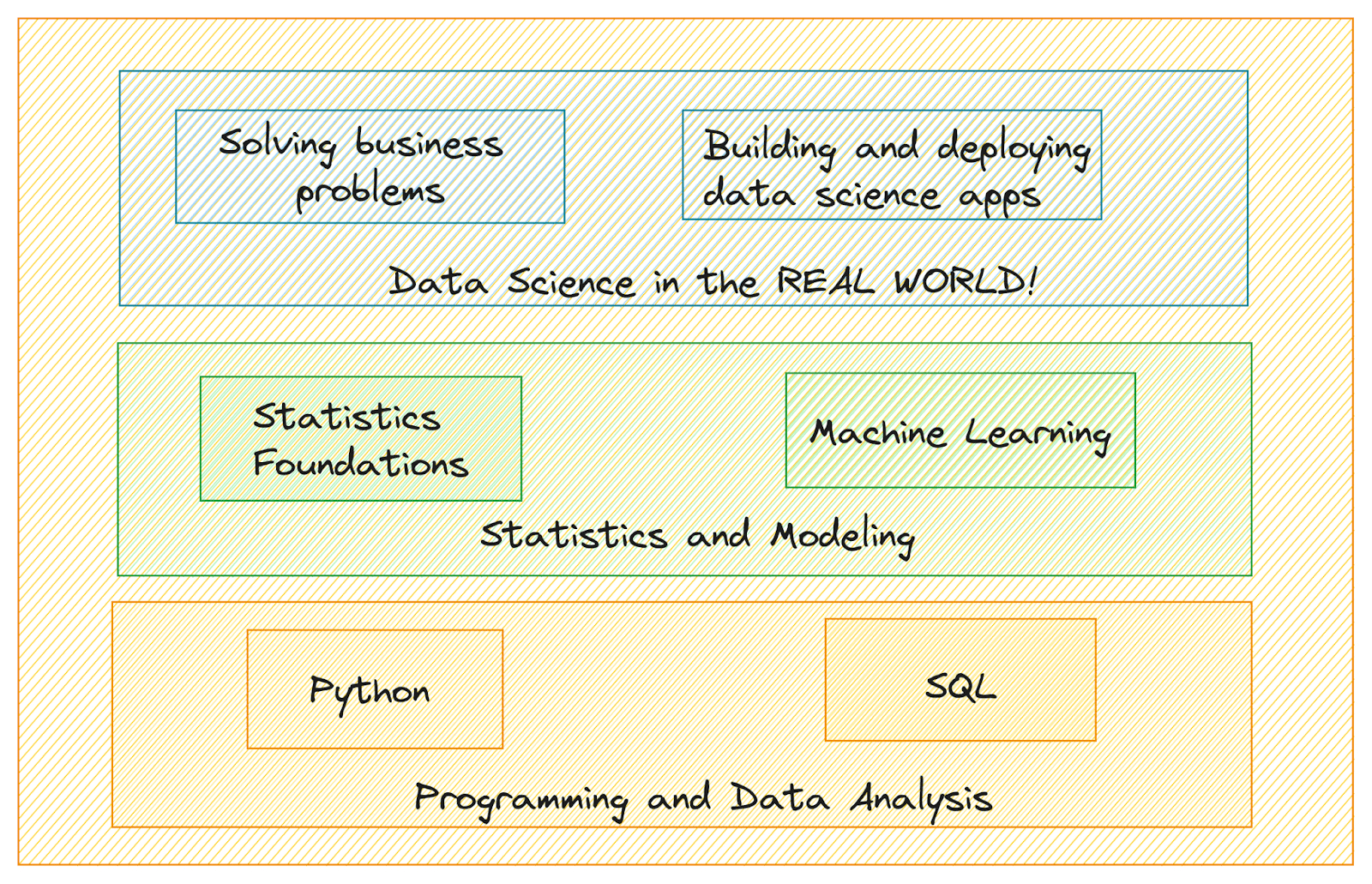
From programming fundamentals to building and deploying data science applications, these courses will teach you everything you need for a successful career pivot.

Let’s dive right in!

1. Python for Everybody

Python for Everybody, taught by Prof. Charles Severance at the University of Michigan is a great course to learn Python. It teaches you Python Programming from the ground up—covering everything you need to know when working with data.

You can also use the Python for Everybody book in conjunction with the course. The course covers the following broad topics:

  • Programming fundamentals with Python
  • Python data structures
  • Conditional execution, loops and iteration
  • Functions
  • Regular expressions
  • Web services and networked programs
  • Data visualization

Course link: Python for Everybody

2. Data Analysis with Python

Now that you have your Python fundamentals down, it’s time to analyze data with Python. Data analysis with Python from Jovian (on freeCodeCamp's YouTube channel) is a free course that’ll help you learn to work with data science libraries with several practice exercises and a course project.

This course starts out with Python Programming fundamentals (which should be a refresher for you) and gradually introduces Python data analysis libraries. And wraps up with an end-of-course project on exploratory data analysis.

Here’s an overview of the course curriculum:

  • Python fundamentals
  • Numerical computing with NumPy
  • Analyzing tabular data with pandas
  • Visualization with Matplotlib and Seaborn
  • Course project: Exploratory Data Analysis

Course link: Data Analysis with Python

3. Databases and SQL

Introduction to Databases in Data Science outlines the essential database skills for data professionals.

From designing databases to writing efficient SQL queries and more, databases and SQL are must-have skills for your data career. This Databases and SQL course from freeCodeCamp will teach you the following:

  • Database fundamentals
  • SQL basics
  • CRUD operations
  • Functions, joins, and unions
  • Nested queries
  • Designing database schema

Course link: Databases and SQL

4. Intro to Inferential Statistics

Aside from high school math—Calculus, Probability, and Linear algebra—you need to have a strong foundation in statistics to excel in data science.

Intro to Inferential Statistics from Udacity’s free course library will teach you the following concepts—along with coding exercises to test your skills:

  • Estimation
  • Hypothesis Testing
  • t-Tests
  • ANOVA
  • Chi-Squared Test
  • Correlation
  • Regression

Course link: Intro to Inferential Statistics

5. Machine Learning Zoomcamp

The courses listed thus far should have helped you gain proficiency over Python fundamentals, data analysis, and statistics foundations.

Now it's time to start building and deploying machine learning models. Machine Learning Zoomcamp by DataTalks.Club is a great course to learn the fundamentals of machine learning through a code-first approach. It also covers a good breadth of topics including model deployment and deep learning.

The course curriculum includes the following:

  • Regression
  • Classification
  • Evaluating machine learning models
  • Deploying machine learning models
  • Decision trees and ensemble learning
  • Neural networks and deep learning
  • Kubernetes and TensorFlow Serving

Course link: Machine Learning Zoomcamp

Wrapping Up

I hope you found these recommended courses helpful. Most of these courses require you to code, build, break, and learn along the way. So you’ll have a good foundation.

But even as you're working through these courses, build your portfolio on the side. Your goal should be to build a handful of interesting projects that showcase your strength and skills. If you need some inspiration to get started, check out 3 Data Science Projects Guaranteed to Land You That Job. Happy learning!

Bala Priya C is a developer and technical writer from India. She likes working at the intersection of math, programming, data science, and content creation. Her areas of interest and expertise include DevOps, data science, and natural language processing. She enjoys reading, writing, coding, and coffee! Currently, she's working on learning and sharing her knowledge with the developer community by authoring tutorials, how-to guides, opinion pieces, and more.

More On This Topic

  • 5 Free Courses to Master Linear Algebra
  • 5 Free Courses to Master Calculus
  • 5 Free Books to Master Data Science
  • KDnuggets News, October 27: 5 Free Books to Master Data Science • 7…
  • KDnuggets News, May 4: 9 Free Harvard Courses to Learn Data…
  • 9 Free Resources to Master Python

Back to Basics Week 2: Database, SQL, Data Management and Statistical Concepts

Back to Basics Week 2: Database, SQL, Data Management and Statistical Concepts
Image by Author

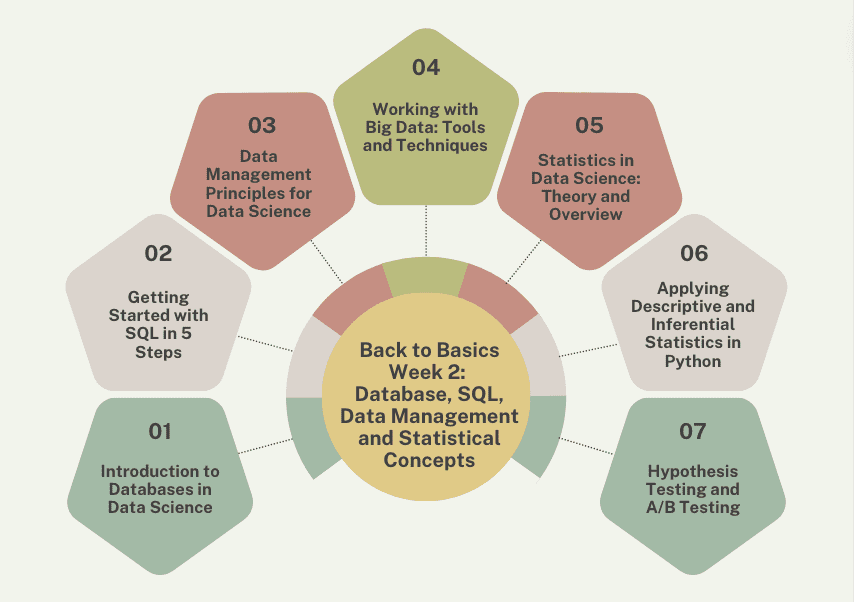
Join KDnuggets with our Back to Basics pathway to get you kickstarted with a new career or a brush up on your data science skills. The Back to Basics pathway is split up into 4 weeks with a bonus week. We hope you can use these blogs as a course guide.

If you haven’t already, have a look at Week 1: Back to Basics Week 1: Python Programming & Data Science Foundations

Moving onto the second week, we will learn about Database, SQL, Data Management and Statistical Concepts.

  • Day 1: Introduction to Databases in Data Science
  • Day 2: Getting Started with SQL in 5 Steps
  • Day 3: Data Management Principles for Data Science
  • Day 4: Working with Big Data: Tools and Techniques
  • Day 5: Statistics in Data Science: Theory and Overview
  • Day 6: Applying Descriptive and Inferential Statistics in Python
  • Day 7: Hypothesis Testing and A/B Testing

Introduction to Databases in Data Science

Week 2 — Part 1: Introduction to Databases in Data Science

Understand the relevance of databases in data science. Also learn the fundamentals of relational databases, NoSQL database categories, and more.

Data science involves extracting value and insights from large volumes of data to drive business decisions. It also involves building predictive models using historical data. Databases facilitate effective storage, management, retrieval, and analysis of such large volumes of data.

So, as a data scientist, you should understand the fundamentals of databases. Because they enable the storage and management of large and complex datasets, allowing for efficient data exploration, modelling, and deriving insights.

Getting Started with SQL in 5 Steps

Week 2 — Part 2: Getting Started with SQL in 5 Steps

When it comes to managing and manipulating data in relational databases, Structured Query Language (SQL) is the biggest name in the game. SQL is a major domain-specific language which serves as the cornerstone for database management and provides a standardized way to interact with databases.

With data being the driving force behind decision-making and innovation, SQL remains an essential technology demanding top-level attention from data analysts, developers, and data scientists.

This comprehensive SQL tutorial covers everything from setting up your SQL environment to mastering advanced concepts like joins, subqueries, and optimising query performance. With step-by-step examples, this guide is perfect for beginners looking to enhance their data management skills.

Data Management Principles for Data Science

Week 2 — Part 3: Data Management Principles for Data Science

Understanding key data management principles that data scientists should know.

Through your journey as a data scientist, you will come across hiccups, and overcome them. You will learn how one process is better than another, and how to use different processes depending on your task at hand.

These processes will work hand-in-hand, to ensure that your data science project goes as effectively as possible and plays a key component in your decision-making process.

Working with Big Data: Tools and Techniques

Week 2 — Part 4: Working with Big Data: Tools and Techniques

Where do you start in a field as vast as big data? Which tools and techniques to use? We explore this and talk about the most common tools in big data.

Long gone are times in business when all the data you needed was in your ‘little black book’. In this era of the digital revolution, not even the classical databases are enough.

Handling big data became a critical skill for businesses and, with them, data scientists. Big data is characterized by its volume, velocity, and variety, offering unprecedented insights into patterns and trends.

To handle such data effectively, it requires the usage of specialized tools and techniques.

Statistics in Data Science: Theory and Overview

Week 2 — Part 5: Statistics in Data Science: Theory and Overview

High-level exploration of the role of statistics in data science.

Are you interested in mastering statistics to stand out in a data science interview? If it’s yes, you shouldn’t do it only for the interview. Understanding Statistics can help you in getting deeper and more fine-grained insights from your data.

In this article, I am going to show the most crucial statistics concepts that need to be known for getting better at solving data science problems.

Applying Descriptive and Inferential Statistics in Python

Week 2 — Part 6: Applying Descriptive and Inferential Statistics in Python

As you progress in your data science journey, here are the elementary statistics you should know.

Statistics is a field encompassing activities from collecting data and data analysis to data interpretation. It’s a study field to help the concerned party decide when facing uncertainty.

Two major branches in the statistics field are descriptive and Inferential. Descriptive statistics is a branch related to data summarization using various manners, such as summary statistics, visualization, and tables. While inferential statistics are more about population generalization based on the data sample.

Hypothesis Testing and A/B Testing

Week 2 — Part 7: Hypothesis Testing and A/B Testing

The pillars of data-driven decisions.

In an era where data reigns supreme, businesses and organizations are constantly on the lookout for ways to harness its power.

From the products you’re recommended on Amazon to the content you see on social media, there’s a meticulous method behind the madness.

At the heart of these decisions? A/B testing and hypothesis testing.

But what are they, and why are they so pivotal in our data-centric world? Let’s discover it all together!

Wrapping it Up

Congratulations on completing week 2!!

The team at KDnuggets hope that the Back to Basics pathway has provided readers with a comprehensive and structured approach to mastering the fundamentals of data science.

Week 3 will be posted next week on Monday — stay tuned!

Nisha Arya is a Data Scientist and Freelance Technical Writer. She is particularly interested in providing Data Science career advice or tutorials and theory based knowledge around Data Science. She also wishes to explore the different ways Artificial Intelligence is/can benefit the longevity of human life. A keen learner, seeking to broaden her tech knowledge and writing skills, whilst helping guide others.

More On This Topic

  • Back to Basics Week 1: Python Programming & Data Science Foundations
  • Back To Basics, Part Dos: Gradient Descent
  • Free 4 Week Data Science Course on AI Quality Management
  • Advanced Statistical Concepts in Data Science
  • 10 Statistical Concepts You Should Know For Data Science Interviews
  • 10 Must-Know Statistical Concepts for Data Scientists

Microsoft’s Thought-Out Plan for LLM Problems

As irrational language models continue to increasingly influence every aspect of our lives, Microsoft has released an approach to make AI reason better, called ‘Everything of Thought’ (XOT). This methodology draws inspiration from Google DeepMind’s AlphaZero which uses tiny neural nets that can perform better with larger ones.

The new XOT method was developed in collaboration with Georgia Institute of Technology, and East China Normal University. They used a blend of reinforcement learning and Monte Carlo Tree Search (MCTS), techniques renowned for their effectiveness in complex decision-making.

These techniques together allow language models to generalise efficiently to unknown problems, the researchers said. The researchers’ trials on a variety of challenging tasks, such as the Game of 24, the 8-Puzzle, and the Pocket Cube, yielded impressive results. XOT has outshone its contemporaries in tackling problems that have stymied other methods. This superiority, however, is not without its limitations. The system, despite its advances, has not reached a state of 100% reliability.

However, the research team views the framework as an effective approach for incorporating external knowledge into language model inference. They are sure that it improves performance, efficiency, and flexibility simultaneously—a combination not attainable through alternative methods.

Trying To Reason

The reason for researchers eyeing games to integrate next into language models is because these models can form sentences with impressive accuracy yet they fall short in an aspect critical to human-like thinking: the ability to reason logically.

Researchers have long studied the subject. For years, the academic and tech communities have delved deep into this conundrum. However, despite their efforts in augmenting AI with more layers, parameters, and attention mechanisms, a solution remains missing. They have also been exploring multimodality but nothing much advanced and dependable has come out of that yet either.

Earlier this year, a collaborative team at Virginia Tech and Microsoft released an approach titled “Algorithm of Thoughts” (AoT), to refine AI’s algorithmic reasoning as we all know how bad ChatGPT was at maths when released. Additionally, it suggested that with this training method, large language models could become capable of integrating their intuition into searches that are optimised for better outcomes.

Moreover, a little over a month ago Microsoft also put the moral reasoning of these models under a microscope. As a result, the team proposed a new framework designed to assess its ethical decision-making skills. In the outcome, the 70-billion parameter LlamaChat model outperformed its larger counterparts. The result challenged the long-held belief that bigger always equates to better and the community’s over-reliance on large parameters.

As the big tech companies continue to face the consequences of their irrational language models, Microsoft’s strategy appears to be one of careful progress. Rather than racing to add complexity to their models, they are picking their battles one by one.

More Possibilities

Microsoft has not disclosed plans for implementing the XOT method in its products. Meanwhile, Google DeepMind, led by CEO Demis Hassabis, is considering integrating AlphaGo-inspired concepts into its Gemini project, as he mentioned in an interview.

Meta’s CICERO, named with a nod to the famed Roman orator, also entered the fray a year ago, raising eyebrows across the AI community for being so well skilled at the complex board game Diplomacy. This game, demanding not just strategic awareness but also the art of negotiation, has long been considered a challenge for AI. Yet, CICERO navigated these waters, showing an ability to engage in nuanced, human-like conversations.

This discovery did not go unnoticed, especially in light of the benchmarks set by DeepMind. For years, the UK-based research lab has championed the use of games for developing and refining neural networks.

Their feats with AlphaGo, have set a high bar, one that Meta met with borrowing elements from DeepMind’s playbook; combining strategic reasoning algorithms, like AlphaGo, with a natural language processing model, like GPT-3.

Meta’s model stood out because, for an AI agent to play Diplomacy, it has to not only understand the rules of the game, it also has to accurately gauge the possibility of betrayal by other human players. The agent’s capability to engage in conversations in natural-sounding language with other humans makes it the next best thing to be integrated as Meta continues to build Llama-3.

The integration of CICERO’s capabilities with Meta’s broader AI initiatives could mark the beginning of true conversational AI.

The post Microsoft’s Thought-Out Plan for LLM Problems appeared first on Analytics India Magazine.

GPT-4 Turbo: After Hype Comes “Lost in the Middle” Phenomenon

Last week, OpenAI held a first developer conference in which it announced GPT-4 Turbo, an enhanced iteration of GPT-4, now features an expansive 128k context window, enabling it to process the equivalent of over 300 pages of text in a single prompt. This upgrade comes with knowledge extending up to April 2023. Several announcements were made, spanning open source models and developer tools, addressing areas where the generative capabilities of OpenAI previously faced competition gaps.

These announcements drew the attention of the AI world as they sounded like death sentences for many other AI startups out there.

A week later, the hype is coming down and nothing has changed much. GPT-4 Turbo was not as revolutionary as it sounded.

Context Length Extn Issue

In a late July study, Stanford University, UC Berkeley, and Samaya AI researchers revealed a phenomenon in large language models termed “Lost in the Middle,” where information retrieval accuracy is high at the document’s start and end but declines in the middle, especially with increased input processing.

Building on this, Greg Kamradt, Shawn Wang, and Jerry Liu tested if GPT-4 Turbo exhibited this effect. Using YC founder Paul Graham’s essays, they inserted a random statement at different document points and evaluated GPT-4’s recall. Findings showed decreased recall above 73,000 tokens, particularly affecting mid-document statements, emphasizing context length’s impact on accuracy. It means that the accuracy typically drops off as you get to 60-70% of the context length supported by an LLM.

Opting for smaller context-length inputs is recommended for accuracy, even with the advent of long-context LLMs. Notably, facts at the input’s beginning and end are better retained than those in the middle. Comparatively, a 128K context-length LLM performs better than a 32K context-length one for a given context, suggesting the use of large context-length LLMs with relatively smaller documents. The “forgetting problem” remains a challenge, requiring ongoing development in LLM applications with multiple components and prompt engineering.

While larger context windows, such as those offered by advanced language models like GPT-4, allow for more extensive data processing in a single prompt, embedded search functions or vector databases remain superior in terms of accuracy and cost-effectiveness, particularly for specific information retrieval tasks.

Vector databases specialise in organising and retrieving information based on semantic similarities, offering a more targeted and efficient approach. These systems are designed to excel in precision, ensuring that the retrieved information aligns closely with the user’s query. Additionally, the focused nature of embedded search functions often results in reduced computational costs, making them an optimal choice for specific and precise data retrieval needs.

OpenAI’s Retrieval APIs Not the Ultimate Solution

While OpenAI’s introduction of retrieval APIs is noteworthy, it’s crucial to highlight the limitation of exclusively working with GPT-4. Despite a price reduction, the scalability of usage remains a significant challenge due to its high cost.

There are open-source retrieval APIs that are revolutionising enterprise LLM adoption.

These APIs come equipped with open-source LLMs tailored for enterprise applications, featuring expansive 32K contexts and specialization in specific enterprise use cases like Q/A and summarization. The cost-effectiveness of these open-source APIs is noteworthy, being 20 times more economical than GPT-4. Additionally, developers have the flexibility to switch to closed-source LLMs from OpenAI, Anthropic, or Google if that better aligns with their preferences. Furthermore, if a customized fine-tuned LLM is essential and a developer possesses labeled data, they provide the service of fine-tuning the LLM to meet their specific requirements. In many instances, the combination of Retrieval-Augmented Generation (RAG) with fine-tuning proves to yield optimal results.

In the ever-evolving landscape of an enterprise’s internal knowledge base, the challenge is avoiding the hassle of repeatedly uploading new data each time the database undergoes changes. Typically, enterprise clients store their data in cloud repositories such as Azure, GCP, and S3. The open-source retrieval APIs facilitate a seamless connection to these cloud buckets, ensuring regular updates without manual intervention. Moreover, this functionality extends to pulling in data from various sources, including Confluence or any cloud database like Snowflake, Databricks, and others, enhancing versatility and adaptability.

While the intricacies are abstracted for a seamless experience, the open-source retrieval API allows users the flexibility to delve into the details and fine-tune parameters as needed. Despite the API’s intelligent approach in making decisions on chunking and embedding strategies based on dataset and API requests, users retain the ability to make manual adjustments.

In the realm of enterprise operations, establishing pipelines and robust monitoring systems is indispensable. Connecting to diverse data sources, ensuring regular updates to vector stores, and meticulous indexing are vital components. The Retrieval API fundamentally streamlines the development of LLM applications on your data, offering a quick start within a few hours. It emerges as the optimal choice, especially for those emphasising cost-effectiveness and scalability in Retrieval/RAG processes.

The post GPT-4 Turbo: After Hype Comes “Lost in the Middle” Phenomenon appeared first on Analytics India Magazine.

What is Noise in Image Processing? – A Primer

What is Noise in Image Processing?

If you’ve ever seen a picture where you notice dust particles that are not part of the actual image, you’re probably seeing ‘noise’ in the image. There are many technical reasons for why this happens. It often obscures the actual image and is the leading cause of image quality degradation in digital image transmission.

This is where image processing offers a robust solution. It provides a wide range of noise reduction techniques, such as spatial filtering, frequency filtering, transformation-based filtering, deep learning-based filtering, etc.

In this article, we’ll explore some key techniques that can be used to reduce noise in images, along with investigating the leading types and causes of image noise. Let’s dive in!

Types of Noise in Image Processing

Types of Noise in Image Processing

A simulation of noise variations – Mdf, CC BY-SA 3.0, via Wikimedia Commons

Factors ranging from environmental conditions to the camera’s sensor can introduce noise into the image. The four main types of noise that you usually see in images include:

  • Additive Noise: Caused by random variations in brightness or color information across the image. This is the most common type of noise seen in images.
  • Subtractive Noise: Caused by the random subtraction of pixel values from the original image, leading to poor image quality, often seen as dark spots or regions in the image. Subtractive noise usually occurs in low-light settings.
  • Multiplicative Noise: Caused when the noise value is multiplied by the original pixel value, often resulting in poor image quality around the brighter parts of the image. This is the most difficult type of noise to remove due to significant pixel value variations.
  • Impulse Noise: Caused by sudden changes in pixel value that are visible as random black and white pixels seen as sharp disturbances in the image. It is also referred to as ‘salt and pepper noise.’ It results from camera defects, transmission errors, or cosmic rays.

Causes of Noise in Image Processing

Image noise can result from various sources, including:

  1. Environmental Conditions: External factors such as poor lighting or nearby electronic interference commonly cause noise in images. They can add random variations in images.
  2. Sensor Noise: Any issues with the sensor used in cameras and scanners can add to noise in images. For example, in poor lighting conditions, if you’re not using a good quality sensor, it can amplify the noise along with the light.
  3. Quantization Noise: Occurs when analog signals are converted to digital form, particularly in high-contrast images. For example, when you scan a photograph, you’ll often see noise appear in the resulting image. This is quantization noise appearing from image digitization.
  4. Transmission Noise: Occurs when images are transmitted over noisy channels, be it through networks (e.g., the internet) or stored on noisy storage media (like hard drives).
  5. Processing Noise: Occurs during image processing operations, such as filtering, compression, etc.

Noise Models in Image Processing

"</p

Noise models in image processing serve as mathematical representations of the different kinds of noise that can affect images. These models help understand the occurrence of different kinds of noise through simulations, which in turn helps develop strategies to reduce it.

Some common noise models include:

  1. Gaussian Noise: One of the most common types of noise models, ‘Gaussian noise’ is characterized by a bell-shaped probability distribution. It simulates random variations found in images. It can stem from sources such as sensor and quantization noise and is similar to the static you often see on TV or a radio signal.
  2. Erlang Noise: Also known as gamma noise, this is another multiplicative noise model characterized by a gamma distribution. It's typically found in images captured with noisy sensors or transmitted through noisy channels.
  3. Uniform Noise: This is an additive noise model with a uniform distribution, often observed in quantized images or those corrupted by transmission errors.

Noise Measurement

In image analysis, noise assessment and evaluation is a fundamental task. It involves quantifying the level of noise in an image. This process relies on two primary noise measurement techniques:

  1. Peak Signal-to-Noise Ratio (PSNR): PSNR serves as a benchmark for evaluating the quality of image reconstruction. It compares the pixel values of the original image to those of the reproduced image, providing a numerical measure of how faithfully the image is reproduced.
  2. Mean Squared Error (MSE): MSE, in contrast, assesses the differences between the pixel values of two images. This method calculates the average of the squared differences between corresponding pixels in the two images. This quantitative approach helps us understand the extent of noise in an image and its impact on quality.

Common Noise Reduction Techniques

Noise makes images grainy and discolored, obscuring fine details. To neutralize this effect, noise reduction techniques help improve image quality for better outcomes in many domains like photography, security, video conferencing, surveillance, etc. For example, noise reduction is critical for accurate diagnosis and treatment planning in medical imagery.

The noise reduction techniques work best under conditions like low light, high ISO settings, rapid shutter speeds, or when dealing with inherently noisy cameras.

Some common noise reduction techniques include:

  • Median Filtering: To eliminate impulse noise, median filtering substitutes the pixel's value with the median values of its nearby pixels.
  • Gaussian Filtering: This technique replaces each pixel in an image with a weighted average of the pixels in a neighborhood of pixels around that pixel.
  • Bilateral Filtering: This technique combines the median and Gaussian filtering to reduce noise with intact edges.
  • Wavelet Filtering: This technique uses the Fourier Transform model to pass image wavelet coefficients to reduce noise.

Applications of Noise Reduction

Noise reduction has a variety of applications across industries, such as image restoration and image upscaling, but the most important ones are:

  • Medical imaging: Noise reduction techniques improve disease diagnosis in MRI and CT scans, streamlining patient outcomes.
  • Satellite imagery: Noise reduction aids in better object and feature identification in satellite images.
  • Disaster management: Noise reduction improves remote sensing images for environmental monitoring and mapping.
  • Law enforcement: It enhances clarity in surveillance footage and forensic images for suspect and object identification.
  • Space research: Noise reduction cleans astronomical images, enabling the detection of faint celestial objects and fine details in deep space observations.

To read related content, visit Unite AI.