The AWS re:Invent felt like it was all about reinventing OpenAI’s products. “Reinventing is in our DNA, and it continues to drive us every day,” said Amazon CEO Adam Selipsky as he began his keynote. Sadly, AWS’s reinventing was mostly about taking shots at OpenAI and calling out its security flaws.
As Microsoft Azure with OpenAI by its side took the biggest leap in the latest quarter in terms of revenue growth, AWS is trying hard to shrug off the idea that it is lagging behind. At re:Invent, AWS made a slew of announcements spanning from the bottommost layer of AI infrastructure to the topmost layer of AI apps, similar to what Microsoft did at Ignite 2023.
Interestingly, the tech stack of AWS and Microsoft’s Azure for generative AI is very similar.
Catching the ‘Q’ Train
Last week, the letter ‘Q’ out of nowhere started trending on X, all thanks to OpenAI’s latest model, Q*, which some AI experts believe will achieve AGI. Who knows if AWS took inspiration from that and introduced Amazon Q- its newest generative AI assistant, designed for work that can be tailored to business.
“You can easily chat, generate content, and take actions with Q,” said Selipsky. “It’s all informed by an understanding of your systems, your data repositories, and your operations,” he added, explaining that Amazon Q can be connected to the company’s information repositories, code, data, and enterprise systems.
Interestingly, the functionality of Amazon Q is almost identical to that of OpenAI’s ChatGPT Enterprise and Microsoft’s Copilot Studio. Copilot Studio, built on OpenAI’s models, enables users to create standalone copilots, custom GPTs, add generative AI plugins, and manual topics. It offers precise access controls, data management, user controls, and analytics.
Furthermore, AWS announced that Agents for Amazon Bedrock are now generally available to customers, looks eerie similar to custom GPTs.
Focus on Enhancing Inhouse Capabilities
AWS announced that it is building its own LLM models, apart from hosting models from other players like Anthropic, Stability AI, Cohere, AI21 Labs and Meta.
It introduced three new models to the Titan family, namely Titan Text Lite, Titan Text Express, and Titan Text Embedding Model. Meanwhile, Microsoft also announced an in-house-built open-source model called phi-2.
Besides LLMs, both Microsoft and AWS have developed their own AI chips. Amazon Web Services (AWS) announced two new AI chips –AWS Graviton4 and AWS Trainium2.
On a similar note, Microsoft said it is building its very first custom in-house CPU series called Microsoft Azure Cobalt CPU—an Arm-based processor tailored to run general-purpose compute workloads on the Microsoft Cloud. Microsoft has also introduced Maia, a special chip for running AI work on the cloud.
Anthropic is OpenAI’s reinvention
Anthropic can be considered OpenAI’s reinvention. An interesting aspect is that it originated from OpenAI. Notably, the chief of Anthropic,invited to re:Invent, began his discussion by referencing his past experiences at OpenAI.
“Anthropic were a set of people who worked at OpenAI for several years. We developed ideas like GPT-3, reinforcement learning from human feedback, scaling laws for language models and some of the key ideas behind the current generative AI. Seven of us left and founded Anthropic” he said.
Anthropic differentiates itself from OpenAI by saying that its focus is on developing safe and beneficial AGI. Similarly, yesterday AWS attempted to set itself apart from both Microsoft and OpenAI by advocating for Responsible AI and announcing guardrails for Amazon Bedrock. The question remains: ‘Is it enough?’
Meanwhile, OpenAI has reassured its customers about its commitment to data security and privacy for enterprise users. While AWS’s re:Invent was predominantly focused on AWS, there was a subtle sense that Microsoft and OpenAI had a presence at the event.
The post AWS re:Invent was All About Reinventing OpenAI appeared first on Analytics India Magazine.
To expand its presence in the competitive AI market, Dell Technologies Inc. has inked a lucrative $150 million deal with Imbue, an AI startup that aims to build personal computers with AI agents.
Under the deal, Dell will provide Imbue with servers essential for processing the massive datasets required to develop advanced AI systems and construct models with sophisticated reasoning capabilities. Imbue, which recently raised $200 million in funding, stands out among AI startups by independently building its AI foundation models from the ground up, a resource-intensive endeavour demanding substantial computing power.
While industry leaders like Microsoft, Google, and Amazon have aggressively pursued partnerships with AI startups through investments and cloud computing arrangements, Dell has positioned itself as a smaller player, emphasising the potential benefits of its server business in the AI landscape.
Matt Baker, senior vice president of AI strategy at Dell, expressed the company’s eagerness to support the dynamic innovation in the AI space, stating, “The entirety of our business is pivoting to support what we believe is a once or twice-in-a-lifetime opportunity. The innovation that generative AI is driving is rivalling the arrival of the internet.”
Unlike typical cloud deals in which AI startups receive computing services, Imbue’s agreement with Dell involves the upfront purchase of computing hardware. Imbue contends that this approach is not only cost-effective compared to using major cloud providers like Amazon and Google but also provides greater flexibility, preventing overreliance on any single large tech company.
Josh Albrecht, co-founder and CTO of Imbue, highlighted the decision to partner with Dell, explaining, “The main reason we went with Dell is that we don’t want to be locked into a computing provider. This allows us to be able to remain independent.”
Baker emphasised that Dell’s partnership with Imbue demonstrates that AI startups have alternatives to turning to public cloud providers. “These are things that you can actually own, install, and innovate on your own,” he stated.
Imbue and Dell collaborated to design a custom system featuring smaller “clusters” of servers for rapid experimentation in AI system development. Additionally, a larger cluster is tailored for constructing foundation models—versatile AI systems adaptable to a range of tasks. Imbue’s computing system is managed by Voltage Park, another firm.
Founded in 2021 and currently valued at over $1 billion, Imbue is actively developing early prototypes of AI tools known as “agents.” These agents aim to automate complex tasks such as analysing code bugs, interpreting lengthy documents, and eventually planning vacations without user supervision. Imbue’s ultimate goal is to create agents with advanced reasoning capabilities to assist engineers in coding and aid analysts in drafting policy proposals.
The post Dell Secures $150 Million Hardware Deal with AI Startup Imbue appeared first on Analytics India Magazine.
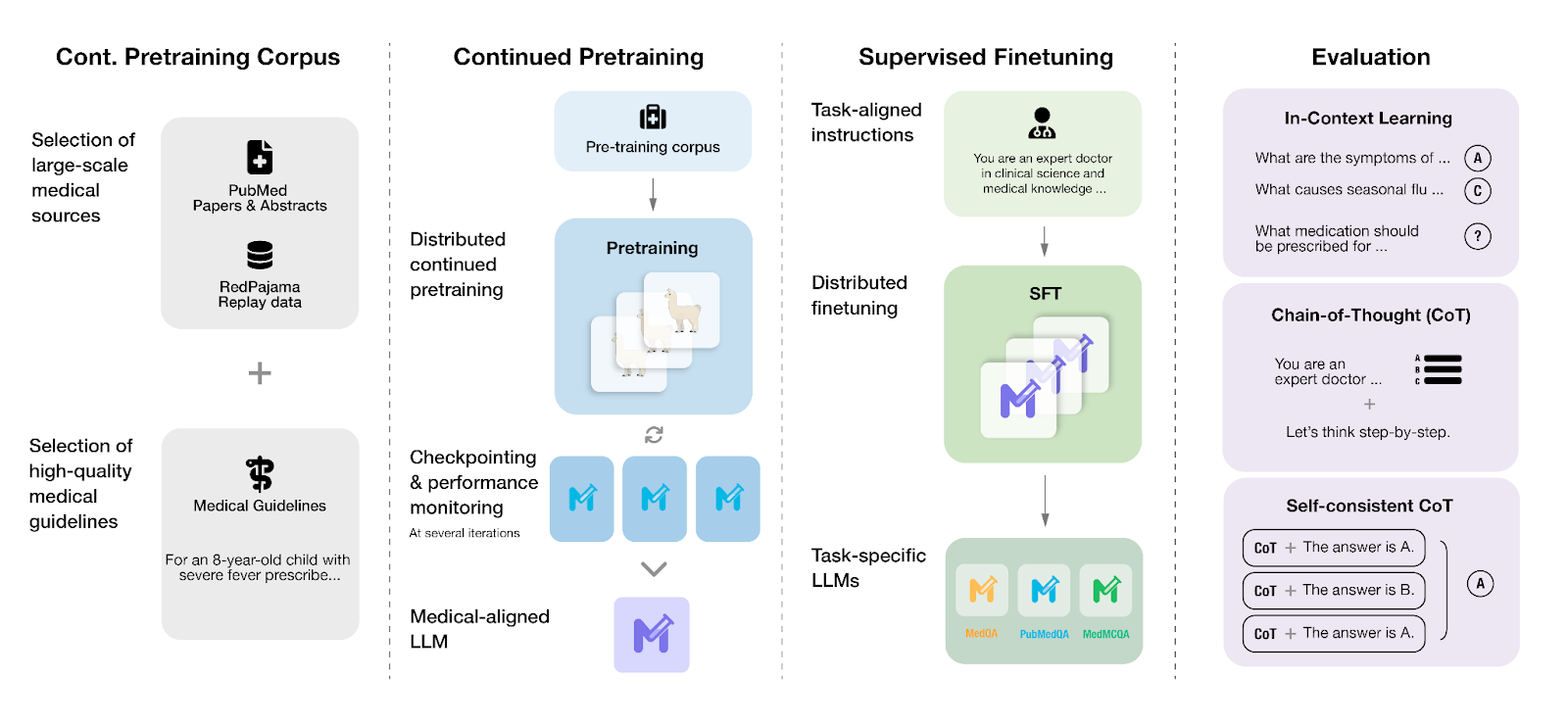
EPFL researchers have unveiled Meditron, an open-source and open access large language model (LLM) tailored to the medical field, trained on top of Meta’s Llama 2.
Check out the GitHub repository here.
EPFL’s MEDITRON, available in 7B and 70B versions, stands out for its open-source nature. The models were carefully trained on curated medical data, including literature from PubMed and clinical guidelines from diverse sources, as the paper reads.
The model comes with a Llama 2 community licence agreement and Apache 2.0 licence for commercial use. The model is also available on Hugging Face.
Evaluation against medical benchmarks revealed superior performance compared to existing open-source models and closed models like GPT-3.5 and Med-PaLM.
Zeming Chen, lead author and doctoral candidate, highlighted MEDITRON-70B’s competitiveness, being within 5% of GPT-4 and 10% of Med-PaLM-2. Professor Martin Jaggi stressed the significance of MEDITRON’s transparency, providing the code for training and model weights. The open-source approach allows researchers to enhance the model’s reliability and robustness through stress testing.
Professor Mary-Anne Hartley, a medical doctor, emphasised MEDITRON’s safety design, encoding medical knowledge from transparent and high-quality sources. Collaboration with the International Committee of the Red Cross integrates their clinical practice guidelines into the model, catering to humanitarian contexts.
Dr. Javier Elkin from the International Committee for the Red Cross expressed excitement about the initiative, noting the rare sensitivity of health tools to humanitarian needs. A workshop in Geneva, funded by the Humanitarian Action Challenge grant, will explore the potential, limitations, and risks of MEDITRON, focusing on its unique features.
Professor Antoine Bosselut, the principal investigator, outlined the goal of MEDITRON—to make access to medical knowledge a universal right. The release aligns with the EPFL AI Center’s mission, emphasising responsible and effective AI for societal benefit. The centre fosters multidisciplinary engagement in AI research, education, and innovation, promoting partnerships across various sectors.
While generalist models serve diverse tasks, specialised models, such as those in the medical domain, can be more accessible. Previous attempts at medical LLMs, like Med-PaLM 2 and GPT-4, were either closed source or limited in scale. While there was medAlpaca that was open source, but only for medical question answering.
The post EPFL Researchers Develop Open Source LLM for Healthcare appeared first on Analytics India Magazine.
Pika has taken the internet by storm, giving tough competition to Stability AI and RunwayML in text-to-video and image-to-video platforms.
Pika Labs has introduced Pika 1.0, for creating and editing videos with AI, and aims to bring everyone’s creativity to life, as their blog says. This new generative AI platform can edit and create in various styles including anime, cinematic, and 3D animation. All of this would come in a new web experience. Pika was available on Discord all this while.
Furthermore, Pika has also announced its Series A funding round of $35 million, which is led by Lightspeed Venture Partners. This makes the total raised funds of $55 million, which was initiated by Nat Friedman and Daniel Gross in the pre-seed and seed rounds. With this new funding, the co-founders want to expand their team to 20 people by next year.
“Our vision for Pika is to enable everyone to be the director of their own stories and to bring out the creator in each of us,” say the co-founders of Pika. The co-founders do not want to monetise the product right now, and that is how they aim to differentiate themselves from others in the field.
Friedman said that even though there are well-funded companies like Runway and Stability AI, and behemoths like Adobe in the same segment, Pika’s face is unmatched. He along with Gross have a 2,500-plus GPU cluster called Andromeda which they gave to all the startups they invest in, and Pika is also one of them, utilising hundreds of them.
You know how image generation went from blurry 32×32 texture patches to high-resolution images that are difficult to distinguish from real in roughly a snap of a finger? The same is now happening along the time axis (extending to video) and the repercussions boggle the mind just… https://t.co/OMLruSYt3p
— Andrej Karpathy (@karpathy) November 28, 2023
Pika is loved and supported by everyone. Elad Gil, Adam D’Angelo, founder and CEO of Quora, Andrej Karpathy, research scientist at OpenAI, Clem Delangue, co-founder and CEO of Hugging Face, Craig Kallman, CEO of Atlantic Records, Alex Chung, co-founder of Giphy, Zach Frankel, Aravind Srinivas, CEO of Perplexity, Vipul Ved Prakash, CEO of Together, Mateusz Staniszewski, CEO of ElevenLabs, and Keith Peiris, CEO of Tome.
Better than RunwayML and StabilityAI?
“My Co-Founder and I are creatives at heart. We know firsthand that making high-quality content is difficult and expensive, and we built Pika to give everyone, from home users to film professionals, the tools to bring high-quality video to life,” said Demi Guo, Pika co-founder and CEO. “Our vision is to enable anyone to be the director of their stories and to bring out the creator in all of us.”
“We’re not trying to build a product for film production,” she said in a recent interview.“What we’re trying to do is something more for everyday consumers — people like me and [Meng] who are creators at heart, but not that professional.”
The initial iteration of Pika debuted in beta on Discord in late April 2023 and currently boasts over 500,000 users who produce millions of videos on a weekly basis. Dedicated Pika enthusiasts on Discord dedicate up to 10 hours daily to crafting videos using the platform. Videos created with Pika have gained widespread attention on social media; for instance, the #pikalabs hashtag on TikTok has accumulated nearly 30 million views.
Though, we tested the Discord version of the model, as the new one is still on the waitlist. The first version does not improve much beyond RunwayML and StabilityAI’s latest Stable Video Diffusion, which offers the same functionality. But the promos of the new version of Pika definitely shows its prowess.
New functionalities that enable AI-based video editing and the creation of videos in various novel styles:
Text-to-Video and Image-to-Video: Simply input a few lines of text or upload an image to Pika, and the platform leverages AI to produce concise, high-quality videos.
Video-to-Video: Reimagine your current videos in diverse styles, incorporating various characters and elements, all while preserving the original video’s structure. For instance, transform a live-action video into an animated format.
Expand: Enlarge the canvas or alter the aspect ratio of a video. For example, convert a video from a TikTok 9:16 format to a widescreen 16:9 format, with the AI model predicting content beyond the original video border.
Change: Employ AI to edit video content, such as altering clothing, introducing new characters, modifying the environment, or adding props.
Extend: Lengthen the duration of an existing video clip using AI.
One of the coolest things about Pika 1.0 is that it lets you upload your own video footage and use generative AI to edit and reimagine the scene. This alone makes @pika_labs one of the most useful AI video tools out there. One of the most exciting AI launches of the year tbh pic.twitter.com/5IKM1f4LUI
— Nick St. Pierre (@nickfloats) November 28, 2023
Why everyone loves Pika
CEO Guo began her journey at Harvard University, earning a bachelor’s degree in mathematics. Guo continued to demonstrate her commitment to tech innovation in roles like Tech & Innovation Chair at the Harvard China Forum and Director at the Harvard MIT Math Tournament.
After co-founding Hacklodge, she became a scholar in the inaugural batch of the Neo Fellowship. Following a successful undergraduate journey, she pursued a Master’s degree in Computer Science at Harvard and later a Ph.D. in Computer Science at Stanford University, co-advised by Professors Ron Fedkiw and Chris Manning, then later did her internship at Bing Microsoft.
The other co-founder and CTO, Chenlin Meng, is also from Stanford University’s StanfordAILab where she specialised in generative AI and diffusion models. Before joining Pika Labs, she gained experience as an intern at GoogleAI. Advised by Prof. Stefano Ermon at Stanford, she was enthusiastic about exploring the wide-ranging applications of generative AI.
Guo said in a recent interview that she entered an AI film making contest announced by Runway and didn’t even place even though they had the most technically advanced team. “It just didn’t look that good,” she says of the film. “I was so frustrated.” In April, both the co-founders dropped out of Stanford and started building an “easier” AI video generator and came up with Pika.
The post Now Everyone’s a Filmmaker, Thanks to Pika appeared first on Analytics India Magazine.
Christmas may come early for Google 8 Pro users, by way of an AI Core update. This update focuses on the AI power on the phone, which empowers the Pixel 8 Pro smart features (such Magic Eraser and Photo Unblur for the camera and Google Assistant). Of course, AI powers more than just the camera and Assistant.
Also: Google Pixel 8 Pro review: This phone sold me on an AI-powered future
The AI Core app provides AI functionality while running as a background service. The eventual goal with AI is to roll out generative text and image capabilities across Pixel devices — and the AI Core app is a step toward this reality. Of course, this first update won't suddenly empower your Pixel phone to generate AI images for you. That takes more processing power than a phone can supply. However, it will (most likely) eventually be able to access Google's massive cloud processing power to make this a reality.
Google has not provided many specifics about AI Core. In fact, the app listing in the Google Play Store offers very little descriptive information. Scroll to the bottom and you'll find this in the "About this App" section:
AI Core powers features across Android and provides apps with the latest AI models.
However, if you glance at the included listing images, you see the following:
AI-driven features run directly on your device, using the latest foundation models. To keep those features smart, your device updates the AI models automatically, and AI Core manages these updates while providing AI functionality to other apps.
From that description, we can deduce that AI Core is responsible for keeping the foundation models updated and providing AI functionality to apps on your device.
Also: 4 AI-powered features on Pixel 8 and Pixel 8 Pro giving us Google envy
Given that Google has gone all in on AI for Pixel devices, that's a rather important service. With the update, features like Magic Eraser will not only work faster but smarter. On top of that, all apps that depend on AI will have access to the latest Foundation Models, of which there are three:
Imagen Model Family — image generation and editing models
Codey — empowers developers to be more productive and creative
Chirp — models for automatic speech recognition in more than 100 languages
This first AI Core update will give Pixel phones access to the latest versions of those models (as well as new AI features for your hardware and installed software).
There is currently no timetable for when the Core AI update will be available. I've checked my Pixel 8 Pro and it has yet to land on my device. When the update is first released, it will only be available to the Pixel 8 Pro but is expected to roll out to other Pixel devices soon.
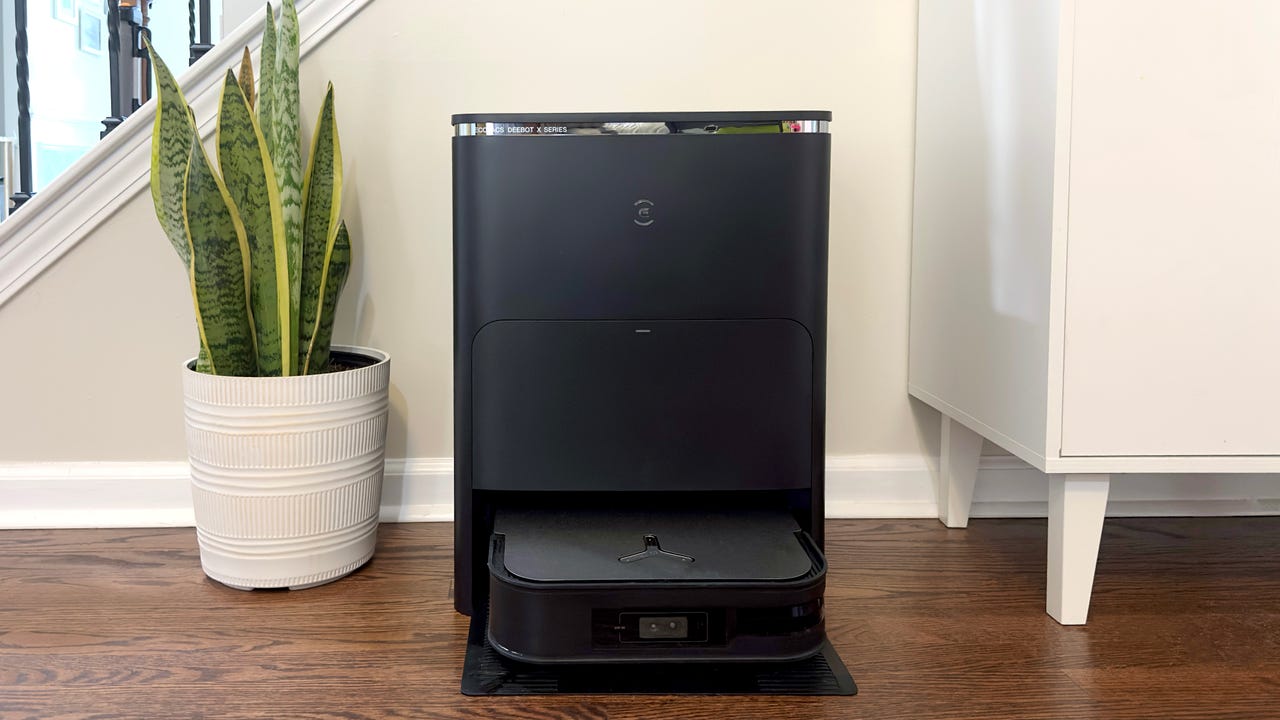
Amazon's Cyber Monday sale may be over, but the Ecovacs Deebot X2 Omni is a whopping $455 off for a limited time.
Why this deal is ZDNET-recommended
You know that gratifying feeling of coming home to a clean house? With a family of five, that's not a feeling I often get, if at all. Enter the Ecovacs Deebot X2 Omni.
Also: Ecovacs announced a new robot vacuum that squares up to the competition
I've tested a fair share of robot vacuum and mop combinations, so I quite appreciate the experience of having a robot roaming around my home that picks up crumbs, dust, and everything in between. But the Deebot X2 Omni is the best robot vacuum and mop I've tried.
ZDNET RECOMMENDS
Ecovacs Deebot X2 Omni
This high-end robot vacuum and mop has been engineered to give users a hands-free cleaning experience.
View at Amazon
Ecovacs launched the Deebot X2 Omni today, a new flagship robot vacuum and mop combo with a clear edge. After testing it out for a couple of weeks, I've found room for improvement in some tasks — largely outweighed by its long list of strengths.
The X2 Omni checks all the specs boxes for a high-end robot vacuum and mop. It has 8,000Pa of suction power, higher than the 6,000Pa of the current market leader, the Roborock S8 Pro Ultra. Using artificial intelligence (AI), the robot can detect and avoid objects strewn about the floor, such as socks and charging cables, and has a mopping pad that automatically lifts 15mm when carpets or rugs are detected.
The Omni station charges the robot vacuum and mop and works as a base where it empties its dustbin and self-washes and dries its mop pads. This feature means you only have to worry about keeping the base station's clean water tank filled and its dirty water tank empty, which you must complete every few cleaning cycles.
Designed to be a hands-free experience, the base station is also self-cleaning. Running the self-cleaning option in the Ecovacs app will clean the base plate in the station — the spot where your mops are cleaned that typically sees water and dirt accumulation. This feature is a level above competitors like Yeedi, which requires users to periodically clean dirty water at the bottom of the docking station.
The dust bag holds everything the Deebot X2 sweeps from your floors and only needs emptying about once a month, although your mileage may vary.
This closure is supposed to hold four liters of clean water when you carry the clean water tank by the handle.
One of my only gripes is that the clean water tank feels awkward to hold when filled — it almost feels like it's not built to last, although I won't know for certain until I've used it for several months. It's a four-liter water tank with a handle to carry it on the lid, held shut by a plastic clip. I hold the tank from the bottom because I feel like using the handle to carry the full tank around will result in the closure failing and four liters of water going everywhere.
About the square shape
The Deebot X2 Omni has several superpowers, starting with its compact package. The squared edges stood out to me as a feature when I unpacked the device, along with how narrow and short it was. At only 12.6 inches wide, it's about 0.3 inches narrower than the Eufy X9 Pro robot vacuum mop, which had been my super mop until the X2 Omni arrived.
Although 0.3 inches sounds like a small difference in size, it's proven to be considerable when a robot has to navigate through furniture legs. Case in point: the Eufy X9 Pro uses AI to avoid objects, but whenever I sent it to clean the first floor, it'd get stuck between the kitchen barstools legs. The stools are fairly lightweight, so the robot would drag them around instead of signaling it was stuck. I'd see my kitchen barstools gliding around my floor or randomly find one hanging out by the shoe bench.
This isn't a big deal and is highly subjective, so it's not something I included in my Eufy review; it's not the robot's fault that it's the exact size as the width of the distance between my barstool's legs. But the narrower Deebot X2 Omni can clean under the barstools and figure its way back out, which means no more 'guess where the barstools are today' games.
The Ecovacs Deebot X2 Omni making its way out of the traveling barstools.
The Deebot X2 is also almost an inch shorter than my Eufy robot vacuum, at 3.7 inches in height. The lower dimensions and narrow build allow the Deebot X2 to clean in places other robots typically can't reach or navigate under.
Some AI-powered features
The Deebot X2 leverages Ecovacs' AIVI 3D 2.0 and combines an AI processor with 3D-structured light sensors with dual-laser LiDAR technology. The result is efficient maps that allow the robot to detect objects during navigation and clean around them intelligently. This feature set means you won't have to ensure your floors are free of charging cables, toys, or shoes before sending out the X2.
The AI-powered navigation and obstacle avoidance, backed by Ecovacs' proprietary AINA Model, uses visual recognition and reinforcement learning based on sensor information.
Also: 6 things to know about robot vacuums before you buy one
The Deebot X2's clever technology also makes for a customized cleaning process if that's your thing. The device's AI-powered visual recognition, ability to detect floor type, and historical cleaning logs let the robot infer which room it's cleaning, such as the kitchen, living room, or bedroom, and adjust its suction power and mopping mode.
A new level of voice control
Voice control makes everything in my home easier. Countless robot vacuums let you use a third-party virtual assistant for voice control, such as Amazon Alexa, Google Assistant, or Siri. Saying, "Alexa, clean the floors" in my house dispatches the Eufy X9 Pro to clean my bedroom and hallway. However, these assistants are limited in the functions they can make the robot perform.
Sure, you can dispatch your robot with Alexa or Google, but have you ever been able to tell it to "turn right, move three meters forward, turn left, and clean there"?
Also: This robot vacuum connects to your home's water supply for full automation
Ecovacs robot vacuums have a built-in voice assistant named YIKO that users can talk with to control the robot directly — and it works swimmingly. Saying "OK, YIKO" wakes up the voice assistant. If your robot is out cleaning, you can ask it to return and clean the dining room again or give it multiple commands in one sentence without pulling up the app.
ZDNET's buying advice
The Ecovacs Deebot X2 Omni is the company's new flagship robot with all the smart features and a price to match, at $1,500, though $455 off right now after Cyber Monday. Over the past few weeks, it's gained a top-dog position in our home, becoming the main robot to clean the downstairs floor — and that's saying a lot.
The great thing about an all-in-one, self-emptying, and self-cleaning robot vacuum and mop is that it's not best suited for some circumstances — it's suited for all. Some mid-range models might be great at mopping but suffer from not having strong or effective suction, making them best suited for homes with hard floors. Others might boast great suction power, okay mopping, and short battery life, making them best for mostly carpeted apartments or small homes.
The Deebot X2 Omni is great at all of these things. The biggest challenge in our home is downstairs because it's mostly hardwood and tile with some area rugs — it's where the dog comes in and out from the yard, where we cook, and where the toddler drops most of the crumbs.
Also: Skip the Dyson: This $150 stick vacuum is just as powerful (and can mop, too)
The X2 Omni's MSRP of $1,500 compares to $1,600 for the Roborock S8 Pro Ultra (also discounted at $400 off). Suppose I were looking for a hands-free robot vacuum and mop suitable for my home's complex needs. In that case, I'd have to choose the Deebot X2 Omni over the Roborock's flagship because the extra features, like the self-cleaning station and stronger suction, set it apart.
Earlier in the fall, Charles Hoffman joined our non-profit Dataworthy Collective (DC) that focuses on best practices in trusted knowledge graph development. Hoffman is a CPA, consultant and former PwC auditor who works with clients who use the Extensible Business Reporting Language (XBRL).
For those who don’t know the history of standard digital business reporting, the Securities and Exchange Commission (SEC) in the US, the European Single Market Regulator (ESMA) in the European Union and other regulatory bodies in India, Singapore, the UK and even Ukraine, to name a few, require publicly held companies to issue their financials using the XBRL standard.
XBRL for these reasons can be considered a success. Hoffman, however, does point out that standard business reporting needs to go well beyond XBRL, which provides a standard syntax and some high-level taxonomic semantics, but lacks other essential logic. XBRL, first released in 2003, hasn’t been gone enough for businesspeople who aren’t technologists to take full advantage of it.
To make XBRL-compliant systems user friendly, it’s important for there to be logical consistency all the way down to the fully networked document object level, where the users are.
For this reason, Hoffman is working with DC co-founder Pete Rivett at the Object Management Group on an adjacent, document-level standard called the Standard Business Report Model (SBRM). The goal of SBRM is to logically contextualize business documents so that they’re interoperable. When they’re logically consistent and governed, spreadsheets could “talk to each other”, Hoffman says.
Graph-based data centricity: The path to zero-copy integration, interoperability and trust
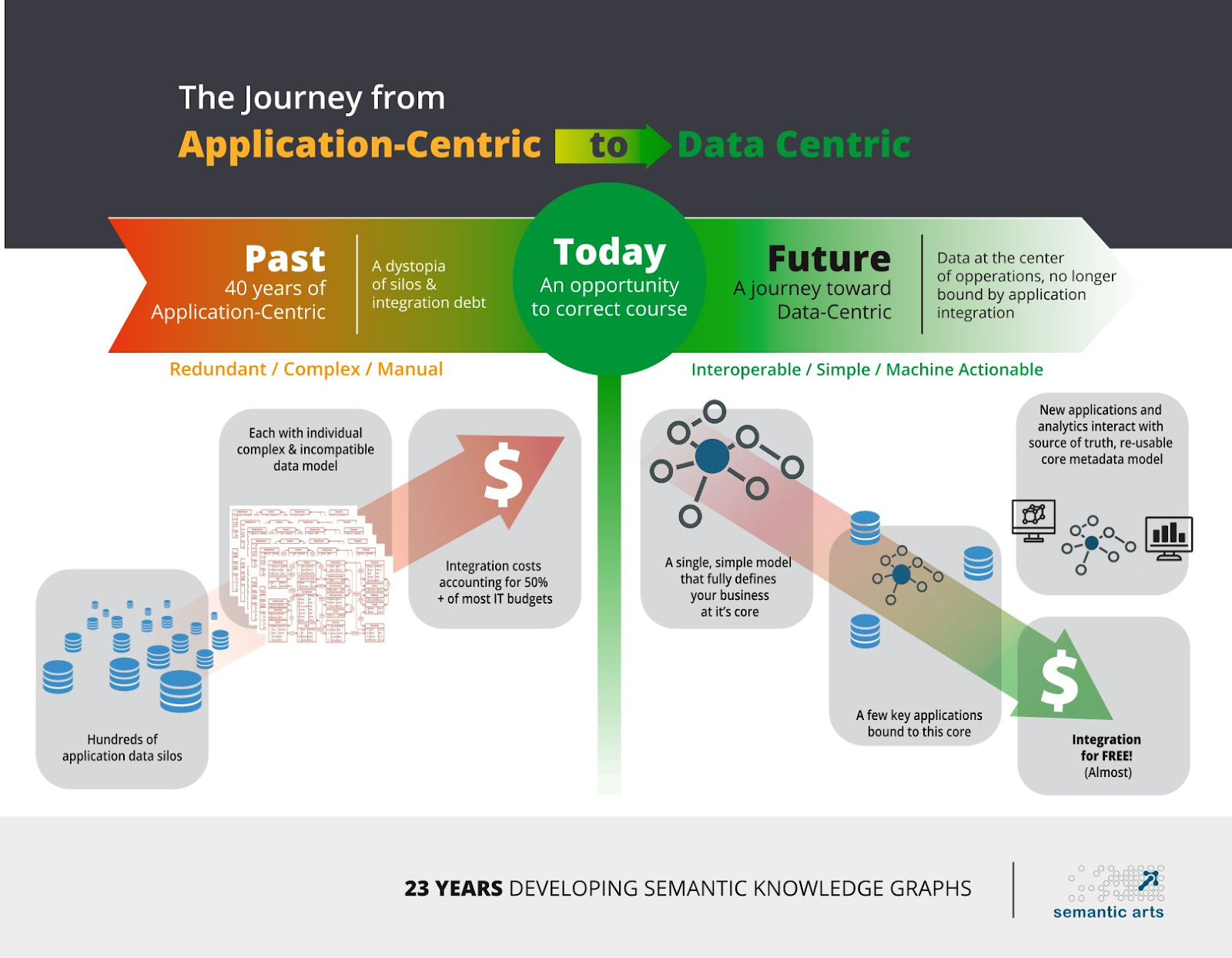
The SBRM effort is aligned with the concept of data centricity articulated by Dave McComb, president of enterprise knowledge graph consultancy Semantic Arts. McComb points out in his books Software Wasteland and The Data-Centric Revolution that each application in a typical, technical debt generating application-centric architecture has its own data model.
Each of those data models lacks alignment with the other models it needs to co-exist with. That lack of alignment constitutes more technical debt. Hoffman reminds us of Total Quality Management’s 1-10-100 Rule: Preventing each error will only set you back $1, by comparison with $10 per error for remediation and $100 of inaction per year.
Much better if you can design up front to avoid technical debt later. Data-centric graph architecture enables this kind of prevention.
In order to share data across systems in a trusted way, the model must be logically consistent from upper ontology, to domain ontology, to domain object,, exposed in a knowledge graph and expressed as contextualizing data so that it can be reused. Once that happens, the lines of code in each application that’s now using the knowledge graph’s declaration and rule logic can be reduced by 85 percent.
Semantic Arts, 2023
To reduce the risk of generating more integration complexity, it’s essential that the graph model be fully abstracted and at the same time articulated in a consistent way. Otherwise, you won’t get the complete benefit of graph technology.
Examples of commercial data-centric graph architecture
Modern graphs can be powerful in systems that are architected in a fully data-centric manner. Dave Duggal, founder of interoperation and automation platform EnterpriseWeb, points out that EWEB’s architecture, for example, has all graphs up and down. But when processing, EWEB just sees all of these as a single, unitary graph.
In essence, EWEB has a hypergraph architecture that’s agent managed for enterprise-wide automation purposes. (See {link to} Dave Duggal interview on DSC for more information.) Many telecom carriers use EWEB for software-defined network creation and configuration changes.
Other modern, end-to-end data-centric graph architectures that come to mind include these:
Eccenca: Creates a business-wide, knowledge graph-based digital twin, allowing manufacturers, for example, to make siloed data for all product categories findable, accessible, interoperable and reusable (FAIR). Currently in use at Radio Frequency Systems (RFS).
Graphmetrix: Allows zero-copy PDF sharing, version control and management across supply networks with the help of Solid decentralized storage pods and a hypergraph architecture. Currently designed for use in the construction industry supply chain.
Iotics: Installs knowledge subgraphs (a.k.a., digital twins) at each sensor node in an IoT network for ESG monitoring and compliance purposes, then uses agents to manage the messaging from nodes to a lightweight central graph, as well as from the central graph to consumers. In use at Portsmouth International Ports.
How to think about the machine-readable logic required for document object-level data sharing
Hoffman has thought long and hard about what’s necessary to bring spreadsheets to life and make their contents sharable in a data centric way. In a draft brief entitled “Special Purpose Logical Spreadsheet for Accountants,” Hoffman ponders the relationship between the key elements of control, rules, quality, repeatable process and automation:
Without control, there can be no automation, no repeatable processes.
Rules provide control.
Control leads to high quality.
High quality leads to effective automation.
Machine-readable rules are used to control systems.
Accountants manage the rules.
This kind of bridge building between businesspeople and technologists is long overdue. I and others at the DC are looking forward to learning more about the SBRM effort and how better business/technology collaboration can achieve this next level of automation.
Amazon Web Services announced an AI chatbot for enterprise use, new generations of its AI training chips, expanded partnerships and more during AWS re:Invent, held from November 27 to December 1, in Las Vegas.
The focus of AWS CEO Adam Selipsky’s keynote held on day two of the conference was on generative AI and how to enable organizations to train powerful models through cloud services.
Jump to:
Graviton4 and Trainium2 chips announced
Amazon Bedrock: Content guardrails and other features added
Amazon Q: Amazon enters the chatbot race
Amazon S3 Express One Zone opens its doors
Salesforce CRM available on AWS Marketplace
Amazon removes ETL from more Amazon Redshift integrations
Introducing Amazon One Enterprise authentication scanner
NVIDIA and AWS make cloud pact
Graviton4 and Trainium2 chips announced
AWS announced new generations of its Graviton chips, which are server processors for cloud workloads and Trainium, which provides compute power for AI foundation model training.
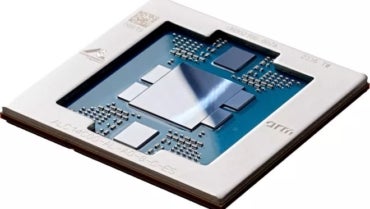
Graviton4 (Figure A) has 30% better compute performance, 50% more cores and 75% more memory bandwidth than Graviton3, Selipsky said. The first instance based on Graviton4 will be the R8g Instances for EC2 for memory-intensive workloads, available through AWS.
Trainium2 is coming to Amazon EC2 Trn2 instances, and each instance will be able to scale up to 100,000 Trainium2 chips. That provides the ability to train a 300-billion parameter large language model in weeks, AWS stated in a press release.
Figure A
Graviton4 chip. Image: AWS
Anthropic will use Trainium and Amazon’s high-performance machine learning chip Inferentia for its AI models, Selipsky and Dario Amodei, chief executive officer and co-founder of Anthropic, announced. These chips may help Amazon muscle into Microsoft’s space in the AI chip market.
Amazon Bedrock: Content guardrails and other features added
Selipsky made several announcements about Amazon Bedrock, the foundation model building service, during re:Invent:
Agents for Amazon Bedrock are generally available in preview today.
Custom models built with bespoke fine-tuning and ongoing pretraining are open in preview for customers in the U.S. today.
Guardrails for Amazon Bedrock are coming soon; Guardrails lets organizations conform Bedrock to their own AI content limitations using a natural language wizard.
Knowledge Bases for Amazon Bedrock, which bridge foundation models in Amazon Bedrock to internal company data for retrieval augmented generation, are now generally available in the U.S.
Amazon Q: Amazon enters the chatbot race
Amazon launched its own generative AI assistant, Amazon Q, designed for natural language interactions and content generation for work. It can fit into existing identities, roles and permissions in enterprise security permissions.
Amazon Q can be used throughout an organization and can access a wide range of other business software. Amazon is pitching Amazon Q as business-focused and specialized for individual employees who may ask specific questions about their sales or tasks.
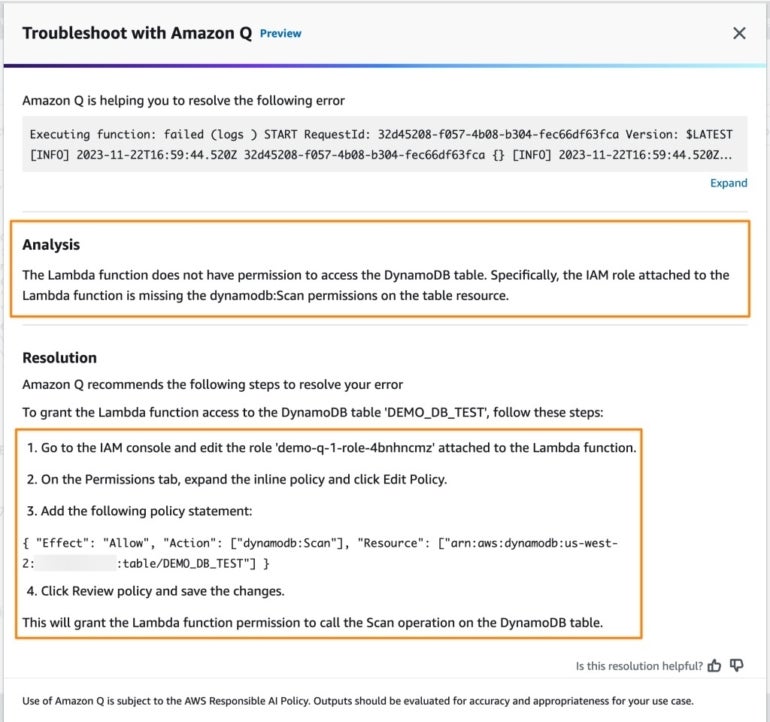
Amazon Q is especially suited for developers and IT pros working within AWS CodeCatalyst because it can help troubleshoot errors or network connections. Amazon Q will exist in the AWS management console and documentation within CodeWhisperer, in the serverless computing platform AWS Lambda, or in workplace communication apps like Slack (Figure B).
Figure B
Amazon Q can help troubleshoot errors in AWS Lambda. Image: AWS
Amazon Q has a feature that allows application developers to update their applications using natural language instructions. This feature of Amazon Q is available in preview in AWS CodeCatalyst today and will soon be coming to supported integrated development environments.
SEE: Data governance is one of the many factors that needs to be considered during generative AI deployment. (TechRepublic)
Many Amazon Q features within other Amazon services and products are available in preview today. For example, contact center administrators can access Amazon Q in Amazon Connect now.
Amazon S3 Express One Zone opens its doors
The Amazon S3 Express One Zone, now in general availability, is a new S3 storage class purpose-built for high-performance and low-latency cloud object storage for frequently-accessed data, Selipsky said. It’s designed for workloads that require single-digit millisecond latency such as finance or machine learning. Today, customers move data from S3 to custom caching solutions; with the Amazon S3 Express One Zone, they can choose their own geographical availability zone and bring their frequently accessed data next to their high-performance computing. Selipsky said Amazon S3 Express One Zone can be run with 50% lower access costs than the standard Amazon S3.
Salesforce CRM available on AWS Marketplace
On Nov. 27, AWS announced Salesforce’s partnership with Amazon will expand to certain Salesforce CRM products accessed on AWS Marketplace. Specifically, Salesforce’s Data Cloud, Service Cloud, Sales Cloud, Industry Clouds, Tableau, MuleSoft, Platform and Heroku will be available for joint customers of Salesforce and AWS in the U.S. More products are expected to be available, and the geographical availability is expected to be expanded next year.
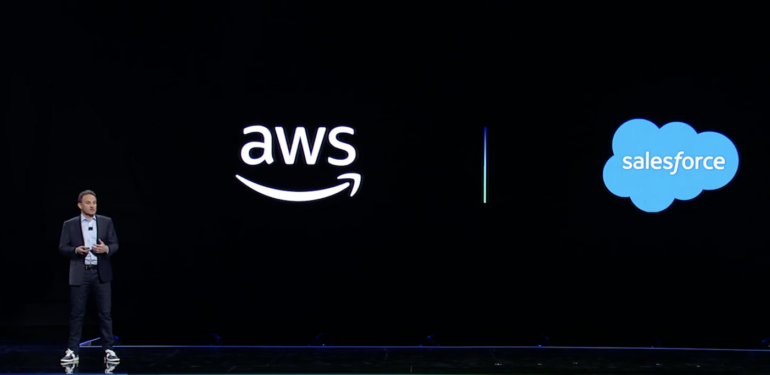
AWS CEO Adam Selipsky speaks at AWS re:Invent in Las Vegas on Nov. 28. Image: TechRepublic
New options include:
The Amazon Bedrock AI service will be available within Salesforce’s Einstein Trust Layer.
Salesforce Data Cloud will support data sharing across AWS technologies including Amazon Simple Storage Service.
“Salesforce and AWS make it easy for developers to securely access and leverage data and generative AI technologies to drive rapid transformation for their organizations and industries,” Selipsky said in a press release.
Conversely, AWS will be using Salesforce products such as Salesforce Data Cloud more often internally.
Amazon removes ETL from more Amazon Redshift integrations
ETL can be a cumbersome part of coding with transactional data. Last year, Amazon announced a zero-ETL integration between Amazon Aurora, MySQL and Amazon Redshift.
Today AWS introduced more zero-ETL integrations with Amazon Redshift:
Aurora PostgreSQL
Amazon RDS for MySQL
Amazon DynamoDB
All three are available globally in preview now.
The next thing Amazon wanted to do is make search in transactional data more smooth; many people use Amazon OpenSearch Service for this. In response, Amazon announced DynamoDB zero-ETL with OpenSearch Service is available today.
Plus, in an effort to make data more discoverable in Amazon DataZone, Amazon added a new capability to add business descriptions to data sets using generative AI.
Introducing Amazon One Enterprise authentication scanner
Amazon One Enterprise enables security management for access to physical locations in industries such as hospitality, education or technologies. It’s a fully-managed online service paired with the AWS One palm scanner for biometric authentication administered through the AWS Management Console. Amazon One Enterprise is currently available in preview in the U.S.
NVIDIA and AWS make cloud pact
NVIDIA announced a new set of GPUs available through AWS, the NVIDIA L4 GPUs, NVIDIA L40S GPUs and NVIDIA H200 GPUs. AWS will be the first cloud provider to bring the H200 chips with NV link to the cloud. Through this link, the GPU and CPU can share memory to speed up processing, NVIDIA CEO Jensen Huang explained during Selipsky’s keynote. Amazon EC2 G6e instances featuring NVIDIA L40S GPUs and Amazon G6 instances powered by L4 GPUs will start to roll out in 2024.
In addition, the NVIDIA DGX Cloud, NVIDIA’s AI building platform, is coming to AWS. An exact date for its availability hasn’t yet been announced.
NVIDIA brought on AWS as a primary partner in Project Ceiba, NVIDIA’s 65 exaflop supercomputer including 16,384 NVIDIA GH200 Superchips.
NVIDIA NeMo Retriever
Another announcement made during re:Invent is the NVIDIA NeMo Retriever, which allows enterprise customers to provide more accurate responses from their multimodal generative AI applications using retrieval-augmented generation.
Specifically, NVIDIA NeMo Retriever is a semantic-retrieval microservice that connects custom LLMs to applications. NVIDIA NeMo Retriever’s embedding models determine the semantic relationships between words. Then, that data is fed into an LLM, which processes and analyzes the textual data. Business customers can connect that LLM to their own data sources and knowledge bases.
NVIDIA NeMo Retriever is available in early access now through the NVIDIA AI Enterprise Software platform wherever it can be accessed through the AWS Marketplace.
Early partners working with NVIDIA on retrieval-augmented generation services include Cadence, Dropbox, SAP and ServiceNow.
Note: TechRepublic is covering AWS re:Invent virtually.
Generative AI is rapidly altering the landscape for e-commerce professionals with applications ranging from effective supply chain management to tailored client experiences.
The application of generative AI has transformed e-commerce and offered cutting-edge fixes to improve almost all facets of online enterprises. E-commerce companies may provide a more personalized shopping experience by delivering personalized product and service recommendations based on individual interests.
Given its capacity to provide unique customer experiences, enhance supply chain efficiency, optimize inventory management, and improve product design. Generative AI is fundamentally altering the face of e-commerce.
Generative AI’s influence on various fields
Using algorithms and input data, generative AI creates novel content or solutions. Machine learning models are trained to capture fresh content such as text, photos, or music.
Generative AI systems fundamentally analyze vast volumes of data to create fresh content. Neural network interpretation of the data is a part of this process. Generative artificial intelligence has the potential to produce realistic 3D models, personalized product suggestions, and engaging content.
The extremely brief time that generative AI requires to do specific jobs. With the increasing popularity of tools like ChatGPT, Bard, and DALL-E, generative AI has become more popular. Leading to a substantial improvement in the speed of generative AI models and tools.
This pace depends on several variables, including the quantity of the dataset, and the complexity of the data. But thanks to developments in both software and hardware, generative AI is now able to swiftly and effectively process and evaluate enormous volumes of data.
Role of generative AI in e-commerce
The market for generative AI in e-commerce, according to DataHorizzon Research, was estimated to be worth USD 4.2 billion in 2022 and is projected to increase at a compound annual growth rate of 15.8% to USD 18.2 billion by 2032.
Adopting AI isn’t just a technology advance; it’s an investment in getting to know your customers like never before as the e-commerce industry changes. When generative AI tools are utilized appropriately, e-commerce experts have limitless opportunities.
You can use generative AI to maximize the online experiences that your e-commerce business can provide for clients. Enhanced engagement and higher conversion rates should be the outcome of employing generative AI algorithms to produce content that provides consumers with a distinctive shopping experience.
With the help of generative artificial intelligence, companies can now examine past purchases, browsing habits, and demographic data to provide real-time, customized recommendations and offers. Customers are shown content that is specially matched to their interests, which enhances the buying experience.
Personalization in e-commerce
The epidemic caused a surge in online purchasing, which changed the focus of e-commerce from simply having an online business to being able to differentiate oneself from the competition. Additionally, depending on the industry your online store is operating in, it may be a crowded marketplace.
Social eCommerce teams may effectively support e-commerce personalization projects with the help of generative AI. Teams may generate content, goods, and services that are tailored to the unique needs and tastes of each customer.
Businesses can obtain deep insights into client preferences by using their algorithms to evaluate vast quantities of customer data. Astute firms leverage these insights to create experiences that connect with customers personally. Whether that’s through product recommendations, personalized content curation, or focused marketing messaging.
To provide genuinely one-to-one experiences, it considers distinctive client traits and behavior patterns. You may provide targeted recommendations, anticipate their wants, and establish a sense of relevance and connection with your consumers by getting to know their essential facts.
Online shopping
Today’s consumers want a seamless purchasing experience, and merchants may better satisfy it by employing AI to create individualized experiences.
AI has increased operational efficiencies in the retail sector in addition to customization. AI-powered solutions have decreased costs and enhanced productivity by streamlining fulfillment procedures, automating the supply chain, and improving inventory management.
AI has also changed the way that customers interact with brands online. Conversational AI-driven chatbots offer prompt and efficient responses to consumer inquiries, while virtual assistants support customers during the purchasing process.
Data gathered from client interactions is collected, analyzed, and interpreted by GenAI using a variety of algorithms and specialized tools. It makes it possible to create positively precise and customized customer recommendations.
Just wait if you already believe GenAI is outstanding. The capacity of many generative AI models to get more useful over time as more and more data is collected is one of their most remarkable qualities. This is because data is constantly used to forecast client behavior and provide suggestions for your target audience.
Importance of generative AI in e-commerce
The use of generative AI has enormous promise for commerce teams and is by no means a fad.
Generating large volumes of data
Teams can use this to tailor marketing campaigns, product recommendations, and customer interactions to each customer’s preferences. Increased conversions and client loyalty follow from a more focused and pertinent approach that connects with consumers on a deeper level.
Adaptability
Its algorithms can recognize new trends and opportunities, which enables businesses to quickly adjust their tactics and maintain an advantage over rivals.
Automation Process
AI algorithms take maintenance of data analysis, content creation, and campaign optimization, freeing teams to concentrate on strategic planning. By releasing precious resources, GenAI helps teams operate more productively and focus their time and energy on areas that need human knowledge.
Final thoughts
To satisfy the many demands and desires of e-commerce vendors, business stakeholders, employees, and customers, new features are constantly being introduced in the GenAI and e-commerce space.
More and more individuals are evolving at ease with the growth of artificial intelligence replacing human customer service representatives, even though not everyone is amenable to this idea. In particular, for stores facing a labor crisis, it offers extra comforts.
E-commerce enterprises may build their businesses sustainably and innovatively by moving forward with conviction, with generative AI development services playing a corroborative role.
The Eufy Security Video Doorbell E340 is available now for $180.
This doorbell features two cameras to give you complete visibility of the person at your door and any packages left on your porch, all with no monthly fees.
Although the doorbell comes with 8GB of built-in local storage (enough for up to 60 days of event recordings), you do need to add a Eufy Security HomeBase to get the most out of it.
If you're looking for a reliable video doorbell that can help protect your home and packages and comes with the bonus of local storage, let me introduce you to the Eufy Security Video Doorbell E340.
Also: Eufy's new Floodlight Cam E340 is the hardest-working security camera I've tested
This doorbell has two cameras: One camera gives you the traditional visibility of who's at your front door and another camera is pointed downwards to let you know when a package has been delivered.
ZDNET RECOMMENDS
Eufy Security Video Doorbell E340
This doorbell helps you keep track not only of who's at your door, but what was delivered. It can alert you when a package is dropped off or picked up, play an alarm if a stranger approaches a package, and remind you if a package has not been brought inside before your bedtime.
View at Amazon
Eufy Security just launched a new line of dual-camera security devices, which included this doorbell as one of the options. The new E340 video doorbell's two cameras deliver real-time notifications to your mobile device when a person is detected and a package is delivered.
This doorbell camera will also send real-time notifications of motion to your mobile device, and it offers the option to use two-way talk to communicate with whoever is at the door from your mobile phone or use quick replies to automatically respond when they ring the doorbell.
The camera above the doorbell button records events in 2048 x 1536 resolution, to deliver 2K footage that is clear and gives you a detailed view of whoever is at the door. The doorbell itself has two motion-activated lights, one at the top and a second one below — where the other camera is — to light the way in the dark, alert visitors or would-be intruders that the camera has been activated, and to support the camera's color night vision recording.
The biggest improvement I've seen after replacing my old Eufy Security video doorbell with this dual E340, aside from the package detection, is night vision recordings. The doorbell can correctly determine what motion is a person, animal, vehicle, or just the wind, with very few false alerts. For example, we put up pirate skeletons all over the porch for Halloween, and the doorbell only had issues mistaking one for a person a couple of times.
Add the HomeBase 3 and the E340 dual doorbell can also confidently identify who's at the door by name. This is powered by AI technology within the HomeBase 3 that allows users to name the faces the camera detects to let you know when "Maria" is detected at the front door instead of just "a person."
Eufy's Delivery Guard technology notifies you when packages are delivered and picked up and lets you set up zone restrictions to avoid false alerts. You can also set up the Eufy video doorbell E340 to trigger an alarm — which can be a siren or a voice response — when someone approaches a package at your door, with the option to activate it at custom times. I also have mine set to alert me each night of any uncollected packages at the front door, which reminds me to bring them in before bedtime.
On the left, both video doorbell cameras show a package was delivered. The activity history is on the right.
The doorbell's local storage means you don't have to pay cloud storage fees and can access your video recordings quickly and easily. With the addition of a HomeBase 3, you could expand that storage by 16GB and later add SSDs to expand that to 16TB, if that's more your speed.
ZDNET's buying advice
You can get the Eufy Security Video Doorbell E340 for $180 right now. It features 2K-resolution video recording, 8GB of local storage, color night vision with a clear viewing distance of up to 16ft, and, my personal favorite, no monthly fees. The video doorbell E340 is perfect for anyone who wants a doorbell camera to be on the alert when any visitors arrive and one to help protect their packages.
This doorbell has been really helpful at alerting us when a package arrives so we can bring it inside promptly. Most of our drivers don't ring the doorbell during delivery, which we appreciate with three young kids and an excitable dog.
Now I get an alert on my phone or smartwatch when "A package was delivered," which is much better than finding a heavy package when I'm in a hurry out the door. This video doorbell isn't helpful only for my situation, but also for anyone living in a place that is often targeted by porch pirates, as this can prevent packages from sitting out overnight and can deter strangers from approaching it.