Will an AI-powered robocop keep New York’s busiest subway station safe?

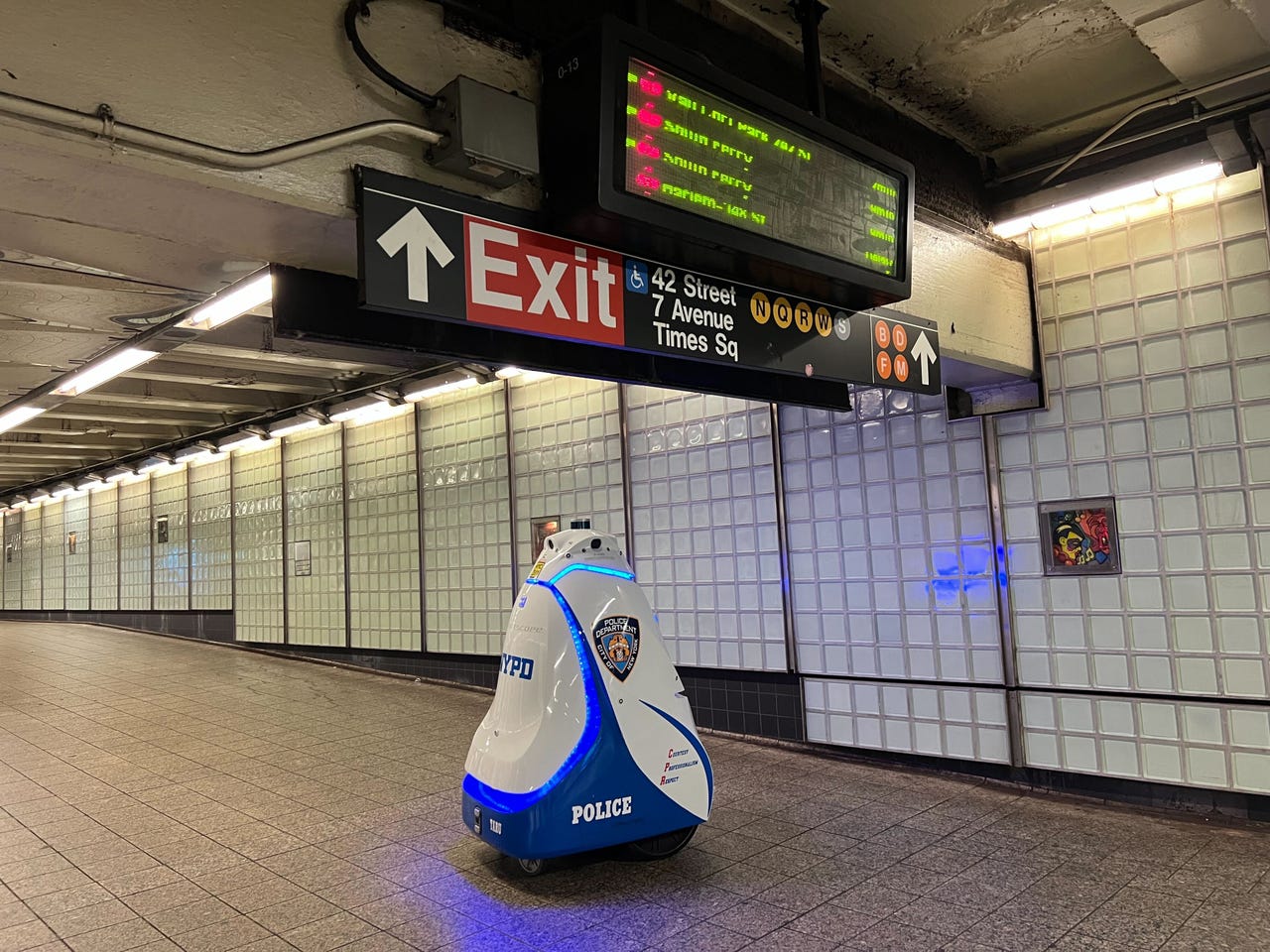
K5 robot cop standing in the mezzanine of the Times Square-42nd St. station

The New York Police Department's K5 robot cop roams the mezzanine of the Times Square — 42nd St. subway station. A broken monitor with indecipherable subway arrival times hangs above the robot, which is being rented for $9 an hour.

I met New York's subway robot cop on a temperate November Monday at midnight. I found the robot known as K5 patrolling the mostly empty mezzanine of the Times Square-42nd St. subway station, pacing from one end of the corridor to the other, pausing, like a cautious Roomba, as riders passed by.

In late September, the New York Police Department deployed a 5'2, 398-pound, hunk of metal in the city's busiest and most tourist-heavy subway station. Equipped with four HD wide angle cameras, one infrared thermal camera, 16 microphones, and wheels, the K5 security robot works the subway station, accompanied by an officer, between midnight and 6 a.m.

I needed to see it, but had to pull some teeth to find someone to accompany me. All three of my roommates left my text request on read, and a few friends initially acquiesced and later bailed. On a subway ride to Queens the day prior, I explained my K5 mission to another friend who luckily agreed to go with me. "It'd be funny to see a police officer replaced by a big cone," they said.

As I approached K5, the robot's cameras came eye-level with my face. It rolled along the hallway as I walked behind it. The blue fluorescent lights flashing across K5's armor reflected on the dirty white subway wall tiles as it moved. As if suspicious of my stalking, it stopped and stared back at me. Its movements felt so uncanny that at that moment, and — I know this sounds silly — I was waiting for it to say something to me.

Amid department-wide staffing shortages, New York City is renting the security camera on wheels for $9 an hour, well below the $15 minimum wage, as the city finds more "cost-efficient ways to bring about safety," Mayor Eric Adams said in a joint press conference announcing the robot in September.

Police departments and privately-owned businesses across the country are deploying robots like the K5 as a lower-cost crime reduction alternative to security guards and police. Some are diffusing bombs or responding to 911 calls. But most of them are simply taking videos in public spaces and storing that footage in a database, where behind a screen, departments and business owners can access it to monitor suspicious activity.

The NYPD and Knightscope, the self-driving autonomous security robot company behind K5, say they believe this robot could act as a physical deterrent to crime, as well as on-the-ground eyes to record those who commit crimes for future prosecution. More crime will be caught on video, and the perpetrators will wisen up to where and when they commit one (or at least be deterred by a four-eyed robot). Privacy advocates, on the other hand, say these sorts of bots function as "security theater" at best and state-sanctioned surveillance at worst. But will these robocops actually stop crime and make our world safer?

The K5 robot taking a stroll, accompanied by an NYPD officer.

Supplementing human patrol with robot police

In 2022 alone, the Times Square-42nd St. station saw 45 million passengers, the highest ridership out of all 400-plus New York City subway stations in 2022 alone, according to data released by the Metro Transit Authority.

Compared to last year, subway crime is down by 4.5% this year, and down 8.1% compared to pre-pandemic levels, said NYPD Transit chief Michael Kemper at the September press conference. However, those statistics haven't changed the public safety perception that a majority of New Yorkers hold. Some 57% of New York City residents say they are concerned about safety in public places and 46% say they have witnessed violent or threatening behavior themselves, according to a recent poll conducted by the Siena College Research Institute.

In comes Knightscope, whose mission is to "make the United States of America the safest country in the world." The company's robots patrol hospitals, malls, casinos, public parks, parking lots, and more. A few of its robots implement facial recognition, a few of them can read license plates — and all of them use AI. They use it to navigate the locations they patrol, re-navigate those locations when a car or a person or a fallen tree gets in the way of their computed path, make decisions on when and how to autonomously recharge, detect certain people and license plates, and more, according to a Knightscope blog post that addresses customers' AI questions.

To speak with a Knightscope representative, I filled out a form and clicked a button that ironically confirmed to Knightscope that I myself was not a robot. I then connected with Knightscope executive vice president and chief client officer Stacy Stephens, who told me humans are absolutely terrible at boring, routine, and monotonous activities, like a patrol.

"If you're doing the same thing over and over again, you become complacent very, very quickly. Robots, on the other hand, do that exceptionally well," he said.

Also: Robots are servicing short-staffed restaurants. What happens to the human waiters?

A lot of what a police officer does on patrol is standing and watching his environment to detect odd activity — to keep an eye out for a bag that's left behind on a subway platform or check in on an erratic passenger. But if, for instance, a robot is surveilling an area when a fight breaks out or someone's purse is robbed, it would take on-the-ground video, and then a human officer could still intervene. The robot also has a call button that uses two-way audio to connect riders to immediate human assistance.

The robots are incapable of spotting a criminal act on their own, Stephens said. Instead, they're monitoring for "out-of-the-ordinary detections" that the user programs into the bot.

Knightscope and the NYPD say that the K5 robot doesn't use facial recognition. But when asked what methods the robot employs to detect suspicious activity, Stephens said the robot has a watch list that pulls from license plate recognition, mobile devices, and photographs to detect known threats and bad actors.

The New York City subway system is not short on cameras. In fact, the subway network has "more cameras than a Las Vegas casino," president of NYC Transit Richard Davey said at the press conference. And more are on their way. News came out in July that a select number of stations installed cameras that use AI to track fare evasion, and two dozen more stations will implement the technology by the end of the year. The system doesn't currently flag individual evaders to law enforcement, but an MTA spokesperson and police spokesperson declined to comment to NBC on whether that policy would change.

So if the K5 does not use facial recognition, then why does the NYPD need more cameras in the form of a roaming robot? At the same press conference, Kemper said the robot is "supplementing" the expansive camera network with K5's moving cameras. Along with 360-degree video footage that could be used as evidence to prosecute criminals after they commit crimes, Stephens also said he believes the sheer presence of K5 would deter crimes in its field of vision.

Knightscope's robots have captured video of domestic violence that was eventually used for prosecution, identified the person of interest in a stolen vehicle incident through license plate recognition, aided in the arrest warrant of a sexual predator, and assisted in the identification of a gunman in a mall shooting, according to its website.

The security robot company is swimming in success. It has nearly doubled sales from this year to last and announces new contracts multiple times a week, Stephens said. Not too shabby for a company that told its investors in 2021 that it wouldn't be solvent after the third quarter of 2022, according to an NBC News report.

The goal seems to be to implement surveillance technologies like Knightscope's robots on a "large scale," its website states. With over 19,000 police agencies, 8,000 security companies, and many more private security practitioners across the country, its website suggests the need for a national database or "single objective source" for tracking and fighting crime.

Stephens said Knightscope isn't doing anything "offensive" with its robots. "It is something that can be utilized to hold somebody accountable for their actions," he said.

Also: Can AI curb loneliness in older adults? This robot companion is proving it's possible

This isn't the NYPD's first robot rodeo. Two years ago, the police department rolled out a Boston Dynamics robodog, to the chagrin of activists and council members who cut its run short and called it dystopian. This year, the NYPD is deploying the robodogs once again to be used for life-threatening situations like bomb threats or shootings.

Subway passenger Sean Carey shares a similar dystopian sentiment on robot surveillance. He moved to New York in 2014, and has spent the last two and a half years penning poems for the public in places like the station. He spends a few hours a day sitting on a collapsible camping stool at the subway. That night I met Carey, he wore a Canadian tuxedo with an "Ask me for a poem" sign hung around his neck and a Hermes Baby typewriter on his lap. For someone who spends so much time in areas New York is investing security resources in, he isn't keen on being under the city's constant surveillance.

"It forces you, rather than to be your true self, to perform. If people are forced to perform too much, they're gonna get angry," Carey said.

Carey said he feels safer down in the subway than in the city streets above — that is, without the robot cop. Safety aside, he still values the human part of patrol. At Washington Square Park, where he also sets up and types poems, he recounts one police officer who makes a point every day to interact with the street performers, vendors, and artists in the area.

"He gets to know them and gets to know what they're doing. That way [the police] come up with a nuanced approach to encouraging you to comply with whatever regulations they're enforcing," Carey said.

Diffusing intense situations requires lots of interpersonal experience and community knowledge. "I've been on the street enough to see just how much the rules are bent, interpreted, and inconsistently enforced. It's kind of up to the discretion of the officer, but there needs to be discretion," he said.

Carey sees the robot as something other than a security ruse. Earlier that night, he witnessed a family come up to K5 and take a family portrait with it, "like it was a mascot in Times Square."

'Security theater' in NYC subways?

With or without a roaming robot cop, this particular subway station teems with scenes and otherworldly sights. Monotony might come easy in an empty mall or suburban parking lot, but not the underbelly of Times Square. The question arises: is it effective for a robot to use data and predictive analytics to detect or even predict unusual behavior in such a populous subway system?

"If there's a place in America where the unusual is usual, it's the New York City subways," said Andrew Guthrie Ferguson, an American University law professor and author of the book "The Rise of Big Data Policing."

"The idea that you could sit in some computer lab and create a situation where you'd be able identify the unusual such that it should draw police suspicion — I'd love to see it, but I just can't imagine that they're able to successfully figure out what's normal in a city that prides itself on not being normal."

Also: Robots can empower you to create your own products. Here's how

As much as the station serves as a destination, departure, or connection to another part of the city, equally matched in its utility is its spectacle. Find women selling fresh fruit and churros as you transfer trains, or a jazz band surrounded by an enthusiastic crowd in your terminal. A city distilled into underground blocks, there are naked cowboys, droves of drunken Santas in December, Broadway actors running to and from shows, tourists visiting from every corner of the earth, and so much more. A robot cop could learn a lot if it spent some time here, or, to Ferguson's point, get utterly confused.

Ferguson calls K5 a "physical manifestation of security theater," that is, a performance of safety to placate fears rather than an actual mechanism to protect people — and it's all around us. For example, after 9/11, the NYPD did subway bag searches where they picked a few random subway stations and looked through every passenger's bag before they boarded the train.

"Of course, if you were really intent on doing something bad, you could just go to a different subway stop and do whatever you're planning on doing. But the idea was to show the public you are trying to do something even though you knew it wouldn't be very effective," Ferguson said.

Knightscope CEO William Santana Li, unsurprisingly, shares a different perspective on crime and surveillance. Li sees a future brimming with opportunities for AI to do good and stop crime, albeit through contentious use cases. Li wants to link historic data on crime, location, weather, and other patterns with real-time, on-site data for total predictive and preventative crime measures.

"It's been shown that it is possible to make a positive impact on crime through multiple studies just using historical data, but I still believe without knowing what is happening real-time on the ground right now — that algorithm is flawed," Li writes in a Knightscope blog post.

Police are already responding and aggregating real-time crime data with data police departments store through cameras and other technology like gunshot detectors and license plate readers. Meanwhile, behind every second of video footage is massive amounts of data that the NYPD stores in its database.

But, like the humans who aggregate and shape the data, it is never objective and it includes the same biases held by its creators. Leading privacy law expert Neil Richards authored the academic article "The Dangers of Surveillance," which critically points out the risks of discrimination.

"[T]he gathering of information affects the power dynamic between the watcher and the watched, giving the watcher greater power to influence or direct the subject of surveillance," writes the law professor at Washington University, advocating for guardrails on surveillance.

While these technologies concentrate on using available data to predict and deter crime before it happens, it can only go so far to quell the reasons people commit crime in the first place. In Ferguson's "The Rise of Big Data Policing," he recounted the Chicago Police Department's mission of "mapping the social network of violence" through a heat list in 2016 that found that 70% of those shot in Chicago to be on the list and 80 of those arrested in connection with the shootings. If these technologies aren't paired with "interventions, resources, and redirection," however, crime continues.

"Without targeted (and funded) social service interventions, the algorithm just became a targeting mechanism for police. Plainly stated, mapping the social network of violence may be easier than ending the violence. Data identifies the disease but offers no cure," Ferguson wrote.

After the night ended and I'd successfully sought out K5, my friend and I took the subway home. As we waited for the S train to arrive, I looked up to find a security camera above my head. Once we arrived at our home station and got off the subway, I noticed a screen hanging on the tile wall displaying a message from the MTA: "We're always looking out for your safety." The picture on display shows a collage of computer monitors and security camera footage of a subway platform.

"Safety counts," the header read.

Google’s Gemini continues the dangerous obfuscation of AI technology

Google Gemini website on laptop reads, welcome to the Gemini era

Until this year, it was possible to learn a lot about artificial intelligence technology simply by reading research documentation published by Google and other AI leaders with each new program they released. Open disclosure was the norm for the AI world.

All that changed in March of this year, when OpenAI elected to announce its latest program, GPT-4, with almost no technical detail. The research paper provided by the company obscured just about every important detail of GPT-4 that would allow researchers to understand its structure and to attempt to replicate its effects.

Also: AI in 2023: A year of breakthroughs that left no human thing unchanged

Last week, Google continued that new approach of obfuscation, announcing the formal release of its newest generative AI program, Gemini, developed in conjunction with its DeepMind unit, which was first unveiled in May. The Google and DeepMind researchers offered a blog post devoid of technical specifications, and an accompanying technical report almost completely devoid of any relevant technical details.

Much of the blog post and the technical report cite a raft of benchmark scores, with Google boasting of beating out OpenAI's GPT-4 on most measures, and beating Google's former top neural network, PaLM.

Neither the blog nor the technical paper include key details that have been customary in years past, such as how many neural net "parameters," or, "weights," the program has, a key aspect of its design and function. Instead, Google refers to three versions of Gemini, with three different sizes, "Ultra," "Pro," and "Nano." The paper does disclose that Nano is trained with two different weight counts, 1.8 billion and 3.25 billion, while failing to disclose the weights of the other two sizes.

Also: These 5 major tech advances of 2023 were the biggest game-changers

Numerous other technical details are absent, just as with the GPT-4 technical paper from OpenAI. In the absence of technical details, online debate has focused on whether the boasting of benchmarks means anything.

OpenAI researcher Rowan Zellers wrote on X (formerly Twitter) that Gemini is "super impressive," and added, "I also don't have a good sense on how much to trust the dozen or so text benchmarks that all the LLM papers report on these days."

😂 in a more serious note though —
the gemini model is super impressive (can't wait to play with the new multimodality aspects!)
I also don't have a good sense on how much to trust the dozen or so text benchmarks that all the LLM papers report on these days 😀

— Rowan Zellers (@rown) December 7, 2023

Tech news site TechCrunch's Kyle Wiggers reports anecdotes of poor performance by Google's Bard search engine, enhanced by Gemini. He cites posts on X by people asking Bard questions such as movie trivia or vocabulary suggestions and reporting the failures.

Also: I asked DALL-E 3 to create a portrait of every US state, and the results were gloriously strange

Mud-slinging is a common phenomenon in the introduction of a new technology or product. In the past, however, technical details allowed outsiders to make a more-informed assessment of capabilities by assessing the technical differences between the latest program and the program's immediate predecessors, such as PaLM.

For lack of such information, assessments are being made in hit-or-miss fashion, by people randomly typing things to Bard.

The sudden swing to secrecy by Google and OpenAI is becoming a major ethical issue for the tech industry because no one knows, outside OpenAI and its partner Microsoft, what is going on in the black box in their computing cloud.

In October, scholars Emanuele La Malfa at the University of Oxford and collaborators at The Alan Turing Institute and the University of Leeds, warned that the obscurity of GPT-4 and other models "causes a significant problem" for AI for society, namely that, "the most potent and risky models are also the most difficult to analyze."

Google's lack of disclosure, while not surprising given its commercial battle with OpenAI, and partner Microsoft, for market share, is made more striking by one very large omission: model cards.

Also: Two breakthroughs made 2023 tech's most innovative year in over a decade

Model cards are a form of standard disclosure used in AI to report on the details of neural networks, including potential harms of the program (hate speech, etc.) While the GPT-4 report from OpenAI omitted most details, it at least made a nod to model cards with a "GPT-4 System Card" section in the paper, which it said was inspired by model cards.

Google doesn't even go that far, omitting anything resembling model cards. The omission is particularly strange given that model cards were invented at Google, by a team that included Margaret Mitchell, formerly co-lead of Ethical AI at Google, and former co-lead Timnit Gebru.

Instead of model cards, the report offers a brief, rather bizarre passage about the deployment of the program with vague language about having model cards at some point:

Following the completion of reviews, model cards ?? [emphasis Google's] for each approved Gemini model are created for structured and consistent internal documentation of critical performance and responsibility metrics as well as to inform appropriate external communication of these metrics over time.

If Google puts question marks next to model cards in its own technical disclosure, one has to wonder what the future of oversight and safety is for neural networks.

Featured

Universal basic income and the gig economy: A combined policy approach to alleviate the challenges of AI

Universal basic income and the gig economy: A combined policy approach to alleviate the challenges of AI

Much has been said about the economic impact of AGI, some of it is already been felt
But not much has been proposed about solutions
Specifically, what approaches should policy makers take?

Here, I propose that policy makers should encourage two key trends – together which could alleviate the issues of AI – The Gig economy and Universal Basic Income.

The first trend is the Gig economy. The term “sharing” or “gig” economy refers to a growing trend, especially among young people, to eschew traditional asset ownership, such as houses and cars, in favour of a more flexible, experience-driven lifestyle. This trend reflects a significant shift in priorities, where experiences, from travel to entertainment, are valued more than acquiring physical assets.

Economic realities play a crucial role in this shift. For many young adults, the financial burden of owning a house or car is exacerbated by challenges like soaring real estate prices and substantial student loan debts. This economic pressure is steering them away from traditional ownership models. Additionally, there’s a growing environmental consciousness among this demographic. The desire for sustainable living and reducing one’s carbon footprint leads to a minimalist approach, favoring sharing or renting over owning.

Technological advancements have also catalyzed this trend. With the advent of mobile technology and various platforms, access to goods and services like ride-sharing and short-term rentals is more convenient than ever, diminishing the allure of ownership. Furthermore, living in densely populated urban areas with efficient public transport systems makes owning a car less of a necessity. In contrast, high property prices in these areas make home ownership less attainable.

This trend is more than an economic decision; it’s a cultural shift. Today’s young adults are redefining success and stability, choosing flexibility and freedom over the traditional path of accumulating possessions. This change in attitude is also reflected in their approach to life milestones like marriage and starting a family, which are often delayed in favor of less materialistic and more experience-focused lifestyles. This societal evolution marks a significant departure from previous generations’ values and aspirations, indicating a profound change in how young people perceive and interact with the world around them.

The second trend is Universal basic income. The advent of Artificial General Intelligence (AGI) brings forth solid arguments for implementing Universal Basic Income (UBI), addressing the socio-economic upheavals anticipated with advanced AI technologies. A central concern is job displacement; AGI’s ability to automate complex tasks, not just manual labor, poses a risk of widespread job losses. UBI offers a solution by providing financial stability to those whose employment is jeopardized by technological advancements.

Economic inequality is another pressing issue. The disparity in AI-driven productivity gains could widen the wealth gap, as those controlling the technology reap the most benefits. UBI presents a way to redistribute wealth more equitably. It also encourages innovation and creativity by providing individuals the financial security to pursue entrepreneurial and artistic ventures, potentially fostering a surge in cultural and innovative activities.

UBI’s role in combating poverty and enhancing welfare is significant. It ensures that basic living costs are covered for all, regardless of employment status in an economy influenced by AGI. This approach could also simplify the social security system, reducing bureaucratic complexities and associated costs.

Regarding workforce dynamics, UBI offers greater flexibility, allowing individuals to adapt, re-skill, or work intermittently without the risk of total income loss. This flexibility is crucial as work evolves with AGI’s integration. Moreover, during economic transitions brought on by AGI, UBI could stabilize the economy by sustaining consumer spending.

Ethically, there’s a strong case for ensuring that the benefits of AGI are shared universally, not confined to a select few. UBI supports this ethos, promoting a more equitable distribution of technological advancements. Additionally, UBI could enhance mental health and societal well-being by alleviating financial stress and insecurity, contributing to a more stable and contented society.

Finally, UBI is a step towards a more equitable society where access to essential resources and opportunities is a fundamental right, not dictated by job or income level. The proposal of UBI in the AGI era is rooted in the understanding that the traditional economic and work models are undergoing fundamental changes, necessitating new approaches to income and social security to adapt to these evolving conditions.

The trend is not unusual – already 66 countries offer digital nomad visas. I believe over time more countriews will and a combination of UBI and the gig economy, if encouraged by politicians, will help to overcome the challenges of work in the age of AGI

Image source: https://www.theguardian.com/commentisfree/2020/may/03/universal-basic-income-coronavirus-shocks

Microsoft, OpenAI Partnership Draws UK Antitrust Regulators’ Eyes

The UK’s Competition and Markets Authority is looking into whether the connections between Microsoft and OpenAI open up the possibility of a merger, which could impact competition.

On Dec. 8, the CMA announced it is seeking comments from Microsoft, OpenAI and interested third parties. This is not a formal investigation, the CMA noted, but is rather a standard, preliminary information-gathering step.

The CMA’s eventual decision might set a standard for other AI companies. OpenAI’s situation is very specific due to its ownership structure and its particular relationship with Microsoft. From here, the CMA will decide whether or not to open a formal phase 1 investigation into alleged anti-competitive business practices.

Jump to:

  • The CMA’s look into Microsoft and OpenAI
  • Does Microsoft own OpenAI?
  • The CMA’s ongoing study of the AI foundation model industry

The CMA’s look into Microsoft and OpenAI

Of particular note to the CMA is the shakeup at OpenAI in November 2023, when the board removed and later reinstated CEO Sam Altman. Microsoft CEO Satya Nadella announced Altman would join Microsoft, but Altman later returned to OpenAI as CEO and to the board n Nov. 29.

“Since 2019, we’ve forged a partnership with OpenAI that has fostered more AI innovation and competition, while preserving independence for both companies,” Microsoft President and Vice Chair Brad Smith said on X (formerly Twitter). “The only thing that has changed is that Microsoft will now have a non-voting observer on OpenAI’s board, which is very different from an acquisition such as Google’s purchase of DeepMind in the UK. We will work closely with the CMA to provide all the information it needs.”

Microsoft has not publicly released the name of the individual who will be the non-voting observer on OpenAI’s board.

SEE: Google just released its large language model Gemini, which competes with OpenAI’s GPT-4. (TechRepublic)

Specifically, “The CMA will review whether the partnership has resulted in an acquisition of control – that is, where it results in one party having material influence, de facto control or more than 50% of the voting rights over another entity – or change in the nature of control by one entity over another.”

The CMA will finish the information gathering step on Jan. 3, 2024. After this period, the CMA will decide whether to open a formal phase 1 investigation. If both companies are found to have violated UK antitrust laws, both companies could be impacted negatively in terms of their operations in the UK.

On Nov. 30, Microsoft announced it would put $3.2 billion toward AI capabilities in the UK over the next three years.

Does Microsoft own OpenAI?

Microsoft does not own or control all of OpenAI; instead, Microsoft has a stake in OpenAI and, as of Nov. 29, a non-voting observer on Microsoft’s board.

“While details of our agreement remain confidential, it is important to note that Microsoft does not own any portion of OpenAI and is simply entitled to share of profit distributions,” said Frank Shaw, Microsoft chief communications officer, in an email to TechRepublic.

Adding wrinkles to the relationship is that the board of directors technically controls OpenAI, Inc., a nonprofit devoted to safe artificial intelligence. That nonprofit owns a holding company that is majority owner in a capped profit company, OpenAI Global LLC. Microsoft is a minority owner of OpenAI Global LLC.

The CMA’s ongoing study of the AI foundation model industry

In September 2023, the CMA published a report around AI foundation models, the technology that allows for generative AI. The CMA created proposed principles for the AI industry based on opportunities and risks for competition and consumer protection.

“Critical among these is the need for sustained competition between AI developers which will help to deliver innovation, growth and responsible practices across the sector, as well as the need for open and effective competition in the deployment of FMs across a range of downstream activities,” the CMA wrote in a press release.

(Note: TechRepublic has reached out to OpenAI for comment.)

Maximizing marketing potential: The AI-driven revolution in outsourced digital marketing

Maximizing marketing potential: The AI-driven revolution in outsourced digital marketing

In today’s digital marketing world, things are changing fast, and artificial intelligence (AI) is a big part of that. Companies want to stay ahead, so they’re smartly choosing to get help from outside experts in digital marketing who use AI tools. This helps them make the most of what AI can do.

AI is like a super-smart assistant for businesses. It can look at lots of information, figure out what customers might do next, and make marketing work better in real-time. So, businesses are teaming up with outside experts to use AI without spending too much money on it themselves. This way, they can keep up with the latest trends in the digital world and make sure people keep noticing and liking their brand. It’s a bit like having a secret weapon to stay sharp in the fast-paced digital game.

In this article, we’ll explore the transformative impact of artificial intelligence on digital marketing, highlighting how businesses are strategically outsourcing services to leverage AI-driven tools for enhanced online presence and competitive advantage.

The AI advantage in crafting a marketing strategy

Artificial intelligence has emerged as a game-changer in crafting marketing strategies that resonate with target audiences. Advanced algorithms, capable of analyzing vast datasets, identifying trends, consumer behaviors, and market dynamics.

This data-driven approach empowers marketers to make informed decisions, ensuring that strategies are not only dynamic but also rooted in real-time insights. Whether through predictive analytics, sentiment analysis, or competitor monitoring, AI positions businesses to adapt swiftly to the ever-shifting digital landscape.

Maximizing marketing potential: The AI-driven revolution in outsourced digital marketing

Task automation: Unleashing efficiency in operations

AI’s contribution to outsourced digital marketing extends beyond strategy formulation—it redefines operational efficiency through task automation. Repetitive and time-consuming tasks, ranging from data entry to social media posting and email campaigns, can be seamlessly automated. This not only reduces the manual workload but also guarantees accuracy and consistency in execution.

Automation liberates marketing teams from routine tasks, enabling them to channel their energy into high-level strategic planning and creative endeavors that are quintessential for brand differentiation.

Precision in personalization

AI-driven personalization has elevated customer experiences to unprecedented levels. Through analyzing user behavior and preferences, AI algorithms facilitate:

  • Hyper-personalized content;
  • Recommendations, and;
  • Advertisements.

This level of personalization fosters stronger connections between brands and consumers, leading to increased engagement, customer loyalty, and, ultimately, higher conversion rates. The ability to deliver content that aligns with individual preferences creates a personalized journey for each customer, significantly impacting their perception of a brand.

ROI optimization through AI analytic

Understanding the return on investment is paramount in any marketing campaign. AI analytics tools provide comprehensive insights into the performance of various channels, campaigns, and audience segments. This granular data enables marketers to allocate budgets effectively, optimize campaigns in real time, and maximize ROI.

The result is a more cost-effective and efficient use of resources, where marketing spend is aligned with the channels and strategies that yield the highest returns.

Revolutionizing customer experiences: The AI touch

AI has redefined the way customers interact with brands. Chatbots, powered by AI, provide instant and personalized responses, enhancing customer service and satisfaction. Virtual assistants analyze customer queries, offering solutions and information promptly.

This 24/7 availability contributes to improved customer experiences, building trust and loyalty over time. The integration of AI in customer interactions ensures consistency and responsiveness, irrespective of the time or volume of queries, creating a positive and lasting impression.

The pivotal role of outsourcing in harnessing AI

In the era of AI-driven marketing, outsourcing digital marketing services has become more than a trend—it is a strategic imperative. Businesses can tap into specialized expertise, cutting-edge tools, and global perspectives by partnering with external agencies.

Among the critical components of outsourced marketing, SEO specialists play a pivotal role in ensuring visibility and relevance in search engine results.

Maximizing marketing potential: The AI-driven revolution in outsourced digital marketing

Outsourcing SEO specialists: A global perspective

Checking a list of outsourcing companies globally to find the right SEO specialists to work with, offers diverse advantages because they contribute to enhancing digital strategies. SEO specialists near you navigate the intricacies of the local digital landscape, ensuring cultural relevance and resonance with your local audience.

In Japan, professionals excel in optimizing content for search engines like Yahoo Japan, tailoring strategies to align with Japanese user preferences. India stands out as a hub for cost-effective yet high-quality SEO services, with specialists demonstrating technical proficiency across on-page and off-page optimization.

Brazil’s SEO experts leverage a deep understanding of Portuguese and regional search engines to craft strategies that resonate with the dynamic Brazilian online audience. Australian specialists focus on aligning digital strategies with the preferences of the local market dominated by Google and Bing.

Overall, outsourcing SEO to specialists around the world ensures a comprehensive approach, blending advanced AI algorithms with localized insights. Whether it’s understanding German consumer behavior, navigating Japanese search engines, tapping into India’s technical expertise, crafting strategies for the Brazilian market, or aligning with Australian preferences, these specialists bridge the gap between global algorithms and the intricacies of regional digital landscapes.

The symbiosis of AI and outsourced expertise

As businesses navigate the AI-driven revolution in outsourced digital marketing, the key lies in striking a delicate balance between advanced technologies and localized expertise. AI empowers marketers with data-driven insights, automation, and unparalleled personalization.

However, when it comes to navigating specific markets, such as Germany, outsourcing SEO specialists adds a layer of localized knowledge that ensures your brand stands out in a competitive landscape.

The symbiosis of AI and outsourced expertise emerges as the winning formula for businesses seeking to maximize their marketing potential in the digital age. By combining the analytical prowess of AI with the nuanced understanding of local markets provided by outsourcing, businesses can create holistic strategies that not only meet but exceed customer expectations.

Final thoughts

Ultimately, the marriage of artificial intelligence and outsourced digital marketing services represents a paradigm shift in how businesses approach their marketing endeavors. AI acts as a catalyst, enhancing strategy formulation, task execution, personalization, analytics, and customer experiences. The strategic outsourcing of digital marketing services, especially the collaboration with SEO specialists, ensures that businesses not only leverage cutting-edge technology but also tap into the invaluable insights derived from localized expertise. As we navigate the intricate landscape of digital marketing, the fusion of AI and outsourced expertise emerges as the blueprint for maximizing marketing potential and staying at the forefront of the ever-evolving digital landscape.

Generative AI now requires developers to stretch cross-functionally. Here’s why

Person looking at code on a screen

The rapid embrace of artificial intelligence — especially generative AI — not only means changes to developers' workflows, but also modifications to the way they work with the rest of the enterprise. Now that generative AI is part of the picture, software developers need to adapt and work across different team with different functions.

It's already clear that AI will have a significant impact on the future of jobs, productivity, and the way we work in teams. However, while AI is a technology, it's successful adoption and adaptation is not the province of technologists alone.

Also: Implementing AI into software engineering? Here's everything you need to know

To make the most of AI, many professionals from different disciplines across the business should be involved in its implementation and exploitation.

An AI-intensive world "requires cross-functional teams that include domain experts coupled with developers, data scientists, or business analysts who understand the power of tuning AI to a particular industry," says Luis Flynn, senior manager for AI and analytics at SAS.

"These are the people who know how to navigate our collective computational wisdom, but can trim the fat and train with smaller data sets tuned for the desired outcomes of a particular business in a specific industry."

Mahesh Saptharishi, CTO of Motorola Solutions, also points to broad range of skills that will be required to help developers and engineers make the most of AI: "The teachers, writers, artists and psychologists of today could very well be our app developers of tomorrow, as skills like coaching and development, understanding behavior and decision-making and effective communication become increasingly important in IT."

For example, he says there will be a need to work closely with the business to hone prompt-engineering techniques — "with the expectation that as these models get better, there will be less of a need to engineer the inputs to get the desired outputs."

The requirements for cross-business interaction in an age of AI will also mean changes to the way we work with one another. It's already a common practice in programming "to use code from other sources, and having a bot draft your code isn't much different," says Nick Gausling, managing director of Romy Group and author of Bots in Suits: Using Generative AI to Revolutionize Your Business.

"But as anyone in that field knows, a ton of work still happens in QA, maintenance, and upgrades. We'll probably see a much higher demand for product management skills that emphasize bridging the gap between users and developers."

Also: These are my 5 favorite AI tools for work
Yet while AI, and generative AI in particular, promises to reshape the roles and tasks of software developers and other professionals across the business, these are still early days for AI — and the bounadries for effective cross-functional working are still being drawn.

"Today's generative AI party resembles a middle school dance more than a full-on college bash with a live band," says Flynn. "Developers are rightfully proceeding with caution. Today ChatGPT users can rapidly and casually inquire about any code or syntax so they can begin prototyping applications in moments all from a tiny bit of dialogue. This type of digital push button is simultaneously impressive and scary."

As it stands, Flynn continues, "AI is a digital mirror of what humanity has learned using the internet. And it shows us humanity is inherently flawed. By blindly and hastily leveraging ChatGPT, we can misuse code or — at the very least — impose error into our workstreams."
However, when responsibly vetted by seasoned developers, "the potential of generative AI is incredible," Flynn says. "Scrappy data scientists, data engineers and business analysts have mechanisms to fuel their productivity to new levels. But we're not quite there yet."

Also: How to use ChatGPT to write code
AI will increasingly help developers do their jobs better, but we must also remember that this emerging technology is a part of the solutions that IT professionals will be building for their clients or employers. Flynn has recommendations in terms of the skills IT pros should learn and emphasize to succeed in an increasingly AI-intensive world. And once again, cross-business working is crucial.

"A profound understanding of your organizational data and where it fits into your business processes is key," he says. "If you couple data competence with ambition, resourcefulness and a curious approach to problem-solving, things will fall into place."
IT professionals will have various roles themselves as app development and deployment is streamlined, says Flynn — but they can't afford to work in isolation. "There will always be someone to enforce compliance and uphold the transparency and ethical use of AI. Beyond the fears of privacy and ethical breaches, there will be a need for power user experience advocacy and design. The simplicity of ChatGPT is one of its most impressive features."

Importantly, it will be the job of developers and IT professionals to facilitate the democratization of AI, making it safe, useful, and accessible to all users. Think about the implications of when the metaverse came online, Flynn explained. "The barrier was getting people to buy virtual reality headsets. It's like throwing a destination wedding: If you make it hard to get to, you limit your audience.

Also: How does ChatGPT actually work?

"There will always be people who understand the human factors involved in any emerging technology. They'll know how to invoke time and space to fold generative AI into everyday workflows. Many of our roles in IT will stay the same, but we'll be more productive because powerful tools like generative AI will be just a click away."

Artificial Intelligence

7 Pandas Plotting Functions for Quick Data Visualization

7 Pandas Plotting Functions for Quick Data Visualization
Image generated with Segmind SSD-1B Model

When you're analyzing data with pandas, you’ll use pandas functions for filtering and transforming the columns, joining data from multiple dataframes, and the like.

But it can often be helpful to generate plots—to visualize the data in the dataframe—rather than just looking at the numbers.

Pandas has several plotting functions you can use for quick and easy data visualization. And we'll go over them in this tutorial.

🔗 Link to Google Colab notebook (if you’d like to code along).

Creating a Pandas DataFrame

Let's create a sample dataframe for analysis. We’ll create a dataframe called df_employees containing employee records.

We’ll use Faker and the NumPy’s random module to populate the dataframe with 200 records.

Note: If you don't have Faker installed in your development environment, you can install it using pip: pip install Faker.

Run the following snippet to create and populate df_employees with records:

import pandas as pd  from faker import Faker  import numpy as np    # Instantiate Faker object  fake = Faker()  Faker.seed(27)    # Create a DataFrame for employees  num_employees = 200  departments = ['Engineering', 'Finance', 'HR', 'Marketing', 'Sales', 'IT']    years_with_company = np.random.randint(1, 10, size=num_employees)  salary = 40000 + 2000 * years_with_company * np.random.randn()    employee_data = {  	'EmployeeID': np.arange(1, num_employees + 1),  	'FirstName': [fake.first_name() for _ in range(num_employees)],  	'LastName': [fake.last_name() for _ in range(num_employees)],  	'Age': np.random.randint(22, 60, size=num_employees),  	'Department': [fake.random_element(departments) for _ in range(num_employees)],  	'Salary': np.round(salary),  	'YearsWithCompany': years_with_company  }    df_employees = pd.DataFrame(employee_data)    # Display the head of the DataFrame  df_employees.head(10)

We have set the seed for reproducibility. So every time you run this code, you’ll get the same records.

Here are the first view records of the dataframe:

7 Pandas Plotting Functions for Quick Data Visualization
Output of df_employees.head(10) 1. Scatter Plot

Scatter plots are generally used to understand the relationship between any two variables in the dataset.

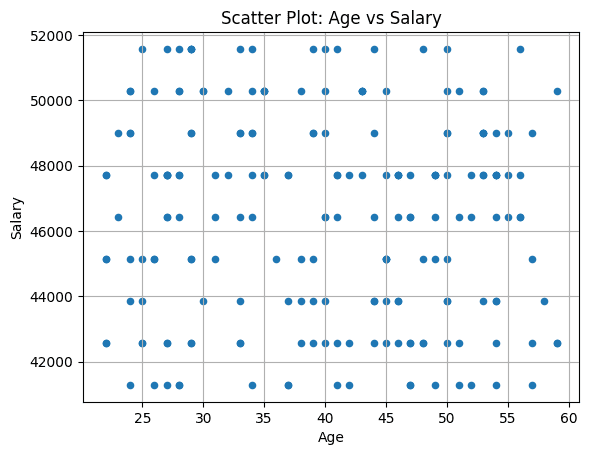
For the df_employees dataframe, let's create a scatter plot to visualize the relationship between the age of the employee and the salary. This will help us understand if there is any correlation between the ages of the employees and their salaries.

To create a scatter plot, we can use plot.scatter() like so:

# Scatter Plot: Age vs Salary  df_employees.plot.scatter(x='Age', y='Salary', title='Scatter Plot: Age vs Salary', xlabel='Age', ylabel='Salary', grid=True)

7 Pandas Plotting Functions for Quick Data Visualization

For this example dataframe, we do not see any correlation between the age of the employees and the salaries.

2. Line Plot

A line plot is suitable for identifying trends and patterns over a continuous variable which is usually time or a similar scale.

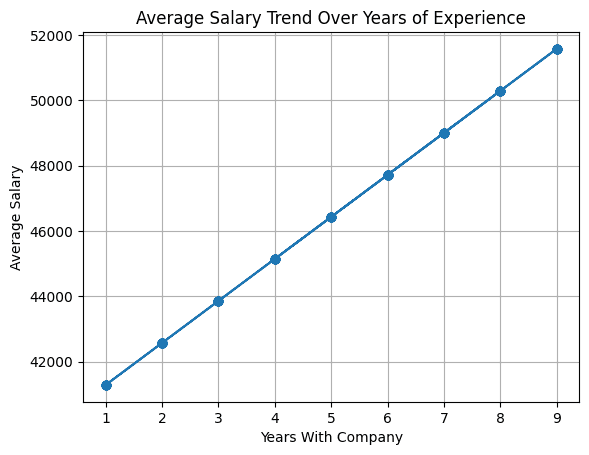
When creating the df_employees dataframe, we had defined a linear relationship between the number of years an employee has worked with the company and their salary. So let’s look at the line plot showing how the average salaries vary with the number of years.

We find the average salary grouped by the years with company, and then create a line plot with plot.line():

# Line Plot: Average Salary Trend Over Years of Experience  average_salary_by_experience = df_employees.groupby('YearsWithCompany')['Salary'].mean()  df_employees['AverageSalaryByExperience'] = df_employees['YearsWithCompany'].map(average_salary_by_experience)    df_employees.plot.line(x='YearsWithCompany', y='AverageSalaryByExperience', marker='o', linestyle='-', title='Average Salary Trend Over Years of Experience', xlabel='Years With Company', ylabel='Average Salary', legend=False, grid=True)

7 Pandas Plotting Functions for Quick Data Visualization

Because we choose to populate the salary field using a linear relationship to the number of years an employee has worked at the company, we see that the line plot reflects that.

3. Histogram

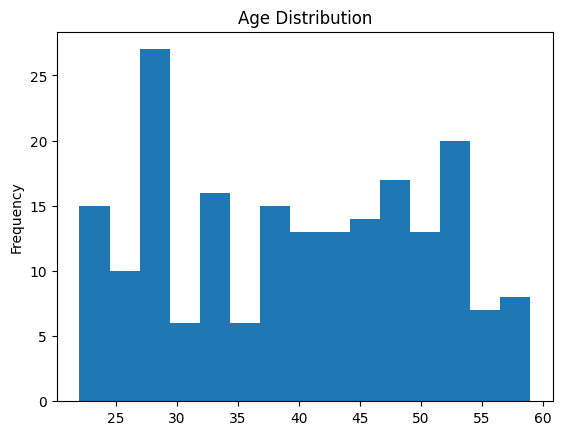
You can use histograms to visualize the distribution of continuous variables—by dividing the values into intervals or bins—and displaying the number of data points in each bin.

Let’s understand the distribution of ages of the employees using a histogram using plot.hist() as shown:

# Histogram: Distribution of Ages  df_employees['Age'].plot.hist(title='Age Distribution', bins=15)

7 Pandas Plotting Functions for Quick Data Visualization 4. Box Plot

A box plot is helpful in understanding the distribution of a variable, its spread, and for identifying outliers.

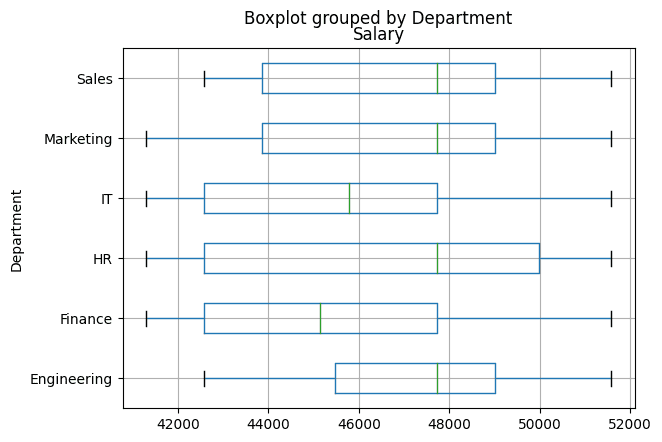
Let's create a box plot to compare the distribution of salaries across different departments—giving a high-level comparison of salary distribution within the organization.

Box plot will also help identify the salary range as well as useful information such as the median salary and potential outliers for each department.

Here, we use boxplot of the ‘Salary’ column grouped by ‘Department’:

# Box Plot: Salary distribution by Department  df_employees.boxplot(column='Salary', by='Department', grid=True, vert=False)

7 Pandas Plotting Functions for Quick Data Visualization

From the box plot, we see that some departments have a greater spread of salaries than others.

5. Bar Plot

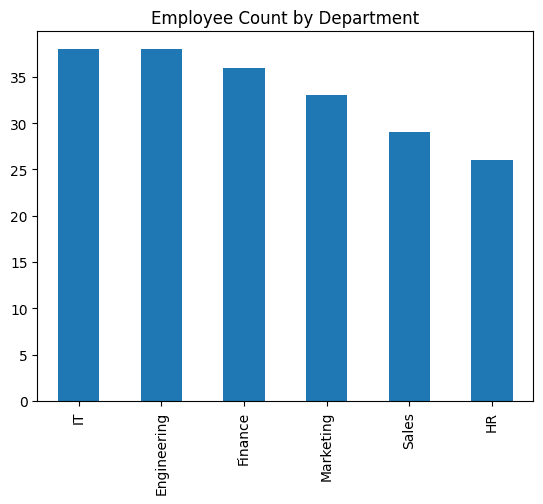
When you want to understand the distribution of variables in terms of frequency of occurrence, you can use a bar plot.

Now let's create a bar plot using plot.bar() to visualize the number of employees:

# Bar Plot: Department-wise employee count  df_employees['Department'].value_counts().plot.bar(title='Employee Count by Department')

7 Pandas Plotting Functions for Quick Data Visualization 6. Area Plot

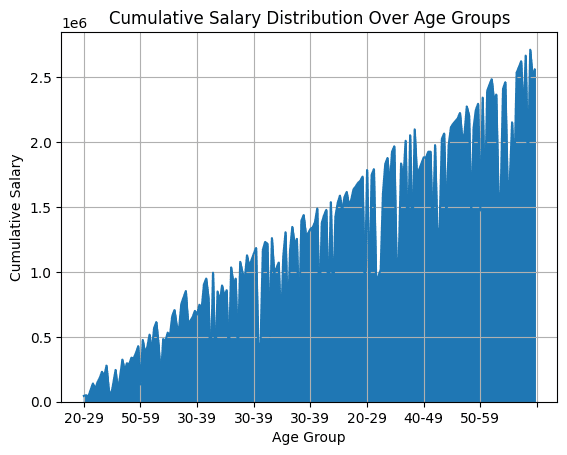
Area plots are generally used for visualizing the cumulative distribution of a variable over the continuous or categorical axis.

For the employees dataframe, we can plot the cumulative salary distribution over different age groups. To map the employees into bins based on age group, we use pd.cut().

We then find the cumulative sum of the salaries group the salary by ‘AgeGroup’. To get the area plot, we use plot.area():

# Area Plot: Cumulative Salary Distribution Over Age Groups  df_employees['AgeGroup'] = pd.cut(df_employees['Age'], bins=[20, 30, 40, 50, 60], labels=['20-29', '30-39', '40-49', '50-59'])  cumulative_salary_by_age_group = df_employees.groupby('AgeGroup')['Salary'].cumsum()    df_employees['CumulativeSalaryByAgeGroup'] = cumulative_salary_by_age_group    df_employees.plot.area(x='AgeGroup', y='CumulativeSalaryByAgeGroup', title='Cumulative Salary Distribution Over Age Groups', xlabel='Age Group', ylabel='Cumulative Salary', legend=False, grid=True)

7 Pandas Plotting Functions for Quick Data Visualization 7. Pie Chart

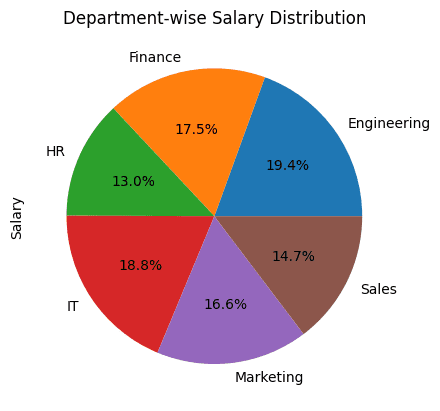
Pie Charts are helpful when you want to visualize the proportion of each of the categories within a whole.

For our example, it makes sense to create a pie chart that displays the distribution of salaries across departments within the organization.

We find the total salary of the employees grouped by the department. And then use plot.pie() to plot the pie chart:

# Pie Chart: Department-wise Salary distribution  df_employees.groupby('Department')['Salary'].sum().plot.pie(title='Department-wise Salary Distribution', autopct='%1.1f%%')

7 Pandas Plotting Functions for Quick Data Visualization Wrapping Up

I hope you found a few helpful plotting functions you can use in pandas.

Yes, you can generate much prettier plots with matplotlib and seaborn. But for quick data visualization, these functions can be super handy.

What are some of the other pandas plotting functions that you use often? Let us know in the comments.

Bala Priya C is a developer and technical writer from India. She likes working at the intersection of math, programming, data science, and content creation. Her areas of interest and expertise include DevOps, data science, and natural language processing. She enjoys reading, writing, coding, and coffee! Currently, she's working on learning and sharing her knowledge with the developer community by authoring tutorials, how-to guides, opinion pieces, and more.

More On This Topic

  • 5 Pandas Plotting Functions You Might Not Know
  • Plotting and Data Visualization for Data Science
  • 10 Essential Pandas Functions Every Data Scientist Should Know
  • Quick Data Science Tips and Tricks to Learn SAS
  • A Quick Guide to Find the Right Minds for Annotation
  • A Quick Overview of Voronoi Diagrams

Watch the Top 8 Ads that GenAI Created in 2023 

As the buzz around generative AI peaked in 2023, one of its early and impactful applications surfaced in the realm of advertising. The ability to churn out creative content using ChatGPT opened a new window of opportunity for copywriters and content creators.

Moreover, with the emergence of image and video generator AI tools, the scope for creativity became endless. In 2023, many companies didn’t hold back; they went ahead and created some of the most compelling AI-driven ad campaigns.

Here, we have cherry-picked a few of them that garnered customers’ attention.

Boat ICC World Cup Campaign

During the ICC 2023 Men’s World Cup, Tagglabs and boAt collaborated to create a music video titled ‘India India’. It marked the first music video of its kind, composed and written by Prashant Ingole, and voiced by Vishal Dadlani.

It uses AI-generated visuals to paint a vivid picture of India: bustling roads filled with the hum of daily life, passionate fans with painted faces cheering from stadium stands, families gathered around TVs, and individuals in quiet corners, hands folded in prayer, hoping for India’s victory. These aren’t just scenes; they are the heartbeat of a nation that lives and breathes cricket.

Cadbury Celebrations Birthday Song

Cadbury Celebrations, the renowned chocolate gifting brand in India, launched an ad campaign allowing users to create a personalised birthday song for their loved ones. Developed in collaboration with agencies Ogilvy and Wavemaker, as well as tech partners Gan.ai and Uberduck, the campaign enabled gifters to convey even more love to their dear ones by crafting a personalised #MyBirthdaySong.

Zomato

Earlier this year, AI-generated images featuring Zomato delivery persons dancing in the rain went viral on the internet, garnering over 37K likes. These images depicted Zomato delivery persons seemingly delaying their deliveries while relishing the rain.

The caption read, ‘Sorry sir, order late hua. Thoda zindagi jeene laga tha‘ (Sorry sir, the order got delayed. We got caught up enjoying life a little bit). The digital art was created by video production manager Sourabh Dhabhai using Midjourney.

Sunfeast Dark Fantasy

The SunFeast Dark Fantasy campaign was one of the popular ones created using generative AI in India. This campaign leverages generative AI to empower fans and consumers to create personalised advertisements featuring themselves alongside Shah Rukh Khan, with just the help of a selfie.

ITC Sunfeast Dark Fantasy, in collaboration with their media partner IPG, teamed up with Akool to bring this technology to life, offering every SRK fan a first-of-its-kind experience. The campaign revolved around the concept ‘Har Dil Ki Fantasy’, translating to ‘Every Heart’s Fantasy’. It also encouraged participants to share their personalised ads on their social media handles using the hashtag #MyFantasyAdWithSRK.

Coca-Cola

Coca-Cola led the way in utilising generative AI tools for captivating and interactive campaigns throughout the year. Their AI-powered campaign, Masterpiece, created a global sensation by showcasing some of history’s most iconic artworks.

In February 2023, Coca-Cola announced a collaboration with OpenAI’s DALL.E 2 model and ChatGPT for marketing campaigns. During Diwali, the company used DALL.E 3 to generate Diwali cards. The beverage giant also employed AI to create a new flavour, Coca-Cola Y3000 Zero Sugar, for its latest drink.

Mumbai Indians

Mumbai Indians, a prominent sports franchise globally, elevated fan engagement through an innovative AI-driven video campaign. Partnering with the recently funded generative AI startup Gan.ai, the team employed Instagram Direct Messages to deliver real-time automated personalised videos showcasing their star cricketer, Cameron Green.

This approach established an unparalleled connection with their fan base throughout the IPL 2023 season.

MG Motor

MG Motor India, a distinguished British car brand, recently introduced the ‘100 Years of Driving Smiles’ campaign, utilising AI technology to evoke the visionary spirit of its founder, Cecil Kimber. In partnership with EFGH Brand Innovations, the campaign video features an AI-generated representation of Cecil Kimber, conveying a powerful message and underscoring MG’s revitalised commitment to prioritising a customer-centric approach.

Virgin Voyages

Virgin Voyages made history by featuring Jennifer Lopez as the inaugural celebrity to “lend her likeness to an AI program”, known as “Jen AI”, inviting individuals to embark on a cruise.

In a collaborative effort between Virgin Voyages, advertising agency VMLY&R, and AI startup Deeplocal, the campaign introduces an innovative way for consumers to craft personalised cruise invitations using the Jen AI tool on the Virgin Voyages website. The advertisement cleverly exposes a humorous “glitch”, highlighting the imperfections of AI.

The post Watch the Top 8 Ads that GenAI Created in 2023 appeared first on Analytics India Magazine.

Almost half of tech executives say their organizations aren’t ready for AI or other advanced initiatives

Outline of brain with geometric shapes inside

People have been talking about IT and business alignment since the 1990s. Yet, despite decades of consultant engagements, analyst pronouncements, internal reengineering projects, and Agile scrums, we don't seem to know if all that work on alignment has made a difference.

Now, fresh data on the topic hints at some progress on IT and business alignment, tempered by concerns that outdated or inefficient processes may quash efforts to adopt next-generation initiatives, such as artificial intelligence (AI).

Also: Two breakthroughs made 2023 tech's most innovative year in over a decade
More than eight out of 10 business leaders say IT has been doing a good job of keeping up with business needs, a recent survey finds. The survey, commissioned by Celonis, covered 1,217 senior business leaders — of which 300 respondents lead IT departments — and shows 81% believe IT "is able to support the business at the speed required, indicating the central role IT now plays in supporting transformation."

That focus on transformation also goes into new areas and is paving a pathway for AI. Eighty-one percent of executives say well-preforming IT processes will help harness AI initiatives. Conversely, more than two-thirds (68%) express concern that suboptimal process shortcomings may "hold back further successful implementation of AI — as well as automation and other emerging technologies — in the next two years."

Also: AI in 2023: A year of breakthroughs that left no human thing unchanged

Top factors driving process optimization include interest in harnessing emerging technologies, such as AI (70%), cutting costs (69%), and competitive pressures (64%), the survey shows. Examples of key processes that are essential to moving forward with advanced technologies include the following:

  • Asset management
  • Auditing
  • Backup and recovery
  • Business continuity
  • Capacity planning
  • Change management
  • Configuration management
  • Cybersecurity
  • Operations
  • Release management
  • Service request management
  • Software development
  • Testing
  • User access/user experience
  • Vendor and outsourcing management

On average, 55% of IT processes are running as they should, the survey shows. That proportion might sound impressive, but it also means that close to half of processes such as "IT service management or incident response are running in a sub-optimal way," the report's authors point out. "And of course, there's a high chance the 55% of processes that are seen as fully optimized could still be improved."

Therefore, many IT leaders and professionals are still struggling to optimize IT processes, which has far-reaching implications for their businesses, the survey shows. For starters, more than three-quarters of IT leaders (78%) say a lack of visibility is holding them back from achieving greater process optimization. Complexity is another challenge, cited by 56% of IT leaders.

Also: These 5 major tech advances of 2023 were the biggest game-changers

IT leaders "are best placed to understand the foundations enterprises must lay before AI can truly deliver on its promise," the survey's authors state. "As we've seen, 81% of IT leaders say interest in harnessing AI and other emerging technologies is a major factor driving the need to optimize processes in the next 12 months."

The implications of sub-optimal processes on IT spell trouble for the business. Sixty-one percent of executives say underperforming IT costs time and reduces productivity, and 41% believe it leads to a lack of efficiency that costs money. Yet with well-designed IT processes, businesses will see revenue growth (cited by 51%), cost reduction (46%), and greater flexibility (41%), the survey shows.

Artificial Intelligence

8 Research Papers Microsoft is Presenting at NeurIPS 2023

One of the most important AI conferences, NeurIPS, has kickstarted its 37th edition. The gathering is so important in the AI/ML community because it provides a good bellwether on the state-of-the-art and where the field may be heading.

As usual, most companies and institutions in the domain are presenting their research at the conference in New Orleans. Out of the lot, here are eight papers presented by Microsoft at the event this year:

AR-Diffusion: Auto-Regressive Diffusion Model for Text Generation

Diffusion models are great for generating images, so the researchers at Microsoft have extended their use to generate text. However, text has a sequential structure, unlike images. So, they introduced Auto-Regressive Diffusion (AR-Diffusion). It ensures that generating words on the right depends on those on the left.

In experiments, AR-Diffusion outperformed other models in tasks like text summarisation and machine translation and did so 100 to 600 times faster for similar results.

The code is available on GitHub.

Dissecting In-Context Learning of Translations in GPTs

Recent work on machine translation using large language models has focused chiefly on selecting a small set of examples. This study by Microsoft explores the importance of showing translations in context by modifying high-quality examples.

The researchers found that changes in the target language significantly impact translation quality, emphasising the importance of the output text distribution in learning. They also introduce a method, Zero-Shot-Context, which improves zero-shot translation performance in models like GPT-3, making it competitive with prompted translations.

TextDiffuser: Diffusion Models as Text Painters

TextDiffuser improves text generation in images by using two steps: a model designs text layout, and diffusion models create images. The researchers introduce the MARIO-10M dataset for evaluation, containing 10 million annotated image-text pairs. TextDiffuser is shown to be flexible, creating high-quality text images with prompts or templates and filling in missing text in incomplete images.

A Theory of Unsupervised Translation Motivated by Understanding Animal Communication

In this research, Microsoft researchers introduce a framework to analyse Unsupervised Machine Translation (UMT) when there’s no parallel data and the source and target languages are unrelated. The framework relies on a prior probability distribution that assigns probabilities to potential translations. The researchers apply this framework to two language models, finding that translation accuracy depends on the complexity of the source language and the commonalities between the source and target languages.

They also establish limits on the source language data needed for unsupervised translation, showing surprisingly similar requirements to supervised translation. This suggests that, for specific language models, the amount of data required in unsupervised translation is comparable to supervised translation.

(S)GD over Diagonal Linear Networks: Implicit bias, Large Stepsizes and Edge of Stability

In this paper, the researchers investigate how randomness and step sizes in gradient descent (GD) and stochastic gradient descent (SGD) affect the regularisation of diagonal linear networks.

The study shows that larger step sizes consistently benefit SGD in sparse regression problems but can hinder the recovery of sparse solutions for GD. These effects are most pronounced when step sizes are in a specific range just before instability, termed the “edge of stability” regime.

Adversarial Model for Offline Reinforcement Learning

Here, the researchers introduce ARMOR, a novel offline Reinforcement Learning framework. ARMOR robustly improves policies relative to a reference, even with incomplete data coverage. It adversarially trains a model, remaining competitive within available data and resilient to hyperparameter choices. ARMOR outperforms existing methods without using model ensembles in practical tests and consistently enhances reference policies across various hyperparameter settings.

Aging with GRACE: Lifelong Model Editing with Discrete Key-Value Adaptors

Over time, deployed models decay due to shifting inputs, changing user needs, or emergent knowledge gaps. When harmful behaviours are identified, targeted edits are required. However, current model editors, which adjust specific behaviours of pre-trained models, degrade model performance over multiple edits.

Researchers at Microsoft have proposed GRACE, a Lifelong Model Editing method, which uses spot-fixes on streaming errors of a deployed model, to leave minimal impact on unrelated inputs. GRACE writes new mappings into a pre-trained model’s latent space, creating a discrete, local codebook of edits without altering model weights. The researchers stated that this is the first method that enables thousands of sequential edits using only streaming errors.

The code is available on GitHub.

A Unified Model and Dimension for Interactive Estimation

In this research, scientists explore a concept called interactive estimation, a framework for learning where the goal is to estimate a target based on its similarity to points queried by the learner.

They introduce a measure called dissimilarity dimension, which helps understand how easy it is to learn in this framework. Additionally, they explain how the dissimilarity dimension relates to well-known parameters in both frameworks, offering improved analyses in some cases.

The post 8 Research Papers Microsoft is Presenting at NeurIPS 2023 appeared first on Analytics India Magazine.