Y Combinator-backed Intrinsic is building infrastructure for trust and safety teams Kyle Wiggers 8 hours
A few years ago, Karine Mellata and Michael Lin met while working at Apple’s fraud engineering and algorithmic risk team. Both engineers, Mellata and Lin were involved with helping to address online abuse problems including spam, botting, account security and developer fraud for Apple’s growing customer base.
Despite their efforts to develop new models to keep up with the evolving patterns of abuse, Mellata and Lin felt that they were falling behind — and stuck rebuilding core elements of their trust and safety infrastructure.
“As regulation puts more scrutiny on teams to centralize their somewhat ad-hoc trust and safety responses, we saw a true opportunity for us to help modernize this industry and help build a safer internet for everyone,” Mellata told TechCrunch in an email interview. “We dreamt of a system that could magically adapt as quickly as the abuse itself.”
So Mellata and Lin co-founded Intrinsic, a startup that aims to give safety teams the tools necessary to prevent abusive behavior on their products. Intrinsic recently raised $3.1 million in a seed round that had participation from Urban Innovation Fund, Y Combinator, 645 Ventures and Okta.
Intrinsic’s platform is designed for moderating both user- and AI-generated content, delivering infrastructure to enable customers — mainly social media companies and e-commerce marketplaces — to detect and take action on content that violates their policies. Intrinsic focuses on safety product integration, automatically orchestrating tasks like banning users and flagging content for review.
“Intrinsic is a fully customizable AI content moderation platform,” Mellata said. “For instance, Intrinsic can help a publishing company that’s generating marketing materials avoid giving financial advice, which entails legal liabilities. Or we can help marketplaces detect listings such as brass knuckles, which are illegal in California but not Texas.”
Mellata makes the case that there’s no off-the-shelf classifiers for these types of nuanced categories, and that even a well-resourced trust and safety team would need several weeks — or even months — of engineering time to add new automated detection categories in-house.
Asked about rival platforms like Spectrum Labs, Azure and Cinder (which is nearly a direct competitor), Mellata says that he sees Intrinsic standing apart in its (1) explainability and (2) greatly expanded tooling. Intrinsic, he explained, lets customers “ask” it about mistakes it makes in content moderation decisions and offers explanation as to its reasoning. The platform also hosts manual review and labeling tools that allow customers to fine-tune moderation models on their own data.
“Most conventional trust and safety solutions aren’t flexible and weren’t built to evolve with abuse,” Mellata said. “Resource-constrained trust and safety teams are seeking vendor help now more than ever and looking to cut moderation costs while maintaining high safety standards.”
Absent a third-party audit, it’s tough to say just how accurate a given vendor’s moderation models are — and whether they’re susceptible to the sorts of biases that plague content moderation models elsewhere. But Intrinsic, in any case, appears to be gaining traction thanks to “large, established” enterprise customers signing contracts in the “six-figure” range on average.
Intrinsic’s near-term plans are expanding the size of its three-person team and extending its moderation tech to cover not only text and images but video and audio.
“The broader slowdown in tech is driving more interest in automation for trust and safety, which places Intrinsic in a unique position,” Mellata said. “COOs care about cutting costs. Chief compliance officers care about reducing risk. Intrinsic helps with both. We’re cheaper and faster and catch way more abuse than existing vendors or equivalent in-house solutions.”
Last week, Republican presidential candidate Vivek Ramaswamy delved into the intricate landscape of AI policy and said that human response to AI poses the greatest risk, emphasising the critical need for competence in leadership to navigate the challenges posed by this rapidly advancing AI landscape.
No bullshit, watch this clip. @VivekGRamaswamy is talking about AI. Everything he says and how he says it. We'd be lucky to have him as Prez pic.twitter.com/1hcqph9Asr
— Adam Townsend (@adamscrabble) December 17, 2023
Citing Tennis, Ramaswamy said that his first job was as a ball boy in Cincinnati, and he was later promoted to a line judge in the ninth grade. That was the time he stumbled upon AI. “So, as a human line judge, you make the line calls. It’s not done that way anymore. It’s all done by AI,” he said, saying it predicts where the ball is going to land.
He said when humans made the decision, the players used to argue with the line judges. “Something funny happened when the AI started making the call. The first generation of the AI. It was so bad that you could literally see it with your eye that it was like a bad call. But the funny thing is that the players stopped arguing with the calls,” he said, stating that the biggest danger of AI is actually the human response to it.
“I don’t mean to get too philosophical, but I think it’s actually important,” he added.
Further, talking about regulating it at a policy level. He said it is important to draw a hard lines where AI powered algorithms should not be regularly interfacing broadly with kids.
“I think that we should not ban anything that China is also not willing to ban,” added Ramaswamy, saying that the companies should be given liability. He said that the companies are going to be liable for any unforeseen consequences of a protocol that they develop.
“At least makes them take the risks into account on the front end, which they are not doing today,” he said, saying that is the right answer as a matter of policy, giving example of ChatGPT and how it could go wrong.
AI expert Gary Marcus also retweeted the video, and opined saying that it was the “Weirdest take on AI I have ever seen, and I’ve seen some weird ones.” He also agreed with Ramaswamy on the potential dangers of AI, particularly in terms of societal manipulation and loss of control, that also expressed reservations about the emphasis on reviving faith and patriotism as primary solutions.
Despite differing on specific solutions, Marcus underscored the importance of addressing societal anxieties highlighted by Ramaswamy and encouraged evidence-based approaches to AI policy, advocating for decisions grounded in factual data and rigorous analysis rather than simplistic solutions based on faith or nationalism.
The post Vivek Ramaswamy Belives that Human Response to AI Poses Greatest Risk appeared first on Analytics India Magazine.
In August, when the value of Worldcoin tokens (WLD) sank to its lowest, dropping by 46% of its launch value, the fate of Worldcoin looked questionable. With no exact use cases appearing from this Sam Altman-backed venture, the second version, World ID 2.0 was released last week. With new integration methods and advanced use cases across sectors, the announcement of World ID 2.0 pushed the price of WLD to two times its value, touching as high as $4.23. And, Worldcoin now looks to address online frauds.
Worldcoin Price Chart. Source: Coingecko
Solution to Multi Sector Frauds
As per a recent report, retailers are losing $100 billion annually owing to bots, coupon stacking and return frauds. With unique identification methods that are being offered by Worldcoin, frauds related to duplicate accounts can be eliminated.
Yesterday, Worldcoin released a blog on the results of Worldcoin’s first anti-fraud retail integration with Shopify. The company reiterates that there would be improved loyalty defence mechanisms and control over the maximum number of accounts per person, which will help towards fraud mitigation.
Interestingly, not just in retail, other sectors will also benefit from the same. With Minecraft also onboarded in the latest version of Worldcoin, frauds associated with gaming can be minimised. With a digital passport verification system, a fair-gaming experience can be obtained.
Automated bots, and bad actor resistance for in-game marketplaces, can fortify security. Additionally, proof of personhood allows the protection against unlawful account sharing which is a potential way for hackers to gain access to multiple accounts. These measures aides towards building an equitable gaming ecosystem.
Finance sector is not far behind either. With Worldcoin, any form of verification and re-verification can be safely done via a digital passport. When the onboarding process in banks and financial institutions went digital, the scope of frauds for misrepresentation and fake verification also opened up, something which even Zerodha co-founder Nikhil Kamath recently spoke about. With World ID 2.0, these deepfake scams can be countered to a certain extent.
Interestingly, those verified via Worldcoin on Reddit would now get a verified status, thereby, addressing the problem of spams.
App Verification Via Passport
World ID, a digital passport, seeks to validate unique human identities online while prioritising privacy. As an open protocol for collective ownership, World ID 2.0 has introduced significant upgrades, including enhanced privacy controls, apps, levels, and a developer portal, which aims to provide users with improved security and functionality.
With a number of app integration on World ID 2.0, including Reddit, Shopify, Discord and others, user accounts on all these platforms can be verified with the help of this digital passport. The second generation introduces new protocol levels such as Orb+ with face identification, enabling users to exclusively utilise it for specific actions. Furthermore , a user can also build their own application based on the apps available in the Worldcoin App store.
Captcha, No More?
Captcha (Completely Automated Public Turing test), a type of challenge-response test to differentiate between a human user and bots, is slowly losing relevance. With AI, able to solve captchas with accuracies 15% higher than that of humans. Furthermore, as these codes become more complex, genuine users find it increasingly difficult to solve them, thereby defeating the purpose of having captchas in the first place.
With Worldcoin ID, a user can easily verify themselves without any tedious or time-consuming methods such as captchas. Furthermore, once verified, a user will not be subjected to re-verification. Interestingly, big tech companies are also coming up with ways to avoid captchas in order to provide a seamless experience for their users.
Scepticism Still Continues
While Worldcoin’s proof of personhood continues sign ups across the globe, the controversies that marred the company a few months ago, still continues in certain regions. Owing to security concerns and even mismanagement of people, certain countries including India had banned physical Orb verification processes.
However, for this to come to fruition, the entire ecosystem should allow World ID verification as well. With a list of companies from sectors ranging from gaming, ecommerce, finance, and others already allowing World ID verification, more companies can be expected to join the wagon, which can probably address the problem.
The post Worldcoin In, Captcha Out appeared first on Analytics India Magazine.
Text analysis tasks have been around for some time as the needs are always there. Research has come a long way, from simple description statistics to text classification and advanced text generation. With the addition of the Large Language Model in our arsenal, our working tasks become even more accessible.
The Scikit-LLM is a Python package developed for text analysis activity with the power of LLM. This package stood out because we could integrate the standard Scikit-Learn pipeline with the Scikit-LLM.
So, what is this package about, and how does it work? Let’s get into it.
Scikit-LLM
Scikit-LLM is a Python package to enhance text data analytic tasks via LLM. It was developed by Beatsbyte to help bridge the standard Scikit-Learn library and the power of the language model. Scikit-LLM created its API to be similar to the SKlearn library, so we don’t have too much trouble using it.
Installation
To use the package, we need to install them. To do that, you can use the following code.
pip install scikit-llm
As of the time this article was written, Scikit-LLM is only compatible with some of the OpenAI and GPT4ALL Models. That’s why we would only going to work with the OpenAI model. However, you can use the GPT4ALL model by installing the component initially.
pip install scikit-llm[gpt4all]
After installation, you must set up the OpenAI key to access the LLM models.
from skllm.config import SKLLMConfig SKLLMConfig.set_openai_key("") SKLLMConfig.set_openai_org("")
Trying out Scikit-LLM
Let’s try out some Scikit-LLM capabilities with the environment set. One ability that LLMs have is to perform text classification without retraining, which we call Zero-Shot. However, we would initially try a Few-Shot text classification with the sample data.
from skllm import ZeroShotGPTClassifier from skllm.datasets import get_classification_dataset #label: Positive, Neutral, Negative X, y = get_classification_dataset() #Initiate the model with GPT-3.5 clf = ZeroShotGPTClassifier(openai_model="gpt-3.5-turbo") clf.fit(X, y) labels = clf.predict(X)
You only need to provide the text data within the X variable and the label y in the dataset. In this case, the label consists of the sentiment, which is Positive, Neutral, or Negative.
As you can see, the process is similar to using the fitting method in the Scikit-Learn package. However, we already know that Zero-Shot didn’t necessarily require a dataset for training. That’s why we can provide the labels without the training data.
What’s amazing about the Scikit-LLM is that it allows the user to extend the power of LLM to the typical Scikit-Learn pipeline.
Scikit-LLM in the ML Pipeline
In the next example, I will show how we can initiate the Scikit-LLM as a vectorizer and use XGBoost as the model classifier. We would also wrap the steps into the model pipeline.
First, we would load the data and initiate the label encoder to transform the label data into a numerical value.
from sklearn.preprocessing import LabelEncoder X, y = get_classification_dataset() le = LabelEncoder() y_train_enc = le.fit_transform(y_train) y_test_enc = le.transform(y_test)
Next, we would define a pipeline to perform vectorization and model fitting. We can do that with the following code.
from sklearn.pipeline import Pipeline from xgboost import XGBClassifier from skllm.preprocessing import GPTVectorizer steps = [("GPT", GPTVectorizer()), ("Clf", XGBClassifier())] clf = Pipeline(steps) #Fitting the dataset clf.fit(X_train, y_train_enc)
Lastly, we can perform prediction with the following code.
As we can see, we can use the Scikit-LLM and XGBoost under the Scikit-Learn pipeline. Combining all the necessary packages would make our prediction even stronger.
There are still various tasks you can do with Scikit-LLM, including model fine-tuning, which I suggest you check the documentation to learn further. You can also use the open-source model from GPT4ALL if necessary.
Conclusion
Scikit-LLM is a Python package that empowers Scikit-Learn text data analysis tasks with LLM. In this article, we have discussed how we use Scikit-LLM for text classification and combine them into the machine learning pipeline.
Cornellius Yudha Wijaya is a data science assistant manager and data writer. While working full-time at Allianz Indonesia, he loves to share Python and Data tips via social media and writing media.
More On This Topic
Explore LLMs Easily on Your Laptop with openplayground
Learn how to integrate third-party location data with AWS Data Exchange
RAPIDS cuDF to Speed up Your Next Data Science Workflow
Falcon LLM: The New King of Open-Source LLMs
Introduction to Streaming-LLM: LLMs for Infinite-Length Inputs
How to create an interactive 3D chart and share it easily with anyone
From hyper-realistic NPCs in games like ‘Detroit: Become Human’ and ‘Cyberpunk 2077’ capable of engaging in sophisticated conversations, to adaptive game worlds where environments evolve based on player actions, AI is creating a dynamic and responsive gaming experience.
Even NVIDIA is navigating the intricate interplay between AI and gaming, presenting both opportunities and challenges. As AI continues its rapid evolution, gamers can anticipate a future filled with even more groundbreaking developments, ensuring that the gaming experience remains at the forefront of technological innovation.
Here is a list of the top AI simulation games that gained popularity in 2023.
Proxi
This forthcoming AI simulation game from Gallium Studios generates substantial anticipation for its innovative approach to gaming. Players will have an unprecedented opportunity to craft their own AI companion, tailoring every aspect from personality to appearance, and even imbuing it with their own voice.
The game invites users to guide their Proxi through a rich and evolving narrative, witnessing the consequences of their choices on the digital companion’s growth and emotional development.
Led by industry luminaries Will Wright and Lauren Elliott, Proxi promises a visually captivating world, coupled with a profound exploration of themes related to artificial intelligence and human-AI relationships.
StarCraft II
In the ever-evolving gaming landscape, AlphaStar stands out as a trailblazer, continually dominating the StarCraft II scene in 2023. Beyond securing victories in prestigious tournaments, AlphaStar’s dynamic strategies and ability to learn from losses mark a paradigm shift in AI gaming. Its emphasis on micromanagement sets it apart, showcasing an unparalleled level of precision in executing complex manoeuvres.
AlphaStar’s impact extends beyond eSports, sparking debates about AI’s role in professional gaming and its potential applications in training tools. The DeepMind team is committed to further refining AlphaStar’s capabilities, ensuring its continuous improvement and potentially expanding its reach beyond StarCraft II.
Halite 8
In Halite 8, programmers engage in a dynamic and thrilling AI competition set in a 2D space arena, orchestrating spaceships to vie for the precious resource, Halite. The 2023 edition ups the ante with dynamic obstacles such as asteroids and shipwrecks, injecting spontaneity into gameplay. Bots now possess the ability to form strategic alliances, enabling resource sharing and collaborative attacks on mutual foes.
The revamped shipyard mechanics introduce the option to upgrade and produce specialised ships, enhancing strategic depth. With improved visualisation tools, participants can track their bots’ performance in real-time. The game’s popularity stems from its accessibility, offering a free and open-source platform for programmers of all levels.
Kindred Games
Kindred for PC is an intellectually stimulating gaming experience seamlessly blending planet simulation, evolutionary biology, and artificial intelligence. In this unique game, players embark on the captivating journey of terraforming a barren world, sculpting landscapes, adjusting atmospheric conditions, and influencing the emergence and evolution of life.
The AI-driven ecosystems respond dynamically to environmental changes, showcasing natural selection, mutations, and the emergence of complex behaviours within evolving life forms. As a player, you play an active role, making decisions that impact the trajectory of evolution, from microscopic organisms to advanced civilizations. The game’s minimalist yet aesthetically pleasing visuals and a dynamic soundtrack enhance the immersive experience.
AI City Planner
AI City Planner revolutionises the city-building simulation genre by integrating advanced AI agents into the intricate tapestry of urban development. Beyond the typical challenges of managing resources and infrastructure, this game introduces a realistic touch with dynamic weather patterns and potential natural disasters, prompting players to strategize for resilience.
The standout feature lies in the AI city agents, which autonomously handle the day-to-day intricacies of city management, adapting to changing conditions and responding dynamically to crises. The 2023 update showcases enhanced decision-making and optimization algorithms, emphasising sustainability and long-term planning. Players are not merely architects but orchestrators of a living, breathing city where emergent gameplay unfolds through the actions of intelligent AI entities.
The post Top 5 Simulation Games for AI Agents appeared first on Analytics India Magazine.
Companies developing AI models today are in a Darwinian competition for market share and profits. Be it Google or Microsoft, the mantra seems to be: ethics be damned. Both big tech companies with billions of dollars at stake in the game have trimmed their responsible and ethical AI teams in 2023, yet no signs of pause or shuffle is visible among the other AI teams.
For Sasha Luccioni, an AI researcher and Climate Lead at Hugging Face, the distinction between “responsible AI” and just plain AI is bothersome. “It makes no sense. It’s like you imagine there being safe cars and cars,” she quipped. Reflecting on the layoffs, she surmised there were budget cuts and recession, but lack of agreement between the teams was probably the biggest reason they were let go.
“When you have this distinction, there’s too much friction because the responsible AI team’s job is essentially to push back,” Luccioni mused. Recollecting the Google debacle two years ago, where the company’s star AI ethicist Timnit Gebru and her team faced the axe for sounding alarms on the dangers of large language models, Luccioni stated, “That is what they were hired to do, and yet when the push comes, responsible AI researchers are the ones that get shoved out because they’re in conflict with the broader profit model of the company.”
Among the list of companies struggling to find a place for AI ethicists was Meta, the multinational conglomerate. The company run by Mark Zuckerberg dissolved its responsible AI division and transferred its (human) resources into different generative AI teams. Luccioni sees merit in the strategy and calls it a logical move. “You shouldn’t have an isolated responsible AI team; you should have an integrated responsible AI network,” she contended.
Similarly, Hugging Face’s responsibility experts regularly meet people across the company who work on different projects, so there’s no tension between the responsible team and the rest of the company. “That means from the beginning of a project, we are thinking about responsibility and is not just something added as an appendix at the end,” Luccioni proudly noted.
Generative AI: Interesting, not Revolutionary
What frustrates Luccioni, she says, is the fact that AI has become so much about marketing and who makes the most noise with a launch. “The focus is so less on robustness, transparency or responsibility. Even if a model is launched, there’s always some fine print,” she pinpointed and quoted the recent example of Google launching Gemini through a demo mired in controversy due to edits.
This was one of the company’s gambit gone wrong to gain an edge in generative AI. Last year, Google entered panic mode after ChatGPT became the most popular kid on the block and ended up losing a $100 billion valuation after Bard’s live demo spat out factually inaccurate answers.
At the mere mention of the technology, Luccioni’s scepticism is palpable. “Generative AI is interesting,” she acknowledged, “I just don’t see the commercial advantages yet. Generating an image is great and could be useful, but it won’t change the world. Same for ChatGPT or large language models, they’re useful for different cases, but it’s not like this groundbreaking, revolutionary technology that people say it is,” she added.
Technologically, Luccioni is a big fan of old-school approaches. “I spent some time working with the United Nations and realised to what extent all the big models that we develop in the lab are not as useful in the real world,” she noted.
Breaking The Binary
Apart from researching at Hugging Face, the 33-year-old is also a Founding Member of Climate Change AI. She has good enough reasons not to be impressed by the human-mimicking technology which has become the belle of the ball in Silicon Valley.
Luccioni is not much impressed by the tech regarding climate change applications. Some researchers trained a model on IPCC reports that can reply to questions about global warming and the greenhouse effects. “But honestly, you can do the same thing with just information retrieval; you don’t need generative AI.” Luccioni asserted. While acknowledging potential use cases, she dismissed it as a game-changer. “Especially given the amount of resources and the planetary impact of these models I don’t think it’s worth using them given their costs essentially,” she added with conviction.
Luccioni suggested that impactful actions can be taken, like channelling AI expertise to support existing communities of climate change researchers. “But it’s not really like starting from scratch. They were doing the work before AI came along,” she said. “It’s the kind of work that’s hard to publish in conferences because it’s usually not novel or state of the art. But it can really help communities of scientists do their jobs more efficiently.”
“When I started in AI, I felt that the work we were doing was really to make better and useful technologies that will help people,” Luccioni recalled. “I was just reading about Imagen 2, which is great research work, but why are we doing this? What problem is it solving?” she pondered. “I feel like the values of the field have shifted, and I find it difficult to get excited about this stuff anymore.”
Seven years ago, Luccioni, an applied AI researcher in finance, pivoted to her true passion—climate and nature. She quit her job, took a massive pay cut and decided to use her AI background to help fight climate change. After a stint with computer scientist Yoshua Bengio, she sought a space between academia and the industry.
“I got a couple of job offers from big tech companies, and then I chose Hugging Face because I believe in the mission and importance of keeping AI as accessible as possible to as many people,” she said.
“That’s why I keep doing the work that I do because I want to understand it better, and it’s not a binary thing. It’s not like AI is good or bad for the planet. It’s more like there are ways in which AI can help. But to figure out whether it’s more good than bad, you need to understand its impact,” Luccioni said in conclusion.
The post Tech Shifts: Sasha Luccioni Critiques the Marketing Noise Around GenAI appeared first on Analytics India Magazine.
Former OpenAI employees who founded the artificial intelligence startup Anthropic in 2021 are in advanced talks to secure $750 million in funding. The aim is to bolster the development of a safety-focused conversational AI chatbot, potentially valuing Anthropic at a soaring $18.4 billion.
According to insiders familiar with the matter, Silicon Valley venture capital firm Menlo Ventures is spearheading the funding round. However, the deal has not been finalised and is being kept under wraps.
Anthropic has actively engaged in an investment spree lately. Alphabet Inc.’s Google committed a substantial $2 billion in October, while Amazon.com Inc. agreed to an investment of up to $4 billion earlier this year. Both investments were structured as convertible notes, signalling a strong vote of confidence in Anthropic’s potential growth.
The startup’s flagship conversational AI chatbot, Claude, is designed to perform various tasks, including summarisation, search, question answering, and coding. The founders left OpenAI due to differences in the company’s direction, positioning Anthropic as a distinct player in the rapidly evolving AI landscape.
Anthropic Surges
Notably, Anthropic is not only focused on innovation but also emphasises responsible AI practices. The company is registered as a public-benefit corporation, signalling a commitment to advancing the greater good. It operates under a Long-Term Benefit Trust with disinterested members separate from its corporate board.
Earlier this year, Anthropic secured a major cloud agreement with Google, reportedly surpassing the subsequent $2 billion investment from the tech giant. Amazon also deals with Anthropic, aligning with the trend of cloud service providers investing in promising AI startups to establish future relationships and tap into the vast computing resources required for cutting-edge AI development.
As of PitchBook data earlier this year, Anthropic’s valuation was around $5 billion, reflecting the remarkable surge during recent funding rounds. The startup competes directly with OpenAI, another generative AI company in which Microsoft Corp. invests a substantial $10 billion.
Both Anthropic and OpenAI are dedicated to building advanced chatbots capable of generating content in response to prompts. If successful, this funding round is poised to solidify Anthropic’s position as one of the most well-funded and promising players in the rapidly expanding field of artificial intelligence.
The post Anthropic to Raise $750 Mn in Series C from Menlo Ventures to Outshine OpenAI appeared first on Analytics India Magazine.
The AI ecosystem in India is thriving, with a diverse range of companies receiving significant funding. Indian AI companies garnered $1.11 billion across 47 funding rounds in 2022. A notable portion of these startups, 17%, offer conversational AI solutions, while 15% work in computer vision.
Multiple startups grew over the 60 startups that have sprouted within the country of engineers building native AI solutions for the diverse population. Most of them are using the hybrid approach of building on top of LLM models of OpenAI and Llama.
Here is a list of the most exciting AI startups and companies to look forward to in 2024:
Sarvam AI, a startup founded earlier this year in July, has recently gained attention for its $41 million funding round to develop large language models (LLMs) focusing on Indian languages.
Founders Vivek Raghavan and Pratyush Kumar started Sarvam AI, focusing on building indigenous AI models that support various Indian languages and voice-first interfaces, with their first model, OpenHathi v.01, recently announced.
The company aims to break language barriers and democratise AI, particularly catering to India’s diverse linguistic landscape. Focused on building large language models with support for Indian languages, Sarvam AI aims to provide a platform for businesses to utilise these models.
The company was founded in 2016 by Ankush Sabharwal, Manav Gandotra, and Kunal Bhakhri.
CoRover specialises in AI chatbots to enhance operational efficiency and customer experience in businesses.
CoRover’s technology is focused on creating human-centric conversational AI platforms that are secure, scalable, and reliable. This technology includes patent-pending advancements based on AI, ML, NLP, AR, and VR, and is capable of powering multi-format (VideoBot, VoiceBot, ChatBot) and multilingual (supporting over 100 languages) solutions. CoRover’s solutions are aimed at improving customer engagement and operational efficiency for businesses in various sectors.
Krutrim AI, referred to as India’s first full-stack AI solution, was unveiled by Ola’s chief, Bhavish Aggarwal. Krutrim AI has raised $24 million in debt from Matrix Partners, also a shareholder of Ola Electric. However, Aggarwal clarified that Krutrim is a separate entity from Ola.
The platform, which shows similarities to OpenAI’s ChatGPT but with a greenish UI/UX, is claimed to outperform GPT-4 in various Indic languages.
It’s trained on 2 trillion tokens and can understand over 20 Indian languages, generating content in about 10 languages, including Marathi, Hindi, Bengali, Tamil, Kannada, Telugu, Odia, Gujarati, and Malayalam.
Haptik AI, a conversational AI company, was founded by Aakrit Vaish and Swapan Rajdev. The company was established in 2013 in Mumbai, India.
Haptik AI specialises in building AI-powered chatbots and virtual assistants. These technologies are used to automate customer service and support processes, providing users with instant, accurate, and efficient assistance. The company’s platforms leverage natural language processing (NLP) and machine learning to understand and respond to user inquiries in a human-like manner.
With $12.2 million in funding till date, the company has been expanding to e-commerce, finance, insurance, healthcare, and more. The company’s technology is being used to improve customer engagement, streamline operations, and deliver tailored user experiences across these industries.
Karya AI was founded in 2021 by Manu Chopra, Vivek Seshadri, and Safiya Husain. The Bengaluru-based startup focuses on using AI to create employment opportunities for rural Indians.
Through their app, users perform tasks like recording audio in their native languages, contributing to AI data. Karya AI is expanding into various Indian languages, enriching AI databases with diverse linguistic data. Their unique model benefits non-English speakers and provides rural workers with dignified employment.
Microsoft uses Karya for sourcing local speech data for AI products. The Bill & Melinda Gates Foundation collaborates with Karya to mitigate gender bias in AI data. Google partnered with Karya and others for speech data collection across 85 Indian districts, aiming to expand this to all districts.
Arya.ai was founded by Vinay Kumar Sankarapu and Deekshith Marla in 2013. The Mumbai-based company is renowned for creating a comprehensive AI platform designed to empower other AI companies and developers.
This platform offers a suite of tools and capabilities, streamlining the rapid development, training, and deployment of AI models. It simplifies the complexities involved in AI model development, making the process more efficient.
The company is actively expanding its AI platform’s capabilities and reach. Arya.ai aims to serve a diverse range of industries requiring AI solutions, including finance, healthcare, and technology.
Their growth strategy focuses on enhancing the platform’s features and broadening their service offerings. By doing so, Arya.ai is positioning itself to meet the growing demand for AI technology across various applications and industries.
ScribbleData.io was co-founded by Indrayudh Ghoshal, serving as the COO, and Venkata Pingali, who is the CEO. The company started its journey in 2017.
Their leading product, Enrich, is designed to streamline data preparation and facilitate the execution of lightweight machine learning algorithms.
Firstly, it accelerates time-to-value, enabling businesses to quickly and efficiently derive insights from their data. Secondly, it breaks down data silos, enhancing collaboration. Lastly, it ensures data reliability and trustworthiness for solid decision-making and offers a pre-built private data product marketplace with ready-made solutions.
They are integrating generative AI into their offerings, evidenced by the launch of their Hasper engine. This engine leverages Large Language Models (LLMs) to create a comprehensive LLM data products platform, which promises to deliver even more potent data analysis and insights.
Kissan AI, founded in 2022 by Dr. Pratik Desai, focuses on integrating AI into Indian agriculture. They use AI and Natural Language Processing (NLP) for solutions like Dhenu 1.0, an Agriculture Large Language Model. Dhenu understands English, Hindi, and Hinglish, aiding farmers with queries, crop recommendations, and pest control. Kissan AI also develops AI tools for soil and crop monitoring, precision agriculture, and market intelligence.
The company is working to expand Dhenu’s capabilities, including more regional dialects and local knowledge. They plan to create new AI tools for automated farming tasks and aim to reach more farmers through partnerships with government and NGOs. Kissan AI’s mission is to enhance farming practices, improve crop yields, and promote sustainable agriculture in India.
JanAI, proposed to rival ChatGPT, is an initiative led by Jaspreet Bindra from Tech Whisperer Ltd. and Sudhir Tiwari, the Managing Director at Thoughtworks. Their vision is to create an AI model tailored to India, focusing on the country’s diverse languages and needs, similar in concept to Aadhaar and UPI as digital public goods.
The project calls for a collaboration between the government, IT industry, and academic institutions. It emphasises creating a Large Language Model (LLM) trained on Indian data, capable of understanding various dialects. The model is yet to be developed, and there are discussions on whether to follow a Western capitalist or a Chinese state-controlled approach.
JanAI would join other initiatives like BharatGPT by CoRover.ai, which also targets Indian languages, MeitY’s Bhashini as a potential data source, and Tech Mahindra’s Project Indus.
Bengaluru-based MachineHack GenAI, was founded by AIM CEO Bhasker Gupta and CTO Krishna Rastogi in 2021. The company hosts AI hackathons, courses, assessments, and coding competitions. It has developed an AI co-pilot designed to guide developers throughout their AI career.
MachineHack uses GPT-4 and its proprietary algorithms to help developers in improving their coding skills. It offers features like code recommendations and suggestions, fostering skill improvement. The platform also introduced a new generative AI tool that provides instant data analysis, adding to its suite of developer tools.
MachineHack contributes to the AI community by publishing articles and insights on generative AI, meeting the needs of its rapidly growing user base. This platform is recognized for having one of the highest growth rates in the country, reflecting its significant impact in the field of AI and coding education.
Blend, co-founded by Vishwanath Kollapudi and Jamsheed Kamardeen. The company was established in 2022 and has quickly made a mark in the e-commerce sector.
Blend’s AI-powered platform offers e-commerce sellers innovative tools for creating professional product photos and marketing materials efficiently. Their platform features product mockups, allowing for the generation of professional images in various settings; product variations, to create different colour, size, and angle options; social media graphics for captivating online posts; and AI-generated product descriptions with relevant keywords.
Currently, Blend is focused on expanding its product offerings, adding new features and functionalities to cater to a broader range of e-commerce needs. They are actively seeking partnerships with e-commerce platforms and marketplaces to integrate their technology.
Additionally, while primarily serving the Indian market, Blend is planning to extend its reach to other high-growth e-commerce regions globally.
The post 11 Exciting Indian AI Startups to Watch Out for in 2024 appeared first on Analytics India Magazine.
The year 2023 was a big year for cyber security professionals in Australia. While IT teams continued to deal with the fallout of some big Australian data breaches, the new 2023-2030 Australian Cyber Security Strategy was released to boost defences against future threats.
Experts from Rapid7 have argued that Australia can expect both advantages and risks from AI cyber tools in 2024. Meanwhile, ransomware attacks will continue as threat actors seek rewards from holding critical infrastructure hostage and exploit defence weaknesses in the mid-market.
Jump to:
Ransomware will continue to plague Australian organisations
AI and automation to provide advantages for cyber teams
Critical infrastructure attacks to rise as criminals seek disruption
Attacks on mid-market organisations to escalate
Enterprises to consolidate vendors to improve efficiency
Ransomware will continue to plague Australian organisations
Sabeen Malik, VP of Global Government Affairs and Public Policy at Rapid7
The Australian market is a global top-10 destination for ransomware attacks, and the trend will continue next year. Rapid7 VP of Global Government Affairs and Public Policy Sabeen Malik said Australia’s cyber strategy showed the realisation many would be affected.
“The idea of the no-liability framework (for ransomware reporting) is a recognition that, at some level and at some scale, this is going to be more ubiquitous than just critical infrastructure; everybody, at some point, is going to possibly have to deal with this issue,” said Malik.
More organisations urged to plan approach to ransomware threats
Organisations should be stepping back now and asking what their policy and program is for ransomware, Malik said. This would include things like what disclosure will mean and whether they will pay a ransom, so they are not waiting until it happens, and it is too late.
PREMIUM: Use this security incident response plan.
The use of AI and automation will accelerate in cyber security in 2024. With AI and automation tools becoming more advanced in 2023, a lot of detection and remediation or prevention work can now occur automatically before vulnerabilities are exploited.
Rapid7’s Malik said this will help with the cyber security skills shortage because some of the functions usually done by analysts can now be automated using advanced technology.
“Another benefit is context. One of our industry challenges has been that, when it is working effectively, it can provide alerts in the tens of thousands if not hundreds of thousands a day. AI can provide more context, so analysts can do higher value work,” Malik said.
Some AI products could create more business risks than rewards
Enterprises using AI to enhance security have also been warned to proceed with caution. Rapid7 said some AI capabilities will “miss the mark” because a solution has been “rushed to market,” diminishing efficacy and, at times, increasing risk due to using AI solutions.
“In the AI use case, even as an assistant, all models are not the same,” Malik said.
With problems including hallucinations and variables such as whether a model uses open source or in-house data, Rapid7 recommends looking at each cyber security tool that uses AI on its own merits to assess the benefits and risks of using it for the organisation.
Critical infrastructure attacks to rise as criminals seek rewards
Disruptive ransomware attacks on critical infrastructure are likely to increase, in addition to attacks seeking to exploit personally identifiable information. Rapid7’s VP of Asia-Pacific and Japan, Rob Dooley, argues criminals will want to target greater rewards from the disruption.
SEE: Australia’s cyber shields strategy aims to protect critical infrastructure.
Rob Dooley, VP of Asia-Pacific and Japan at Rapid7
“For organised threat groups it is all about how to extract financial benefit,” said Dooley. “If you compromise personal and identifiable information, there’s the potential for identity theft. And those are significant issues, but they are kind of a long-term game for some of those organisations.”
Urgency creates ransom potential for infrastructure attackers
While Dooley said Australians are even beginning to feel a little blasé about data breaches, incidents like the recent cyberattack against ports operator DP World and the national Optus network outage showed the potential chaos that ensues when infrastructure is impacted.
“There’s been a rise in these disruptive attacks,” Dooley said. “But also, in terms of the ability to extract financial benefit, if you shut down a system like that, it really brings the urgency for it forward, and there’s a greater chance you’re going to be able to extract that ransom.”
Attacks on mid-market business weaknesses to escalate
Mid-market companies will likely be targets of interest for threat actors in 2024. A lack of in-house cyber security resources and competencies will combine to make them softer targets than some of Australia’s larger, better-protected organisations and sectors, said Dooley.
“In the mid-market, it’s often not economically feasible to have more than probably two or three people in your cyber team,” Dooley said. “So in terms of your ability to defend yourself versus a bank, it’s just a bit tougher. Criminals are out to exploit the weakest points.”
Extended SOC support can boost mid-market defences
The Federal Government is focusing on smaller businesses as part of its cyber strategy. This includes a AUD $7.2 million (USD $4.9 million) voluntary cyber health check program and AUD $11 million (USD $7.4 million) for one-on-one assistance for businesses during cyber challenges, including attack recovery.
Dooley said the mid-market is where businesses could extend a security operations centre methodology; organisations with small cyber teams could team up with a global partner with access to the tech, people and skill set to run a security program around the clock.
SEE: Logicalis turns to talent as a service to fill IT talent gaps in Australia.
“It’s foolhardy to think a mid-market business will have the resources or time or appetite to become a cyber security powerhouse,” Dooley said. “They really need to have partnerships in place.”
Enterprises to consolidate vendors to improve efficiency
Enterprises will seek to further consolidate the number of security vendors they use. Dooley said tool proliferation has often had detrimental effects on efficiency, as organisations deal with problems like the “noise” of more alerts or gaps due to configuration challenges.
“I don’t think the market will ever be in a position where an organisation can rely on a single security vendor, but there will be a shift from ‘best-of-breed’ to ‘best-of-suite,’ where they will work with two, three or four suites within an enterprise organisation,” Dooley said.
As such, consolidation of security vendors has been a global trend. In 2022, Gartner found that 75% of organisations wanted to decrease the number of vendors they use to reduce complexity, leverage commonalities, reduce admin overhead and provide more effective security.
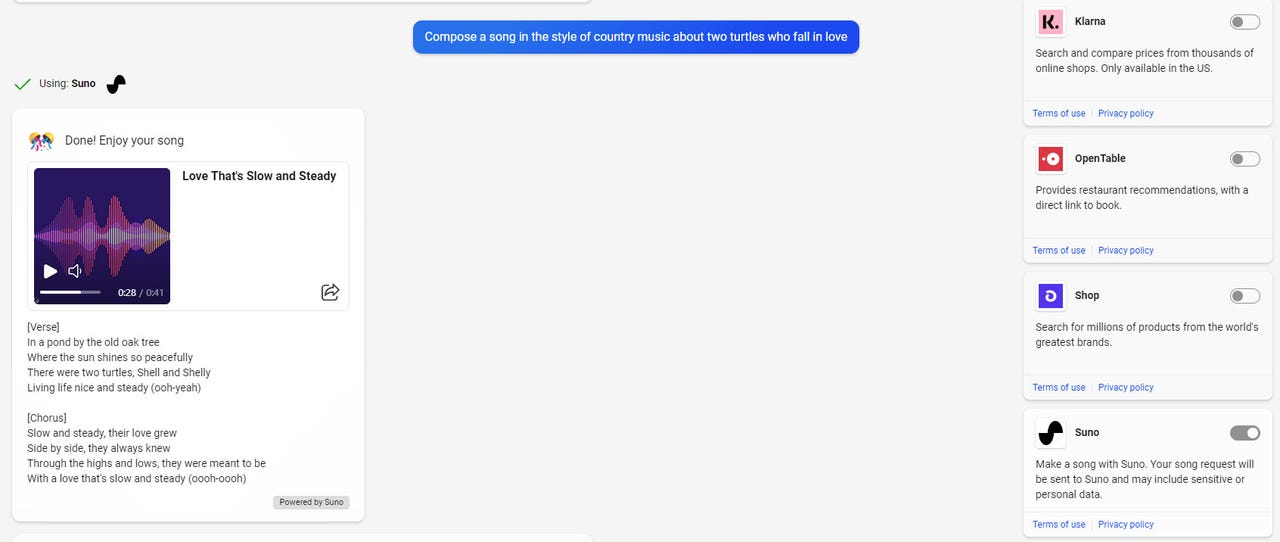
Microsoft's AI-powered Copilot can now act as your personal song writer by creating songs based on your requests. In a blog post published Wednesday, Microsoft revealed Copilot's new skills as a composer courtesy of a third-party plug-in called Suno, an AI-based music generator.
Also: Windows 12 FAQ: Yes, it's coming in 2024 (and more surprising predictions)
With the plug-in enabled, you describe the subject of the song and the style or genre at the prompt. In response, Copilot writes and displays the lyrics and offers a Play button for you to hear its musical masterpiece. As a few examples, ask it to compose a country music song about two turtles who fall in love or a jazz song about a man getting a haircut or a rap song about a robot learning to be human.
The lyrics appear fairly quickly, but you may need to wait a while for the song itself to generate depending on the lyrics and style. After the music is ready, you can play it and share it via email or social media.
How to try it
To give it a shot, open Microsoft Edge and browse to the Copilot website. Click the heading for Plugins at the right and turn on the one for Suno if it's not already on. Alternatively, click the Suno logo that says: "Make music with Suno." Type your request at the prompt, and the response is slowly generated. When the image for your music appears, click the Play button to give it a listen.
I tried a few prompts asking Copilot to compose tunes in different styles and on different subjects. Though the results wouldn't win any Grammys, they did show a certain flair and were especially adept at capturing the style of music I specified.
Also: ZDNET looks back on tech in 2023, and looks ahead to 2024
With the progress being made in generative AI, more tools have been popping up that can create images, videos, and music based on your text descriptions. Using the Suno plug-in, Microsoft Copilot joins other current and upcoming AI-enabled music creation tools, including Google's MusicLM, Meta's AudioCraft, and Stability AI's Stable Audio.
"You don't have to know how to sing, play an instrument, or read music to bring your musical ideas to life," Microsoft said in its blog post. "Microsoft Copilot and Suno will do all the hard work for you, matching the song to cues in your prompt. We believe that this partnership will open new horizons for creativity and fun, making music creation accessible to everyone."


 No bullshit, watch this clip. @VivekGRamaswamy is talking about AI.
  Everything he says and how he says it. We'd be lucky to have him as Prez pic.twitter.com/1hcqph9Asr