Reliance Jio Partners with IIT Bombay to Build ‘Bharat GPT’

Reliance Jio Partners with IIT Bombay to Build Bharat GPT

Mukesh Ambani’s Reliance Jio Infocomm has forged an alliance with IIT Bombay for the ‘Bharat GPT’ initiative, according to revelations made by the company’s chairman, Akash Ambani. This collaboration, rooted in a partnership established in 2014, underscores a concerted effort to propel technological advancements.

At IIT Bombay’s annual Techfest, Ambani unveiled the company’s visionary roadmap, painting a picture of a far-reaching “ecosystem of development” and signalling the imminent advent of “Jio 2.0.” by leveraging large language models and generative AI, as indicated by Ambani.

“AI stands for Artificial Intelligence, but it also stands for All Included”
Shri Akash Ambani at IIT Bombay Techfest.
He shares his views on the transformative power of AI, innovations and initiatives at Jio to make India proud.
#IITBombay #Techfest #AI #Technology #India #Jio pic.twitter.com/Ru8zFVoyxF

— Reliance Jio (@reliancejio) December 27, 2023

This comes after Reliance had announced its partnership with NVIDIA in September for advancing AI india. This was for developing LLMs and nurturing India’s generative AI applications. Further, NVIDIA said that it will provide access to Reliance with GH200 Grace Hopper Superchip and NVIDIA DGX Cloud for exceptional performance.

Foreseeing a paradigm shift catalysed by AI across diverse industries, Ambani outlined plans to integrate AI both vertically within the organisation and horizontally across multiple sectors. The announcement also hinted at the prospect of introducing an operating system tailored for televisions, providing a glimpse into the multifaceted nature of the forthcoming technological innovations.

The expansion blueprint for Reliance Jio encompasses the introduction of novel offerings in media, communication, commerce, and devices, reflecting a comprehensive strategy to diversify and enhance its portfolio. Ambani expressed unwavering confidence in the transformative potential of 5G private networks, envisaging a future where enterprises of all scales can harness the capabilities of a 5G stack.

In underlining India’s potential as a forthcoming “innovation centre,” Ambani projected a lofty ambition of achieving a $6 trillion economy status by the close of the decade. He reiterated the ubiquitous role of AI in shaping society and industries, emphasising Jio’s commitment to national development, with monetary gains deemed a “byproduct” rather than the primary objective.

In a compelling call to action, Ambani urged young entrepreneurs to embrace risk-taking and actively contribute to societal well-being, underscoring the company’s ethos of aligning its pursuits with the broader national interest.

Interestingly, there is another BharatGPT created by CoRover already in the market which is also doing exactly the same thing, and is also planning to launch chatbot soon in partnership with Google Cloud.

The post Reliance Jio Partners with IIT Bombay to Build ‘Bharat GPT’ appeared first on Analytics India Magazine.

7 Must-Read Generative AI Books for Unleashing Your Technology Prowess 

Generative AI has gained significant attention in 2023. As everyone is busy experimenting with it and building innovative applications and tools for the betterment of humanity, it becomes increasingly more important to understand the basics and technical nuances, and not just fall prey for the hype.

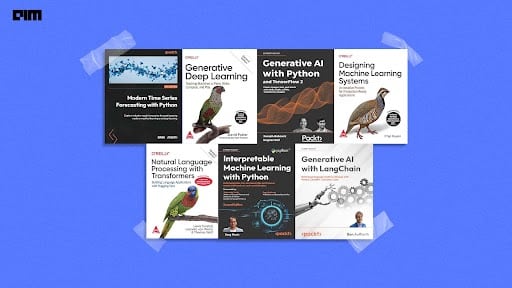
Here AIM has listed the top seven must read generative AI books of 2023 for machine learning engineers and data scientists, enhancing your understanding and skills in the field of Generative AI.

Modern Time Series Forecasting with Python

by Manu Joseph

Modern Times Series Forecasting with Python by Manu Joseph offers a comprehensive guide to analysing, visualising, and creating state-of-the-art forecasting systems using machine learning and deep learning techniques. It covers topics such as global forecasting models, cross-validation strategies, and forecast metrics. The book covers data handling, visualization, classical statistical methods, and developing ML and DL models on real-world datasets. By the end, readers can build world-class time series forecasting systems and tackle real-world problems.

Generative AI with Python and TensorFlow 2

by Joseph Babcock and Raghav Bali

In this book, Generative AI with Python and TensorFlow 2 by Joseph Babcock and Raghav Bali gives you a glimpse of generative models evolution, from Boltzmann machines to VAEs and GANs, learn TensorFlow model implementation, and stay updated on deep neural network research.

Generative Deep Learning

By David Foster (Author) & Karl Friston (Foreword)

Generative Deep Learning by David Foster and Karl Friston talks about machine learning engineers and data scientists how to create generative deep learning models using TensorFlow and Keras, including VAEs, GANs, Transformers, normalizing flows, energy-based models, and denoising diffusion models. It covers deep learning basics and advanced architectures, providing tips for efficient learning and creativity.

Designing Machine Learning Systems

By Chip Huyen

Designing Machine Learning Systems by Chip Huyen tells about a holistic approach to designing ML systems that are reliable, scalable, maintainable, and adaptive to changing environments and business requirements.

Natural Language Processing with Transformers

By Lewis Tunstall, Leondro von Werra & Thomas Wolf


Natural Language Processing with Transformer by authors Tunstall, von Werra, and Wolf, provides a hands-on explanation of transformers’ functionality and their integration into various applications, including news writing, Google Search queries, and chatbots. If you’re a data scientist or coder, this practical book shows you how to train and scale these large models using Hugging Face Transformers, a Python-based deep learning library.

Interpretable Machine Learning with Python – Second Edition

BySerg Masis

Interpretable Machine Learning with Python, Second Edition, by Serg Masis teaches the key concepts of interpreting machine learning models using real-world data. It provides a range of skills and tools to decipher complex models, from flight delay prediction to waste classification. The book covers traditional methods like feature importance and partial dependence plots, as well as integrated gradients and gradient-based attribution methods. It also teaches hands-on techniques for tuning models and training data for interpretability, reducing complexity, mitigating bias, and enhancing reliability.

Generative AI with LangChain

By BenAuffarth

Generative AI with LangChain by Ben Auffarth explores the functions, capabilities, and limitations of LLR models like ChatGPT and Bard, and how to use the LangChain framework for production-ready applications. It covers transformer models, attention mechanisms, training and fine-tuning, data-driven decision-making, automated analysis and visualization using pandas and Python, and heuristics for model usage. The goal is to provide a comprehensive understanding of LLMs and their potential for enhancing our understanding of the world.

The post 7 Must-Read Generative AI Books for Unleashing Your Technology Prowess appeared first on Analytics India Magazine.

Bill Gates predicts a ‘massive technology boom’ from AI coming soon

Bill Gates

The use of artificial intelligence by the general population in developed countries such as the US to a "significant" degree will start to take place in the next 18 to 24 months, according to Microsoft co-founder and philanthropist Bill Gates in his year-end letter released last week.

The impact on things such as productivity and innovation could be unprecedented, says Gates.

"Artificial intelligence is about to accelerate the rate of new discoveries at a pace we've never seen before," wrote Gates on his blog.

Also: You can now run Microsoft's AI-powered Copilot as a free Android app

Gates, who serves on the Gates Foundation that he formed with Melinda French Gates, focused his remarks in the letter on the uses of AI in the developing world.

"A key priority of the Gates Foundation in AI is ensuring these tools also address health issues that disproportionately affect the world's poorest, like AIDS, TB, and malaria," wrote Gates.

Gates cites multiple applications of AI in different countries while noting that the practical implementation will come not this year but in the latter years of this decade.

Also: These 5 major tech advances of 2023 were the biggest game-changers

"The work that will be done over the next year is setting the stage for a massive technology boom later this decade" through AI, wrote Gates.

Examples of AI being developed for uses in education and fighting disease cited by Gates in his letter include:

  • Fighting resistance to antibiotics, or antimicrobial resistance (AMR) — A researcher at the Aurum Institute in Ghana in Africa is working on a software tool that will comb through reams of information "including local clinical guidelines and health surveillance data about which pathogens are currently at risk of developing resistance in the area—and make suggestions for the best drug, dosage, and duration."
  • AI-driven personalized education, such as "Somanasi" — An AI-based tutoring software program in Nairobi that "has been designed with the cultural context in mind so it feels familiar to the students who use it."
  • Reducing risks during pregnancies, given "a woman dies in childbirth every two minutes" on average, globally. Solutions include a health worker "Copilot" software program being developed in India by Armman for nurses and midwives working to "improve the odds for new mothers in India" and that adjusts to the experience level of the aid worker.
  • A chatbot for assessing HIV risk that "acts like an unbiased and nonjudgmental counselor who can provide around-the-clock advice," in particular to "marginalized and vulnerable populations" that are leery of talking to physicians about their sexual history.
  • A voice-powered mobile app for health workers in Pakistan that lets them speak into a prompt to fill out a medical health record when visiting a patient in the field, in order to close the gap where "many people don't have any documented medical history."

Gates places particular emphasis on the AI applications that are being built in the respective countries that will presumably be better attuned to the realities of those countries. For example, voice input in the Pakistan health records app matches the common practice of people sending voice messages on mobile devices rather than typing out messages.

Also: ZDNET's product of the year: Meta Quest 3 is the quiet shocker of 2023

"We can learn a lot from global health about how to make AI more equitable. The main lesson is that the product must be tailored to the people who will use it," wrote Gates.

Gates predicts the developing world will not be that far behind the developed world in seeing adoption of AI:

If I had to make a prediction, in high-income countries like the United States, I would guess that we are 18–24 months away from significant levels of AI use by the general population. In African countries, I expect to see a comparable level of use in three years or so. That's still a gap, but it's much shorter than the lag times we've seen with other innovations.

Featured

The New York Times wants OpenAI and Microsoft to pay for training data

The New York Times wants OpenAI and Microsoft to pay for training data Kyle Wiggers 9 hours

The New York Times is suing OpenAI and its close collaborator (and investor), Microsoft, for allegedly violating copyright law by training generative AI models on Times’ content.

In the lawsuit, filed in the Federal District Court in Manhattan, The Times contends that millions of its articles were used to train AI models, including those underpinning OpenAI’s ultra-popular ChatGPT and Microsoft’s Copilot, without its consent. The Times is calling for OpenAI and Microsoft to “destroy” models and training data containing the offending material and to be held responsible for “billions of dollars in statutory and actual damages” related to the “unlawful copying and use of The Times’s uniquely valuable works.”

“If The Times and other news organizations cannot produce and protect their independent journalism, there will be a vacuum that no computer or artificial intelligence can fill,” reads The Times’ complaint. “Less journalism will be produced, and the cost to society will be enormous.”

Generative AI models “learn” from examples to craft essays, code, emails, articles and more, and vendors like OpenAI scrape the web for millions to billions of these examples to add to their training sets. Some examples are in the public domain. Others aren’t, or come under restrictive licenses that require citation or specific forms of compensation.

Vendors argue fair use doctrine provides a blanket protection for their web-scraping practices. Copyright holders disagree; hundreds of news organizations are now using code to prevent OpenAI, Google and others from scanning their websites for training data.

The vendor-outlet conflict has led to a growing number of legal battles, The Times’ being the latest.

Actress Sarah Silverman joined a pair of lawsuits in July that accuse Meta and OpenAI of having “ingested” Silverman’s memoir to train their AI models. In a separate suit, thousands of novelists, including Jonathan Franzen and John Grisham, claim OpenAI sourced their work as training data without their permission or knowledge. And several programmers have an ongoing case against Microsoft, OpenAI and GitHub over Copilot, an AI-powered code-generating tool, which the plaintiffs say was developed using their IP-protected code.

While The Times isn’t the first to sue generative AI vendors over alleged IP violations involving written works, it’s the largest publisher involved in such a suit to date — and one of the first to highlight potential damage to its brand through “hallucinations,” or made-up facts from generative AI models.

The Times’ complaint cites several cases in which Microsoft’s Bing Chat (now called Copilot), which is underpinned by an OpenAI model, provided incorrect information that was said to have come from The Times — including results for “the 15 most heart-healthy foods,” 12 of which weren’t mentioned in any Times article.

The Times makes the case, also, that OpenAI and Microsoft are effectively building news publisher competitors using The Times’ works, harming The Times’ business by providing information that couldn’t normally be accessed without a subscription — information that isn’t always cited, sometimes monetized and stripped of affiliate links that The Times uses to generate commissions, moreover.

As The Times’ complaint alludes to, generative AI models have a tendency to regurgitate training data, for example reproducing almost verbatim results from articles. Beyond regurgitation, OpenAI has on at least one occasion inadvertently enabled ChatGPT users to get around paywalled news content.

“Defendants seek to free-ride on The Times’s massive investment in its journalism,” the complaint says, accusing OpenAI and Microsoft of “using The Times’s content without payment to create products that substitute for The Times and steal audiences away from it.”

Impacts to the news subscription business — and publisher web traffic — is at the heart of a tangentially similar suit filed by publishers earlier in the month against Google. In the case, the defendants, like The Times, argued Google’s GenAI experiments, including its AI-powered Bard chatbot and Search Generative Experience, siphon off publishers’ content, readers and ad revenue through anticompetitive means.

There’s credence to publishers’ assertions. A recent model from The Atlantic found that, if a search engine like Google were to integrate AI into search, it’d answer a user’s query 75% of the time without requiring a click-through to its website. Publishers in the Google suit estimate they’d lose as much as 40% of their traffic.

Some news outlets, rather than fight vendors in court, have chosen to ink licensing agreements with them. The Associated Press struck a deal in July with OpenAI, and Axel Springer, the German publisher that owns Politico and Business Insider, did likewise this month.

In its complaint, The Times says that it attempted to reach a licensing arrangement with Microsoft and OpenAI in April but that talks weren’t ultimately fruitful.

Generative Everything: An Exploration of Breakthroughs in 2023, Impacts, and Future Insights Across Industries with AI

Explore 2023's breakthroughs in generative AI, industry impacts, and 2024 trends. Navigating challenges for responsible innovation

Generative AI is an evolving field that has experienced significant growth and progress in 2023. By utilizing machine learning algorithms, it produces new content, including images, text, and audio, that resembles existing data. Generative AI has tremendous potential to revolutionize various industries, such as healthcare, manufacturing, media, and entertainment, by enabling the creation of innovative products, services, and experiences.

Notable advancements in generative AI have emerged in 2023, including the emergence of generative language models, increased adoption by different sectors, and the rapid growth of generative AI tools. These developments offer unprecedented opportunities for both businesses and individuals to leverage generative AI for innovation and growth.

A Closer Look at Breakthroughs in Generative AI

Taking a closer look at breakthroughs in generative AI, one significant development is the explosive growth of Gen AI tools. These tools, such as OpenAI's DALL-E, Google's Bard chatbot, and Microsoft's Azure OpenAI Service, empower users to generate content that resembles existing data. This availability of diverse Gen AI tools reveals new possibilities for innovation and growth.

Another breakthrough is the rise of generative language models powered by deep learning algorithms. Leading models like OpenAI's GPT-3, Google's T5, and Facebook's RoBERTa have played a crucial role in various applications, including chatbots, content creation, and language translation. These innovations have been, in fact, the foundation for the AI developments we witnessed recently.

OpenAI's GPT-4 stands as a state-of-the-art generative language model, boasting an impressive over 1.7 trillion parameters, making it one of the largest language models ever created. Its applications range from chatbots to content creation and language translation.

Facebook's RoBERTa, built on the BERT architecture, utilizes deep learning algorithms to generate text based on given prompts. Its applications span from chatbots to content creation and language translation.

Moreover, Google has introduced a groundbreaking generative language model called Gemini. Operating on Google's state-of-the-art TPUv5 chips, Gemini claims to have computing power five times greater than GPT-4. It was publicly released at the start of December 2023.

The Impact and Adoption Across Industries

In 2023, generative AI adoption surged across industries, notably in healthcare for drug discovery, disease diagnosis, and personalized medicine. The technology processes vast medical datasets, creating content such as images and records, enhancing healthcare quality and accessibility.

Philips employs generative AI to revolutionize healthcare, aiding patient engagement by simplifying complex medical information. Clinicians benefit from actionable insights derived from intricate data, facilitating informed decisions. The application extends to optimizing operations, forecasting patient volumes, and streamlining administration, showcasing Philips' commitment to innovative healthcare solutions and improved patient outcomes through advanced technologies.

Likewise, Paige utilizes generative AI for cancer diagnosis through its Paige Platform, leveraging extensive global datasets for the full digitization of pathology. Clinically validated, the AI applications show notable improvements, including a 70% reduction in cancer detection errors.

In manufacturing, 2023 witnessed profound breakthroughs in product design, optimization, and quality control. Generative AI revolutionized product design, reducing time and costs while enhancing efficiency and product quality. In optimization, it revamped manufacturing processes, creating workflows that reduce waste, boost productivity, and elevate final product quality. In quality control, it emerged as a game-changer, identifying defects through advanced inspection methods, enhancing accuracy, efficiency, and overall product quality while reducing time and costs.

LeewayHertz's ZBrain AI platform revolutionizes manufacturing workflows by optimizing supply chains, improving quality control, streamlining production, and automating supplier evaluations. Leveraging large language models, ZBrain transforms data into actionable insights, enhancing efficiency, reducing errors, and elevating overall product quality for greater operational agility, productivity, and efficiency in businesses.

The media and entertainment sectors benefitted from generative AI in 2023 for content creation, recommendation systems, and audience engagement. This trend is expected to persist as businesses recognize its potential for innovation and growth. Generative AI optimizes designs, reduces costs, and transforms personalized content, enhancing engagement and creating new revenue streams. Addressing risks and workforce changes tied to generative AI adoption is crucial despite the opportunities it presents.

For example, OpenAI's DALL-E has transformed media and entertainment by generating realistic images from text prompts. In addition, platforms like Netflix and TikTok employ machine learning algorithms to predict user preferences, enhancing content recommendations.

Anticipating Generative AI Trends for 2024

As we step into the year 2024, compelling trends in generative AI are set to reshape industries. Quantum AI, which combines quantum computing and machine learning, holds immense potential to revolutionize healthcare, finance, and transportation. A groundbreaking concept known as Web3, built on blockchain technology, offers new possibilities for decentralized content creation and distribution through generative AI applications.

The emergence of multimodal generative AI, which combines different types of data like text, images, and audio, is expected to give rise to more diversified innovative applications such as virtual assistants and chatbots. One particularly significant development is the introduction of emotion-infused virtual assistants capable of detecting and responding to human emotions. This advancement has the potential to greatly enhance customer service quality and create new revenue streams.

Another important trend is prompt engineering, which focuses on creating high-quality prompts for generative AI models. This trend plays a pivotal role in improving the accuracy and efficiency of these models. Collectively, these trends promise a transformative landscape, impacting various industries from virtual assistance to decentralized content creation and beyond.

Challenges for Generative AI

While generative AI holds immense promise, it also presents challenges and risks that require careful consideration. Ethical concerns, data-related issues, security risks, regulatory compliance, and technical challenges are among the key obstacles.

Maintaining a balance between innovation and ethical considerations is crucial to ensure the responsible use of generative AI. The effectiveness of generative AI heavily relies on large volumes of data, which may contain biases or be incomplete, leading to potential inaccuracies or unreliable outcomes. Maintaining the right balance between the quantity and quality of data becomes essential in handling this challenge.

In addition, overcoming security risks is pertinent to avoid the generation of malicious content or unauthorized access and theft of sensitive data. Effectively managing these risks is vital for creating a secure environment for the deployment of generative AI.

Moreover, regulatory compliance adds another layer of complexity, as generative AI falls under the purview of various regulations and laws, including those related to data privacy and intellectual property. Ensuring adherence to these legal frameworks becomes imperative for responsible and lawful use.

On a technical front, generative AI may face challenges in producing content that is of high quality and relevance. Addressing these challenges will be crucial for the continued advancement and success of generative AI.

The Bottom Line

In conclusion, it is evident that generative AI has the potential to bring about significant transformation, but it also poses ethical, data-related, security, regulatory, and technical challenges. Maintaining a balance between innovation and responsibility is crucial.

By addressing these challenges through comprehensive risk management, we can ensure the ethical, secure, and compliant use of generative AI, thereby promoting its positive impact across various industries. As we navigate the complex domain of generative AI, a thoughtful and holistic approach will be key to realizing its full potential.


You can now run Microsoft’s AI-powered Copilot as a free Android app

Microsoft's Copilot app for Android

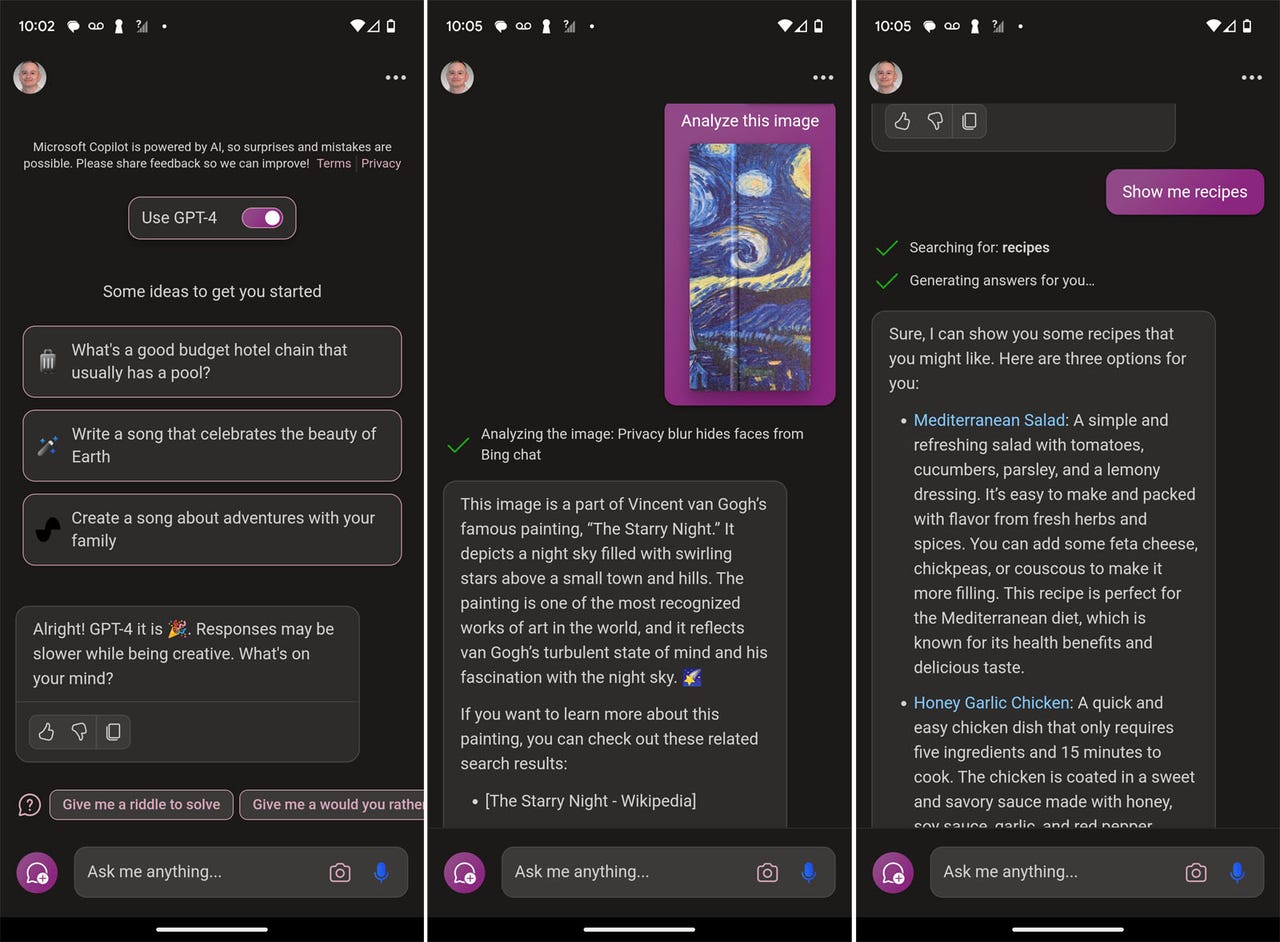
Android users now have yet another AI-powered app they can run on their devices. Courtesy of Microsoft, the new Copilot app works similarly to OpenAI's ChatGPT app and Microsoft's own Bing AI app and kicks in the latest models for GPT-4 and DALL-E 3.

Debuting about a week ago, according to the folks at Neowin, the app is freely available at Google Play. Upon launching the app, you'll find the usual AI features and capabilities. You can use it without an account. But signing in with your Microsoft account grants you more questions and longer conversations.

Also: I asked DALL-E 3 to create a portrait of every US state, and the results were gloriously strange

Start with sample questions or dive in with your own requests. You can type your question at the prompt or speak it by tapping the microphone icon. You're also able to upload a photo or other image and ask the app to analyze it. You can enable GPT-4 to try to get more reliable and accurate responses. And you're able to switch between Light and Dark modes depending on your preference.

"Copilot is a pioneering chat assistant from Microsoft powered by the latest OpenAI models, GPT-4 and DALL-E 3," states the app's product page. "These advanced AI technologies provide fast, complex, and precise responses, as well as the ability to create breathtaking visuals from simple text descriptions."

So why would Microsoft release another AI app when it already has Bing? The answer likely lies in the use of the word Copilot.

Also: I spent a weekend with Amazon's free AI courses, and highly recommend you do too

Microsoft has been on a tear trying to infuse that term and technology into many of its products, resulting in Copilot for Windows, Copilot for Microsoft 365, Copilot for Azure, GitHub Copilot, and more. The company even renamed its Bing Chat platform to Copilot. Launching a dedicated app with the Copilot name is yet another way to further the brand and concept.

For now, the app is limited to Android. Sorry, iPhone users. But it's a safe bet that Microsoft will expand it to iOS. Until then, iPhone owners can always use the Bing AI app.

BotBuilt wants to lower the cost of homebuilding with robots

BotBuilt wants to lower the cost of homebuilding with robots Kyle Wiggers 10 hours

Homes aren’t getting cheaper — or necessarily easier to secure.

This year, the median household income for home buyers jumped to $107,000 from $88,000 last year, according to the National Association of Realtors. The volume of homes for sale in the U.S. reached record a low, meanwhile — and shows no sign of recovery.

Now, one might argue the increasing price and interrelated decreasing supply of homes are positive trends, in fact, because they could push families toward more environmentally friendly, sustainable alternatives. Studies show that single-family suburbs contribute significant greenhouse gas emissions while discouraging affordable new housing.

But startups such as BotBuilt make the case that prospective homebuyers can have their cake and eat it, too, by embracing tech to lower the cost — and mitigate the negative impacts — of homebuilding.

BotBuilt is the brainchild of Brent Wadas, Colin Devine and robotics engineer Barrett Ames. Founded in 2020, the company aims to create a robotic system that can take in a building plan, translate that plan into a series of machine commands and send those commands to the aforementioned system.

What inspired the co-founders to tackle homebuilding? Personal experience, according to Ames. While a graduate student at Duke, Ames and his wife bought a fixer-upper near the college campus and recruited friends and family to help renovate the house. Throughout the remodel, Ames says he learned a lot about the challenges — and patterns — of construction.

“The housing industry is facing a huge housing shortage, and builders know they have to continue to build as many homes as possible to make up for years of underbuilding,” Ames told TechCrunch in an email interview. “Because of the increase in interest rates, many people do not want to leave their current homes and associated rates, further increasing the demand for new housing.”

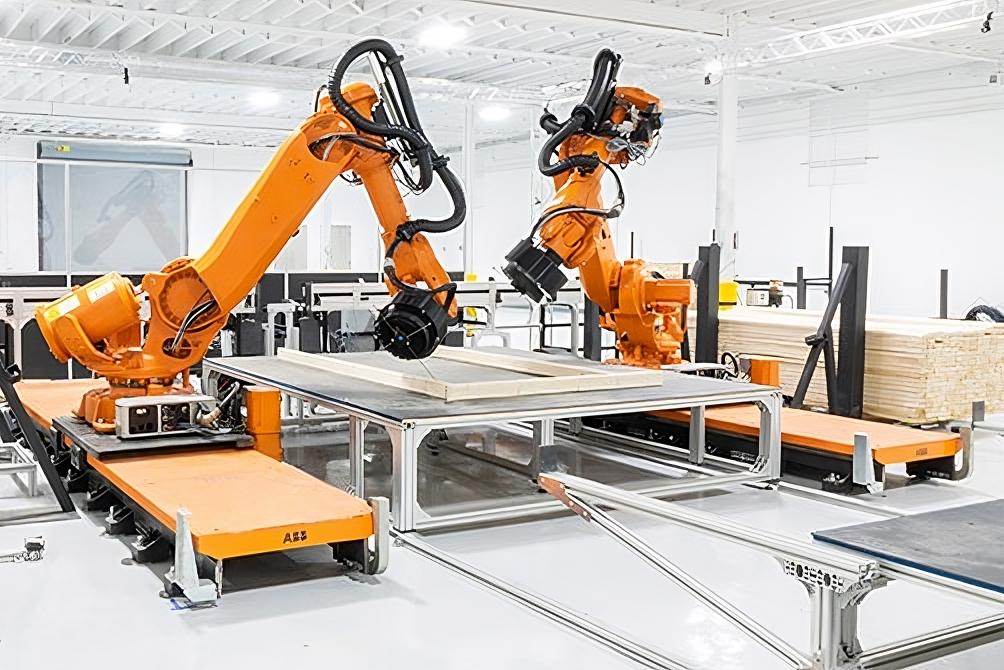
Now, BotBuilt’s envisioned system doesn’t erect homes from scratch. It focuses instead on a specific part of the homebuilding “flow”: constructing framing.

BotBuilt’s robotics piece together panels for walls, floor trusses and roof trusses, several of the major framing components of homes. The company’s system, which ostensibly costs under $1 per hour to run, can be reprogrammed to build “entirely” different frame designs for homes relatively quickly, Ames says.

BotBuilt

Image Credits: BotBuilt

“The flexibility of our robotic systems is our … big advantage,” Ames said. “Prior attempts to use robots to innovate within construction have largely relied on hard automation, which means that robots are programmed to do the same task over and over again. This approach works well for repetitive tasks like building cars, but it’s a poor fit for the construction industry, where there’s a huge variety of designs.”

By automating the framing step, it’s Ames’ theory that the pace of homebuilding can be dramatically accelerated while reducing costs.

Typically, house framing costs $7 to $16 per square foot, which includes $4 to $10 in framing labor costs. Framing takes about a month best-case scenario, but factors like bad weather can delay things — as can labor shortages. According to the National Association of Home Builders, more than 55% of single-family home builders reported a shortage of skilled labor across home building trades, including framers, in 2021.

BotBuilt primarily provides services to homebuilders. It doesn’t sell the frame-building system itself, but rather operates robot-equipped factories to produce framing for homebuilding customers.

“The timing of framing impacts every other trade involved in the construction process and can make or break a developer’s budget,” Ames said. “The vast majority of … framing components are built by people using manual methods … BotBuilt empowers builders by helping them increase both their volume and margin by leveraging plentiful, high-quality and affordable robotic labor.”

Ames acknowledges that BotBuilt has rivals in the robotics homebuilding space like Randek, Weinmann and House of Design. Others include Diamond Age and Mighty Homes, both of which have created systems that can print and assemble components like home interiors and roof structures.

BotBuilt is off to a gentle start, with only nine homes built so far and revenue hovering around $75,000. But Ames claims the pace will ramp up in 2024; the plan is to begin shipping trusses built by its robotics while scaling BotBuilt’s general operations, he says.

“Manual wall panel and truss plants operate at 30-40% gross margins, so our level of automation will allow us to be significantly higher than that and still deliver significant cost savings to builders,” Ames says. (He estimates that BotBuilt makes ~$15,000 in revenue per house of wall panels built.) “We already have ten builders with over 2,000 homes and apartment units in our pipeline to build, and we will build them as quickly as we can with our initial two factories.”

To help scale the company, BotBuilt has raised $12.4 million in a seed funding round led by Shadow Ventures. Part of the tranche, which values BotBuilt at $34 million post-money, will be put toward growing the Durham, North Calrionia-based company’s team from 13 people to about 20, Ames says.

Alibaba Makes AI Agents Come to Life with Make-A-Character 

Alibaba’s Cloud Business Gets Qwen-ched!

In a bid to lower the barrier to 3D digital human creation, researchers from Alibaba recently unveiled a text-to-3D model, Make-A-Character (aka Mach). This new tool leverages large language and vision foundation models to generate detailed and lifelike 3D avatars from simple text descriptions, or natural language.

Check out the GitHub repository here.

The researchers said that its current version focuses on generating visually appealing 3D avatars of Asian ethnicity, as its selected SD model is primarily trained on Asian facial images. They look to expand support for different ethnicities and styles in the coming months.

Further, the researchers said that its de-lighting datasets only consist of clean face textures. The generated avatars may weaken non-natural facial patterns like scribbles or stickers. “Currently, our garments and body parts are pre-produced and matched based on textual similarity. However, we are actively working on developing cloth, expression, and motion generation techniques driven by text prompts,” shared the researchers.

How it works?

Alibaba’s Mach seamlessly converts textual descriptors into visual avatars, providing users with a simple way to create custom avatars that resonate with their intended personas.

The way it works is that these semantic attributes (prompts) are then mapped to corresponding visual clues, which in turn guide the generation of reference portrait images using Stable Diffusion along with ControlNet.

Once that is done, through a series of 2D face parsing and 3D generation modules, the mesh and textures of the target face are generated and assembled along with additional matched accessories. Later the parameterised representation enables easy animation of the generated 3D avatar.

Other AI models

A few days ago, Alibaba also addressed the challenge of 2D to 3D generation by unveiling Richdreamer, a normal-depth diffusion model. Additionally, Alibaba introduced ‘Animate Anyone,’ an advanced character animation technology utilizing diffusion models for transforming static images into dynamic character videos.

Building on this momentum, Alibaba recently launched Qwen-72B, a language model with increased parameters and enhanced customization, following the earlier release of Qwen-7B in October. Moreover, it presented a smaller language model, Qwen-1.8B, as a gift to the research community, featuring a 2K context length and a modest 3GB GPU memory requirement.

The post Alibaba Makes AI Agents Come to Life with Make-A-Character appeared first on Analytics India Magazine.

25 Free Courses to Master Data Science, Data Engineering, Machine Learning, MLOps, and Generative AI

25 Free Courses to Master Data Science, Data Engineering, Machine Learning, MLOps, and Generative AI
Image by Author

In today's rapidly developing technological landscape, it is crucial to master skills in data science, machine learning, and AI. Whether you're seeking to embark on a new career or enhance your existing expertise, there is a plethora of online resources available, and many of them are free! We have gathered the top posts on free courses (that you love) from KDnuggets and compiled them to provide you with a collection of courses that are excellent. Bookmark this page for future reference, as you will likely return to it to learn new skills or try out new courses.

Data Science

  1. Python for Everybody by Prof. Charles Severance: A comprehensive introduction to programming using Python, ideal for beginners.
  2. Data analysis with Python by Jovian: Dive into data analysis techniques using Python.
  3. Databases and SQL by freeCodeCamp: Learn how to manage databases with SQL.
  4. Intro to Inferential Statistics from Udacity: Gain insights into making predictions from statistical learning.
  5. Machine Learning Zoomcamp by DataTalks.Club: A practical (project based) approach to learning machine learning.

Learn more about individual course by reading 5 Free Courses to Master Data Science

Data Engineering

  1. Data Engineering by IBM on edX: Understand the fundamentals of data engineering.
  2. Data Engineer Learning Path by Google: A guided path for aspiring data engineers.
  3. Database Engineer Professional Certificate by Meta: Get certified in database engineering.
  4. Big Data Specialization by UC San Diego: Learn about big data technologies and applications.
  5. The Data Engineering Zoomcamp by DataTalks.Club: A hands-on (project based) course for data engineering.

Learn more about individual course by reading 5 Free Courses to Master Data Engineering

Machine Learning

  1. Intro to Machine Learning by Kaggle: A beginner-friendly introduction to machine learning.
  2. Machine Learning for Everybody by Kylie Ying: An accessible approach to machine learning concepts.
  3. Machine Learning in Python with Scikit-Learn by FUN MOOC: Focus on machine learning using Python and Scikit-Learn.Â
  4. Machine Learning Crash Course by Google: A quick yet thorough introduction to machine learning.
  5. CS229: Machine Learning by Stanford University: A more advanced course for those looking to deepen their knowledge.

Learn more about individual course by reading 5 Free Courses to Master Machine Learning

MLOps

  1. Python Essentials for MLOps by Duke University: An essential course for MLOps enthusiasts.
  2. MLOps for Beginners by Udemy: A great starting point for MLOps novices.
  3. Machine Learning Engineering for Production (MLOps) Specialisation by DeepLearning.AI: Dive deep into the world of MLOps. It is a collection of course.
  4. Machine Learning Operations Specialization by Duke University: Focus on the operational aspects of machine learning.
  5. Made With ML by Goku Mohandas: A unique course that blends machine learning with practical applications. Quite popular on GitHub.

Learn more about individual course by reading 5 Free Courses to Master MLOps

Generative AI

  1. Generative AI for Beginners by Microsoft: 12 lessons for building Generative AI applications.
  2. Generative AI Fundamentals by DataBricks: Explore the basics of Generative AI.
  3. Introduction to Generative AI Learning Path by Google: From learning the basics of large language models to understanding responsible AI principles.
  4. Generative AI with Large Language Models by AWS and DeepLearning.AI: Get hands-on experience in AI with AWS experts who build and deploy AI in business use cases.
  5. Generative AI for Everyone by DeepLearning.AI: What it is, how it works, common use cases, and limitations of GenAI.

Learn more about individual course by reading 5 Free Courses to Master Generative AI

Conclusion

In this blog, we have covered 25 free online courses that can help you build a strong foundation in data science and its related subfields. Level up your skills with more advanced courses in topics like machine learning, MLOps, and Generative AI. No matter where you are in your data science learning journey, these free courses make quality education accessible for everyone. They offer flexible learning that fits into even the busiest schedules. Happy learning!

Abid Ali Awan (@1abidaliawan) is a certified data scientist professional who loves building machine learning models. Currently, he is focusing on content creation and writing technical blogs on machine learning and data science technologies. Abid holds a Master's degree in Technology Management and a bachelor's degree in Telecommunication Engineering. His vision is to build an AI product using a graph neural network for students struggling with mental illness.

More On This Topic

  • 5 Free Courses to Master MLOps
  • 5 Free Courses to Master Generative AI
  • 5 Free Courses to Master Data Engineering
  • 5 Free Courses to Master Machine Learning
  • Mastering Generative AI and Prompt Engineering: A Free eBook
  • 5 Free Courses to Master Data Science

ChatGPT Plugins Are Dead and Developers Are Not Happy

ChatGPT Plugins Are Dead and Developers Are Not Happy

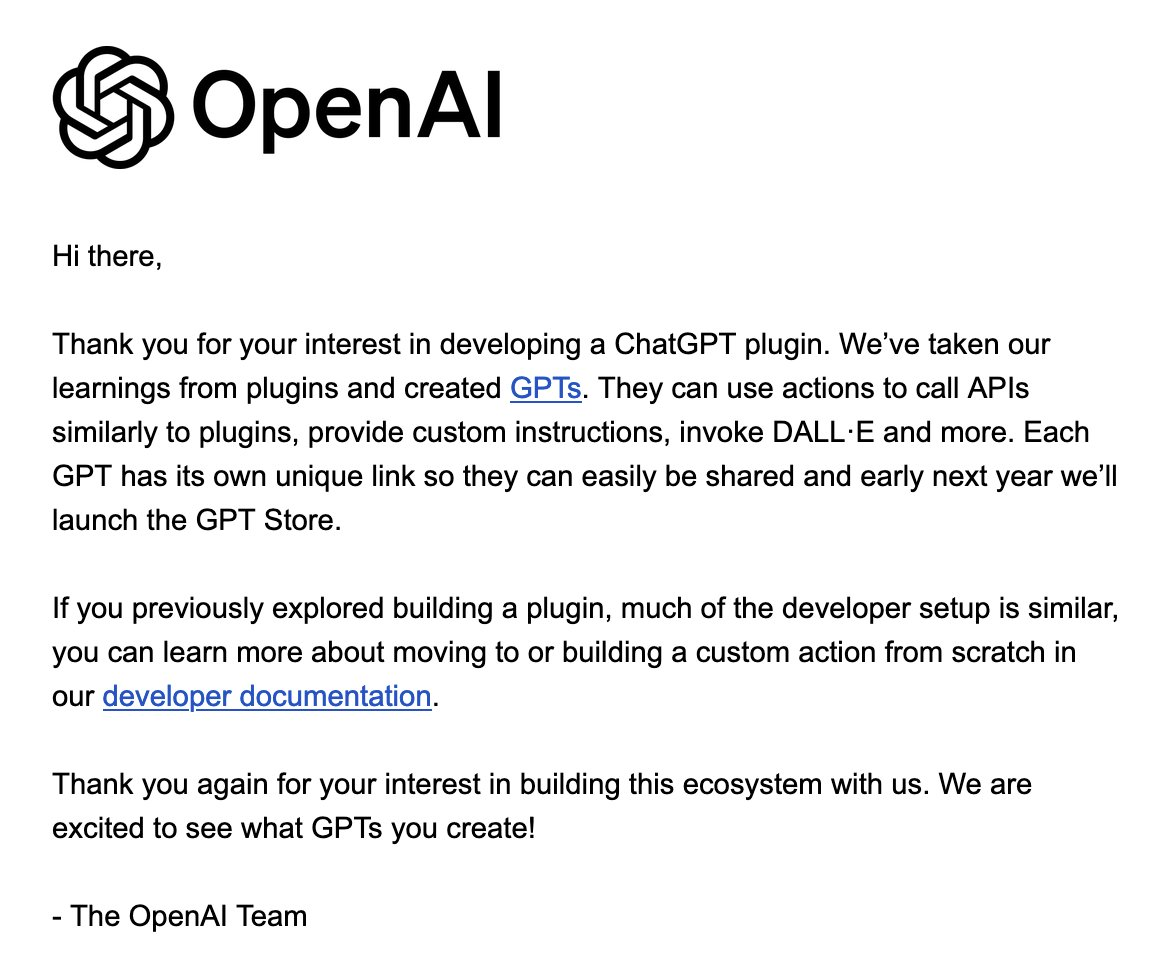
When GPTs were launched by OpenAI, we said that it was the first step towards the end of ChatGPT Plugins. And it indeed was. OpenAI has now officially sent a mail to all the plugin developers that they might soon support for plugins, and the developers can now shift to building GPTs, which the company claims is somewhat similar in process.

Though ChatGPT plugins are not absolutely dead yet as people can still register to build them, OpenAI’s mail is sent to the people registering for making plugins that GPTs can do the same thing, but better. “They can use actions to call APIs, similarly to plugins, provide custom instructions, invoke DALL-E and more,” read the mail also talking about the launch of GPT Store early next year.

OpenAI Email to Plugin Developers

Developers are not happy

Though it clearly seems like GPTs are easier to build and also offer more functionality when compared to plugins, developers are not happy with OpenAI’s decision.

The primary difference lies in the construction method, as GPTs incorporate a no-code chat interface within ChatGPT, whereas plugins are constructed through code outside of ChatGPT. A plugin functions akin to an application linked to ChatGPT, while a GPT resembles a chatbot equipped with specific knowledge and instructions. GPTs are designed to be user-friendly for the general public, while plugins, favoured by developers, provide enhanced functionality.

Logan Kilpatrick, OpenAI’s head of developer relations responded to one of the posts on X that said “RIP ChatGPT Plugins”, saying “FYI, plugins aren’t going away yet, this was just a reminder to everyone who joined the developer waitlist that never got access that we launched GPTs and anyone with plus can build them!” In another post, he said that once the GPT Store goes live, most people will move away from Plugins.

It seems as though that is not the case though. “Plug-ins were superior to Custom GPTs.” said a user on X. Another said, “As a plugin developer, it doesn’t feel the same for me. Eg previews are open graphs for plugins, but images for GPT.” A user on the developer forum said, “Plugins are crucial for the development and progress in AI applications that we continue to have access to such powerful tools.”

To put it simply, OpenAI needs developers to build better use cases of ChatGPT, but this decision has definitely pissed off some of the developers from the company’s community.

Since their launch in March 2023, developers have created numerous ChatGPT plugins. However, on November 6th, during DevDay, OpenAI opted to remove plugins from the ChatGPT home screen, thereby increasing the difficulty of accessing them. In an interview with Human Loop, Sam Altman had earlier expressed that “ChatGPT plugins don’t have product market fit,” although OpenAI later requested the removal of the article.

Another hot mess?

GPTs don’t solve the problems that Plugins had as well. For example, with a little fancier prompt engineering, a user on X was able to download the original knowledge files from someone else’s GPTs. This was the same with ChatGPT Plugins that had the potential to be exploited for unauthorised access to someone’s chat history, retrieval of personal information, and the execution of code on an individual’s machine.

But now, just as ChatGPT Plugins store was launched and touted as an iOS store moment, GPTs Store is also the same. There are thousands of plugins available right now, and it is a hot mess. What if the same happens with the new store?

Now that we are talking about the iOS store, Apple is also putting a lot of effort into pulling developers onto its platforms. It has released a bunch of open source offerings for its silicon along with multimodal open source models. It is also releasing models for powering edge capabilities.

On the other hand, OpenAI is messing with its developers. Arguably, it might not affect the company so much in the longer run, which is what they hope as well. Apple did the same thing earlier when it did not allow ports for its iOS, now OpenAI is doing the same, and is hoping to deliver more finished products.

The post ChatGPT Plugins Are Dead and Developers Are Not Happy appeared first on Analytics India Magazine.