Global IT Spending Forecast: Gartner Predicts 6.8 Percent Growth in 2024 January 23, 2024 by Ali Azhar
While the tech industry is grappling with layoffs, there is no lack of IT spending. The worldwide spending on IT is expected to reach $5 trillion in 2024 marking a jump of 6.8 percent from 2023, according to a new report by Gartner.
The latest report by Gartner, one of the leading market research and advisory firms, offers a unique perspective on IT spending across different segments including IT services, hardware, and software. Gartner had earlier predicted a growth rate of 8 percent for IT spending, so it has downsized its forecast. However, the expected increase in IT spending is still more than double the previous year’s growth rate.
Interestingly, according to Gartner the GenAI type will not significantly change the growth of IT spending in the near term.
“While GenAI will change everything, it won’t impact IT spending significantly, similar to IoT, blockchain, and other big trends we have experienced,” said John-David Lovelock, Distinguished VP Analyst at Gartner.
According to Lovelock, the year 2024 will be more about planning how to use GenAI. The major share of IT spending will continue to be driven by traditional forces such as labor and profitability. The spending will be negatively impacted by the continued wave of “change fatigue”, which is the feeling of being overwhelmed by too many organizational changes in a row.
The Gartner report highlights change fatigue is most common for CIOs, who are becoming increasingly reluctant to commit to long-term initiatives or take on board new technology partners. The CIOs want greater certainty of outcomes and a high level of risk mitigation for new initiatives.
Despite the challenge of change fatigue, IT services are expected to see the biggest growth (8.7 percent) in 2024, becoming the largest segment of IT spending for the first time in terms of total spending ($1.5 trillion). A key driving factor behind this unprecedented growth in IT services is the rise in enterprise investment in optimization projects and organizational efficiency.
The spending on IT devices is expected to rebound after a significant drop in IT spending in 2023, to a healthy 4.6 percent growth in 2024. The crash in spending on devices in 2023 was mainly due to the excess spending in this segment during the pandemic.
(Gorodenkoff/Shutterstock)
The spending on data center systems and software continues its upward trajectory with growth rates of 7.5 percent and 8.7 percent respectively. Gartner predicts communication services to be the slowest growing sector with 2.3 percent of total IT spending.
While IT was traditionally a back-office function, but has now become a major revenue line time. “Adoption rates among consumers for devices and communications services plateaued over a decade ago. Consumer spending levels are primarily driven by price changes and replacement cycles, leaving room for only incremental growths, so being surpassed by software and services was inevitable,” said Lovelock.
The Gartner report sheds light on market opportunities and challenges. Enterprises that can make smart investments in the IT services sector will be well-positioned to reap the rewards of this rapidly evolving segment in the long term.
Are you looking to switch to a data science career? If so, chances are you’ve already signed up for an online course, a bootcamp, or the like. Perhaps, you’ve bookmarked a self-study data science roadmap that you’re planning to work through. So how will yet another guide—this guide—help you?
If you’ve decided to pursue a data science career, you must work towards it. There’s no other way. Also, landing a data science job is much more than simply learning data science concepts. And even in the process of learning, the concepts, tools, techniques, and libraries that you need to learn can be overwhelming.
This article is not a clickbait; so, no tall promises to help you land your data science job in X days. Rather we provide a holistic approach to the data science job search process. Which includes:
Learning data science concepts
Working on projects to showcase your technical expertise
Marketing yourself as a professional
Preparing strategically for interviews
We hope this guide helps you along the way!
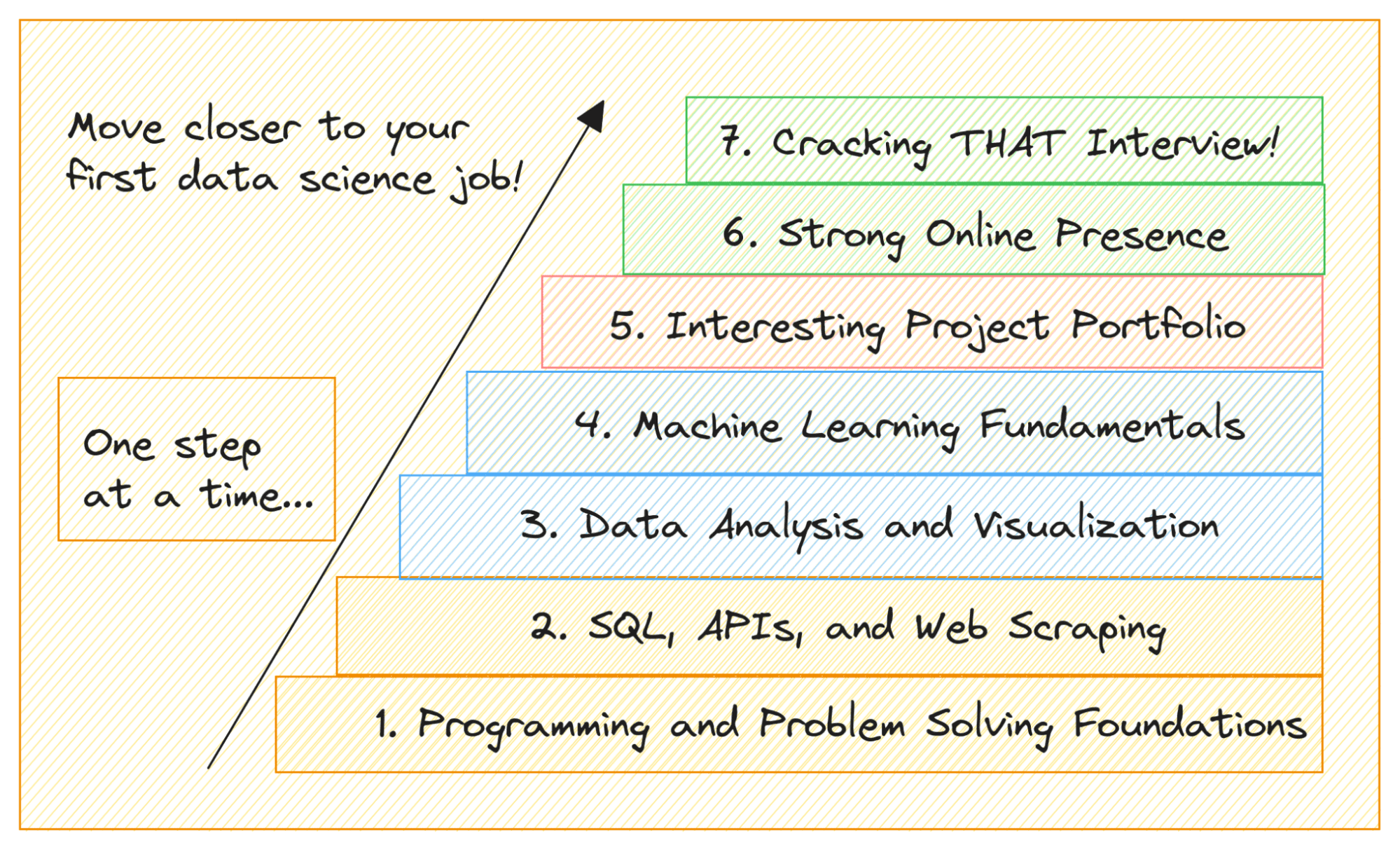
1. Learn Programming and Problem Solving Foundations
To break into data science, you should first develop a solid foundation in programming and problem solving. I suggest learning Python as your first language.
With its easy-to-follow syntax and several great learning resources, you can get up and running with Python in a few hours. You can then spend a few weeks focusing on the following programming fundamentals with Python:
Built-in data structures
Loops
Functions
Classes and objects
Functional programming basics
Pythonic features: comprehensions and generators
If you want a quickstart guide to Python, do this Python lecture in Harvard’s CS50 course. For more immersive learning, check out Introduction to Programming with Python, also a free course from Harvard.
For practice you can work through the projects in the above Python course and also practice solving a few problems on Hackerrank.
Also, at this stage, you should be comfortable working at the command line. It’s also helpful to learn how to create and work with virtual environments in Python.
2. Learn SQL, APIs, and Web Scraping
Regardless of what data role you're applying to, learning and gaining proficiency in SQL is super important. You can start with the following topics:
Basic SQL queries
Conditional filtering
Joins
Subqueries
SQL string functions
As with Python, SQL also requires dedicated practice and there are several helpful platforms to practice SQL. If you prefer a tutorial to work through, check out SQL tutorial by Mode Analytics.
You now have your Python foundations down, so you can build on that by learning web scraping with Python. Because as a data professional, you should be comfortable with data collection. Specifically, scraping the web programmatically and parsing JSON responses from APIs.
After familiarizing yourself with basic HTTP methods, you can build on your Python skills by learning:
HTTP requests with the Requests library
Web scraping with the BeautifulSoup Python library; Learning Scrapy will also be helpful
Parsing JSON responses from APIs using functionality from the built-in json module
At this point, you can try to code a simple web scraping project. Keep it simple yet relatable so that you’re interested. Say, you want to scrape your shopping data from Amazon so that you can analyze it later. This is just an example; you can work on a project that interests you.
3. Learn Data Analysis and Visualization
At this point in your data science learning journey, you should be comfortable with both Python and SQL. With these foundational skills, you can now proceed to analyze and visualize data to understand it better:
For data analysis with Python, you can learn to use the pandas library. If you’re looking for a step-by-step learning guide for pandas, check out 7 Steps to Mastering Data Wrangling with Pandas and Python.
For data visualization, you can learn to work with the matplotlib and seaborn libraries.
This free Data Analysis with Python certification course from freeCodeCamp covers all the essential Python data science libraries that you need to know. You’ll also get to code some simple projects.
Here again, you have the opportunity to build a project:try to collect data using web scraping; analyze it using pandas; learn a library like Streamlit to create an interactive dashboard to present the results of your analysis.
4. Explore Machine Learning
With programming and data analysis, you can build interesting projects. But it's also helpful to learn machine learning fundamentals.
Even if you don't have the time to learn the working of the algorithms in greater detail focus on:
gaining a high-level overview how the algorithm works and
building models using scikit-learn
This scikit-learn crash course will help you get up to speed on building machine learning models with scikit-learn. Once you learn how to build a baseline model with scikit-learn, you should also focus on the following to help you build better models:
Data preprocessing
Feature engineering
Hyperparameter tuning
Now again it's time to build projects. You can start with something simple like a loan default prediction project and gradually move to employee attrition prediction, market basket analysis, and more.
5. Build a Portfolio of Projects
In the previous steps, we did talk about building projects to reinforce learning. However most aspiring data professionals tend to focus more on the learning and overlook this step of building a portfolio of interesting projects—the applying part.
No matter how much you learn (and know), if you don't have projects showcasing your proficiency, it's not possible to convince recruiters of your expertise.
Because of the amount of front-end coding that goes into creating a simple page to showcase projects, most learners do not build a portfolio. You probably use GitHub repository—with an informative README file—to track changes to your project’s code. However, to build out a data science portfolio showcasing your projects, you can check out other free platforms such as Kaggle and DataSciencePortfol.io.
Choose your projects depending on which domain you’d like to land a data science role in: heathcare, FinTech, supply chain, and much more. So that you can demonstrate both your interest and proficiency. Alternatively, you can try building out a few projects to figure out your domain of interest.
6. Build a Strong Online Presence
Getting found online and showcasing your experience are both helpful in the job search process, especially in the early stages of your career. That is why building a strong online presence is our next step.
To this end, the best path is to build your own personal website with:
An informative “About” page and contact info
A blog that features articles and tutorials you write
A project page with details of projects you’ve worked on
Having a personal website is always preferred. But at the least you should have a LinkedIn profile and Twitter (now X) handle when you’re in the job search process.
On Twitter, add a relevant headline, and engage meaningfully with technical and career advice shared. On LinkedIn ensure that you profile is as complete as possible and accurate:
Update your headline to reflect your professional expertise
Fill out the experience and education sections
In the “Projects” section, add your projects with a short description. Also link to the projects
Add your published articles to your profile
Be proactive when networking on these platforms. Also share your learning periodically. If you don't want to start writing on your own blog just yet, try writing on socials to work on your writing skills.
You can write a LinkedIn post or an article about a data science concept you just learned or a project you’re working on. Or tweet about what you’re learning and mistakes you make along the way, and what you learned from them.
Notice how this step is not completely separate from building your project portfolio. In addition to working on your technical skills and building projects (yes, your portfolio), you also want to build your online presence. So that recruiters can find you and reach out with relevant opportunities when they are looking for candidates.
7. Prepare Strategically; Crack interviews
To crack data science interviews, you need to work on both coding rounds that test your problem-solving skills as well as core technical interviews where you should be able to showcase your understanding of data science.
I recommend taking at least an introductory course on data structures and algorithms and then solving problems on Hackerrank and Leetcode. If you are running short of time, you can work through a problem set such as Blind 75. This problem set contains questions across all major concepts like arrays, dynamic programming, strings, graphs, and more.
In all data science interviews, you’ll have an SQL round at the very least. You can practice SQL on Hackerrank and Leetcode too. In addition, you can solve previously asked interview questions on platforms like StrataScratch and DataLemur.
Once you crack these coding interviews and proceed to the next rounds, you should be able to demonstrate your proficiency over data science. You should know your projects in great detail. When explaining projects you’ve worked on, you should also be able to explain:
The business problem you've attempted to solve
Why you approached it the way you did
How and why the approach is good
Focus on preparing not only from an algorithms and concepts perspective but also from that of understanding business objectives and solving business problems.
Wrapping Up
And that's a wrap. In this guide, we discussed the different steps to landing your first data science role.
We also went over the importance of marketing yourself as a professional and prospective candidate in addition to learning data science concepts. For steps that involved learning data science concepts, we also looked at helpful resources.
Good luck on your data science journey!
Bala Priya C is a developer and technical writer from India. She likes working at the intersection of math, programming, data science, and content creation. Her areas of interest and expertise include DevOps, data science, and natural language processing. She enjoys reading, writing, coding, and coffee! Currently, she's working on learning and sharing her knowledge with the developer community by authoring tutorials, how-to guides, opinion pieces, and more.
More On This Topic
How to Get Your First Job in Data Science without Any Work Experience
5 Tips to Get Your First Data Scientist Job
Data Scientist Career Path from Novice to First Job
How I Got My First Job as a Data Scientist
Learning Data Science and Machine Learning: First Steps After The Roadmap
Job Trends in Data Analytics: NLP for Job Trend Analysis
When it comes to India and generative AI, all of the recent Indic language models have been built on top of models built by Meta or Mistral. The Indian research community, though is rising up in the realm, wants to build models from scratch, and that is where BharatGPT is finding its moat.
Speaking to AIM, Ganesh Ramakrishnan, professor at IIT Bombay who is leading the BharatGPT initiative said that there is definitely a need for a foundational model for Indic languages. “We are building foundational models from scratch and that is what is keeping us busy,” said Ramakrishnan about how BharatGPT will mark India on the global AI map.
Every company and every country is racing towards being the best at generative AI, more specifically LLMs. In the beginning it was the US companies such as Google, Microsoft, and OpenAI building the best AI models, now it’s Meta with Llama 2 and Mistral from France with its open source models that can be touted as leading the way. Same goes for China with Baidu and Alibaba leading research. It is only time that India makes its mark.
Open source is the winner
The Indian academic institutions know the power of open source, especially when it comes to specialised models that are focused on healthcare or any other specific field. For example, researchers from IIT Patna recently unveiled a massive multilingual dataset for healthcare called MedSumm.
“The hope is that once we put something out, the bandwagon then begins. Folks put more stuff out and like I said, the dataset piece is very important because once you make that available, people start to utilise it in various different ways,” Aman Chadha, the researcher of the paper, told AIM.
BharatGPT is also building on with a similar philosophy. Even though BharatGPT is currently focused on building foundational models for India, the initiative has also been open-sourcing a lot of its work on Decile (similar to GitHub and Hugging Face), along with licence-permitting commercial usage, and aims to continue doing it.
Ramakrishnan also emphasised that the solutions need to be developed across different verticals as well such as banking, healthcare, farming, etc. “Mistral got France on the AI map. We want India to get on the AI map with BharatGPT.”
He said that while we can keep writing research papers and creating graduates, it is important that all these help bolster the Indian ecosystem. “I think it’s time to not just create some AI solution for India, but a working full stack,” Ramakrishnan added.
“We want everyone to use generative AI,” Vishnu Vardhan, the founder of Vizzhy, who is also the GPU buddy of BharatGPT told AIM, that the initiative would not just be about releasing weights, but making it available to everyone. He highlighted that the first model would be open source and wants developers to help them make it better. “The more people use it, the better it will become,” and eventually, they would release more versions of the model.
Vardhan emphasised that English models such as Llama and Mistral are good, but cannot address the complexity of Indian languages. He said that building Indic LLMs with a million tokens on top of English foundational models, which have trillions of token, won’t be enough to make them on par with GPT-4 for other languages such as Kannada or Tamil or Hindi.
He highlighted that Indic languages are very well connected with each other with their grammatical structure, which is very different from English. “That is why we decided that it would be easier to build models if they are originally in any Indic languages such as Hindi,” he explained, as it would be easier to mould them into other languages later.
The BharatGPT team is also working on video and speech models which would be released soon after the launch of the initial text-based foundational model.
The need for open source Indic models
Indian developers are one of the biggest contributors to open source. According to GitHub, with 13.2 million developers now on GitHub in India, the nation has firmly secured its position as the second-largest contributor to AI projects worldwide, just behind the United States. Of the total number 3.5M new developers joined GitHub in 2023.
All of this is while Meta, the open source giant is aiming for AGI goals with its upcoming Llama 3 model, and has a total of 350k H100 GPUs. BharatGPT team is also looking to acquire a lot more GPUs to continue training its models and also create an AI lab at IIT Bombay, where developers can train their own models.
“Nobody else will build these Indic language models, and it’s definitely needed at the moment,” Amit Sheth, professor at Arizona State University who recently met Prime Minister Narendra Modi for discussions on AI policy, told AIM expressing enthusiasm about the rise of Indic LLMs such as Kannada, Tamil, and Telugu models based on Meta’s Llama 2 model. But he also highlighted that India needs to build models from scratch.
Sheth also acknowledged that it is a very expensive and compute heavy task. He believes that we are not ready yet to train a model to compete with OpenAI’s GPT-4 as it would take millions of dollars and compute, which is hard to acquire at the moment. Plus, he also says that we also need to make sure about gathering data ethically.
He believes that this can be achieved with academic and private partnerships, which BharatGPT, Ola’s Krutrim, Sarvam AI, and Tech Mahindra’s Project Indus are also on the path. “A lot more research needs to be done, and I think high-quality original research is growing,” he added.
It only makes sense that BharatGPT becomes the open source foundational model for Indic language models, and as the researchers say, it is clearly headed that way.
The post BharatGPT Aims to Become Meta of Indic LLMs appeared first on Analytics India Magazine.
California-based ServiceNow, one of the leading names when it comes to operating as a cloud-based company delivering Software as a Service (SaaS) has brought purpose-built AI with the highly intelligent NOW platform. Last September, the company expanded this using a domain-specific ServiceNow language model designed for enterprise use.
The NOW platform converts machine intelligence into practical actions, aiming to enhance process efficiency, reduce risks, optimise workforce productivity, and facilitate automated workflows with the help of purpose-built AI, providing users with self-solving capabilities through augmented intelligence
“With this (NOW Platform), we are enabling enterprises to increase process efficiency, minimise risk by avoiding human mistakes, optimise workforce productivity to focus on higher value tasks, leverage automated workflows to drive standardisation and empower users to self-solve with augmented intelligence,” Sumeet Mathur, vice president and managing director of ServiceNow’s India Technology and Business Center, told AIM.
The company has eight open positions in data science.
Applied research scientists in the Core LLM Team focus on developing generative AI solutions, collaborating with diverse teams to create AI-powered products and work experiences. Simultaneously, they conduct research, experiment, and mitigate risks associated with AI technologies to unlock novel work experiences.
On the other hand, as a machine learning engineer, you’ll craft user-friendly AI/ML solutions to enhance enterprise services’ efficiency, emphasising accessibility for users with varying technical knowledge.
Inside ServiceNow’s AI & Analytics Lab
The Now platform aims to create proactive and intelligent IT processes. The platform is built around big data and advanced analytics, incorporating real-time and stored data to enhance accessibility and support various use cases, such as self-service, incident detection, pattern discovery, knowledge base optimisation, workflow automation, and user empowerment.
ServiceNow’s self-service has evolved with augmented AI and automation, using intelligent virtual agents to understand customer intent and resolve complex issues. Augmented agent support focuses on improving human capabilities through recommendation engines, automated workflows, and increased productivity, aligning with specific business objectives for measurable value.
Tapping into Generative AI
Last September, the company expanded its Now Platform using a domain-specific ServiceNow language model designed for enterprise use, prioritising accuracy and data privacy. The Now LLM incorporates top-notch foundational models, including a pre-trained model called StarCodel, developed in collaboration with Hugging Face and a partnership with NVIDIA, along with other open-source models.
The initial release of Now LLM introduces features such as interactive Q&A, summarisation capabilities for incidents/cases and chats, and assistive code generation for developers. The development of this model involved significant efforts from engineering, research, product, QE, and design teams, as well as data centre operation teams managing the GPU infrastructure.
Clients like Mondalez, Delta, Standard Chartered, Coca Cola, LTIMindtree, and various other companies across industries have used the platform for AI applications in areas like improving healthcare workflows, providing financial auditors with quick insights, and transforming supply chain management in manufacturing.
“We believe that the most constructive and value-creating strategies for generative AI are grounded in embedding human experience and expertise into its core capabilities,” added Mathur.
So it adopts a humans-in-the-loop model for generative AI, integrating human expertise into its core capabilities. The NOW platform’s generative AI is applied in diverse use cases, including case summarisation, content generation, conversational exchanges, and code generation.
Interview Process
“Our hiring process for data science roles follows a structured approach aimed at attracting a diverse pool of qualified candidates. We publish job openings on various platforms, including our career site, job boards, social media, and professional networks,” added Mathur. The process involves careful evaluation through interviews to ensure the selection of the right candidate.
The interview process consists of three technical rounds, each focusing on key competencies such as programming proficiency and experience with core ML and LLM. This assessment is followed by an interview with the hiring manager and, for certain roles, an additional round with the senior leadership.
However, Mathur shared that during the data science interview process, candidates often make common mistakes that should be avoided. Some of them include inadequate technical readiness, a limited understanding of the company’s objectives and role, failure to ask insightful questions, overlooking the latest AI/ML trends, and neglecting to demonstrate effective problem-solving skills.
Expectations
Upon joining the data science team at the Advanced Technology Group (ATG) of ServiceNow, candidates can expect to work within a customer-focused innovation group. The team builds intelligent software and smart user experiences using advanced technologies to deliver industry-leading work experiences for customers.
The ATG comprises researchers, applied scientists, engineers, and product managers with a dual mission: building and evolving the AI platform and collaborating with other teams to create AI-powered products and work experiences. The company expects that team members will contribute to laying the foundations, conducting research, experimenting, and de-risking AI technologies for future work experiences.
Work Culture
“Our company fosters a purpose-driven work culture where employees have the opportunity to be part of something big. We make work better for everyone—including our own. We know that your best work happens when you live your best life and share your unique talents, so we do everything we can to make that possible for our employees,” Mathur added.
Some of the key perks include a hybrid working model, paid time off, well-being days, employee belonging groups, DEI learnings, internal opportunities, and paid volunteering.
According to him, joining ServiceNow means becoming part of an inclusive and diverse community with resources for well-being, mental health, and family planning, among others. Prioritising value and trust, SaaS giant provides ongoing support for learning and development, growth pathways, and action-oriented feedback aligned with clear expectations. The programs cater to individuals at all career stages.
“We’re committed to creating a positive impact on the world, building innovative technology in service of people – with a core set of values and a deep responsibility to each other, our customers and our global communities,” he concluded.
Check out the careers page now.
The post Data Science Hiring Process at ServiceNow appeared first on Analytics India Magazine.
You’ve read on these pages (and I’m guilty of writing some of those articles) that data science projects are crucial for developing the whole package of technical data science skills. That’s true, they are. But what’s also vital is having high-quality datasets for your data science projects. Collecting quality data is just one of the stages of a data science project, but the one that can make or break it.
The question is, where to find this frigging data? Fortunately, numerous websites are offering a wealth of data for various purposes.
Image by Author 1. Kaggle
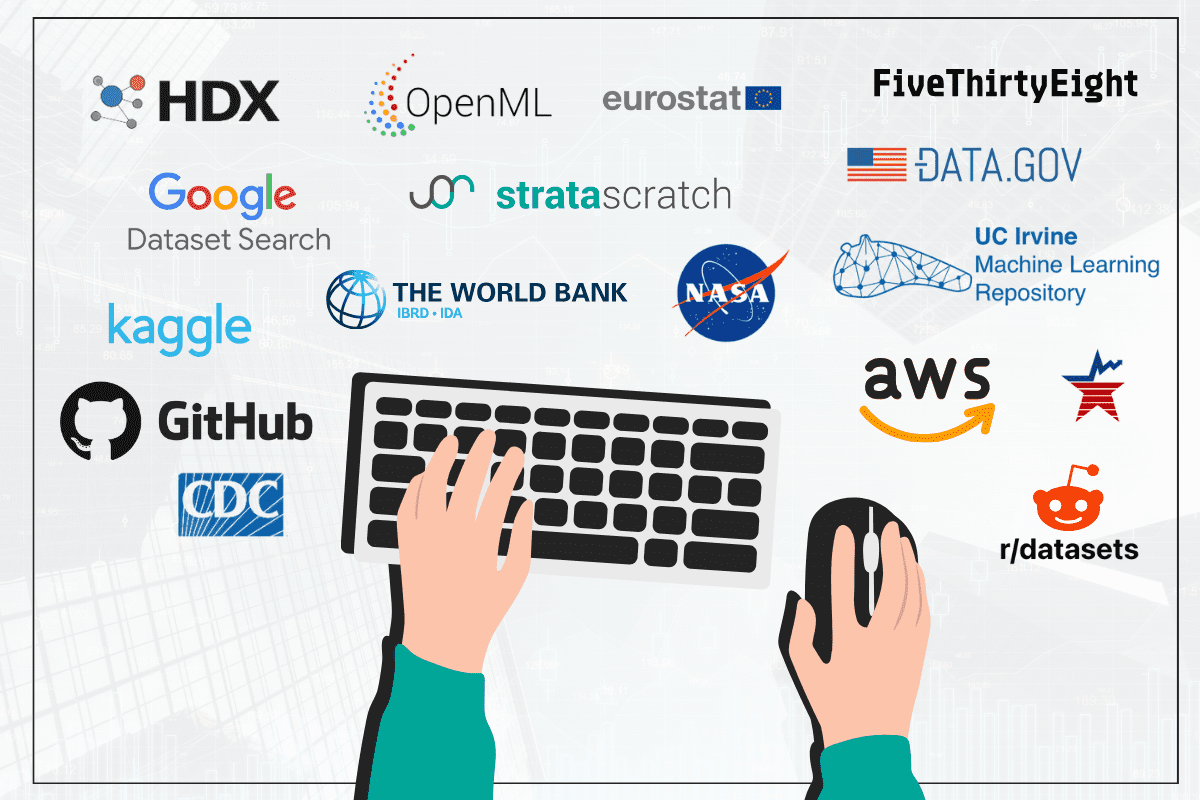
You heard about Kaggle, probably the most well-known platform in the data science community. It hosts a vast array of datasets in various formats (CSV, JSON, SQLite, BigQuery) and from multiple industries and topics, such as health, automotive, arts & entertainment, biology, social science, investing, social networks, sports, and so on. You can also search for datasets depending on their technical focus, e.g., computer science, classification, computer vision, NLP, or data visualization.
Currently, there are 274,855 datasets available, so you won’t be lacking data.
Kaggle’s user-friendly interface and active community forums make it an excellent resource for both beginners and professionals.
2. UCI Machine Learning Repository
If you’re a machine learning enthusiast, the UCI Machine Learning Repository should be your go-to site . As the name says, this repository is created by the University of California, Irvine (UCI). They collected an extensive collection of datasets tailored for machine learning. As the datasets cover various topics, they are especially useful These datasets cover a wide range of topics and are particularly useful for those wanting to practice and improve their machine-learning skills.
There are currently 653 datasets; you can browse them by data type, subject area, task, number of features & instances, and feature type.
3. StrataScratch
StrataScratch provides 49 datasets and projects sourced from actual companies. This is particularly beneficial for those preparing for data science interviews, as it helps users develop their technical skills and ability to derive business insights from data. This allows for a practical and industry-relevant approach to data science projects.
The projects cover various topics, such as data exploration, data engineering, business analysis, regression, classification, NLP, and clustering.
4. Google Dataset Search
Google Dataset Search is a tool whose purpose is to find datasets across the web. You already know how to use it, even if you never heard about it until now. Why? Well, it looks and works like a regular Google search, only it’s focused exclusively on finding datasets. It’s extremely useful if you’re looking for data from various sources, academic papers, and government databases.
5. Amazon Web Services (AWS) Public Datasets
Amazon’s AWS Public Datasets program is another site where you can find a lot of open data. With 494 datasets currently available, it’s a precious resource for data scientists. The datasets you find there can be integrated with AWS cloud services. This might be helpful if your projects require more computing resources.
The range of data available includes genomics, meteorology, and astronomy, among others.
6. Data.gov
Data.gov is a data repository sponsored by the US government and contains data from various US organizations. It includes 283,935 datasets from 132 US organizations. There’s a wide array of data, such as agriculture, public health, finance, education, demographics, economics, and environmental data.
The datasets come in almost 50 different formats, with the most popular including HTML, XML, ZIP, CSV, PDF, ArcGIS GeoServices REST API, KML, GeoJSON, JSON, and TEXT.
7. FiveThirtyEight
FiveThirtyEight by ABC News is their articles' and graphics' data and code repository. It’s a perfect resource for data journalists and anyone interested in statistical storytelling. If you’re interested in doing projects that involve current events, politics, sports, and more, this is your source.
It offers more than 160 datasets from 2014 until today.
8. The World Bank Open Data
The World Bank Open Data offers extensive datasets revolving around global development data. This data includes indicators on the economy, environment, and social issues from countries around the world. If you’re interested in global development and socio-economic topics, you might find a lot of interesting data here.
9. GitHub
GitHub isn’t only a platform for sharing code. It can also be used for finding datasets for data projects. Lots of organizations and individual users host their datasets on GitHub repositories. This data covers a wide range of topics, often supported by extensive documentation and code for analysis.
10. OpenML
OpenML is an online platform for machine learning. This also means giving you access to a lot of data. More specifically, almost 5,400 datasets. It's designed for sharing, organizing, and discussing data and results of machine learning experiments. OpenML can be integrated with popular machine learning environments, which is a bonus for your data science learning.
11. Reddit Datasets
The Datasets subreddit is a community-driven source of data. People share everything on reddit. Well, they also share and request datasets for data projects. Sometimes it’s difficult to find data there. But not because of the lack of data. On the contrary! The place brims with data, which can make the search for data quite chaotic sometimes. The data ranges from highly specific and unusual to more traditional datasets. As this is basically a forum, you can also participate in discussions and ask for assistance with datasets.
12. Eurostat
The statistical office of the European Union is called Eurostat, and it’s a comprehensive source of data. If you’re interested in high-quality statistical data about EU member countries, this should be your main data source. Data on EU countries includes topics such as economy, population, health, and trade.
13. The Humanitarian Data Exchange (HDX)
HDX is an open platform where you can find humanitarian data. It is managed by the United Nations Office for the Coordination of Humanitarian Affairs. This platform provides data revolving around humanitarian crises and emergencies in every country in the world. You could find this useful if you’re into projects focusing on global issues, disaster response, and human welfare.
There are 20,344 active and 2,570 archived datasets with various features and formats.
14. The Centers for Disease Control and Prevention (CDC)
On the CDC, you can find health-related data. The datasets are focused on various health conditions, risk factors, and public health. So, if these are the topics you’re interested in, you’ll find a lot of useful data here.
15. The Bureau of Labor Statistics (BLS)
The BLS site has lots of data on the US economic conditions, labor market, price changes, quality of life, etc. You’ll find lots of quality datasets if you’re into those topics.
16. The National Aeronautics and Space Administration (NASA)
The last source of data I’ll mention is NASA. There’s lots of data on aerospace, applied science, apps, Earth science, management/operations, raw data, software, and space science.
It has more than 10,000 datasets, so don’t get lost in its universe of data!
Conclusion
These 16 websites will, I’m sure, give you enough data to work with until the end of time, which was precisely my goal! However, the amount of data is not everything.
I’ve chosen these sites as they will provide you with a very diverse range of datasets suitable for a variety of data science projects. The dataset specifics differ from industry to industry. So, working with various datasets also allows you to gain domain knowledge.
Whether you’re delving into machine learning, data analysis, data journalism, statistical analysis, or data visualization, you can always count on these resources.
Now, you can do your own data science project! If you need more ideas, here are some data science projects you can do as a beginner.
Nate Rosidi is a data scientist and in product strategy. He's also an adjunct professor teaching analytics, and is the founder of StrataScratch, a platform helping data scientists prepare for their interviews with real interview questions from top companies. Connect with him on Twitter: StrataScratch or LinkedIn.
More On This Topic
Create Efficient Combined Data Sources with Tableau
Facebook Open Sources a Chatbot That Can Discuss Any Topic
With Data Privacy learn to implement technical privacy solutions…
How to Write Engaging Technical Blogs
Hidden Technical Debts Every AI Practitioner Should be Aware of
ChatGPT vs Google Bard: A Comparison of the Technical Differences
Ten years ago, data was something an analyst reviewed and handed over to people who were going to use it. Now, businesses run on data, with automated processes, machine learning models, and hundreds, sometimes thousands, of people in the organization using data daily.
The data space now, with the spurring advancements in AI, has been exploding. And companies are investing heavily in data and data infrastructure, putting data to use in the business, whether it’s analytics or large language models that power different parts of the business or the customer-facing experience.
But it’s also easy to get distracted by the hype, which can impede progress. “Data scientist is kind of like a not well-defined job description,” says Dr. Ingo Mierswa, an industry-veteran computer scientist and founder of Altair RapidMiner. “It’s straightforward,” he reasons; “A software engineer writes code for programs. And if you’re into event marketing, it’s quite clear that you’ll be working on events for your organization. But for data scientists, it’s often very unclear what this person actually does.”
Is this person focusing most of the time on understanding the business, identifying additional use cases, and mapping those use cases and business problems to analytical approaches? It matters whether that person is actually sitting down and working with the dirty data to create it in a better shape—which is closer to data engineering. Or maybe they are focusing only on machine learning models and optimizing them, or taking those models and integrating them into other business applications.
What is this person going to do? Maybe there’s no machine learning involved at all, in which case the role is more like that of a traditional data analyst.
Mierswa, along with two notable data science leaders, each shares insights for both hiring decision-makers and data scientists seeking opportunities.
Keep an open mind
“Data scientists can do all of those things, but not every data scientist is equally good for all of them,” Mierswa elaborates: “When someone comes to me saying, ‘Hey, Ingo, I need a data scientist,’ the first thing I ask is, ‘Why do you need one? What is actually the problem you want to solve? What are the specific needs you have? Like things you think you may need—let’s actually have a conversation if that’s really the right profile or not?’ And one of the things I find interesting, many people fall into this trap and assume they’ll use machine learning for everything; but that’s typically not true for all the reasons. So, if you define the tasks that need to be solved, you also derive the skills you’re looking for in the process. It’s at this stage that I’m actually specifying if I’m hiring a data scientist, as I articulate these requirements. These details become part of the job description and are crucial in assessing people on those elements. Based on this,” he says, “when I’m hiring, I conduct a pretty thorough interview process.”
There are multiple stages in the interview process, as with any other job interview, but only the technical assessment holds more weight because it’s closer to what a data scientist would actually do. “I care way more about conceptual understanding, communication skills, and the fact that this data scientist can truly take a business problem and go end-to-end,” Mierswa expounds. “But most people mix things up—they hear data science and think they can play around all day with data and look for interesting stuff,” he exhorts. “No, you cannot. This is not the profile of a data scientist.”
It requires a more deliberate effort to think clearly about a specific problem. And if you need an end-to-end solution, that doesn’t mean the data scientist is the one person who delivers all of that, but is someone who can help move forward in the right direction. “Taking this into consideration,” he says, “when we go into the technical assessment, I feel much more focused on—putting more focus on, like, conversational skills, analytical thinking, critical thinking, and the understanding of data science concepts.”
Look for thinking skills
When something is in the buzz phase, magically, we encounter hype cycles — moments when certain skills or tools are fervently promoted as indispensable, encouraging people to close the skills gap. Mierswa dispels that, pointing out, “The truth is, data scientists in most cases don’t need programming skills. But let’s say one out of 50 data scientists I’m hiring is actually a coding data scientist, so this person has to have strong programming skills in addition to all the other things — communication skills, critical thinking, analytical thinking, etc.”
“It’s great if you have strong Python skills, some experience, and also if you are a good software engineer. But the good news is that it’s only one out of 50 and the other 49 data scientists don’t need any Python skills.” Humoring against the red herring, he says, “It seems like you’re setting up your data science organization in a way that you think you need to use and write code all the time. If you’re coding twice for the same problem, you’re not solving it efficiently because the true problem-solving in data science means creating reusable, not repetitive, solutions.”
I am always loving people who have a good understanding of databases, Mierswa remarks—some basic SQL always helps because that’s where your data is. And actually, I like to work with people who still have strong Excel, PowerPoint and other presentation skills. Why? Because that is going to be the format you’re going to share results with most of the time, even though some may dislike Excel.
Let’s face it, Excel is still one of the most widely used analytics tools globally. “In our particular case,” Mierswa states, “we are always looking for people with these skills, coupled with the ability to think in workflows, as that’s what data science is at the end.” It doesn’t matter if you code or if you don’t code, but you need to be able to structure your thoughts. It’s about thinking, ‘Now I’m doing this, and based on the outcome, I’ll proceed to the next step. Now I’m looping back…’—that’s what defines workflow thinking. It is mathematical intuition, like you have the mindset of somebody who understands algorithms, but you don’t have to have the technical skills of actually writing them down in code.
Workflow thinking is the technical skill you need to get ahead. And it’s also always good if you can write some Python code and build ML workflows. But this you can learn if you need it, and the rest of the type of the school of thinking—that’s something you have to bring. “I’m not investing years of time to change the way you think,” he says, “but I’m happy to invest into you to give you the right tools and train you in those tools.”
And you’d be remiss to skimp on AI. It’s a priority for data teams because Generative AI will change everything. “If you’re still not familiar with what’s going on out there and how to actually work with large language models, you have to get up to speed immediately,” Mierswa encourages every aspiring data scientist. “Set some time apart, even personal projects, and learn data science the right way—hack your way to getting up to speed on the general, in case you’re still not.”
Keep an eye on the landscape
Much of Mierswa’s optimism comes from his years of experience. More than a decade ago, he created Altair RapidMiner, a no-code data science platform, and his contributions have influenced the adoption and implementation of no-code data science and machine learning functionalities in the industry. And that’s part of why he’s for purpose bullish. “If you think you know it already, you’re in the wrong field. This is also true for software engineers, but for data scientists, in my opinion,” he makes clear, “it’s almost more true. It’s more critical because things change very very quickly in our field.”
And if you are just starting your career—you need to be hungry for learning new things. “I have zero interest,” he urges, “If you want to be a scientist, go work for a university. Don’t go work for an enterprise because for most enterprises we don’t have enough room for researchers.”
It’s important also to note that the job title ‘data scientist’ is often used broadly. But, the naked truth behind the ‘Data Scientist is a sexy Job’ hype is that there is a continental divide with a mountain range of complexity between textbooks and reality. Unlike the neatly organized and structured data often encountered in the academic sphere during learning experiences, the real-world industry data can be messy and less organized.
Varun Mandalapu, Senior Data Scientist in the Insurtech domain, says, ‘”I see many candidates having misconceptions just by relying on job descriptions, which are mostly generic, and some also out of compulsion making poor decisions, hoping to make a career change.” Having hired data scientists across various levels, he shares, “I’ve been fortunate to work on the cutting edge of AI and have seen the stark contrast between the underlying science and the art of what is possible. And for data scientists, there’s never a one-size-fits-all process, whether within a company or even within a team.”
“We solve problems,” he shares, “and it is only in practice, working with competitive people, that we identify the underlying requirements, which are essential for data teams to understand how to solve the problem or we exacerbate the problem by hiring a wrong candidate.”
“And for this reason, when I am interviewing,” he continues, “I don’t want to always talk much technical first but scan their data science portfolio. I want to see instead what impact they made either in their primary occupation or by contributing to projects.”
Shadowing Mierswa, Mandalapu also pointed out the problem of a myopic approach because each team has its unique requirements. One team might be diving into machine learning for marketing, while another is developing AI-powered products. Even within the same team, roles can differ widely — one data scientist could be working on linear ML models, while another tackles dynamic adaptive models.
There is always going to be noise and these distinctions aren’t always obvious in job postings. “It’s essential to recognize that hiring managers and data science teams should precisely articulate these needs,” he also highlights. “Any job interview is a great opportunity for candidates to showcase their data science skills but also a significantly important responsibility for the hiring managers to ensure that the role aligns with their expectations and career goals.”
Key considerations
When we asked about developing and retaining data science talent, Ravindra Patil, Ph.D., Senior Director of Data Science at Tredence, shared his insights on how leaders want to source and hire the right data science talent. He elaborated on the following traits he looks for when conducting interviews with candidates.
Solving Business Problems with Data Science Solutions: To hire candidates, I must be confident they can solve specific business challenges with data-driven solutions. In the interview, candidates should be able to describe how they have applied advanced data science techniques to solve industry and business problems and explain how their contributions have improved operational processes and decision-making.
Combining AI Models and Domain Expertise: One crucial trait for quality data scientists to possess is domain expertise. They understand industry trends, pain points, and enterprise goals and are able to think strategically about how to use their technical skills. Data scientists with domain knowledge can help create AI models that address real-world issues, automate tasks, enhance operational efficiency, and directly influence business decisions. They are able to do this work at a pace since business is speeding up and customer expectations are always increasing.
Using No-Code/Low-Code Tools in Entry-Level Roles: If I’m hiring for entry-level data science and AI roles, I’ll look for candidates’ experience with no-code and low-code platforms. These tools enable individuals with limited coding experience to build and deploy AI solutions more easily. But for complex projects, candidates need to possess traditional coding skills to ensure the reliability, scalability, and maintainability of the solutions.
Enabling Rapid Experimentation with Generative AI: Generative AI is now at the top of everyone’s wish list. Candidates who possess knowledge and understanding of LLMs, the inner workings of RAG, and Multimodal RAG are highly desirable. They even play an instrumental role in developing cost-optimized solutions using advanced AI solutions.
Scaling Data Across the Enterprise: Solving data problems at scale is another critical skill set data scientists must have, along with the ability to cleverly navigate data challenges using augmentation techniques. To democratize data across organizations, they must work effectively with growing data volumes, integrate both structured and unstructured data, collaborate closely with engineering teams to employ or develop cutting-edge tools for insights, ensure data accuracy, and address data sparsity issues. These capabilities empower teams to confidently make informed decisions.
Union Minister of State for Electronics and IT, Rajeev Chandrasekhar, inaugurated Synopsys’ Chip Design Centre at DLF Tech Park in Noida today. As Synopsys’ second-largest design centre in India, it houses approximately 6,000 Indian engineers, constituting 27% of the global design workforce.
These engineers contribute to every aspect of the design cycle of semiconductor chips/IP Cores, reaffirming India’s growing influence in fabless chip design and innovation.
Minister Chandrasekhar spoke about the evolving ecosystem of fabless chip design and innovation in India during the inauguration. He commended Synopsys for its significant contribution to this ecosystem, emphasising the importance of design in India as outlined by Prime Minister Modi.
The minister’s initiatives, including SemiconIndia futureDESIGN, Digital India RISC-V (DIR-V) Program, and the India Semiconductor Research Center (ISRC), align with the vision that “Design in India is as crucial as Make in India.”
Synopsys’ increasing footprint in Noida, hosting 1,650 engineers to begin with, stands as a testament to the expanding ecosystem of fabless chip design and innovation in India. The Indian engineers at Synopsys play a vital role not only in the design cycle of semiconductor chips/IP Cores but also contribute to the success stories of leading semiconductor companies globally. Their expertise in EDA/IP solutions is integral to the development of chips by various companies.
Synopsys, is a global company contributing to $5.9 billion in revenue, is renowned for its design portfolios covering silicon to software. Established in 1986, the company was pivotal in commercialising logic synthesis and revolutionising digital design creation from language descriptions. With a market-leading position in Electronic Design Automation (EDA) tools and Interface, Foundation, & Physical IPs, Synopsys stands at the forefront of advancing digital chips within the technology ecosystem.
The post Rajeev Chandrasekhar Inaugurates Synopsys’ Chip Design Centre in Noida appeared first on Analytics India Magazine.
Data is the lifeblood of our digital world. We crave it, analyze it, base decisions on it. But a hidden truth lurks beneath the glossy surface of charts and graphs: our data is often a muddy mess. Inconsistent, riddled with errors, and prone to manipulation, it can lead to faulty insights, misguided decisions, and even financial losses.
Emerging tools offer innovative ways to combat this problem. This blog covers some of the imminent trends in tech and how they help improve data quality.
Data quality and blockchain
At its core, blockchain is like a shared book of records updated by many computers. Each piece of data becomes a block and is connected to others in a chain. If someone tries to change one block, it messes up the whole chain, showing something’s wrong.
Imagine sending a document across the world. Normally, it passes through many hands, and someone might change it. But with blockchain, it’s locked up digitally and stays safe. Every step is checked, just like a sealed package that arrives unopened.
This transparency builds trust. Everyone involved with the data—from suppliers to consumers—can see where it came from and how it was handled. This transparency stops arguments because everyone knows the facts.
Blockchain doesn’t just keep records; it also stops problems. Since it’s not stored in one place, it’s hard for hackers to mess with it. They can’t break into one computer to change things.
Blockchain can help with data quality in many areas:
Tracking products: It can show where things like food came from, so you know they’re real and safe.
Medical info: It keeps sensitive info safe and only lets the right people see it.
Voting: It stops cheating in elections by recording every vote.
Digital money: It tracks who owns what in things like cryptocurrencies.
Real-time refinement with edge computing
Data is often stuck in big centers waiting to be checked and used. But now, we want info quickly and right where it comes from. That’s where edge computing comes in—it helps clean up data where it starts, making it better and faster.
Think of a factory with many sensors gathering information on temperature and production. Normally, this info travels far to a central computer, taking time. By then, it might be too late to act on it.
Edge computing changes this. It puts the power to process data closer to where it’s collected, like on devices or servers nearby. This means we can immediately fix mistakes or weird info before it messes up everything else.
For example, if a sensor gives a crazy temperature, edge computing can spot it fast and fix it locally without causing big alarms. This not only makes data better but also helps things run smoother.
Data quality doesn’t have to wait for centralized processing anymore. Edge computing brings the cleaning power closer to the data source, analyzing it in real-time at the network’s edge. This reduces latency, improves responsiveness, and ensures high-quality data feeds even in remote locations.
Edge computing helps ensure data quality in many ways:
Less data traffic: It sorts data early, so only the important stuff goes to the main computer, saving time and money.
Better accuracy: Checking data where it’s from makes it more accurate and valuable for local decisions.
Quick reactions: Quickly fixing problems means less time wasted and things working better.
More safety: Keeping sensitive data close by makes it safer and follows the rules about data privacy.
Advanced AI and ML
These intelligent tools are already shaking up the data quality game. Machine learning algorithms can automate anomaly detection, pattern recognition, and even predictive maintenance, proactively identifying and eliminating potential issues before they impact downstream processes. Artificial intelligence can further elevate data quality by understanding context, filling in missing values, and enriching data with insights from external sources.
AI and ML can do amazing things to ensure data quality:
Predictive detection: They can look at old data and tell when there might be problems in the future, helping stop issues before they happen.
Data enrichment: They can make data richer by adding info from other sources, like social media or demographics, making it more useful.
Continuous learning: They keep getting better as they see more data. This process means they stay helpful even as things change.
Even with challenges such as ethical issues and biases, AI and ML can make data quality much better. They can save time, make fewer mistakes, and help us understand data better.
Sensor symphony and the IoT edge
The Internet of Things plays a critical role in enhancing data quality by enabling the collection of real-time, accurate, and diverse data from various sources.
Data Accuracy: IoT devices collect data directly from sensors, machinery, or environments. This data is often more accurate because it’s captured instantly and consistently, reducing human error.
Real-time Monitoring: IoT allows continuous monitoring of processes or environments. This real-time data can provide immediate insights, enabling faster responses to anomalies or issues, thus promptly maintaining data quality by addressing problems.
Diverse Data Sources: IoT devices can gather data from various sources and formats. This diversity enriches datasets, providing a comprehensive view that can lead to better-informed decisions and improved data quality.
Automated Data Collection: IoT devices automate data collection processes, reducing the need for manual entry. This automation minimizes errors and ensures that data is consistently and continuously gathered.
Predictive Maintenance: IoT sensors can predict potential equipment failures or maintenance needs by analyzing patterns in data. This proactive approach helps prevent data quality issues caused by equipment malfunctions or breakdowns.
Contextual Insights: IoT devices capture data in context. For instance, in a manufacturing setting, IoT sensors don’t just record temperature; they provide information about the machine, its location, and operational conditions. This contextual data improves the understanding and relevance of the collected information.
Improved Decision-making: High-quality, real-time data from IoT devices allows for better-informed decision-making. Organizations can rely on accurate and timely insights to make strategic choices that positively impact operations.
Conclusion
As we move towards a more interconnected future, emerging technologies like AI, ML, Edge Computing, and Blockchain are revolutionizing how we ensure data quality. These innovations automate processes, provide real-time insights, and establish trust in data integrity.
While these advancements promise a future where data is accurate, predictive, and secure, they also present challenges like bias, privacy concerns, and the need for human collaboration. Overcoming these challenges is important for using the full potential of these technologies.
Ultimately, the synergy between these cutting-edge tools and data quality drives us toward a future where information is reliable but also rich, timely, and essential for informed decision-making and innovation. It’s about leveraging technology to empower us with invaluable, high-quality data for a better future.
In a recent study, the Massachusetts Institute of Technology (MIT) found that AI can still not replace most jobs cost-efficiently.
Over the last year, the discourse on AI eating away human jobs has gained widespread attention. This is because the adoption of AI has increased significantly after OpenAI released ChatGPT.
“Machines will steal our jobs’ is a sentiment frequently expressed during times of rapid technological change. Such anxiety has re-emerged with the creation of large language models,” the researchers said in the report titled ‘Beyond AI Exposure’.
In one of the most comprehensive examinations assessing the feasibility of AI replacing human labour, the researchers at MIT conducted a detailed analysis of the cost-effectiveness of automating diverse tasks in the US.
The focus was particularly on occupations utilising computer vision, a subset of AI enabling computers to derive information from images, videos and other inputs.
In the report, the researchers also said, “We find that at today’s costs, US businesses would choose not to automate most vision tasks that have ‘AI Exposure,’ and that only 23% of worker wages being paid for vision tasks would be attractive to automate.”
They further revealed that only 3% of these tasks can be automated in a cost-effective manner. However, the researchers indicated that this figure could potentially increase to 40% by 2030, assuming a decline in data costs and an enhancement in accuracy.
The research employed online surveys to gather data on approximately 1,000 visually-assisted tasks spanning 800 occupations.
The post Majority of Jobs Still Beyond AI Replacement: MIT Report appeared first on Analytics India Magazine.
$300k/year. That’s probably the first thing you saw and you’re probably thinking ‘Huh, how?.’ I asked myself the exact same thing. But I am not surprised. With the way Generative AI was going in the year 2023, this was bound to be the next hot career that everybody wanted a piece of.
If you still don’t believe me, have a look at the vacancy from Anthropics here.
Believe me now?
I’ll take that as a yes and stop dilly-dallying and get right into how you can learn AI prompt engineering for FREE and hopefully land yourself a new swanky job!
Open AI Prompt Engineering Guide
Link: Prompt Engineering Guide
Let’s start with the ones who are currently leading the prompt engineering/generative AI game at the moment — OpenAI.
OpenAI has provided a guide which will go through strategic tactics to help you get better results from large language models such as GPT-4. They encourage users to experiment, trial and error until they find the best method that works for them!
They go through a range of examples along with 6 strategies for getting better results.
NLP with Deep Learning
Link: NLP with Deep Learning
It’s great to know how to prompt a model to do what you want, but it’s even better when you understand the way it works — the ins and outs.
A course offered by Deep Learning which explores the foundations and applications of natural language processing (NLP) using deep learning techniques. So rather than just clearing how to communicate with a computer system, dive a little deeper and understand how computer systems understand and create human-like speech.
Learn Prompting
Link: Learn Prompt Engineer Guide
Oh another guide, but this time more extensive! The founders came together to create a comprehensive and FREE guide on how to use Generative AI. If you’re new to the world of AI, the guide is for you. It has been specifically aimed at non-technical readers who want to learn more about Generative AI and Prompt Engineering.
If you have a bit of tech knowledge under your belt and need something a bit more challenging, the later modules will be for you.
Prompt Engineering Masterclass
Link: Prompt Engineering Masterclass
If you’re willing to subscribe, the content from Prompt Engineering Masterclass is free to you! It is an evolving series which is divided into sectioned articles. You will gain insight into advanced prompt engineering techniques used for Generative AI.
You will start with learning about Generative AI foundations, an introduction to Large Language Models and Prompt Engineering, and then slowly move onto more advanced topics such as prompt engineering techniques, conversational AI models, AGI, and enterprise GenAI, as well as practical examples.
Prompt Engineering for Developers
Link: Prompt Engineering for Developers
A free 1-hour course provided by DeepLearning.AI with Isa Fulford and Andrew Ng as your course coordinators. This course has been curated specifically for developers, in which you will learn how to use an LLM and build new and powerful applications.
Using the OpenAI API, you’ll learn to innovate, master the best practices for prompt engineering, and explore how LLM APIs can be used for a variety of tasks.
Prompt Engineering Guide
Link: Prompt Engineering Guide
Last but not least, another prompt engineering guide. There’s no such thing as too many free guides!
With a high interest in the development of LLMs, PromptingGuide.AI have created a prompt engineering guide. Not only will you be able to master prompt engineering, but it also contains the latest papers, advanced prompting techniques, learning guides, and more.
Wrapping it up
6 courses away from landing yourself that new swanky job that could be paying you big bucks! Of course, there’s more to it than just mastering prompt engineering, you will need to put it into practice, create a good portfolio and put your best foot forward!
Nisha Arya is a Data Scientist and Freelance Technical Writer. She is particularly interested in providing Data Science career advice or tutorials and theory based knowledge around Data Science. She also wishes to explore the different ways Artificial Intelligence is/can benefit the longevity of human life. A keen learner, seeking to broaden her tech knowledge and writing skills, whilst helping guide others.
More On This Topic
Ploomber vs Kubeflow: Making MLOps Easier
The Significance of Data Quality in Making a Successful Machine…
Making Intelligent Document Processing Smarter: Part 1
From Data Analyst to Data Strategist: The Career Path for Making an Impact
Making Predictions: A Beginner's Guide to Linear Regression in Python
How Predictive Analytics is Revolutionizing Decision-Making in Tech