Top 15 AI Image Generators of 2024

Keep these in SEO field

SEO Title:

Slug:

__________________________________________________________________________

Google released the much-awaited access to Gemini Pro for image generation. Users can instruct Bard to create images through Google’s Imagen 2 text-to-image model. This adds to a plethora of text-to-image generation tools already available to users.

The journey into AI image generation began in 2015 with automated image captioning, designed to assist individuals with vision impairments. This led to models that could generate images from text – a complex task. OpenAI’s DALL.E and DALL.E 2 significantly advanced text-to-image generation, despite initial concerns of misuse, fueling demand for AI creativity tools.

The field grew competitive with open-source options like DALL.E Mini (now Craiyon), broadening access to AI art generation. This resulted in a variety of AI image generators, mostly free, enhancing creative possibilities.

Here is a list of the top image generators.

Dall.E 3

DALL.E 3 is a text-to-image generative AI model developed by OpenAI. It improves upon its predecessors by synthesising images from text descriptions. It can produce detailed, realistic images and understand abstract concepts to create visuals.

The model supports editing images and generating variations. It transforms text into images through a process involving text encoding, image generation based on a dataset, and ranking the generated images for relevance and quality. DALL.E 3 is available through ChatGPT Plus and Enterprise subscriptions, the OpenAI API, and powers Microsoft Designer’s Image Creator.

Additionally, DALL.E 3 powers Microsoft Designer’s Image Creator, which may have its own subscription or usage fees.

Canva

Canva’s AI Image Generator is a tool for graphic design, offering features like templates and custom colour options. Its more advanced features require payment, and some users may need to learn how to use it effectively.

Compared to Adobe Spark and Snappa, Canva is user-friendly and intuitive, though it may offer fewer features than Adobe Spark. It is available in both free and paid versions, suitable for beginners and professionals, and supports mobile use.

Stable Diffusion

Stable Diffusion XL is a text-to-image generator developed by Stability AI, launched as an open-source model on August 22, 2022. It allows users to create images from text prompts and is known for its flexibility and openness, inviting developers to modify and distribute its code.

With over 10 million users by September 2023, it offers advanced features like editing images, generating variations, and excluding unwanted elements through negative prompts. Users can access Stable Diffusion through platforms like Clipdrop and Dream Studio, with varying pricing models.

Midjourney

Midjourney uses AI to create images from text prompts. The system has been trained on a vast number of images to produce new visuals. It converts text to images, offering several options per prompt, and allowing users to adjust and refine these images.

Users can also customise image attributes such as size and aspect ratio. Support is available through Discord, and there is API access for developers.

Shutterstock

Shutterstock has introduced AI editing tools to its stock photo library, allowing users to edit images directly on its platform. This new feature aims to integrate image editing with stock photo selection, enabling users to modify any image from Shutterstock’s library without needing external software.

The AI editor is currently in beta and free to use, but downloading edited images requires payment. Shutterstock subscribers can use this feature without extra charges, and contributors are compensated for the use of edited versions of their images.

Shutterstock’s move to add AI editing capabilities responds to the growing use of AI in creating and modifying digital content. By offering these tools, Shutterstock positions itself as a one-stop solution for obtaining and personalising stock images.

Gemini Pro

Google Bard now offers AI image generation, competing with ChatGPT Plus. This feature is free and uses Google’s Imagen 2 model for creating simple images, with improvements expected over time. Initially, there were expectations for Bard to use the more advanced Gemini Ultra model, but it remains under development.

Unlike ChatGPT Plus’s subscription model, Bard’s image generation is free, making it accessible to more users. Google ensures safety in Bard’s image creation, embedding watermarks in AI-generated photos to indicate their artificial nature. It also implements safeguards against generating images of public figures or inappropriate content.

CGDream AI

CGDream AI is an all-encompassing tool designed for creating visuals from 3D models. This platform empowers users to transform any 3D model into an image with prompts. Users can choose from a library of 3D models or upload their own, offering unparalleled flexibility.

The process involves fine-tuning the model’s angle, setting the scene, applying filters for added flair, and adding text prompts before hitting the generate button to bring visions to life.

Image Creator from Microsoft Designer

Microsoft Designer is an integrated tool called Image Creator, which allows you to generate AI-powered images using the capabilities of DALL-E 2. This tool is available within a free tier version of Designer, though limitations on image generation apply.

Image Creator is capable of producing images in styles ranging from photographs to illustrations to 3D renders. Since Image Creator is connected to the broader Microsoft Designer app, any images you generate can easily be incorporated into your other design projects.

ImageFX by Google

Google’s ImageFX is a free-to-use AI image generation tool that you can access directly through your web browser. It’s notable for producing high-quality images quickly. To use ImageFX, you simply provide a text description of the image you’d like to see, and the platform will generate four different image options based on your prompt.

A unique feature called ‘expressive chips’ allows you to apply artistic styles or quickly make changes to your prompts with just a few clicks.

DreamStudio by Stability AI

DreamStudio by Stability AI is a web-based AI image generator that offers a flexible model with both free access and a credit-based system. When you sign up, you’ll receive some free credits to try the service. Once those are used, you can purchase additional credits if you’d like to generate more images.

DreamStudio is known for producing high-quality outputs quickly. Plus, it offers extensive customization options, allowing you to fine-tune the images created from your prompts.

Dream by WOMBO

WOMBO Dream is an AI image generator that offers a combination of free image generation and an optional subscription plan for expanded features. It’s a popular choice due to its speed and the realism of the images it produces. You can use WOMBO Dream through its mobile app or access it through a web browser on your computer.

WOMBO Dream includes templates to help you get started and structure your prompts. Users can upload their own images and have WOMBO Dream apply different styles or create variations based on them.

Craiyon

Craiyon (formerly DALL-E Mini) is a free-to-use AI image generator accessible through its website. Simply type in a description of what you’d like to see, and Craiyon will generate several image options.

While Craiyon’s output speed may be a bit slower compared to some paid alternatives, its unlimited prompts and simple interface make it a popular choice for anyone wanting to experiment with AI image generation.

Generative AI by Getty Images

Getty Images Generative AI offers a customisable pricing model tailored to your individual needs. You can contact Getty Images directly for a pricing quote. This AI image generator is unique because it draws upon Getty Images’ vast image library. This ensures the resulting images are safe for commercial use and allows you to personalise existing stock images. Additionally, Getty Images compensates the artists whose work contributes to the AI’s learning process.

Adobe Firefly

Adobe Firefly is an ethical AI image generator trained on open-source, Adobe Stock, and copyright-expired images, setting it apart from rivals like Midjourney and DALL-E2.

Despite some pricing model concerns from Adobe Stock contributors, Firefly is marketed as commercially safe, offering legal protection to users. It uniquely generates vectors, text, and integrates with Adobe software, accessible via web with free and premium plans.

Recent updates have enhanced its capabilities, including improved text prompt understanding and creative control tools. Firefly supports collaborative editing in Photoshop and is committed to ethical training practices, allowing users to opt out of their work being used for training.

Runway ML

Runway ML, launched in 2019, provides access to machine learning for creators without coding expertise, offering a platform where users can easily apply AI tools to their projects. It simplifies the integration of AI into creative workflows, particularly for text-to-image applications, by providing a user-friendly “app store” of machine learning models.

It allows for the direct import of models from GitHub, catering to the dynamic needs of the AI art community. Despite its broad appeal, the platform faces limitations for those seeking to create highly customised artwork due to its reliance on pretrained models. Additionally, its pay-per-minute computation fee after initial free credits may not be cost-effective for extensive training needs.

The post Top 15 AI Image Generators of 2024 appeared first on Analytics India Magazine.

India vs China vs US in Open Source AI

It takes a lot for open source models to be on top of the Hugging Face Open LLM Leaderboard. Falcon, LLaMA and Mistral, the models that have had their moment at the top, are now making way for open source models from China. But, there is no need to be worried about the Chinese models (as long as they are open source).

Currently, an unfamiliar model Smaug-72B, is on top of the leaderboard. It boasts an average score of 80, outperforming Mistral. Developed by Abacus AI, Smaug-72B is a fine-tuned model of Qwen-72B, which was developed by the Chinese tech-giant Alibaba and released in December last year, along with a 1.8 billion parameter model.

Qwen-72B is only one of the larger models that Alibaba has developed. The company also released its latest open source model, Qwen1.5-72B model, which surpassed Claude-2.1, GPT-3.5-Turbo-0613 on several benchmarks. Notably, Qwen is also an organisation building LLMs and large multimodal models (LMMs), and other AGI-related projects.

China’s open source dominance

Clearly, the fear of China rising up against US AI models is becoming a reality. The models from the country are increasingly dominating open source, and will continue to do so in the upcoming years. But as with the case of Abacus AI’s Smaug model, it is clear that the researchers are more interested in using open source models, rather than taking any risk, which is how research works.

Apart from Qwen, Tencent in September last year released ‘Hunyuan’ LLM for enterprise usage, marking a significant move as companies in the country strive to establish themselves as leaders in the technology industry, more specifically, the generative AI field. Tencent’s vice president, Jiang Jie, highlighted the competitive landscape, stating that over 130 LLMs had surfaced in China by July.

In December, DeepSeek, a company based in China which aims to “unravel the mystery of AGI with curiosity”, open sourced DeepSeek LLM, a 67-billion parameter model trained meticulously from scratch on a dataset consisting of 2 trillion tokens, in both English and Chinese, clearly hinting the bid to go across the globe. It also outperformed Llama 2, Claude-2, and Grok-1 on various metrics.

Moreover, Kai-Fu Lee’s AI startup, 01.AI has open sourced its foundational LLM called Yi-34B, which outperforms Llama 2 on various key metrics. Lee said that all he wanted to do was provide an alternative to Meta’s Llama 2, which has been “the gold standard and a big contribution to the open-source community”.

Speaking of Meta, the company has clear plans to release Llama 3 as soon as possible. Though open source is clearly the winner of the AI race, there is no definite one winner in the open source race, as everyone is aiming for the top spot, and manage to stay on top of the leaderboard for a significant amount of time, be it Llama, Mistral, or UAE’s Falcon. It is clearly the right time to also adopt the impressive open source LLMs from China.

What about India?

When it comes to India and generative AI, all the recent Indic language models such as Kannada, Tamil, or Telugu, have been built on top of models built by Meta’s Llama 2 or Mistral. There is a dire need for India to build its own open source model from scratch and let others build on top of it.

Speaking to AIM, Ganesh Ramakrishnan, the IIT Bombay professor who is leading the BharatGPT initiative, said that there is definitely the need for a foundational model for Indic languages. “We are building foundational models from scratch and that is what is keeping us busy,” said Ramakrishnan about how BharatGPT will mark India on the global AI map.

But even now, while Indian researchers are focusing on Indic language, and taking on the herculean task of collecting Indic language dataset, there is still not a single model built from scratch even in English to have reached the Hugging Face leaderboard. It is hard to assume that an Indic language model, though becoming open source, would be used by researchers from other countries.

That is why China releases its models in both English and Chinese, for others to use the model, instead of forming a bubble within the country.

Apart from building Indic LLMs for India to be used in several ways, it is also necessary for an open source model from India that outperforms others globally, even if it is just an English LLM. “Mistral got France on the AI map. We want India to get on the AI map with BharatGPT,” said Ramakrishnan.

“We want everyone to use generative AI,” Vishnu Vardhan, the founder of Vizzhy, who is also the GPU buddy of BharatGPT told AIM. He said that the initiative would not just be about releasing weights, but making it available to everyone and highlighted that the first model would be open source. He wants developers to help them make it better. “The more people use it, the better it will become,” and eventually, they would release more versions of the model.

The post India vs China vs US in Open Source AI appeared first on Analytics India Magazine.

Unico Housing Finance Partners with Oracle for Affordable Housing Solutions

Unico Housing Finance, a digital housing finance company in India, has partnered with Oracle Cloud Infrastructure (OCI) to address the housing needs of the country’s unbanked and underserved communities, the company said in a statement.

With the demand for homeownership on the rise in India, Unico aims to expedite the home loan approval process, providing affordable housing loan solutions and services to lower and middle-income customers at scale.

Unico has strategically chosen OCI for its superior performance, scalability, security, and cost-effectiveness. The cloud infrastructure will enable Unico to run applications faster, adjust capacity based on demand, and manage operational expenses efficiently.

We required a resilient, scalable, and secure platform to meet the increasing demand for housing loan solutions and services, and OCI emerged as the ideal choice,” said Babu Vellingiri, CEO of Unico Housing Finance.

Additionally, Oracle Cloud Lift Services will support Unico’s lean IT team in planning, architecting, prototyping, and managing cloud migrations, accelerating their time to value.

Unico has implemented various OCI services to support its digital business ambitions. The Oracle Base Database Service enhances database performance, while the Oracle Autonomous Data Warehouse streamlines data staging, eliminating cumbersome backup tasks.

Oracle Analytics Cloud provides a complete platform for sourcing data from anywhere, aiding in uncovering business insights and increasing productivity.The use of OCI Database with PostgreSQL, a top-tier managed service, improves system resilience, scalability, and data security through end-to-end encryption.

OCI Full Stack Disaster Recovery facilitates tailored disaster recovery plans for Oracle Applications, and Cloud Guard manages Unico’s security posture, offering a unified view of cloud security across Oracle Cloud Infrastructure.

In addition to OCI, Unico plans to implement Oracle FLEXCUBE to process loans efficiently without compromising the banking experience. Oracle Fusion Cloud Financials, known for its speed and scalability, will automate financial management processes to meet compliance standards, providing real-time visibility into financial reports.

The post Unico Housing Finance Partners with Oracle for Affordable Housing Solutions appeared first on Analytics India Magazine.

Peak XV takes startups on a Silicon Valley trip in AI push

Peak XV takes startups on a Silicon Valley trip in AI push Manish Singh 8 hours

Peak XV, the venture capital firm that split from Sequoia Capital last year, is taking its portfolio companies from India, Southeast Asia and Australia on an “immersion” trip to Silicon Valley this week to meet several industry titans, the latest in the venture firm’s broadening offerings and networking flex.

About 60 founders, many backed by Peak XV’s powerfully influential program Surge, will join partners from the firm on the trip to meet industry leaders and visit AI research centers, according to a participant briefed on the matter.

The week includes strategy sessions with executives from OpenAI and Nvidia as well as Sequoia partner Doug Leone, and talks from seasoned operators like Uniphore chief Umesh Sachdev and DoorDash advisor Gokul Rajaram, according to an email the firm sent to portfolio startups seen by TechCrunch.

The program, internally dubbed “Immersion Week,” is the latest peek at Peak XV’s broadening roster beyond writing checks as competition intensifies among venture investors seeking access to the most promising AI startups globally.

India, one of the largest startup ecosystems, currently lacks the depth in deeptech and AI startups. Very few players in India are attempting to build foundational large language models. Sarvam AI, one such startup, announced a $41 million funding late last year led by Peak XV and Lightspeed India and scored a partnership with Microsoft last week.

Investors say that many existing startups in India are strategizing on what new capabilities to build and in finding customers overseas — and that’s where a trip like ‘Immersion’ can prove beneficial.

Peak XV’s latest Surge batch is 77% AI and deep tech startups

Peak XV, which has $2.5 billion to deploy in the region, has taken an aggressive approach since its split last year, rapidly building out its bench strength and networking capabilities across geographies.

Peak XV didn’t immediately respond to a request for comment Monday morning. But in the email to portfolio companies over the weekend, Peak XV told founders the trip would “focus on building world-class products” and gaining “a glimpse into the AI world.”

Peak XV Managing Directors Shailendra Singh, Rajan Anandan, Harshjit Sethi, Ashish Agrawal, and Surge Partner Pieter Kemps are among those hosting the week, according to the person briefed on the matter.

Your AI Journey: Start Small AND Strategic – Part 2

Slide1-1

In part 1 of the series “Your AI Journey: Start Small AND Strategic,” we learned that it’s essential to begin your AI journey by focusing on delivering significant and measurable business and operational value. This is necessary because AI projects require significant data, technology, people skills, and culture investments to succeed. Thus, you will need the support of senior management to make these investments and stay the course as your organization learns to apply AI to derive and drive new sources of customer, product, service, and operational value.

However, don’t attempt to build all your data and analytics capabilities and architecture upfront – the dreaded “Big Bang” approach. Instead, focus on incrementally delivering quantifiable business and operational value (and exploiting the economies of learning).

Start small, but start small and strategic, not small and random.

Part 2 of this blog series will discuss how to triage your organization’s strategic business initiatives. We will break down that business initiative into its supporting use cases, enabling your AI initiative to deliver the required value and urgency to gain organizational agreement and support.

Start Your AI Journey with a Strategic Business Initiative

A Business Initiative is a cross-functional effort typically lasting 9-12 months that includes well-defined KPIs and metrics supporting the organization’s business and operational objectives.

To get senior management’s attention and commitment to support and participate in your AI journey, you must link your AI initiative to what’s critical to the organization – a Strategic Business Initiative. A Strategic Business Initiative is characterized as:

  • Critical to the immediate-term (12 to 16 months) performance of the organization
  • Documented (communicated either internally or publicly)
  • Cross-functional (involves more than one business function)
  • Owned/championed by a senior business executive
  • Has measurable goals (KPIs and metrics)
  • Has a well-defined delivery time frame
  • Characterized as either an opportunity or a challenge
  • Delivers significant, compelling, and distinguishable financial, organizational, or competitive advantage

Business initiatives focus on helping organizations optimize critical operational processes, improve operational efficiencies, mitigate regulatory and compliance risks, uncover new revenue streams, and create a more relevant, differentiated customer experience. Here are examples of strategic business initiatives by industry (Table 1).

Industry Strategic Business Initiatives
Consumer Increase customer loyalty and retention
Expand into new markets, customer segments, and audiences
Enhance brand reputation and awareness
Education Improve student outcomes
Increase student enrollment and retention
Improve faculty and staff retention
Energy, Resources & Industrials Reduce environmental impact and carbon footprint
Optimize asset performance and maintenance
Increase safety and compliance
Entertainment Acceleration the creation and distribution of engaging content
Analyze and anticipate audience preferences and behavior
Optimize distribution and monetization channels
Financial Services Optimize transaction processes
Reduce fraud, theft, and money laundering
Improve customer acquisition and retention
Government & Public Services Improve public service delivery and citizen satisfaction
Optimize operational effectiveness and eliminate unnecessary costs
Reduce fraud
Life Sciences & Health Care Accelerate new drug discovery
Improve patient outcomes and treatment effectiveness
Reduce operational costs and inefficiencies
Manufacturing Reduce unplanned operational downtime
Reduce obsolete and excessive inventory
Improve supplier quality and reliability
Retail Improve customer satisfaction, loyalty, and referrals
Improve sales forecasting and inventory management
Reduce fraud, theft, and shrinkage
Technology, Media & Telecom Create products and services to attract new customers and audiences
Optimize operational effectiveness
Expand into new markets and customer segments/audiences
Transportation Optimize traffic flow and reduce congestion
Improve delivery and service quality and reliability
Improve operational effectiveness.

Table 1: Strategic Business Initiatives by Industry

Note: strategic business initiatives are unique to each organization. Even organizations in the same industry will likely have different business initiatives. Consequently, always invest the time to identify and understand your organization’s strategic business initiatives.

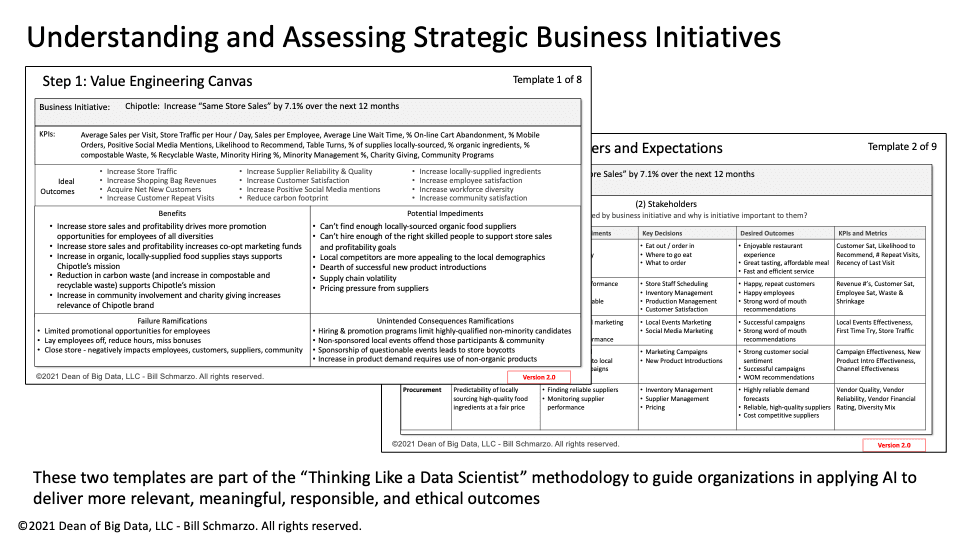
By the way, the Value Engineering and Stakeholder Assessments templates (the first two steps in the “Thinking Like a Data Scientist” methodology) are great (and free) templates for assessing your organization’s business initiatives and the impact of those business initiatives on your key stakeholders (Figure 2).

Slide2-1

Figure 2: Templates for Assessing Your Strategic Business Initiative

Understanding your strategic business initiative and its impact on key stakeholders is the first step in your AI journey. But to turn our vision into reality, you need to break down the business initiative into actionable use cases that define the specific outcomes, metrics, and data sources that will guide your data and analytics efforts. These use cases provide the roadmap for achieving business initiative success and creating value for your customers and organization.

Identifying Use Cases

Use Cases are a cluster of desired outcomes, critical stakeholder decisions, and the KPIs and metrics against which outcomes and decision effectiveness are measured.

Once you thoroughly understand your targeted business initiatives, we can apply the “Thinking Like a Data Scientist” methodology to identify, validate, value, and prioritize the use cases that support or enable those strategic business initiatives. A use case is characterized as:

  • Directly aligned with the strategic business initiative’s goals, metrics, and time frame
  • Supports the execution of the organization’s strategic business initiative
  • Focused on optimizing a business or operational outcome
  • Results are measurable
  • Impacts multiple organizations
  • Is part of a more significant value stream or value chain process
  • Articulated with an action verb, a desired outcome, and a quantifiable measure of success

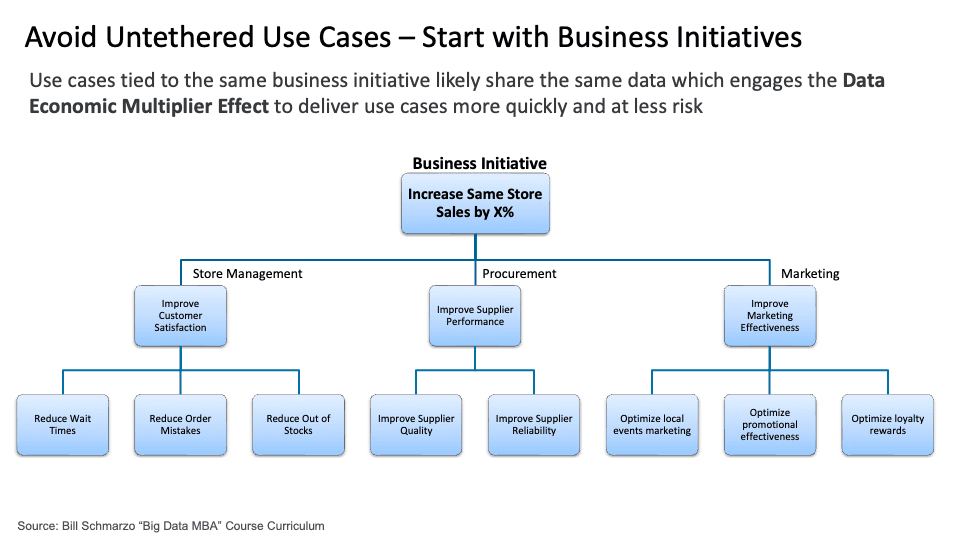
The goal is to identify the use cases that directly support the organization’s strategic business initiatives and then create a use case roadmap where the organization can build out its data, analytics, and people capabilities on a use case-by-use case basis (Figure 3).

Slide3-1

Figure 3: Avoid Untethered, Random Use Cases

The Use Case Approach and the Economies of Learning

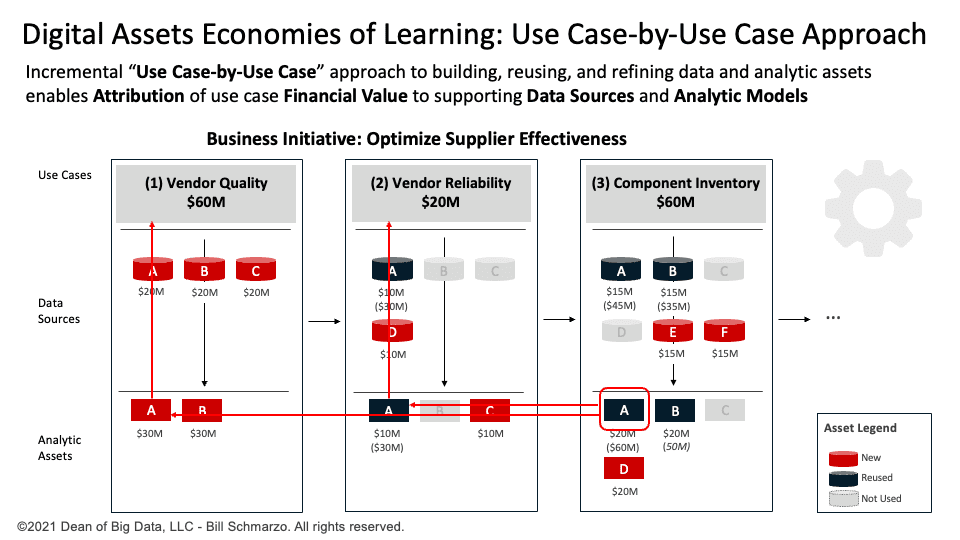
The “Economies of Learning” concept posits that data’s value increases exponentially as organizations leverage it to continuously learn, innovate, and make informed decisions that drive strategic improvements and competitive advantage.

A use case approach enables the organization to incrementally build its data and analytics capabilities (and avoid the dreaded big bang approach), where each use case directly contributes to its strategic business initiatives. Check out the “Big Data MBA Video Episode 17: Power of Use Case-based Data & Analytics Strategy” video to learn the key data and analytic economic concepts underpinning the incremental use case approach in Figure 4.

Slide4-1

Figure 4: The Power of the “Economies of Learning”

Or as the “Dean of Big Data” GPT states:

“In a landscape increasingly governed by the intricacies of artificial intelligence, the capacity for perpetual learning and agile adaptation will delineate the victors from the vanquished. This dynamic environment demands not just the utilization of AI technologies, but a strategic embrace of the ‘Economies of Learning,’ where the iterative cycle of learning from data, applying insights, and fostering innovation becomes the linchpin of sustained competitive advantage. Organizations that master this cycle will not only survive but thrive, transforming challenges into opportunities for growth and differentiation.”

Dang, that digital Bill Schmarzo is much more eloquent than the human version!

Summary: Your AI Journey: Start Small and Strategic

All organizations are under intense pressure to deliver on the power and potential of AI. But starting that journey by focusing on AI or data can lead the company astray and hinder the organization’s ability to leverage AI to deliver more meaningful, relevant, responsible, and ethical outcomes.

As we remember from the blog “Schmarzo and the Value·Nauts: The Journey from Data to Value”, the journey from data to value starts by understanding how your organization defines and measures the effectiveness of your value creation processes. And remember:

Start small, but start small and strategic, not small and random.

Solo Giants! List of Successful One-Person Companies 

Sam Altman mentioned to Alexis Ohanian, the co-founder of Reddit in their tech CEO group chat, there’s a bet on when the first billion-dollar company with just one person will appear, made possible by AI. “Which would have been unimaginable without AI and now will happen,” Altman said.

Tech companies see a future where companies succeed with smaller, more efficient teams, challenging the idea that growth requires more employees. “There’s going to be a new phenomenon where CEOs and founders are going to be so excited to get up and go to work with much smaller, much more performant, much more culturally strong teams,” Ohanian said.

There are already tech ventures that are successful as a one person company.

Plenty of Fish

Founded in 2003 by Markus Frind, the dating website is headquartered in Vancouver, Canada. The company that began in 2003 was run single handedly by the founder till 2007. The company today is one of the most popular dating sites and boasts around 170 million users in 2024.

In the beginning, Frind operated POF from his home, relying on Google AdSense for revenue, which grew from $5 to $3,300 a month by year’s end. This success convinced him to focus solely on POF. Despite its growth and profitability, Frind avoided venture capital, preferring to grow POF independently. By 2008, POF had 15 million registered users and was generating about $10 million annually, all without any employees for the first five years.

As POF continued to grow, Frind moved operations to Vancouver, hiring a team to expand and improve the website, introducing new features and premium options. By 2015, Frind decided to sell POF to The Match Group for $575 million, leaving the company.

Builtwith

Founded in 2005 by Gary Brewer, BuiltWith is headquartered in Brighton, United Kingdom, and operates as a website technology analysis tool. Despite its modest team of 50 employees as of 2020, the company generated over $14 million in annual revenue with just one full-time employee.

Gary Brewer started BuiltWith in 2007 after realizing the need for a platform that could easily identify the technologies used by websites. Initially a side project while working a corporate job in Sydney. The platform quickly became valuable for lead generation, allowing competitors of services like Mailchimp to identify and contact potential customers.

In 2011, Andrew Rogers, who was working on a similar project joined Brewer.

The duo set a high bar for hiring additional staff, deciding only to consider expanding the team if monthly revenue reached $100k.

BuiltWith’s marketing strategy relies on its free tool to attract paid users, supported by a weekly blog post from a contractor. By 2017, the platform had garnered significant traction, with over 2 million page views, more than 500,000 users a month, and between 2,000 to 3,000 paying customers on plans ranging from $295 to $995 per month.

Balsamiq

In 2008, Giacomo (Peldi) Guilizzoni founded Balamiq, a wireframing and prototyping tool company based in Turin, Italy. By 2020, the company, with 50 employees, was generating $10 million annually. The company is a web-based user interface design tool for creating wireframes. Users generate digital sketches or concepts for an application or website, and facilitate discussion and understanding before any code is written.

“My idea originally was to start a one man company and stay a one man company but the product was too successful for that the market told me that I needed to grow and that’s what we’ve been doing ever since,” Peldi said. The company now employs around 40 people and reported a revenue of $7.3M in 2023.

Viral Nova

Founded by Scott Delong, in 2013, it is a curation site for the most viral content on the Internet, similar to buzzfeed. At its peak, it generated $5-$10M per year in revenue and 100M readers per month with 0 funding and 0 employees.

The startup operated solely by DeLong and assisted by two freelance writers, managed to expand its website to match Buzzfeed’s reach and scale, attracting around 100 million monthly readers. This growth was achieved without employing any full-time staff or securing external investment.

ViralNova was purchased by Zealot Networks in a cash and stock deal for upwards of $100 million. DeLong subsequently launched GodVine, a website that features inspiring stories that appealed to Facebook’s predominantly female audience. It rose to become a top 1,500 website according to Alexa’s traffic rankings.

Stardew Valley

Founded by Eric Barone began working on Stardew Valley in 2011 as a side project, with the game officially releasing in February 2016.

Barone developed Stardew Valley, a hit indie farming simulator RPG inspired by Harvest Moon. The game stands out for being crafted entirely by Barone, covering coding, art, music, and design, and became a commercial success without any external funding.

Eric Barone started Stardew Valley to improve his job prospects after college. What began as a resume builder evolved into a full-time project fueled by passion. Despite the lack of a formal plan, Barone’s intuitive development process and deep research into game mechanics led to a rich and authentic experience. He announced the game on Steam Greenlight in 2012, gaining early attention and community support.

A partnership with Chucklefish in 2013 helped with logistics while allowing Barone to maintain creative control. By 2021, Stardew Valley had sold over 15 million copies across all platforms, indicating substantial revenue given the game’s price point, which varies by platform but is generally around $14.99 USD.

Photopea

Founded by Ivan Kutskir, Photopea is a free online photo and graphics editor that has carved out a significant niche in the digital editing space. Launched as a solo project, Kutskir’s creation has grown into a robust platform, rivaling traditional software with its comprehensive suite of editing tools.

The platform now boasts 10 million visits per month and generates approximately $1.5 million in annual revenue. Remarkably, users spend a collective 1.5 million hours each month on the site, a testament to its utility and user-friendly design.

Kutskir’s journey with Photopea began as an experiment, aiming to offer a free, web-based alternative to Photoshop. This experiment quickly evolved into Kutskir’s primary source of income, with the platform’s growth trajectory showing no signs of slowing down. In the last year alone, Photopea crossed the $500,000 mark in annual recurring revenue (ARR), a significant milestone for any digital tool.

Monetization of Photopea comes primarily through ads, a strategy Kutskir chose based on his previous experience with online games. This approach, coupled with licensing deals that allow for API customization, has proven effective.

Kutskir today has an annual server cost of just $45, a figure that is almost unheard of for platforms with such high traffic.

The post Solo Giants! List of Successful One-Person Companies appeared first on Analytics India Magazine.
OpenAI to Invest in India, Host Developer Summits

ChatGPT maker OpenAI will continue investing in the developer community in India and will hold several developer summits in the country this year, as reported by the Economic Times, citing the company’s Chief Strategy Officer, Jason Kwon.

“India has the key ingredients of being one of the world’s leaders in AI. It has the largest developer community in the world, with some of the most impressive talent in the field, a track record of developing extraordinary technology businesses and a relentless focus on competing on the world stage,” said Kwon at the ET Now Global Business Summit in New Delhi, as mentioned in the ET report.

The company intends to collaborate with developers in India, partnering with OpenAI product leaders to address some of the most challenging issues in AI. On January 5, OpenAI’s Vice President of Engineering, Srinivas Narayanan, engaged with developers in Bengaluru.

Kwon also highlighted the importance of prioritizing safety in AI exploration. He mentioned that OpenAI is actively working on making its tools safer through technology, partnerships, and collaboration with governments.

Last year, OpenAI appointed Rishi Jaitly, a former Vice President at Twitter, to the role of Senior Advisor. His executive experience positions him to guide the company through India’s AI policy and regulatory landscape.

As per recent statistics, ChatGPT has over 180 million users, with the US contributing to 10.81% of total users, followed by India with 9.08% users. Being the 2nd highest market for ChatGPT, India’s contribution to the OpenAI market is already well placed.

The post OpenAI to Invest in India, Host Developer Summits appeared first on Analytics India Magazine.
Prama India & C-DAC (MeitY) Forge Partnership for Thermal Camera Technology

In a significant move towards bolstering innovation and indigenous manufacturing, Prama India and the Centre for Development of Advanced Computing (C-DAC), Ministry of Electronics & Information Technology (MeitY), Government of India, have entered into a technology partnership for Thermal Cameras. The partnership was officially unveiled at the ‘Digital India FutureLabs’ launch event at IIITM, New Delhi.

The ‘Transfer of Technology’ (ToT) agreement empowers Prama India as a technology partner to manufacture, market, and support the newly introduced thermal camera solutions. MoS for Electronics & IT, Rajeev Chandrasekhar, marked the occasion by launching the “Digital India FutureLABS” and delivering the keynote address at the event.

“The signing of Transfer of Technology (ToT) Agreement for Thermal Camera Technology with C-DAC, Thiruvananthapuram is a new milestone in our indigenous manufacturing journey,” expressed a representative from Prama India. “We are committed to the vision of Atmanirbhar Bharat for achieving the goal of Viksit Bharat and Surakshit Bharat. This joint initiative by C-DAC and MeitY has created a landmark milestone for Prama India, a leading indigenous manufacturer of Video Security Products.”

Highlighting the significance of the partnership, the representative added, “The certificate of partnership states that Prama India is the Technology Partner of C-DAC for general-purpose thermal cameras. Prama India is authorized to manufacture, market, and support general-purpose thermal cameras in India as per the transfer of Technology agreement with C-DAC, Thiruvananthapuram.”

Prama India, known for its commitment to ‘Made for India, Made by India, and Made in India,’ has positioned itself as the first mover in indigenous manufacturing in the video security products sector. The company’s state-of-the-art manufacturing facility near Mumbai aims to transform India into a global manufacturing and export hub for video security products.

The minister emphasised the importance of ‘Digital India FutureLABS,’ stating, “It represents an opportunity for Indian startups at the forefront of developing NextGen Electronics in Automotive, Compute, Telecom, Industrial, and Strategic Electronics.”

The ‘Digital India FutureLABS’ initiative by C-DAC aims to tap into the trillion-dollar opportunity presented by the Electronics System Design and Manufacturing (ESDM) sector. With a focus on key growth areas such as Compute, Communication, Automotive & Mobility, Strategic Electronics, and Industrial IoT, the initiative is strategically positioned to leverage futuristic technologies, including AI, Big Data, and Quantum Computing, marking a transformative phase in Indian research.

The post Prama India & C-DAC (MeitY) Forge Partnership for Thermal Camera Technology appeared first on Analytics India Magazine.
The best ad of Super Bowl weekend comes from Apple (and it’s not in the Super Bowl)

screenshot-2024-02-06-at-4-44-13pm.png

Technology brings you into another world.

It's time to huddle around our screens.

It's time to celebrate a quintessential pastime that involves men, large and less large, pushing each other to the limits.

No, I'm not talking about an overnight Meta hackathon. I'm talking about the Super Bowl, the one time of year when Americans express strong opinions about ads — many for tech companies — and the role of football as a backdrop.

Also: How to watch Super Bowl 2024: All the best streaming options

It's always a moment for national debate.

As we approach the big game — my colleague Steven Vaughan-Nichols has a fine Super Bowl streaming guide — a big debate has revolved around Apple's Vision Pro and how it may affect human life.

Will it revolutionize the way we work and play? Will it increase feelings of loneliness? Will Apple have a Vision Pro ad in the Super Bowl? (Well, Apple Music will certainly be there, in an ad starring, goodness, Tim Cook.)

The future is currently a hot topic.

Microsoft's offering for Sunday's big show is an anthemic vision for professionals. Or, rather, for those aspiring to be.

With rousing music and aggressive spirit, Microsoft touts what young people — oh, they're all young people — will be able to achieve with Microsoft's new AI companion, Copilot.

It's all very persuasive and moving — and oddly reminiscent of another Microsoft campaign, ultimately quashed by Bill Gates in the last century, called "Where Do You Want To Go Today?"

I can imagine many dreamers being utterly entranced by this Microsoft ad, as they watch the Super Bowl and its superhuman cast of characters.

Yet, as you parse the Super Bowl ad merits of Microsoft raising your hopes and Uber Eats fighting DoorDash, please spare a thought for a different ad Apple released specially for this weekend.

No, not for the Super Bowl but for Chinese New Year.

Fifteen minutes of contemplation

It so happens that Chinese New Year falls on February 10, the day before the Chiefs and 49ers enjoy their own little festival of joy. And I fancy Apple's Chinese New Year ad may have more to say than all the Super Bowl ads put together.

This, you see, is a 15-minute-long tale of a little girl called Wei who believes she's imperfect, but suddenly discovers she has superpowers. She can become something different — more importantly, in her mind, someone different.

Also: Everything on how to protect your privacy and stay safe online

"If I can become everything, I'll be the most popular girl around," she tells her grandfather. "Everyone would like me."

Don't we all want everyone to like us? Don't we grow up with that desperation ingrained in our souls?

Wei believes she's not as attractive as models in magazines, yet as she comes to terms with her own power to become anyone she likes, she suddenly concludes: "I want to be alone."

The full force of technology

It's a temporary feeling.

When she grows up, she leaves her village and heads for the big city. That's when she confronts the full force of technology and, specifically, social media.

Who is she really? How should she be? When you're on the likes of Instagram or TikTok, you can become anyone you want, so Wei begins to deal with life's obstacles by using her superpowers to become someone else, many someone elses indeed.

For us mere mortals, technology gives us a little of that superpower too.

Wei finds her shapeshifting so much fun that, when her grandad calls, she doesn't bother answering.

Also: The 3 biggest risks from generative AI — and how to deal with them

Her shapeshifting — and the technology that disseminates her new selves — is far more useful in offering her ego trips. Who needs dull voyages down memory lane?

When grandad comes to see her, she denies she's who she really is. Yet, once he's gone, she finally begins to realize what her shapeshifting superpower, coupled with social media ubiquity, has done to her. She realizes that she's lost touch with her genuine self.

Yes it's Apple, but it's still thoughtful

This little film — naturally all shot on an iPhone 15 Pro Max with a stellar film crew — offers the notion that if you can't be perfect, you might as well be yourself, because that's the best path to happiness.

Some might find excessive schmaltz in all this. Some might even find it painfully dated, a mundane contrast with Microsoft's forward-looking adventure.

Also: The best Apple deals you can buy right now

The ad is, though, an elegant reminder that for all the approbation people seek in the digital world — and some research now suggests that young people find far more there than in the real world — there's (ultimately) a deeper joy in simple, real-world self-acceptance.

I know this isn't the sort of thing that Super Bowl ads will often offer you. And I know, too, that Apple has played its own role in making it easier to leave your true self behind and disappear into that, well, other world online. Apple Vision Pro offers, perhaps, the highest level of personal disappearance yet.

It's still uplifting, though, to see a tech company acknowledge at least a little of the personal disturbances its own products contribute to engendering.

Also: The Apple products you shouldn't buy this month

No, it's not a beer company telling you a joke. It's not Uber Eats and DoorDash fighting to see which celebrities you like best. It's not Microsoft telling you its new AI will shapeshift your future. It's not even Apple getting its CEO to act.

But perhaps this Apple ad will make some people feel better about their true selves and isn't that what all tech companies should strive to do?

Featured

The State of Multilingual LLMs: Moving Beyond English

Multilingual LLMs Blog image

According to Microsoft research, around 88% of the world's languages, spoken by 1.2 billion people, lack access to Large Language Models (LLMs). This is because most LLMs are English-centered, i.e., they are mostly built with English data and for English speakers. ​This English dominance also prevails in LLM development and has resulted in a digital language gap, potentially excluding most people from the benefits of LLMs. To solve this problem for LLMs, an LLM that can be trained in different languages and perform tasks in different languages is needed. Enter Multilingual LLMs!

What are Multilingual LLMs?

A multilingual LLM can understand and generate text in multiple languages. They are trained on datasets that contain different languages and can take on various tasks in more than one language from a user's prompt.

Multilingual LLM applications are enormous, they include translating literature into local dialects, real-time multilingual communication, multilingual content creation, etc. They would help everyone access information and talk to each other easily, no matter their language.

Also, multilingual LLMs address challenges such as lack of cultural nuances and context, training data limitations, and the potential loss of knowledge during translation.

How do Multilingual LLMs Work?

Building a multilingual LLM involves carefully preparing a balanced corpus of text in various languages and selecting a suitable architecture and training technique for training the model, preferably a Transformer model, which is perfect for multilingual learning.

Steps to build a multilingual LLM

Source: Image by author

One technique is to share embeddings, which capture the semantic meaning of words across different languages. This makes the LLM learn the similarities and differences of each language, enabling it to understand the different languages better.

This knowledge also empowers the LLM to adapt to various linguistic tasks, like translating languages, writing in different styles, etc. Another technique used is cross-lingual transfer learning, where the model is pre-trained on a large corpus of multilingual data before being fine-tuned on specific tasks.

This two-step process ensures the model has a strong foundation in multilingual language understanding, making it adaptable to various downstream applications.

Examples of Multilingual Large Language Models

Multilingual LLM comparison chart

Source: Ruder.io

Several notable examples of multilingual LLMs have emerged, each catering to specific linguistic needs and cultural contexts. Let's explore a few of them:

1. BLOOM

BLOOM is an open-access multilingual LLM that prioritizes diverse languages and accessibility. With 176 billion parameters, BLOOM can handle tasks in 46 natural and 13 programming languages, making it one of the biggest and most diverse LLMs.

BLOOM's open-source nature allows researchers, developers, and language communities to benefit from its capabilities and contribute to its improvement.

2. YAYI 2

YAYI 2 is an open-source LLM designed specifically for Asian languages, considering the region's complexities and cultural nuances. It was pre-trained from scratch on a multilingual corpus of over 16 Asian languages containing 2.65 trillion filtered tokens.

This makes the model give better results, meeting the specific requirements of languages and cultures in Asia.

3. PolyLM

PolyLM is an open-source ‘polyglot’ LLM that focuses on addressing the challenges of low-resource languages by offering adaptation capabilities. It was trained on a dataset of about 640 billion tokens and is available in two model sizes: 1.7B and 13B. PolyLM knows over 16 different languages.

It enables models trained on high-resource languages to be fine-tuned for low-resource languages with limited data. This flexibility makes LLMs more useful in different language situations and tasks.

4. XGLM

XGLM, boasting 7.5 billion parameters, is a multilingual LLM trained on a corpus covering a diverse set of over 20 languages using the few-shot learning technique. It is part of a family of large-scale multilingual LLMs trained on a massive dataset of text and code.

It aims to cover many languages completely, which is why it focuses on inclusivity and linguistic diversity. XGLM demonstrates the potential for building models catering to the needs of various language communities.

5. mT5

The mT5 (massively multilingual Text-to-Text Transfer Transformer) was developed by Google AI. Trained on the common crawl dataset, mt5 is a state-of-the-art multilingual LLM that can handle 101 languages, ranging from widely spoken Spanish and Chinese to less-resourced languages like Basque and Quechua.

It also excels at multilingual tasks like translation, summarization, question-answering, etc.

Is a Universal LLM Possible?

The concept of a language-neutral LLM, capable of understanding and generating language without bias towards any particular language, is intriguing.

While developing a truly universal LLM is still far away, current multilingual LLMs have demonstrated significant success. Once developed fully, they can cater to the needs of under-represented languages and diverse communities.

For instance, research shows that most multilingual LLMs can facilitate zero-shot cross-lingual transfer from a resource-rich language to a resource-deprived language without task-specific training data.

Also, models like YAYI and BLOOM, which focus on specific languages and communities, have demonstrated the potential of language-centric approaches in driving progress and inclusivity.

To build a universal LLM or improve current Multilingual LLMs, individuals and organizations must do the following:

  • Crowdsource native speakers for community engagement and curation of the language datasets.
  • Support community efforts regarding open-source contributions and funding to multilingual research and developments.

Challenges of Multilingual LLMs

While the concept of universal multilingual LLMs holds great promise, they also face several challenges that must be addressed before we can benefit from them:

1. Data Quantity

Multilingual models require a larger vocabulary to represent tokens in many languages than monolingual models, but many languages lack large-scale datasets. This makes it difficult to train these models effectively.

2. Data Quality Concerns

Ensuring the accuracy and cultural appropriateness of multilingual LLM outputs across languages is a significant concern. Models must train and fine-tune with meticulous attention to linguistic and cultural nuances to avoid biases and inaccuracies.

3. Resource Limitations

Training and running multilingual models require substantial computational resources such as powerful GPUs (e.g., NVIDIA A100 GPU). The high cost poses challenges, particularly for low-resource languages and communities with limited access to computational infrastructure.

4. Model Architecture

Adapting model architectures to accommodate diverse linguistic structures and complexities is an ongoing challenge. Models must be able to handle languages with different word orders, morphological variations, and writing systems while maintaining high performance and efficiency.

5. Evaluation Complexities

Evaluating the performance of multilingual LLMs beyond English benchmarks is critical for measuring their true effectiveness. It requires considering cultural nuances, linguistic peculiarities, and domain-specific requirements.

Multilingual LLMs have the potential to break language barriers, empower under-resourced languages, and facilitate effective communication across diverse communities.

Don't miss out on the latest news and analysis in AI and ML – visit unite.ai today.