UiPath is Building Foundational Models: CEO

UiPath, a leading enterprise automation software company, is developing foundational models, according to Daniel Dines, co-founder and chief innovation officer at UiPath. While speaking at the UiPath DevCon 2024, held in Bengaluru, Dines also pointed out that the company revealed its vision model in DevCon the previous year.

At the event, UiPath also announced a host of new features in its platform designed to enable developers to build, test, and accelerate implementation of automation.

The company announced UiPath Autopilot for Test Suite, now in public preview. Autopilot for Test Suite provides a collection of advanced AI capabilities designed to boost the productivity of testers throughout the entire testing lifecycle. Autopilot for Test Suite includes:

  • AI-Powered Quality Checks: acts as an expert reviewer at a tester’s fingertips analysing requirements, from popular lifecycle tools such as Jira or Azure DevOps or documents such as a PDD, process design document.
  • AI-Powered Test Design: generates manual tests with step-by-step instructions from developers’ requirements and supporting docs, such as workflows or design documents.
  • AI-Powered Test Automation: converts any text, including manual test steps, into automated tests in UiPath Studio Desktop with little effort; and
  • AI-Powered Test Insights: provides real-time, actionable insights into the test case portfolio, empowering rapid issue resolution and continuous improvement almost instantaneously.

“With the UiPath developer community in excess of 2 million, and developers and learners across 43 countries, the innovations we provide this community are absolutely essential in the AI and automation era. To build modern automations, it is not only about driving the UI. Developers also need API integrations, data, and AI solutions. We are making it possible for developers to access all these constructs in one integrated platform,” Dines said in a press release.

“We are infusing Generative AI across all our products. We believe when AI is combined with automation, magic happens. It’s like combining an intelligent brain with highly capable body to carry out powerful tasks,” said Munil Shah, chief technology officer, UiPath Automation Cloud.

The post UiPath is Building Foundational Models: CEO appeared first on Analytics India Magazine.

7 Steps to Mastering Exploratory Data Analysis

7 Steps to Mastering Exploratory Data Analysis
Image by Author

Exploratory Data Analysis (or EDA) stands as a core phase within the Data Analysis Process, emphasizing a thorough investigation into a dataset's inner details and characteristics.

Its primary aim is to uncover underlying patterns, grasp the dataset's structure, and identify any potential anomalies or relationships between variables.

By performing EDA, data professionals check the quality of the data. Therefore, it ensures that further analysis is based on accurate and insightful information, thereby reducing the likelihood of errors in subsequent stages.

So let’s try to understand together what are the basic steps to perform a good EDA for our next Data Science project.

The Significance of EDA

I am pretty sure you have already heard the phrase:

Garbage in, Garbage out

Input data quality is always the most important factor for any successful data project.

Unfortunately, most data is dirt at first. Through the process of Exploratory Data Analysis, a dataset that is nearly usable can be transformed into one that is fully usable.

It's important to clarify that it is not a magic solution for purifying any dataset. Nonetheless, numerous EDA strategies are effective at addressing several typical issues encountered within datasets.

So… let’s learn the most basic steps according to Ayodele Oluleye in his book Exploratory Data Analysis with Python Cookbook.

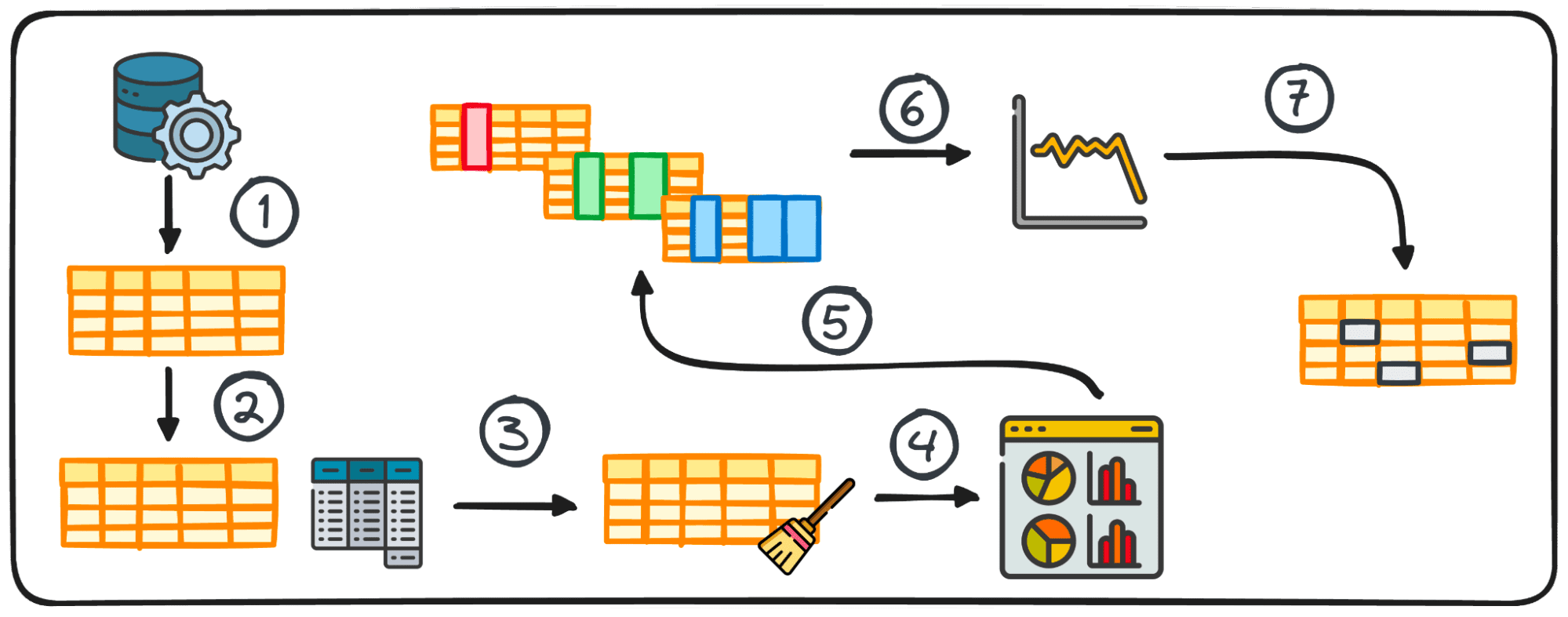
Step 1: Data Collection

The initial step in any data project is having the data itself. This first step is where data is gathered from various sources for subsequent analysis.

2. Summary Statistics

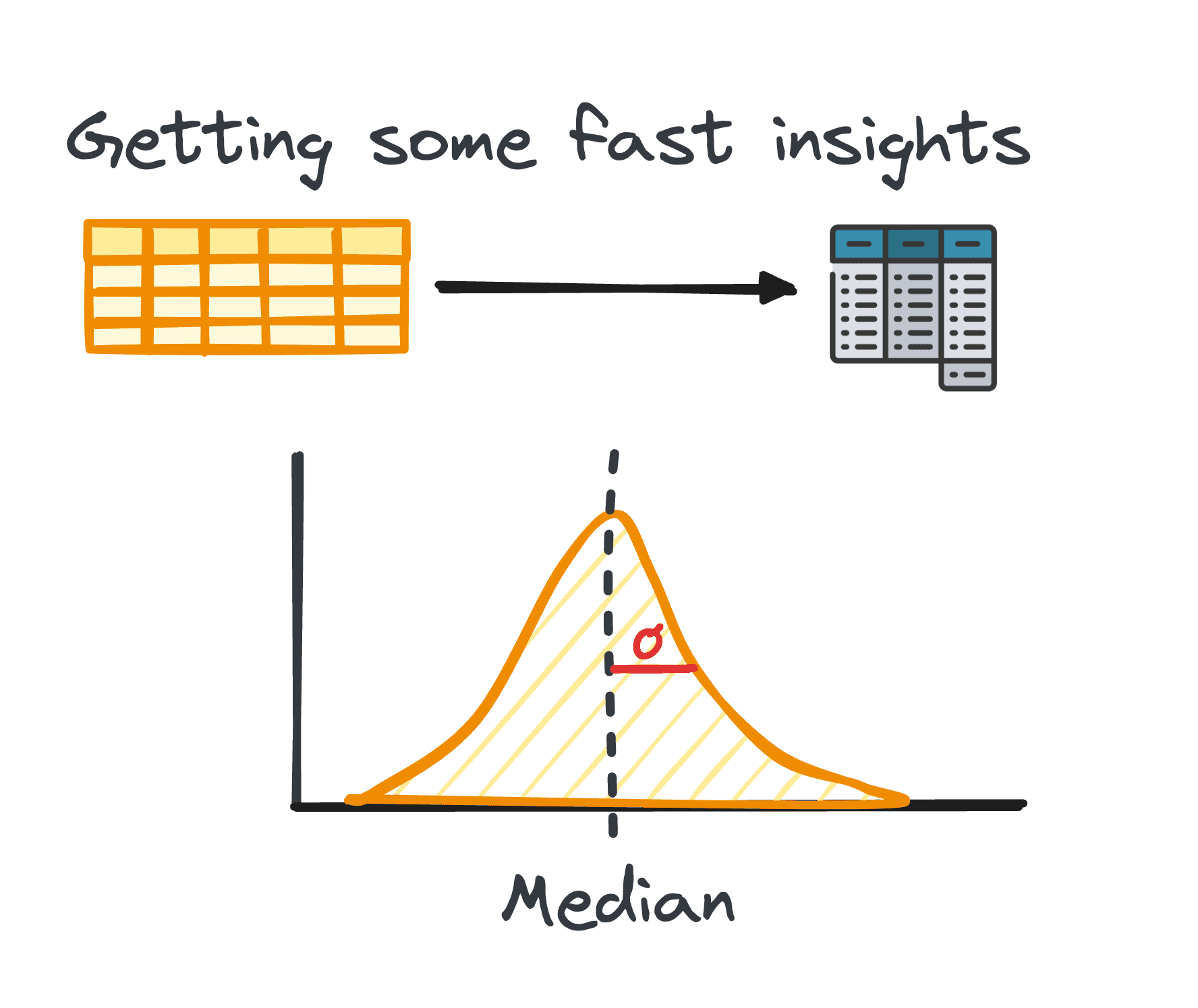
In data analysis, handling tabular data is quite common. During the analysis of such data, it's often necessary to gain rapid insights into the data's patterns and distribution.

These initial insights serve as a base for further exploration and in-depth analysis and are known as summary statistics.

They offer a concise overview of the dataset's distribution and patterns, encapsulated through metrics such as mean, median, mode, variance, standard deviation, range, percentiles, and quartiles.

7 Steps to Mastering Exploratory Data Analysis
Image by Author

3. Preparing Data for EDA

Before starting our exploration, data usually needs to be prepared for further analysis. Data preparation involves transforming, aggregating, or cleaning data using Python's pandas library to suit the needs of your analysis.

This step is tailored to the data’s structure and can include grouping, appending, merging, sorting, categorizing, and dealing with duplicates.

In Python, accomplishing this task is facilitated by the pandas library through its various modules.

The preparation process for tabular data doesn't adhere to a universal method; instead, it's shaped by the specific characteristics of our data, including its rows, columns, data types, and the values it contains.

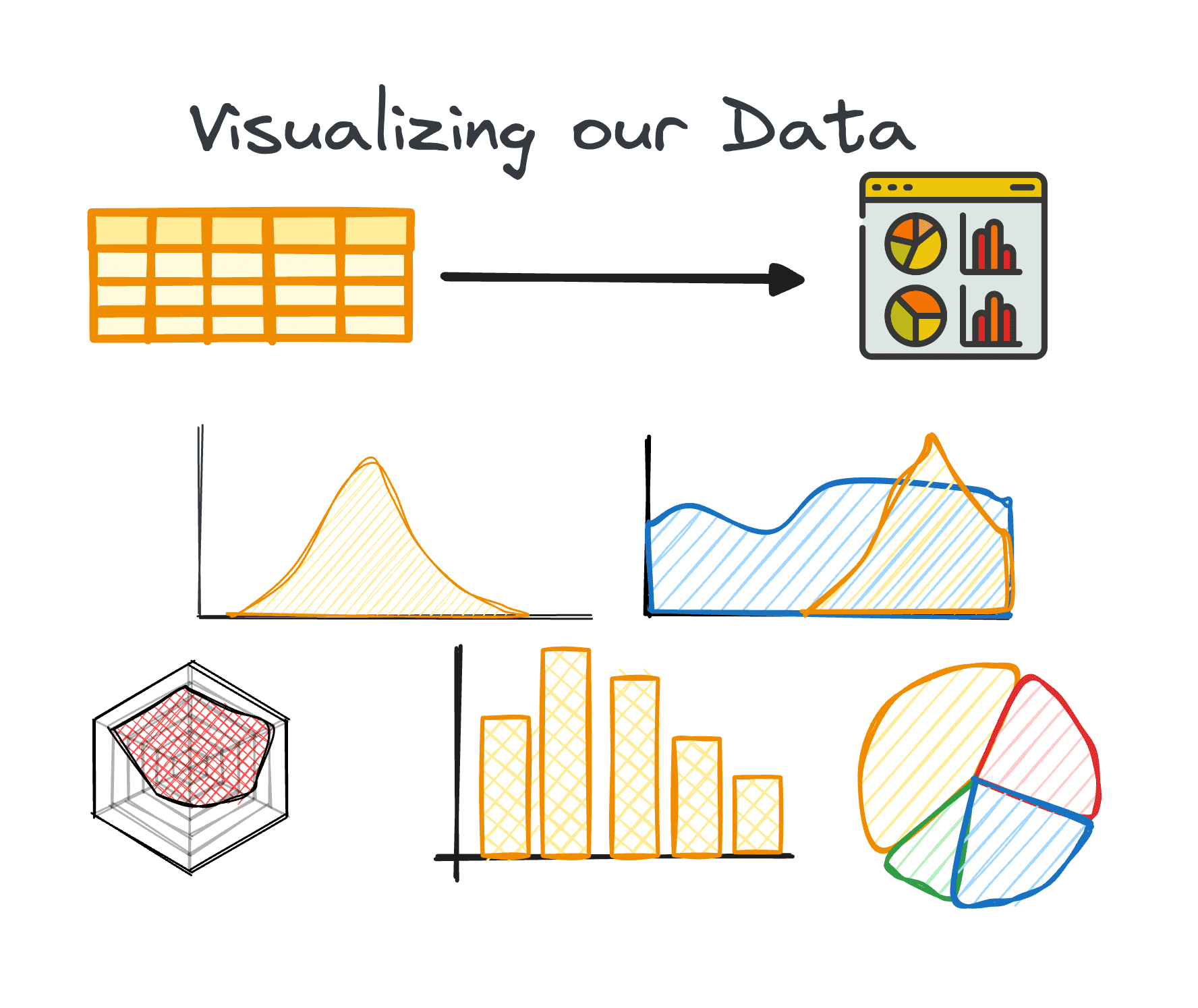
4. Visualizing Data

Visualization is a core component of EDA, making complex relationships and trends within the dataset easily comprehensible.

Using the right charts can help us identify trends within a big dataset and find hidden patterns or outliers. Python offers different libraries for data visualization, including Matplotlib or Seaborn among others.

7 Steps to Mastering Exploratory Data Analysis
Image by Author

5. Performing Variable Analysis:

Variable analysis can be either univariate, bivariate, or multivariate. Each of them provides insights into the distribution and correlations between the dataset's variables. Techniques vary depending on the number of variables analyzed:

Univariate

The main focus in univariate analysis is on examining each variable within our dataset on its own. During this analysis, we can uncover insights such as the median, mode, maximum, range, and outliers.

This type of analysis is applicable to both categorical and numerical variables.

Bivariate

Bivariate analysis aims to reveal insights between two chosen variables and focuses on understanding the distribution and relationship between these two variables.

As we analyze two variables at the same time, this type of analysis can be trickier. It can encompass three different pairs of variables: numerical-numerical, numerical-categorical, and categorical-categorical.

Multivariate

A frequent challenge with large datasets is the simultaneous analysis of multiple variables. Even though univariate and bivariate analysis methods offer valuable insights, this is usually not enough for analyzing datasets containing multiple variables (usually more than five).

This issue of managing high-dimensional data, usually referred to as the curse of dimensionality, is well-documented. Having a large number of variables can be advantageous as it allows the extraction of more insights. At the same time, this advantage can be against us due to the limited number of techniques available for analyzing or visualizing multiple variables concurrently.

6. Analyzing Time Series Data

This step focuses on the examination of data points collected over regular time intervals. Time series data applies to data that change over time. This basically means our dataset is composed of a group of data points that are recorded over regular time intervals.

When we analyze time series data, we can typically uncover patterns or trends that repeat over time and present a temporal seasonality. Key components of time series data include trends, seasonal variations, cyclical variations, and irregular variations or noise.

7. Dealing with Outliers and Missing Values

Outliers and missing values can skew analysis results if not properly addressed. This is why we should always consider a single phase to deal with them.

Identifying, removing, or replacing these data points is crucial for maintaining the integrity of the dataset's analysis. Therefore, it is highly important to address them before start analyzing our data.

  • Outliers are data points that present a significant deviation from the rest. They usually present unusually high or low values.
  • Missing values are the absence of data points corresponding to a specific variable or observation.

A critical initial step in dealing with missing values and outliers is to understand why they are present in the dataset. This understanding often guides the selection of the most suitable method for addressing them. Additional factors to consider are the characteristics of the data and the specific analysis that will be conducted.

Conclusions

EDA not only enhances the dataset's clarity but also enables data professionals to navigate the curse of dimensionality by providing strategies for managing datasets with numerous variables.

Through these meticulous steps, EDA with Python equips analysts with the tools necessary to extract meaningful insights from data, laying a solid foundation for all subsequent data analysis endeavors.

Josep Ferrer is an analytics engineer from Barcelona. He graduated in physics engineering and is currently working in the Data Science field applied to human mobility. He is a part-time content creator focused on data science and technology. You can contact him on LinkedIn, Twitter or Medium.

More On This Topic

  • Exploratory Data Analysis Techniques for Unstructured Data
  • A Data Scientist’s Essential Guide to Exploratory Data Analysis
  • A Lightning Fast Look at Single Line Exploratory Data Analysis
  • How Visualization is Transforming Exploratory Data Analysis
  • Mastering the Data Universe: Key Steps to a Thriving Data Science Career
  • KDnuggets™ News 22:n05, Feb 2: 7 Steps to Mastering Machine…

OpenAI unveils text-to-video model and the results are astonishing. Take a look for yourself

OpenAI video gnerator still frame

Still frame from a video generated by Sora. OpenAI's prompt was, "The camera directly faces colorful buildings in burano italy. An adorable dalmation looks through a window on a building on the ground floor. Many people are walking and cycling along the canal streets in front of the buildings."

Open AI already has market-leading AI models in image and text generation with DALL-E 3 and ChatGPT, respectively. Now, the company is coming for the text-to-video generation space, too, with a brand-new model.

Also: The best AI image generators of 2024: Tested and reviewed

On Thursday, OpenAI unveiled Sora, its text-to-video model that can generate videos up to a minute long with impressive quality and detail, as seen in the demo video below:

Sora can tackle complex scenes, including multiple characters, specific types of motion, and great detail, because of the model's deep understanding of language, prompts, and how the subjects exist in the world, according to OpenAI.

From watching different demo videos, you can see that OpenAI has managed to tackle two big issues in the video-generating space: continuity and longevity:

AI-generated videos are often choppy and distorted, making it clear to the audience where every frame ends and begins. For example, Runaway AI released its most advanced text-to-video model, Gen-2, in March. As seen below, the clips don't quite compare to those of OpenAI's model today:

OpenAI's model, on the other hand, can generate fluid video, making each generated clip look like it was lifted from a Hollywood-produced film.

Also: How to use ChatGPT

OpenAI says Sora is a diffusion model that's able to produce high-quality output by using a transformer architecture similar to the GPT models, as well as past research from DALL-E and GPT models. In addition to generating video from text, Sora can generate video from a still image or fill in missing frames from videos:

Despite showing all of its advancements, OpenAI also addresses the model's weaknesses, claiming it can sometimes struggle with "simulating the physics of a complex scene, and may not understand specific instances of cause and effect." The model could also confuse the spatial details of a prompt.

The model is becoming available to red teamers first to asses the model's risks, and to a select number of creatives, such as visual artists, designers, and filmmakers, to collect feedback on how to improve the model to meet their needs.

Also: I tried Microsoft Copilot's new AI image-generating feature, and it solves a real problem

It seems like we are entering a new era in which companies will shift focus to researching, developing, and launching capable AI text-to-video generators. Just two weeks ago, Google Research published a research paper on Lumiere, a text-to-video diffusion model that can also create highly realistic video.

Artificial Intelligence

6 Text-to-Video Generative AI Models 

Soon after DALL-E gave rise to text-to-image AI, companies took a step ahead and started creating text-to-video models. Over two years, the landscape has evolved from being noisy to producing hyper-realistic results using text prompts.

While the results may still be imperfect, several models today display a high degree of controllability and the ability to generate footage in various artistic styles.

Here are six latest text-to-video AI models you could try out.

Sora

ChatGPT creator OpenAI just showcased Sora, their new text-to-video model. Everyone’s excited since the model has “a deep understanding of language” and can generate “compelling characters that express vibrant emotions”. People on social media are flipping out over how realistic the videos look, calling it a total game-changer.

But, before releasing it to the public, the AI startup is taking measures to be careful about safety. They also admit that Sora has some hiccups, like struggling with keeping things smooth and telling left from right. [Sam Altman Brings CRED Founder Kunal Shah’s Wild Imagination to Life with Sora]

Click here to know more.

Lumiere

Google’s got this video generation AI called Lumiere, powered by a new diffusion model known as Space-Time-U-Net, or STUNet for short. According to Ars Technica, Lumiere doesn’t mess around with stitching together still frames; instead, it figures out where things are in a video (that’s the space part) and tracks how they move and change at the same time (that’s the time part).

It’s like one smooth process, no need for puzzle pieces.

Lumiere has yet to be ready for common folks to recreate with. But it hints at Google’s knack for crafting an AI video powerhouse that might outshine the generally available models like Runway and Pika. Google has made a tech leap in AI video games within two years.

Click here to know more.

VideoPoet

VideoPoet, is a large language model schooled on a colossal dataset of videos, images, audio, and text. This model can pull off various video generation tasks, from turning text or images into videos to jazzing up videos with style, video inpainting and outpainting, and video-to-audio.

The model is built on a straightforward idea: convert any autoregressive language model into a video-generating system. Autoregressive language models can crank out text and code like nobody’s business. But they hit a roadblock when it comes to video.

To tackle that, VideoPoet rolls with multiple tokenisers that can turn video, image, and audio clips into a language it understands.

Click here to know more.

Emu Video

Meta’s AI model involves two steps. First, it makes a picture from text. Then, it uses that text and image to create a top-notch video. The researchers achieved this by optimising noise schedules for diffusion and multi-stage training.

Human evaluators claimed they preferred it 81% more than Google’s Imagen Video, 90% picked it over NVIDIA’s PYOCO, and 96% said it was better than Meta’s own Make-A-Video. Not just that, it’s even beating commercial options like RunwayML’s Gen2 and Pika Labs.

Notably, their factorising approach is well-suited for animating images based on user text prompts, surpassing prior works by 96%.

Click here to know more.

Phenaki

The team behind Phenaki Video used Mask GIT to produce text-guided videos in PyTorch. The model can generate videos guided by text and go up to 2-min long.

The paper suggested that instead of just trusting the predicted probabilities, they’re suggesting a tweak – bringing in an extra critic to decide what to mask during sampling iteratively. This helps determine what parts to focus on during the video-making process. It’s like having a second opinion.

The model is versatile and open for researchers to train on text-to-image and text-to-video. They can start with images and then fine-tune on video for unconditional training.

Click here to know more.

CogVideo

A group of researchers from the University of Tsinghua in Beijing developed CogVideo, a large-scale pretrained text-to-video generative model. They built the model using a pre-trained text-to-image model called CogView2 to exploit the knowledge it learned from pre-training.

Now, this computer artist named Glenn Marshall tried it out. He was so impressed initially that he said directors might lose their jobs to this thing. The short film he made with CogVideo, ‘The Crow’, performed well and even got a shot at the BAFTA Awards.

Click here to know more.

The post 6 Text-to-Video Generative AI Models appeared first on Analytics India Magazine.

Anthropic takes steps to prevent election misinformation

Anthropic takes steps to prevent election misinformation Kyle Wiggers 8 hours

Ahead of the 2024 U.S. presidential election, Anthropic, the well-funded AI startup, is testing a technology to detect when users of its GenAI chatbot ask about political topics and redirect those users to “authoritative” sources of voting information.

Called Prompt Shield, the technology, which relies on a combination of AI detection models and rules, shows a pop-up if a U.S.-based user of Claude, Anthropic’s chatbot, asks for voting information. The pop-up offers to redirect the user to TurboVote, a resource from the nonpartisan organization Democracy Works, where they can find up-to-date, accurate voting information.

Anthropic says that Prompt Shield was necessitated by Claude’s shortcomings in the area of politics- and election-related information. Claude isn’t trained frequently enough to provide real-time information about specific elections, Anthropic acknowledges, and so is prone to hallucinating — i.e. inventing facts — about those elections.

“We’ve had ‘prompt shield’ in place since we launched Claude — it flags a number of different types of harms, based on our acceptable user policy,” a spokesperson told TechCrunch via email. “We’ll be launching our election-specific prompt shield intervention in the coming weeks and we intend to monitor use and limitations … We’ve spoken to a variety of stakeholders including policymakers, other companies, civil society and nongovernmental agencies and election-specific consultants [in developing this].”

It’s seemingly a limited test at the moment. Claude didn’t present the pop-up when I asked it about how to vote in the upcoming election, instead spitting out a generic voting guide. Anthropic claims that it’s fine-tuning Prompt Shield as it prepares to expand it to more users.

Anthropic, which prohibits the use of its tools in political campaigning and lobbying, is the latest GenAI vendor to implement policies and technologies to attempt to prevent election interference.

The timing’s no coincidence. This year, globally, more voters than ever in history will head to the polls, as at least 64 countries representing a combined population of about 49% of the people in the world are meant to hold national elections.

In January, OpenAI said that it would ban people from using ChatGPT, its viral AI-powered chatbot, to create bots that impersonate real candidates or governments, misrepresent how voting works or discourage people from voting. Like Anthropic, OpenAI currently doesn’t allow users to build apps using its tools for the purposes of political campaigning or lobbying — a policy which the company reiterated last month.

In a technical approach similar to Prompt Shield, OpenAI is also employing detection systems to steer ChatGPT users who ask logistical questions about voting to a nonpartisan website, CanIVote.org, maintained by the National Association of Secretaries of State.

In the U.S., Congress has yet to pass legislation seeking to regulate the AI industry’s role in politics despite some bipartisan support. Meanwhile, more than a third of U.S. states have passed or introduced bills to address deepfakes in political campaigns as federal legislation stalls.

In lieu of legislation, some platforms — under pressure from watchdogs and regulators — are taking steps to stop GenAI from being abused to mislead or manipulate voters.

Google said last September that it would require political ads using GenAI on YouTube and its other platforms, such as Google Search, be accompanied by a prominent disclosure if the imagery or sounds were synthetically altered. Meta has also barred political campaigns from using GenAI tools — including its own — in advertising across its properties.

OpenAI Steals the Spotlight with Sora ✨

Just when we thought that Google made OpenAI and Microsoft dance with the Gemini 1.5 release, OpenAI chief Sam Altman stole the spotlight with Sora – a super cool, text-to-video tool that generates life-like, hyper-realistic video footage, something the world has never seen before.

“The difference that is getting more and more obvious between OpenAI and Google every day is one company talks, and the other company shows,” wrote Nikunj Kothari, a partner at Khosla Ventures.

Partially, Google did make OpenAI dance when Altman personally sought prompts from users on X to create a buzz around Sora. “We’d like to show you what Sora can do, please reply with captions for videos you’d like to see and we’ll start making some!” wrote Altman, asking users to not hold back on the details or difficulty. The rest was history.

“Have to step out, more videos coming in about 45 mins,” cried Altman, as the wave of requests continued to overflow. And upon his return, CRED’s Kunal Shah’s was one of the cherry-picked requests that came to life.

Altman didn’t stop at that. He even gave much-deserved credit to the team behind Sora, saying, “OpenAI is the most talented and nicest group of people I have ever seen in one place.” Further, he said that they were working on the toughest, most interesting, and most important problems with all the resources in place, focused on building AGI. “You should perhaps consider joining us,” he added.

The team behind Sora is led by Tim Brooks, a research scientist at OpenAI, William Peebles, also a research scientist at OpenAI, and Aditya Ramesh, the creator of DALL·E and the head of Videogen.

All this feels like a stop-gap mechanism by OpenAI as it prepares to release GPT-5 in the coming weeks. “It will be more intelligent, multimodal, and faster,” said Altman at the World Government Summit in Dubai. In a recent episode of Unconfuse Me with Bill Gates as well, he highlighted the importance of multimodality as the key aspect of GPT-5 that enables it to process video input and generate new videos.

Sora might be just what GPT-5 needs.

A ChatGPT Moment in Video Generation?

OpenAI’s all new super-cool, text-to-video tool can create videos of up to 60 seconds featuring highly detailed scenes, complex camera motion, and multiple characters with vibrant emotions. Many are also calling this a ChatGPT moment in video generation.

Sora is not just a video generation model for OpenAI, it’s a stepping stone to AGI. OpenAI is teaching Sora to understand and simulate the physical world in motion, with the goal of training models that help people solve problems requiring real-world interaction.

How Sora Works

Sora is just like an LLM using Transformer architecture. While LLMs utilise text tokens, Sora employs visual patches. Patches serve as a highly scalable and effective representation for training generative models on various types of videos and images. Similar to how LLMs predict words, Sora is trained to predict the original ‘clean’ patches, given input noisy patches.

Sora has multiple features like animating DALL·E images, extending generated videos, video-to-video editing and connecting videos. However, apart from video generation, the possibilities with Sora are endless. It can simulate some aspects of people, animals and environments from the physical world.

Moreover, it can also simulate digital worlds, which includes popular games like Minecraft. It can simultaneously control the player in Minecraft with a basic policy while also rendering the world and its dynamics in high fidelity.

The introduction of Sora comes on the heels of Google’s recent launch of Lumiere, a text-to-video diffusion model crafted to synthesise videos, producing realistic, diverse, and coherent motion. Sora translates to ‘sky’ in Japanese. Sora is surely a sky full of stars instead of a mere constellation. It also a wake-up call for other text-to-video generators like RunwayML, Pika, and Stable Video.

The post OpenAI Steals the Spotlight with Sora ✨ appeared first on Analytics India Magazine.

GitHub: AI helps developers write safer code, but basic safety is crucial

Lock with colorful background

It might be nice to have sophisticated cybersecurity tools to help detect vulnerabilities, but code safety still needs to start with developers getting the basics right.

This focus on the foundations means adhering to fundamentals, such as turning on two-factor authentication (2FA) and adopting industry standards and best practices, said Mike Hanley, GitHub's chief security officer (CSO) and senior vice president of engineering.

Also: The best VPN services (and how to choose the right one for you)

The Microsoft-owned software development platform has more than 100 million users and sees its fair share of targeted cyberattacks. However, the form of these attacks has not changed significantly during the past decade. The majority of these atttempts are phishing and social-engineering attacks, which aim to take over the credentials and accounts of software maintainers, as well as exploits of web application vulnerabilities.

With cybercriminals largely sticking to the same tactics, it is critical that security starts with the developer. "You can buy tools to prevent and detect vulnerabilities, but the first thing you need to do is help developers ensure they're building secure applications," Hanley said in a video interview with ZDNET.

Also: The best password managers to save you from login hassle

As major software tools, including those that power video-conferencing calls and autonomous cars, are built and their libraries made available on GitHub, if the accounts of people maintaining these applications are not properly secured, malicious hackers can take over these accounts and compromise a library.

The damage can be wide-reaching and lead to another third-party breach, such as the likes of SolarWinds and Log4j, he noted. Hanley joined GitHub in 2021, taking on the newly created role of CSO as news of the colossal SolarWinds attack spread.

"We still tell people to turn on 2FA…getting the basics is a priority," he said.

He pointed to GitHub's efforts to mandate the use of 2FA for all users, which is a process that has been in the works during the last one and a half years and will be completed early this year.

Also: What are passkeys? The life-changing magic of going passwordless

With the security market now flooded with "flashy" offerings, it can be easy for professionals to overlook the need for a simple deadbolt on the door.

The basic controls are going to be more effective in securing an organisation's environment, alongside the adoption of industry standards and best practices, he said. These practices include Cloud Security Alliance's published benchmarks and Singapore's Safe App Standard, which is built on "common sense" basic security practices and input from both private and public organizations to help focus on the most essential components.

Redefining shift-left development with AI

Artificial intelligence (AI), including generative AI, is also emerging as an important companion for software developers, particularly in identifying potential vulnerabilities as they write their code, according to Hanley.

Also: How to use ChatGPT to write code

AI redefines the shift-left model and helps prevent developers from writing vulnerabilities in their code right from the start, he said.

The shift-left approach involves testing software earlier in the development lifecycle, so its quality can be assessed and refined throughout the development stage.

With software vulnerabilities often discovered after the codes are released to the public — and sometimes it takes years before they are uncovered, such as in the case of Log4j — the ability for AI to identify and provide suggestions to plug potential vulnerabilities before the software is published is a game-changer for developers, Hanley said.

According to research from GitClear, which looked at 153 million changed lines of code written from 2020 to 2023, the proportion of codes that are reverted or updated less than two weeks after they are written is predicted to double this year compared to 2021.

Also: Implementing AI into software engineering? Here's everything you need to know

Pointing to GitHub's AI-assisted software development tool, Copilot, Hanley said the technology aims to not only help developers write code, but also to review and fix it.

GitHub Copilot is touted to provide code suggestions that are aligned with a project's context and style conventions, offering developers the ability to decide what to accept, reject, or edit. The tool can be integrated with other editors, such as Visual Studio and Neovim, and can suggest syntax and code in several languages, including Python, JavaScript, Ruby, and C#.

First introduced in October 2021, GitHub Copilot is currently used by more than one million developers and 20,000 organizations, GitHub CEO Thomas Dohmke said in a June 2023 post. The AI-assisted tool has generated more than three billion accepted lines of codes.

Its users on average have accepted almost 30% of code suggestions, with this figure climbing as developers have gained familiarity with the tool, Dohmke said, citing a sample analysis of 934,533 GitHub Copilot users.

Based on the 30% productivity rate, and a projected 45 million developers in 2030, he said generative AI developer tools can potentially add 15 million "effective developers" to the global capacity by 2030, boosting GDP by more than $1.5 trillion.

Also: How AI-assisted code development can make your IT job more complicated

GitHub Copilot users also report coding 55% faster with the tool, he noted, adding that 46% of codes were completed by the AI-powered technology in files where it was activated.

Like self-driving cars, though, AI-assisted development tools are not a replacement for human developers and code review processes, Hanley said. They are companion tools and, as the moniker suggests, co-pilots for software developers are more effective when they work together with their human counterparts.

Developer

Generative AI Boosts Work Productivity by 70%

According to a recent survey report, generative AI has improved the productivity of software engineers by 70%. Developers have witnessed the reduction in task completion time for existing code updates, especially impactful in leveraging existing codebase functions and reducing development cycle time

The study, conducted by New York-based management consulting firm Zinnov and data engineering and lifecycle company Ness Digital Engineering is based on based on data collected using Ness’s Matrix platform from over 100 software engineers, across various use cases and development settings, offering an analysis of their practical experiences in live engineering scenarios. This was over 14 sprints where the team evaluated sprints before and after generative AI deployment.

“We identified multiple gains from this. We saw productivity enhancements in line with the complexity of tasks and based on the experience of the engineer. The generative AI integration into engineering workflow tasks has led to a significant 38% decrease in the time required to complete tasks, with a notable 48% reduction in task completion time observed among senior engineers,” Sidhant Rastogi, managing partner of Zinnov, told AIM, emphasising that as the engineers get more conversant with generative AI, efficiency will increase further.

Even though generative has shown promising results in reducing time and bossing production, concerns arise about the potential negative impact on junior developers’ learning opportunities by limiting exposure to these tasks.

“Generative AI accelerates coding updates, allowing engineers to focus on business context and logic. This shift elevates the workload’s nature and empowers senior engineers to guide junior developers, expediting learning and encouraging innovative contributions to projects,” commented Rastogi.

Key Findings

Besides improving productivity, the report shows that senior engineers experienced a 48% reduction in task completion time, enabling better planning and support for junior engineers.

Generative AI contributed to approximately a 10% reduction in high code complexity tasks, helping engineers in navigating complex coding scenarios efficiently. Additionally, there was a 70% improvement in engagement due to simplified tasks and a more collaborative work environment, leading to a positive professional experience.

“Generative AI significantly impacts routine sustenance tasks in software development, such as legacy code maintenance and updates. Automated tasks, like generating test cases from existing code, ensure continuous alignment with evolving software architecture, reducing regression bugs and ensuring quality assurance. It also facilitates global collaboration, breaks down knowledge barriers, and creates a cohesive product development environment, enhancing decision-making and employee engagement,” Vikas Basra, global head, IE practice, Ness Digital Engineering, told AIM about the report.

The post Generative AI Boosts Work Productivity by 70% appeared first on Analytics India Magazine.
Clarity raises $16M to fight deepfakes through detection

Clarity raises $16M to fight deepfakes through detection Kyle Wiggers 1 day

Fake porn of Taylor Swift. Photorealistic — but fictionalized — images of Gaza. The list of disconcerting deepfakes goes on, and — as deepfake-creating tools grow easier and cheaper to use — the waves of fakes are coming faster and fiercer.

According to a recent Pew Center poll, about two-thirds of Americans (66%) say they at least sometimes come across altered videos and images that are intended to mislead, with 15% encountering them often. In a separate survey of AI experts by Axios and Syracuse University, 62% said that misinformation will be the biggest challenge to maintaining the authenticity and credibility of news in an era of AI-generated content.

So what’s the answer? Is there one?

If you talk with folks like Michael Matias, a cybersecurity specialist and the co-founder and CEO of Clarity, they’ll tell you it’s deepfake detectors. Matias started Clarity with Gil Avriel and Natalie Fridman in 2022, with the goal of developing technology to spot AI-manipulated media — mainly video and audio.

Clarity is among the many vendors large and small racing to develop deepfake-spotting tools. Others include Reality Defender, which offers a platform to isolate text, video and image deepfakes, and Sentinel, which focuses on deepfaked images and videos.

It’s difficult, actually, to distinguish Clarity’s offerings from the others out there — at least for this writer. Like rival vendors, Clarity maintains a scanning tool available via an app and API that leverages several AI models trained to identify patterns in videos, image and audio deepface creation techniques. In addition, Clarity provides a form of watermarking that customers can use to indicate their content is legitimate.

But Matias insists that the differentiators lie not above but beneath the surface, with Clarity’s rapid response to new types of deepfakes.

“At its core, Clarity is leveraging AI but operating as a cybersecurity company,” Matias said. “Clarity treats deepfakes as viruses, acting like pathogens that quickly fork and replicate. As such, its solution was also built to fork and replicate to maintain adaptivity and resiliency … The team built infrastructure and AI models dedicated to accomplishing the ask.”

Of course, precision in the deepfakes detection realm is a moving target. Even with the best expertise and tech stack money can buy, it’s an impossible game to win considering the rate at which GenAI, deepfake-creating apps are improving. That’s perhaps why some major players — including Google, Microsoft and AWS — are embracing more sophisticated watermarking and provenance metadata as alternative — albeit imperfect — deepfake-fighting measures.

Be that as it may, Clarity hasn’t had any trouble attracting backing. The New York-based, 13-employee startup recently closed a $16 million seed round co-led by Walden Catalyst Ventures and Bessemer Venture Partners with participation from Secret Chord Ventures, Ascend Ventures and Flying Fish Partners.

And it appears to have carved out a niche. Initially, Clarity — which sells subscription as well as pay-as-you-go plans — sought customers in news publishers and the public sector, including the Israeli government. (Matias claims that Clarity is helping authenticate and verify videos coming out of the Israel-Hamas conflict.) But it’s since expanded to identity verification providers and other, unnamed “large enterprises.”

“This is a fast-paced arms race, just like traditional cybersecurity,” Matias said. “Any company that wants to tackle deepfakes needs to move as fast as those creating and spreading them are.”

How Fractal is Leveraging Generative AI for Insurance

How Fractal is Leveraging Generative AI for Insurance

The global insurance industry is undergoing a profound transformation powered by a cutting-edge technology: generative AI. Gone are the days of experimental tests; Fractal Analytics, a leader in the field, reveals how this AI revolution is scaling up, reshaping internal operations, and paving the way for a brighter future.

“Generative AI is no longer the future, it’s the present,” declares Amarava Roy, Principal Consultant at Fractal. This shift isn’t just hype; it’s driven by the immense potential AI holds to streamline processes and unlock deeper insights. Insurance companies, traditionally seen as tech adoption laggards given the risk management nature of the industry and the regulatory side of it, are embracing this change with open arms.

“At the heart of this revolution lies internal efficiency,” Rashid Khan, Engagement Manager at Fractal, explains how document-heavy workflows are being streamlined with AI-powered knowledge management. Underwriters get instant access to critical guidelines, and claims adjusters leverage past case insights, empowering them to make faster, more informed decisions.

But the magic extends beyond simple automation. Code generation AI, capable of boosting programmer productivity by 80%, thus empowering coding professionals to advance their skills in an industry where regulatory changes demand frequent updates to pricing models for example. Generative AI aids in code maintenance and updates, ensuring compliance and accuracy. And self-serve analytics solutions built on generative AI are putting powerful insights at the fingertips of everyone, not just data scientists.

Khan says that one of the standout areas where generative AI is making a significant impact is in streamlining internal operations. “Traditionally document-heavy and reliant on manual processes, the insurance industry is leveraging generative AI to enhance productivity and efficiency,” he added.

In the realm of knowledge management, underwriters now have rapid access to guidelines and policy documents, facilitating quicker decision-making during the critical underwriting process. Similarly, claims adjusters benefit from knowledge bases built on adjuster notes, empowering less experienced professionals by providing insights from past cases.

“Insurance industry is very excited about Generative AI”

The roles of underwriters and claims adjusters is constantly and rapidly evolving with generative AI. Roy and Khan highlighted the importance of setting clear expectations and reassuring users that generative AI is meant to augment human capabilities, not replace them. Addressing fears and curiosities among employees, especially in a technology-enabled ecosystem, is crucial for successful adoption.

One of the things that Khan pointed out was that Generation Z is increasingly not looking for jobs as underwriters and in the insurance industry as a whole. “Generative AI can attract talent from Generation Z, offering an edge to early adopters. However, it is essential to clarify that while it enhances efficiency, it does not replace the core functions and expertise of underwriters and claims adjusters,” Khan added.

“Generative AI is not here to replace humans, it’s here to empower them,” emphasises Khan. Fractal’s “Crux,” an in-house AI copilot, exemplifies this philosophy. Crux doesn’t just answer questions; it explains the reasoning behind its answers, fostering understanding and collaboration between humans and AI. Positioned as a bridge between generative AI and business intelligence, Crux provides a conversational interface for users to interact with data. This tool not only provides answers but also explains the reasoning behind them, enhancing the user’s understanding of the insights generated.

Yet, with such power comes responsibility! Roy acknowledges the ethical concerns surrounding “hallucination,” where AI models generate inaccurate information. Fractal tackles this head-on with RAG, an approach that verifies information against trusted sources, ensuring data integrity and user trust. This focus on responsible AI isn’t just lip service. Fractal embraces a robust multi-cloud approach, ensuring flexibility and data privacy. They champion open-source language models, allowing for customization and control over algorithms. And their commitment to governance guarantees ethical implementation, mitigating risks, and building trust.

This journey doesn’t end with internal optimisations. As Roy points out, “the focus is on driving customer value ethically and securely.” From personalised risk assessments to faster claims processing, the future of insurance promises a seamless customer experience powered by responsible AI.

All the tech

Fractal has a cloud agnostic approach and does not depend on any specific cloud provider for the same. Khan said that when ChatGPT was released, it was obvious for them to rely on Microsoft Azure for OpenAI services. But with the increasing number of models and companies, they have experimented with AWS and Google Cloud as well.

Furthermore, Khan said organisations are adopting a multi-cloud strategy, choosing cloud providers based on existing infrastructure, preferences, and strategic partnerships. The use of open-source language models adds flexibility and transparency to Generative AI implementations, allowing for customization and control over algorithms.

He also focused on the fact that open-source language models have been crucial for ensuring that their goals in the insurance industry work perfectly for ensuring data privacy and flexibility with the cloud providers.

Data privacy and security are also paramount concerns, along with potential biases in the data used for training generative AI models. Adherence to ethical standards is crucial for building trust with customers and upholding the industry’s reputation.

To solve the hallucination problem, Fractal has been implementing RAG for fetching information from specific sources, instead of relying on it. “We have been using RAG and it has been working pretty well for us,” added Khan. For this, Khan said that there is no specific solution provider they focus on and decide the provider as per specific use cases. The company is also working to figure out how hallucinations can be reduced even further by employing agents in their frameworks.

Looking Ahead: The Future of Generative AI in Insurance

As the insurance industry continues its journey with Generative AI, the focus remains on security, ethics, and internal productivity. The technology is not just a novel addition but a transformative force shaping day-to-day operations. The transition from experimentation to scaling indicates a future where AI seamlessly integrates into the insurance workflows, contributing to enhanced efficiency, informed decision-making, and a more empowered workforce.

“It is important to emphasise that across industries, organisations are experimenting with generative AI, each striving to drive customer value ethically and securely. The focus on responsible AI, keeping humans at the centre, and setting clear expectations emerged as critical considerations for successful adoption,” Roy added.

This is not just a tech revolution; it’s a cultural shift. Fractal’s roadmap includes building a robust “Generative AI Center of Excellence” to fuel experimentation and rapid scaling. By empowering Insurance workforces with human-centric AI solutions, they’re paving the way for a future where insurance thrives on efficiency, informed decisions, and a deeply human touch.

Governance is also identified as a crucial layer to ensure responsible and ethical AI implementation. The need for a comprehensive governance structure involving technical, legal, and leadership perspectives was emphasised to address technical, regulatory, reputational, and revenue risks.

In conclusion, Fractal provides a comprehensive view of the transformative journey of Generative AI in the insurance sector. From internal empowerment and ethical considerations to technology choices and the roadmap for adoption, the insights shared highlight the industry’s commitment to leveraging AI responsibly.

As generative AI continues to evolve, the insurance sector stands on the cusp of a technological revolution that promises enhanced efficiency, informed decision-making, and a workforce empowered by human-centric AI solutions.

The post How Fractal is Leveraging Generative AI for Insurance appeared first on Analytics India Magazine.