Webflow acquires Intellimize to add AI-powered webpage personalization

Webflow acquires Intellimize to add AI-powered webpage personalization Kyle Wiggers 9 hours

Webflow, a web design and hosting platform that’s raised over $330 million at a $4 billion valuation, is expanding into a new sector: marketing optimization.

Today, Webflow announced that it acquired Intellimize, a startup leveraging AI to personalize websites for unique visitors. The terms of the deal weren’t disclosed. But a source familiar with the matter tells TechCrunch that the purchase price was in the “eight-figure” range.

The majority of the Intellimize team — around 50 people — will join Webflow. But some staffers either took outplacement packages or were let go and given severance; Webflow wouldn’t say how many.

Vlad Magdalin, the CEO of Webflow, said Intellimize was a natural fit for Webflow’s first-ever acquisition because its product meets a need many Webflow customers share: personalizing and optimizing their websites.

“The common thread among our many customer segments is that they’re building professional websites that are meant not only to look great, but ultimately to drive business results — and tons of our customers and partners have been asking us to help them improve how well their websites are able to bring them new customers beyond the initial build phase,” Magdalin said. “Intellimize quickly emerged as a really impressive product in this space that many marketing and growth leaders raved about — and it soon became very evident that combining the forces of our respective products and our teams can create a much more powerful combination.”

Guy Yalif, former head of vertical marketing at Twitter, co-founded Intellimize in 2016 with Brian Webb and Jin Lim. While in a previous exec role at Yahoo, Yalif worked with Lim, Yahoo’s VP of engineering at the time, and Webb, who was an architect on Yahoo’s personalized content recommendation team. (Full disclosure: Yahoo is TechCrunch’s corporate parent.)

With Intellimize, Yalif, Webb and Lim — drawing on their combined marketing know-how — set out to build a platform that could generate personalized webpages for visitors on demand.

The motivation? Seventy-four percent of customers feel frustrated when a website’s content isn’t customized, according to stats cited by Porch Group Media. Companies that do personalize report not only increased revenue, but more efficient marketing spend.

Intellimize taps AI to generate pages, automatically making adjustments in response to how users behave (and where they’re coming from). Companies create a website template, then Intellimize’s AI runs experiments, fiddling with various knobs and dials is it were before delivering the top-performing results to visitors.

Now, Intellimize isn’t the only one doing this.

Amazon’s Personalize can drive tailored product and search recommendations on the web. Sstartups such as Evolv AI and Episerver-owned Optimizely automate certain forms of A/B web testing with algorithms. That’s not to mention generative AI-driven platforms like Adobe’s GenStudio, Movable Ink, Mutiny and Blend, which are hastening in new and novel forms of experience personalization.

But Intellimize — whether on the strength of its tech, partnerships or advertising — manage to establish a sizeable foothold in the market for AI-powered marketing.

At the time of the acquisition, Intellimize — which had raised over $50 million from investors like Cobalt Capital, Addition, Amplify Partners and Homebrew — had several tentpole customers including Sumo Logic, Dermalogica and ZoomInfo.

“The Intellimize team had already built most of the personalization and optimization tools that we were considering building in-house, and had an impressive roster of enterprise customers using their solution,” Magdalin said. “Their team and product demonstrated world-class expertise in machine learning and AI to power website personalization and conversion rate optimization, which we believe would be a very powerful addition to Webflow’s existing platform.”

So what changes can Intellimize customers expect as the company joins the Webflow fold? Not many disruptive ones, Yalif stressed. Intellimize will continue to be sold standalone to non-Webflow customers, but it’ll increasingly link to — and integrate with — Webflow services. Yalif, meanwhile, will join Webflow as “head of personalization,” guiding — what else? — personalization product efforts at Webflow.

“Joining Webflow allows us to scale and significantly accelerate our forward momentum,” Yalif said. “Webflow is building out its integrated solution for website building, design and optimization. Intellimize is the foundation of the personalization and optimization pieces of that vision. Together, we can take on larger, much more expensive, harder-to-use players in the digital experience space.”

Here’s Magdalin’s take:

“Integrating Intellimize expands our primary audience beyond designers and developers … For the initial phase [of the merger], we’re focusing on natively integrating both of our products together — so customers should expect the best of Webflow and the best of Intellimize to be available as one unified product experience later this year.”

Enhancing AI Integration through Optimal Data Management in the Global Convenience Food and Beverage Sector

Enhancing AI Integration through Optimal Data Management in the Global Convenience Food and Beverage Sector

The convenience food and beverage sector worldwide is experiencing a profound shift propelled by dependable and credible AI systems. Through the implementation of advanced data management methodologies, resilient data observability solutions, and cutting-edge AI frameworks, Course5i is spearheading the evolution of AI-powered decision-making within the industry.

Data Management Complexity

Managing vast amounts of data with integrity and reliability is a core challenge in the food and beverage industry. Given the diverse data sources and global operations, companies have invested in mature data management practices to address these complexities.

A focus on data quality, governance, and lineage has been instrumental in ensuring the integrity of data assets. Companies have implemented robust data governance frameworks, automated data validation processes, and enhanced data security measures to mitigate risks and improve data management efficiency.

Building Trustworthy AI

The ethical deployment of AI systems is paramount to gaining stakeholder confidence and ensuring sustainable growth. Building AI systems that are transparent, explainable, fair, and accountable has been a priority for companies in the industry.

To achieve this, Course5i has developed trustworthy AI frameworks that guide the AI development process. These frameworks emphasise transparency in AI algorithms, explainability of AI-driven decisions, fairness in data handling, and accountability in AI deployment. Regular audits, compliance checks, and stakeholder engagement have further strengthened trust in AI systems.

Integration of Large Language Models (LLMs)

The integration of LLMs has redefined data management and decision-making in the industry. By utilising the power of LLMs, companies have gained unprecedented insights into data patterns, customer preferences, and market trends.

LLMs are being integrated into data governance processes, enabling proactive data management and predictive analytics. Real-time data processing, anomaly detection, and predictive modelling capabilities have enhanced agility and resilience in operations, enabling companies to stay ahead of evolving challenges.

Conclusion

In conclusion, the global convenience foods and beverages industry is witnessing a transformational shift in AI adoption and data management practices. Through strategic initiatives, innovative solutions, and a commitment to ethical AI deployment, Course5i Intelligence is driving excellence, innovation, and trust in AI-driven decision-making. This transformation paves the way for a future where data-driven insights and AI capabilities drive sustainable growth and competitive advantage in the industry.

The post Enhancing AI Integration through Optimal Data Management in the Global Convenience Food and Beverage Sector appeared first on Analytics India Magazine.

Ultimate Collection of 50 Free Courses for Mastering Data Science

Ultimate Collection of 50 Free Courses for Mastering Data Science
Image by Author

Learning from free courses can be highly beneficial for those seeking to enter the field of data science. Free courses offer numerous advantages such as cost-effectiveness, flexibility, access to the latest tools and concepts, opportunities to learn from industry experts, community support, and hands-on learning experience instead of spoon-feeding.

In this blog, my goal is to help you enhance your data science skills by providing a comprehensive list of free courses on various topics, including Python, SQL, data analytics, business intelligence, data engineering, machine learning, deep learning, generative AI, and MLOps.

Most of these courses are from top universities and platforms like Coursera, MIT, UC Davis, FreeCodeCamp, Google, Microsoft, IBM, Harvard, and Stanford Universities. So, start your journey of becoming a professional data scientist today!

Note: Coursera courses are available for free to audit, and if that option is not available, you can complete the courses during the trial period or ask for financial aid.

1. Python

Python is a necessary programming language for data science. You will learn it for data manipulation, analysis, visualization, and machine learning. It offers a vast array of libraries and frameworks that simplify complex tasks, making it a popular choice among data scientists.

  • Python for Beginners by Programming with Mosh
  • Python for Everybody by freecodecamp
  • Intermediate Python Programming by freecodecamp
  • CS50’s Introduction to Programming with Python by Harvard University
  • Principles of Computation with Python by Carnegie Mellon University

2. Databases and SQL

SQL (Structured Query Language) is a query language used to manage and manipulate relational databases, which are crucial for data storage, retrieval, and analysis.

  • SQL Tutorial — Full Database Course for Beginners by freecodecamp
  • Learn SQL Basics for Data Science Specialization by UC Davis
  • NoSQL vs SQL – Which Type of Database Should You Use? by freecodecamp
  • Intro to Database Systems by Carnegie Mellon University
  • Advanced Database Systems by Carnegie Mellon University

3. Data Analytics

As you may know, data analytics is a crucial aspect of data science that helps businesses make informed decisions based on data-driven insights. This involves using a variety of tools and techniques to extract meaningful information from data.

  • Google Data Analytics Professional Certificate by Google
  • Data Analysis with Python for Excel Users by freecodecamp
  • Data Analysis with Python Certification by freecodecamp
  • Advanced Data Analytics Professional Certificate by Google
  • Data Analyst Professional Certificate by IBM

4. General Data Science

General data science courses cover a wide range of topics, from data manipulation to time series analysis and data modeling.

  • 9 Free Harvard Courses to Learn Data Science by Harvard University
  • Data Science Undergraduate Program by OSSU
  • Data Visualization by Kaggle
  • Introduction to Data Science with Python by Harvard University
  • Statistical Learning by Stanford University

5. Business Intelligence

You can use Business Intelligence tools like Power BI or Tableau to transform raw data into actionable insights, which helps with decision-making. You don't need to learn any other programming languages besides SQL.

  • Power BI Full Course by edureka
  • Tableau For Data Science by SimpleLearn
  • Data Warehousing for Business Intelligence by University of Colorado
  • Business Intelligence Course with Certificate by SimpleLearn
  • Business Analyst Roadmap 2024 by WsCube Tech

6. Data Engineering

Data engineering is the subfield of data science that deals with designing, building, and maintaining data pipelines and infrastructure.

  • Data Engineering by IBM
  • Data Engineer Learning Path by Google
  • Database Engineer Professional Certificate by Meta
  • Big Data Specialization by UC San Diego
  • The Data Engineering Zoomcamp by DataTalks.Club

7. Machine Learning

Machine learning is a branch of artificial intelligence that involves creating algorithms capable of learning from data and making predictions. It is an essential skill for data scientists.

  • Intro to Machine Learning by Kaggle
  • Machine Learning for Everybody by Kylie Ying
  • Machine Learning in Python with Scikit-Learn by FUN MOOC
  • Machine Learning Zoomcamp by DataTalksClub
  • CS229: Machine Learning by Stanford University

8. Deep Learning

Deep learning is a subset of machine learning that focuses on neural networks with multiple layers. It is widely used in image and speech recognition, natural language processing, and other complex tasks.

  • Artificial Intelligence: The Big Picture of AI by Pluralsight
  • Basics of Deep Learning by Udemy
  • The Key to Understanding Deep Learning by MIT
  • Deep Learning Specialization by DeepLearning.AI
  • Deep Learning Crash Course for Beginners by freecodecamp

9. Generative AI

Generative AI refers to the process of creating new content, such as text, images, and audio, by analyzing patterns and structures learned from existing data. In your learning process, you will mainly focus on Large Language Models, and how to train, fine-tune, and deploy them.

  • Generative AI for Beginners by Microsoft
  • LangChain & Vector Databases in Production by Activeloop
  • Generative AI with Large Language Models by AWS
  • Large Language Models: Application through Production by DataBricks
  • Large Language Model Course by Maxime Labonne

10. MLOps

MLOps, short for Machine Learning Operations, is the process of automating and streamlining the deployment and management of machine learning models. Currently, it is one of the most in-demand career fields in the data science industry.

  1. Python Essentials for MLOps by Duke University
  2. MLOps for Beginners by Udemy
  3. Machine Learning Engineering for Production (MLOps) Specialisation by DeepLearning.AI
  4. MLOps bootcamp from DataTalks.Club
  5. Made With ML by Goku Mohandas

Conclusion

You don't need to search Google to find high-quality courses on data. All you have to do is bookmark this page and start your journey with Python and SQL. In a few months, you will be able to ingest, process, analyze, and model data. After that, it will be a continuous learning journey. It is highly recommended to build your portfolio on GitHub or any other platform from the start if you want to get hired by top recruiters.

Check out the blog on "5 Free Platforms for Building a Strong Data Science Portfolio" to learn about other platforms and what they provide.

Abid Ali Awan (@1abidaliawan) is a certified data scientist professional who loves building machine learning models. Currently, he is focusing on content creation and writing technical blogs on machine learning and data science technologies. Abid holds a Master's degree in technology management and a bachelor's degree in telecommunication engineering. His vision is to build an AI product using a graph neural network for students struggling with mental illness.

More On This Topic

  • The Ultimate Guide to Mastering Seasonality and Boosting Business Results
  • KDnuggets News, April 6: 8 Free MIT Courses to Learn Data Science…
  • Collection of Free Courses to Learn Data Science, Data Engineering,…
  • A Complete Collection of Data Science Free Courses — Part 2
  • A Complete Collection of Data Science Free Courses — Part 1
  • A Collection Of Free Data Science Courses From Harvard, Stanford,…

KissanAI Releases Dhenu Llama 3, an Indic LLM for Farmers

KissanAI has released Dhenu Llama 3, fine-tuned on Llama3 8B, as announced by KissanAI founder Pratik Desai.

Agri Vertical Dhenu1.0 model, fine tuned on Llama3 8B, available for anyone to tinker and provide feedback
Feel free to host+share if you got a spare GPU
Still using the 1.0 dataset, we will have instruct version with 5x larger data set in near futurehttps://t.co/tRxCZUH6pi pic.twitter.com/lK29hZOQq8

— Pratik Desai (@chheplo) April 19, 2024

“It is available for anyone to tinker with and provide feedback. Feel free to host and share if you have a spare GPU. We will have an instruction version with a dataset five times larger in the near future,” wrote Desai on LinkedIn.

Meta recently released Llama 3. The model is available in 8B and 70B parameter versions and has been trained on over 15 trillion tokens, making it seven times larger than Llama 2’s dataset. Llama 3 provides enhanced reasoning and coding capabilities, and its training process is three times more efficient than its predecessor.

The models are now also available on Hugging Face.

Interestingly, In its Community License Agreement conditions, the company has mentioned, “If you use the Llama Materials to create, train, fine-tune, or otherwise improve an AI model, which is distributed or made available, you shall also include “Llama 3” at the beginning of any such AI model name”, under the redistribution and use section.

Meta is also training a model with more than 400 billion parameters which Mark Zuckerberg said in a Reel on Instagram is going to be the top performing model out there.

The 7B models outperforms Gemma and Mistral on all benchmarks and the 70B model outperforms Gemini Pro 1.5 and Claude 3 Sonnet.

Llama 3 models are now rolling out on Amazon SageMaker, Databricks, Google Cloud, Hugging Face, Kaggle, IBM WatsonX, Microsoft Azure, NVIDIA NIM, and Snowflake. Additionally, the models will be compatible with hardware platforms provided by AMD, AWS, Dell, Intel, NVIDIA, and Qualcomm.

Last year, KissanAI released Dhenu 1.0, a Agriculture LLM for Indian farming built on Llama 2. This model understands English, Hindi, and Hinglish, catering to farmers’ language preferences. It is trained on extensive datasets and processes 300,000 instructions in both languages, enhancing support for farmers’ queries.

The post KissanAI Releases Dhenu Llama 3, an Indic LLM for Farmers appeared first on Analytics India Magazine.

Vector Databases in AI and LLM Use Cases

Vector Databases in AI and LLM Use Cases
Image generated with Ideogram.ai

So, you might hear all these Vector Database terms. Some might understand about it, and some might not. No worries if you don’t know about them, as Vector Databases have only become a more prominent topic in recent years.

Vector databases have risen in popularity thanks to the introduction of Generative AI to the public, especially the LLM.

Many LLM products, such as GPT-4 and Gemini, help our work by providing text generation capability for our input. Well, vector databases actually play a part in these LLM products.

But How did Vector Database work? And what are their relevances in the LLM?

The question above is what we would answer in this article. Well, Let’s explore them together.

Vector Databases

A vector database is a specialized database storage designed to store, index, and query vector data. It’s often optimized for high-dimensional vector data as usually it is the output for the machine learning model, especially LLM.

In the context of a Vector Database, the vector is a mathematical representation of the data. Each vector consists of an array of numerical points representing the data position. Vector is often used in the LLM to represent the text data as a vector is easier to process than the text data.

In the LLM space, the model might have a text input and could transform the text into a high-dimensional vector representing the semantic and syntactic characteristics of the text. This process is what we call Embedding. In simpler terms, embedding is a process that transforms text into vectors with numerical data.

Embedding generally uses a Neural Network model called the Embedding Model to represent the text in the Embedding Space.

Let’s use an example text: “I Love Data Science”. Representing them with the OpenAI model text-embedding-3-small would result in a vector with 1536 dimensions.

[0.024739108979701996, -0.04105354845523834, 0.006121257785707712, -0.02210472710430622, 0.029098540544509888,...]

The number within the vector is the coordinate within the model’s embedding space. Together, they would form a unique representation of the sentence meaning coming from the model.

Vector Database would then be responsible for storing these embedding model outputs. The user then could query, index, and retrieve the vector as they need.

Maybe that’s enough introduction, and let’s get into a more technical hands-on. We would try to establish and store vectors with an open-source vector database called Weaviate.

Weaviate is a scalable open-source Vector Database that serves as a framework to store our vector. We can run Weaviate in instances like Docker or use Weaviate Cloud Services (WCS).

To start using Weaviate, we need to install the packages using the following code:

pip install weaviate-client

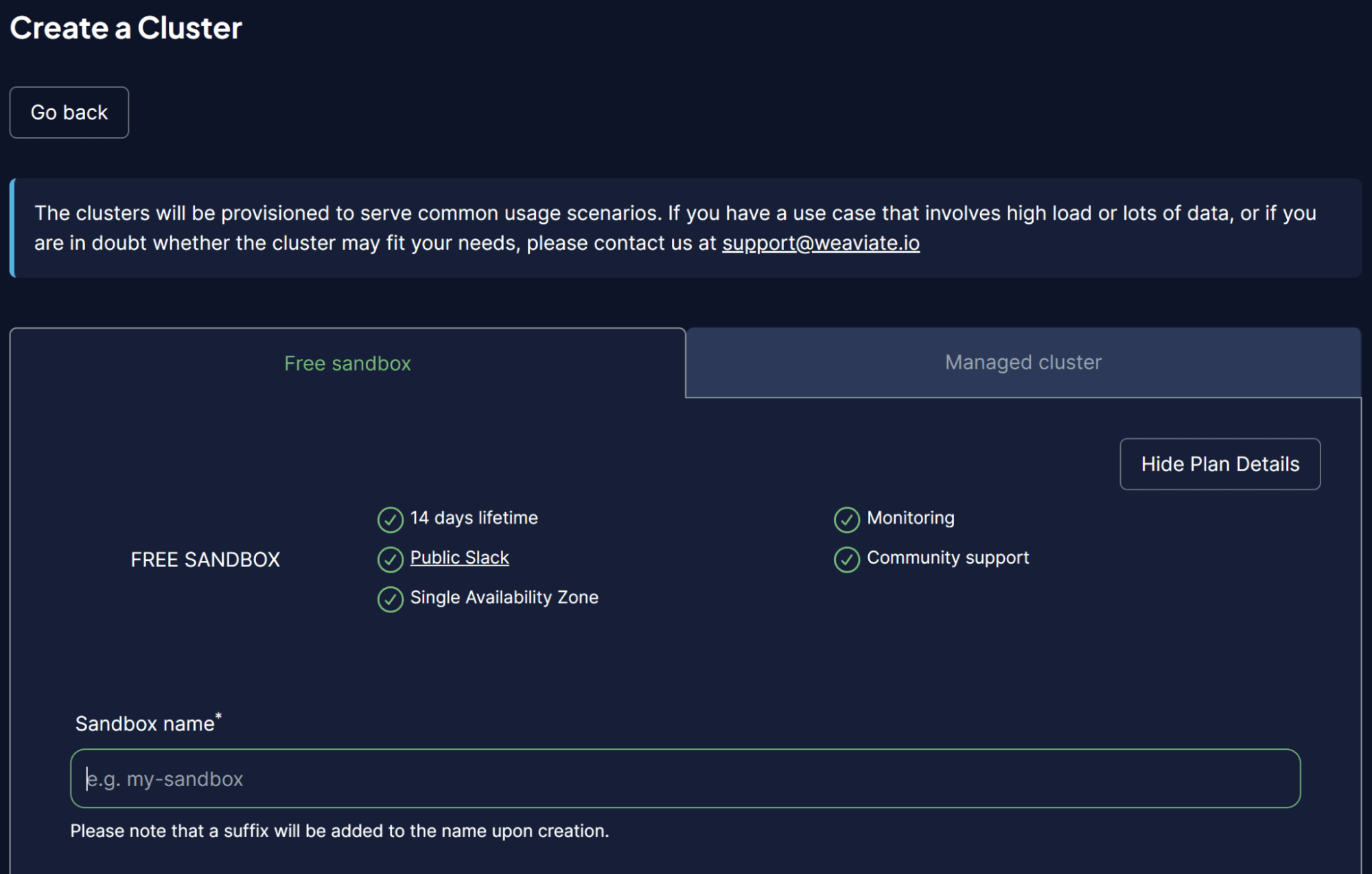
To make things easier, we would use a sandbox cluster from WCS to act as our Vector Database. Weaviate provides a 14-day free cluster that we can use to store our vectors without registering any payment method. To do that, you need to register on their WCS console initially.

Once within the WCS platform, select Create a Cluster and input your Sandbox name. The UI should look like the image below.
Vector Databases in AI and LLM Use Cases
Image by Author

Don’t forget to enable authentication, as we also want to access this cluster via the WCS API Key. After the cluster is ready, find the API key and Cluster URL, which we will use to access the Vector Database.

Once things are ready, we would simulate storing our first vector in the Vector Database.

For the Vector Database storing example, I would use the Book Collection example dataset from Kaggle. I would only use the top 100 rows and 3 columns (title, description, intro).

import pandas as pd  data = pd.read_csv('commonlit_texts.csv', nrows = 100, usecols=['title', 'description', 'intro'])

Let’s set aside our data and connect to our Vector Database. First, we need to set up a remote connection using the API key and your Cluster URL.

import weaviate  import os  import requests  import json      cluster_url = "Your Cluster URL"  wcs_api_key = "Your WCS API Key"  Openai_api_key ="Your OpenAI API Key"    client = weaviate.connect_to_wcs(      cluster_url=cluster_url,      auth_credentials=weaviate.auth.AuthApiKey(wcs_api_key),      headers={          "X-OpenAI-Api-Key": openai_api_key      }  )

Once you set up your client variable, we will connect to the Weaviate Cloud Service and create a class to store the vector. Class in Weaviate is the data collection or analogs to the table name in a relational database.

import weaviate.classes as wvc    client.connect()  book_collection = client.collections.create(      name="BookCollection",      vectorizer_config=wvc.config.Configure.Vectorizer.text2vec_openai(),        generative_config=wvc.config.Configure.Generative.openai()    )

In the code above, we connect to the Weaviate Cluster and create a BookCollection class. The class object also uses the OpenAI text2vec embedding model to vectorize the text data and OpenAI generative module.

Let’s try to store the text data in a vector database. To do that, you can use the following code.

sent_to_vdb = data.to_dict(orient='records')  book_collection.data.insert_many(sent_to_vdb)

Vector Databases in AI and LLM Use Cases
Image by Author

We just successfully stored our dataset in the Vector Database! How easy is that?

Now, you might be curious about the use cases for using Vector Databases with LLM. That’s what we are going to discuss next.

Vector Database and LLM Use Cases

A few use cases in which LLM can be applied with Vector Database. Let’s explore them together.

Semantic Search

Semantic Search is a process of searching for data by using the meaning of the query to retrieve relevant results rather than relying solely on the traditional keyword-based search.

The process involves the utilization of the LLM Model Embedding of the query and performing embedding similarity search into our stored embedded in the vector database.

Let’s try to use Weaviate to perform a semantic search based on a specific query.

book_collection = client.collections.get("BookCollection")    client.connect()  response = book_collection.query.near_text(        query="childhood story,        limit=2    )

In the code above, we try to perform a semantic search with Weaviate to find the top two books closely related to the query childhood story. The semantic search uses the OpenAI embedding model we previously set up. The result is what you can see in below.

{'title': 'Act Your Age', 'description': 'A young girl is told over and over again to act her age.', 'intro': 'Colleen Archer has written for nHighlightsn. In this short story, a young girl is told over and over again to act her age.nAs you read, take notes on what Frances is doing when she is told to act her age. '}    {'title': 'The Anklet', 'description': 'A young woman must deal with unkind and spiteful treatment from her two older sisters.', 'intro': "Neil Philip is a writer and poet who has retold the best-known stories from nThe Arabian Nightsn for a modern day audience. nThe Arabian Nightsn is the English-language nickname frequently given to nOne Thousand and One Arabian Nightsn, a collection of folk tales written and collected in the Middle East during the Islamic Golden Age of the 8th to 13th centuries. In this tale, a poor young woman must deal with mistreatment by members of her own family.nAs you read, take notes on the youngest sister's actions and feelings."}

As you can see, no direct words about childhood stories are in the result above. However, the result is still closely related to a story that aims for children.

Generative Search

The Generative Search could be defined as an extension application for the Semantic Search. The Generative Search, or Retrieval Augmented Generation (RAG), utilizes LLM prompting with the Semantic search that retrieved data from the vector database.

With RAG, the result from the query search is processed to LLM, so we get them in the form we want instead of the raw data. Let’s try a simple implementation of the RAG with Vector Database.

response = book_collection.generate.near_text(      query="childhood story",      limit=2,      grouped_task="Write a short LinkedIn post about these books."  )    print(response.generated)

The result can be seen in the text below.

Excited to share two captivating short stories that explore themes of age and mistreatment. "Act Your Age" by Colleen Archer follows a young girl who is constantly told to act her age, while "The Anklet" by Neil Philip delves into the unkind treatment faced by a young woman from her older sisters. These thought-provoking tales will leave you reflecting on societal expectations and family dynamics. #ShortStories #Literature #BookRecommendations 📚

As you can see, the data content is the same as before but has now been processed with OpenAI LLM to provide a short LinkedIn post. In this way, RAG is useful when we want specific form output from the data.

Question Answering with RAG

In our previous example, we used a query to get the data we wanted, and RAG processed that data into the intended output.

However, we can turn the RAG capability into a question-answering tool. We can achieve this by combining them with the LangChain framework.

First, let’s install the necessary packages.

pip install langchain   pip install langchain_community   pip install langchain_openai  

Then, let’s try to import the packages and initiate the variables we require to make QA with RAG work.

from langchain.chains import RetrievalQA  from langchain_community.vectorstores import Weaviate  import weaviate  from langchain_openai import OpenAIEmbeddings  from langchain_openai.llms.base import OpenAI    llm = OpenAI(openai_api_key = openai_api_key, model_name = 'gpt-3.5-turbo-instruct', temperature = 1)    embeddings = OpenAIEmbeddings(openai_api_key = openai_api_key )    client = weaviate.Client(      url=cluster_url, auth_client_secret=weaviate.AuthApiKey(wcs_api_key)  )

In the code above, we set up the LLM for the text generation, embedding model, and the Weaviate client connection.

Next, we set the Weaviate connection to the Vector Database.

weaviate_vectorstore = Weaviate(client=client, index_name='BookCollection', text_key='intro',by_text = False, embedding=embeddings)  retriever = weaviate_vectorstore.as_retriever()

In the code above, make the Weaviate Database BookCollection the RAG tool that would search the ‘intro’ feature when prompted.

Then, we would create Question Answering Chain from the LangChain with the code below.

qa_chain = RetrievalQA.from_chain_type(      llm=llm, chain_type="stuff", retriever = retriever  )

Everything is now ready. Let’s try out the QA with RAG using the following code example.

response = qa_chain.invoke(      "Who is the writer who write about love between two goldfish?")  print(response)

The result is shown in the text below.

{'query': 'Who is the writer who write about love between two goldfish?', 'result': ' The writer is Grace Chua.'}

With the Vector Database as the place to store all the text data, we can implement RAG to perform QA with LangChain. How neat is that?

Conclusion

A vector database is a specialized storage solution designed to store, index, and query vector data. It is often used to store text data and implemented in conjunction with Large Language Models (LLMs). This article will try a hands-on setup of the Vector Database Weaviate, including example use cases such as Semantic Search, Retrieval-Augmented Generation (RAG), and Question Answering with RAG.

Cornellius Yudha Wijaya is a data science assistant manager and data writer. While working full-time at Allianz Indonesia, he loves to share Python and data tips via social media and writing media. Cornellius writes on a variety of AI and machine learning topics.

More On This Topic

  • Python Vector Databases and Vector Indexes: Architecting LLM Apps
  • NoSQL Databases and Their Use Cases
  • What are Vector Databases and Why Are They Important for LLMs?
  • An Honest Comparison of Open Source Vector Databases
  • A Comprehensive Guide to Pinecone Vector Databases
  • The 5 Best Vector Databases You Must Try in 2024

Save More Than $200 on This All-In-One AI Toolkit

TL;DR: Use AI to streamline your entire business with the IdeaAize All-in-One AI Tool. A lifetime subscription is now $169.99 at TechRepublic Academy.

Artificial intelligence is taking over the business world, providing fast solutions for all kinds of business challenges. While it’s cheaper than hiring humans to do everything, AI solutions can still get expensive, especially when you’re paying for them every month. Fortunately, you can check off a number of AI boxes for a one-time price with this deal on the IdeaAize All-in-One AI Tool.

IdeaAize is trusted by more than 10,000 companies worldwide. This intuitive AI generates high-quality content across a range of categories. IdeaAize leverages advanced natural language processing to create original content for blogs, social media, ads and much more. But it’s far more than just an AI writing assistant.

About IdeaAize All-in-One AI Tool

IdeaAize supports a range of content creation options, including AI voiceovers, image generation, code generation and conversion between text-to-speech and speech-to-text. You can build intelligent chatbots for your website to answer questions about your company and provide 24/7 customer support. AI chat also supports interaction with data in PDF, CSV, websites and other file formats, allowing you to automate tedious data entry or transcription tasks.

IdeaAize offers solutions for every department, from marketing to engineering, and is intuitive enough for even beginners to use and bring to scale. All you have to do is select your template and input some details about what you’re looking for, and IdeaAize will generate high-quality content that meets your needs in a matter of seconds. Don’t miss this limited-time opportunity.

Invest in scalable, affordable solutions for your business. Right now, you can get a lifetime subscription to an IdeaAize All-in-One AI Tool Business Plan for 57% off $399 at just $169.99.

Get IdeaAize

Prices and availability subject to change.

Is it Humane to Bash Humane Ai Pin?

Humane Ai Pin

The latest futuristic AI wearable, the Humane Ai Pin, has been grabbing all the attention – and it’s not for the first batch of products being shipped to its users. It’s because of the many user reviews criticising and utterly demolishing the product.

This begs the question: Should a first-of-its-kind technology breakthrough be chastised so much?

Source: X

Brutally Honest?

The ambient computing interactive device, or the AI Pin that can be worn on your clothes or bag, can execute a range of functions. From picking calls, reading messages, to clicking pictures, or simply using it as a personal assistant that operates through voice, the wearable was delivered to its first set of users last week.

However, the device that was expected to be a probable replacement for a smartphone, did not garner user reviews that lived up to the expectation of their demo video.

A number of gadget reviewers, including prominent YouTubers, have called it “not good” and even termed it as the ‘worst product reviewed’. Some of the key problems highlighted were the long latency, imperfect speech intonations and even hallucinations. However, the biggest is the price point.

Though the pin is packaged as a $699 product, a customer ends up spending $1700 when subscription and other charges are added.

While the bashing may seem too harsh, the phenomenon is not new.

History Repeats

When Apple’s first Macbook was launched in 2006, the product faced heavy criticism. The initial polycarbonate MacBook versions had problems such as unexpected shutdowns and palm-rest discolouration. Interestingly, Apple has always been on the receiving end of brick-bats.

Apple’s iPad was initially dismissed as a ‘big iPod touch’ and questioned its utility and potential success. Even iPhones were not spared when first unveiled. One of the main concerns at that time was the lack of features such as a physical keyboard and replaceable batteries that were prevalent in other phones at that time.

Former Microsoft CEO first reaction to the iPhone launch (2007) pic.twitter.com/Z1dPFlCBou

— Historic Vids (@historyinmemes) April 19, 2024

The relatively new spatial computing device Apple Vision Pro also faced a setback when many users returned the product after using it. However, new use cases for the devices are still emerging, and the device can be even equated to an autonomous vehicle.

Interestingly, the founders of Humane Ai Pin, Imran Chaudhri and Bethany Bongiorno, were former director of design and software engineering at Apple. And, going by the criticism garnered, it looks like the Apple didn’t fall far from the tree.

The criticism for new products arise from nascent technology that will always take time to adopt. Further, iterations for products are when initial problems are rectified. Problems such as latency could possibly be something that can be rectified in the Ai Pins with the future versions of the device.

The storm that followed the Humane Ai Pin’s release, had one set of users bash the product, but at the same time, another set came out in full support. Marc Andreessen, American entrepreneur and founder of VC firm Andreessen Horowitz, showed support for the new technology.

Source: X

“For people like me who struggle to remember details, lists, manage calendars and like to think verbally, this will be a game changer. Sure it’s slow or whatever now, but can you imagine what it will be like in 10 years?” said a user on X.

Looking Through Different Lens

While the backlash for the product was criticised, MKBHD retorted with another video explaining the reason for the Humane Ai Pin’s scathing review video. He also asked, “Do bad reviews kill companies or bad products kill companies?” A question only time can answer.

It is probably too soon to diss an innovative new product, as use cases are only slowly emerging. Further, innovative devices will not stop being produced. Just yesterday, Nothing introduced earbuds that have ChatGPT integration and users can converse with it, via a pinch feature.

It might make sense to review a product, a few months after using it. Afterall, Steve Jobs once said, “People don’t know what they want until you show it to them.”In Humane Ai Pin’s case, people may still not be too sure of what they want even after giving it to them.

The post Is it Humane to Bash Humane Ai Pin? appeared first on Analytics India Magazine.

How Databricks is Enabling Agriculture’s Data Revolution with UPL

At the Data + AI Summit, Databricks recently announced its partnership with Indian customers such as UPL, Air India, Aditya Birla Fashion, Freshworks, InMobi, Meesho, Myntra, Parle, and many others. This will help leverage the Databricks Data Intelligence Platform to drive business innovation, optimise operations, and enhance decision-making.

One among these is UPL Limited, a multinational company headquartered in Mumbai, which provides sustainable agriculture products and solutions in more than 138 countries.

The company’s UPL Agri-Tech Platform, built in collaboration with Microsoft, uses AI and machine learning to provide crop management, pest control, and nutrient application recommendations.

With a market cap of $4.37 billion as of April 2024, the company’s product portfolio includes crop protection, seed treatment, post-harvest solutions, and other agricultural inputs, with a presence in markets such as India, the United States, Brazil, and Europe.

Having experienced massive growth in recent years, the partnership between UPL and Databricks becomes critical for the former.

“In 2022, we were at the end of a massive growth period. We grew 2x in about three to four years,” Vijay Balakrishnan, chief data & analytics officer at UPL Group, told AIM on the sidelines of the event in Bengaluru on March 22.

This growth triggered the need for UPL to leverage data more effectively to make informed decisions and drive further growth. This is when the company found solace in Databricks.

UPL, the largest manufacturer and distributor of agrochemicals in India with a market share of around 20%, has actively started using Databricks’ Unity Catalog, which democratises data across the organisation.

Using Databricks to Scale AI Solutions Across 50 Countries

By leveraging Databricks, UPL also aims to enable AI solutions across 20 countries, with the potential to scale up to 50 countries in the future.

“We aim to democratise access to AI, enabling citizen data scientists and proficient digital business leaders to leverage and operate the AI solutions we’ve established, whether for commercial endeavours, supply chain optimisation, or other applications,” elaborated Balakrishnan.

For instance, they conduct extensive farmer outreach programmes, providing training and advisory services to help farmers adopt best agricultural practices.

The company has also found Databricks’ serverless SQL engine to be efficient, especially in instances where the speed of data pooling is critical. “We have seen it to be quite efficient today because there are a lot of instances where the speed of the data pool is very critical for us,” noted Balakrishnan.

As UPL continues to explore and leverage Databricks’ generative AI and lakehouse capabilities, the partnership between the two companies is poised to drive innovation and transform the agriculture industry through data-driven solutions.

UPL has started exploring Databricks’ Genie Data Room, which provides a drag-and-drop interface for generative AI. “The Genie Data Room actually makes it almost drag and drop. All we did was create a data room with the data that we’ve already pulled into Databricks and started working,”

According to Balakrishnan, UPL is also focusing on prompt engineering and even considering using AI for prompt engineering itself. He also emphasised the importance of governance, particularly as metadata becomes complex.

Leveraging Databricks for Demand Forecasting

One of the key areas where UPL is leveraging Databricks’ capabilities is demand forecasting. “Demand forecasting has its own challenges in the agriculture sector because many external variables play a role,” Balakrishna said.

“For instance, the last 10-12 months have been an El Nino drought situation in most of the Northern Hemisphere. But that has a reverse effect in countries in the Southern Hemisphere,” he added.

These external factors, along with the constantly evolving product portfolio, make demand forecasting a complex task. Timing is also crucial in the agriculture industry, with many products requiring application within a specific three-day window.

“A lot of our products have to be timed in such a way that you’ve got a three-day window within which a certain product has to be applied. And if you don’t predict that three-day window and apply, you don’t have a play,” explained Balakrishnan.

For instance, if UPL gauges demand incorrectly, they run the risk of spoiled products which may be stuck in transportation – out of cold storage or in transit for extended periods.

To address these challenges, UPL has developed a demand forecasting model that considers various factors. Databricks’ platform provides UPL with a unified and governed data management and analytics environment, enabling more accurate demand forecasts.

Challenges to Solve Going Forward

Balakrishnan also highlighted the challenges faced by the company in data ingestion and orchestration.

“The way we look at Databricks is we would love for them to be all in analytics for us. Now, there are two areas where it is a little challenging today. One is on the, let’s say, the data collection part or ingestion, but more ingestion and collection part, especially in complex source ecosystems like SAP,” said Balakrishnan.

SAP poses its own set of challenges due to contractual aspects that need to be considered before pulling data, whether in a CDC (Change Data Capture) fashion or a batch mode.

While Databricks has a good partner ecosystem, Balakrishnan noted that there is still a gap in this area. “That part, while there are good partners, an ecosystem with Databricks, there’s a little bit of a gap, at least from my perspective. And I brought it up on a couple of forums earlier,” he said.

Bhasin acknowledged these challenges and emphasised that while Databricks wants to be everything to everybody, it is an evolving platform, and it’s a matter of different priorities at different points.

“We take pride in our commitment to identifying common pain points and developing the necessary capabilities to address them. This approach is integral to the evolution of our platform. By actively listening to our customers and discerning prevalent pain points, we prioritise investments that yield meaningful solutions,” he explained.

Databricks has been investing disproportionately in R&D to stay at the cutting edge of technology. Bhasin acknowledged the feedback from UPL and assured that Databricks is working on addressing these challenges.

Conclusively, as UPL and Databricks continue to collaborate and co-innovate, they aim to address the data ingestion and orchestration challenges in the agriculture industry, unlocking new opportunities for growth and efficiency.

The post How Databricks is Enabling Agriculture’s Data Revolution with UPL appeared first on Analytics India Magazine.

Instant-Style: Style-Preservation in Text-to-Image Generation

Over the past few years, tuning-based diffusion models have demonstrated remarkable progress across a wide array of image personalization and customization tasks. However, despite their potential, current tuning-based diffusion models continue to face a host of complex challenges in producing and generating style-consistent images, and there might be three reasons behind the same. First, the concept of style still remains widely undefined and undetermined, and comprises a combination of elements including atmosphere, structure, design, material, color, and much more. Second inversion-based methods are prone to style degradation, resulting in frequent loss of fine-grained details. Finally, adapter-based approaches require frequent weight tuning for each reference image to maintain a balance between text controllability, and style intensity.

Furthermore, the primary goal of a majority of style transfer approaches or style image generation is to use the reference image, and apply its specific style from a given subset or reference image to a target content image. However, it is the wide number of attributes of style that makes the job difficult for researchers to collect stylized datasets, representing style correctly, and evaluating the success of the transfer. Previously, models and frameworks that deal with fine-tuning based diffusion process, fine-tune the dataset of images that share a common style, a process that is both time-consuming, and with limited generalizability in real-world tasks since it is difficult to gather a subset of images that share the same or nearly identical style.

In this article, we will talk about InstantStyle, a framework designed with the aim of tackling the issues faced by the current tuning-based diffusion models for image generation and customization. We will talk about the two key strategies implemented by the InstantStyle framework:

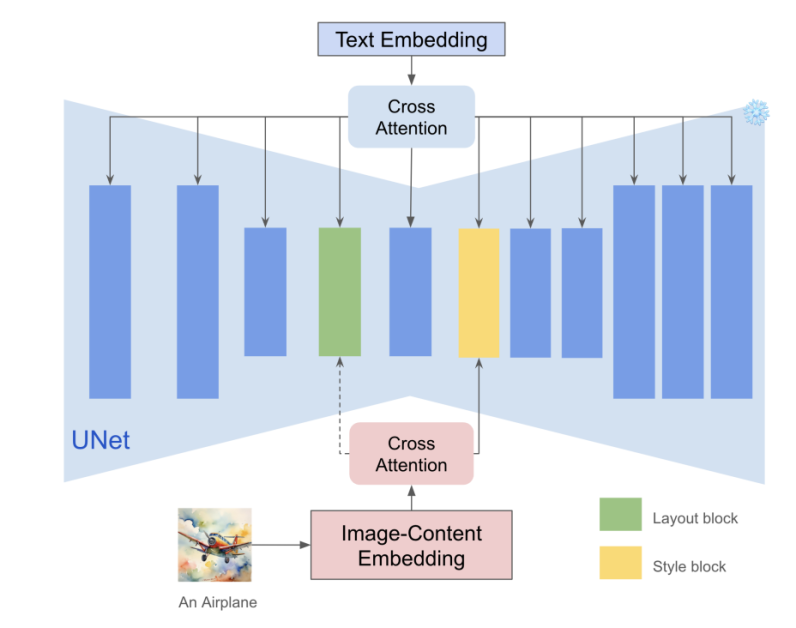
  1. A simple yet effective approach to decouple style and content from reference images within the feature space, predicted on the assumption that features within the same feature space can be either added to or subtracted from one another.
  2. Preventing style leaks by injecting the reference image features exclusively into the style-specific blocks, and deliberately avoiding the need to use cumbersome weights for fine-tuning, often characterizing more parameter-heavy designs.

This article aims to cover the InstantStyle framework in depth, and we explore the mechanism, the methodology, the architecture of the framework along with its comparison with state of the art frameworks. We will also talk about how the InstantStyle framework demonstrates remarkable visual stylization outcomes, and strikes an optimal balance between the controllability of textual elements and the intensity of style. So let’s get started.

InstantStyle : Style Preservation in Text to Image Generation

Diffusion based text to image generative AI frameworks have garnered noticeable and remarkable success across a wide array of customization and personalization tasks, particularly in consistent image generation tasks including object customization, image preservation, and style transfer. However, despite the recent success and boost in performance, style transfer remains a challenging task for researchers owing to the undetermined and undefined nature of style, often including a variety of elements including atmosphere, structure, design, material, color, and much more. With that being said, the primary goal of stylized image generation or style transfer is to apply the specific style from a given reference image or a reference subset of images to the target content image. However, the wide number of attributes of style makes the job difficult for researchers to collect stylized datasets, representing style correctly, and evaluating the success of the transfer. Previously, models and frameworks that deal with fine-tuning based diffusion process, fine-tune the dataset of images that share a common style, a process that is both time-consuming, and with limited generalizability in real-world tasks since it is difficult to gather a subset of images that share the same or nearly identical style.

With the challenges encountered by the current approach, researchers have taken an interest in developing fine-tuning approaches for style transfer or stylized image generation, and these frameworks can be split into two different groups:

  • Adapter-free Approaches: Adapter-free approaches and frameworks leverage the power of self-attention within the diffusion process, and by implementing a shared attention operation, these models are capable of extracting essential features including keys and values from a given reference style images directly.
  • Adapter-based Approaches: Adapter-based approaches and frameworks on the other hand incorporate a lightweight model designed to extract detailed image representations from the reference style images. The framework then integrates these representations into the diffusion process skillfully using cross-attention mechanisms. The primary goal of the integration process is to guide the generation process, and to ensure that the resulting image is aligned with the desired stylistic nuances of the reference image.

However, despite the promises, tuning-free methods often encounter a few challenges. First, the adapter-free approach requires an exchange of key and values within the self-attention layers, and pre-catches the key and value matrices derived from the reference style images. When implemented on natural images, the adapter-free approach demands the inversion of image back to the latent noise using techniques like DDIM or Denoising Diffusion Implicit Models inversion. However, using DDIM or other inversion approaches might result in the loss of fine-grained details like color and texture, therefore diminishing the style information in the generated images. Furthermore, the additional step introduced by these approaches is a time consuming process, and can pose significant drawbacks in practical applications. On the other hand, the primary challenge for adapter-based methods lies in striking the right balance between the context leakage and style intensity. Content leakage occurs when an increase in the style intensity results in the appearance of non-style elements from the reference image in the generated output, with the primary point of difficulty being separating styles from content within the reference image effectively. To address this issue, some frameworks construct paired datasets that represent the same object in different styles, facilitating the extraction of content representation, and disentangled styles. However, thanks to the inherently undetermined representation of style, the task of creating large-scale paired datasets is limited in terms of the diversity of styles it can capture, and it is a resource-intensive process as well.

To tackle these limitations, the InstantStyle framework is introduced which is a novel tuning-free mechanism based on existing adapter-based methods with the ability to seamlessly integrate with other attention-based injecting methods, and achieving the decoupling of content and style effectively. Furthermore, the InstantStyle framework introduces not one, but two effective ways to complete the decoupling of style and content, achieving better style migration without having the need to introduce additional methods to achieve decoupling or building paired datasets.

Furthermore, prior adapter-based frameworks have been used widely in the CLIP-based methods as an image feature extractor, some frameworks have explored the possibility of implementing feature decoupling within the feature space, and when compared against undetermination of style, it is easier to describe the content with text. Since images and texts share a feature space in CLIP-based methods, a simple subtraction operation of context text features and image features can reduce content leakage significantly. Furthermore, in a majority of diffusion models, there is a particular layer in its architecture that injects the style information, and accomplishes the decoupling of content and style by injecting image features only into specific style blocks. By implementing these two simple strategies, the InstantStyle framework is able to solve content leakage problems encountered by a majority of existing frameworks while maintaining the strength of style.

To sum it up, the InstantStyle framework employs two simple, straightforward yet effective mechanisms to achieve an effective disentanglement of content and style from reference images. The Instant-Style framework is a model independent and tuning-free approach that demonstrates remarkable performance in style transfer tasks with a huge potential for downstream tasks.

Instant-Style: Methodology and Architecture

As demonstrated by previous approaches, there is a balance in the injection of style conditions in tuning-free diffusion models. If the intensity of the image condition is too high, it might result in content leakage, whereas if the intensity of the image condition drops too low, the style may not appear to be obvious enough. A major reason behind this observation is that in an image, the style and content are intercoupled, and due to the inherent undetermined style attributes, it is difficult to decouple the style and intent. As a result, meticulous weights are often tuned for each reference image in an attempt to balance text controllability and strength of style. Furthermore, for a given input reference image and its corresponding text description in the inversion-based methods, inversion approaches like DDIM are adopted over the image to get the inverted diffusion trajectory, a process that approximates the inversion equation to transform an image into a latent noise representation. Building on the same, and starting from the inverted diffusion trajectory along with a new set of prompts, these methods generate new content with its style aligning with the input. However, as shown in the following figure, the DDIM inversion approach for real images is often unstable as it relies on local linearization assumptions, resulting in propagation of errors, and leads to loss of content and incorrect image reconstruction.

Coming to the methodology, instead of employing complex strategies to disentangle content and style from images, the Instant-Style framework takes the simplest approach to achieve similar performance. When compared against the underdetermined style attributes, content can be represented by natural text, allowing the Instant-Style framework to use the text encoder from CLIP to extract the characteristics of the content text as context representations. Simultaneously, the Instant-Style framework implements CLIP image encoder to extract the features of the reference image. Taking advantage of the characterization of CLIP global features, and post subtracting the content text features from the image features, the Instant-Style framework is able to decouple the style and content explicitly. Although it is a simple strategy, it helps the Instant-Style framework is quite effective in keeping content leakage to a minimum.

Furthermore, each layer within a deep network is responsible for capturing different semantic information, and the key observation from previous models is that there exist two attention layers that are responsible for handling style. up Specifically, it is the blocks.0.attentions.1 and down blocks.2.attentions.1 layers responsible for capturing style like color, material, atmosphere, and the spatial layout layer captures structure and composition respectively. The Instant-Style framework uses these layers implicitly to extract style information, and prevents content leakage without losing the style strength. The strategy is simple yet effective since the model has located style blocks that can inject the image features into these blocks to achieve seamless style transfer. Furthermore, since the model greatly reduces the number of parameters of the adapter, the text control ability of the framework is enhanced, and the mechanism is also applicable to other attention-based feature injection models for editing and other tasks.

Instant-Style : Experiments and Results

The Instant-Style framework is implemented on the Stable Diffusion XL framework, and it uses the commonly adopted pre-trained IR-adapter as its exemplar to validate its methodology, and mutes all blocks except the style blocks for image features. The Instant-Style model also trains the IR-adapter on 4 million large-scale text-image paired datasets from scratch, and instead of training all blocks, updates only the style blocks.

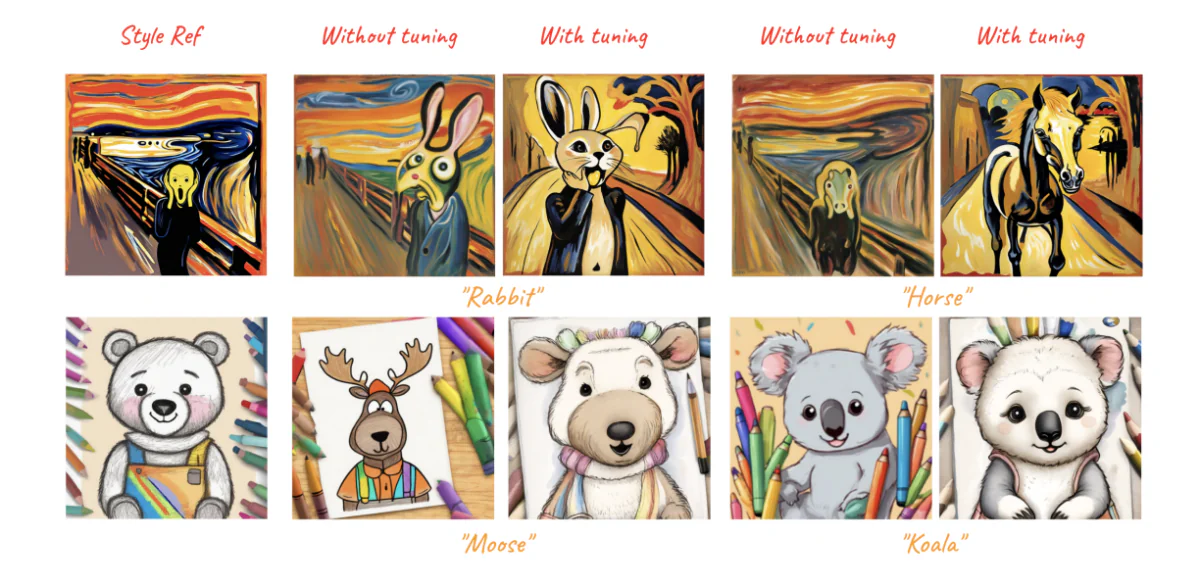
To conduct its generalization capabilities and robustness, the Instant-Style framework conducts numerous style transfer experiments with various styles across different content, and the results can be observed in the following images. Given a single style reference image along with varying prompts, the Instant-Style framework delivers high quality, consistent style image generation.

Furthermore, since the model injects image information only in the style blocks, it is able to mitigate the issue of content leakage significantly, and therefore, does not need to perform weight tuning.

Moving along, the Instant-Style framework also adopts the ControlNet architecture to achieve image-based stylization with spatial control, and the results are demonstrated in the following image.

When compared against previous state of the art methods including StyleAlign, B-LoRA, Swapping Self Attention, and IP-Adapter, the Instant-Style framework demonstrates the best visual effects.

Final Thoughts

In this article, we have talked about Instant-Style, a general framework that employs two simple yet effective strategies to achieve effective disentanglement of content and style from reference images. The InstantStyle framework is designed with the aim of tackling the issues faced by the current tuning-based diffusion models for image generation and customization. The Instant-Style framework implements two vital strategies: A simple yet effective approach to decouple style and content from reference images within the feature space, predicted on the assumption that features within the same feature space can be either added to or subtracted from one another. Second, preventing style leaks by injecting the reference image features exclusively into the style-specific blocks, and deliberately avoiding the need to use cumbersome weights for fine-tuning, often characterizing more parameter-heavy designs.

How Good is Llama 3 for Indic Languages?

How Good is Llama 3 for Indic Languages?

Meta’s contribution to the open-source community is undeniably one of the greatest. Now that the company has dropped Llama 3, its latest LLM, all the Indic LLM developers who have been building ‘Indic Llamas’ can now shift from Llama 2 to Llama 3. But all of this comes with certain twists and riders.

For starters, the model is available in 8B and 70B parameter versions and has been trained on over 15 trillion tokens, making it seven times larger than Llama 2’s dataset. This means that it has increased reasoning and coding capabilities, but it does not necessarily improve on the tokenisation aspect of the model for Indic languages.

Moreover, it is reportedly only available in English right now.

“It’s going to be hard to adapt Llama 3 for Indic languages, in my opinion,” said Adithya S Kolavi, the founder of CognitiveLab and the creator of the Indic LLM Leaderboad.

Even though initial tests show better performance with Devanagari compared to Llama 2, it struggles with other languages like Kannada, Malayalam, and Tamil. More testing is needed to fully assess Llama 3’s performance with these languages.

He explained in his blog that Llama 3 uses a TikToken-based tokeniser, which struggles to efficiently tokenise Indic languages, even with a vocabulary size of 121k. Moreover, when it comes to vocabulary expansion, unlike models using sentence-piece tokenisation, Llama 3 may face difficulties in expanding its vocabulary to better handle the wide variety of Indic languages.

It's going to be hard to adapt Llama3 for Indic languages, in my opinion.
Here are a few reasons why:
👉🏼 The tokenizer used is TikToken-based, which is not really efficient in tokenizing Indic text despite having a vocabular size of 121k.
👉🏼 unlike sentence-piece based models,… pic.twitter.com/vO1RnnSKS1

— Adithya S K (@adithya_s_k) April 18, 2024

Worth the wait?

Kurian Benoy, ML engineer at Sentient.io, expressed his disappointment with Llama 3 as he expected it to be multimodal. “Dear Zuck Bhai, I am sad. Promise me, you will do a better job for Llama4,” he said in a post on X.

He also posted a screenshot on LinkedIn testing Llama 3 on a few questions in the Indian context. “Not so bad, but still there is a lot of room to improve in my quick analysis,” he opined.

On the other hand, the biggest version of Llama 3 with 400 billion parameters is still in training, which might be multimodal, as many expect.

Having tried Llama 2, Gemma, Mistral, and other open source models, the Indic AI community had been desperately waiting to get their hands on Llama 3. Ramsri Goutham Golla, one of the creators of Telugu LLM Labs along with Ravi Theja Desetty, also shared his initial thoughts on the model.

He highlighted that more than 5% of Llama 3’s pre-training dataset consists of high-quality non-English data from over 30 languages, which include Indic languages as well.

Kolavi had also told AIM that the problem with Indic models is that they take more time than English models because the number of tokens is significantly higher. He said that CognitiveLab has been using Llama 2 and Mistral for a lot of internal work, but according to him, the most versatile model when it comes to the Indic LLM landscape is Gemma because it is a pre-built context of Indian languages.

“What I observed was that you need to re-train the model for it to perform well,” Kolavi explained that the Llama needs to be trained on at least 5-10 billion tokens for it to have great performance. “The model doesn’t really adapt the vocabulary that well, but it is a good alternative,” he added.

Now that Llama 3’s tokeniser has a length of 128k, which is four times longer than the 32k tokeniser in Llama 2, it is also trained on 15 trillion tokens, significantly more than Llama 2’s 2 trillion tokens and Google’s Gemma, which was trained on 6 trillion tokens. It means that there might be a possibility that Llama 3 may actually be a really good model for Indic languages.

What’s in a name?

Here comes another twist to the story. Meta has highlighted in its licence that any model built on top of Llama 3 should include “Llama 3” in the beginning of its name. Moreover, Meta has also forbidden the usage of any output generated by the models to be used to train any other AI model apart from Llama 3 derivatives.

“This is some BS,” said Pratik Desai, the creator of KissanAI who also created the Dhenu model on top of Llama 2. But since Meta has been giving away the model to everyone, it seems like a fair ask. Meanwhile, Desai also confirmed that Dhenu Llama 3 would be coming soon.

Now, it will be interesting to see how companies such as Sarvam AI, who have built OpenHathi on top of Llama 2, adapt to this new rule.

Meanwhile, Meta AI chief Yann LeCun has been quite impressed with the Indic Llama landscape. He applauded Kannada Llama on X, saying: “I love this. This is why open source AI platforms will win: it’s the only way for AI to cater to highly diverse languages, cultures, values, and centers of interest.”

It is now time for the Indic Llama boys to test out Llama 3 and create a bunch of Llama models in every Indic language.

The post How Good is Llama 3 for Indic Languages? appeared first on Analytics India Magazine.