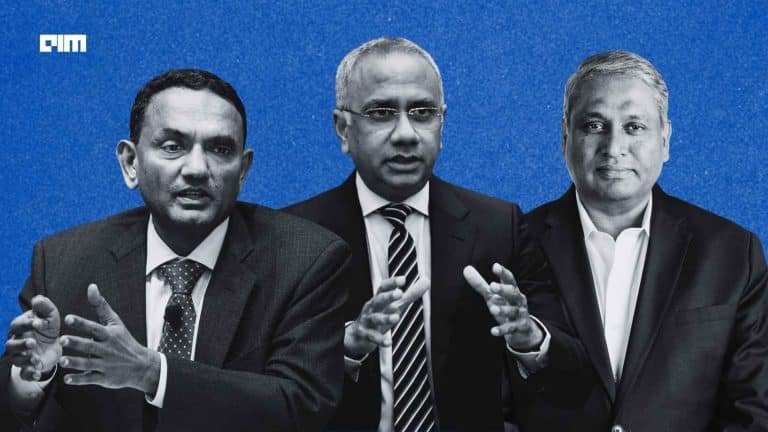


Three earnings reports. Three approaches to artificial intelligence. And one clear signal that Indian IT has moved beyond experimentation.
In the December quarter, TCS, HCLTech and Infosys all show that AI now drives real business. The difference lies in how they report.
TCS reported $1.8 billion in annualised AI revenue in Q3. HCLTech showed a $146 million advanced AI business growing nearly 20% in one quarter. Infosys, instead, is measuring what it calls AI impact.
On its Q3 earnings call, Infosys CEO Salil Parekh detailed the AI footprint, mentioning 4,600 active AI projects, over 500 AI agents, and nearly 28 million lines of code created with AI tools.
The company claims that around 90% of its top 200 clients are now running AI programmes.
Yet there are no AI revenue numbers. By comparison, TCS reported $1.8 billion in annualised AI revenue for Q3. HCLTech reported an advanced AI business of $146 million, which grew nearly 20% quarter-on-quarter. Infosys chooses to report AI impact.
“We are using agents in several of our service lines to help enhance either growth or productivity. So that’s what we are sharing, in terms of what our impact is,” Parekh said.
A Deliberate Choice
This approach is not evasive. It reflects how Infosys positions AI. In Q3, the company integrated Cognition’s AI software engineer Devin into its Infosys Topaz Fabric. This turns Topaz from a toolset into a system that can deploy, manage, and govern AI agents inside live enterprise environments.
Parekh says the Cognition partnership helps Infosys deliver software agents directly into client systems. For Infosys, AI is part of the delivery, not an add-on.
Gaurav Vasu from UnearthInsight, a market intelligence firm, tells AIM that as AI matures, it is increasingly being embedded across the full spectrum of enterprise technology work, including transformation programs, application development and modernisation (ADM), ER&D engagements, and managed services.
That strategy shows up in deal flow. Infosys closed $4.8 billion in large deal wins in Q3, up sharply from $3.1 billion in Q2. AI-led modernisation, automation, and agent deployment form part of the core scope of work.
This is where the comparison with peers matters.
Greyhound Research calls this a deliberate choice. Sanchit Vir Gogia, the founder, says Infosys is avoiding the trap of treating AI as a fragile line item. “AI is being positioned as a horizontal capability, not a vertical business line. It is infused across build, modernise, test, and run. That makes revenue attribution not only difficult but potentially misleading,” Gogia told AIM.
Accenture took a similar approach. Vasu draws a direct line to earlier tech cycles.
“This mirrors earlier technology cycles such as cloud, automation, and DevOps, where initial standalone reporting gradually gave way to embedded delivery models,” Vasu says.
Vasu argues that much of what the industry is calling “AI revenue” is already buried in existing contracts. “AI components are bundled within broader transformation or run engagements, and pricing reflects outcome improvement rather than tool usage,” he says. In many deals, AI is assumed as a default capability rather than a premium add-on.
That makes a clean AI revenue line harder to defend as AI becomes normalised across delivery.
Metrics Matter More Than Revenue
There is also a commercial logic. Gogia said that once a company publishes an AI revenue number, it must defend its definition and growth every quarter. Any change creates confusion.
Infosys instead shows the delivery metrics clients care about. Projects, agents, code, and penetration.
Greyhound’s enterprise fieldwork backs that up. Procurement teams are increasingly rejecting headline AI revenue claims in RFPs. They ask for code-level auditability, faster release cycles, fewer defects and lower infrastructure costs after AI refactoring.
Infosys’ disclosure aligns with that demand. Gogia points to the 28 million lines of AI-generated code that require strict controls. Infosys embeds policy gates, human review, and provenance tracking into its AI workflows. This matters in regulated industries where a single error can carry high risk.
Vasu says, the real impact will be seen in execution, not as a flashy revenue line. “The impact going forward is primarily around speed, scale, and productivity.” AI-assisted coding lets Infosys push more work through the same programs faster, which supports margins without linear hiring.
This model also reshapes pricing. When AI cuts delivery effort by 30%, clients resist old pricing models. Outcome-based contracts and shared productivity gains become the norm. Infosys prepares for that shift by tying AI to business KPIs rather than billed hours.
Gartner sees the same pattern. Biswajit Maity, senior principal analyst at Gartner, said Infosys’ Q3 showed a robust AI strategy built around enterprise-wide adoption, not isolated use cases. “Infosys focuses on generative and agentic AI across entire enterprises,” he says. Products like Topaz Fabric, Maity added, now support more granular and AI-driven delivery.
Visible in the Numbers
The financial trade-off reflects the transition. Infosys reported Q3 revenue of ₹45,479 crore, up 8.9% year on year, adding nearly ₹1,000 crore in a single quarter. Net profit fell 2.2% to ₹6,654 crore as margins came under pressure from higher costs and the new labour codes.
TCS, by contrast, maintained margins above 25% while increasing AI revenue. HCLTech took a margin hit from restructuring but is seeing fast growth in advanced AI. Infosys sits between the two. It spends on building platforms, agents, and governance that will pay off in the long run.
Hiring trends reinforce this. Infosys added 5,043 employees in Q3. TCS cut over 11,000 jobs. HCLTech trimmed staff. Greyhound sees this as demand-driven rather than denial. Large, long-term deals still need people. The difference lies in roles. The delivery pyramid now rebuilds around AI oversight, testing, risk and workflow design.
Vasu notes that AI tools speed up tasks like coding and testing, but large enterprises still rely heavily on system integration, legacy modernisation, security, compliance, and change management.
Those are still people-heavy. In this model, “AI shortens timelines and raises throughput, allowing teams to deliver more with incremental headcount,” He says. Freshers no longer join to write boilerplate code. They join to manage systems that do.
Indian IT has cracked AI monetisation. All three IT firms simply choose to measure it differently.
The post Three IT Giants, Three AI Playbooks appeared first on Analytics India Magazine.