
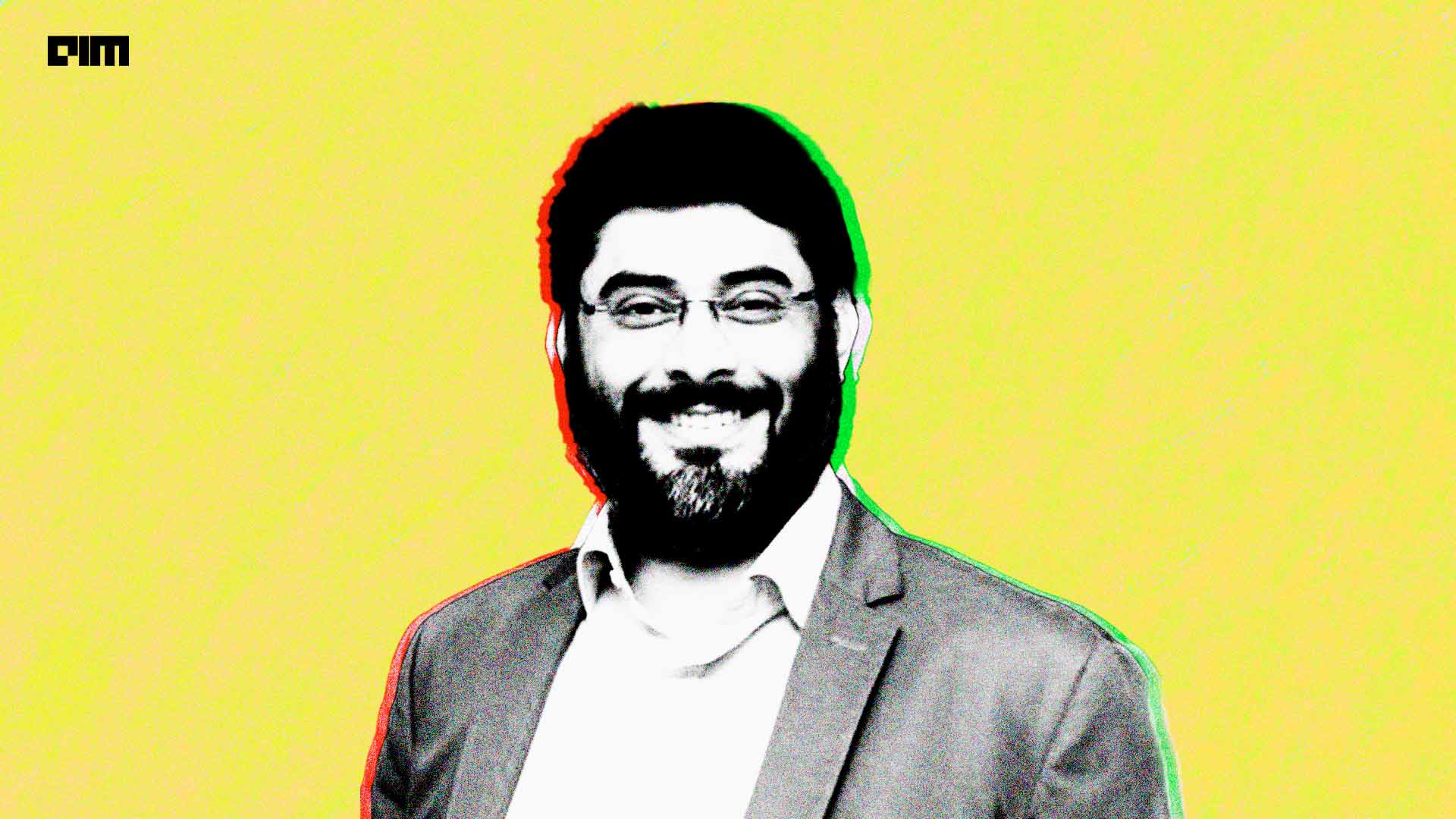
Ankush Sabharwal, the co-founder of CoRover.ai, has had a busy few months building BharatGPT. Most recently, his company launched an educational tablet called Milkyway, which would be powered by CoRover’s BharatGPT virtual assistant, including video and chatbots for students.
Notwithstanding a packed schedule, Sabharwal spoke to AIM about how CoRover.ai’s BharatGPT was built and what exactly it offers that the government is on board to implement in its services. Starting its AI journey in 2016, CoRover has been building virtual assistants for various partners and government agencies such as IRCTC, MaxLife, Chennai Police, and LIC, to name a few.
“Ours is the only platform that supports informational, transactional, advisory, and multilingual support of 14 Indian languages, including audio, video, and text format,” emphasised Sabharwal. He claims that over 130 crore users have used its virtual assistant not directly, but through their customers.
‘Why build from scratch?’
Right from the start, Sabharwal said that they had heaps of multilingual data from their customers and were able to build simple assistants for them all these years. In the beginning, CoRover.ai used Microsoft’s Gordon model which was very small but useful enough to build these assistants.
“Now with generative AI, our data became very useful to build LLM-based chatbots that could solve larger problems,” said Sabharwal. He said that with the success of ChatGPT, the company started fine-tuning Instruct GPT-based Pythia model, which is a 6.9 billion parameter open source model by Allen AI Institute. This was after they experimented with several open source models.
Sabharwal said that CoRover.ai’s BharatGPT is used only to power other virtual assistants, and they do not charge extra for building their own models. “You can come with your data and we can build an assistant for your business with very simple steps,” said Sabharwal. He said that this includes assistants in 14 languages including voice.
“The luxury we had while building the model was that in almost all of our contracts, we said that we would also have the right to collect the data from our customers,” he said, talking about how difficult it is to collect Indic language data. “Most of this is anonymous data, so that is not a problem.”
“We are building something out of open source, fine-tuning it on our data, and making it proprietary,” said Sabharwal. He added that the company has been looking to acquire more GPUs as they have already finished building their first model on open source and aim to build a foundational model soon. “We have the data which is unique and would be able to create a foundational model as soon as we have the resources,” said Sabharwal.
The best way forward
Sabharwal, giving an example of Java script, said that there is not exactly a requirement for building models from scratch. “We have all these foundational models that are good enough to build virtual assistants for specific use cases. That is what we are doing by building models for specific use cases, instead of a broad generalised model,” said Sabharwal, highlighting how Corover.ai believes in solving focused and accurate problems in different sectors and domains.
“When Java was launched, there was no urge to create another Java,” explained Sabharwal, saying that we have enough technology to implement LLMs in useful ways and solve problems in useful ways. “India is the biggest producer of data and if we focus on creating more products with AI, I think we would have solved the problems for India,” he said.
Corover.ai is backed by Google, and leverages its cloud for building LLMs. “Like the government of India’s mission of Make AI in India and Make AI Work for India, our BharatGPT ensures that the data is from India, and remains in India,” highlighted Sabharwal, saying that the company is also currently renting GPUs from Google for building its models.
“We have over 400 leads from companies in India, Korea, and other parts of the world, and our motto is to provide human centric conversation virtual assistants to the world, which we have been doing since 2016,” said Sabharwal.
“We are agnostic with how we want to implement our technology. The Milkyway tablet is the first step towards integrating it into hardware devices,” concluded Sabharwal.
The post CoRover.ai is the Silent Winner of Indian LLM Race appeared first on Analytics India Magazine.