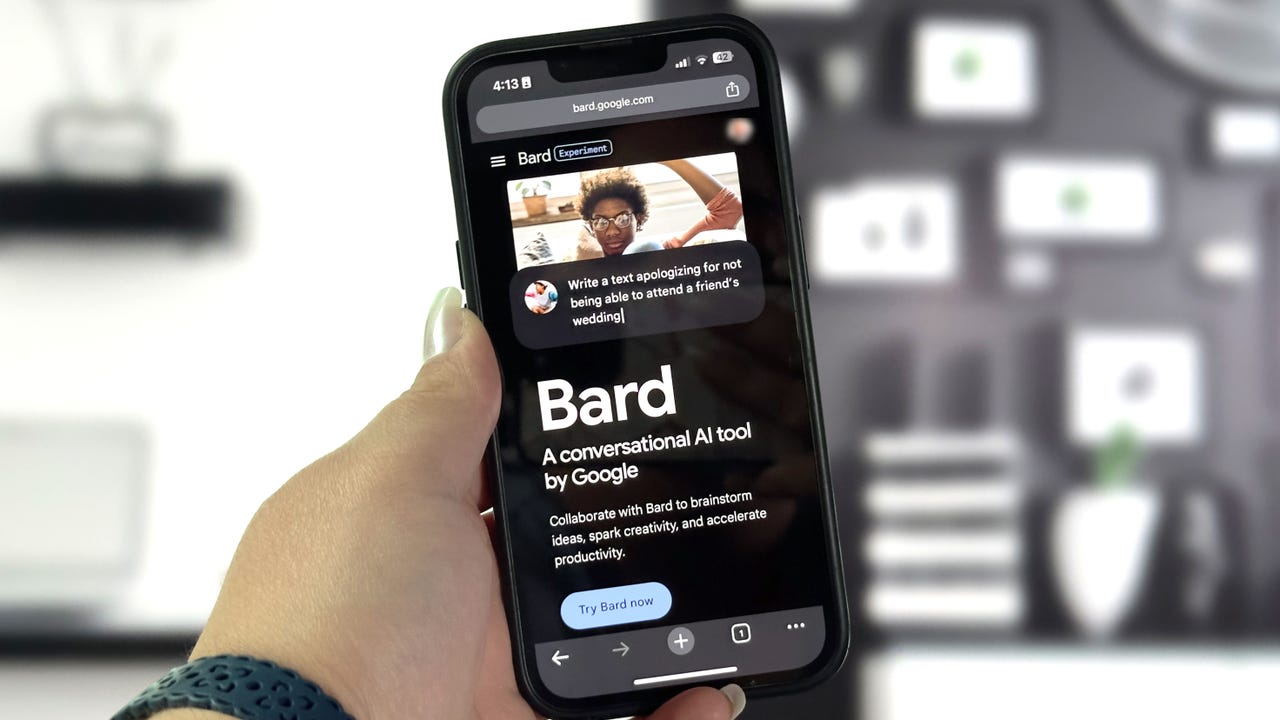
At the same time that new artificial intelligence (AI) tools have dominated headlines with their innovative ideas and captivating abilities, Google's own creation has been gaining attention for entirely different reasons.
Google Bard is meant to be an assistive AI chatbot; a generative AI tool that can generate text for everything from cover letters and homework to computer code and Excel formulas, question answers, and onto detailed translations. Similar to ChatGPT, Bard uses AI to provide human-like conversational responses when prompted by a user.
Bard's performance, however, has been found lacking on more than one occasion. From its abysmal opening debut to its official launch, users have struggled to get the chatbot to provide accurate information or even follow along with a conversation without hallucinating.
How to use Google Bard
Here's what the chat window looks like before sending any prompts.
Here's an example of a response from Bard.
FAQ
What can I ask Google Bard?
The Bard AI chatbot can answer most questions you ask since it uses the search tools from Google. These AI-based answers can serve many purposes, from giving you recipes to helping you debug code.
Also: How to write better ChatGPT prompts (and this applies to most other text-based AIs, too)
Here are some examples of prompts you can ask the bot:
- Write two to-do lists, one for daily household cleaning and another for maintenance
- Write a —- plugin that does ——
- What is at the center of the Earth?
- Write a poem for a trashbag that fell in love with a reusable water bottle
- Define XML
As with all AI chatbots, it's important to refrain from giving Bard any personally identifiable information or private information that you don't want to be shared. Even if generative AI tools say they are private, personal information isn't something that should be used to test that claim.
Does Bard provide inaccurate answers?
When Bard AI was announced last February, it faced scrutiny after factual mistakes made during its demo. Users have subsequently wondered whether Google's new chatbot still continues to provide inaccurate or inappropriate responses and whether it can be trusted, as some have come to trust other AI tools.
Also: How does ChatGPT actually work?
Google has reiterated that Bard is an experiment capable of making mistakes. The company upgraded Bard to use it's next-generation large language model, PaLM 2 — after launching the AI chatbot with its earlier model, LaMDA — and has made significant upgrades to the user experience through integrations with Gmail, Maps, Lens, and more.
Does Bard AI save my conversations?
Google doesn't save your entire interaction each time you chat with its chatbot, but it does save the prompts and questions you asked it. That being said, as a search engine, Google is known for being one of the largest trackers in the world, so giving its chatbot private information is probably not a great idea.
Also: Your Bard conversations are someone else's Google results
Does Bard AI use GPT-4?
Bard uses Google's proprietary large language model named PaLM 2 (Pathway Language Model), instead of the GPT series, which is the technology that many popular AI chatbots are using.
Also: Google's Bard AI says urgent action should be taken to limit (*checks notes*) Google's power
Will Bard AI replace Google Search?
Google Bard and other AI chatbots, such as Bing Chat and ChatGPT, certainly have the potential to replace search engines. These AI tools use information found on the web to provide answers to users' queries, but instead of giving them a list of websites where that answer may or may not be found, these tools provide a straightforward answer in a conversational manner. The drawback is that these answers may not always be accurate.
Also: 4 things Claude AI can do that ChatGPT can't
Some people might use AI chatbots in place of Google Search, especially since the added abilities of asking follow-up questions and generating text make it more functional for some use cases than a search engine.
Does Google Bard have a waitlist?
For months now, Bard AI has only been accessible through a waitlist, but in May, the company announced during its Google I/O event that it's ending the waitlist access program and opening up its new AI tool to over 180 countries and territories. Now anyone who logs in with their Google account can access Bard AI; no need to wait.